Scott Duffy interviews Pro Football Hall of Famer, Warren Moon Business & Burgers: Season 1 Ep. 11
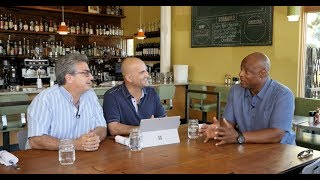
Warren Moon talks about his path from the CFL to the NFL, his cookie franchise and Sports 1 Marketing, and what the Crescent Moon Foundation does. He shares lessons on adversity and integrity while tasting burgers at a Seattle diner.
Chapters
I'm Alan Taylor.
My buddy Scott Duffy and I are in search of the best burger in America. Each month we visit a new city to try some of the top restaurants, pubs and brewhouses while sitting down for a candid conversation with some of the top entrepreneurs, athletes, entertainers and celebrities. I don't know about you, but I love talking business over a burger. Welcome to business and burgers.
We're back in Seattle meeting with some of the top tech and business minds in the Pacific Northwest.
Scott and I just had to come back to the Skillet Diner when Chef Nick promised us a sneak peek at a bacon top burger that isn't even on the menu yet. How could we resist? Today we're breaking bread with one of the world's top businessmen and philanthropists. Oh, did I mention he's an NFL hall of Famer too? Warren Moon's 23 year football career started in the Canadian Football League where he led his team to five consecutive Grey cup victories. His success started a bidding war that brought him back stateside to the NFL's Houston Oilers. Warren knew he had to plan for life after football, so he turned to his other passion, baking. And he employed his hard work ethic and quickly proved to be a champion in the cookie industry as well with his chain, W. Moon's Chocolate Chippery. It was such a success that Mrs. Fields bought the franchise from Warren back in the 80s. Today, Warren Moon's focus is on his global sports and entertainment firm, Sports 1 Marketing, and his charitable foundation, Crescent Moon, helping kids get the education they need.
So, Warren, awesome to see you here today.
Great to see you, sir.
Good to see you again. And I want to introduce you to my buddy Alan Taylor.
Good to meet you.
Are you really?
I am so impressed with your career and with Scott told me we were going to have a chance to talk, I was excited.
I would love to start by asking you is about one word because whenever I think of you in your career, the thing that always sticks out is leadership. What's your philosophy around leading great teams and people?
Well, I think first of all, you have to empower your people. You have to give them some incentive to show who they are and show that they have ability. Give them some free reign to be creative. If you're a good leader, you're going to listen to people that are good and what their strengths are and you'll take those strengths from them incorporated into your leadership.
And how do you do that on the field as a quarterback?
Well, I think it starts way back in training camp and then it works into the season as you get in preparation for a game. So if there's a guy that's putting in the right amount of time as far as his preparation to get ready for the game, you're going to have a lot more confidence in what he's saying means something because you know he's putting the time in.
I know that a lot of athletes struggle with life after their initial career.
What have you done and how have.
You been so successful? I mean, what was your journey like to get to this point place where you are right now?
I definitely was always thinking, okay, what if this doesn't work out? I've got to be able to do something else. I definitely wanted to get to college. That was the main reason why I played sports, because I knew that was going to be my way to get an education because my mother wasn't going to be able to afford it as a single mom with seven kids. So when I got to college, played well enough, felt like I had a chance to maybe play pro ball. In the back of my mind, I was always thinking about what I was going to do when my career was over. You're only 32 years old when you're retiring, 33 years old, what are you going to do with the next 30 years of life that you have to work? I started dabbling in different things while I was playing. I got into commercial real estate. I did broadcasting, different things like that. So I had a good understanding of what I wanted to do when I was done playing football. By the time that came around, how.
Do you trust people when you're, let's say you're really a great football player, great at whatever it is you do, and now you want to try something different, Maybe you want to invest in something different. Lack real estate or business, how do you evaluate whether or not somebody is a person you should trust?
A lot of it for me, started the trust that I had and my attorney, Lee Steinberg, he was going to put me in front of the right people. And then I had to do the interviewing myself as well. So as long as you're doing the due diligence on different people, I think you'll get a pretty good understanding of whether you're dealing with somebody that's legitimate or not.
Tell me about the young born men, the little boy.
A large part of my of who I am right now started way back when, when I was probably 7 years old. When I found out my dad passed away and I had to become the man of the house. I took on a Lot of responsibility at a very, very young age. And became a lot more mature probably than I should have been age. I was always worried about our household. I was always worried about am I going to be able to protect my sisters. But I also watched my mother and I watched how she made our house work. She went back to school, became a private duty nurse. We worked two shifts to make sure we had enough money, but she always had clean clothes on our back. We always had hot food on the table. I never really felt like I was poor, even though we didn't come from a lot. But one of my motivations as a young kid, too, was to make it in sports so I could take care of her because she made all these sacrifices for me to be able to play sports, give her the type of life that she really deserved. And I'm so proud I've been able to do that.
You go to college, you lead your team to the Rose Bowl. Right. And you big winning, and then you're an undrafted quarterback.
Yeah.
First of all, I'm curious what that felt like and also what led you to go to Canada.
I wasn't given the opportunity to play in the National Football League as a quarterback. They were going to switch my position. Everybody was telling my agent that we're going to switch him to wide receiver, we're going to switch him to defensive back. There was no way I was going to switch positions. I felt like I was good enough to play it. I decided to go to Canada over playing in the National Football League because I wanted to play the position I felt like I could play. It was a very bittersweet feeling for me coming out of college, being a Rose Bowl's most valuable player. I was tack 8 player of the year. I had all these accolades, but I'm not allowed to play the position I want to play. I wouldn't have had the relationships that I had up there if I wouldn't have went up there. I wouldn't have been involved in those types of teams and have those type of memories. So there's so many good things about it. But at the time, there's no question I was bitter about it.
What do you do? What do you focus on to make sure that you continue to move towards your goal?
I look again. I'm gonna go back to my mom a lot. Whenever something wasn't going on right in our family, I mean, she just worked harder. She just put her nose to the grindstone and went after it. If it was something that we needed, she made sure we got it. By just working harder. And that's kind of what I've done. I've said, okay, I'm not gonna get this opportunity here, so I'm gonna go work my tail off, and if I. If that opportunity comes again, I'm gonna be ready when that door opens.
Wow. Whoa.
Burgers for y'. All.
All right, folks.
All right, Nick, what do we got here?
What do we got here, Chef Nick?
So today, we've got two different types of burgers here. We have a burger that hasn't quite hit the menu yet. Something really special. And then we have our classic all American burger.
Looks like we got some onions.
So, yeah, so we have our chicken fried onions, which is our, you know, legit chicken flour fried. We have aged white cheddar on top. So that's a really nice. Kind of gives it a little bit more sharpness to play with the peppers. Caviar, and then mizuna greens, so it'll add a little bit more bitterness and a little bit more veg to the bite.
Thank you very much.
I really appreciate it.
Looking forward to hearing.
Yeah, but wait a minute. I kind of like his burger compared to my burger. I kind of like the bacon hanging off the side tree tray.
All right, all right, all right.
I'll still be the guinea fan.
I am the guest on this show. You are.
Oh, my gosh.
Right?
Look at this.
You guys ready?
See, it's dripping down my arm right now.
Here we go.
Oh, my gosh. That is a good burger. That is a good burger. Yeah, that's a great burger.
You had this amazing career in the NFL, and how did you make the transition from the NFL to businessman?
First of all, I played 23 years, so that's a long time to play professional football.
Yeah.
So I had a lot of time to think about it, and I never knew when my last day was. I did a lot of things while I was playing to get myself ready for when I was done with football. And I just talked to a lot of different people in whatever business it was I was thinking about going into just to pick their brains, especially people that were successful in certain things.
First of all, you've got to talk about the cookie business. How did you get into the cookie business?
The reason I started baking, my mother taught me to bake when I was a young boy, because the night before games, I would get so nervous. She wanted to do something to calm me down. So she taught me how to bake to kind of take my mind off of the game the next week. Oh, my gosh I always bake three or four dozen cookies before every game, every week. It was her recipe. But I ended up changing it over the years to the point where I thought it was good enough to be a business. When I went to Canada, they really didn't have anything like Mrs. Fields, which you see down here, or Famous Amos. And with my name recognition, maybe I'd have a good chance to be successful. So opened five stores when I was in Canada. They did really well.
So you played up in the Canadian Football League hall of Fame in the Canadian. Actually, Warren is the only hall of Famer ever to be inducted in the Canadian and the National Football League. And then you move back to the States, to the NFL. Can you tell me about that transition?
Well, it was something that I was hoping would happen when I first went up there. And then I got to a point when I was in Canada, I enjoyed it so much. I enjoyed the lifestyle, I enjoyed the winning. I loved the money that I was making. My family liked it up there. So I thought I was going to stay up there my whole career. I really did. And they were making me an offer to stay my whole career. They were offering me a 10 year deal to stay because my contract was coming up. In the back of my mind, I was always wondering as I watched NFL games on tv, am I good enough in the. The only way to prove that is to play against the best. I'm considered one of the best up there, but I want to see how I am against the best players basically in the world. That was my motivation to come back. Not so much the money or anything like that. It was just to see if I was good enough. I got into a bidding war with like six different teams. So I go from being a guy that wasn't even drafted in the National Football League. When I signed my contract in the NFL, I'm high highest paid player in the league.
Dude, that's so awesome. That is so awesome. And that's the whole, I don't get bitter, I get better.
Yeah, right, exactly. And you just take advantage of your opportunities. And like I said, when that opportunity came, I was ready.
Talk about Warren Moon today. How do you get to where you are with this sports one marketing? I mean, that's like not cookies. It's not football.
No, it isn't. But it's. But it's sports. When I got the opportunity to start this business, Dave and I sat down and we said, how do we want to go about starting this business? What's going to be our main focus is Because I'm a very philanthropic guy as well. Because of my foundation and the way I was raised. We wanted to try and start a business that would make a lot of money so we could help a lot of people. And we wanted to have a lot of fun while we were making that money. So everything we do has a charitable component to it. We try and get as much money as we can out of any deal that we get into, and we try and give back to anything that we're doing.
What are those core values for Warm Moon?
My big thing is integrity. And integrity starts with respect. And if you're living your life the right way, then you're going to be perceived the right way. And in return, you're going to get respect for that. And if you work hard, I work extremely hard at everything that I do. I think all that will come back in positive ways for you.
All right, let's talk about the Crescent Moon Foundation.
Yeah, well, you know, I started that back in 1989 when I was a player, believe it or not. And the main focus of it was everybody can't be a professional athlete. Everybody can't be an entertainer. But if you have the chance to be educated, you have a chance to be successful in life. So there's a lot of kids out there that just don't have an opportunity to go to college because they don't have the financial means. They might have good grades, but not good enough to get an academic scholarship. And I wanted kids that were involved in their community because I always felt like giving back to your community was very important. So that was the kind of the criteria that I set up the foundation with. So it's been a very successful program. We just gave out 15 scholarships this year. Just had a big scholarship reception at the Seahawk game a couple of weeks ago. So you get a chance to go off to college with a very positive vibe.
What would you say now to young Warren as the man you are today to give him advice to move through his life?
I think the big thing is, first of all, you have to find out what. What you love and what your passion is. A lot of young boys today, they don't figure out sometimes what they want to do, sometimes till after they're done with college. The earlier you can find out what your passion is and what it is you want to do in life, then you can get started on that, whatever it is, and then there's no substitution for the hard work. I mean, you got to put the work in, and then you got to be able to persevere through any adversity because you're going to have adversity in life. When you get knocked down, are you going to lay there and feel sorry for yourself or are you going to get back up and wipe yourself off and get back at it again? And every time I got knocked down, I was able to get back up and do that.
And that's really what it is. It's that adversity that gives us the character. And that to me, I see a lot of character in you.
I don't think there's anybody that's ever gone through life that's successful, hasn't gone through tough times. They say tough times make tough people. And I think that's very, very true.
Adversity, integrity, sticking to it, hard work and respect.
And that's one of the things I was always fighting for throughout my whole career was respect. I just wanted people to respect me, respect what I did. And once I got that, then I knew I had arrived at the top of my profession.
I respect you.
Well, thank you, sir. You're awesome. Thanks so much. Thanks for having me. What a great burger. I can't wait to finish this.
It's the good burger and it is good.
I know.
Warren's success from the NFL to selling his cookie franchise to starting a top super sports agency and marketing firm really left Scott and I with some food for thought. Hire great people, empower them, and then give them the freedom they need to do their job well. Work hard and you'll be ready when opportunity knocks at your door. Tough times make tough people. Adversity is inevitable. It's how you deal with it that counts.
Next time on Business and Burgers, we talk to esteemed sports agent and marketing mogul Dave Meltzer. Dave has spent the last 25 years as an entrepreneur in the legal, tech, sports and entertainment field. Dave's career began as the CEO of the sports world's most notable sports agency, Lee Steinberg, where he negotiated over $2 billion in sports and entertainment contracts. Today, Dave is CEO of Sports One Marketing, where he leverages his years of relationship capital to negotiate the best deals for his clients. Join us for a bite next time right here on Business and Burgers.
Check out more episodes of Business and Burger and our BNB blog at our website, businessandburgers. Com. And don't forget, visit business and burgers on Facebook and give us a big thumbs up. We'll see you next time right here on Business and Burgers.
More from Scott









Business & Burgers-Sequence Collection bracelet for National Entrepreneurship Week

