Scott Duffy interviews Scott Schwab: Revolutionary Education, Business & Burgers: Season 2 Ep. 6
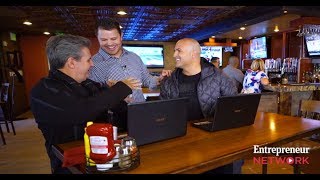
Scott Schwab, co-founder of Bottega online technical school, survived Guillain-Barré syndrome before building a platform with flexible 12-week courses and AI-supported learning. He argues blended, individualized education can disrupt traditional college models.
Chapters
I'm Alan Taylor.
My buddy Scott Duffy and I are in search of the best burger in America. Each month we visit a new city to try some of the top restaurants, pubs and brewhouses while sitting down for a candid conversation with some of the top entrepreneurs, athletes, entertainers and celebrities. I don't know about you, but I love talking business over a burger. Welcome to business and burgers.
Today we're back at the Westgate Park City Resort and Spa at Draft Sports Bar and Grill. We're here to try another one of the best burgers in the state of Utah. Joining us is Scott Schwab, the co founder and president of Bottega, an online technical school that gives the next generation of coders the skills they need to succeed in the workplace. Scott's personal struggle with chronic illness gave him the drive he needed to go from a door to door salesman to entrepreneur. In only a few years, he not only succeeded in building a successful company, but he's also made it his mission to change the face of education as we know it. And if anyone can do it, Scott can.
What's up, guys?
How are you?
Good to see you, Scott.
Good to see you, man.
Good to see you, Scott. Allen. Allen, Scott.
So tell us about Scott.
We're in education. Our goal is to disrupt the space of education by making it available to everybody.
So how do you disrupt something that people are so passionate about without pissing people off?
Well, you're gonna piss people off. That's just gonna be how it is because you come from two different schools of thought. One being like the traditional side of it has to be this way. There has to be this many hours in the seats and then you got more trade based or vocational based, which is all about learning the trade and understanding what it is to get into industry. So we come from both approaches. We are accredited, but we also know that to hire somebody, they've got to have specific skills to be able to work in industry. In the last 100 years, you look at our classroom and you're going to see pretty much the same thing. You got seats, you got a teacher, you got, you've got a whiteboard now, whereas you had a chalkboard before. But really the interaction hasn't really changed much. And we think that we can disrupt that from a standpoint of making it blended. So you have time that you're going to collaborate with your peers and also with your professor or with your teacher, but then also go home and learn the things that light your fire, because there's things that will allow you to be able to expound your knowledge on the core subject when you're interested in it.
Well, I'll tell you, the thing that really excites me these days is coding. But that's really what you have built an entire curriculum in school around. So if I want to learn how to code, I can go online to Bottega and I can take a 12 week course.
Correct.
And then those courses build on top of each other.
Correct.
So is every course that you offer 12 weeks?
No. Great question. Thanks for asking that. Modules are a shorter segment, 12, where you can learn them in a couple of weeks, even a couple of days. And then through that stackable set of the path towards a full stack software accreditation, you're able to then take those and put them into snippets. So you may have an hour, one night and you can learn one module that would then stack up to something more inclusive.
So let's talk about kind of the genesis of this journey.
My parents really wanted me to go to college. I see the value of college and I wanted to go as well. But when you're getting into it and really not finding your fit, I did business management. It was frustrating at times to have to sit in a classroom and learn concepts that I felt I already knew or felt as though I could learn actually getting out there and doing something. And so I exited college, saw a challenge in the market where I was like, education can be adjusted and disrupted for those that may not have the same experience that a person who tests well does.
Right.
And so I started doing door to door sales.
What?
What were you selling?
Door to door security systems.
Wow.
And that's what financed this?
It did. Oh my God, it did.
What motivated you? What was that kind of tipping point inside of your. Your head, your heart, your soul that said I've got to do this?
You know, for me, it goes back to even when I was a teenager. I came down with a disease when I was 15 called Guillain Bar. And it paralyzed me.
What?
What is it?
Yeah, it's an ascending paralysis. It eats away your mylon sheath, which is your protective coating around your nervous system. And when your nerves are exposed, they die. And so at the age of 15, I was told by everybody that I needed to start adjusting my life to live differently. And I was like, no way, I'm not gonna live differently. And so I've taken on every challenge that I've wanted to take on and hit it head on.
When you were first told that you could be paralyzed, most people when, when Something really tough happens in life. Whether they're told they could be paralyzed, whether their business is going sideways, whatever, they freeze. Right. Or they focus on their fear. Right thing they fear most. What did you do in that moment to help keep you moving forward?
Yeah, great question. I think one thing I would attribute is just the fact of having good people around me, good mentors. I had great family people who wouldn't allow my victim minded thinking. But I thought, well, nothing's worse than losing your ability to walk.
Perspective.
Yeah, it was great perspective for me at a young age. That helped me grow up pretty quick so that by the time that I was in my 20s, I was really poised to go out and make a difference.
You know, one of our good friends, Dave Meltzer, he always says that the way to change your life is to take 90 days and just do one thing in the morning and night. When you wake up and you go to sleep, say two words. Thank you. When things are tough, it's really easy to focus on everything that we don't have. But saying thank you on a regular basis forces you to focus on the things that you do have.
When are you going to start with me?
Thank you.
What am I going to be thankful.
For you or start thankful.
Talk about being thankful. Wow.
Holy cow, look at that.
So this is the world famous garlic burger. All Angus beef patty, prepared, prepared, medium, but the toppings are where it's really at. We have a house made garlic aioli, sauteed mushrooms and some smoked Niman ranch bacon.
Thank you.
Thank you so much, gentlemen. Enjoy. Let me know if I can get you anything else.
Thank you.
Thank you.
We'll be right back for these tasty burgers after a word from our sponsors.
I'm Alan Taylor, this is Scott Duffy.
We're business and burgers. We're on the road with our new Acer SwiftOne laptop.
You know, Scott, these are great for.
Students or business people on a budget. They are.
They've got all the essentials including Windows 10 and, and they're a great value.
Throughout April and May, you could get your new Acer SwiftOne from CDW for just $289.99. That's over $100 in savings. The Acer Swift One with Windows 10 Pro and Microsoft Office is a super light, thin, powerful and economical way to get the power and functionality that you need to run your business. Pick up one for yourself or get a few for your team today at CDW for just $289.99 each. This deal is Only good throughout April and May. So don't wait. Get your new Acer sw.
So, Scott, what was the biggest obstacle you encountered along the way?
I think it's surrounding myself with the right people. I think that there's a lot of people who want to be involved in entrepreneurship when really when it starts getting hard, they kind of disappear. And earlier on I made some pretty pivotal mistakes just because I wanted somebody who I was friends with or wanted somebody because we got along. And what I've learned is that actually it's better to have somebody who compliments your skill set and not who you're going to go to the golf course with. I think what we do in our organization is we allow people to manage themselves. We hire them because they've got great skills, they understand what they're doing. They don't need to be told what to do. They just need some parameters of how we make money or how we become a success, successful business.
So you give them the vision and then they manage things.
How do you ensure that each person.
Remains an individual?
So immersive learning allows us to be able to really dive deep into behavior and into what makes a person tick. Because how you learn is not going to be the same way that I.
Learned exactly what I was thinking.
So in the classroom, I may be responding better to some of the teaching mechanisms that we're giving to them. That is a teacher, a group project. But you may be better off learning on your own. And so we built our technology platform and our delivery model, be asynchronous right from the get go. So you may be a self paced learner and an online environment is going to be awesome for you, whereas you may need that constant instruction. And so we have a live remote class to where you can remote into a course and have the collaborative learning aspect to it. Or if you're a person who needs to be driven and in person, that's going to be the best bet for you. Well, come in and learn from a program that allows you to be able to be integrated with students with learning and then being able to tie in professionals from industry who can then speak to some of the challenges that you're having.
You know, my hat's off to you. This could be the most difficult job in the entire world that you have taken on. I don't know about that. And it took a special guy like you to take this on, I can tell you right now. Because I mean, I look at myself and my family members. I have four children and not one of them is the Same. Not one of them wants to learn the same thing that the other one did, the same way that the other one did. It's like you have more tools today to do this job than ever before. And so it could be that you have just finally hit the tipping point for true excellent education. I take my hat off to you.
Well, thank you. And I think you got to remove the barriers. Right. More and more people are wanting to consume information on their phones or on a tablet. Well, why doesn't that transition into a learning platform?
And that's so cool. Because let's say I'm in a job.
And I need to improve my skill set or I need to broaden my skill set. Absolutely right. Things are changing in my company or I want to go out as an entrepreneur and I want to start my own thing, my own business. The flexibility that an online learning system gives to someone enables them to go home, to learn at their speed, to learn at their pace, to use whatever device it is. So it's a lot like what we're doing with Microsoft and leveraging online tools, cloud based tools, whether it's Office365 or it's OneNote, and be able to access Skype. Skype and get to the information when we need. It's the same thing with learning. Right. I mean, what do you see as the future of education?
Yeah. Thank you. I personally think that traditional learning is not working, like in a broad scope.
You mean education education?
Yeah, traditional education. Time in the seat, how we factor out whether somebody's going to learn based on testing. That's not working. And so we predict that learning is going to become more and more individualized, predictive machine learning. AI is really paving the way for us to be able to better serve the learner. And that's our goal, is to be able to meet you where you are, you know, not try to give you something that's for everybody else, but to say, hey, what does Scott need specifically to learn?
Here's what I'd like from you.
Yeah.
People that watch this show, they watch because they want to learn something. And we have something called Food for Thought. I'm looking for your lessons.
Where do we start?
I would start with get outside of your comfort zone. Because learning actually doesn't happen in your comfort zone because everything's all good in my mind. You've got to get outside of that and start training yourself, training your mind, training your body. Because entrepreneurship life is hard. It's going to grind you and grind you. And if you're not mentally Sound and you don't have a strong physical presence about yourself as far as your confidence and where you fit in to what your business is. You're going to have more trials than you need to have in entrepreneurship. Whereas if you have balance, you have success. That's how I would define success is through balance. And there's trade offs and I haven't always been able to make the right decision. But through learning, I now have a schedule. I'm not trying to prioritize my schedule. I schedule my priorities and that's a big difference.
I love it. I learned something recently. Consistency over intensity. And I consistently eat a burger every week, every day, most.
Was there ever a time that you, like you thought about quitting and just packing it all in and how did you get through that?
Yeah, yeah, Great question and I'll add a little story to it, but I had just been on a 15 day straight travel because towards the end of my door to door time, I was a corporate trainer and I traveled 300 days a year, 300 days a year to go out and train in all of these different markets. Wow. And I remember getting on a plane and I was going somewhere. I don't even know where I was going, but I put my head up against the window and I started to cry because I could not keep up with the intensity that I was being asked to deliver on what my job was.
Yeah, you were a business junkie, man.
And then going home at night and still trying to write a book and trying to write curriculum, go through the accreditation process. At that point I was like, this isn't all worth it. And I think the tears almost were liberating. And it was fun.
It was a tipping point. You knew it was.
As I felt them come down my cheek, I was like, you know what, you've worked too hard to try and throw in the towel and make some excuse like hey, it didn't work out. It works for those who work. And so that's what my philosophy was, is get up and go to work.
Awesome. Great to see you, brother.
Good to see you. Thank you for joining us. Thanks so much.
How are you, man? This is a big job and you're a big man.
I appreciate it.
Scott had some fantastic insights into the future of education that left us with some great food for thought. Sitting in the classroom isn't the only way to learn a trade. Some people learn better in a hands on environment.
Don't lose perspective. Be thankful for the things that you have rather than focusing on the things you don't.
Have.
Don't be afraid to step outside your comfort zone. Growth only happens when you challenge yourself.
Next time, Scott and I sit down with football legend Rudy Rudiger to discuss something that both football players and entrepreneurs can relate to. Overcoming the odds. Rudy's amazing underdog story has inspired people all over the world, and we consider ourselves lucky to sit down and share a burger with him. So join us next time as we talk sports, business and following your dreams right here on Business and Burgers.
Check out more episodes of Business and Burgers and our BNB blog at our website, businessandburgers. Com. And don't forget, visit Business and Burgers on Facebook and give us a big thumbs up. See you next time right here on Business and Burgers.
More from Scott









Business & Burgers-Sequence Collection bracelet for National Entrepreneurship Week

