Scott Duffy interviews Tony Robbins: How to Easily Generate Content & Stay Relevant Online, Ep. 45
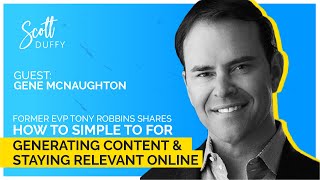
Scott Duffy interviews Gene McNaughton, former EVP at Tony Robbins, on adapting your business during crisis. Ask customers what matters most to them now. Repurpose content using transcription tools, offer quick-start deals to speed up sales, and journal to generate ideas.
Chapters
Good morning, everybody. Whoa. Good morning, everybody, and welcome to what now with Scott Duffy, presented by SAP. Concur. I want to welcome all of you for joining today. Super excited about today's show. Got a great guest and a lot to report. And yes, I just wanted to say good morning and welcome to what now with Scott Duffy, presented by SAP. Concur. I want to join you from wherever you are watching or listening. We broadcast live each day at 10am on Facebook and YouTube, on Instagram and Periscope. We also are now broadcasting live each day across Apple TV and Roku. You can listen each day on Dash Radio or download the podcast. And if this is the first time that you are watching the show, you're a part of this show and you're. You're viewing it live. What I'd love to ask you to do is this. If you could write down your name and the industry that you're in and the biggest questions or challenges or things like that going on in your business or your industry, I love it. If you would share those so that I can use that to customize this show for you. Again, really super excited to have you here. We do this show for radio, so we're going to kick in just a second, but right now.
We'Re going to.
Let this propagate for just about 60 more seconds. While we do, I want to say good morning to Dave Corbin. It is always so good to see you at the Corbino. Sarah, great to see you. Patrick, Craig, thanks for joining today. Sita over here on YouTube. Bill and Jean, great to see you.
Jennifer, thank you for dropping in.
So good to see all of you. By the way, if you've watched this show in the past and you found any value out of it, I would love it if you could share this right now. If you could share this with people that are in your friends or your family, that your. Your business colleagues, anyone that you think could benefit from this program. Christy, it's great to see you this morning. Thanks for, for dropping in. All right, we got about five seconds.
So for radio, here we go. Good morning. My name is Scott Duffy and this is what now with Scott Duffy, presented by SAP. Concur. I want to welcome you from wherever you're listening. You can tune in each day at 10am Pacific Time to watch the live broadcast on YouTube and Facebook or download the podcast. The show's for entrepreneurs, small businesses, and those thinking about starting their own company. It's for people affected by this economy. Maybe they lost their jobs, their businesses. They were furloughed or they saw their consulting contracts canceled. And for many of us, it happened just like that. As for people asking the question, what do I do now? And how do I come out of this period even stronger? Now, on today's show, we're going to talk about how to engage with your customers. What is the most effective way to engage your customers and increase your sales during uncertain times? There are a lot of people right now that feel like there's something wrong, there's something like dirty, there's something you're not supposed to do when it comes to selling during these times, that somehow selling is insensitive, that somehow selling is just, I don't know, it's like a scarlet letter. And so, you know, when we had Julie Catino on, the former VP of brand for Virgin, one of the things that she was sharing with us is this idea of stop selling and start serving. And the most graceful and elegant way to kind of manage through this issue right now was to do just that. So I'm going to bring on Gene McNaughton in a little bit. Jean is our special guest and we're going to talk much more about that. Again, our goal today is, is to help you better engage with your customers, with your prospects, do it in a really sensible way and increase your sales during this pandemic. Now, our special guest Today is Gene McNaughton. Gene is the former EVP for Tony Robbins. We're going to talk about work that he did with Tony and Chet Holmes and building out business mastery. He's also the former head of Success Resources running a business, a business training events company that would fill stadiums with 10 to 20,000 people to listen to some amazing speakers. And today's the founder of Growth Smart Consulting. And we're going to have Gene on in just a second. But first, let's talk about the news. So in the past 24 hours, the number of COVID cases worldwide has jumped to 3.7 million confirmed with 258,000 deaths. In the US over 1.2 million cases are now confirmed and 71,000 dead. Now, looking at the data this morning, I really dug into the data. The trending data shows that the curve is still slightly on its way up. It hasn't really gotten flat.
And an internal document that was revised over the weekend has projected deaths to increase from a target that we heard two, three weeks ago of 60,000 to now 134,000. And that comes from the, the CDC.
But one thing's clear, one thing is clear, and that is we all need to get back to work. We need to get back to work. We need to get outside. And as small businesses, as micro businesses, entrepreneurs, we don't have some of the same benefits that big companies do. We're not the ones that are getting bailed out. We're not the ones that are getting these big checks in order to stay in business. So we have to be stronger and we have to be more resilient. Yesterday, President Trump, he also said it was time to get back to work and we need to open up to save the economy. He also said that could mean more lives lost, but it's something that we need to do, which, by the way, I totally agree with. I think we need to get back to work. And if you're a person that is at risk, you just got to be more conservative. You got to stay at home. You got to stay away from people who have a higher risk of spreading. Covid, you got to wear masks, gloves, whatever protective gear you have in crowded spaces. But we have got to get back to work also, in addition to getting back to work, this is a time where we have to take really great care of ourselves. We've got to strengthen our immune systems by exercising, by eating well, by filling our minds with great stuff. And spiritually, it's so important. And the question is, and I ask this every day, what is the world like? What does it look like when we get back? And how can we change and adapt and shift and iterate our businesses so that we are doing something spectacular? We're serving our customer, and we're meeting needs, the needs that they have today in the way that they want them to be met. And the two words that keep coming back to me as I think about this are, number one, as we go back, we'll be more technical. And number two, when we go back, we'll be more local. So how can you think about your business in terms of adapting and pivoting with those two things in mind? You know, we're entering a world that is more technical and it is more local. And so what does that mean for your business? I'm always talking about ideas for how to adapt your business, because what we're going into isn't normal. It's not a new. It's like a whole different paradigm. And what I've shared with you in the past is this. I've shared that now. Your job today is to do one thing. Your job is to get in front of as many customers, of your current customers or prospects as you have and ask two Things. The first question, the most important question is what is most important to you now? What is most important to you now? That's number one. And number two is what has to happen. How do you know that those needs are being met so important? Because again, really quickly, if you go to somebody, let's say you're building a new exercise product, and you go to a potential customer or a client or a prospect, and you ask them what is most important to you about an exercise product? And they say, right now, it's easy to use. Well, here's the thing. We all have a different definition for what easy to use means. And so as a result, we may build something that's based on our definition of easy to use that doesn't match theirs. So the second most important question to ask is this. Well, what has to happen? How do you know that it's easy to use? Super important. Because what's going to happen is your target is going to give you their rules. They're going to give you their buyer blueprint. So, for example, they may say, if it's easy to use, to me, that means that, number one, it's a tech product. Number two, it's an app that I can get on my phone. Number three, I use an iPhone. I don't use an Android. Number four, I want to pay one time, I don't want to pay a subscription. And they'll go on and on and on. And so what you're going to get is you're going to get their buyer blueprint. And your job today, your job today is not just to hear what's most important, but how to deliver, how to meet a person's buyer blueprint and build your products based on that. Stop thinking about what your next great idea is, and instead start listening to what the customer wants. So yesterday I really kind of played and I called friends, I went around the Internet, I listened to the news, and I just. I sought out some new cool ideas around adapting. And one of the things I thought was cool because it was so obvious, it was so obvious was people are starting to think about back to school. And when you go back to school, whenever that is, wherever you live, you know, here in California, we hear it maybe July, kids might get in early. We hear August, kids might get in early. We hear September, we hear we may not get till, like, who knows? But when you go back to school, what are the things that you need? Well, one of the things I saw an entrepreneur do yesterday was they were taking their backpacks. So they went into this they have a company, small business, makes really cool backpacks. And they're trying to get these backpacks to be distributed by Staples and Office Depot. Right now, they primarily sell on Amazon, but that's their goal. So their twist was that with. And again, Julie Catino, former VP of brand for Virgin, two days ago said, we have to have a twist. So the twist that they made was the backpack not only comes with some of your school supplies in it, so it's kind of like we talked about getting a business in a box. What this was is it was kind of like getting school, your school stuff in a box. I know every summer when it's time to get ready for school, I take my daughters to Staple or Office Depot or wherever I go with them. And we have a list of things that we need to get. Pretty much the same list every year. Pens and pencils and paper and things like that. Well, what. So what this entrepreneur has done is they basically taken that list from the public school system in their area and they filled their really cool backpack with all of that stuff so you can just grab and go. And the other thing they've done is they have also included some really cool Covid stuff. Some Covid pivots. And what does that mean? There's hand sanitizer, there's a mask that fits kids. Great idea. Because most of the masks that you see today don't fit kids. So you got your hand sanitizer, you got your Covid mask, you got your personal protection stuff, and all of that is in, like, this one thing. So I thought it was a really neat idea. It was really time sensitive and topical for me yesterday because I was talking to my kids about school. And again, you know, here's the thing. We're going to get through this period. We're going to get through it together, and we're going to come out stronger. And that's awesome. What we do in the markets that we serve and the way that we serve them may be completely different on the other side than they were eight weeks ago. And that's okay. That's totally okay. Right now. Just know that there are smart entrepreneurs iterating everywhere and they're making money and they're building market share. And this is the kind of thing that I hope for and I want for you as well. So.
As I think again about where we're going and kind of what's going on and what I'm hearing before we bring in Gene, there's one more thing I want to talk on. I want to talk about. And that's bankruptcy. So I brought it up yesterday. And the reason I brought it up is because.
Reading the news yesterday and over the weekend, what I started to see was kind of that first line in that first wave of big companies declaring bankruptcy. And I had projected six weeks ago that later this month, late May, June and July is when we'd start to see small businesses start to file for bankruptcy. And the reason is those businesses would be holding on as long as they could in order for markets to open and customers to come back, but they just might not be able to make it. And again, over the past couple days, when I take a look at some of the big companies that have started to file, you know, it's, it's. It's pretty amazing. It's companies like J. Crew, Borden Dairy, Dean and Deluca Diamond Offshore Drilling. You've got Frontier communications, Gold's Gym, McClatchy Newspapers, Modell Sporting Goods, an icon in the Northeast, Pier 1, True Religion jeans. So here's the thing. I want to talk about this because not only is it becoming a hot topic, but also because right after the show yesterday, two people reached out to me and they said that we are thinking about doing this. What is your experience around bankruptcy and what would you advise us? So I'm just going to give you really quickly my experience in this area. Again, this isn't from a book. I'm not an attorney. I'm an entrepreneur. I'm going to share what I went through and I'm going to share what I learned and what I would do if I had to go through this period again. So the first thing is this, the first part about bankruptcy is virtually every single person that I know, a lot of people, I know not everyone, but a lot of people I know that are super successful as founders, have declared bankruptcy at some point in their career, whether it was a personal bankruptcy or it was a business bankruptcy. That's number one. Number two, I've never met, in my network and in my peer group, I've never met anybody that had something happen with the economy or in their business that required a bankruptcy. I've never had anyone that regretted told me they regretted actually doing it. However, what I would tell you, what I would tell you is that a lot of them, what they say is, I never, I don't regret it. If I could do one thing different, what I would do is I would have done it faster. I would have done it sooner. And this is really important. You know, our country is. There are laws to protect entrepreneurs. The Backbone of this company is entrepreneurship. It's innovation. It's people getting out there and identifying big problems and solving those problems and figuring out how to solve those problems, figuring out how to finance those things. And sometimes it works, and sometimes it doesn't work. That's just how it goes. But the way our country is set up, which is amazing, is if taking that shot puts us into a hole, our country set up to help encourage you to get back on the horse and to do it again. And that's part of what bankruptcy law is there to do. And so the biggest thing that I found for myself and with other people I know in my network that have filed and again, didn't regret it, I don't know anybody that said they regretted it, but I know lots of people that said they would have done it sooner. Is the ego is what gets in the way. The ego is what gets in the way. It's people thinking that. What are people going to think if I do this? What are people going to say if I do this? How is it going to impact my career going forward if I do this? How's it going to impact my credit going forward if I do this? Is it going to completely paralyze me if I do this? These are the questions they ask, but where they tend to get stuck is the ego. What will other people say? And as my buddy Greg, Greg Reed said yesterday, here's what other people will say. Nothing. Because they're not paying attention to you. The thing is, people today are paying attention to their own stuff. In fact, they're always paying attention to their own stuff. They couldn't care less about what happens to you and potentially filing for something like bankruptcy. Now, for me personally, when I went through my 2008, 2009, and I had my thing that really kind of hurt me financially and I was way underwater and I didn't know what to do. I said to myself, there is no way that I would ever, ever, ever declare bankruptcy. And there was a person in the media who I really respected, a multi company entrepreneur. And this person was out there. It was interesting, this person was out there saying during the market while his companies were doing poorly, he would never file bankruptcy. He had so many business, he would never do it. But here's the crazy thing. I like looked up to that person. So I said, I'm gonna be like that person. I'm never, no matter what, I'm not gonna do it. Well, a couple of years later, I found out he had done it multiple times. It was all big Media spin.
But what I did is I waited, and I kept getting myself into kind of a further and further and further hole, and it created legal issues and all kinds of stuff. And all of my friends and my peers were saying, this is what you need to do. But I didn't. Till one day I decided, you know, enough was enough. I had to. I had to protect. I had to protect the house. I just had to protect certain things. And so I hired a bankruptcy attorney. I filled everything out for my home. I sent everything into him. We did our calls over the phone. In the day that I was supposed to do it, I drove to go and see him. And I remember I called my buddy Greg Reed, who was on yesterday, and I was so caught up in my ego. I was so embarrassed. I thought, like, I, like, cried like a baby the whole time on the way to the. To the attorney's office. And when I got there, and I was just supposed to sign stuff when I got there, I sat down across the table from him, and here's what he said. He said, scott, he said, I'm really sorry. But you know what? He said, I made a mistake. There are a few things that I didn't catch when I was. When I was going through your paperwork. And he said, there's one thing that stands out. And he said that one thing is you have a company and you have your personal accounts. And he said, 11 months ago, you moved something that was signed to you personally into your company. You move the asset. And I said, yeah. And I explained it. I said, I signed a big book publishing deal. And I said, by mistake, they put my name instead of my company name on the paperwork. It took so long to do it, and it was under such a tight deadline. I signed it. And then the same day, we all agreed that we would submit the change to the agreement that would be under my company name. So we did that. It took four months for the big company to get that back to me, Four months for the publisher to get that back to me. Now, what the attorney told me is, because you move that asset, he said, I don't care about your story. He said, one of these banks is going to come back and sue you. He said, so I cannot do this for you now. He said, I wouldn't put my name on it. So after all of that energy and all of that getting in my head and all of that ego and all of that upset in my stomach, you know, I couldn't even do it. And that was so frustrating. Now, I couldn't have done it later, I could have done it later. I didn't. Instead, I worked it all out. But that was kind of my experience. And I just, you know, looking back, I, you know, would have probably done it much sooner. I probably would have done it very early on, because what I found is that my friends and my peers and people I look up to who have gone through this process, what they've done is because they've reset, they've been able to get credit faster, reboot faster, build cool companies faster, apply the lessons that they learned to their new thing faster, and ultimately turn it all around. And so, you know, this isn't a. I'm not telling you what to do and what not to do, but I try. And my goal is to share everything. My goal is to share the stuff that people don't normally want to talk about. But I don't care, because if it helps you to provide some perspective, that's what I want to give to you. That's my. That's my promise to you. So with that, what I want to do is I want to bring in today's special guest. And our special guest today is my buddy, Gene McNaughton. Now, Gene is the former executive vice president for Tony Robbins Company. He did work with Tony Robbins and Chet Holmes, which we'll talk about. He did work in launching Business Mastery, Tony Robbins big event, which we'll talk about. For a time, he ran Success Resources. This is a group that put 10 to 20,000 people in stadiums. And think about how a business like that has to pivot this type of market. And today, he's the founder of Growth Smart Consulting and honest to goodness, when it comes to sales and sales training, one of the biggest studs that I know. And so I'm going to bring him in now. Gene?
Hey, Scott. Can you hear me? Okay? Can you hear me?
I can hear you. Perfect.
Excellent.
First of all, thank you for joining us today. Super appreciate it. I know how busy you are. I want to ask you a question today. There's a lot of people that are out there that think, they feel that if they are, they have a product and they're actively engaging in selling that product, whether it's direct or it's through marketing, they feel like they're doing something wrong, like because of what's going on around them, because there are some people that are struggling that energetically, they just don't feel right. What would you tell those people?
Well, it's a very simple equation to think about, which is this. Think about the clients you have in the past that have used your product or used your service and gotten the desired outcome. And that is where you need to spend your energy. You know, Jay Abraham, one of the greatest marketers of all time, talked about what he called the moral obligation. If you believe in what it is that you have, then it's your moral obligation to do everything in your power to help the other person. That would be the prospect, that would be the marketplace. So selling something now is more important than ever before. And I'll give you one competitive advantage is most people aren't actively selling. So it is easier to stand out more than ever right now.
That is such great perspective. I mean, I really hadn't thought about it that way. You're right. Most people are not actively selling. I totally believe that most people aren't actively selling. And the ones that are selling, many of them are so distracted. They're distracted because they're at home, they're distracted because they're watching kids. They're distracted because they're living in fear. They're distracted because they're worried. All of these things that if you truly believe in what it is that you do and you truly believe in what it is that you sell, you have an incredible advantage over other people. And you know, my buddy Dave Meltzer, he has what he calls the 2100 rule, and I quote this all the time, the 2100 rule is this. If you were to give me a $20 bill and I gave you $100 back, you give me 20, give you 100 back. You do that every day, energetically. When it comes to sales, that's the relationship that you want to have with your customer. And when you truly believe that you're doing that, you're really doing this disservice by not selling or offering them something to buy from.
You fully agree, Scott. And I want to make sure everybody gets this. There is a dynamic difference between actively marketing and actively selling versus being seen as an opportunist. You just have to go into social media and you'll see plenty of opportunists that are trying to take advantage of this disastrous situation to pitch their products and services like overly do it. On the other hand, there are, and all of my clients certainly are being even more aggressive in education based marketing, sending out tips and steps and free content, free information. It's very no different than what we're doing right here. Scott show is educating the ideal buyers on how to do what they do even better than they are, regardless if they're great and they Want to get to another level or they're strong, struggling and they want to get out of struggle. So know that actively selling and marketing is what everybody should be doing. And there's, there's nothing that can stop you, even as little as writing an article on LinkedIn or recording a short video, starting your own podcast, putting together the three keys to success in your industry or the three biggest mistakes that you see and just literally sitting down and typing it, doing short videos, client testimonials. That's active market and active selling. Right. Everybody should be doing this. And I think the, you know, listening to the first half of the show. Scott, great job as always. I listen to this every single day.
What does the future look like? Well, I don't think anybody really knows, but I do know this. Some people would say doom and gloom, oh my gosh, what are we going to do? Some people are saying with absolute faith that it's going to be better than it's ever been before in our lives. Now nobody knows which one of those are true, how what believes is a little Southern California woo woo. And I'm from Iowa. Right. I'm a skeptic. As skeptical as it gets. But when you listen to Dave Meltzer and Scott and Greg Reed about, you know, you're going to tend to see, attract and.
Recognize that which you're focusing on the most. It's called the law of attraction. So you can focus on faith. This is going to be amazing. How can I position myself for this? Amazing.
Or you can cower in fear. And unfortunately most people are cowering in fear and it's detrimental to their success.
What are two or three things? If I could only focus on two or three things as a salesperson.
In terms of engaging.
Helping when people are so distracted, to move them through a sales process and then getting it closed, what would you tell people to focus on today? Because what I'm finding, what I'm finding is that decision makers are getting stuck or they're dragging their feet. There's a lot of distraction, there's a lot of uncertainty and they're afraid to commit in many cases. So as salespeople, how can we do a better job getting them over the world?
Okay, so you ask a handful of questions there. So is it true that in most situations sales cycles have gotten a little bit longer, a little bit more delayed? Especially if you're selling to big companies like I do and no longer, at least currently, can they all gather in the room and talk through and hash it out? Or I can go there and influence that buyer's table doesn't work that way. So if you acknowledge the facts are what the facts are, everybody, just about everybody's working remote and you acknowledge that sales cycles are going to get a little longer, my question is what can you do? What is an ethical offer you can make to help influence the cycle? And that could be everything from special discounts, added service, bundling programs, quick start packages. That's what we're doing in my company. So while companies are delaying a big, big, big decisions, I'm cutting free sample videos and sending it to them saying, this is what your learning system is going to look like. Now do I have to do that? No. But I'm adding value when they're not asking me to add value and that's speeding up cycles. Because in my book I say, you know, I'm a, I'm a sales, I'm a business growth expert, consultant, expert, whatever. But that, that's not just sales. That's CRM like salesforce.com and it's marketing collateral, case studies and white papers and education resources for that company to put out into their marketplace. Sure. I'm saying is this is the time to be doing that. So I've taken the difficult situation and said, this is exactly why you need to do this now. Everybody's at home. You know, I'm saying to these heads of companies, your people are at home. They have more additional time than they'll ever have in their life.
Exactly.
This is the time to be giving them development ideas, to getting them on the conference calls, to having whether it's me or somebody else come in as a third party voice or somebody that brings a different perspective to, to inspire them, to teach them, to, to help them get better at their craft. So for you that are watching this right now, you can actively be. And if you're not, you're missing the boat. Even if it's posting videos on whatever social channel, whatever social channel the your desired best buyers are at. If it's B2B, it's LinkedIn. If it's, if it's stay home people, it might be Instagram and Facebook. If it's younger generation, you better be hitting TikTok pretty hard. Right? I haven't done that yet, but that's not my ideal audience. But you've got to go where the attention is and be your market's best educator. That's marketing. And you'll be surprised at how many people go, we'll take you up for the console, we'll download the report, we'll get the free chapter out of the book. I mean, that's active marketing. And you do it by adding value to others, not by trying to hard close a deal.
I really believe. And by the way, for those listening that are hearing feedback, this is an Internet thing. You know, the Internet's crazy today. This is kind of COVID baby. So if you could just roll with it. We've done everything that we can. We have an audio board over, like, everything looks right and sounds on this end. But I know that we're getting some feedback, so I apologize for that.
So I really believe that.
One of the things that happens with people when they take a break on their career, like if they take a pause. So this is really common, or it used to be really common. I have a friend, made a bunch of money, decides to take a year off. I have a friend whose company got bought or sold, decide to take a year off, then they'll get back into it. I have a friend who maybe they were laid off, and they decide, I'm gonna take a year off, recharge the batteries. I haven't had this time. I'm gonna get back to it. They completely drop out. They think they'll be able to drop back in seamlessly. My message to you is this. The moment, the second, the instant that you stop providing value to your network, you get replaced.
Yep.
Here is your opportunity right now. Did you hear that? The moment that you stop providing value to your network, you get replaced. This is your opportunity. There are so many people caught up in other stuff that they've stopped providing value to their networks. So when things do start to pick up, those people are going to be out of sight, out of mind. This is the time that you double down on value. Now you may say, I don't have an ebook. I don't have a this, I don't have a that. I don't have a something, I don't have a whatever. Okay? The simplest thing you can do. So I see people around me doing this, and by the way, I think it's really working. I know a lot of people in different industries that have started these little Facebook groups where once a week they get on and they do like a Facebook happy hour, you know, or a zoom happy hour, or they do whatever. And here's the thing. Sometimes I've been told, you know, maybe two or three people come on. Sometimes 40 or 50 people come on, but they do it every week, and they constantly provide value. So simple. Doesn't cost you anything. Like, what can you do to continue to touch your target or your customer so that you are the person. Hey, one more thing, Gene, is that it's gotten really hard to market and advertise over the past two, three years through social media. It's been gotten really hard, expensive. There's so much noise, there's so many ads. Everyone's doing it. It's really hard.
Today, Today, when it comes to getting in front of your customer, you can get off social media and connect with them and they've never had more time. Like this is the time to strike. What do you think about that, Gene?
Fully agree. And you know, we gotta understand marketing on social media. There's organic, that's the report you build. And you're right, there's a lot of people. Well, I don't have an ebook and I don't have a video series. But here's what I would challenge you to say is, you know the three keys to being successful in whatever your industry is, you know, the three common mistakes people make in your industry. Write an article, be surprised at how easy that will flow. Or maybe it's five mistakes. Or maybe it's the. The four pillars of being successful in lawn care, whatever your thing is.
Can I say something about that? Because let me just insert something here. I think what happens a lot of the times is people especially that don't write a lot think that that sounds really hard or. It sounds like it. Here's the thing. Your ebook, like your, your thing doesn't need to be much. It just needs to be something. Like it could be this long. You know, if it's one step to whatever, you know, it does not have to be long. The way that I do this, and I just wanted to share is I use an app called Rev R E V and. Right, Gene. It's like it's an awesome app. By the way. This is how most of the people I know that write books today, they write their books that are frequent bloggers, they write their blogs. What they do is they go to Rev.com or you download the Rev R E V app. Excuse me. And then what you do is you, you just, you speak into it. So this is how I write my blogs, is I will be driving from Newport to la. I've got some time. I speak into Rev. Here's the magic. The magic is when it's over, you just click a button and it transcribes what you just said at a dollar a minute. It's not only machine reviewed and AI reviewed, but a person actually looks at it and Within a very short period of time, usually within like the hour you get it back and it's all tight. So all I have to do or somebody that works with me has to do is go in and just edit what I said. So this doesn't have to be complicated for a dollar a minute, like say you talk for five minutes for five bucks, you have the most incredible way of connecting a lead magnet that you could imagine.
Hey Scott. I'll add to that is that the how to do anything is readily available for anybody. Doesn't matter what it is. Like we talked about social media advertising. There's organic what you do yourself and like Scott uses rev and gets a thought in his head or he hears a saying or speaks it out loud, it gets sent back to him in written form and you can look at it, edit it, what, five minutes maybe and on your channels, right, the how to is readily available. If you want to learn how to you to do paid advertising spend on social media, the how to is there and in many cases it's free. But I recommend if you're going to go invest money in paid spend, then go take a class, go spend a little bit of money to learn from somebody who's done it, whether it's local or national, and understand so you don't waste money.
Overriding all of this is reason. Right? So you, if you were never ran a day in your life and you want to run a marathon by next year, you can get online and you can find apps, you can find videos on YouTube, you can find the how to on virtually any subject matter you could ever imagine. It's on Twitter, it's on YouTube, it's on Google. But why isn't everybody wildly successful? Why doesn't everybody have a wildly profitable business and why isn't everybody calm while there's this economic collapse? Because they had, they did the work the few years prior to have money put away in case rainy day happens. We're in the rainy day.
Sure.
Because of reasons. And that's what people have to examine. Jim Rohn said it best. Reasons come first, answers come second. So while you're looking at what, what do the next 90 days hold for your business now, you can cower in fear or you can move forward with strength and have faith to say we're coming out of this. The buying landscape is going to change. Is it going to be a little bit different? Yeah. Will it be back to normal ever? Who knows? But at the end of the day, what can you do now to set yourself up for 90 days from now. And if it's writing that first article, great. If it's getting online and finding somebody who's really good at something and spending a hundred bucks to do their E course, great. But I have found that very few people do things with free resources like YouTube videos and so forth. But wild difference. When you spend some money, your hard earned money, to invest in a skill set and become part of a program where you have group accountability, you're learning from somebody who's done what it is you want to do. Not a wannabe, but somebody who's been there, done that, and is gonna share her or his eight steps or ten steps. Secret sauce. Your growth accelerates geometrically when you put money down. Because what happens is you give yourself your own moral obligation to actually do the program. Found very few people that said, yep, I learned off all this. Now granted, if I need to fix my remote control, YouTube, that fix it and I'm good to go, right? But I'm talking about a real skill set. Sales, marketing, social media, how to get more viewers, how to write a good article, copywriting, spend. This is the time to invest in you. And you know that as you invest in you. Like a good friend of ours, Scott, was, was telling me the other day that he's, he's been doing this copywriting course, thousand bucks. And now this guy is successful, former super bowl champ. He's a, he's a life and business coach, like a, like a high level performer. Then I'm thinking, why don't you just go hire these people? And he goes, I want to learn the skill set.
Amen. I mean that, that's awesome. And by the way, there's a couple of people that have jumped in. Sarah Christy, talking about what you're doing, Sarah, I just wanted to say that is so awesome that you're doing Facebook lives now. Super cool. I think that the key is, you know, creating content. The key is consistency. That's the key. And so, and creating content is a lot of work. And what happens a lot of the time is that we kind of run out. People run out of content. So I would say whether you're doing it once or twice or five times or whatever it is a week, just make sure it's consistent, do it at a consistent time and make sure that you have like, you spread out the interval between so that you kind of never run out of content. Super important. Christie, you're talking about digital. Yeah.
One thing I want to add is you can release the pressure off of yourself of having to write and create every single day. I think most people get stuck on that. What am I going to say? You can release the pressure by looking at yourself as the conduit of information. Let's say that you listen to Scott Duffy's show that you're on right now and you've learned two or three things. You can go right after this, take your three or four key highlights and go right to the camera and said, I just got off of a great session and I learned three things. Here's what they, One of the things.
I did that is so true. And by the way, so here's what you do. Here's a great way to do that. Gene, Such a great idea. So, so what you do is you listen to somebody's thing or you go and you read a book or you whatever. And so let's say Gene was doing whatever. And I'm watching it and I'm writing down three ideas that Gene says. Because I listen to what Gene says and then what I do is I post them on my Facebook wall. I was just on this thing with Gene. I, I, I add, I tagged Gene. So now I'm getting connected to Gene, into Gene's community. And I've got content like.
Leverage the content of other people. I write books, I do like all this kind of stuff. I do it. But the majority of what I write in the information I share doesn't come from me. It comes from the people that I interview and what they share with me. And then my job is to really package it. And Gene, that is such a great idea.
Scott, I'll add, and I just happen to have my journal because I was taking notes on your talk because I listened to your show, you know, every day, 10am consistency. I have a journal and I start a new journal every year. And I take this journal everywhere. Right? There's all my notes to church. I put it in the car when we used to go to, used to go to movies because I, you know, you hear something in a movie and you're like, oh my gosh, that's so good. I want to get it out of my head and onto paper and in this journal when I hear, like, when I hear something that I've never heard before, and being somebody that reads a lot and been into personal development for more than 20 years, I think if I, if I've never heard this, then there's a giant, giant audience that's never heard it either. So I could say I was at church today and the pastor, Rick Warren, said this, and then I can Interpret my take on it. Here's what it meant to me. I realized that I've been doing this, and I need to do that. And boom, there's content, there's an article. And every seminar I go to, when I watch a movie, this journal is always either in my kitchen, in my office. Now, because we're at home, obviously, I'm in my house. But I don't have to be the creator of every single stitch of content. I can be the conduit.
Exactly. What a great way to save time for people. Yeah.
Or John Asraf, you know, one of our. You know, somebody that I admire and follow and learn from. When they do an article or they cut a video, I can forward that video and put my comments on it, because I'm exactly serving the audience of the people that follow me. I look at myself as. You know, my job is to become a educational resource for anybody who chooses to get in my LinkedIn feed or Instagram or Facebook or Twitter. Right. And if you look at yourself that way, you don't have to keep yourself on the hook of, gosh, I just. I just can't sit at my computer and type. I get that. I've been there. I experience that sometimes. But if you commit, if you have a strong enough reason to serve people and you say, I am going to teach my audience, whatever your industry is, whatever your company does, whatever the. Whoever the customers are you serve that you commit, you don't have to write it all. Be. Be a great journaler.
This is a little tidbit for the audience, and I learned this through multiple seminars, is I start a new journal. I like to do it at the beginning of the year. People say, you don't have to, but I do.
Yeah.
You know, I take a look. I go somewhere with Jennifer, and we said, okay, what do we want to do this year? What if this year. If it's now a year later, and we look back and said we had the most amazing year ever, what would have to happen for us to do that? I write down financial goals. I write down my body goals. I write down physical goals, places we want to go.
Things I've done with the kids, how many times. I want to go to church. Where do we want. What are some cool places we want to go? What are concerts we want to see?
I put it all here so I can. I'm always looking at my goals and what I wrote down. And then I journal as I go to seminars or watch movies or watch something, Videos online. Sure, there's no shortage of I got enough content in the first four months of this year that I could post.
You know, three by leveraging other, other people's stuff.
Other people stuff. And by the way, if you want some, some practical, usable tips, never poach content. It's perfectly okay to say, I listened to Scott Duffy and he said this. And then you say, here's my perspective. So stay away from phrases like what I call or I invented. I've always said stay away from that. It just, it hurts you more than it helps you.
It's, it's your, it's your delivery, it's your packaging. It's. So I wondered about that gene for years, kind of how to do that. And my favorite, you know, my favorite motivational speaker in the world is Les Brown. Like, I'm so excited. We haven't talked about, we haven't announced the event and we have whatever. But Les Brown, you're going to be at the event May 21. We announced on Monday. Hits the press on Monday. Les Brown is going to be one of our speakers, which I'm so excited about. And, and so one of the things that he does is when he's speaking, he gives you so many bites, like amazing, like morsels like, like you just want to take away, but. But they're not all his. And he's the only person I've ever watched on stage who so consistently says, he says the person's name and then the thing so he doesn't say like such and such. A quote by. He says so and so, so said or when so and so and so said when, Jim Rohn said when, Tony Robbins said when, whatever. And what it does is a few things. One, he's giving credit. And I think that there's something about giving credit and what that does with energy in the universe, right? Because energy is so much bigger than matter. So I think that that's something that happens. I think he also sounds incredibly up to date and well read and whatever. And it feels like he's doing a service to me by sharing that information. I didn't have to go find because I'm so busy. Like, there's so much that happens when you, when you do that. And.
One more, one more thing on this.
Is it could be anything that you share, like just give credit. So I'll give an example. I'm drinking water. So I'm drinking water. It's got lemon in it. And you know, when I'm doing this, when I'm doing this, I kind of try not to do it a lot when There's a camera on, but I like to do it. And the reason is because Stu Middleman. So when I work with Tony Robbins, Gene, you may know Stu. Stu had the thousand mile running race. He ran a thousand miles, 11 days and 19 hours. The record. It's crazy. So when you add it up, he ran for like 21 hours a day. He had beliefs like he could eat. He knew his body so well. He would take an orange, he would know he needed vitamin C, touch it on his lips and his tongue, throw the orange out and tell his brain that he had the vitamin C that he needed and he would keep going. This is Stu. Stu, I said, what's the number one piece of advice that you would give me? He said, drink your water. No. Eat your water and drink your food. And what he meant was. Yeah, he said, so I was thinking about this morning, Stu Middleman, top guy in the world. What he does said drink your water. He say, drink it slow, swish it around in there. Right, do that. And I hadn't thought about that. We were with the Navy seals at the beginning of last year. We jumped out of helicopters with the Navy SEALs. That was really cool. And I remember asking a SEAL, I said, when you're out there with water and you're drinking water, what's the number one piece of advice? And he said, you're a river, not a lake. He said, just keep drinking throughout the day. Just a little bit of water, like a river. If you drink it all at one time, it just like lakes up in your body. And that's not a good thing. So here's the thing. Whether you like those tips or you don't, that's two pieces of content that I shared that I didn't have to create. All I did is say what they said to me, you know, and you can. What Gene has taught us today is we can take so much pressure off of ourselves by, by leveraging other people's content. As long as you give them credit. The second that you don't give them credit in a social media world, somebody else sees it and they find out and you're a frickin fraud. That's they call you, right? You're just using somebody else. You're not unique. One more story, Gene, then I want to turn it back to you. Yeah, I don't think I've told this story on the show before. Back in 2000. It was a while ago, back a while ago, the first time I was ever interviewed on live national TV for a business show. It was actually Second time. It was no first time. It was cnbc. And I remember I was so nervous. And it was on a Friday after the market closed and after the bell. What CNBC used to do that that summer is they used to go across the street. So if you. If you don't know the geography, you have the New York Stock Exchange. And right across the street from the stock exchange is the old Capitol building. It is the original US Capitol building in New York. That's where Washington led. That's where Washington was inaugurated. So what they do is they would go onto the Capitol steps and they would set the setup. So we're recording from the Capitol. And the back shot behind Maria was the stock exchange. Really cool. But they would close the thing down. So I remember I'm so nervous. I'm like, nervous as hell to do this. So nervous. And all I could think about was me. All I could think about is, what am I going to wear? How am I going to talk this? And I wanted to model people. Back at the time, Jack Welch was the top manager out there in corporate America. And so, like, I was thinking, what would he wear? What would he say? What would his gestures be? I wanted to be like, just like that, or. Because I thought that's what. What would get me. Like, that's what would make people believe in me and buy in me. So I'm so nervous trying to be other people. I was literally, how cool is this, Gene? I was in this place. I was like the only person in this original Capitol building. There were a handful of people outside. I crossed the purple, the velvet rope, and I stood on the block where Washington was inaugurated. And they actually had a thing where they said his feet were. And I stood in where he was inaugurated. And I'm thinking through all this stuff, scared to sell. My PR person comes up to me and she goes, you just seem like you are so off what's going on? And I said, well, I took her through this thing. And she said, scott, there's only one thing that you need to know. And she said, and I think this is going to be the biggest lesson for you for the rest of your life. She goes, there's already a Jack Welch. There's already an Oprah. There's already a this, there's already a that. What people want is you. That's what people want. Be you. And so as you're leveraging other people's content, deliver it in a way, or you're you. Because that's what people are going to fall in love with. Gene how do you see that kind of thing as it relates to sales?
Well, that's such a great story. I have to step back and I had to grab my journal and write down, your body is a river, not a lake. Look at what you drink and how you drink every single day. You know what I mean? It's like I'm on the journey just like everybody else, and if I can share how I digest information and use information like that. I was just thinking, I went for a walk yesterday, I got back and I slammed water, and next thing you know, it's a Diet Coke and a Fresca. Right. I'm like.
First of all, don't rely on hearing something one time and expect that to be a lifelong. You're going to use this forever. It just doesn't work that way because I see Scott drinking that water, I'm like, shoot, I got lemons sitting right here and I'm not even putting them in my water. That's why these programs are so good in the repetition. But, you know, going back to, you know, being you. Yeah. I mean, every. This is. If you're a business owner, you're in sales, you're in marketing, you run a business, whatever, this is the time to step up and, and, you know, you know what it costs to start a podcast, Scott? Nothing.
Nothing.
What it costs to do a video interview with somebody? Nothing. It doesn't cost anything right now. So if you look at the barriers to entry, whether it's not financial, it's not. Do you have something to say? Because the odds are you have a lot to say, you just haven't discovered it yet, or maybe some things down and there's a ton more. You haven't even began to tap the mountain of information that's in your brain and the learnings. But now knowing that, well, you don't have to put yourself on the hook for that. You can be a conduit of other people stuff and share that out to your network. Right. There's no excuse. So it all is going to come down to the reasons. The reasons why. Why would you do it? That's going to be the compelling factor that's going to cause you to. If it's the first video or the hundredth video. The other thing is, is those of you that start doing this now is it's like going to the gym. Don't expect to go to the gym a couple times and get in shape. It's, it's, it's, it's got to be consistent and you're going to find yourself. Every time you do, say, a video, you're going to find yourself getting a little bit better. You're going to watch your videos and realize, ah, maybe you need a light above you or you want to watch a little money on a camera or, you know, make sure your background set, make sure that you're. You know what I mean? You just, you get better through the repetition. But it's available. Success is available to everybody, even in these challenging and uncertain times. Especially when it's challenging and uncertain that as you look at the future, you can do it through fear, which means you're not going to do anything. You're going to get easily distracted doing things that don't necessarily take you towards what you want, or you're going to do it in faith and saying, okay, this thing's going to turn around. Am I ready? What can I do now to get ready? Let me grab my journal and build the list of the people I need to call, the things I need to do, the social media things I need to do. And hold yourself accountable and you'll be glad you did.
Amen. I got to tell you one more. It's your own story. It's just telling that story about, about the CNBC show. Oh, you know what? I'll just, I'll just share this part because I didn't. The end of that story. So when, when Brooke, Brooke Hammerly from Brew pr, she was the person who said that to me. When Brooke said that.
She said to me, if you were being you, what would you do right now? And I said I would take off the sport coat. And she said, then take it off. And I said, but that's not the way you're supposed to be on the show. And she said, take it off. And she took my sport coat. So I walk up and it's my turn to get ready. They're at a station, they're at a break, and. And I sit down in the thing and Maria's right here. I'm meeting her for the first time. Hi. Hi. I sit there, I go, I go, hey, Maria. I said, be gentle. This is my first time doing this. And she laughed. And then she said to me, where's your sport coat? And I said, I don't wear one. And she goes, that's actually pretty cool. Wow. People. This is the thing. People want us. That's what they want. You don't have to fit into anybody's mold, you know, you just, you just gotta. You just gotta be you. And when I say that, you know, the Key to success today is love. It all starts with, you know, in love. In business, it all starts with loving ourselves, you know, and really. But to love ourselves, I believe you gotta do the work. You don't just say, I love myself. You know, you gotta do the work. If part of loving yourself means that you would respect yourself more if you ate right, if you would respect yourself more if you got out and you took that walk, you'd respect yourself more if you sat on a program, you went to digitalmarketer.com today, you signed up, and every day for the next third, like, what you need to do is you need to build those references for yourself. And when you do that and you do the work, that's when. I mean, that's when the magic happens. And you can't. The thing is, we talk about loving your customer. You can't give what you don't have. And so if you don't love yourself, there's. I mean, this is a little woo. But here's the thing. The truth is, unless you love yourself and you pull it in and you truly love, you can't love your customer. You can't give them what you don't have because it's what you don't know it. And you can't share with somebody what you don't know.
So true. So true.
We've got 20 seconds here. Give us a nugget to leave. Leave with us 20 seconds. A nugget.
Here's my favorite nugget. There is no better investment than the investment in yourself. This is. We all have more free time than we've ever had. And now, granted, I got kids in here too. And there's a lot more things we're managing, however busy or not busy. Reading a book you know is good for you. Watching a program from somebody you admire is good for you. Yeah, that's personal development. Going for the walk, having a salad versus the milkshake. That's personal development. And again, it comes back to when you get your reasons. Big enough, the how shows up. There's no shortage of how. It's all about your why.
Awesome. We want to thank Gene McNaughton for joining us today. This is Scott Duffy. This is what now with Scott Duffy, presented by SAP Concur. You can catch us each day for the live broadcast at 10am Pacific on YouTube, Facebook, Instagram, Periscope. You can now watch us on Apple TV and Roku as well. Listen nationwide on Dash Radio each day or download the podcast until we talk tomorrow. You guys have a great day. Keep breaking through. We will talk to you tomorrow, 10:00am thank you again, Gene McNaughton.
Thanks, everybody. Go make it happen.
Take care.
More from Scott









Business & Burgers-Sequence Collection bracelet for National Entrepreneurship Week

