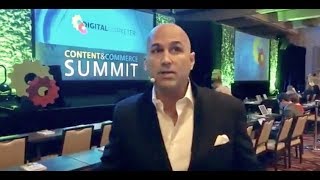
Scott Duffy walks through his backstage process for hosting Content and Commerce 2017 at LA Live: how he organizes schedules in a spreadsheet, prepares speaker bios/slides, creates a single note card of key messaging, annotates the printed program (binder clips, pencil), rehearses backstage flow, and performs a final sound check and stage-blocking to avoid audio feedback (notes ~1500 attendees).
Questions this video answers
About 1,500 people.
About 15 to 20 minutes before doors open.
An Excel spreadsheet.
Chapters
Hey guys, it's Scott Duffy and I am here at content and commerce 2017 at LA Live, which by the way, if you haven't been here, is a killer, killer venue. Last night we were right next door to the Emmys, which was pretty cool, which they were filming at the Microsoft Theater and they used this hotel as a staging area. So it was cool. While we were rehearsing upstairs, downstairs they had this whole other event taking place, which is pretty cool. One of the things I wanted to do is we're going to start here in like 15 minutes, so we don't have much time. But a lot of people ask me when I emcee or I host an event, kind of what's my process and what are some tips or ideas I can give for others that are doing the same thing. So I just want to take you through my process really quick and then we're going to go out and get ready to go on stage. The first thing I do whenever I work on an event is this I put together and you'll see it right here like an Excel spreadsheet. I put together each day of the event, the time that each speaker is going to come out, the speaker name. I also have an area for all the session details. So it's just like one line that highlights what it is that they're going to talk about. So I know have some more context for how to intro and then the room that this is going to be in. So a lot of the events I work are in multiple rooms, so which room that speaker will be in. I not only like to know who I'm going to introduce, but I also have the same thing for everyone else that's going to be in any room throughout the event. And I this is really important because when you're at events like this, there's always things that happen, things move around, somebody misses a plane, somebody comes late. So I think you always need to be ready to jump in and to fill in wherever possible. The other thing that I do is I actually go back and I research every single person that's going to speak. I put together in PowerPoint their photo, their bio and a session description. So you can see like an example here with Ryan Deiss, what I've done, the CEO and co founder of Digital Marketer. And then what I do after our first practice is I put together a single note card. And this single note card has all of the key takeaways and messaging points that I want to make sure that I hit over the next here it's three days, but your event may be an hour. But the key messaging points that we want to keep hitting. Finally, what I do is if the event has a program or it has some kind of schedule. What I do, and here's ours here for Content and Commerce is I go to the schedule page, and this is where I make all my notes. And this is what I work off of, by the way. I always work using a pencil. I never use a pen because things change so much. I think it's really important that I'm able to erase and scratch and stuff like that without having to throw this book out and go find. Another last thing on a program is if at the beginning you're going to reference certain pages or certain content or certain material in the program. What I do is it can be really kind of cumbersome on stage to flip through pages. So what I do is I actually take a clip, a binder clip like this, and I make sure that I binder clip the pages that I want to go to. So it's really simple and easy to flip through when you're on a stage. Okay, we don't have much time, so I'm going to take you. I'm actually going to put on my jacket because I think we're almost ready to go. What we're going to do is we're going to go out front and I'm going to show you how we prepare before we open the doors up front. So. So let me grab these things right here. What's up, guys?
Good luck. Thank you. All right.
So we're going to leave that staging area, and this is the path at Content and Commerce to the stage. And what you'll see is we have operations back here. We have our projection right here. So the other side, this is the monitor everyone's going to see. We have all of our audio set up right here. So what will happen at this event is speakers are going to come through the back. They'll come sit in these chairs over here. So we have time to prep and go through their introduction and things like that beforehand. And then if they're hungry, they want snacks, they'll go behind that curtain up there. So now.
Okay.
So we're about. I think we're about 15 minutes from the doors opening. So what I typically do is 15 to 20 minutes early. I'll go out and I'll do a final sound check. So this is really important. It's super important that you not only check to make sure that your audio is working on stage, but if you're going to walk around. So I'm going to actually go down into the crowd. We're going to have about 1500 people here today. I want to make sure that I know the boundaries of my speaker. So let me give you an example. So we'll talk up on stage.
And then what we'll do is we'll walk around and if you can kind of see this room right here, that'll be all filled up in about 15, 20 minutes. What I want to know is where I can.
Safely not have my audio cut out. So in this room, I know that I can hang in the middle, but the problem is if I go too far to the side, you'll see speakers up here. And what happens is then you start to get feedback. And so that's not going to work. So I know in a room like this that I have to kind of stay in the middle, and if I do that, everything's going to be cool.
Other stuff. For events these days, I really recommend at the beginning of your event, like, put together some kind of competition or contest that has to do with selfies. Have people take selfies of themselves, have them lean into the person next to them, have them, like, post content. Like, if they see something great on the screen, have them post that to social media and tag it, tag their company, because I can only help them. But it's a great way to get your message out, your event out there, get people to have fun right at the beginning to meet each other. So I really am a big fan of selfies and posting those and then tagging the event and then finally, just like, be cool. Because here's the thing with events. It doesn't matter how much you plan, it doesn't. Doesn't matter. You know how nailed down things seem to be before you step on stage. Stuff always happens. It just does. And so you just need to know that it's gonna work out. You're gonna work it out, stay cool, stay relaxed, and just like go with it. And your speakers, make sure that they know the same thing. Also make sure that they know, hey, you know, if something doesn't go right, doesn't go perfect, doesn't matter. We're all cool here. We're all in this together. We're going to figure this out. So music's going on, people are coming in. I got to go. You guys have a great day.