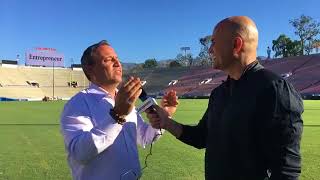
A live YouTube interview at the Rose Bowl between Scott Duffy and David Meltzer covering the stadium's history and the Rose Bowl Speakers Series, Meltzer's talk on "leadership through legacy," and his entrepreneurial work. Meltzer outlines four core value types for building legacy (personal, experiential, giving, receiving); describes Elevator Pitch (digital show: 12 episodes, 90 entrepreneurs, '60 floors in 60 seconds' format); highlights The Playbook podcast (debuted at #4 on iTunes) and themes from interviews (persistence and giving back); and discusses the Rose Bowl Legacy Foundation fundraising campaign ($40M goal, $10M lead donation) and the Warren Moon Tunnel project. Format: live interview / transcript of a spoken conversation.
Questions this video answers
Built in 1922; first game played in 1922 (USC vs Cal in 1923 noted as an early game).
Personal values; experiential values; giving values; receiving values.
Digital show on Entrepreneur network and other platforms; 12 episodes with 90 entrepreneurs; format: '60 floors in 60 seconds' elevator pitch to judges.
Debuted at number four in the world on iTunes.
$40 million campaign goal; opened with a $10 million donation.
Chapters
Oh, no.
Hi, my name is Scott Duffy, and I'm here at the Rose bowl in Pasadena, California for the Rose Bowl Speakers Series and also for the Rose Bowl Legacy Foundation. And I'm here with my guest, David Meltzer. How you doing, David?
I'm excellent. How are you, Scott?
Good to see you, brother. And we are. I mean, like, this is the most amazing place to be. Right?
I dreamed of being here, suited up as Ohio State Buckeye, but I'm suited up as just a Buckeye, I guess.
Just as a Buckeye. Well, I tell you, the. I'm like, I'm the biggest college football fan that you probably ever met. You like college football?
I love it. You know, my partner was the MVP of the Rose bowl, so this is a very special place for me.
Yeah, you know, this place, the Rose bowl has so much history. It was built in 1922, actually played the first game here in 1922. It was USC against Cal in 1923. They had the first Rose bowl game in 1982. This became the home stadium for UCLA football. And you can see, actually, if you look in the distance, they're painting the field for Saturday's UCLA home game. They've had two Olympic games here, and I think they're going to have their third in 2028, five Super Bowls, two World cup championships. I can't tell you how many times I've been to concerts here. It's unbelievable.
They actually even had carriage races here. In fact, the reason the Rose bowl will never be played on a Sunday is, is that all the carriages, horses and carriages on Colorado Boulevard were parked out there for church, so they decided to never have the Rose bowl parade on a Sunday. And so. Wow. Yeah. So there's all kinds of interesting history here. That's why they're building the museum that they have here, which is incredible. The locker rooms and the legacy of the Rose bowl far goes beyond the granddaddy of them all, which is the Rose bowl game.
So tell me a little bit about why we're here today.
Well, number one, who is MVP and my business partner. But moreover, we're to talk about leadership through legacy. And so I'll be doing a short little TED Talk about leadership through legacy and building a legacy and the importance of that, as well as an extraordinary panel with Mark Watts, who was the talent producer of NFL Network, with, of course, Warren Moon, Sean Merriman, Ann Meyers, Roger Abramson, and of course, the king of New York during the World Series, Jim Laritz.
What does a person have to do like what is the process for creating a legacy?
You know, I'm going to talk about today, the process is understanding your values. And there's four core values that there are. One, your personal values, two, your experiential values, three, your giving values, and four, your receiving values. And the key to a legacy is, you know, in the end, the only thing that you'll have left is what people remember you for, the impact that you had or empowerment that you gave them in their lives. And that's what we should strive for, to enjoy the pursuit of that potential, of being a legacy.
Now, I know one of your business partners is Warren Moon, right? Unbelievable. Just an unbelievable human being. What have you learned about building legacy and about leadership? Being around Warren.
You know, Warren had every reason to make his life an excuse, right? They didn't allow him to play in the NFL. He had to go to Edmonton for six years. Before that, they didn't allow him to be a quarterback for the back then Pac8. And he could have made that his excuse, but instead he made it his story. He created a legacy of not only believing in yourself, even though you're against all odds and everyone else telling you you can't do it, but also beyond believing yourself. He never went to blame shame and justification. He was simply accountable. And he still lives his life to be of service. And our dream was to someday not have people talk about the black quarterback and just the quarterback, whether he's short, can't process bad accuracy. And I think to be hon. Over the last decade, Warren and I working with great quarterbacks like Cam Newton and others, we've been able to transcend that moniker. And people don't really talk about a black quarterback anymore. They just talk about their skills instead of their color.
I see you everywhere today. I see Elevator Pitch. I was just watching that last night. Can you tell us a little bit about Elevator Pitch, the program you're doing with Entrepreneur? And also what is the number one thing that you've learned entrepreneurs need to do when pitching their idea?
Yeah. So Elevator Pitch is a digital show on Entrepreneur network, Amazon, Ruku, YouTube, it's all over, but it's digital. And what we do is we put these Entrepreneurs, we did 12 episodes with 90 of them and they go up 60 floors in 60 seconds by themselves in cameras and pitch their idea. They stop at the elevators and the judges, four of us, decide whether send them down or open the doors. And what I've learned through that process is how little entrepreneurs know about, number one, what, what an elevator Pitch is. And what the purpose of it is, simply the purpose of an elevator pitch is to one, stimulate interest, two, transition interest, and then three, the hardest part is to share that vision of what I want and how much you're gonna get. And they are, you know, 10%, maybe got through that process.
The Playbook. So you also have one of the top podcasts on itunes. I think it was. It was number three. Number four, number five is really killing it. Can you tell us about the Playbook and also where can people find it and download it?
Yeah. So the Playbook is a business podcast and we debuted at number four in the world on itunes. You can get it on itunes and Android and Entrepreneur Network, of course. But the idea of the Playbook was that we're blessed to have all this relationship capital. I always say Warren and I are one degree of separation from not only celebrities, athletes and entertainers, but media, high net wealth, individuals, CEOs, officials of the government, all these extraordinary people. And what I do is I'm not really concerned about the plays on the field. I really want to know, what is your playbook to success? How can our entrepreneurs take your character, integrity, your philosophies and procedures, all the things that you do to make you successful, and apply that playbook to their own personal and professional lives?
What's the biggest surprise that you found interviewing successful athletes and performer high performers?
You know, I was truly surprised that they all have certain things that they all do. I thought, you know, there's everyone's unique and there's different roads to success. But I'll tell you the things that I see that are similar, and that's really what I think over the years people see with the Playbook. My podcast is that they're going to get this consistent feedback that one, persistence. Every one of these people have persistence, and two, the abundance of giving back. Those are the two things that I've learned through, and I think we've done eight so far. We've obviously recorded many more. But every single successful person, no matter what field space they're in, they're all persistent, they never give up, and they're all giving.
So we're not only here to celebrate this amazing stadium and for the Rose bowl speaker series, but we're also here in support of the Rose Bowl Legacy Foundation. Can you share a little bit about the Legacy foundation and also what we're trying to do with Warren Moon here in tunnel number one?
Yeah. So the Rose Bowl Legacy foundation, which Warren and I both sit on the board of advisors for, we raise Money to transcend the legacy of the Rose bowl, to create an experience here so that not just the game can be played, but all types of content can be seen here both in, in person and on tv and of course now social media. But to portray and transcend the values that the Rose bowl represents. And so we're raising money. We have a $40 million campaign going. We actually have just been blowing it out. We do a lot of media. So, you know, whether it's Peyton Manning who played his first game here, Warren Moon who's the MVP here, or Brandy Chastain who slid across the field with the Olympic team, and then of course U2 who plays here. Whoever it is, we have these killer videos that we do with S1 Media, our company that specifically geared to stimulate interest. 30 and 60 second sizzle reels. Great for social media, great for viral campaigning. But we were actually able to open with our first 10 million dollar donation for the Rose Bowl Legacy Foundation. And we'll soon close that $40 million foundation, that big campaign that we have. And me personally, my goal is to finish up and we're very close the Warren Moon Tunnel, Tunnel number one. So that people know that Warren Moon is not only number one in your playbook, but number one in your heart.
That's awesome. Where can people find you?
Find me right here with you, Scott. We're on Entrepreneur network. I have davemeltzer.com avidmeltzer. We also have sportsonemarketing.com or just Google David Meltzer. And I'm blessed to have a lot of different things going on in my life. And our goal is to make a lot of money so we can help a lot of people and have a lot of fun.
Make sure to go to entrepreneur.com and you can find there you can find Elevator Pitch or a television show. You can also find the playbook podcast from entrepreneur.com and next big event right.
Around the corner here. November 9th, entrepreneur live in Burbank. And it'll be a great event. We actually have tryouts for the second season of Elevator Pitch there and we're doing a great panel there with Apollo Ono, Maria Sharapova. We have incredible, incredible Sean Merriman. It's going to be incredible day with great entrepreneurs. There's a lot of VCs. So if you're interested in raising money, you're interested in your business, interested in getting great mentors and advice, come to Entrepreneur live next November 9th.
November 9th. And it's a great location at Digiland in Burbank. So if you're in Southern California. Even if you're not in Southern California, you should hop on a plane or get in a car or play a train, plane, whatever, and get out here for the entrepreneur live event November 9th and go to entrepreneur.com where you can find those tickets. So again, three things we got to do. Entrepreneur.com we're going to find Elevator, Pitch, the Playbook, and also the upcoming Entrepreneur Live event. For Dave Meltzer, I'm Scott Duffy. We're here at the Rose bowl in amazing Pasadena, California. If you have any questions, please hit us up in the comments. We'll make sure to go in there and answer any questions that you have. Until next time. You guys have an awesome day.