Scott Duffy: What To Do Now
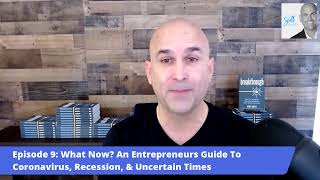
Transcript of a live-stream (episode 8) by Scott Duffy offering practical advice to entrepreneurs during the early COVID-19 pandemic. Duffy reviews infection timelines and economic outlook, emphasizes conserving cash and rapid planning, explains government assistance differences for employees vs. entrepreneurs, and provides operational tips for remote work, health, pricing and rapid product pivots to generate immediate revenue.
Chapters
Good morning, everybody.
Good morning. This is Scott Duffy and I want to welcome all of you for joining this live stream video. This is episode eight of what now An Entrepreneur's Guide to Managing Through Coronavirus, Recession and Uncertain Times. And what I'm going to do is I am going to take just a couple of minutes and let this stream propagate. We are streaming live right now on Facebook, on Instagram, on YouTube, on Periscope. And so wherever you are and you're joining from, I just wanted to say hello and good morning and I wanted to thank you for being here today. And while you guys are jumping on this live stream broadcast, what I ask you to do is just go into the comments and if you could introduce yourself and the industry that you're in and if you can share maybe one or two of the biggest challenges that you have or things that you're thinking about or working on right now, that would be a really big help to me. So that way I could go ahead and I could help to, I could use that to tailor what we talk about today. It was a big night. I received about 3,500 emails and texts and messages last night from entrepreneurs just like you, asking me a variety of questions really about what to do now, what to do now and how to make all of sense of everything that's going on today in the world. And really some of the common themes I'm hearing are how do I protect myself as an entrepreneur, how do I protect my cash? That's really number one. Number two, how do I create some kind of stability in my business? And number three, if there's a way, how can I take advantage of this time, of this period to set myself up for a longer term success? And so my goal today is going to be to address those things and many more issues that keep coming up. And what I also want to do is.
Help to dispel some of the confusion that's happening out there in the marketplace about where things stand from a medical standpoint, what programs are and are not available for small businesses and for entrepreneurs. I want to talk to people that work for big companies and that are in a position where they're starting to have conversations with their employers with regard to furloughs, layoffs and other things, and share with all of you some of the resources that you have available, maybe some action items that you can take today in order to prepare yourself and set yourself up as we go into the next two, three months. And so we're going to spend a little bit of time Here, not with dead air, but with me. Again, just welcoming you and.
And thanking you for joining me today and asking you, as you hop on this, on this live broadcast, to do a couple things. One is jump in and please introduce who you are, the industry that you're in, maybe one or two things that you're experiencing right now that you could use help with. And also if there's something that you're doing today, if there's something that's working for you as we all go through this together, if you could share what those things are and I would ask you, we are all in this together and the information I'm going to share with you today is going to be timely and it should be very beneficial for entrepreneurs, for solo preneurs, for small business owners. And also today I'm going to make a bit of a shift for people that work for big companies that are hearing from their employers today that they're about to begin getting furloughed, getting.
Potentially losing their job and kind of how they adapt to and some ideas and how they could adapt to.
That reality. While we're talking, I have got a bunch of news channels up, so I can give you any new news, any new information that breaks. I might be looking down from time to time. I have an exceptional network and I want to thank my network so much of people who are on the front lines of this medical situation, people who are working directly with the quarantine centers, people who are in big media and technology companies that are helping the government, assisting the government in doing several things, whether it's procuring masks or dealing with a ventilator issue that we have, helping to open up capacity for hospitals and also working with the government to help provide assistance to people just like you and me. So from time to time, I may take a pause and look down and see what's coming in so I can share that information with all of you. And again, I want to thank you from wherever you're joining today. We are streaming live across Facebook, across Instagram, we are on LinkedIn, we are on Periscope and several other places. So again, I want to thank you for joining. And by the way, I just found out last night, for those of you, I haven't shared this or I haven't announced it, but starting in April.
I done a deal to do national radio and we were going to be recording every day. The studio has been built. It's on Hollywood Boulevard in Cahuenga and it is through dash. And I'm so excited about this. We Plan to start the end of next month. But it looks like we are working on actually slotting in a dating a daily national show for broadcast all across the United States that mirrors what we're doing here today that talks about an entrepreneur's guide to dealing with all these things. Coronavirus, recession and uncertain times.
And again, as people begin to join this stream, I want to ask you to please share this with your audience. Share this with the people around you. This information will be really, really super helpful to help you to adjust to our current market in this current market position, to help you prepare for what's coming next so that you can protect yourself as, as an really just protect yourself personally, number one. Number two, create some stability for your business. Number three, position yourself and your business to thrive when we come out of this, out of this, this market.
I'll say that, I'll say this.
Since last Tuesday night and I believe that last Tuesday night, where was the night where all of what's going on today really became real for many of us? Last Tuesday night is when the city of San Francisco basically shut itself down and banned public events. It's when the Golden State warriors said we won't have fans in our games. It's when Rudy Gobert from the Utah Jazz tested positive for coronavirus. It is when the NBA shut down. It's when Tom Hanks and his wife Rita.
Were diagnosed as having coronavirus and put into quarantine down in Australia. And so starting that night, I began getting a flood of texts and emails and messages, phone calls from entrepreneurs.
Asking what do I do now? And every single day, as we get more information about what really this means to all of us, we get more data. The types of questions I get in, the tenor seems to change. And last night, between actually between the time we finished yesterday this program and this morning when we got started, I saw the biggest shift of all. And it felt to me, based on what people were asking, like things were really starting to sink in and people were beginning to accept that what is happening now isn't something that is going to be a short term type of deal. This isn't something that's going to resolve itself in the next two weeks, in the month, next four weeks, in the next eight weeks. What we're experiencing now is, is something that we will be experiencing kind of this feeling, this new normal, likely into the end of the summer. And I wanted to give you guys some of the latest statistics on coronavirus because this will impact all of our businesses. The first is this, that coronavirus is in all 50 states today. But the concentration of the infection is in 3 in California, new York and in Washington state. And in the United states, we have 3,007 counties. We have over 3,000 counties. The concentration of this spread right now is in only 10 of those counties. What we know today is based on the data that we've been getting from our increased testing, is that based on the number of new cases, we'll reach our hospital capacity between April 10 and April 15. So again, if you think that when Donald Trump said he's got a 15 day plan and that after that we may return back to normal, that's not going to happen. Our hospital capacity will be maxed out between April 10 and April 15. One of the questions I get from people is why does this happen? Why would we max out our hospital capacity? And the reason is simple. The reason is in the United States, hospitals, you know, they're built by private businesses. And those private businesses, in order to maximize profits, don't create or build a bunch of extra rooms. And so hospitals weren't built with something like this in mind. So we reach hospital capacity April 10th to 15th. Our infection height will be between May 8th and May 15th. So the infection height is May 8th to May 15th. And so if you know by that time, I wouldn't be surprised if we're getting about 20,000 new cases, new infection cases that are announced every day. And our death lag, and that's really what they call it, the death lag. So that's the people that have been, that have been diagnosed with coronavirus potentially go onto ventilators and are able to prolong kind of their fight against the virus. The death lag goes into June and July based on the latest statistics. So if we get back to any kind of normal or new normal, I just want you as entrepreneurs, as people that maybe their companies have said, we're going to send you home until things get back to normal. I want you to begin thinking about August, September as the time that things may start to get back to some type of new normal. Today was the first day that China announced that they had no new cases that came through China. Now, depending on whether or not you want to believe this data from China, what that would mean is that if their first case was around November, it took five months for them to get to this point. And so again, the five months for us, if you assume that last week was the first week, is in August. So again, I just wanted to share some of that information because I still am talking to entrepreneurs that are hoping that things will turn faster, that are hoping and they're waiting to make changes in their business because they think that maybe things will improve and we'll get that big bounce that the government keeps talking about.
But the bigger challenge and what we have to prepare for as entrepreneurs is this. It is on the likelihood that when we come out of this.
We go straight into recession. And the reason that we go into recession is again, recession is defined as three consecutive, two consecutive quarters of negative growth. So this is our first quarter, January, February, March, that we're dealing with the virus. And we will be negative growth in this quarter. And because we don't expect this virus to leave until leave us work through our system, cycle through our system till the end of the summer, beginning of the fall. Now, based on the data, that would mean at least 2/4 of negative growth. So our job is entrepreneurs. Our job as business owners is to plan. It's to prepare. And just really quickly, before I jump in today's new lessons, I just want to review some of the things that we need to do. Number one is we need to plan like we have to act fast. Again, as entrepreneurs, we tend to drag our feet. As entrepreneurs, we tend to be very optimistic. As entrepreneurs, we tend to hope. And hope is not a good strategy. What we need to do. And by the way, as entrepreneurs, we are used to putting on a brave face. We're used to telling ourselves and telling our investors in the world and our clients that things are great. But what I need you to do right now is I need you to panic, not get filled with fear. I need you to panic faster. And what that means is take the actions today that need to be taken in order to protect yourself. It starts again with an. It starts with protecting your finances. It starts with conserving cash. So here's what I want you to do. You've heard this all week. If you haven't done it already. The first thing that I want you to do is to print out your last two months of your credit card statements. Any auto pays, auto hits, auto bills, anything that hits you automatically that you do not absolutely need. Cancel that today. That is number one. The number two thing is I want you to reach out to all of the bigger billers that you have. Reach out to your car if you have a car loan, reach out if you have credit cards, reach out to your utilities, reach out to anybody that you're paying monthly. And what I want you to do is share with them the situation that you're in and ask for an extension, Ask for forgiveness. What I found, I've done this personally over the last week. First of all, these lines are really busy. There's a lot of people calling. So the amount of time to take to do this, it could be a half day. It could be a full day for you. So block it out. But again, what we want to do is protect your cash. I found that everybody that I've called from, again, the cars, the utilities, everyone, has been so willing to work with me. Half of the companies I've called have pushed off all payments for at least a month. Half of the companies I've called have asked for some kind of small deposit. So, for example, if a bill was $300, can you give me $15 today? Can you give me $20 today? We'll push it back. Some of the companies that I've called have offered to actually break out payments now over the course of a year. So there's not a big hit down the road. So again, the number one thing I want you to do is I want you to look at your statements, see what you don't need. See what. Then I want you to go in and I want you to call these companies so that you can hold on and preserve all of your cash. And then number three, I want to start thinking about what it is that we're going to do to secure our business, the foundation for our business, and continue to move forward. And I'm going to pause for a second. What I'd love to do is just welcome some of the people that are here in our live. Aaron, it is great to see you. We're actually going to have Aaron on later this week. So Aaron, if you don't mind me saying, Aaron. Aaron is the. His company, ddi, is the biggest supplier of delivery drivers. Delivery drivers in the United States to all of the big brands, whether it's an Amazon or a Walmart or companies like that. GrubHub. So the odds are if you're ordering stuff to be brought to your home or your business, it's Aaron's drivers that are delivering it. And Aaron's learned a bunch of new lessons from the front lines of dealing with this crisis. And one of the things that he's had to do is he's had to adapt. Aaron needs drivers. He needs more drivers. But for some odd reason, he hasn't been able to get the number of people that he needs to apply for these new driving positions. And so what Aaron's decided to do is to innovate. And he's gone Back to restaurants all over the country. And he's been talking to their owners, their wait staffs, he's been talking to their hosts.
He'S been talking to their servers, their waiters and their waitresses and their servers. And what he's been asking them is, do you guys want to drive during this crisis? Trying to help create opportunity. And the question I have is, in your business, where is the opportunity? And are there new positions that you need to be filled? And how can we help help you to fill them? If you have positions, if you have jobs that you need to fill, what I would ask is this, what I would ask is, you post that here in this feed post that here in this feed so that we can share that with other people. And with that, I got to actually put you guys on hold because my daughter just got here. And this, by the way, is. This is the new normal. Working from home and trying to juggle work and kids that aren't in school and all that stuff. So I'm going to ask you guys to hold for just a second. I'm going to be right back. Hold on.
Okay, so first of all, thank you guys for holding. And yes, that is the new normal. That is exactly the new normal. So I am here at home. I'm working my kids, who'd normally be in school. The kids are here as well, or they're coming here. They were just at their mom's. And so the question I have for all of you is this. The question I have is in this new normal in working at home and also trying to help manage your kids and your lifestyle, what is it that you're doing today that's helping you? What tips can you share with the rest of us so that we can manage better and we can manage this process better?
And I'm just going to jump to some of some ideas for you guys right now. So if you're working from home for the first time or you have a company and you're managing people that are working from home for the first time. Most of us, by the way, are dealing for the first time with having an. An entire. A 100% virtual workforce. What are some ideas on what to do? The first thing is this. The first thing is you need to create a routine that is by far the number one most important thing. A routine for yourself, a routine for your kids, and a routine for the business. This has never been so important. And there's a couple of things that I think should be a part of that routine. First, if you're an Employer and you have a team and they're all working virtual. What I recommend is set a schedule where you talk four times a day face to face, like this. Use Zoom if you want to do it for free. Use Skype, use Google Hangouts, use tools like that so that you can make sure that people are up, they're dressed and prepared for work and they're engaged in what you do. You can share with those people anything that you've learned on the front line. And what you can do is you can actually hold them accountable for their work, you can hold them accountable for their jobs. And what it is, you know what it is that you need to get done. Because the thing is, during this time, with so much negative news, negative press, negative media out there, if you're not controlling the dialogue in your company and you're not holding people accountable for their work, they're going to get distracted, they're not going to get anything done, they're going to go off and they're going to do other things. So as an employee, that's what I recommend that you do. Again, a morning check in, it's like a morning huddle and then three additional check in times during the day. I would invite my employees, my FTEs, my part time employees, and I would bring my contractors in as well. The other thing, I actually wrote down some notes here this morning about this. There are some things that I definitely would and would not recommend. If you are working from home and you are that contractor, you're that employee. Number one is this. Don't work in your PJs. There is something that happens and there's all kinds of research around this. When you have a routine and you get up and you dress and you get ready for work, not only does the world take you more seriously, but you take that day and that task more seriously. So number one, get up, shower, dress in the same way as if you were going to work. And getting in front of a customer today, that is number one. Number two, work in, don't work from a bed or a couch. So a lot of people do this, especially when they're flooded with negative news and hard things to digest. What they do is they go and they work from a bed or a couch. And what I recommend is take the time to go carve a place out at your home and make that your workspace. And if you don't have a lot of space, I mean, it can be your coffee table, it can be, you know, your, your kitchen, it can be wherever it is. But carve out your own workspace. This is so important.
Next. Don't go dark. Whatever you do, and no matter how you feel, don't go dark on your team, on your employers, on your employees, do not go dark. It is really important not just to communicate, but to over communicate during this time. Next. It has never been more important for you to take care of your health. You have got to take care of your health. Because with all of this kind of negative news, with the feedback, the shifts that are taking place in the marketplace, with all of these different things that we're trying to digest, clearly this creates stress, and stress ain't good for us. And in order for you to be able to manage through this crisis effectively, you got to be strong.
I remember in 2008, the market had crashed, and I was the CEO for a company that Virgin had bought for me. I ran it for Richard Branson for a couple years, and.
I was invited by Virgin to Necker island, which is Richard's home. And at the time, Richard was invested in 400 companies. Virgin was invested in 400 companies, and they brought like 35, 40 of US CEOs from some very strategic companies to Necker to talk about how we were going to deal with the crisis in 2008. And here's what's interesting. When the event was over, I walked out to. We went to this little airport on this little island, and there were two planes. And I walked over to the person who was hopping on one. It was a guy named Steve Ridgeway. And Steve is a complete icon. He's a complete icon in the aviation business. He ran Virgin Atlantic from, I think around the time it started until. For over 20, 20 years. And I remember I walked up to Steve and I said, hey, Steve, I said, I gotta tell you, this is a great couple days, but I'm nervous. I said, I'm kind of freaking out. And is there one thing, just one thing you can share with me the most? Like what is the number one thing, most important part of my job as a leader? And I thought he was going to say things like, you know, having a clear vision, making sure that you got the right team in place, adjusting your marketing, something like that. But his answer was exercise. And I said, exercise. I said, I'm surprised you'd say that. He said, I'm disappointed that you're surprised. And so Steve got onto the plane, and I ended up getting onto the other plane. The other plane had Dave Kush. And Dave Kush was the CEO of Virgin America at the time. And I remember we were flying over the US and it was about an hour later. And I looked over at Steve. I'm sorry, David. And I said, david, I have a question. I was just talking to Steve, and he said the craziest thing. What he said to me. I asked him, he said, what's the most important part of your job today? And he looked at me and he said, exercise.
And there was no way for those two guys to talk. And I said, exercise? That's so interesting. Why would you say that? And he said, because when times get tough, you have to be the toughest person in the room. And if you're not taking care of yourself, there's no way that you can be. So again, if you're working from home, what we talked about is, you know, get up and dress up. This is like a no PJ environment. Get up and, you know, get ready to take charge of the day, number one. Number two, don't work on the bed of the couch. Go and create your own workspace and figure this is a workspace that you're going to be in for the next two, three, maybe four months. Next. Don't go dark. Make sure that you're constantly communicating with your team or the people that you work with. Next. Take care of your health. So important. And finally, it's never been more important for you to provide value to your network. What I've learned in life is this. I've had a lot of friends that have made a lot of money. A lot of friends, particularly in technology, that have made from a million to tens of millions to hundreds of millions of dollars. And oftentimes what happens is these people, when they make the money, they decide that they're going to take like a year off or they're going to take a couple years off. I also run into this issue with entrepreneurs that sell their company. So they sell their company successfully. And maybe the win wasn't that big, but they decided they worked hard, they're going to take time off, and they believe that when they're ready to go, when they plug themselves back in, it'll be seamless. They'll be just as important, just as powerful, just as influential. They'll have a seat at the table in the same way that they always did. But what I've learned in my life is this. The moment, the moment that you stop adding value to your network, you get replaced. And I want you to remember this. It's never been more important. The moment you stop adding value to your network, you get replaced. And so what does that mean for you today. What that means for you today is to reach out to people in your network, whether it is on the phone, it's in a text, it's through social media, and check in with people, stay in front of people. And when you're in front of people, because you're taking care of yourself, right? And because you're going to have a positive mindset, you will be that connection has never been so more important. And use this power that you have, this, this power that you, that you're now embracing to get ahead of this thing. You're out there, you're protecting yourself financially. You're out there, you're setting up a solid foundation for your business. You're out there talking to customers, you're learning what new products, what new services that you need, that they need, and you're innovating. You're taking care of yourself. So take that positive energy and share it with other people. One of the things that I've noticed is I have been on the phone every single day since last Tuesday night. So figure Wednesday morning through the weekend, through today. I've been starting about 6 o' clock in the morning with phone calls, with clients, with friends, with people that are all asking me, what now? What do I do? And what you notice in a lot of these people is they're stuck. They feel paralyzed. They're letting uncertainty shut them down. And when you look at their posture, you look at their position, you can see it, you can feel it. And so what I want to ask you to do is to add value to your network. Get on the phone, lift people up, right? Ask how you can be a value. Ask how you can be, how you can be of service to those folks.
I want to talk to you about government help. So several people reached out to me overnight and they asked about what kind of tools were available right now for entrepreneurs, for small business owners to help them through this crisis. I posted a link inside of our channel. If you haven't joined the channel and you're watching this for the first time, please come join. Join our channel, our Facebook group. I post a link from the sba. I just want to be. A lot of people have asked me about the sba. The programs that the SBA has in place right now are really more for disasters and disaster recoveries like earthquakes and tornadoes, natural disasters, things like that. So they don't have a program right now that I see that really fits this particular crisis that we're going through. But if they change that, I'll be sure I'LL be sure to let you know. The government has announced several new programs over the past 48 hours. And there's another bill that's supposed to be voted on in the next couple of days that should provide assistance to all Americans. Now, when I think of assistance to all Americans, I divide the world into two groups. Entrepreneurs and people that are employed. Okay? Because the government treats both groups very differently. And it's really interesting because in the United States, 99% of businesses are small businesses. 88% of businesses have less than 20% have less than 20 employees. And 80%, 80%, 8 in 10 businesses are solopreneurs. They're one of the two person companies.
But the way those companies are treated is much different than the way everyone else is treated. So if you're an employee of a company right now, you have access to several benefits. If your company shuts down or if you're let go and you find yourself unemployed, you have the ability to go and get unemployment insurance. There's disability insurance out there. There are other programs that are being developed by the government to help you. You can get on COBRA if you had health insurance, things like that. But if you're an entrepreneur, most of these programs don't apply. If you're an entrepreneur. What we understand, if we're looking through the media, is that there's going to be a bill passed in the next couple days and every American depending, and it will be based on how many kids they have and what their income is, is going to get a check, one check in April and one check in May, and it's from the government. And my understanding is it will range from $1,000 to $2,000 in each month. So those are things that we may be maybe eligible, but we're not eligible for those other programs. And so what that means is if you were employed or if you are employed now and you think you may not be, you have a number of different programs that will service you, that will serve you. And I'm going to start putting links to those programs inside of this group. And if you have the opportunity to take unemployment insurance, take unemployment insurance. Like, do not wait, take unemployment insurance. Sign up for it today. It is a government benefit. It's something that you pay into and don't feel like. Somebody reached out to me yesterday and they were actually at an unemployment office and they were in line and they were trying to decide whether or not to take the insurance. And I said, of course. And they said, why wouldn't you do it? And they told me that they were embarrassed. They were embarrassed. They felt like they needed a handout. And that's not like what they were all about. I'm going to tell you this. I mean, after the market crashed in 2008, I waited and I was embarrassed, and I didn't want to take it. I was too prideful. But I did. I went and I got it. And unemployment insurance was something that didn't pay a lot. I think it paid me like 1200 bucks a month. But you know what? That money can buy food, it can buy groceries, it can buy those necessary items that you need. It's incredibly powerful. And by the way, the way unemployment insurance comes, at least in, I believe it's everywhere in the country now, is it comes as a card, and it's like an ATM card. So you don't have to take it into a bank and cash it or anything like that. It's like a card, and you swipe it just like you would an ATM card. You give it a PIN and the whole thing. So if you have access to unemployment insurance, take it. Now.
If you're an entrepreneur or you're someone that looks like you're going to be unemployed, it is time to adjust. It is time to adapt. I keep repeating this. There's never been a more important time to get out in front of your customers. Every single day, I'm running into people that are incredibly innovative, that have come up with new ideas and new ways. Here's the most important thing I want you to listen. To generate cash today. They're finding new ways to generate cash today. And the reason they're doing it is because they're talking to their customers and they're asking those customers, what's going on in your business? What are, you know, how's it impacting you? How will that impact me as a supplier, as a vendor, as somebody that you pay, as somebody you buy from? What new needs are coming up for you in your business? What new needs are coming up for you? And what do we have right now? How can we adapt what we have in order to better meet your condition in this current market? It's what all of these people are doing. In fact, today, Sita and I, we go and we do yoga over. One of the places we do in Los Angeles is a great studio on the Brea. And today the owner sent an email out that he's going to start doing his yoga classes all alone in his studio, but he's going to do them by video. So if you want, and you want to be a Part of the group. And it's really cool because this kind of stuff can be zoomed out so you can see lots of people on the screen that have their video cameras on. So you get that sense of community. And. And now he's got an entirely new membership program. So instead of everybody canceling or pausing and him losing all that revenue, he's been innovative and he's come up with a new way to do things. I think that that's super cool. I keep sharing because I just paid for it. For my daughter, One of her. My eldest daughter, she's 11 years old. One of her favorite things to do is paint. And she can't go to the paint studio anymore. Obviously, the classes in the studio have several K, several people. And so what that that studio owner did is when she shut down, she decided to instead create a painting courses. She's charging, I think it's $3, $15 and $25 a month. And now you can get daily, daily painting courses and painting programming on online. And people are subscribing. In our neighborhood, tons of people are subscribing because their kids are home and they don't have anything to do right now. And so it's just another way that an entrepreneur is innovating. And I would love to know from you guys if there is anything that you're seeing out there. If you find entrepreneurs, if you're innovating, you find ways that people are innovating in their businesses. If you could do this, if you could share that in that, in this space, that would be amazing. Because the more we share this stuff, the more we activate new neurons, the more we. The more we inspire other people to think differently about their businesses, which obviously is so doggone important today, probably more important than any time in the past. And I have a whole bunch of different channels going right now. So I'm going to just take a look real quick in some of the comments and.
See what you guys. If there's anything you would like to address that we're not addressing right now.
A couple other ideas that came up yesterday from really inspiring entrepreneurs. One person who is in the event space has decided that they are going to go and work with event coordinators and teach them it's a business in a box, how to take their live events and bring them online and create digital courses. And the business in the box is going to have everything from how to create the content, how to market the content, how to deliver the content, how to follow up and upsell from the content. I have Another entrepreneur that I work with, he's also in the training business. And this guy is amazing at creating courses. He is so good at creating digital courses. And so what he's decided to do, because so many people in our space have decided to go digital, but they don't know how to do it. What he's decided to do is to go out there and market a product where he helps other people to come online and he's creating their courses. It's a great idea, it's a great pivot. And he's generating cash right away. I'm raising money for a new project. I'll share it with you later. But I've been raising money for this project. It's around digital learning now. I can tell you the last time the market crashed in 2008, I was in the private jet business. That was an awful business to have to raise money in. It was so tough. I can tell you in the last week I've had more investor activity early on than any time in my entire career raising money. And I've raised tens of millions of dollars. And the reason is it's the right product at the right time. And so if you ask your clients, if you ask yourself this one question, how can I adjust? How can I adapt? How can I rewire what I'm doing today in order to meet these new product needs? This could become the best time for you. Now. You may have to change your product, you may have to change your pricing. So for example, the girl over at Timory who's doing the painting, it cost a lot more to come to her classes when you went directly to her classes, right? But now what she's doing is she's betting on volume and she's getting it. What she's doing is charging a lower price for monthly courses. They're easy for her to deliver. And again, it all happens, it all happens digitally. Managers from a leadership perspective, I just can't say enough. It has never been more important to be in touch with your teams, to be scheduling routine check ins and to be driving that dialogue. It's so important.
On the supply side. Here's another question that came up overnight. So it was, it was actually a friend of mine reached out and he was at a grocery store in Orange County. So Orange county is one of those counties in the United States. And by the way, if you're confused about what you can and you can't do where you live, you are not alone. It's a really interesting thing. The federal government has said that they want us to stay home for two weeks. It's a recommendation. But local governments, state governments, counties, have opposed their own separate set of kind of restrictions and asks. So I can tell you when I'm in Los Angeles, what I can and can't do is different than when I'm in Orange County. When I'm in Orange county, what I can and I can't do is different than I went in Sandy when I'm in San Diego. And so if you feel confused by all this stuff, you're not alone. But I do want to share with you something. I do get a lot of questions about.
What it means when I'm told that I have to stay in place and what it means when supposedly something is going into lockdown. Because they're very different things. And I think these words kind of scare people. And so I just want to kind of dispel any myths. I just want you to know what this stuff means. When, when, when we are told to stay in place, okay, like we have been in Orange county, like we have been in Los Angeles, like we have been in San Francisco, when we're told to stay in place. What that means is they are asking, the government's not requiring, they're asking that we stay at home. They're asking that we don't participate in groups that are larger than a certain number of people. And the number of people is different. It depends based on where you are.
But it does allow people to continue to perform certain essential activities. So let me share with you what those essential activities are. Here's how essential activity is defined. An essential activity is anything that's engaging or anyone engaging or performing a task that is essential to the health and the safety of the community or, or the health and the safety of a family member or a household member or even a pet. This includes things like going to the market, it's picking up medicine, it's visiting a doctor, it's getting supplies. And that means getting supplies for your business as well. Essential activities also are those activities where you are getting, you're picking up, you're delivering things for friends, for family, for neighbors, things like that. An essential activity is moving around, going around, doing anything that's required to care for anyone or to perform essential business. So essential activities cover a huge scope of things. So when you're told to stay in place, it's because we don't want you close to people. And by the way, when we're told to stay six feet away from people, the way that they come up with that number is that the main way or one of the main ways? Not the main way. One of the ways that we contract this virus and we spread it is by coughing or sneezing or talking and allowing water droplets leave our mouth. They leave our nose, things like that. A droplet is pulled down by gravity and either hits the ground or it hits a surface in the typical range of a droplet from all of us is 3ft. And so what the government does is they ask for six feet, twice the difference that a droplet or anything like that could, could, could go, could carry. And they asked for that to be the distance. So just so you know, that's how we come up with, with our six feet. All right, I'm going to take a second and I'm going to take a look at some of the questions here. First of all, I want to say hello to Al Manfrey. Thank you so much for joining us today. I saw you in there, Aaron. I saw you, Sita. Thank you guys so much. Alex, it's great to see you. It was awesome call yesterday. Doc V, thank you so much for joining us. And I have to say.
Doc V, Doc Vong is an incredible resource when it comes to medical data around coronavirus. So go and follow Dr. Duck Duc Vong of Euong, and he's got a Facebook Live that he does every morning and he shares really hard data and facts around coronavirus. So if you're interested in that kind of thing, Doc V is an amazing source for all of you. Skyler, it is awesome to see you. Bob, I love you. I'm here in Orange County. Let's connect today. And Bobby Jo, you are trying to raise money for an amazing app that has never been more important. Social distancing does not have to mean social disengagement. Completely true. Completely true. So the question I have around your app, is the app that you're creating today absolutely essential for people? Because if you're raising money today, the money that people are investing in companies is around products and services that are being viewed as either absolutely essential today or they are part of what will become the new norm for us over the next one to two years. Okay? So that's really important. If your app, your product or service doesn't necessarily fit into those categories, it's going to be much more difficult for you to be able to raise capital in this market now, when things shift, when they adjust, it's a different market. But in this market today, again, if you're out there raising capital, if you don't address a current need Today that is absolutely essential. Because here's the thing, especially with a product like an app or a SaaS service, you know, when we have apps and SaaS services or monthly subscription services, one of the factors that we think about in our modeling is churn. And the churn rate is the rate at which people.
Subscribe to our service and continue to pay us on a monthly rate and then disengage.
What we're finding today is that people are canceling their subscriptions, they're churning at a much higher and faster rate for the stuff that they don't think is essential for their non essential needs. And investors know this. So again, it's really important. If you are raising money, it's got to be relevant now or it's got to be super relevant. And you've got to draw a straight line to show what noun super relevant means for when we come out of this thing in this new normal. But I tell you entrepreneurs, this is an incredible time to innovate. It's an incredible time to innovate. Now a lot of my peers are out there saying in social media that what you should be doing is focusing right now on growth, growth, growth. This is time to 10x20x100x your company. I gotta tell you, I think that that is the worst freaking advice on the planet. I think that right now, this week, because I'm just talking about today, right now, this is the time where you go inside and this is the time where you focus on protecting yourself financially. Holding onto as much cash as you possibly can for the longest period of time in order to basically lengthen your Runway, your cash Runway. So if your sales drop, if your clients cancel, if things don't return back to normal for a while, you have as much cash as possible to be able to live on. And then once you've done that, the next step is to identify new needs in the marketplace. The next step is to figure out what people need in this new environment. And then the next step is to deliver it. And again, I always say this. Don't try and deliver everything. Deliver one thing and then find out what your customers tell you about one thing, decide how to update, how to iterate, how to, and then change your approach if you have to, or go bigger. Because the biggest mistake that entrepreneurs make, especially in times like this, is they throw as much as they possibly can against the wall. They throw as much as they can and they hope that something will stick. And so they basically take their energy and they scatter like a shotgun. And that approach Just doesn't work. What I really encourage you to do, especially in times where cash is tight, is to launch one thing, test one thing, adapt your product to do one thing different. That's it. Get it out there as quick as you can, as cheap as you can. Don't make it perfect. Perfect in this market is the enemy of success. And if you're thinking about spending additional money, you know, like, if you think maybe I need to make this tweak here or this tweak there or make it that much better, I'm here to tell you that 85% is good enough. Good is good enough. Get it out there and ship it. Because the feedback that you're going to get from customers is far more valuable than what you'd be able to build in that extra 15%. And here's the thing in technology.
So there's an amazing book.
That is kind of like a bible for engineers, and it's called the Mythical Man Month. It's a textbook and it was written, I believe it was written by the first cto, chief Technology Officer of IBM back in the day. I think the book is from the late 60s and when I got up to Silicon Valley, I was 24, 25 years old back in the 90s. And I remember I went to work for my first company and I was in business development and sales and everyone else is an engineer. And I had such a tough time talking to these people and I had such a tough time bridging the gap between my expectations about what could be done in a reasonable period of time, even what reasonable meant, and what theirs was. And so an engineer, a young kid, gave me a book and he said, read this. The Mythical Man Month. And basically there's two ideas to share about the Mythical Man Month that are really relevant for today. And the first is this. The longer that you. The closer you get to the end of any software development project, the further away you actually are from the end. Think about that. The closer you get to the end of building your product and service, the further away you actually are from the end. Because that's not all the bugs. That's all the bugs come out. That's not all that stuff happens, right? That's when you find out all the messy stuff and that's when the real work starts. So again, going back to this point of finding one thing, conserving your cash, getting it out and testing it quickly, getting feedback from the market on something that's really rough and raw, and then going and iterating and changing your approach if necessary, that's the thing to do. And in this market, as you're out there with a new product, the trickiest thing that you're going to have to deal with. No matter how amazing your product is and how amazing the fit is for this particular time and circumstance, the trickiest part for you is going to be identifying the right, the right product market, the right pricing fit. Because a lot of the pricing models that we use, that we have used are going to be thrown out the window during this time.
Think about this. If things feel the way they feel today for the next three to four months, if it feels like this until August, how will that affect pricing for your product? In your industry? People aren't going to stop buying things, people aren't going to stop paying for things. People aren't going to stop that. People are going to stop shopping. But what they're going to do is they're going to focus on the things that address their most important and most immediate needs. And the pricing models they use may be different. They may spend less for things than they have in the past, the same types of things. But there may be more people today that have a need for your product and service. So you make it up in the scale. So I think it's just a really important lesson for all of us to, for all of us to take away. Let me see here in the comments. What else.
What else is on your mind? If there's anything that's on your mind, please drop it in here for me because I want to do everything I can to be able to address it. And by the way, I'm using a new streaming software. So I am testing every day this week a new streaming software service. This One is called Streamyard. And this is enabling me to stream across three different Facebook channels at the same time. Two different streams on YouTube, Instagram and LinkedIn.
Let me know what you think of this particular streaming product. I'm curious if it's coming through clearly.
And all that kind of stuff. Aaron Garcia, amazing to see you. Aaron Garcia was really helpful for me working through and testing a streaming program. So I want to thank you, Aaron, for all of that you just said here. How do you decide the proper pricing plan for an online course during recession, especially if people are concerned about spending? It's a great question. So one of the ways that you do it is you A, B or you ABC test. And what this means is you offer your product or service to a small group of people and you break it up into one or two or three different groups of people, name it differently, price it differently and see what people do really leverage this AB or ABC testing. That's one thing. The second thing is I believe that the number one people on the planet when it comes to digital marketing are the guys that run Digital Marketer. My friends, you know Ryan Dice Perry who used to be there, Roland Frazier is amazing. If you go to digitalmarketer.com they are the largest digital marketing training company in the world. They own Traffic and Conversion, the biggest digital marketing conference in the world. They used to host those events for them. And I would imagine that they are publishing amazing data right now on what pricing is working in this market. I can tell you one of the things they shared with me because I reached out and as I was developing a new. We're developing an academy, an entrepreneur academy that we're going to launch here in the next couple of weeks. And we've been working on this for a year. And when we were planning our model, we were taking a look at what would happen in the case of recession. And we built a bunch of data around that. We looked at a bunch of data and I got the input of people from DM and we learned that $47 to $49 was a price point, a great price point for a high end SaaS product in that kind of market, which probably isn't that much different than what this market feels like. So in our modeling, we were also told by again, people that are the best in the world to test $9, $19 and 47 to $49. So that is my personal experience about.
How I'm looking at pricing in this market. And by the way, if you guys have any idea or you can share how pricing models have changed, what price points are working for you, what aren't working for you? I have a really good buddy who had a product that he rolled out about four weeks ago. It was $19 a month. It was a SaaS product. An incredible uptake over the course of a week at thousands of people that signed up for this product. And what happened was it was a challenge. And what happened was when the market started to correct, people started to cancel their subscriptions because maybe the challenge wasn't something that they saw as being absolutely essential today in this market. So what he did is he pivoted. And because this person does daily Facebook lives and is very engaged with his audience, what he's been able to do is see he's been able to learn firsthand, like what do people want now? What are they looking at? So he changed the product, he adapted it, and now people are coming back online because he's meeting that current market need. So, you know, again, before we wrap up here, you know, I want to share this, and I say this often, that whatever it is that you did in your business, the product or service that worked the best for you, the way that you made money, the skill set that you had, that was always the skill set that enabled you to crush the work. Whatever your superhero thing was last Tuesday morning is your baggage today. And so I want you to approach each and every day in this new world with Shoshone. With a beginner's mind. I approach every single day, every single conversation, every client engagement, every client interaction, every product launch like it was the first one that you had ever done in your life. Be completely open to feedback. Have five ears, not two or six years, not two. Be really great at listening. I'll tell you. And here's where we'll wrap for today.
You know.
By the way, Craig Collins, I want to just give a shout out to Craig Collins. Craig Collins has been out there for the last 10, 20 years teaching people how to read. And if you know people. So this is something that we're supporting in our new company. If you know people, this is a great time that are struggling, learning how to read. They want to improve their reading skills. Maybe they're disadvantaged one way or another. Maybe they're kids or this is a great time to put them in a course to improve their reading. Please hit Craig up. He is here inside of our conversation. He is absolutely amazing, the best in the world.
And love Craig. Kayleen I hope I pronounced that right. I'm going to read this. Kaylene Howdy from Austin, Texas. Entrepreneur in the luxury space. Been there. Kyari K Y a r I kyari.com Women's travel bags Kyari Group Got it here Interior design Goals to grow community.
Goals to grow community. Interview women who are leaders and to bring in as many interior design projects that will require growth of the firm with a team opportunities virtual interior design to continue growing pipeline or projects. Nurture a community of women who love to travel and are going places. Opening up my options to pivot and offer my skill set. I have to tell you this is an incredible time for you to do that.
You know, Sita, you know, I spent I was in the travel business in the luxury travel business in the private jet space, you know, back in the early 2000s through the market crash. And I saw it happen. And.
You know what I deal with right now? At home with seats is we're dealing with.
Hotels, spas, resorts, again, luxury travel. And there is a huge shift, there is a huge pivot in this space right now. We found in this space there have been a ton of layoffs over the last week and people are wondering what to do. And I think if you can create a community that enables women in that community to come together and share what they're going through and talk about how to innovate in this space, I think it can be an incredible way for people to release and to grow together. And that may be a great first step. And what's awesome about these kinds of groups in a Facebook or in a LinkedIn or whatever is there's an opportunity for us to be able to scale for people to share and stuff like that so quickly that that might be a really interesting place to place for you to start. Let me see here.
Let's see stuff about infections. Michelle Patterson, it is amazing just to see you here. You're such an inspiration. We have a Facebook user from Santa Rosa beach in Florida who's a small business and so grateful to be in this live. Thank you so much. By the way. If you guys find value in these lives, if you find value and you think this helps, will you please share now? Will you just please share this with your groups in your communities?
I don't want anything. All I want is to help people. All I want to do is to share my experience and to share my network. I have got such an amazing network. I mean I started my career working in Robbins research for Tony Robbins. I have worked with Richard Branson and in between some incredible entrepreneurs. I have been through some high highs in the market and some low lows in the market. I've been a guy that has made millions. I've been a guy that's lost millions and got hundreds of thousands of dollars in debt and had to figure it all out. And so what I have collectively through my network and through my experience is counsel to be able to share is not just guesses but I've been in your shoes and I want to share the lessons I have. The communications I'm having with the kind of people that I'm talking to you about about what they're doing to innovate and to get through this market. To wrap today.
Just one more thing. Don't wait. Life doesn't wait. Don't wait. Get started and get started by preserving your cash. Get started by doing what I shared. Printing out your bank statements, getting rid of all non necessary monthly hits that hit your account, reaching out to your bank, to your credit card companies, reaching out to your car companies, reaching out to your utilities, reaching out to your lenders. And what you will find is with all of these, bar none, with all of them, they will work with you, they will push payment back, they will spread payment back over a year. Some of them are actually forgiving payment for a month. There's so many things that are being done to help and the number one thing I want you to do is to not make the same frickin mistake that I made in 2008 when the market crashed. I was paralyzed, I stopped, I was stuck in fear and I had all of this stuff running.
Against my bank statements and I was using all this cash that I could have used later. And so what it did, because I didn't panic faster, I didn't adjust faster, is it really shortened my Runway, my cash Runway. And I don't want you to make the same mistake. So as we wrap up today, please post your comments. Please share with as many people as you can. Please feel free to reach out to me. I love the emails, the texts, the direct messages. I'll do everything I possibly can to help you. And also, you know, if you are going to start a business or if you have a business that needs to adjust, I really recommend if you want more information go pick up my book Breakthrough. It was published by Entrepreneur Magazine, came out last year and it's really a step by step guide to getting through all of this stuff. For taking your ideas to market, growing and scaling, managing through crisis and down the road figuring out how to position and sell. So go pick it up breakthrough from me, Amazon.com, barnes and Noble. I love you all. I honor you all. I'm grateful for all of you. You have an amazing day and I look forward to seeing you back here tomorrow. Take care.
More from Scott









Business & Burgers-Sequence Collection bracelet for National Entrepreneurship Week

