Scott Duffy: When Will We Get Back To Work? What Opportunities What Create?
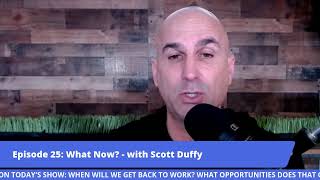
Scott Duffy talks through COVID-19's economic fallout, government stimulus, and what entrepreneurs can do right now. He answers questions about business challenges during the pandemic and where opportunities might emerge as things shift.
Chapters
Good morning, everybody. Good Monday to all of you and welcome to what now with Scott Duffy. I want to thank all of you for joining from wherever you're joining. You can tune in live every single day, Monday through Friday at 10am Pacific Time. We are live on YouTube, Facebook, Instagram, Periscope and LinkedIn. You can also listen to the show each day on Dash Radio nationwide or download the podcast I want to welcome you with. We have got so much to talk about today. There is so much that happened over the weekend, so much I want to share with you, not only with regard to coronavirus.
And government stimulus, but also how we position ourselves right now, how we position ourselves to get back to work, running when we get back to work, which hopefully will be sooner rather than later. And so again, if you're just joining us for the first time, what I'd ask you to do is please, from wherever you're joining, if you can drop your name into the comments, the industry that you're in and the biggest challenge or challenges that you may be facing in your business so that I can customize the rest of the show for you today. Patrick, good morning. It is amazing to see you again this morning. Kimberly, it is so good to see you. Sarah, great to see you as well. Thank you guys for jumping on. I see Sita over here. Robin, thank you guys so much over there on YouTube and, and we're going to give this just a minute so this stream can propagate. But I just want to share, there is, there's a lot of stuff that happened over the weekend and I hope you all had a. I hope you all had a good weekend. I know many of you were celebrating Easter and others were celebrating Passover last week. And so I hope you guys had a really, really awesome holiday. I was down in Newport beach all weekend with the kids and that was really amazing. And good morning to you, Sarah. Great to see you here again as well. And yeah, we had a great time, but I was stir crazy. Oh my goodness. Are any of you guys, Are you guys getting stir crazy? Because I felt it. I felt it like for the first time in full effect. I woke up on Saturday and it was so beautiful out and I wanted to go down to the beach. So first I started a walk across the street down to the beach and people looked at me like really funny and so I felt uncomfortable. Then I got down to the beach and the beach was closed so I couldn't really do anything there. And then I got in the car and I thought, I just wanted to See people, that was it. And so I drove around for a little bit and before dropping in back at home. But I'm curious how all of you are doing with stir craziness and how are you guys keeping yourselves busy? How are you guys keeping yourself fresh on the weekends? I would love to hear, I'd love to hear your stories. So we have a ton to talk about today and we're going to be live here in just one minute on radio. So we're going to let this stream stream propagate for one, about 30 more seconds. And again, I want to welcome everybody that's joining and if you're joining for the first time, please drop your name in the comments, the industry that you're in and maybe the biggest challenge or challenges that you're having so that I can be sure to address those today. Excuse me. And here we go. Good morning. My name is Scott Duffy and this is what now with Scott Duffy. I want to welcome you from wherever you're listening. You can tune in each day at 10am Pacific time to watch the live broadcast on YouTube and Facebook, listen nationwide on Dash radio throughout the day or download the podcast. This show is for entrepreneurs, small businesses and those thinking about starting their own company. It's for people affected by this economy. Maybe they lost their business, their job, they were furloughed or they saw their consulting contracts canceled just like that. It's for people asking, what do I do now and how do I come out of this? Even stronger, Our focus on today's show is going to be when do we go back to work and what opportunities will that create? When do we go back to work and what opportunities will that create? By the way, beginning next week, every day we have planned a special guest. So beginning next Monday, every week we will have a special guest join us for the bottom half of the show. And I'm really looking forward to that. We have experts in just about every area of business you can think of, from direct to consumer to direct to business, all with great ideas to share to not only help you stabilize your business now, but come out of this period even stronger. What's in the news? First, as of this morning, there were 1.8 million cases of coronavirus around the world. 114,000 death. All 50 states in the United States are under. Check this out. All 50 states in the United States are under a disaster declaration for the first time in the country's history. 95% of the US population is currently under stay at home orders. Amazing. And 70, 70% want to stay under lockdown until they know they're safe to go outside. Nearly half of those who are at home and are employed are afraid that before they get back to work, they're going to lose their jobs. So it's a really interesting time out there. We've got, you know, we've got, you know, 1.8 million cases. We have almost 120,000 deaths. 95% of the population is under quarantine. Over 70% actually want to stay at home until they know that it's safe for them to go out. And this thing won't get any worse. But there's really good news. So here's the good News. There are 70 coronavirus vaccines that are in development globally today. 70 coronavirus vaccines in development today. In the next few days, good news. In the next few days, the number of new cases in the United States should stabilize. Meaning we've hit the top of that bell curve. Now, we still have a long way to go because we have to go down. This doesn't mean that the cases go away. This doesn't mean that new cases go away or people stop dying. This means we have to go down the other side. So if we were at, you know, 2,000 new cases today, it means we're at 1999 tomorrow. But the good news is, or we appear to be at the top, and we're just about to start to go down the other side. We're also beginning to see much more supply of masks, gowns and ventilators come online. The supply chain, chain in the supply is catching up to the market. Now, in part what's really cool, because as entrepreneurs, we are always talking about innovation. And one of the big reasons that you see more masks, gowns and ventilators coming online is because of innovation. So, for example, today the FDA approved a new process so that N95 masks could be sterilized instead of discarded. N93 masks can be sterilized instead of discarded. With regard to masks and gowns, I shared with you a couple weeks ago. Every time a doctor did a test on someone who potentially had coronavirus, when the test was done, they had to discard their mask and their gown until a new test was created. Innovation that was spurned by necessity, where a swab was created. So a person who was going to take a test would be given a bag with a swab. They take the swab out, they swab their mouth, they put it back in the bag, Then they would go and they would write their name and some other information, and they put it in a thingamajigger. So here's the thing. The doctors and the nurses and the healthcare practitioners did not have to change their mask and gown. So, again, innovation that was brought on by entrepreneurs. Next, ventilators. There's a new design I shared with you last week from F1 Racing and Mercedes Benz that's created a new way of manufacturing ventilators that uses fewer parts and more parts that are already out there in the marketplace. And so what they've been able to do is get ventilators into hospitals in Europe faster than anybody else starting last week. And again, all of these, all of these things that have happened to bring more supply to the people that need it were created by entrepreneurs just like you and me, who listened to a market need instead of creating something just because they had a great idea, listened to the need, adapted or pivoted their business in order to come up with things that are really serving people and that they're willing to pay for. Now, at some point, we're going to get back to work. At some point, we're going to get back to work. And the question is when we're going to be able to do that.
So the timetable that our President Donald Trump has given is April 30th. He's talking about the beginning of May. But our current stay at home order across the country ends on April 30th. Our Secretary of the Treasury Munchen is saying in May. Our Federal Reserve chair is saying in June. Dr. Fauci, the virologist, who's the top doctor on the coronavirus tax task force, is saying sometime in the summer, maybe July. And then there's me that has said all along that I thought it would be sometime this summer, probably later summer, August, when things really started to get back to normal. Now, the UK Announced yesterday that they may not let their people come out of the stay at home type of, type of order until there is a vaccine found. And so what that would mean in the UK is they are projecting it could be up to a year that they keep people at home. And this is from the government just yesterday. So here's the thing. We all know, but here's the thing, our country runs on confidence. So to open, you know, there's, you need to have confidence that, you know, the system is there and that it's to be there tomorrow, that the banking system is strong, that the medical system is strong, that the stock market, you know, it's. Our system runs on confidence. And so to open things up and then have to close things again, Quickly could be a real problem and kind of a second iteration of this outbreak in the market. And because. Because it runs on confidence, what our leaders are doing is they're looking to other parts of the world to see how they have gone back to work. And the best example is China. So China, even though it's not a perfect example, it's a different type of government and things like that. It's really interesting to see what's happened now. What we found is that when countries have tried to open a little too early, they've seen the rate of disease and the rate of death go up and to the right quickly. So China Today reported that they had the highest number of new cases in the last six weeks after trying to open over the past week. Italy, in some areas where they've tried to create some leniency, has seen the same thing in those areas. So what does it look like when we go back to work? And again, the narrative here in the United States with the federal government is may. What it likely looks like is this. It'll be a staged rollout. It'll be a stage rollout, where, number one, the rollout will be based on the size of the threat in a particular area. So, for example, if you look at Los Angeles or you look at New York, they may not phase in as quickly as other parts of the country that really haven't been affected in the same way by coronavirus. So let's say, as an example, we start to be able to go out here in Los Angeles, it will probably be that certain things will open first. So a doctor's office versus a sporting event, something where a few people go and gather in one place versus where hundreds or thousands of people go, like a mall. So that's number one. Number two, there'll probably be some kind of tracking mechanism that's put in place. So Google and Apple are actually working together on a tracking mechanism for people that have either had coronavirus or. Or have shown that they have the antibodies to fight coronavirus or have gotten a vaccine when available. Another question is, when we start to roll back to work, who is gonna watch the kids? Because if our kids are not in school, how are we gonna. How are we gonna manage that when that happens? So something to think about. Also, another thing that's being asked is, who actually is the one that gets to tell people in the States when they can go back to work and they can start to not be staying at home? Is it the federal government, which Donald Trump is saying this morning, or is it the Government, which is. Or is it the governors? Which is what the governors are saying this morning. So I think, you know, at the end of the day, this won't be perfect. We're all just going to kind of have to roll with it. But again, hopefully we're able to start with much sooner than later. And a lot of the news this morning is, is, you know, saying some very positive things with regard to us hitting the top of this spread, not just here in the United States, but also around the rest of the world, which could be a great sign for us to be able to start looking forward to getting back to work.
Because we don't know exactly when that's going to be. All I know is this. There's only a couple things that we can do. What we can do is, number one, we can focus on. We can control what we. We can control the things that we focus on. We can control what we're in control of. And again, that's what we focus on. It's how we move, and it's also how we spend time and what we do to make sure that we're out there talking to customers and we're listening and we're adapting so when people are back at work, we have the right products and services. So we hit the market. We hit the market running.
Some more good news today. Amazon. So Amazon announced today they're going to be hiring another 75,000 workers, another 75,000 workers as a result to demand for products and services for Amazon. So if you are looking for work, if during this period you need to find some cash, you need quick access to a paycheck, you need something like that. I've shared with you a number of different companies that are hiring. Amazon has now increased from 100 to 175,000 open positions. Walmart with 150,000 open positions. Target, 9,000 open positions. You go down the list. Instacart that will pick up people's groceries for them at the market. Store at the market. 300,000 open positions. Walgreens, 10,000 positions. Microsoft, still looking for 4,000 people. GE Healthcare, still looking for a thousand people. Zoom is hiring like crazy. Again. If you're not a member of the private or, I'm sorry, the public Facebook group called what now with Scott Duffy. All you have to do is go into that group, join the group. It's a public group. And if you scroll down, you're going to see a list, an updated list of jobs that are now available. If you do need to pick up some quick cash during this period. In other good news, UK Prime Minister Boris Johnson. So the prime Minister of Britain literally was at death's door. This is what he shared with us. He was on his way out. He was hospitalized last week, late last week, he was put on ventilators. And it really didn't look like he was going to make it. The good news is he has. We haven't learned how he was treated yet, but again, just another really, really good sign. And before we jump in to our core content today, I want to talk to you about this Fire Fauci buzz that's going around the Internet today and you'll see in the news. So most of you, if not all of you, know who Dr. Fauci is. Dr. Fauci is the doctor on President Trump's coronavirus task force. He's in charge. He's reg as maybe the number one virologist in the entire world. He was there on the front lines for AIDS, for Ebola, for SARS, and now here in this country for coronavirus. So Dr. Fauci is now, by many publications being called and many independent polls are being done, the most trusted man in America. In fact, the New Yorker is about to run a cover story with Dr. Fauci where they list him as the most trusted man in America. Now, his focus has been on keeping the company closed. Keeping the company closed. I'm sorry, the country closed. Until we get a little bit further along where the president. His focus, and I understand why, is on trying to get the economy opened as quickly as possible to get people back to work. So yesterday, Dr. Fauci was being interviewed on CNN. And I was flipping through the channels, trying to get caught up on the news for today's program. And I actually saw the interview live. It was with Jake Tapper. And it was like the biggest setup interview. It's one of those where the doctor was asked in a million different ways to try and get a headline whether or not lives would have been saved if the country was closed any sooner. And so he answered around the question. And then he said, well, obviously, if people are dying and we close the country sooner or something to this effect, less people would have died. It was what you might think is a harmless answer, but you could see after he said it, a change in energy like he said, maybe something that he knew he shouldn't have said. And so what this has done is now it's the headline news that Fauci is opposed to Trump and all this kind of stuff. I'm not trying to be political. What I want to share with you is this simple lesson. I have gotten a ton of media training, a ton of media training. And when you get really good media training, you learn a few things. One is you learn how to talk into a mic, you might learn how to talk into a camera, you might learn how to work with an earpiece in your mouth.
You may write down and learn how to script your talking points. So if you have a business today, or you're about to launch something, or you're going to innovate your product and you want to get it out there, you should have three talking points. Three things that are very short, very digestible and that you hit every single time you go on somewhere, right? Anytime you talk about your new thing. So, and you'll see this if you're talking, if you watch like on CNBC or seeing somebody who's really good and really well coached, it doesn't matter what the question is that somebody's asking them, they're always going to go back to their three talking points. What you also learn in media training is you learn before you go out, depending on, you know, the scale. Like what I was taught is I would know the questions that Maria Bartiromo, when she was at cnbc, would ask me versus Stuart Varney would ask me, and if I answered one way. So you get really, really, really well educated about this stuff and you're prepared. Here's the thing.
In media training, maybe the most important lesson that you learn is in your gut. In your gut, if there's something that's running up here, like you're answering a question and in your gut down here, it just doesn't feel right. Maybe, you know, you shouldn't say it. If you, if it comes out of your mouth and you say that one thing, that is always the headline. It's always the headline. That's always the way it works. It's always the like, kind of controversial thing that's in there. And I think it's true just in our personal, our interpersonal lives as well. It is so true. We got all the. So your gut always knows. So again, if you're being interviewed, and it could be something that's very harmless, right, you're being interviewed, you're doing a live stream these days, or you're going to, doing the press somewhere else or you're talking to a partner, always be prepared with your three talking points and always, always know, just stick to them in that one thing in your gut that's like, oh, man, maybe, maybe it's like the devil, the devil and the angel on your shoulder. That one thing, if you say it, it will be the headline and more than likely it will embarrass you. And I felt like that's what happened yesterday with Fauci. And you can see the firestorm that it has, that it has brought on today with that. Let me go to your comments really quick. I'm looking here on YouTube and Instagram and on Facebook.
And let's see, here's what I see. Hi, Scott, My name is Max. I'm from CS biotech, background, was just getting my new project off the ground when Covid hit. Two investors pulled out. My biggest challenge is getting people on board with risky new tech in this uncertain time. Really been loving your comment. Thanks so much. Awesome. Well, thank you so much, Max.
It is going to be very difficult or challenging to find people that will invest in new ideas and new things that don't have any legs right now because people are holding on to their cash tight. Here's the most important thing. When raising money, you have to create a target investor avatar. You have to have the perfect representation of who it is that will invest in your deal. And Max, I hope this helps. I wasn't going to talk about this today, but I'll give you a quick answer. So investors are in the business of making money. And what that means is they're in the business of understanding how to mitigate their risk. So they typically invest in things that they know and that they really understand and they have a formula for doing this. So as an example, here are the things that you need to know. Number one, where did your investor, your target investor make their money? Again, people invest in things they know. If you take a tech, if you take a biotech deal to a real estate investor, you got to disconnect because they don't know even. They don't even know how to look at or evaluate your deal. You take a biotech deal to a biotech person, it could be a different thing. Now, you may be able to get the real estate person in your biotech deal. I'm going to tell you, it's the worst thing that's ever happened in your business. And the reason is because they don't really understand it. Maybe they've been sold by your charisma or they've been sold by a friend's recommendation because they don't really understand it. They will always be in your grill. They will always be in your face because they want to know what's going on. They want to know what's happening with their money. And they'll know if things go sideways, they'll be too late to understand so they can't jump in and help out. So you always, number one, have to know where do people make their money? Number two, you got to understand what type of goes along the same line, kind of industries or categories. Number three, what stage do they invest so important? So some people like to invest like your deal at the very early stage, at the idea stage that some people take on a ton of risk. Other people, they want to see a company that's in the market or that is generating revenue or that has a certain net margin. So you need to understand what stage of business do they want to invest in Next, you have to understand what is the average size check that they write. So if I go to somebody and I ask for 500,000, but they write $5,000 checks, I got a problem. If I go and ask for five, but they can only write $500,000 checks, I've got an equal size problem. So you got to know the size. Next, you have to know what the.
Expectation is on timing. Do they want to see their money back in a year or two years, five years, 10 years? Next, expectation on return on investment. Do they want to see, you know, a one time, a 10 time, a 20 time return, a VC, a 50 time? What is their expectation for return on capital? Next, you want to understand what their, you want to understand what their decision making process is. So you know, are they the only person that is involved in this decision or are there other people? So you know how to get involved and build consensus with these people to drive towards a decision. So it's, it's a more complicated answer I think than most people would realize. But we have to start by first understanding who the best matches for our deal. Because Max, the perfect match is still out there for your deal. You just have to get really clear on understanding what that person looks like and not waste your time with anybody else. Okay? So I hope that helps you, Max. And keep your head down and keep plugging away. Helen, it's great to see you this morning. Tim. Great to see you this morning. Tim. You have got a question. I'm going to throw it up here about Eidl applications. You say one thing a lot of business owners I know are frustrated about is not getting info on their Eidl applications. They're saying there's no way of knowing whether their application has been accepted or not. Any advice you can share? Yes, yes. Excuse me. Yes.
A lot has Happened and been announced over the weekend with the Eidl npp.
Actually, I want to make sure I don't miss any of it. So I'm going to take a look here at my notes real quick with regard to the personal stimulus. So this is the $1200 that a person was eligible. Eligible for up to, I believe it was $75,000 a year. So if you made up to 75,000 a year, you could get $1,200 from the government, plus $500 per child. That $1,200 starts to ratchet down at $75,000 to 99,000, and then at 99,000, you're not eligible. So for people that have been waiting for this money, you have to have filed a return with the IRS in 2018 or 19 and given your information, your banking information to the government. And usually you give that information if you're expecting a refund. There's 60 million people in the United States that meet that criteria. There's 90 million people in the United States, actually closer to 100 million that don't meet that criteria. They haven't given the information, that specific information in the government. So the money that they're going to send you is not from a paper check. It's going to be. It's sent right to your bank. For that first 60 million people, they started to see money hit this weekend. I believe it started to hit on Saturday. So if you have applied for that money, you should take a look at your bank account and see if that hit, because that money did start to get sent out directly to bank accounts over the weekend. Okay. If you don't have your banking information with the irs, what you do is you look in our group, you join our group, and you look in our group. What now with Scott Duffy, it's here on Facebook. You. You look in there, and I actually have the link. And the link will take you directly to a page that went up on Friday from the IRS where people who did not file an 18 or 19 or filed but not did not provide a banking account number and routing number. You can literally go in and this is your way to get the money. You. You click that link. There's a blue thing on the page. You click on the blue thing, you'll see it. You put in your banking information, and now you're done. Okay, so now you're one of the 90 to 100 million people that couldn't get access to the money, that now can get access to the money. So that right there, that Is the information on the, on the, on, on that. Now, I want to pull this up from Kimberly. So you say here, Kimberly, it's actually 112,500 in filing, head of household, not 99. The amount of recovery rebate is 1200 2,400 if married, filing a joint return. Yes. Plus 500 for each qualifying child under age 17. Recovery rebates are phased out for those with adjusted GROSS Income exceeding 75. Yes. 150,000 if married, filing a joint return. Yes. 112,500 for those filing as head of household. For those with AGI exceeding the threshold amount, the allowable rebate is reduced by $5 for every $100. Yes. Yes. Yes. So, yes. Yes. Great stuff, Kimberly. And so with regard to.
It'S a lot of information. So. Yes. So with regard to these programs and getting that, that personal check or that personal money, that's the latest. And what I'll do, so what, what, what Kimberly had written is in our group, what I'm going to do is I will just to make it easy, I'm going to cut and paste Kimberly's comment and put it down there for information. And I'll put it down there and I'll, I'll re add the link to the EIDL loan if you haven't applied for it or, I'm sorry, the, the personal stimulus to enter your banking information if you haven't done that yet. EIDL loans. Okay. So Eidl, completely different thing. So there's the personal stimulus and then there's the Eidl. EIDL is economic injury disaster loan. So.
The Eidl program was a program that had already been created and had already, it was already funded. There was $10 billion of funding from the government to, to help in the event of a disaster. Okay. To help get money quickly to people in the event of a disaster. So, for example, if there was a hurricane, if there was a tornado, if there was a flood, if there was an earthquake, these are the types of things that the EIDL program was set up for because it was already in place and because it was already funded. It was a program, a loan or a grant program that the government promoted heavily when they first said they were going to try and get money to help all of us through this period.
The Eidl loans offered.
Up to a $10,000 advance, a $10,000 advance on loans that could be as much as $2 million. So the idea was that within three days of applying for an Eidl, what would happen is we could get up to $10,000 advanced and deposited into our accounts. Then the government would have time to review a larger application to see whether or not they extend that money and maybe even more as a loan up to $2 million or waive it and it becomes a grant.
Now. Big change over the weekend. So now, instead of the cap on the EIDL loans being $2 million, it has been dropped from $2 million to $15,000, from 2 million to $15,000 because of the large number of applicants. And they're probably gonna have to find more money. So here, if you just do the math. I want you to do the math with me. $10 billion was set aside. And if everyone only got a $10,000 advance, let's say everyone got a $10,000 advance against that 10 billion, that would mean that 1 million people could get cash advances. Okay? But there's already been over three, close to three and a half million people that have applied so far. So there's a couple reasons, Tim, that we are not hearing about the status of our application and we're not seeing money. Number one, the system was just not designed for this kind of volume. Number two, they never expected, I think, this many people to apply this fast. And so, number three, the system is just completely overwhelmed. It's completely overwhelmed. The first day it was made available for this, I applied within, like, an hour. Haven't heard anything back. And my friends applied. Haven't heard anything back. I actually don't know one person that has received any money from the eidl. If you know somebody, I'd love to know. And I'd love to know how much they got as well now. So that's the latest on the Eidl program.
The PPP programs. The PPP programs. This is the three and a half billion dollars in funding that comes out of the big stimulus plan that was announced two. About two weeks ago. Two weeks ago. So with the PPP loans, there are a couple of issues that are going on. Okay, the first issue is that.
To apply again, to apply. You're not applying directly with the SBA. You're applying with an affiliate of the SBA, an approved lender. About 3,000 approved lenders in the United States before this all happened, before this whole coronavirus thing happened. Okay.
Since then, others have been approved. So if you're having trouble, okay, here's some. Here's some ideas. One, you can go to Kabbage. K A B B A G E. Com. They've completely pivoted their business from Extending working capital loans and credit lines to entrepreneurs to helping you to get this money, you can go to PayPal. This morning, PayPal was approved to help people to get these loans submitted. This morning, QuickBooks was approved to help get these loans through. So there are some. A couple of ideas of places that may be able to help you, be able to help you to do this.
So issue number one was they have had like 10 times more businesses than they ever imagined in this period of time actually apply for these, try to apply for these PPP loans. Didn't have enough people that were approved lenders. They're trying to bring new approved lenders online. Community banks are doing a great job. Every single person I know that has gotten approved, this is just me personally. Every single person I know that has gotten approved has gone through a community bank. Not one person I know has been approved through a big bank. Everybody. Community bank. The big banks are really screwing with small businesses. It fricking sucks. It absolutely, totally sucks because the government isn't handling this and the banks are handling this. What they're doing, many of them is they're opting out of the program so they don't have to deal with it at all, number one. Number two. So by the way, Chase, Wells Fargo, I mean, these, like, they're impossible right now. That's number one. Number two.
If they're not opting out of the program, they're developing their own guidelines, so their own guidelines for funding. So when the program was first announced by the government, and it was announced that the SBA would be backing a certain number three or $350 billion in loans.
The standards that we needed to hit and the information that we were told we needed to apply and get this money was really low. The bar was really low. And that was a really big relief to so many people out there because it enabled so many more businesses to qualify for this money. But here's the real, real. The real real is some of these big banks are totally screwing us. They're absolutely screwing us. So what they're doing is they are applying the same kind of standards, if not higher standards for qualifying for these loans than they did before this crash. So they want government money and they want a lot of help and stimulus from the federal government. But now what they're doing is they're increasing the criteria that would make it easy. So what's happening is up to 40, 45% of people that are applying for the PPP right now are getting. They're not getting the loans. And based on what they had heard when the stimulus plan was offered, they should be getting the loans. But the, the banks have a higher standard than the sba. Now, at the end of the day, it's bullshit because the SBA is backing the investment that the bank is making. So if it doesn't work out, the SBA will step up and take care of that loan. But that's not, that's not the way the banks are playing, if you want to see it. There was a really good interview with Mark Cuban on cnbc, and one of the things he talks about is this, the way the banks are hurting the small businesses. And, and the thing is, small businesses are not big companies. Small businesses are not federal governments. We cannot continue to just pay people. We cannot continue to finance, you know, our companies without this kind of relief. We can't put people back to work without the kind of relief that we've been promised, at least right now. And so if you want to get one of these loans, I strongly suggest go to a community bank. And as an alternative, take a look, take a look at some of these other options, like see what QuickBooks has to offer. See what PayPal has to offer. See what Cabbage has to offer. They may be hungrier and more incentivized to help you out than the others. So, again, just, just some of, of what I am, what I'm seeing today. Tim, I know that's a long answer, but I hope that that answers your question. There's just so much to it.
Let's see here.
Hey, Dennis, it's great to see you. I'm here from China. Thanks so much for, for dropping in. I have an event that I'm going to be announcing. I've shared with you guys. We've teased it just a little bit over the next few days. And I, I just found out that we got distribution into 100 million homes in China. I found that out over the weekend. So we're really excited, excited about that. Have any of you.
Applied for a ppp, an Eidl loan and received it? First of all, have you been approved? I know two people that have been approved. Have you been approved? Number one? Number two, have you received the money? And number three, did you get that personal money, that personal stimulus? Did you see it over the weekend? I would love to know and hear what your experience is. That would be, that would be great. Hey, Doug Vaughn, Doc V. I got to have you on the show next week. So next week we will have a daily guest starting next week, every single day at the bottom half of the hour through the remainder of the show. And we have experts in every area of business that you can imagine. And this will be.
I just, I can't wait to share that with you. Doc V. You've got to come on as one of, as one of our guests. Again, if you don't know Dr. Duck Vong, he is the number one bariatric surgeon in the United States. He's got an incredible program. Instead of just operating on a person to help them remove fat, he requires that you go through personal development programs and training. You take diet, like healthy living classes. Because he understands that it's not just about using the scalpel to change somebody's behavior. You have to change the mindset. So oftentimes, Duck will have a patient get on the table who's 100 pounds lighter than when they first came in, and then he performs the surgery. And Doug has been doing a show on Facebook and on YouTube where he provides incredible medical information about coronavirus. He's getting anywhere from 3 and a half to 5 million views per video. So I really highly recommend that you take a look. Brian Evans, I see that no on any funding so far, not the stimulus, the Eidl or the, or the ppp. So let's hope that people start to see that stimulus money this week. And.
I will check in to QuickBooks and PayPal for you today to learn about what it is that they're doing.
Finally, I want to talk to you today one more time about adapting. I want to talk to you about adapting because.
There has never been a better opportunity for people just to take off, to have their careers take off than now. And the people whose careers do go up and to the right and who come out of this like in a sprint where other people are going to be maybe a little bit of slow to get back to work, a slow to integrate, slow to get back into a rhythm, slow to get back into a groove. There are going to be some people that like turn on the jet burners now and when they take off. And those people I hit on it every day are the people that are going to adapt. They're the people that are going to adjust to the market by listening to two questions. What do you need most today? And what has to happen? How do you know that you're getting what you want? And what I'd love to do again to stimulate this thinking within you, help to stimulate you to think about ways that you can potentially pivot your business or your offering is share what some people have done over the past Four weeks to respond to this virus and to into consumer needs. So number one, one of my favorites, distillers like Jack Daniels and other alcohol distillers getting out of the traditional alcohol distilling business and moving into hand sanitizer. Auto manufacturers that have pivoted into making ventilators. Hotels that have taken their janitorial stabs and now what they've done is built corporate cleaning businesses so they'll go into warehouses and they'll go into big offices with specialty equipment in order to sanitize it and clean it down. OpenTable open table pivoting because open table couldn't enable you to make a reservation at your favorite restaurant because the restaurants were closed. Open table pivoting to enable you to make a reservation to go into your grocery store to secure your place in line so you can, for example, get in early at a grocery store that's available in some markets. You have fitness, wellness and yoga studios that have gone completely to live stream classes. So we've seen a ton of that. You have companies like Hordley. Horley is a, an organizing service. They go in to your cl, they come to your home, they go into your closet, into your garage, all that stuff into your kitchen. They help you to organize because they can't do that now what they did is they pivoted. So now they have virtual programs where they can guide you on something like this through a live stream or through a zoom. And then they have other materials they've created to help you step by step, do it yourself. Guides to help you to organize yourself and then there to help, they're there to help encourage you. Timely. Timely is a. I'm sorry, not timely. Timberly. Timberly is a program that my kids have gone to painting classes in the studio. Now those painting classes, they're offered at home and so for a subscription you can go on a zoom link and by paying, I think it's $3, 15 or $25, you have access to printing classes. Great service for the kids. It's an awesome service for the parents who are trying to keep their kids busy now that they are at home. Luxury coronavirus hotels. So I don't see much of that here. Actually, I don't think I've heard any about any of that here in the United States. But in Europe there has been this, like this, this, this outspring of luxury quarantine hotels. So you can literally check into a hotel if you have core, if you have coronavirus or you're. You suspect that you have it and you have to go into a 14 day lockdown. And what the hotel will do is they will bring in, in a very safe environment. They'll bring in doctors, nurses and medical professionals. They'll give you testing, they'll take your temperature, they'll make you meals, they'll take care of you, they'll do all of that stuff. So again, this was all started by a hotel that really did not know how it was going to stay in business. And what the owners did is they listened to the market and they're like, okay, so what is out there? What, what do people need and how do they want it? And there were people out there that wanted to be quarantined in an environment where they could have safe access to doctors, nurses, testing and be away from their families. They solve that problem. It's a great idea. Team building. So team building, I mentioned this before, there's a company that does pamper polls and things like that. They invite companies to come and do these big corporate trainings. And at these big corporate trainings you do all kinds of activities and you're touching and breathing on each other. Doesn't work in this environment. So what they've done is they have figured out a way to create courses, curriculum, fun activities, fun games, things like that. So now during the day, instead of having people go somewhere for team building through zoom, they'll work with a company and they'll hold these regular meetings or these regular like events where they enable their people to have fun, to break up routine, to team build, to bond, to stay engaged, all that kind of stuff while working from home. So again, these are just some of the things that people are doing to innovate. But I'll tell you, there's a lot of areas, you know, somebody said to me the other day.
They said the money doesn't feel like it's flowing anywhere right now. You know what's different about this thing that we're in versus like 2008, 2009, is that money is flowing. I have a lot of friends, I know a lot of people, I know a lot of people that are making a lot of money right now. And the reason is they're responding to real customer needs. Some of them have closed their businesses entirely and they've gotten into new businesses that they think will be hot going forward. If you're wondering what that looks like, let me give you some ideas. Here's some businesses that are super hot right now. Super hot right now. So if you are laid off, you're furloughed you're starting a company, you're stuck in your company and you think you may have to pivot. You. Here's some areas where you can go out, make some money today. Number one, loan officers. People are hiring loan officers everywhere. You could start a loan officer type of company because there is an unprecedented amount of new applications for loans of all kinds that are being filed. Loans for, for business relief like we're filing with banks for the sba loans to refinance a house, loans to refinance other debt. So there is an unprecedented amount of loan applications happening. So being a loan officer, it's a hotspot. Insurance agents, there has been a radically sharp increase in the number of new life and medical policies that have been drawn up and requested. So if you're in the insurance business or you're in financial planning, it is a really great place to be right now. Real estate agents, now, real estate agents may hear this and they may go, what are you talking about? This doesn't make any sense. Nothing is selling. I can't even show a house. Well, that may be the case today, but sooner rather than later, you're going to see a ton of houses go on the market. You're going to see a ton of commercial office space and a ton of commercial retail space go up on the market. And as a result, being an agent or a broker in the not too distant, distant future will be a great place to be. Notaries. Oh my gosh, is this a hot business right now? There is so much paperwork that we need to sign and notarize. Like, think about the loans that we were talking about above. Think about the insurance policies we were talking about above. Think about the real estate stuff people are doing above. There's an overwhelming amount of need from mobile notaries. So if you are willing to get certified as a notary and then drive to people and have them notarize stuff, that is a great business to be in, I hear. I know a lot of graphic designers that are doing really well. And the reason is because people are at home and they're online. They're trying to fix their social profiles, their websites, they're trying to create online products. So graphic design and E commerce is very, very hot. Same with social media management.
Storage units for people investing in space. Storage units are really hot right now. They're hot right now because when we start to get back to a new normal, there will be a lot of people that are out of work, have to move out of their office, have to move out of their restaurant, have to move out of their home or downsize, but they're not going to want to get rid of all their stuff. And so public self storage facilities are a really hot space to be in in the very near future. And the same with trucking and moving companies for the reasons that I just mentioned. And by the way.
You may be saying, you know what, Scott? None of that stuff sounds glamorous. Moving business, storage, trucking, none of that sounds glamorous. Not glamorous enough for me. You can't make enough money doing that. I have a friend who makes $75 million a year. His company does $75 million a year on a student painting business. 75 million a year on a student painting business. So get over yourself. There's real money. There is real money in these spaces. Daycare, when everyone goes back to work and we get back to a new normal and they are out of the house. What I would expect, what I would expect is this. I would expect people working longer, people working more hours, and I would expect there to be a greater need for daycare and daycare services, babysitting services. So could, could be a good place, could be a good place to go if you want to make games. Game makers right now are thriving. Game makers are totally thriving today. And fitness equipment companies, fitness equipment companies that make things like bikes, that make weights, that make exercise programs, the tape exercise videos, things like that, Those companies are totally thriving today. So again.
My goal today was, after.
Getting caught up in the news over the weekend and taking a look at sentiment this morning, was to really start this week off with a discussion about what really when do we get back to work and when we do go back to work, what opportunities are created for us. My goal is really three things. Number one, I want to make sure and do everything I can that you stabilize yourself personally and you protect your personal downside risk and you protect your cash. That's number one. Number two is to stabilize your business. I want to do everything I can to help to stabilize your business. And number three is I want to help position you to move forward faster and with far less capital than you ever imagined. As we emerge out of this, one last thing, as you're thinking about where to or where not to pivot again, you're not doing it by just guessing. You're doing it by talking to people and getting, finding out what it is that they need. That they need.
So the question that I have is, if you're doing that. One of the things I just want to point out, by the way, David, I stopped. I was looking at your email or your, your note here.
So one of the.
You know, I. Sorry, I lost my train of thought. I looked at a comment here from David Greenwald. David, it is so great to see. It's so great to reconnect with you. You said you just applied through PayPal. They said denied and that they will send me an email with details when you get a chance. I would love to know, maybe we could have a quick call. I would love to know kind of what that process was like and if you do get that email, what that looked like, just so I can, I can learn and I can share that with the, with the rest of the group. So, again, the last thing I want to come back to is one of the possibilities that we keep hearing about is that if it takes a year to a year and a half to create a vaccine for coronavirus, we could see a situation where we go into. We go kind of back to work and we slowly get back to work, and then we may have to slowly get back into the home and stay at home, and then we go back to work and then we come back and we stay at home.
I'm not saying that's what's going to happen, but I want you to start to think about it. I want you to think about it from the perspective of your customers or potential customers. If that were the case, when, what kind of things may they need? I can tell you one of the biggest challenges that I have had in the last week is I had several contractors that were working for me or that still work, still work with me, that, that do different things, that because of the disruption and now all of this work having to be done from home, don't have the office set up or the equipment that they need in order to do our work and to do it well and to do it efficiently. And so if this is the case, if the new normal is many more people stay at home or we go back and forth, there has got to be a hell of a business in creating kind of a home office in a box program where you can literally deliver to the person.
The computer, the printer, the scanner, the little camera for their, for their lives, a good microphone, whatever it is that makes up a business in a box. I think that that type of service could be a really valuable service. I don't know how much money there is or upside, but it might be something that some of you may want to explore because this is a problem I've had working with and managing my teams. It's been really frustrating. And also a lot of the things that we want to get are out of stock now. So if we can get ahead and we can prepare, that would be super, super, super cool. All right. With that, we have got to end today's program. I want to thank all of you guys for joining us. And from wherever you're watching today, whether it is here on Facebook or YouTube, Instagram, LinkedIn or Periscope, thank you for joining. You can also listen to this show each day on DASH Radio that is broadcast nationwide, or you can download the podcast what now with Scott Duffy. It's so great to see you guys here. Have an amazing night, day and night, and I look forward to seeing you tomorrow. Have a great day.
More from Scott









Business & Burgers-Sequence Collection bracelet for National Entrepreneurship Week

