145 | Building Trust in Turbulent Times | Scott McInnes & Kim Bohr
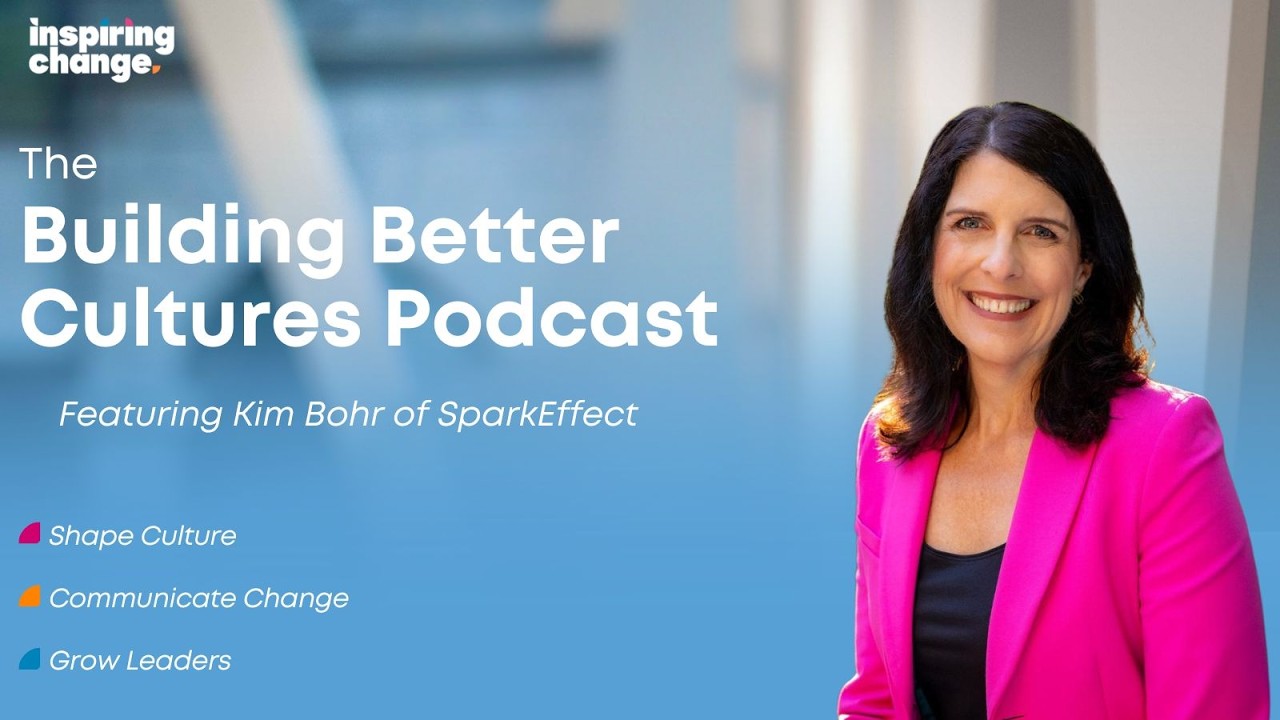
Kim Bohr, President of Spark Effect, presents their 2025 State of Organizational Trust report showing high-trust organizations retain 93% of employees versus 52% at low-trust firms. Trust breaks down into five domains: strategic clarity, psychological safety, relational community, technology systems, and fairness. Line managers matter most as translators who contextualize corporate messages and rebuild trust through transparent dialogue.
Chapters
At Inspiring Change, we help our clients build work cultures that bring out the best in their people. We created this podcast to share real stories and insights from those who are shaping better workplaces every day. So grab a cuppa and pop in your earbuds wherever you are. You're very welcome to the Building Better Cultures podcast. We're excited to have you with us. Hello there and welcome to this episode of the Building Better Cultures podcast with me, Scott McInnes. Lovely to have you. Thanks for being here and having a listen to today's episode. As I always say at the start of every episode, and I'm sorry if you're a regular listener for boring you, but please do pop along if you're on Apple Podcasts or you're on Stitcher or wherever you're listening. Please just pop along and give us a little review and a rating. It really, really helps. We do put an awful lot of effort into finding brilliant guests. And I know today's guest is going to be amazing as well at offering some really practical and helpful insights at helping you to build better cultures and better organizations. Organizations wherever you work. So that literally 30 seconds as you're listening would be really, really appreciated. So thank you very much. Kim Bore is my guest today, and she's the President and Chief Operating Officer of Spark Effect, based over in the US. A report came across my desk, and when I had a read of it, I went, oh, we should probably get them to come on the podcast. But it was released last year. It was called Trust in Turbulence: The 2025 State of Organizational Trust. And I think it was interesting because it actually starts to put some on the idea of trust, a performance index, if you like, they refer to it as. And they've actually kind of broken trust down into 5 domains. And I'm hoping I'm not stealing Kim's thunder. I'll introduce her in a second. But they start to look at it from the perspective of strategic clarity, psychological safety, relational community, technology and systems trust, and fairness and change impact. And I think that when you take something like trust that feels a bit big and amorphous and, oh my God, I don't know how I'm going to actually do anything with that, When you start to break it down into something which is real and practical and applicable, then it becomes easier. And I think you start to see places where you can start to build trust in organizations. And for me, as somebody that comes from an organization that works in the organizational culture space, trust is such a critical foundation stone of any culture. So, Kim, hello, welcome to the pod.
Thank you, Scott. I'm excited to be here and really talk about this state of organizational trust that we're all navigating.
Great! And hopefully, I didn't steal too much of your thunder. One of the things that you said in the report, and I think it's on the website as well, is that trust isn't a soft metric; it's a structural competitive advantage. Now, that's a big statement.
It is.
Talk me through, talk me through that.
Yeah. So we, we really feel confident in that statement because of what we were able to glean and literally the research that came back, um, in this report, we found that trust is really measurable. And I think for many leaders and organizations, there's this understanding of like, yes, of course trust is important, and yet there are all these actions we take on a day-to-day basis that are eroding trust. And so we were curious, we were hearing a lot when we think about the AI disruption and all these other things that were going on, and we wanted to understand what was taking place inside organizations. And so what we found was that you can measure it. Not only can you measure it, but you can actually have a con— direct connection to the impact of revenue retention and reputation. And so for us, that was a really elevated look at trust in a way that hasn't really surfaced as much as we've seen before. And so we came to this conclusion that it's really should be a strategic priority into organizations, just like all the other KPIs we measure as leaders. This should become one of them.
Yeah. And it's, and it's interesting that that idea that trust, of course, it starts life, organizational trust, it starts life inside the organization. But I presume that some of that organizational performance outcome is as a result of that trust perhaps then blossoming outside the organization into the world of our customers, our clients.
Yeah, I mean, we see, you know, it's always about where's that strong foundation, right? And what happens between how we think about it from the organizational— what do we control and what do we kind of set forth— is absolutely really critical. What we also saw, and we intuitively know this, right, but we have hard data around it now, is that that trust between that manager, leader, wherever they are in the organization's pecking order, and their direct team is crucial. And we also saw that that's where the biggest breaking point of trust happens when disruption— we coined it disruption— occurs. And we coined it disruption because there's a whole category of what that looks like, right? A lot of organizations are preparing for these big things. They're trying to mitigate risk against big stuff that might happen. And the, the, the aspect that they're missing is that there is stuff happening on a day-to-day basis, whether that's small policy changes or stuff within teams happening that are absolutely eroding trust. So we think about it from that lens of there's multiple kind of layers of opportunity, if you will, in really bringing, building stronger trust for the culture of an organization.
And it's that idea for me that it's the, it's the, it's in those what we might perceive to be almost irrelevant micro moments. That's when trust gets broken. It's not just the great big stuff, the president or the CEO doing something that he or she shouldn't have done. That's bad, and that's going to obviously erode trust in a very big way. But it's in the everyday little interactions we have, particularly with our bosses, that make that difference.
Absolutely. So think about things like You know, for many people, there's elder care concerns, right? You've got what we've called a sandwich generation where we have still kids that are, are not fully adults yet and aging parents and being in that, that need to have to figure out how to care for both. And so that's just one on the personal disruption side, if you think about what happens there. So if an organization suddenly says, well, we need to have more people back in the office at a higher frequency, and it happens you know, in 2 weeks, that which has been announced in many organizations, that's a perfect example of disruption that the organization doesn't really care or doesn't seemingly be thinking about, well, how is that going to impact what you have to change in some of your other areas of your personal life? And so these little disruptions of a sick, you know, a sick child or some things like that, or even on the, on the organizational level, you know, where you do have a leader that suddenly changes out, or you do lose a team member explicitly, that there's suddenly all of us, they're just gone because somebody, you know, there's, there's been a change in the direction of the company. But yet that conversation about why hasn't taken place. And so all those little, as you just said, those micro moments are happening. And I think we're just, because we're moving through such a quick pace in business, we're just not, we're just kind of brushing over them.
And brushing over them to organizational and leadership detriment.
Absolutely. And we're seeing that this research couldn't have been more clear. And we're just seeing that even in just the sense of our own-to-own kind of day-to-day experiences, but the research really quantified it significantly.
Yeah. And just to go back to something that you talked about there, because I think it's a really, really hot topic at the moment, that whole idea of return to office. And The organizations, I think, have been poor at giving good reason for return to office. And even if the return to office reason they've given is more collaboration, better ideation, newer people coming into the organization, learning from people who are there, I fundamentally agree with all of that. I totally do. And I do think that people should be in the office a couple of days a week for exactly those reasons, as long as it's done in a really managed way. But I do think there's— I remember having a conversation with a senior exec from an organization here, and she said, what do you think about our change of of return to office last week. And I said, "I think it just says that you don't trust your people to do their jobs. They have to be sitting in front of you." And she kind of looked at me, and we went quiet for a few minutes. And that was OK. What do you see as being the knock-on impact of that return to office when not communicated well?
Yeah. Well, I think there's also about like, how do our different teams inside our organization need to get work done, right? Because I think one of the biggest complaints of that is, of course, people want socialization and collaboration. And I think, you know, most people would agree with that. Where I think it breaks down and you get a lot of distrust starting to emerge is when the— really what's happening is if I'm going to sit in meetings all day on Zoom because I have my team is distributed, how am I doing that any better except it's costing me more time to commute into the office? When I'm going to be doing the exact same thing? So you're not creating an environment for when I come in that it's actually that we're having in-person conversations or planning sessions or some of those things, right? And so I think that argument breaks down very quickly if it's not thought through to, well, what does this team need? And if we just make it more blanket, and I think that's one of the, a real indicator of big trust destroyer that we saw was, you know, perceived misalignment between those leadership decisions and what's really needed in the employee and team And so, just that disconnect is a— that's a perfect example that the research supported.
That lack of understanding of what is going on on the front line, how the front line is working, what the front line needs, and the best way for them to work together. There's a lack of understanding there. But I've made a decision based on what I know. Get on with it. Suck it up.
Or the financials, right? Well, hey, we've got the office space and we have it for another 5 years. We're going to use it. Okay. And it's the yes and part of it. It's the, then let's do this well so we bring everybody along. And let's understand, does that mean every team needs to be, you know, following the same suit? Or is it that, well, there are certain teams that really are going to be more productive for our business if they are kept in the way that they are today. And that's just something that I think it's that workforce planning that just doesn't carry through. It just becomes a quicker decision of like, well, we said we're going to do it. We gave everybody heads up. But we didn't actually then follow through with those really necessary pieces. As part of the change management to bring people along.
Yeah, or it wasn't followed through in a consistent way by leaders across the organization. So now people feel annoyed that some areas are doing it, some areas aren't.
Exactly. And that goes back to one of those other pieces that emerged from the, from the research that was a big destroyer was just the lack of transparency around uncertainty or the trade-offs. So like, why are we, if we're doing these things, Like people can get behind it with context, and especially if you give them space to ask questions about it and say, you know, they're just to— so that it makes sense, especially without the fear of any, you know, retaliation. And so that just being able to understand, well, help me connect the pieces, is something that I think organizations just don't want to— many organizations just don't want to put the time into. And yet there's a tremendous benefit of that building of trust if they do.
Yeah, of course, because they get to keep great talent and great talent doesn't walk out the door. I was going to say, let's move on, but actually, let's move back because I want to just come back to that conversation about when trust meets organizational performance. And from the report, or from what you've seen, what evidence is there to show that there's a really strong link between perhaps higher-trust organizations having higher performance?
Yeah. So that was, it was pretty compelling data that came back. So what we found is is when we did this research, we had, it was the survey of people who were people leaders and individual contributors. And one of the markers was looking at if they had had any of these disruptions as we described them, personal or professional, in the last 24 months. And we ended up with a group that did not identify with any of those disruptions. And so, what that told us, that gave us some interesting baseline to work with. So, what we found were things like, Those who identified that they felt that they were in a very high-trust organization saw the— felt that the confidence in the financial performance of their organization was significantly higher than those that didn't. So, for example, high-trust respondents were 97% to those that were considered in a low-trust environment, that was 46%. When you think about the fact of industry reputation, we saw things like 97% felt that their organization had very strong industry reputation because of the high trust. Environment they were in versus 49% of low trust. And so, we saw more stats that kept coming out like that, which really showed us that through the way we were looking at this survey, you actually can measure it, which is why we came to this really bold statement that it should— trust should be another KPI indicator that hits your dashboard, just like all the other indicators that we're measuring on a quarterly basis.
Yeah. And of course, as I said at the top, for me, working in the world of organizational culture, trust is the bottom. You go to Lencioni from a leadership perspective, it's the bottom of the pyramid. For me, it's the same in culture. There has to be trust to have a strong and aligned culture. There has to be trust there. And I wonder from your perspective, and maybe it's come up in your work or maybe it came up through the report, what impact does low trust have on organizational culture? And particularly I'm thinking about psychological safety, which was one of the themes that came out in your report?
Yeah, so we saw things like, you know, just so, yes, from the report and just from, you know, even some CHROs I was speaking to a couple of months ago, you know, those that were in low-trust organizations, people are just really waiting it out. You know, when they are seeing the turnover of the leadership team, they're seeing that we keep changing direction, they're just kind of waiting it out, or they're just starting to leave. And we did see that retention factor of low-trust organizations, for those that had the lower trust in their organizations, the retention factor was something around like 52% versus 93% of high-trust organizations. So what we're seeing is people like, the productivity goes down, the toxicity goes up, and you start to have people that are just really starting to figure out, well, what's my next thing, right? So that, that whole idea of disconnecting happens very quickly. And we know that lower-trust organizations are going to have a much more difficult time to get into that mid- and high-trust place. It's not impossible, but it's going to take a commitment at the executive level to say, we've got a problem and we need to start solving for it differently than we have.
Yeah. And you're not going to have those people that are leaving then, those people that are just on the, on, you know, on the way out the back door, they're not going to be leaving the organization as advocates. And therefore, you've got to assume, and maybe that came out in the research, that people aren't— organizations with low trust aren't then able perhaps to attract the very best talent or great people.
Absolutely. So word starts to get out, and so it does start to spread, and people do start to realize that's not an organization that you're going to go to, right? Or you may get some— you may get high pay because they're having to pay people higher to attract them, but it's— you're— it's going to be a short-term turn, right? So people are going to be leaving and moving on and realizing that it's just not worth, worth it. And I think, you know, people want to be inspired, and they want to be guided and led into, you know, something that's what's possible. And so when you have that organization that is just not able to stay the course, and there's so many great shiny objects that they try to chase, or there's just a lot of things that just get ignored, it's going to become a disconnect really quickly. And I think even more so for this younger generation that's entering into the workforce, because they have a very different set of values and boundaries. And I think they're very committed. I don't, I don't subscribe to the idea that they're lazy at all. But I think they're really much more clear than other generations at least in the U.S. business culture, that they are very much like, this, why am I going to waste my time? Like, what are you doing for me if you're, you know, if I'm only going to see people not being taken care of, turnover happening, an organization that says they have this sort of direction and mission, but they don't, you're not actually doing anything to fulfill it, right? Those are disconnects I think we're going to see that younger generation just not tolerating.
Yeah, they're much more, and again, look, we're casting aspersions here. But Scott, they are much more purposeful, I think, a workforce. They are much more values-led, a workforce. They are much more values-aligned, a workforce. And they want to know that as an organization, your values align with my values. And if they don't, good luck. I'm out of here. And that's tough.
And I think that it is tough. And I think that's where this idea of trust as a measurable KPI is really important because they're not going to tolerate that stuff that many generations before them tolerated. And that's going to be a really tough situation for organizations to retain top talent, especially talent that is very savvy in the technology that we all need to be dealing with and organizations need to be adopting. And one of the things that we saw even in our research on technology was that that's the biggest disruptor is how organizations handle technology. Rollouts. And so you think about these, this generation who's entering into the workforce, who's very tech-savvy, who can really carry forward the, you know, those needs of an organization. I think it's almost, you know, organizations almost doing themselves double damage when they aren't understanding the value of that generation and these things that are going to build trust more quickly.
This episode is brought to you by Inspiring Change. We work with senior teams to help them be clear and intentional about the culture they need to be successful, to communicate change in a more human way, and to give their leaders the skills, tools, and confidence to be amazing catalysts for change. To learn more about our work and who we do it for, just pop along to inspiringchange.ie. I think that the technology thing is really interesting because obviously now with the advent of AI, there's a lot of stuff being, you know, from a tech perspective, a lot of stuff perhaps being made up, a lot of stuff that perhaps isn't quite true or quite right. We've got to have, you know, we've got to have enough about us to be curious to go, "I wonder, is that true or not?" From the macro environmental level, when we look at what's going on in the world at the moment, which is crazy, there was so much change happening from, without getting political, the presidency in the US, with what's going on in Russia, with what's going on in Ukraine. There seems to be so much fake news out there that I think that's impacting people's trust as well, certainly in the media. And I wonder how much of that are you seeing ripple into the workplace? How much of an impact is that having?
Well, I think it's huge impact. You know, there's so many studies around just trust in institutions is at an all-time low. And so that was part of our curiosity of, well, how is that translating into organizations? And I think you're absolutely right. I think that's why it's even much more critical for organizations to leverage some of these, you know, the, some of the real tactical things that came through in this report around how do you build trust and the consistency around it. Because people want to believe in something, right? And we want to believe in that it's true and that it's going to serve us well. And I think that the more organizations are able to really be consistent with some of these trust builders and these day-to-day types of things they can do from within a team, that's going to help combat the fakeness that's out there and maybe expose that even more because people can see what real trust and truth look looks like.
Yeah, so if people are— this, if we— and I agree with you, I think people are coming to work with effectively a trust deficit already. Because I mean, I've even said to my kids, you know, when you watch the news, when you watch any news channel, it doesn't need to be CNN, it could be the BBC or French or German news, there's always going to be an angle. There's always going to be a very slight angle and a very slight bias. So how do you know what to believe? So if we think that people are coming to work with that trust deficit. What are— and you touched upon it there, Kim— what are some of the practical things that organizations and leaders are doing? I think it's really easy and a little throwaway to say, well, look, we just act with integrity and we do the things that we say we're going to do, then that's going to drive trust. There are a million things that organizations need to be doing. Talk me through what some of the big ones are.
Absolutely. So, Let's talk about it on kind of 3 different examples. So one is that you mentioned those 5 domains. So behind those 5 domains are specific statements that— so that's the, that's the foundation of actually creating a measurable way of looking at trust. And so using those domains, the statements that lie beneath them, and doing that on a biannual basis, you know, twice a year is one. And then we would argue quarterly from some of the way to look at it from a dashboard perspective. Being able to measure that and bringing those in is just alongside the other KPI. So that is something that's really tangible; it's doable. The other thing is, you know, thinking about it, you know, even from an organizational or a team level, what we call this 5 C's framework. So when we think about that, it's 5 C's of trust. And it's really looking about, well, what's the context? So what is changing and why it matters? So let's think about how, you know, that and what we're going to message. What's the commitment we're making? So what do we, what will we protect when other things are changing? Let's get really clear there. You know, what is going to change? So what do we know that we in fact needs to evolve in some fashion? What's the care we're going to put behind it? How are we going to support people in this change? Whether that's because we're having to let go of people or we're just going to have to reorg how we're doing this business. How are we going to support them? And then what's the call to action? So what can we do to help make this successful, but to also help bring people along and help them feel that they are understanding? We're connecting the dots, all of those things. So that's one that I think is really valuable at, you know, at a higher-level organization. But then there's some that would, I think, are really practical for an individual manager. One of the things that we saw inside this research, and I think we all can say we've experienced it, is that corporate speak, right? So something passes down and your leader just kind of parrots it. And that's a real, real trust destroyer. And so thinking about, things every, you know, some of the everyday practices is translate the big picture. So that might be what you have to translate, but how does that impact our team, whether we're a team of developers or we're a team of, you know, business development people? Like, what is, how does that look for us specifically? Really thinking about, you know, the, you know, being fair and transparent. So explain why we're assigning work to certain people, why we're giving certain recognition, how we're handling promotion and exits. You know, there's There's other work I've done around the disparity between working parents and what does that look like for while some work gets distributed to people that maybe feels like they don't have children while somebody else is leaving at 5 AM and I'm— or 5 PM and I'm stuck here at 7, right? So the perceived, the perception there needs to be addressed. Modeling openness, acknowledging what I don't know, and asking for input and trying to just look at bringing us all along and solving for whatever this is that we're facing. And the last two I would, you know, suggest that I think are really valuable is, you know, showing up consistently, even if that's where we're, you know, we, we have the challenge. We don't know everything, but we're consistent. We own our mistakes. We're really trying to be very steady under pressure. And then the last one is really investing in the connection. So like we were talking about earlier, If people's lives change, if somebody is suddenly coming to work 10 minutes later than they often do, trying to understand what has changed in their life. Something may have shifted with their school. Maybe the school's drop-off changed, and yet they're the only one that can get them, their child, to drop-off. And so how does you trying to understand what's going on versus just, just, you know, just assuming, you know, there's something negative happening and really celebrating the milestones. I was working with an organization that was an executive team that was just exhausted. And we had released this Trust Report. They had many projects, big projects, huge funding happening at the same time. And they were like, it's on to the next thing. And they never celebrated. They didn't create those moments. Even when things are running in parallel, they failed to create the moments to celebrate and invest in the time with each other. So, That was something that was just tremendously eye-opening for them when they started to realize that it was also something that didn't cost anything to actually change the way they were thinking about how they were interacting and the work they were doing.
Yeah, and there are a couple of things there that really resonated with me. That role of manager as translator, I think, is absolutely critical. And I think as well, because those managers who've got maybe 10 or 12 or 15 people, they know them really well. They understand the context better than anybody else. So, better than the divisional head or better than the department head and much better than the CEO, because she or he wouldn't know each individual person. Whereas you as their line manager or me as their line manager, we know them back to front. So, we know exactly how and when to land a message in the way that both our teams can relate to but also lands with them. And that talks to your connection piece because we're connected to those people. And that to me is really, really, really important. And I think you're right. I think that the pace of work these days, we are moving so fast and the world is changing so fast that we never have time to stop and look back over our shoulder. And I often use the metaphor, I was out hill walking with my son. He was about 8. We were climbing the highest mountain in Wales. I wrote a blog post about it. It's on the website if you want to go and have a look. But I said I said to him, you know where the really good stuff is? Right over your shoulder. Because we can see where you've come from. You can see the view. It's beautiful. It's blue skies and sunny. You can see where you've come. You can see what we've achieved. You can see what we've overcome. But you can still see where we've got to get to. But we're still turning to look behind us to see what it is we've done already. What have we achieved? And that's really powerful. And I don't think organizations and leaders spend enough time doing that.
I, yeah, I completely agree. And we're getting to a breaking point inside our, our businesses, right? To literally where people just, we need the, the ability to reflect and to celebrate and to, you know, acknowledge what's working and what's not working. You know, one of the things we also suggest is at a team level, we could talk about just to build our trust, we could say, hey, How have we supported each other this week? What did we do that maybe wasn't aligned in this area of trust that we've committed to? And just being open and vulnerable as a group of like, because it's, it's a stronger indicator of we have each other's back if we can have that type of communication. And that's something that I think is also because we move so quickly, we're just not thinking about, or we're assuming, and it's not. Consistent inside how each of our members of this team are maybe feeling about one another.
Yeah, let's be more intentional about recognition.
Yeah, let's—
let's be more intentional about what we've achieved. And let's actually put into the beginning, as you said, of every one of our team meetings on a Friday, once a month, let's have a, what shit have we got done this month? What are we proud of?
Yeah. And what did we feel like, you know what, Did we show up for each other? And if not, let's talk about that too. Like, where do we feel like we, we missed it? You know, one of the, the surprising statistics that we found was that the trust in the organ— at the organizational level pretty much stays the same. The trust in the leader drops dramatically when it's not handled well. And so it is really important for leaders to understand and for organizations to understand that their biggest risk point is with these individual managers, regardless of what level you are in the organization leading people. The other thing that really stood out in this that I think was incredibly compelling was that we also saw that organizations that had some significant disruption and did the, the moves to try to, to address it— so had the open dialogue, allowed for people to ask questions, said, "This is what we know," and all that stuff that we identify. They had a 12% gain above the baseline of those people that said they had no disruption at all. So, what that told us was that instead of being concerned and mitigating risk, disruption is going to happen. And yes, there's certain things we absolutely are mitigating, but what we also need to be doing simultaneously is investing in these managers at the different levels of our organization so that they're equipped to be building this trust on a regular basis so that they can and ride it through. And that then people will see that we're trying to, that the something we're trying to do with good intention is actually creating what we ended up coining a trust dividend.
And you know, they're often referred to as the squeezed middle, that they're getting it from beneath, that they're getting it from on top. They're in the middle, trying to do a job as well as do the leadership job. And it's really tough. And often, they're not particularly well invested in either from a skills development perspective, from a support perspective, a confidence or coaching perspective. So maybe that's one takeaway for people listening is think about when it comes to trust, what do you need to do in order to give your people leaders the very, very best chance of being able to build up that trust in the organization? Because as you said, it's those relationships and those trusted relationships with each of those managers what you might say trust with a small t, all of those all added up and then multiplied by the organization. That's what builds organizational trust. For me, organizational trust isn't a thing. People that work in organizations don't necessarily trust the organization. To your point, they trust the people they work for. So, the more tools and support we can give them, the more chance we've got of building a high-trust organization. We're nearly out of time, but let me ask you one final question. Not to bring everything down, I promise, but organizations do end up in situations where they do lose trust and the employees lose trust in an organization or in the leaders within the organization more so. The CEO does something, the COO does something, and trust is broken. How do those organizations go about rebuilding that trust?
I think the number one thing we see is that they have to admit where they misstepped, that they have to admit that we broke your trust and we are now going to do everything we can to re-earn it. And then the work starts, right? And that does work around the consistency, around what does it look like when we're communicating? How do we allow for people to ask the questions? Because they're going to be asking even more questions than they would have been because they're, they're on high alert and without that fear of retribution or retaliation. And so finding the ability to to take those steps. And in our guide, or in our trust research that we did, we really do break down the, the specifics around those interventions, if you will, that were really associated with high-trust organizations. And so bringing those in and just saying, hey, as an organization, we agree, and as an executive leadership team, we agree that this is important, and important enough that it's impacting negatively the other aspects of those KPIs, if you will, that we want to measure. And we need to now take it seriously and see that this is something we have to be measuring also. And then it's about that consistency and admitting when we've made the mistakes and that we're going to do better.
Brilliant, brilliant. If you want to find the report and find actually a really, really nice and helpful leader's guide, manager's guide that goes along with the report, just pop along to sparkeffect.com. And we'll stick that link in the show notes down below as well. For now, Kim, it's been an absolute joy having you on board. Thanks so much. I've really enjoyed the conversation.
Thanks, Scott. It's been wonderful.
Thanks for listening. If you haven't already done so, please take 30 seconds to give us a quick rating and a review wherever you're listening. It really does help. And to hear from other leaders in our podcasts, to read our blogs, or to find out more about the work that we do, please visit inspiringchange.ie.
More from Scott

Leaders can't assume connection happens automatically #LeadershipLessons #EmployeeExperience

The hidden reason your remote team feels disconnected #TeamConnection #HybridWork

This is why people actually stay at their jobs #workplace #culture #retention

156 | Inside Disconnection at Work: Bridging the Connection Gap Report with Sadhbh O'Flaherty




155 | The Overlooked Art of Building Connection at Work | Scott McInnes with Christine Armstrong


