154 | Why Leaders Still Struggle to Foster Psychological Safety | Minette Norman & Karolin Helbig
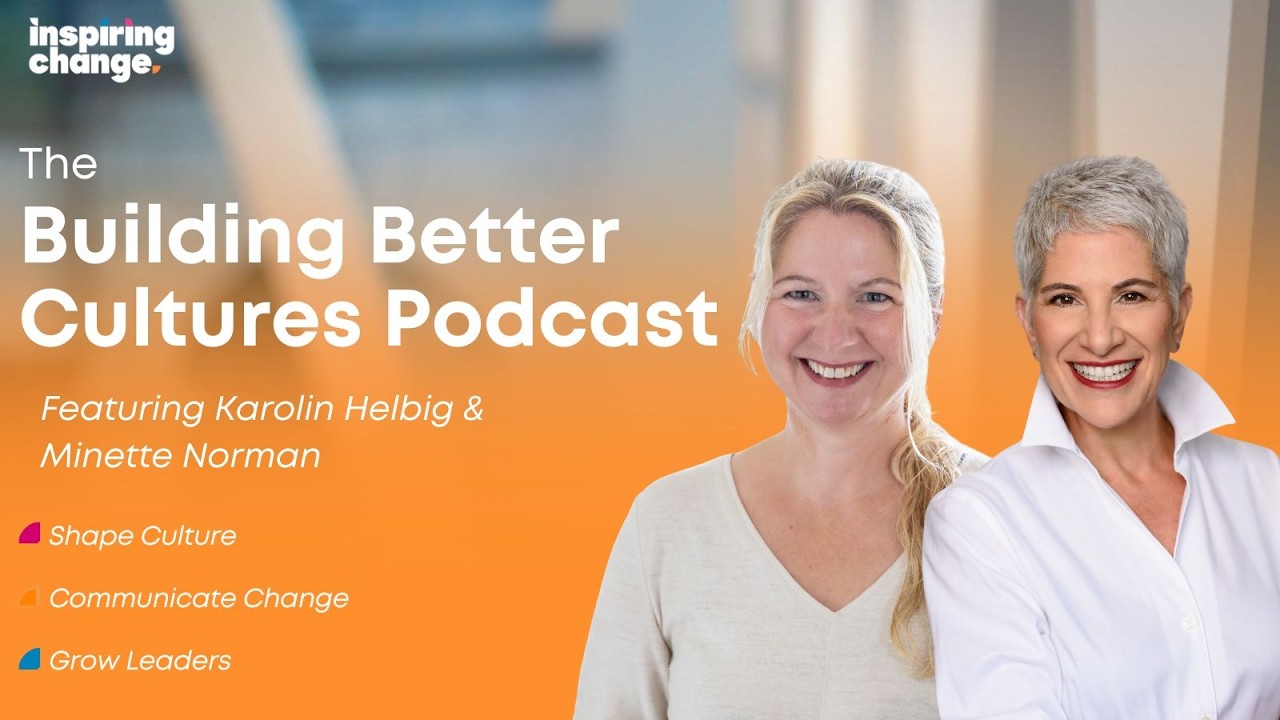
In this episode of the Building Better Cultures podcast, host Scott McInnes interviews Minette Norman and Karolin (Carolyn) Helbig, co‑authors of The Psychological Safety Playbook for Changemakers. The conversation opens with a clear, visceral definition of psychological safety as a group belief that one can ask questions, admit mistakes, and disagree without fear of embarrassment, marginalisation, or punishment. The hosts explore why psychological safety remains rare despite its proven link to performance and innovation. Key barriers identified include misconceptions that safety is “soft” or hampers hard work, the brain’s built‑in risk‑aversion, constant busyness, and leaders’ default reactions (fight‑flight‑freeze). The guests present their five‑play framework for building safety: (1) Courageous Communication – leaders openly admit what they don’t know and invite diverse perspectives; (2) Mastering Listening – listening with the intent to understand, not to respond; (3) Managing Reactions – recognizing physiological cues of defensiveness and choosing a calm, curious response; (4) Embracing Intelligent Failure – treating failures as learning experiments rather than blame‑games; (5) Designing Inclusive Rituals – deliberately structuring meetings so all voices are heard, using tools like written contributions or “yes‑and” language. Throughout, they stress the importance of self‑awareness as the foundation for all practices, suggest micro‑habits and experimentation as low‑effort entry points, and provide concrete advice for leaders (e.g., ask “What am I missing?” in meetings). The episode ends with practical take‑aways: ask missing‑voice questions in the next meeting and replace “yes, but” with “yes, and.”
Chapters
The misconception of psychological safety is also one of the reasons that it has not become the norm because people don't understand it.
Psychological safety is good for performance. It's good for the bottom line. However, in the daily life, especially under pressure when stakes are high and so on, it's not easy to actually, actually do it.
At Inspiring Change, we help our clients build work cultures that bring out the best. In their people. We created this podcast to share real stories and insights from those who are shaping better workplaces every day. So grab a cuppa and pop in your earbuds wherever you are. You're very welcome to the Building Better Cultures podcast. Hello there and welcome to this episode of the Building Better Cultures podcast with me, Scott McInnes. It is lovely to have you. As I always say, if you're a first-time visitor, thanks for coming. And if you're a repeat visitor, Thanks for coming back. I'm hoping that you'll get a lot from these episodes, and I know you're going to get a lot from today's episode. I'm really looking forward to getting to our guests. Before we get to them, my usual little ask, please, please, please. I've got a bet with the team that we can double our number of reviews in the various podcast engines or libraries that you're listening on over the next 6 months. So please, if you could just take 2 minutes just to give us a little rating and a little comment on how much you like the podcast or what you'd like to see more of. It really helps the reach. And also, whatever podcast listener you're listening on, just hit follow because that means that you're going to get the most recent episodes straight into your player. So, a couple of little things you can do for us because hopefully what we're bringing to you is really, really good value. And I know that today's episode is going to be exactly that. So, I'm delighted to be joined today by Carolyn Helbig and Minette Norman, who've written most beautiful book. And it arrived in the mail the other day. And I was just saying to them beforehand, it was a joy. It was like an unboxing, taking the book and the various bits of paraphernalia out of the envelope. It's just a beautiful book, The Psychological Safety Playbook for Changemakers. It's their second book. And I'm really excited to delve into a bit of detail around this book and just find out what what makes you guys tick and what you thought was important enough to include in here. So, hello, Manette, how are you?
Doing well. Thanks for having us, Scott.
Great. And Carolyn, lovely to have you too.
Yeah, thank you for inviting us. Happy to be here.
Yeah, it's great. And look, what I want to do first of all is I'd love to just delve a little bit into psychological safety because it's something that people like us throw around all the time, particularly obviously when we're talking about leaders in organizations and We say to them, well, it's important that you create psychologically safe workplaces and that you're a psychologically safe leader and all of this. But actually, I'm not entirely convinced that people know exactly what it actually means. So, Minette, give me the textbook definition or what you believe to be the definition of psychological safety to kick us off.
Sure. And you're right, there are a lot of misunderstandings about what psychological safety is and is not. So, the way we think about it is this, that psychological safety is a belief and a feeling in a group. And in that group with psychological safety, you know that you can ask a question, you can ask for help, you can disagree with someone else in the group, you can make a mistake, and you know that you will not be embarrassed, marginalized, or punished for doing any of those things. So that's like just the textbook definition. I wanna just briefly get into the feeling of it because I think that's also very important because we do feel it viscerally when we have psychological safety and when we don't. So when we have it, We feel energized, we feel creative because we know that our ideas are welcome. We know that we don't have to mask who we are. We don't have to pretend to be someone we're not, and we're free to do our best work, honestly. So there's this sort of energizing, free feeling about psychological safety. And when we don't have it, I kind of feel my body constricting when I think about it because we are very guarded. We are worried about every word we say. We even think, should I speak? Should I not speak? We often conform to the behavior and the way everyone else behaves in the group because we don't want to stand out as different. And so that can be very damaging to people because when we don't have psychological safety, we're so worried about every word we say or don't say that we can't be creative and we can't do our best work and we suffer. So that's just the, the brief definition and feeling of with it and without it.
Yeah, I love it. And that idea that, you know, and it's something that, again, we throw around all the time, that if we're not failing, we're not trying hard enough, or if we're not failing, we're not moving forwards. Obviously, there has to be psychological safety in a team and in an organization to allow for failure. Carolyn, is that fair?
Yeah, absolutely. And as I was listening to Minette, I'm a biologist by training. So it's, for me, very clear that to us human beings, it's It's so important that we have this feeling we belong and there's no danger that we are kind of excluded from the group because being excluded from the group in former times over millions of years meant sure death. So we have a strong need to feel safe, to feel we belong to a group. And yes, to your question, it's absolutely vital that we can try new things and maybe they don't don't go right from the beginning. And we need to feel safe that we can experience failures and still be included in the group, that we can shift boldly all towards learning mindset. And if failures happen, we all ask, okay, what can we learn from it instead of going into blaming and finger-pointing and And that would mean I feel ashamed, and maybe I think twice before sharing a failure. Dealing with failure is an important element.
Yeah. And that idea that, you know, I don't want to fail because I don't want to be ostracized from a group. And I get it because, you know, as you say, for millions of years, we don't want to be the one on the outside of the group because we're the ones then that get eaten by the saber-toothed tiger. And, you know, these days, that saber-toothed tiger might look like in our heads, not getting the promotion, not getting the recognition, not getting the bonus, being seen as a troublemaker. All of those things, which actually are kind of very counter to bringing ideas to the fore, very counter to failure, which means, back to my point earlier, we're maybe just not trying hard enough.
Yeah. Yeah. I mean, one of the things that you just said is that being labeled a troublemaker or I'm not going to get that promotion. There is this risk calculation that we're always doing in the workplace. And I remember it when I was in the corporate world, sitting around the table at a staff meeting. And it's a bunch of senior executives sitting around and you don't want to get the disfavor of the most senior leader. And so what I've noticed is people are looking to the leader's reactions and wanting to please them instead of like, you know what, I see things really differently. I think either there's a huge risk here or there's a possible idea we're not exploring. But if there's not an openness to that, we hold back and we honestly, not only do we miss big risks, but we miss innovation because that wild idea is not not going to be welcome at that table.
Yeah.
And actually, I think what we do is, don't we find ourselves wondering, why is he or she not saying that thing that we spoke about earlier on? That really important thing? Why are they not now saying that in the meeting? And without that psychological safety, we don't put our hands up and say, sorry, boss, that thing we were chatting about earlier on, why are you not bringing that up? Because in our heads, we're going, there must be another reason why it's not being brought up. Yeah, it's insane. I wonder, when you actually think about psychological safety, it seems like the most normal, straightforward, easiest thing in the world to do. Yet here we are, 3 consultants having a conversation about it again, another book being written about it.
Why?
What is it, do you think, Carolyn, that's getting in the way of of people feeling like they're in a psychologically safe environment, of leaders being able to create that environment? What, what's getting in the way? Why are we still talking about this?
Yeah. And, and maybe what we are mixing up is, yes, it's simple, but it's not easy. So everything we, we suggest in, in our playbooks, these small things we can do to foster psychological safety, they are not rocket science. Actually, they are kind of the koch, the opposite of Rocket Science. They are really easy to understand, but they are not easy as a practice. It's kind of a constant, deliberate daily practice to practice this because we get triggered and react harmfully. We maybe don't like the failures and we default to punishment and so on and so on. So it's not easy to cultivate it. And it's maybe intellectually easy to understand we are all social beings, we need it. Psychological safety is good for performance, it's good for the bottom line. However, in the daily life, especially under pressure when stakes are high and so on, it's not easy to actually do it. And Minette mentioned this risk assessment we are constantly doing. And because of that, our brain is wired to keep us safe and alive. It's very risk-averse. And what we need to do in order to create psychological safety often is kind of against our default wiring. And that makes it tricky and not so easy to do. And I think that's one of the reasons maybe why we are still talking about it, because it's not yet reality everywhere.
Cognitively, that has to be incredibly tiring. Being in that frame of mind all the time, Minette. Is that fair?
Oh, not once you get in the habit. It's honestly everything that we're talking about. You could even think about it as like micro habits. So honestly, over the years, I have gotten so much better at all the things that Caroline and I write about in our books, like how I listen, how I manage my own defensiveness and all of that. And now it is just a default behavior for me. It's not exhausting at all. It takes a commitment that I'm going to try to do something different. And it takes practice, but I don't find it exhausting. And in fact, I think it's kind of freeing when we get to the state of like, this is now a habit that I am truly going to listen when you ask me a question, because then I don't have to go through all of this mental energy that took up the cycles before. But I want to come back actually to what you asked about why it's also not more normalized and to add on to Carolyn's response to that. I think there is this misconception misconception also about psychological safety being something soft and fluffy and almost like, oh, if we have psychological safety, now we can't do the hard things and we can't have hard conversations. And I think the misconception of psychological safety is also one of the reasons that it has not become the norm, because people don't understand it and they think it's something soft and that we don't want that actually because we're a tough culture. And I think that's getting in the way. And I also think people think of it as off to the side of the real work. The real work is making products and whatever our work is. And then later we'll deal with this culture stuff. And I think that is the primary misconception I would like to challenge, which is that the way we get the good work done, the innovation, the high performance, the team engagement is by investing in psychological safety, not for itself, but for what it enables because it does enable performance and innovation and employee motivation and engagement. So, I do find it exhausting to do these practices. And the other thing about our books, we offer a whole bunch of different ideas, but even taking one of them and experimenting with them will make a difference. So you don't have to do everything. And we're very explicit about that. You don't have to change every single thing you do, but small shifts can have a huge positive ripple effect. And you might be surprised.
I love the idea of microhabits and I love the idea of experimentation and I love the idea of just trying something new in a meeting. And just watching and seeing what happens. And I think what's really interesting is that I spent a lot of time in leadership development sessions. And actually, the one thing that we always come back to, we keep coming back to all the time, is this idea of self-awareness, of just being aware of what I've done, of what I'm doing, of how I'm doing it, of the feelings of people in the room, and knowing that there's a different way potentially to do the thing that I've just done. And I wonder, Carolyn, from your perspective, where does, where does self-awareness sit when it comes to thinking about change and psychological safety?
Yeah, self-awareness is absolutely fundamental. I would say it's really the, the— without self-awareness, we do— no one of us would be able to do any of these shifts because we wouldn't be aware of what is it that I'm actually doing. And the automatism, the default is we are not doing what's favorable for psychological safety. So meetings by default are not inclusive. There are a few people doing all the talking and all the quiet voices we don't hear, for example, that's the default. The default is we are not listening. And the default is we are not speaking up courageously like in your example, "Hey boss, you mentioned something else the other day." So shifting from default to doing something intentionally differently, that needs self-awareness. So that's why absolutely self-awareness is the absolute fundamental skill we all need to increase. But the good news is also self-awareness is something we can train. Like Minette explained with the small shift, over time, it's like a muscle we can train.
Yeah, it's interesting. We've been doing a bit of research at the moment in Inspiring Change about disconnection. And one of the big themes that came out from the responses that we got back was that busyness, being busy, is getting in the way of lots of this. It was getting in the way of me as a leader thinking about microhabits and changing and psychological safety. And back to your point earlier on, Minette, about about this idea of psychological safety or other leadership traits not being on the side of the job. They are the job. That is your job. The trouble is that the work gets in the way of doing the job, and that seems to be getting worse and worse. We seem to be getting busier and busier. And even when I said to one of the respondents in our survey, they said, oh, we're using AI a lot more. And I said, well, surely that must be freeing you up to spend more time with people? And they said, no, it's freeing me up to find more time to do more work. So there's just an innate busyness and it feels like this flywheel that everything's just getting faster and faster and faster and more and more and more. How do we fit all this in, in that context of work, Manette?
You know, of course, that's one of the pushbacks we get. It's like, there's no time for this. We are too busy. There's too much work. And we would kind of offer a challenging question back to that is like, what's the risk of you not doing this? Like, just because, because really, if you want to do great work, you do need to invest in having a culture that is going to enable that great work. And this constant treadmill of busyness and more busyness and more AI. And so then we have more work, not less work. It's killing us. People are really burned out, whether it's the most senior leaders or the individual workers. People are very much afraid of losing their job. We just saw more layoffs this week in the Bay Area and Meta with a huge layoff. And so everyone's under this fear. They're under pressure. There's too much work. And I think leaders particularly need to manage this, that we as leaders have got to do something so that our teams are not burning out. And what's in our power? We may or may not be able to influence the C-suite's decisions about what we're doing.. But what we can do is we can help change the experience for the people who work with us and for us. And so it's having these honest discussions about how are you all doing, not in an open way, but what are you not getting to? What do you need help with? Is there someone else here who can help? Being able to have these really open, honest conversations about what we're struggling with and not in a punitive way, but maybe there's someone else who can pick up this work, or maybe I as the leader need to deprioritize this work. So I think there's huge responsibility that leaders often don't take up, which is that they can have a positive influence on their team, but they have to get out from their own busyness, busyness, busyness, and focus on what's important. And what's important? It's the human beings doing this work. And how are we going to create an environment where they can do their best work? Well, we need to look at these things differently. Yeah.
Organizationally, of course, that comes from the top of the organization. Because if there's more work coming down that waterfall, then that hierarchy, then we're going to just keep doing more work. So, it's actually somebody further up the hierarchy that has to say, okay, pause, we need to actually get some, we need to get our people bit sorted because we know that if we have high-performing people, we have a high-performing organization. But still, we are accountable to stakeholders and shareholders and externals and all that kind of stuff. And they just want to see more money. So how do we square that circle, Carolyn?
Yeah, maybe this accelerating busyness is already a sign for lack of self-awareness because we need self-awareness to say, okay, hold on, what are we actually doing? We are burning out our people. We are not taking care of the people side of our organization in order to be sustainably productive in the future. And I think What is your question? I see this among many of my clients here in Germany too. In a way, we are lacking self-awareness, which would enable us to introduce a little bit more pause and reset and, and yeah, change for better cultures.
This episode is brought to you by Inspiring Change. We work with senior teams to help them be clear and intentional about the culture they they need to be successful, to communicate change in a more human way, and to give their leaders the skills, tools, and confidence to be amazing catalysts for change. To learn more about our work and who we do it for, just pop along to inspiringchange.ie. I want to get into the book a little bit because there were 5, what you've termed plays in this playbook of yours, 5 ways that leaders can lead culture change from the perspective of psychological safety. And I love the smattering of quotes that you've got through the book. I really like those. And the first one that I wanted to pick up on is this: "Not everything that is faced can be changed, but nothing can be changed until it is faced." And I love that idea. And it sits very much for me alongside that Peter Senge line from a few years ago, "People don't resist change, they just resist being changed." So, if we can bring people on a change journey, that is way more powerful than simply beating them down the path of and hoping that they'll get there. One of the first plays that you came up with in the book is the idea of communicating courageously, where we're asking leaders to be authentic and vulnerable and recognizing everything that's going on in the workplace. Talk to me about that and why you felt that was so important. Maybe, Minette, we'll kick off with you.
Sure.
Yeah, we start the plays. The 5 plays, by the way, are the foundation of both of our playbooks, the first playbook and now this new one, because we feel that they are They are the sort of the building blocks of how we create psychological safety. And why we started, although the book can be read in any order, we did deliberately pick courageous communication as the starting point. And it's often considered sort of the opposite of what people traditionally think of as courageous communication, the way we think of it. Because I think many leaders would say courageous communication is being certain and being bold and having all the answers. And to us, courageous communication is I'm a leader and yes, I have my expertise and there are things I don't see. And so what's courageous? Asking, what am I missing? Inviting other perspectives. That is courageous. And very few leaders do it well, honestly, because they think that they have to project this mask of perfection and professionalism. And the courageous thing in our perspective is being open to other perspectives. Perspectives. And that is, to us, that is the fundamental starting point for building a psychologically safe culture where all ideas will be welcome.
Yeah. And if you think about that, and I love the idea of not being the person, and I agree, that doesn't have all the answers. A leader's job is to not have all the answers. A leader's job is to ask great questions and bring the team along with them and clear roadblocks out of the way to make them, allow them to be amazing, the team. But I do wonder, is there a tipping point at which a leader does have to have the answers? Because if a leader in response to every question goes, I don't know, what do you think? I'm not sure, what do you think? I'm not sure, what do you think? At what point does the team just lose faith in that person as a leader, Carolyn?
Yeah, and of course, it's always a balancing act. And as Minette said, as a leader, you do, you must have and you do have your expertise and you have your viewpoints and your perspectives and so on and so on. And You can be very bold about your perspectives and at the same time be open and knowing I don't see everything. I have my blind spots. I depend on the team to illuminate my blind spots. And combining kind of the strong viewpoint and the strong expertise with the openness and vulnerability to not know it all, to invite other people to share their divergent viewpoints. That's what we are talking about. And where exactly the balance you find, that's up to personal style, of course, and context and so on. And I know that there are also strong leaders who are very much on the side of vulnerability. And for example, Ellen Fisher, Eileen Fisher, her leadership style is leading by not knowing. So she's deliberately often saying, I don't know yet, let's explore together. But of course, you need to find your own balance.
Goes back to that piece around authenticity, doesn't it? If you're the person that everyone thinks is the big, the big gun, who's always got the answers, and then you suddenly start going, I don't know, what do you think? I don't know, what do you think? Then there's an inauthenticity there that people can spot a mile off.
Yeah, and I think one thing to be really explicit about is that when asking for input and asking for other ideas, we are not advocating that you as the leader give up your decision-making authority because ultimately, as a leader, you do need to make those hard decisions. And what we are instead suggesting is don't make those in a vacuum or don't make them only with your little inner circle. Make them in an informed way by bringing in as much data as you can. That means divergent perspectives. But ultimately, you have to make the decision. I think what's important for people to feel heard is that when you come back and say, I've made this decision, I got a lot of input, is to explain your thinking, right? Like show your math in a way so that people understand what went into this decision. And then they feel like their voices were heard. And that's a really important point because if they don't feel like it mattered, they will stop speaking up. Yeah.
And it comes back to that point then of people feeling like they're being changed as opposed to going on a change journey. Yeah, yeah, definitely. So you talked there about leaders going out and listening, which is the second of your plays, Mastering the Art of Listening. And of course, everybody says, sure, of course I can listen. I've got two ears and I'm a human being. And I'm, you know, I'm— people don't listen. In my experience, people do not listen. And actually, my wife will probably say exactly the same about me, I suspect. And my children. I really don't listen to my children because they just make loads of noise. But my wife will give out to me all the time for not listening because we really, really don't actively listen, do we?
Yeah, I fully agree, particularly leaders. And I think we could change so much if the time we are not talking and someone else is talking, we would really be listening and shifting our attitude towards listening in order, with the intent to understand rather than to come up with your own brilliant response. So maybe sometimes we are distracted and so on, so on. There are millions of reasons why we are not listening. But I think one particularly prominent reason, particularly for leaders, is that we have our own viewpoint and we already have the little voice going on in our head why the viewpoint of the other person is wrong. Or maybe I already know where they are going, for example. I have this and this perspective. Protective against it. It's not true. My story is the right one. And letting go of this kind of inner voice and inner story going on and instead shifting towards real openness and real understanding, real curiosity. I'm interested in understanding how the world looks like from your perspective, from your shoes, and putting myself into your shoes. That would would actually save a lot of time because increasing the quality of listening would save us from a lot of extra iterations we have because we don't understand each other. Yeah.
And we end up going back over the same stuff over and over again and we'd never actually move on. We just, we just stay in that, in that space of going around and around in a circle.
Yeah. And people keep telling the same because they don't feel heard. I get that you are distracted and that my point is not really landing. So I keep repeating myself. You keep not listening and that's going on and on and we are wasting a lot of time.
Or worse, perhaps I keep saying the things I can see you're not listening, or I do something worse and I just stop and I stop saying the thing and I stop making suggestions and I stop giving ideas and I stop bringing things to the fore. Because I can see there's no point because Jimmy, John, Sarah, whoever my boss is, doesn't listen to me.
That's right. And that's a very dangerous and real thing that happens. The more we feel not listened to, the less likely we are to speak up. And then the whole organization misses out.
Talk to me about managing reactions. We are all human beings and we are at our core, we are emotional beings and the whole idea of gut feel that we've got millions of— I'm going to get this wrong now— neurons, bits of our brains in our gut and that we think with our stomachs and then we post-rationalize afterwards with our brain. But actually our gut feeling, our emotions and our reactions are really, really important in getting stuff done and I guess being alive and being here and not being eaten by saber-toothed tiger as we discussed earlier on. Why is managing your reactions so important? What does that look like in the context of the book?
Well, it's critically important because what happens— and everything you're saying is true. We are in survival mode a lot of the time. And our brain, as Carolyn said, is designed to keep us safe and alive. And when we feel under attack, and it doesn't have to be the saber-toothed tiger or the car about to hit us in the road, it can be my boss just criticized me in front of all of my peers. We feel, because our brains register that as an attack, it's just the same as I'm about to get hit by a car. So we go into that primitive state of self-protection. And trying to stay alive. And in a social or work setting, the way that can manifest is that I feel defensive. Either I free, you know, it's the fight, flight, freeze. I freeze. I wanna get outta the room or potentially, and we see this all too often, fight, right? You yell at me, I yell at you. And this whole thing escalates into this everyone being defensive. No one is actually able to think clearly cuz we're in survival mode and it's very damaging. Because it's damaging to our interactions as a group. If you shut me down publicly because I said something, first of all, I'm humiliated. Second of all, I'm likely to never open my mouth again. And third, everyone who witnessed that now sees, "Ooh, better not challenge Scott 'cause Scott's gonna yell," right? And therefore, this is not a safe place. We're all just gonna go along. We're gonna smile. We're gonna nod. We're gonna agree. And this is, you know, the cumulative effect of this goes on because We don't hear the ideas, we don't hear the risks, and people just check out because they know, oh, don't dare cross that person. And so this is why it's so worth investing in. And the good news is, because, you know, as you said, like, all of this must be exhausting. The good news is our bodies give us a warning that we're getting defensive. You know, there's a physiological response when we're in that fight, flight, freeze, and it can be the racing heartbeat or the hot face. And that's just a great gift because that's a sign where we can just go, go, ooh, danger, right? I'm about to do something I'm gonna regret. And this is where we can just pause.
We can take back to the self-awareness piece. Yeah, back to self-awareness piece. We have a choice.
We have a choice.
We have a— there's a fork in the road. And I can absolutely lose the head here.
Yeah.
Or I can double down on just actually relaxing, being calm, and just wondering why why that person has just reacted like that. What is it behind being curious and not judgmental?
Being curious.
Not, yeah, not reacting. Yeah. It's so, so, so important. Carolyn?
Yeah, absolutely. This pause and I like how you pictured it with this fork and we can, we need, yeah, we need this moment of awareness to choose the other the other path and not go our default path into reacting automatically, which often can harm not only the person who's involved in this situation, but all those who witnessed, like Minette described.
Yeah, yeah. And it's that thing. It's the mad dog when we get that, the bit between our teeth and we're shouting and roaring and everything's off the table. We've just completely lost lost the run of ourselves, lost the run of the argument, and nothing good is ever going to come of that. Your fourth play is interesting because it sits really, I think, closely to the first play. This idea of embracing risk and failure. And we talked a little bit about this at the very top in terms of this being kind of core to one of the benefits of creating psychologically safe environments. That if we're not failing, we're not growing if we're not taking risk. And no one's suggesting that we take the bank's money and go put it on a horse. You know, that's probably risk a little too far. But actually, measured risk and creating environments in which we can fail is incredibly powerful.
Incredibly powerful and incredibly important for psychological safety. And of course, like, we are not talking about stupid risk, and we are not talking about stupid mistakes. Like, simple things. Everyone should use a checklist, for example, and so on. But we are talking about what Amy Edmondson in her book, Right Kind of Wrong, calls intelligent failure. So, when we want to do something innovative, something never, which has never been tried before, we kind of craft our best possible experiment. But of course, there's no guarantee that this experiment will have the desired outcome. Fails. And then what's then? And often the default is we go into blaming, who's responsible, finger-pointing, and so on. And that's not at all helpful. What's helpful is to really shift into a complete, completely curiosity-led mindset, open mindset, and prioritize learning. What can we learn from that? And if we If we are not shifting boldly to openness and curiosity, we are not extracting all the learning value we can get out of this experiment. So setting up the best possible experiment, and when it fails, asking what can we learn from that is incredibly powerful. And this attitude, it's not about who's responsible. It's not about kind of personal blame or something. It's about us all on a learning journey.
And it's interesting that we talk about, you know, recognition programs are designed to celebrate success. Let's celebrate success. Actually, let's celebrate failure because in every failure, there is also success. We've tried something, we've tried going down a path, we've realized it's a dead end. And we know now we don't have to, we can just reverse back a little bit and try another path. And that's incredibly important. And I remember Denise Black, who's a friend of mine and a former podcast guest on here, she said that FAIL is simply an acronym for First Attempt in Learning.
Yeah, I like this acronym. Actually, I think we included it in the book too, right, Annette?
I think so. It's definitely in our certification program workbook. It's in one of our books.
Yes.
I love that.
Let's think about designing inclusive rituals because that's the last of your 5 Ps. Maybe talk to me about that, the idea, because I think, again, when we talk about leadership and we talk about vulnerability and accountability and psychological safety and now DEI and belonging, and leaders are probably going, oh my God, what else do I— what else is it you need me to do? Why is this so important? Why is inclusivity so important to this subject?
Well, inclusion, I know people are sick of the word in some places, but it is again so humanly fundamental. We, as Caroline said, we all need to feel that we belong to groups, that we are included, we are not on the outside. And it is again a very visceral human need. And so, the way we see this is that psychological safety is probably the foundation to get to inclusion and belonging. And without this feeling that we are safe here, we don't get to that next level. And it's so critical for teams because we want every single member of our team. They were hired for a reason. We want every one of them to be able to contribute their own expertise or their own ways of seeing the world, their own backgrounds. And we talk about this in terms of inclusive rituals, specifically in meetings, because so much teamwork gets done in meetings. And meetings by default are not inclusive because you have the loud people and you have the quiet people. And so, for us, it's about, again, self-awareness and deliberately designing meetings to be inclusive. And that, you know, we have lots of ideas for that and, you know, lots of exercises for people to do to design the meeting where everyone can fully participate. And maybe that isn't even by speaking. Maybe that's by getting everyone to write everything down on a whiteboard where you get the quiet people to contribute those brilliant ideas that would have remained silent. And so we have lots of creative suggestions and we suggest to others that what they do is they work with their teams to design the meetings that will be the most useful and inclusive for that team. And so, you know, I honestly, I could talk about this for another 2 hours, but I will leave it at that, that it is well worth investing in designing inclusive meetings because they can change the culture. The way you show up in meetings is the way your culture is really acting.
I love the fact, and just listeners, in case you missed that, the way we design meetings was the language that Manette used there. Because we have meetings all the time, a bit like listening. Should we do listening all the time? We can do listening. Should we do meetings all the time? We can do meetings. We need to be more intentional about designing our meetings to get the right outcomes from everybody, I think is the point, Manette, you were making. And I think that's incredibly important to note. Listen, I've just looked at the time and here we are getting carried away. We're kind of quite near the end. So, I wanted to finish up with one question. I'll come to you both because what I really love from these podcasts is coming away with some incredibly practical, just things that listeners can do right now or tomorrow or in their next meeting. And I wonder just when you think about the treasure trove of advice in this book and in the previous one, I'll come to you, Minette, first. What would you say is the one piece of really practical advice that you could give to a leader who's listening right now to help them create a psychologically safe environment in their team?
Well, I guess it's top of mind for me because I just talked about meetings. I would say, leaders, the next time you have a group meeting, practice asking these questions. First of all, as the leader, what am I missing? And as the group, what are we missing? What have we not thought of? Or whose voice have we not heard? Just practice any of those things and that can be game-changing.
What's jumping into my head is one playful move you can do, and that's instead of our default "yes, but," we move to "yes, and." And that's something a whole team can practice as a culture. So maybe not only the leader, but the leader can set the tone and go, First, as an example, if someone suggests an idea which, first of all, sounds a little bit crazy or wild or strange, instead of saying, "Yes, but," finding the 10% which is useful and build on that with "Yes, but." What I like about your idea and da-da-da. That can change completely the culture.
Love it. Love it. If you want to find out more about the Psychological Safety Playbook, there it is. It's very beautiful with the illustrations done by Carolyn herself. I learned earlier on you can pop along to thepsychologicalsafetyplaybook.com and you can also pick up Minette and Carolyn on LinkedIn at Carolyn Helbig and @MinetteNorman. We'll put the links in the show notes down below. But for now, ladies, I've really, really enjoyed the conversation. Thank you so much for coming on the podcast Thank you, Scott.
Thanks, Scott. It was great to be here with you.
Thanks for listening. If you haven't already done so, please take 30 seconds to give us a quick rating and a review wherever you're listening. It really does help. And to hear from other leaders in our podcasts, to read our blogs, or to find out more about the work that we do, please visit inspiringchange.ie.
More from Scott

Leaders can't assume connection happens automatically #LeadershipLessons #EmployeeExperience

The hidden reason your remote team feels disconnected #TeamConnection #HybridWork

This is why people actually stay at their jobs #workplace #culture #retention

156 | Inside Disconnection at Work: Bridging the Connection Gap Report with Sadhbh O'Flaherty




155 | The Overlooked Art of Building Connection at Work | Scott McInnes with Christine Armstrong


