Episode 15 - SEAN MURRAY - Director of Marketing (former), UCD Business School
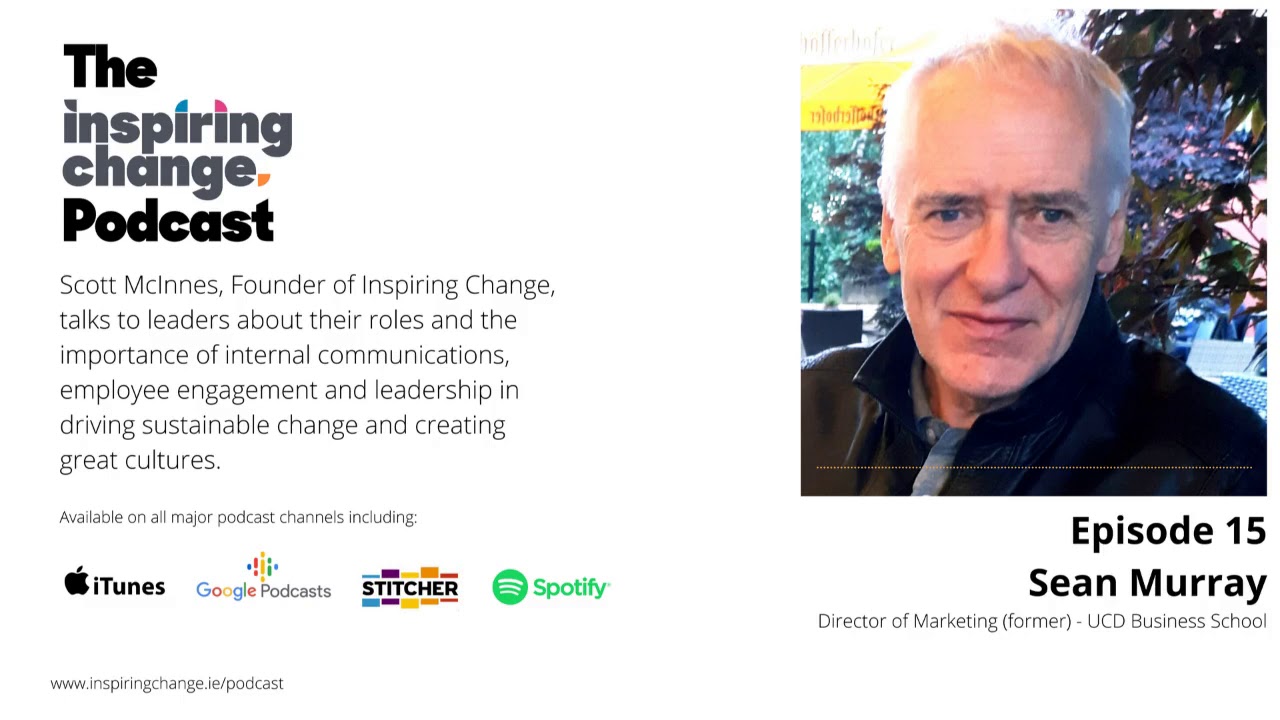
In this episode of the Inspiring Change podcast, host Scott McInnes interviews Sean Murray, former Director of Marketing at UCD Business School. Murray recounts his accidental entry into marketing after a BCom degree and a 30‑year career spanning grocery, health insurance, and academia. The conversation centers on what makes a good leader, emphasizing clarity of purpose, respect for frontline staff, and the need for leaders to ask the right questions rather than have all the answers. Murray introduces the concept of an inverted pyramid, where leaders serve at the bottom to support those closest to customers, and stresses the importance of consensus‑building, decision‑making authority, and realistic buy‑in thresholds (≈50‑60% in academia, ≈80% in business). He advocates for visible leadership through “management by walking around,” personal engagement with team members, and honest communication to build trust. The discussion moves to engagement, linking it to a clear narrative, engaging leaders, employee voice, and integrity, echoing the 2009 McLeod report. Murray outlines a three‑group model for change management—resistors, advocates, and fence‑sitters—and offers tactics for identifying and empowering change champions. He cites leadership role models such as Fergal Quinn, the Dunne family (SuperQuinn), Niall Fitzgerald (Unilever), and Nelson Mandela, highlighting vision, adaptability, and deep understanding of stakeholders. Finally, Murray advises his 20‑year‑old self to recognize what he doesn’t know, hire the best people, provide a clear vision, and let them execute. The episode provides practical leadership insights drawn from decades of experience across sectors.
Chapters
Welcome to Face Forward, the inspiring change podcast on all things internal communications, engagement, leadership, and change. So good morning and welcome to Face Forward, the inspiring change podcast on all things internal communications, engagement, leadership, and change. For any of you that listened to episode 14 with Tom Murphy, his piece of advice to his my 20-year-old self was to always be learning, to keep learning all through your career. So it's great today that I'm joined by Sean Murray, who's the former Director of Marketing in UCD Business School. I'm going to let Sean tell us a little bit about him and what he does in a second. For me, learning is so critically important, and in fact, if we're not learning, we're not growing, and that never stops from when we leave college all the way through to when we leave work and retire. So the fact that we've got Sean here today is brilliant. So Sean, you're very welcome.
Thank you very much, Scott. I started out in 1968 with a BCom degree and not a clue as to what to do and ended up in marketing pretty much by accident, which is sort of where I spent most of my career in a number of companies. I spent nearly 30 years in the grocery sector with companies like Kraft, Glenbia, Cadbury Schweppes, and then made a career direction change in marketing with a startup, Bupa Ireland, health insurance, financial services products, which was a real learning experience, I have to say, coming at the stage that I switched into it and then subsequently moved on to the UCD School of Business, from where I retired about 3 years ago.
Okay, interesting. And tell me, from your perspective, what do you think makes a leader a good leader?
I've given this one a bit of thought since you asked me to do this, and I think I have to be careful about words like good and great leaders because they can mean different things to different people. And different organizations require different things at different stages. Churchill, for example, was a great wartime leader for the British but a disastrous peacetime leader, but he was what they needed in times of war. Having said that, I think that there are a number of things that leaders need no matter what the situation is or the crisis that they're facing in their business or in their organization or in society. And I think clarity of purpose is very, very important. Knowing exactly where you're bringing the organization, where you're bringing the team, where you're bringing the country, whatever your leadership role is, knowing where you're going and communicating that, I think, is tremendously important. I think to do that you need to understand the people that are working for you and to respect them, to get buy-in from them that they understand where the organization is going, what's required of them, and how to get on with their jobs because the guys at the top, the leaders of the team, the leaders of the organization, the leaders of the business, they don't actually make it happen. It's the lower level people, the middle management people, the junior management people, they actually make things happen in the business. And I think there is a need for leaders to understand that and to allow the people to get on with doing that within the clarity of purpose which has been set for them by the leader of the team. When I was kicking off in the late '60s, the early '70s, I would have had a view that when you got to be the boss, that you decided and people did, and that was the end of it. And of course, it doesn't work like that at all, and it probably never did, but I just had a misconception, if you like, in relation to that.
I think everyone has that. I don't think that was just you that had that. I think everybody has that misconception.
And I think one of the things that has changed that conception is education. I mean, we educate people to a very high standard, a much higher standard. I mean, I looked at— when I was working in the business school, I looked at the students and worked with the students coming off various courses. I wouldn't even get on the course now. That's what I feel sometimes when I look at how bright they are and how much they know. And if you educate people to that level of understanding and skill set. What they're lacking is experience. They're not lacking in ability and they're not lacking in thought. And you know, they need to know what they're doing and you need to accept that they're going to question what you're doing and you need to respect that and you need to communicate why you're doing something.
And I think there's a piece around you not having all the answers. As a leader, it's not your job to have all the answers. It's your job, arguably, to ask the right questions and then listen.
Yes, but there is one other thing that you have to do as the leader. Somebody has to make a decision at some point in the process. And getting buy-in from your team— and I'm a big, big fan of consensus agreement. Partly because if you don't get that level of consensus agreement within your team, what you're trying to achieve is probably not going to happen. The team will find ways of frustrating you, not necessarily on purpose, but because they're not committed to the course of action that you've outlined for them, they are going to underperform in achieving that course of action. And I think that's inevitable. Now, you're never going to get 100% buy-in. That just doesn't happen. But you need a critical mass of buy-in, which when you're working with academics was probably about 50 to 60%, but in a non-academic environment, I think about 80% is probably enough. But the leader has to have cognizance of the sort of timeframes that are involved in what's going on, and at some point has to say, we've got to decide. And that is one of the critical roles of the leader, is to make a decision and to say to the people, look, I know you may not agree with me, but I've listened to everything and this is what we're going to do.
We have to make a call.
We've got to make a call because there's a, you know, a tender has to be in or a supplier needs a decision or somebody needs a decision. Or the year-end accounts are coming out, you know, we've got to make the money, we've got to hit the targets. And, you know, I read a lot these days about snowflakes and Generation Z and all of these people, and I think it is important that you understand when you're working for a team leader that not everything is going to go your way, and sometimes the leader has to make a decision decision. And personally, a criteria that I would have always applied in relation to whoever I was working for was, you know, have they, you know, are they in the position to make this decision, and is this their decision, and have they listened to what I said? And if, if the answer to both of those is yes, if they've made a decision I don't agree with, I can either resign the organization or get over it.
Yeah, absolutely.
Generally speaking, I got over it.
Yeah, it was— I was chatting to a guy in the office here the other day. He had a very interesting take on that kind of age-old pyramid. And as you said, you know, you're the guy at the top in inverted commas. And, you know, I heard somebody else— I was watching on TV the day, a program about the Navy and that whole idea of shit flowing downhill. You know, it's just everything comes from the top in an organization like that. What he said was what companies are moving towards more today and should be moving more towards is the idea more of an inverted pyramid where the leader ultimately is actually at the bottom. They're at the very bottom actually holding everybody else up, which probably plays quite well into your idea of that leader's not there to do the doing, they're there to support the team to get the doing done.
Well, I think, I think that the people, if you like, at the bottom— and I don't like much like the phrase— but if you take the inverted pyramid, They know more about your customer than probably you do.
They're closer to them.
They're talking to them every day. Like when we in Bupa Ireland, when we were setting up the health insurance business, we had a couple of hundred people on the phones and we did nothing. We took no initiatives without talking to those people because they're talking to the customer every day. So if you're ignoring that resource, You can go and spend a bundle of money on market research, which is fine and you should do, but I mean, you've got a big, big resource in terms of market research at the bottom, and those people are all bright people, well-educated and well-trained, and they know how to get on with it. So if you're not listening to those people as a leader, then you're sort of in trouble pretty much straight away.
And of course, there's two sides of the coin because there's the benefit of getting the insight from the person that's dealing with those customers every single day of the week, but also the flip side of the coin in asking for opinion, in asking for their feedback and their insights and their thoughts. That, of course, is going to give them a sense of pride and a sense of, you know, I'm playing a role here.
Absolutely, because one of the worst things to be in a position is where you're doing something and you have no idea how what you're doing is influencing the organisation, whether it's achieving anything in terms of the bigger picture. I think if that level of communication is absent within the organisation, you're probably in trouble. But it goes back, I think, to having a very, very clear vision of what you want to achieve. And I just have a sense sometimes at the moment when I look around, particularly in the marketing area, and I look at marketing campaigns that are going on, that there's a lack of strategy and a lack of strategic thinking an awful lot of the time behind what's doing. A lot of it seems to me to be very task-oriented. The tasks are performed super efficiently, But to what end? To what end?
Great.
Is, I think, a very important question. I think it's important in that context that as the leader, you understand that not everything is going to be perfect. Everything is a trade-off at some point. It's not going to be perfect, and you've got to live with that level of imperfection. Of course, you're going to try and minimize it. That's part of your role. But it's going to be there and everything is a trade-off. Agreed.
Agreed. You caught me mid-swallow of coffee there when you finished up. Thanks for that. So tell me, in terms of the role of the leader in creating a more engaging workplace for the team, and I've said this on many podcasts before, that I think engagement has become a bit of a dirty word. It was the new big shiny thing that everyone was talking about. And for me, it's very much just about leaders creating a better place for their employees to want to come to, to work, to feel so they can give more of themselves and to be more aligned with that purpose that you, that you were absolutely spot-on about earlier on. What do you see as a role of a leader in creating that engaging workplace?
Well, I think that the personality and style of the leader sets the tone for the organization, for the team or for the organization or whatever it is that the leader is leading. And I think if as a member of that team you're dissonant with that general tone and style, you've got a problem and you need to recognize that. And different people can succeed in different ways in different organizations. I worked in one organization many years ago and there was an individual who Frankly, he was a bit of a joke, even though operating at senior level within that team and didn't have an awful lot of respect. That individual left the business, went elsewhere, and was extraordinarily successful and did very, very well, much better than most of us that he left behind, frankly. But horses for courses, different organizations at different times. It goes back to what is required of the leader within the team at the time. But to address your question more centrally, I'm a big fan of management by walking around. Emails, text messages, phones, internet make things a lot more efficient, but visibility of the leader I think is terribly important. Management by walking around, I've heard it called. Emails, text messages, Internet, all can help efficiency, but nothing beats the personal touch of the leader. Face to face. Just to be seen around the place, face to face. But that requires the leader to understand the people that are on his or her team, knowing when their birthdays are, knowing if they've got a problem at home, knowing if a child has been sick. Knowing if they've been on holidays, asking about that. You hear frequently mentioned that people shouldn't bring their personal problems to work. Total rubbish.
Total rubbish.
How can you not?
Yeah, you're not— if you don't bring your problems to work, you're not bringing your whole self. And if you're not bringing your whole self to work, you're not going to be able to do as good a job.
But, you know, there is a need. There is a need to understand that on the part of the leader and to actually work with that to the benefit of the team and to the benefit of the organisation. So I think that is one thing, being visible, but at the same time remembering that you are the leader, you're not one of the lads or one of the boys and girls. It's a bit like parenting, you're never your child's friend, You can have a terrific relationship, whatever. You're always the parent. There's always a different dimension that is there in the relationship. And you got to remember that. I think trust is— and generating trust is hugely important. If as the leader you are saying one thing in public and doing another thing in private. That's pretty bad for the team. And this goes on to us, I think still goes on to a surprising extent in business. And there's no point in thinking, particularly there never really was any point in thinking that, well, it's private, nobody will know. They will always know.
And people in organizations always, always know. And if they don't actually think they know, they'll just make something up.
Yeah, yeah, they always know. So that sort of level of openness and honesty and engendering trust, and that might, would, could extend as far as saying to somebody, look, I can't actually tell you what's going on right now, um, one of two reasons. One, because it's sensitive and I can't actually tell you, because it's not that I don't trust you, but really, I just can't. Or secondly, because I actually don't know myself. And I think that because if you don't do that sort of thing, people will make up their own stories. Of course.
And I think that level of honesty engenders a sense of trust and engenders that sense of team, that sense of camaraderie between a leader and the members on that team.
And definitely don't lie. You'll always you'll always be found out.
Always. I agree. I couldn't agree more. I think it's interesting, just even having gone through this, when you look back at the David McLeod report from 2009, Engaged for Success, on engagement, the 4 things that he said drive engaged teams are: 1, a really engaging narrative, a common purpose; 2, having really engaging leaders; 3, having employee voice; and 4, having integrity. And all of those things are the 4 things that we've spoken been talking about for the past 10 or 15 minutes.
Absolutely, and nowadays I think the big problem in relation to not being honest is not that other people in your organization will find out, they would have always found out and they will find out, but in these days of emails and internet and nothing ever goes away, your customers are going to find out. Find out. The public will find out, and they always do. And it continues to amaze me the number of scandals that hit the media. And you say, why do those people think they could write that sort of thing and nobody would find out? Yeah, um, are they nuts? Um, there's always somebody with a recording device or a camera or within a few yards. So More so than ever, I think, and it's become, I think, another huge strand for marketeers in particular to watch out for is the impact of reputational damage, which is, well, it was always there if we go back to the Gerald Ratner days back in the '90s.
The prawn sandwich.
Yeah, but I think it's even more with social media channels, with All of that, it is more important now than ever that you've got that level of honesty and openness and that you maintain the vision and you stay true to the vision as far as you can. But I would go back and say, go over something that I touched on earlier, which is leaders lead and you're not always going to be able to be nice to everybody all the time. Sometimes you have to take decisions that are going to upset people and might even hurt people, but those decisions would be much easier for the people to take if they understand why it's happening and what's going on. I do worry sometimes today when, you know, that we have perhaps pushing the pendulum too far in terms of the softer skills. Hugely important, obviously, but sometimes hard decisions have to be taken, and that is the job of the leader. Like, it's easy to be nice, and if the job was easy, anybody could do it. It's because it's difficult that you need special people or people with something extra to make those decisions.
And actually, that's particularly pertinent, I think, during times of change when you're, you know, when people do need to do need to take decisions and make decisions and do things that might not be particularly popular. I think the whole piece you were talking about earlier on of that whole visibility piece and management by being seen and understanding that, you know, Sarah's got a sick dog and Jimmy's got a new baby and somebody else's mother's just got a cancer diagnosis or whatever it might be, but that, that knowledge that a leader has of their team is fundamentally important, particularly during change for me, because they can then take those leaders' corporate general messages and contextualise them for their teams in a way that makes them relevant. So I wonder from your perspective, I mean, I guess you've seen lots of change through your career, what's been the role of leaders through that for you?
I think if you're looking at a change situation as a leader, you need to understand that the people your team, your organization is going to break down into 3. You're going to have a relatively small group of people who are going to resist change, and that's a problem for you because those people probably don't have a future in the organization because they can't go with the change. You're going to have a relatively small bunch of people at the other end of the spectrum who are going to see the change and are going to embrace that and say, this is going to present me with opportunities and I'm going to will be in there banging on the door looking for that opportunity. They're the people, and you need to identify as a leader that group of people because they're going to be your change advocates who are going to lead the changes that you want if you've got buy-in from them. And then you've probably got 80% of the organisation, 70 to 80% of the organisation in the middle, who probably don't care too much about the change one way or the other as long as it doesn't affect them too much in terms of their earnings or the sort of hours they're going to work or how their jobs are going to change, and they're just going to move with the wind. They're not going to resist change, but they're not going to embrace it either. They're going to look for how is this going to affect me and they're going to sway with it.
That's the fence sitters.
The fence sitters. But you need to be cognizant, I think, of these 3 groups and probably your biggest problem are the change resistors because at some point they're probably going to have to leave the organization. Or else they're going to end up in cul-de-sac jobs, which is not good for them and is not good for the organisation. So, and probably the bit in the middle are the people you've got to worry about the most because you don't want to drive them into the bottom group, and they're never going to get into the top group anyway, but you know, I think if you go into an organisation with a mandate for change and you're on your own in the organisation, as a leader, it's not going to happen. Organisations have a way of frustrating change, even not deliberately. So you, this, the 5% who want to embrace the change or the 10% who want to embrace the change are key for you because they will be the ones that will make it happen. So you've got to convince them that your vision, it's got to be based on the vision, that your vision is correct, the correct way for the organization to go. This is why we're doing, this is where we're going, this is why we're going. These are the, by the way, and you also got to spell out, if we don't do this, this is what's going to happen.
That whole idea of burning platform.
Yeah, and it's, you're going to be in trouble. So there's a stage process there, identifying your top-level change adapters, getting them on board and empowering them. Later on you can sort out the guys at the bottom. Again, that sort of language that they use, sort out, is not fashionable these days, but it is what it is. It is what it is.
Tell me this, who you're— tell me who your leadership role models are. Who were the— as you went through your career, who were the people that you looked to?
I've given this one a bit of thought, and this is actually the hardest question that you're throwing into me. I think I've always admired Fergal Quinn's work when he was with SuperQuinn. He seemed to me to be somebody who was well engaged with his organisation.
And a previous guest of this podcast.
Yeah, and was very clear about where he was bringing the organisation at all times and got out and led a considerable amount of change. I think, and going back to my grocery roots again, the Dunne family. I don't have to agree with everything that they did, but the organisation very, very focused about where, again, where they wanted to bring the organisation, the style of organisation that they wanted, and were not afraid to adapt, to adopt change. Back in the '80s, they would have had a very poor reputation as an organisation to work for, that paid poorly and didn't treat their employees all that well. That's no longer true. It's quite the opposite, in fact. But that is essentially under the same broad leadership team that was back in place back then as an organisation.
But who saw a need to lead differently because they saw that the way they were doing it wasn't perhaps meeting the needs of the staff or the customers, and they had to do something different.
Yeah. Another person that I found quite interesting, who I only came across right at the very end of my career, was Niall Fitzgerald of Unilever, and he came in as chairman of the Smurfit School Advisory Board. Now, it was an advisory board. It didn't actually have any power, but the first meeting of that board that I attended that Niall was in the chair at, it was like a session I hadn't been at for a while, for a long time. He was there saying, let's do this, this, this, and this, He didn't have any power of enforcement, but you were sitting there saying, 'By God, I better get this done.' And could I put my finger on why that was the case? Beyond sheer force of personality, and you knew that this guy had done it all and knew what he was doing, that was it.
So he had some level of kudos behind him.
I mean, certainly of a charisma as well. So they'd be some of the guys I would have— it's probably a cliché, but certainly what Nelson Mandela did in South Africa in the '80s and '90s, even before he got out of jail, was hugely, hugely, hugely impressive in terms of understanding, having a clarity of vision of what he wanted, and in terms of understanding the Afrikaners and the Afrikaner mindset, you know, down to learning to speak Afrikaans and frequently knowing more about the history of Africa, of the Afrikaners, than the people he was dealing with did. Yeah, that's deep understanding, you know.
Let me ask one final question just to wrap up. What leadership advice would you give to your 20-year-old self, knowing what you know now?
I would say, know what you don't know, um, as you go along. Get the best people, give them a clarity of vision, and let them get on with it.
On that note, Sean Murray, former Director of Marketing at UCD Business School, thanks very much for coming in. I've really enjoyed the chat.
Thank you, Scott McInnes.
Thanks for listening. For more on Inspiring Change, to read our blog, and to listen to other podcasts, please visit inspiringchange.ie.
More from Scott

Leaders can't assume connection happens automatically #LeadershipLessons #EmployeeExperience

The hidden reason your remote team feels disconnected #TeamConnection #HybridWork

This is why people actually stay at their jobs #workplace #culture #retention

156 | Inside Disconnection at Work: Bridging the Connection Gap Report with Sadhbh O'Flaherty




155 | The Overlooked Art of Building Connection at Work | Scott McInnes with Christine Armstrong


