Episode 17 | JEFF CASELDEN | Co-Founder & Principal, Caselden Consulting
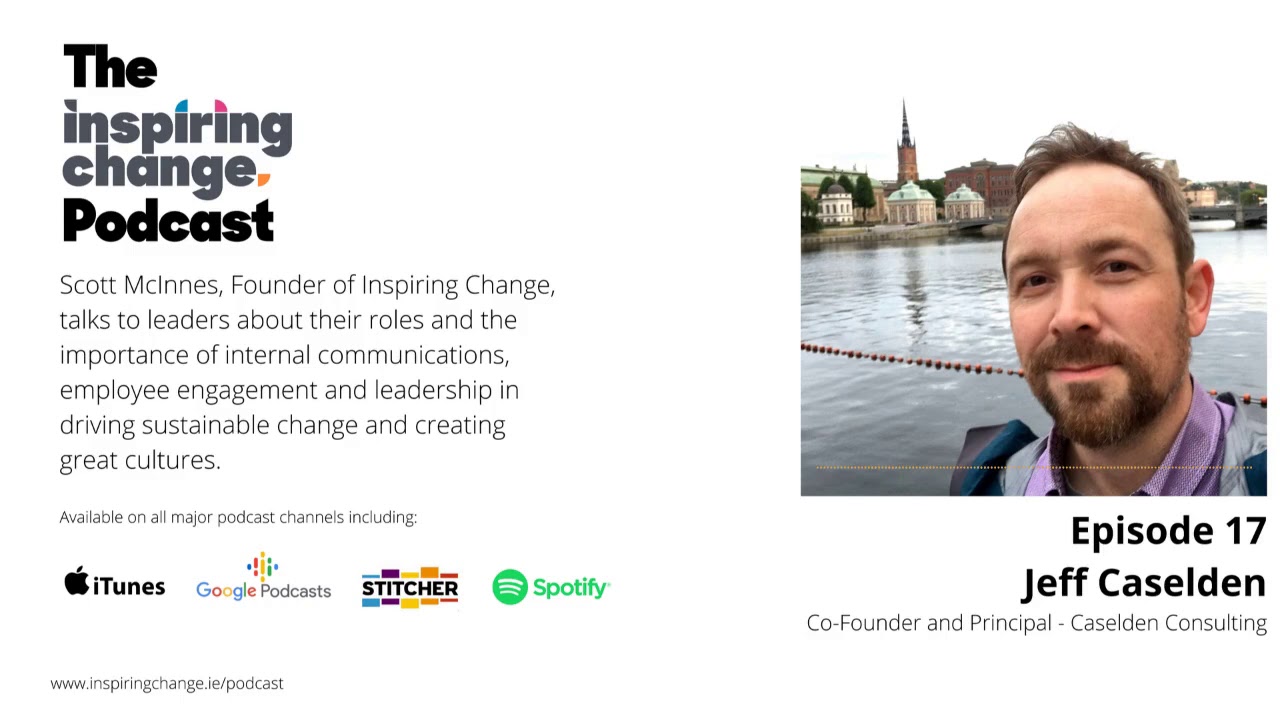
Jeff Caselden spent 18 years at Amazon, growing Dublin's office from 300 to 13,000 people before co-founding Caselden Consulting to coach leaders and build high-performance teams. He credits Amazon's 14 leadership principles, embedded in every hiring and review decision, with preserving culture during rapid scaling. His core belief: hire people smarter than you, lead with trust and vulnerability, and help teams see their blind spots.
Chapters
Welcome to Face Forward, the Inspiring Change podcast on all things internal communications, engagement, leadership, and change. Welcome to Face Forward, the Inspiring Change podcast on all things internal communications, engagement, leadership, and change. And today's a big day because it is our first outside broadcast. Today's guest Jeff Casselden and I have decided that actually it's 25 to 4, the sun is over the yardarm somewhere, and we should hit the pub. So here we are in Ruan Bar in the middle of Dublin city centre doing our first outside broadcast. Jeff, how are you?
I am fantastic. How are you?
I'm good. We have a beer in hand.
We do.
So why don't we kick off the way we always do by perhaps letting you talk a little bit about yourself, your career, where you've come from, and what you're doing today.
Yeah, sure. So I'm originally from the US. I've been in Ireland for just over 10 years now. The majority of my career I spent with a little company called Amazon that most people have probably heard of.
I've heard of them.
Yeah, yeah, as it turns out a lot of people are fairly familiar with them these days. When I joined them back in 1999, it was still a pretty small company, only, you know, a few thousand people. Started as a customer service agent in the organization actually. Prior to that, I'd done some management roles in retail businesses and restaurants, and my background is in television production and African American studies, of all things. The, uh, yeah, the time at Amazon was really great. I think one of the things that was fantastic about the company was that it was a place where there was a lot of opportunity for personal and professional growth, and I took full advantage of that. So a couple years into the company, I moved into engineering roles. I've worked in Infrastructure Services, essentially ran part of the internal help desk for Amazon, onboarding new employees, dealing with mail routing and fairly interesting things like that. And then I moved into working in Product Search for Amazon. So I was responsible for the team that ran the search engine for Amazon's retail business around the globe. Did that for a few years, ended up moving to California from Seattle, and then made a big jump and moved over to Ireland. And helped lead an international team that was part of the Fall of the Sun rotation that we had for running the search engine. Did that for a couple of years and then ended up getting promoted to the head of search for EMEA for Amazon. And the last few years that I was with them, I spent as the GM for the office here in Dublin, the development center that we have here. We were probably about 300 people when I took over that role. We grew by about another 1,000 people over the next 3.5 years. So a lot of challenge in terms of change and just trying to preserve the culture there, because at any given point, half the people that are there had really no idea what it meant to be an Amazonian. And then fittingly, I left the company on Black Friday almost 2 years ago now. I felt that was a good day to leave after having worked through many, many Q4 seasons with the company. Decided I really wanted to focus a lot more on the people side of things. The technology side was really interesting to me, but I found that I really got the most enjoyment and had the most passion out of helping other people kind of achieve the same sort of success that I had in my career. So I was really fortunate enough to work with a number of people that I was able to help move on to bigger and better roles or maybe locations that they wanted to live in their own life, and I just decided in the second act that I was about to embark on that that was going to be my focus. So went into business with my wife Mindy and we founded our, our business Castleton Consulting at the beginning of 2017. So we're almost at 2 years now. The focus for us is really on people and it's about helping people achieve their own potential and their own goals that they have in life. A lot of the work that we do takes the form of one-on-one coaching with emerging leaders or leaders who are taking on bigger challenges. Maybe they're managing managers for the first time, they're taking on international assignments, things of that nature. And we also do a lot of work helping to create high-performance teams within these organizations. So our clients have a pretty wide range. They can be really small companies. I do mentoring for Enterprise Ireland, so sometimes it's 1 to 10 people in the company. But then we also work for— or we also work with some of the, the more successful internet unicorn companies, I guess if you want to call them that, around Europe. So we've done a lot of work here with Intercom in Dublin and doing a lot of work with a company called Klarna in Sweden as well. So it's been a really exciting time. It's been great to kind of follow our own passion and carve our own path out and really looking forward to what's next.
Brilliant. And I love the idea, you know, and certainly, you know, that, that type of story echoes where I came from as well. And I think having the opportunity now for both of us to do what we're passionate about doing with lots and lots of different sizes and scales and types of companies across all different sectors is exciting.
Absolutely. I mean, Amazon was a fantastic place to work. After almost 18 years, I'd learned a tremendous amount there, but I just found myself longing to see things through a different lens, through a different perspective. I knew I could be successful there, but I wanted to see what it was going to be like in other companies. But I also didn't want to jump right into another organization and only work in one place, so it's been really great to almost enjoy the buffet, if you will, of lots of different corporate cultures and see how other people do things and approach the same kind of challenges that we did there.
I think it's exciting for me as well that that whole idea— we talked a lot about learning in episode 15 with Sean Murray from UCD, but I mean, I'm certainly, every time I work with a client It's not often about me telling them what to do. It's also about listening and actually me learning as well.
Yeah.
And that whole idea that I think we're always all learning all the time.
Absolutely. I think once you stop learning, like, that's not a good thing. So yeah, I would agree with that 100%.
So I'm going to come back to culture and being an Amazonian.
Sure.
In a while. I presume there was lots of loincloths. That's what you had to wear all the time.
Well, yeah, yeah, most of the time. Sometimes. Yeah, sure.
Yeah. Okay.
Yeah.
Let me talk a little bit about leaders, because obviously when you joined Amazon, as you said there, you were 300 people. You grew that almost by— I was doing some quick math while you were talking— by almost a body a day in that, in that period from 300 to 13,000.
Yeah, pretty much. Yeah.
What do you believe makes a leader a great leader? What are some of the attributes?
Well, for me, I think 3 things that really stand out to me are that you've got to be able to build trust with the people that you lead. And I think that, you know, that requires a reasonable level of emotional intelligence for one thing. I think being able to have empathy for what people go through is really important. I think openness and honesty are also equally important. The people that I managed at Amazon, the people that I work with in the companies that I work with now, they tend tend to be really, really smart people. They can smell BS coming a mile away. And you know what they really generally want are the same things that a lot of us want in our work. You know, they want to feel like there's a sense of purpose that they're aligned to that brings some sort of bigger meaning to their life. They want to get really great at something and master some new skills, and they want to have some autonomy to be able to go off and do what it is they're great at. So I think for me, I think really being a great leader is about being able to create that environment where that can happen for people. And I think those, those elements of trust, openness, and honesty are really critical.
Yeah, no, I agree. And it was, was it Branson who said, back to your point about being, you know, working with people who are cleverer than you are, that Branson, I think, as I say, said, you know, why is it that we hire people who are smarter than us and then we tell them what to do?
Absolutely. I think that's That's one of the other things for me is like, um, being a great leader doesn't mean that you have to have all the answers, which I think as I was, you know, younger in my career was something that I— maybe intimidated me about moving into management and leadership roles was, gee, I don't, I don't know the answer for this all the time.
What if they try and catch me out?
Yeah, exactly. But I think when you can be honest about what you know, what you don't know, and, uh, you can be vulnerable around that as well and let the people who you surround yourself with, who hopefully are smarter than you if you've done an effective job of hiring, you can really bring out the best in people. I think one of the other things that's important though is that, you know, leaders are often the ones that are responsible for helping to select talent that comes into the organization, and I think that it's important to have an eye towards diversity. I think that bringing in people who are carbon copies of one another isn't really a great way to build an effective team.
Or carbon copies of you.
Yeah, absolutely.
Which is another trap that people tend to fall into.
Definitely. Well, and I think, yeah, and another trap I think that they fall into as well is like, if you're the boss, don't challenge me. And I think one of the things that I usually try to set up front with people that I work with is I'm not going to have all the answers. I'm going to throw some things out there that I think are good ideas, but I'm expecting and requesting you like poke holes in them and push me and push all of us, because together I think we end up finding better answers and better solutions than when you just agree with whatever it is I have to say.
Absolutely, because everyone has something to add. It was interesting, I was chatting to Paul Diggins, the former director of marketing or director of communications at Rolls-Royce, the other day, and vulnerability was one of the things that he threw up about, about great leaders as well. And he said if a leader's vulnerable you'll almost forgive them everything else. Those attributes that you mentioned there, in terms of honesty and trust, you'll almost let them away with some of that because the vulnerability becomes a cloak over the whole lot. That if they're willing to say, you know what, I screwed up, you know what, I don't have all the answers, you know what, God forbid, I'm sorry. If they do that, actually it gives you way more space to forgive them, perhaps the things that they're not so good at.
Well, absolutely. I mean, leaders, employees, I mean, all of us, like, we can't forget we're all human, you know. We're all gonna make mistakes, we're all gonna mess things up from time to time, but I think failure is like, that's how we learn. So being able to have that mindset and bring that into the team that you're working with, I think, is really critical. If the view towards failure is that it's a punishment as a result, or it's something to be avoided, how are people going to take risks? How are you going to actually innovate and push things forward in a way that gets you to where you need to be? You've got to be willing to break a few eggs and make a few omelets along the way. Otherwise, you're probably not really going to go anywhere. Absolutely.
And given that a lot of organizations have kind of that huge fear of failure, you know, I've been in I've been in briefings with CEOs where they're going, you know, it's okay to fail. If we're not failing, we're not growing. You know, you know, perfection is the enemy of progress and all these things. And you can see other people nodding, but in their heads they're going, absolutely no way do I want to be the one that fails.
Yeah.
How do you bridge that gap between the saying piece around failure and people actually going, okay, I get— I'm happy to do that because I realize there's a safety net or that it's okay?
Well, I think really great leaders in this instance lead by example. I mean, just as you said a moment ago, if you can demonstrate that vulnerability yourself and you can help to set the tone for what's, you know, what's acceptable within your organization, that creates space, I think, for people to feel like it is okay. So it's very much living up to your own words there, you know, you've got to walk the walk and talk the talk.
Yeah, talk to me a little bit about the Amazonian culture, and if you're growing an organization, whether it's Amazon or Castledown Consulting in 3 years to 100 people, or any organization in Ireland, when you're adding people at that rate of knots and you're effectively bringing, I guess, and you might correct me here, a culture from an organization which was born in another country, which culturally is very, very different to Ireland. How do you maintain and grow the culture that you want when you're growing that quickly?
Well, I think there were certainly, you know, Amazon has a really, really strong culture that's, that's very, uh, tied to the, the leadership principles that exist within the company. So Regardless of where you work in the world for Amazon, those are always front and center. They're, they're what form that shared mental model that everyone within the company operates within. So it helps to define, you know, what success looks like, what failure looks like, what good behavior in the organization looks like. And they have baked all of that stuff into all of the really integral parts of running the company. That I see as pretty essential to— if you're going to grow an organization, I think that's a key piece. Like, you've got to have an idea of what's the purpose that we have as an organization, what's our mission in the world, and what's the way that we're going to get to where we're going. And I think that's what those values and those leadership principles really define for people. So for us in Dublin, growing at the rate that we did, obviously Yeah, there were some little things that if you came into our office were uniquely sort of Irish or, you know, related to Dublin, but overarching, I would say that the culture was still very, very predominantly driven by those leadership principles, and they were baked into how we interviewed people, what we looked for when we were reviewing their performance at the end of the year, whether or not we were going to promote people, how we were going to bring new products and services to the market.
And when you—
and when it's all that embedded in everything that you do, I think it really starts to gain some momentum and gain some gravitas itself. And that was— those were the primary sort of tools through which we taught new people into— that came into the company how to be successful Amazonians.
So, and that was from day one, I guess, from the day they arrived.
In fact, before they arrived, because if it was during interview as well, it was Oh yeah, I mean, one of the first things we would tell them, or well, certainly at least I would tell people when I was interviewing them or potentially going to have them come on site, was go read our leadership principles on the website because that's what we're going to talk to you about when you come on site. We're going to spend a lot of people's time interviewing you and making sure that you're a great fit for the company. So I want the chance that you're going to succeed to be reasonably high. And you're not giving anything away by telling them that, but you are setting the context for what they need to live up to when you have that conversation. And as leaders, I think the other thing that we did was we just talked about these leadership principles all the time. So when there's 14 of them, that's a lot to talk about. And there certainly were situations where people under-index or over-index on individual principles. And in many ways, some of them were intentionally designed to kind of conflict with one another because the world's not black and white. The world is like many, many shades of gray. But when you have a clear sense of what success and what failure looks like through a framework like that, and you've been able to, you know, define that purpose, that North Star for people, you've then got a framework where you can kind of step back and let them operate more independently within that. And you don't have to, you know, leverage like a command and control kind of leadership model, which really doesn't work with the kind of people that we'd hire in companies like Amazon or a lot of the companies that I work with today either.
Yeah, interesting. It was funny that you should use that term again about baking into, because when you and I were speaking at the event earlier in the week, you used that term and how baking those principles, your values, your culture, your purpose, your vision into everything that happens. And I think the term that you used was it wasn't enough to just print them on a piece of paper and leave them on people's desks.
Yeah.
Even if you laminate them. Yeah, yeah, yeah. You know, it's being baked into and living them and then becoming— and I'm completely in your corner on this— that they become part of BAU, they become part of just how we do things around here.
Yep. Yeah, yeah. In the absence of something that you're putting out there, people will fill the space.. So, I think that was something that Amazon was really quite good at, was from the top down, that was how they led, that was how people interacted with one another, that was what drove the business.
So, I guess Amazon, as one of the world's biggest kind of tech companies, one of the world's biggest retailers, is going through change all the time. And what I say to clients often, and I'm sure I'm sure you say something similar, is that, you know, if you're not changing, you're dying.
Yeah.
Because your competitors are changing, your customers are changing, regulations changing, markets and products are changing.
Yeah.
Everything's changing all the time, so you have to be static. And I'm guessing probably Amazon was changing all the time to suit. And I wonder, as you're going through that change, what do you see as being the role of a leader as a communicator in terms of landing that change and the why?
Yeah, I think there's a woman that I worked with a number of years ago, her name's Sherry Rose. She's back in the Bay Area in the US, and Sherry gave us 5 really great points that I think still resonate with me today that are really important whenever you're dealing with change in an organization. And first of all, like, I agree with what you're saying there. I mean, I think in many ways, like, I guess to steal something out of the Netflix book, Change is the New Black, you know, like it's like, yeah, that's, that's the world that we live in today. And if you're completely static, you're going to be left behind. So I think the role of a leader when you're dealing with change in an organization is, first of all, you've got to really be able to explain the context. Like, why are we going through change? What's, what's the meaning of it? What's the value of it? One of the things that I often like to do when people would start in my teams was just tell them, hey, get used to the fact that it's gonna— things are gonna change a lot. Don't get too wedded to anything. I think in 18 years at Amazon, I probably had like 40 different desks, you know. So people would get— people would get really kind of antsy about, oh, I've always got to have my window seat, or I can't move. Like, you just have to be ready. Like, it's— things are going to change. I think the second thing that you have to do is you've got to be able to focus on like what's going to stay the Even though change is a given in the world today, we as humans still generally don't like change that much. So as you've told them why things are going to change, it's really important to also just let them know what is going to remain static. The third thing I think is you've got to acknowledge the fact that there's going to be inconvenience that goes along with this change. It's pretty rare that that you go through the kind of change that a lot of companies do today and that you're gonna have it right from the get-go. It's gonna be an iterative process where you're gonna do some things, you're gonna figure out maybe they don't work, you might have to pivot in a completely different direction, and you've gotta let people know that like this inconvenience is there and you recognize it because it's a lot for them to deal with. I think the fourth thing is you've gotta have a plan for alleviating that inconvenience. So they've got to have a sense of kind of where we're going, where we're headed, what the other side's going to look like, and do whatever you can to just minimize the pain that they're going to feel. And I think the fifth thing is you have to— the fifth thing, aside from the cutlery, cutlery, is you've got to encourage dialogue. Yeah, if you're not getting feedback from the people in the organization about how that change is going and what's happening, you're missing a big trick right there. So that's one of the key components in my mind is it's always got to be an open conversation. Your employees are the lifeblood of your company. If you're not listening to them and what they're saying and how they're managing through this change and taking on board the ideas that they have themselves, I mean, they're the ones that are often at the coalface base. They're the ones that really see what might be happening with your customers. If you're only making those decisions from up at the top and you're not taking any of that into account, you're probably going to end up with a lot more pain than you thought.
Yeah, absolutely. And they're the ones, as you say, they're the ones that deal with customers every day, deal with problems, deal with issues, and actually probably know how to fix them. And for me, I think your point about keeping channels open in dialogue is so important. And actually, back to your trust and openness piece earlier on, it's very much about taking on board the feedback. And some of that you'll be able to action.
Yep.
Some of that they'll be able to action. And some of that is just not actionable. Some of that is just, you know, well, we want to have stand-up desks, but they're 10 grand a pop and we don't have the money. So that's just not going to happen.
Yeah.
And it's— and I suppose it's about being able to play back their thinking. With a bit of a different lens. Well, here's the realism lens.
Yeah.
And here's why that stuff might not happen.
Yeah, I mean, the people that we're talking about that work in companies like this are smart. You know, they're intelligent people. They often, you know, with an absence of information, they will concoct their own narrative as to what's happening. So I think as much as you can honestly give them some context on things and let them see how you're thinking about things, A, at least they have an idea of what they're dealing with, B, they might be able to illuminate some perspectives that you haven't considered yourself. And I think all great leaders need to have an open mind about those kinds of things.
Yeah, yeah, absolutely. Given you've come from the States and Amazon is a US organization, I'm guessing the whole idea of employee engagement is quite at the core of what the organization did and does and making sure that you're creating that place that people want to come and work in. How do leaders in Amazon or indeed through Castleland Consulting, as you've been working with other organizations, what have you seen that's really good best practice around creating engaging workplaces?
I think some of the best stuff that I've seen revolves around giving people a sense of ownership. One of the clients that I work with now in Sweden called Klarna is a very successful company in the Nordics. They have a strong kind of history over the last 12 years in e-commerce and payments, and they're starting to move into banking. And I work in— I work with part of the organization that's trying to build a bank from the ground up. While there's definitely a view from the top in terms of like where we want to go, there is a significant level of engagement with employees all the way down through the organization to get a sense of like what's really working for them, what are the things that are pushing us closer to our goals, what are the things that are holding us back. And we're consistently having retrospectives every couple weeks that get us as a team team to talk about these kinds of things and surface the kinds of issues that we actually need to be dealing with to make it a better place for people to work and to help people be more productive and help them be more comfortable and be more successful in their job. So there's like a continual sort of dialogue going on. When people feel like they're being heard and they see action coming out of it, that creates a sense of, a sense of passion, a sense of engagement. One of the things that I've seen that doesn't go very well are companies have these really massive surveys and they want to get all this information from their employees about what they think and then they don't actually do anything about it. Amazon was pretty good in this sense. We had this Voice of the Developer program that was really fascinating actually. It was a survey that would go out to essentially the entire technical population of the company and would ask people very pointed questions about what was great in the workplace, what wasn't working very well. And every year there would be a number of initiatives that would be driven out of that, that would address, you know, numerous things that people thought were holding them back from getting closer to where they needed to be. So some of the things that came out of it as a result were changes in terms of how we thought about the hardware that we deployed to employees, or the internal tooling that we use that, you know, were probably common for 70 to 80% of teams to use. I mean, when you don't have to deal with managing the typical overheads and infrastructure, all kinds of things, and you can really focus on what your, your core kind of problem space is, you can be a lot more effective. And I saw Amazon go through a fairly significant shift over a number of years as a as a result of that program.
So, okay, just to pick up on a point you made there about the Nordic Bank that you're working with and that whole idea of kind of ongoing constant dialogue around making sure that the staff are happy, does it get to the point, do you think, and maybe the answer is no, where there's too much dialogue, where actually we're just talking and talking and talking and talking, and because we just keep talking, we're not actually moving forward? Is that a risk?
It's absolutely a risk. I think the way that you have to mitigate it is like any good meeting, you know, when you, when you have a meeting, there's an agenda that you have, and hopefully there's an end result that you're wanting to achieve out of it, some actions that are going to be taken, and those actions always have an owner and a date with them. If you're having these conversations and it's just chat and ideas and nothing comes out of it, I think people will probably get to a point where they, they start to lose trust or they start to lose faith that it's actually making a difference. So there's a level of accountability I think that's required both from leaders but also from individuals within the team, and how much empowerment you give them, you know, probably makes a difference in this as well. But yeah, thus far I've been, I've been really impressed with the organization at Klarna, they, they're very strong at self-organizing. I've seen a couple teams even write up social agreements in terms of like what it means to be, what it means to be a member of the team, and further take that into this is how we're gonna work as an organization. So they're really setting the tone for what behavior and success looks like in the organization.
And social social contract kind of thing.
Yeah, and it gives everybody a real sense of where they stand. I mean, one of the things that I always try to avoid as a leader is surprising people. It's one thing to surprise them if I have something great to surprise them with, like, hey, you're all getting, you know, 10% bonuses. Yeah, or something like that. That's wonderful. But like, you never want to have surprises when it comes to things like performance or, you know, job security. Exactly. So these are the kinds of things I think that as you can create that sense of security for them, where they feel psychologically safe to share their ideas and know that they're actually being heard and that something is happening as a result, I think people are generally pretty cool with that.
Okay, just last couple of questions now to wrap up.
Sure.
And we can get on with our beer then. Yeah. You've been kind of privileged through your career, I guess, in the organizations you've worked in, both through your Amazon career before that and then subsequently in Castledown, to, I guess, work with some fairly solid leaders. And I just wonder who some of your role models are. Who are some of the people that you've learned amazing things from or that you look up to?
There's one gentleman in particular that comes to mind for me. When I moved to Product Search at Amazon, He was the director of search at the time. His name is Bill Staser. Bill's now the head of Siri for Apple. Bill ended up heading up Amazon subsidiary called A9 that I worked for in the Bay Area for a number of years. And Bill was one of these guys that he was super intelligent, you know, like he knew his stuff inside and out, but he also had a really high level of emotional intelligence with people. He was very empathetic. He realized that the people that worked for him were just that—
people.
They had issues that came up in their lives, they had challenges that they faced, and I saw Bill do some really tremendous things as a leader that I didn't see a lot of other people do. I remember a gentleman that we worked with in the organization who was based in Japan, but he was originally from the US, and he was diagnosed with brain cancer.
Wow.
And Bill's response was was, well, let's move him back home so that he can get the treatment that he needs. I remember as well, this was when there was the huge earthquake in Japan and the Fukushima nuclear disaster. I had just moved one of my team members from Dublin to Tokyo, and him and his wife are both from Poland, and she had grown up not far from the Ukraine, so yeah, she was really sensitive sensitive to the idea after Chernobyl of, you know, being in a place that you don't feel safe. And they had only lived there for like 2 months when this happened. And the response from the rest of Amazon Japan was, you know, "Well, it's just business as usual. Show up to work. Do what you're going to do." And Bill's response was, "Actually, here I think there's something that we need to do differently." And we had them come back to Europe for a little while and just kind of work remotely for a month or two before things sort of settled down and they felt safe to go back. Really? They ended up living in Japan for probably 3 or 4 more years before they finally moved on to Australia, which was where they wanted to end up anyways. But Bill was just one of those guys, I think, that really saw that at the end of the day, companies are made of people, and if you treat them like cogs in a machine, you're gonna get one result. And if you treat them like individuals models who have aspirations and goals and emotions. I'm not saying he went necessarily overboard, he wasn't, you know, going out giving everybody hugs every day.
He knew the right thing to do.
Absolutely, he was a really caring individual. He's somebody I would work for again in a heartbeat. So, yeah, I think one of the other role models I would probably talk about is a gentleman that I worked for before I left Amazon. His name was David Dubinsky, and David was the director of operations for product search for Amazon. And David was very similar in that regard. He was just somebody that— he was less of a manager and more of a coach in many ways. He wasn't someone that would come and tell you what to do. He would take an inquisitive mode with you and try to figure out, like, okay, well, What do you think are your options here? How could you move this forward? And in a world where people don't work more than 2 or 3 years in companies anymore, and you might have 2 managers every year— like, I knew people at Amazon who had like 4 or 5 managers in the scope of a year. I worked for David for almost 8 years, and, uh, it was an amazing relationship to have. That's probably the longest relationship I've ever had except with my wife. And it was just somebody that I knew at the end of the day that I could trust, that had my back, that as long as I didn't spring any surprises on him, he wasn't going to spring any on me. He would always advocate for what we needed. And he was an integral part of me staying at Amazon for as long as I did because I knew that I had people in the organization that cared about me as an individual that were looking out for me in terms of where I wanted to take my own career and my own life and supported me. Okay.
And based on all of that, based on all of those leaders, based on all of your experience and people you've worked with now and what you know now that maybe you didn't know then, what one piece of leadership advice would you give to your 20-year-old self?
Yeah, I've been asked this question before, and I probably be reiterating something I said earlier, but I think two, two of the things for me that I would say are, uh, as a leader, hire people that are smarter than you. It requires a certain level of confidence in yourself and vulnerability to know that, uh, you might be bringing somebody in that might run circles around you. But as a leader, especially as you continue to go up the chain within an organization, you're not going to be able to have line of sight into everything. You can't control everything. You've got to be able to bring people in that are capable, that are intelligent, that you can trust to get on with the work and do it. The second thing for me, uh, I met a woman about a year ago named Eliza Manningham-Butler. She was the head of MI5 in the UK, and when I met her, she She was, you know, she's probably, her age doesn't really matter, but just for context, you know, she's probably in her late 60s, early 70s. And she's a very composed, really just brilliant kind of woman. And I saw her speaking at events in London about a year ago. And she was telling the story of how she got kind of tapped for this job and how she was kind of freaking out a little bit about, I don't know any anything about being a spy. Yeah, exactly. And the one thing that she said that just really stuck with me is like, as a leader, you don't have to have all the answers. Um, that's why you surround yourself with these really, really smart people. And then sometimes your job as the leader is just to illuminate these corners, uh, that maybe people aren't looking in, you know, reveal blind spots that they haven't considered themselves. And it's not for you to know everything and be able to do it all. And I think if I had known that when I had my first forays into management, I'd have been a lot less stressed out. I would have spent a hell of a lot less time trying to control everything, and I would have focused on, you know, what I could control, what I had to just accept, and then just trying to influence everything else in between where I could— I felt like I could make a difference. So for me, I think those Those are two of the biggest things.
Brilliant. And that's a great way to finish. Geoff, thanks so much for coming on. I've really, really appreciated it. I've really enjoyed the chat. I'm looking forward to finishing these beers and perhaps having another one to learn about the former head of MI5 and how on earth you met that person.
Well, let's do it then.
Cheers. Thank you.
Cheers, Scott.
Thanks for listening. For more on Inspiring Change, to read our blog, and to listen to other podcasts, please visit inspiringchange.ie.
More from Scott

Leaders can't assume connection happens automatically #LeadershipLessons #EmployeeExperience

The hidden reason your remote team feels disconnected #TeamConnection #HybridWork

This is why people actually stay at their jobs #workplace #culture #retention

156 | Inside Disconnection at Work: Bridging the Connection Gap Report with Sadhbh O'Flaherty




155 | The Overlooked Art of Building Connection at Work | Scott McInnes with Christine Armstrong


