Episode 18 | ANTH BURROWS & OLLIE STRONG | Founders, Intelligent Emotion
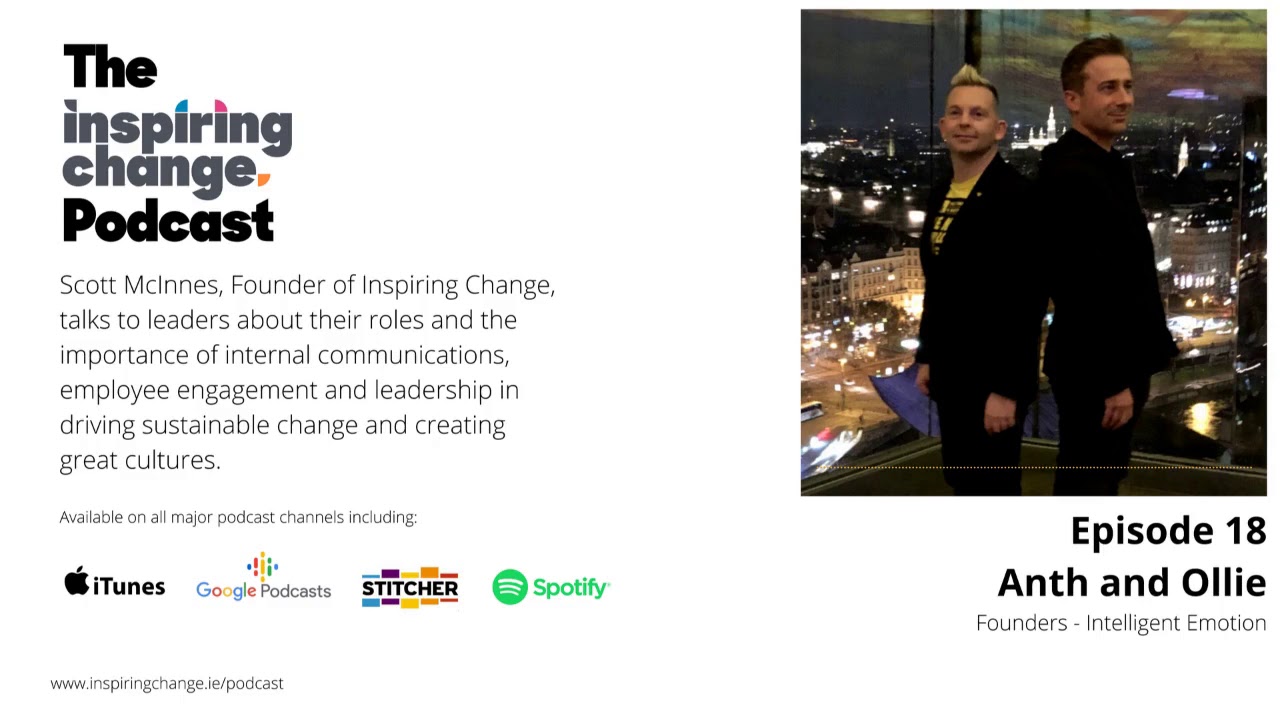
Anth Burrows and Ollie Strong, founders of Intelligent Emotion, argue that authentic communication and leader vulnerability are essential for workplace trust. They warn against robotic internal communications and "Chief Good News Officer" syndrome, where leaders hide problems instead of preparing people for change. The leadership pie tool helps leaders allocate time for people-focused work.
Chapters
Welcome to Face Forward, the inspiring change podcast on all things internal communications, engagement, leadership, and change. I spend a lot of time talking to clients about how they can bring more emotion into how they communicate, how they can help their leaders to be more engaging, and as a result, more effective, more empowering. And actually, even the communications course that I put together recently looks at both the rational and the emotional, how leaders can bring those two elements to bear to be more powerful communicators. So I'm delighted to be joined today by Anth Burrows and Ollie Strong from Intelligent Emotion here in London. Hello, lads.
Hi, Scott.
Hello, Scott.
How are we getting on?
Yeah, we're good, thank you. We're pretty good. Ollie had a good night's sleep last night, which is always a good start for a Monday.
We're powered by coffee and cake.
And yeah, and I went up north to see my family for the weekend. And yeah, so that was all great. I'm feeling raring to go.
Excellent. So a couple of house rules. Number 1, you're not both allowed to answer every question because otherwise we'll be here till tea time. And number 2, you're not allowed to throw anybody under a bus in a kind of a slanderous kind of a way.
Well, you never told me that, Scott. If that's the case, it's going to be a very short interview or it's just going to be you and Ollie because I have nothing to say.
Shortest podcast ever.
I must be more— I'll be more specific in my brief writing the next time.
The lawyer's in the next door room ready to rush in.
I always bring one with me just in case. So listen, tell me, let's just kick off with an easy one to get you going. Tell me a bit about you guys and what you're doing now with Intelligent Emotion.
Yeah, so Ollie and I both came from an in-house background. So, you know, for example, we were both heads of comms and engagement at RSA Insurance, and after that I went on to be head of comms and engagement at Allied Irish Bank, which is where we met, Scott. So we kind of got a long history of kind of in-house working in the field of comms and engagement. But it was towards the end of 2015, actually, when we set Intelligent Emotion up. And the reason why we did it was because I think, you know, we wanted to work with a number of different companies in different sectors, and also We had an emerging purpose that was starting to come through, which was we wanted to help humanize workplaces, especially, you know, humanizing workplaces for the digital age. And we'd come across a few leaders in our time who thought emotion was a really bad thing. They thought it clouded effective decision-making. They thought it was junior. They thought it was something that should be left at home. And you know, Ollie and I just intuitively felt that that was wrong because we thought that, you know, the more we can tap into people on an emotional level at work, the more we can unlock pride, innovation, which all turns into, you know, sustainable business results.
Yeah.
So yeah, we started working with Intelligent Emotion 2015. We've been going for 3 years now, working with a number of different clients in the fields of comms, engagement, culture. And leadership, really.
Great.
Ollie?
Yeah, I think it was— we both got— when we looked at how companies were communicating, it was all around sort of levers and bullet points, and some of the messages you just saw people visibly yawn when the next thing came on the intranet. And we just thought that when, when you meet people outside of companies, especially leaders, they're not like this. So why is it in this corporate environment we have this thing called the robotic shift, where suddenly everything has to be in boxes and everything has to be really stiff and formal? So we think actually the business of the future isn't going to be like that. So this is why we're excited about working with lots of companies to create, I guess, a more human culture.
When you say it, it seems— probably would seem odd to a lot of listeners to have the word human and digital in the same sentence because it feels like there's a bit of a kind of a bit of a conundrum there. How can you be more digital when people are more human? When you move to digital, when people are losing their jobs or we're not going to have as much face time or we're not going to, you know, How does that work?
Well, we believe that, you know, in the digital age, the human touch is going to be more, not less, important because I guess we'll be using technology to be helping to do some of the grunt work to free up time for humans to do more of the value-adding work. So the possibilities of what humans can do in the future will be even greater because they won't be bogged down and constrained by some of the stuff that they have to do now because machines can't. So we have an optimistic view over the future and the fact that humans can play a big part. What I would say though is there's probably a temptation for many leaders that, you know, as we enter the digital age, things like employee engagement might get deprioritised in their mind, or they might even get dehumanised. And there's definitely a risk of that, you know, through these soulless apps that are coming up and, you know, this constant measurement of mood. And for us, we feel very strongly that engagement isn't about apps, it isn't about measuring more frequently or asking more questions. It's about stepping back from all of that and really connecting with what engagement's all about. And for us, that's about creating human connection, that's about, you know, creating trust, giving people hope, creating a sense of confidence and possibility. And a survey is great, it measures that, but it's the starting point, it's not the end in itself.
Agreed. I think it's interesting when you talk about as leaders get more senior, they tend to become more mechanical. And the analogy that I've been using of late is the whole idea that you wouldn't take Usain Bolt and throw him into a pool beside Ian Thorpe and expect him to swim. But we'll take somebody who is a really good— let's take our AIB experience together. You know, you'll take someone who's a lawyer or an IT consultant or somebody that works in procurement or somebody that works wherever, and they'll get to a point where they need to have a team. And you'll say, well, fine, there's your team, on you go, with no realization. Actually, they're just a really good operator. They're a really good SME. Yeah, but they're just not a really good people person. And we expect them to just pick it up like they would, you know, any other job.
Do you know what's interesting though, for me though, that Scott, if you say Bolt ended up in a pool with Thorpe, then he would probably say, 'Do you know what? I'm not a very good swimmer. I'm great at this, but I'm not great at this, so help me.' I think a lot of people who are technically brilliant who end up in leadership positions don't turn around and say, 'I'm really bad at this, help me.' Yeah. They tend to tell themselves that they're really good at it. And you see it with communication. You don't see many people in leadership positions turn around and say, I'm really rubbish at communication. Give me a bit now.
I think it's a sense that once you become a senior leader, you almost have to have the sort of Superman or Superwoman complex, and to show any vulnerability or any need to learn is seen as weakness.
Whereas Paul Diggins, who I had on the podcast two weeks ago, that'll go live in the next little while, said if you can show a bit of that, yeah, actually you'll be forgiven lots and lots of other things if you're a bad leader. But if you can show a bit of, you know, I'm okay making things, you know, getting things wrong.
Yeah.
Oh yeah. You know, because it builds trust. Yeah. I mean, I remember there was a study in Ireland about 3 years ago now, and it was talking about the top 10 traits in management and showing vulnerability was in the top 10, which is quite interesting because, as Ollie says, in the past leaders have kind of built up their leadership credibility through being infallible and having all of the answers. And I think nowadays we're looking to leaders for something a bit different. We want to see them as humans, we want to see them as real, and actually showing a bit of vulnerability builds trust, which is vital for engagement and, you know, high-performing teams.
And I think the other thing that showing some vulnerability does is it means that you reach out and get involvement. Because, I mean, we knew a company a few years back and they had spent a lot of time, senior leader, communicating their strategy. And they had, I don't know, was it 6 levers or whatever it was, and they had done everything, thrown everything at it, so many sort of webcasts, conference calls. And then when we spoke to the people who actually, you know, were the receivers of this information about the strategy, I think no one could remember more than one or two of the leaders, leavers, including some of the leaders who might be delivering it. And it was because it was almost like the senior leader was going to have the answers and everyone was going to just follow, as opposed to, guys, I'm trying to work my way through what our strategy is. I've got some idea, I've got some direction, but I want your help and your involvement in me getting there. And it just means people are engaged much more with it.
So if we're saying that vulnerability is one kind of part of being a great leader. What are some of the other things that great leaders exhibit in your experience?
So to me, it's the ability to ask questions. That's not necessarily about vulnerability, but it's saying, I'm interested in different perspectives here, what do you think? And also being really clear about areas that are fixed and there's nothing, no input required, and some areas where some input or some freedom is the kind of message.
Yeah, I mean, I have a phrase that I use a lot, which is, you know, great leaders nowadays don't have all the answers, they ask the right questions. And I think, you know, that's really important. But to Ollie's point, it's perfectly fine to say to someone sometimes, this one isn't up for debate, this is just something we've got to do, and here's why. Because frankly, if the building was on fire you wouldn't use the facilitative style of leadership to agree what you're going to do.
Sit down and have a focus group.
You would not do it. As tempting as I might find it, you just wouldn't do it. So I think sometimes leaders struggle with this idea of sometimes it's okay to be a bit directive because they think that, you know, if you're going to be engaging, it means you have to be open on everything and friendly and not kind of say anything slightly controversial that people might not agree with, and I think there's absolutely place for that and still being an engaging leader, because what that does is it makes you an authentic leader.
So how do you find that balance? How do you find the balance between being directive and being authentic and inclusive?
I think it's talking about outcomes. So as a leader, I think you need to be quite clear on the outcomes you want to achieve, and then you say to people, this is the outcome I want, this is my sense of how we might get there, but I'm interested in your view. Can we do this smarter or differently? So you, as it's not just, you know, we're not, we're not developing a strategy by committee or anything like that, which just becomes, you know, ridiculous. It's, I'm setting the direction as your leader, but I need you to help me find the way there.
I think it's situational as well. I think, you know, sometimes you've got to give a little bit more to certain individuals working on certain things who might be lacking the confidence or the expertise. Other times you can, you know, give very minimal input as a leader and people will fly. It's about knowing who you're leading and what the situation is and what their kind of capability and confidence is that will determine how you strike that balance, I think.
I think the other thing for me, and you talk about jazz hands here, don't you? So you anthropicise to life very well.
What do we mean by that? I wish I was doing this in video.
Yes, yes, next time.
Let me just tell you about, this was a few years back, and I was invited, and it wasn't a company I was an employee of, but I was invited to go and hear a strategy workshop, and it was by a CEO, and it was, I think, 3 hours worth. So I thought it was going to be quite exciting, strategy workshop.
When have you ever gone to a workshop for 3 hours thinking this is going to be exciting?
Well, you know, it was a workshop, it sounded interactive. As it turned out, it was, I think, 84 slides of people being talked at. And literally it was like, oh my goodness, I wish I had another cushion on this seat. There was one question at the end which tells you how sort of dull it was for everyone.
On a scale of amazing to awesome, how awesome did everyone think my 84-slide presentation was? Was that the question?
But the curious thing about it was this company were talking about, we're going to be like, you know, like a lot of people are now, we're going to be digitizing for the future, our customers are going to have this tremendous experience experience. Everything online, we're going to be using virtual reality. And this CEO was genuinely excited about their strategy. Then the one question at the end was this lady who very bravely put her hand up and said, "I love what we're doing with, you know, IT for our customers, but do you know what, it takes me 25 minutes to load my computer up in the morning. What about us?" So the thing is, he hadn't connected with the reality of people in the room, which meant they were kind of sitting there going, "This is wonderful, but this is This is the CEO strategy. Jazz hands over here at the top right-hand of the change curve is excited because they've been thinking about the strategy for 3 years. So how do you connect with where your people are, connect with their current reality, the kind of stresses they have to go through, and then bring them on the journey? And that's the challenge.
And the only way you get that is by bringing them into the tent earlier to find out, you know, if this is where we're going, what are some of the speed bumps on the way of getting us there, and actually how can we fix them? Because, you know, oftentimes I guess the people on the front line that know the answers to the questions.
I think it's partly that, but I think it's also about, you know, starting from a place of, this is what you guys are experiencing every day, this is what's good about what you're doing, and this is the challenges, and here's how what we are planning to do strategically is going to help make your lives easier, it's going to help you provide a better service to customers. That's the kind of thing that you need as a starting point rather than starting with a vision of excitement of the future, because truthfully people are sitting there thinking, 'What planet are you on? That doesn't reflect my reality, and actually I'm still probably trying to process the last strategy that was communicated to me, so why should I believe this one?' So really connecting in with the current reality of people, showing that you understand it, gives you then permission to excite them about the future. Okay, great. Scott, I was thinking also, just about your question earlier about what makes a great leader. I think more and more what makes a great leader is someone who is curious, someone who is open for learning new ways of doing things. I think leaders in the past felt like they had to have all the answers. I said that before. But I think as we go into the digital age, we don't have all the answers. None of us do. And therefore, having an open and abundant mindset where we think about what the possibilities are, we're open to different ways of doing things, I think is really important. And I think a lot of leaders are going to struggle with that because they've made their name on being technically brilliant and having the answers. And I think that was summed up beautifully in the Manpower Report that came out this year. Which said success in the future isn't going to be determined by your knowledge and what you know, but your capacity to learn and be able to adapt to new things. So I think that's a really interesting leadership challenge.
Yeah, for sure. And I think, you know, for me, you know, when I think about the whole idea of engagement and creating engaged teams, I think for me that's one of the outcomes is getting more input, getting more ideas, getting more thoughts, and actually creating that environment. There's a trust environment where, you know, people are willing to put their hands up and say, I think this is the answer, I think that's the answer. And when I, you know, on a number of these conversations and actually start with clients when I'm talking about engagement, you occasionally start to see a bit of eye rolling, like it's like an old shiny thing. Yeah, yeah, yeah. Engagement, ugh, not that thing again. So I wonder from your guys' perspective, because you're living it every day when you're out with clients, what is it, what's the role of a leader in creating that really engaged environment for their teams specifically?
Well, I'll start that off and I'm going to hand to Ollie, but I think there's a really interesting thing about the word the word leader. So I never cease to be amazed when you use the word leader in organizations and everyone looks at you as if to say, 'Oh, what do you mean by that? Do you mean people who lead people, or do you mean senior leaders, or do you mean thought leaders?' It's like, I mean anyone who leads people, either, you know, through a strong reporting line or virtually through, you know, matrix. But it's always interesting, it's almost like It's a little bit of denial that they are that responsible for engagement if they ask the question. I know when we worked at AIB and we were trying to hold people leaders to account for engagement in their scores, we got loads of people saying, 'Oh, am I a leader? I didn't realise I was a leader.' And you kind of think, well, is that because you just don't want to be held to account for it?
When it suits them, I suspect they wonder if they're a leader or not.
I'm pretty sure. So anyway, I've kind of given that little two-penneth worth. Ollie, what about you?
I think one of the most powerful exercises you can do with anyone who manages people is something called the leadership pie. And I really sort of relate to this model because I think when I was a leader, when I was first promoted to leader back in the day, 10 years ago or whatever, I wasn't very good at this. So I was a deliverer and I made my reputation on delivery and I worked late and I would get to stuff done, and therefore I was promoted into a position where I was leading people. But I then carried on delivering, and actually the engaging the team bit was a bit of a hassle for me because it was stopping me from doing the work, the stuff that I was really good at, the stuff that made my reputation. So I think there's this, the kind of moment for a leader where they think, you know what, me going forward now isn't necessarily about me delivering, it's about me inspiring other people to deliver. So when you look at the leadership pie, it's like a pie chart, you look it up on the net, and you go, you know, how much of my time am I spending doing? How much of my time am I spending sort of planning and learning? And how much of my time am I spending leading? And most people, leaders, will spend too much of their time doing, some dramatically so. And it's how do you then create yourself time to lead? And that's the question. So how do I give myself time? Because I'm so busy on this hamster wheel of delivery that how do I, how do I give enough importance to a one-to-one? So it's not kind of thing I do at the end of the day, not preparing for. It's one of the key moments of my week.
And a lot of the leaders, the problem they have is they don't feel like if they spend more time leading, that's going to get valued and noticed by their leaders. They feel like their leaders are looking at them to deliver the KPIs. And to get stuff over the line, and therefore it becomes tempting to deprioritize that kind of people leadership piece, but it's absolutely critical. And as we all know, you know, the only way you create significant momentum on engagement and you really embed it into the fabric of a company is when you've got people leaders at all levels driving engagement locally. So I'm a big believer in the Gallup philosophy, which is 70% of engagement happens at a local team level, 30% is probably down to organisational factors, top-down actions at a company level. And I still— it's 2018 and we work with clients now who still take the pizzas and parties approach to engagement. They think that if we have a party, if we get pizzas in, if we kind of create a little bit of buzz, that will engage people. And the way I describe it, and you know what I'm going to say, is it's like having a Mars bar for breakfast. It gives you a little spike of energy, but it doesn't leave you feeling full for very long. And I'm a big believer in the peanut butter on toast version of engagement. You know, peanut butter on toast for breakfast, which, you know, might not taste as sweet in the moment, but it definitely leaves you feeling fuller for longer. And I think a lot of companies would do well to remember that engagement isn't just about providing a spike. It's about providing something a bit more sustainable.
Yeah, so it's around how do I as a leader embed the principles of engagement into how I lead?
Definitely, and for me that is, you know, listening to people, asking for their opinion, holding your position lightly so that you can flex a little bit, giving people recognition when they do stuff well. You know, telling them where they stand, giving them clarity. You know, it never ceases to amaze me how companies to this day are still making a balls-up of personal objective setting at the start of the year. They still see it as a pain in the arse HR process, and when are they going to realise that actually the strategy is set in the boardroom, but the people who deliver it are the people on the front line, the people who need the personal objectives. So leaders should be seeing objective setting as the critical lever they can pull to get their strategy delivered, and I don't think they do. They see it as a painful process that they resist doing.
So how do you get— so from a leadership perspective, when I used to do the People Leader Essentials courses a couple of times a month in the IB and talk to new leaders and talk to them about engagement and their role in engagement and say to them, look, back to Ollie's point at the very top of the podcast about it not being about the survey, that being just a line in the sand effectively and an opportunity for discussion. And that's all that is. You know, for many leaders, it's still very much about that and trying to shift their mindset into it being not about what you're doing, but it being about how you're doing what you're doing. So being less about engagement being a thing.
Yeah.
And which I think is why it's got a bit of a, a bit of a bad rap because it's become a bit of a thing. How do we get, how do we get leaders and actually probably more so organizations to look differently at engagement as a concept, as a way that we do things, as opposed to something we do. Because as I said in those People Leader Essentials conversations, if I had a pound for every time somebody said, I'm doing my engagement next week—
yeah, yeah, yeah, yeah—
what exactly are you going to be doing next week for an hour?
Scott, that makes us very sad to the core, what you're saying. But you know, we're very well aware of it. And I think it's because a lot of businesses are run by accountants, they're run by left-brained brainers and there's such a high kind of value and currency placed on delivery and tasks and getting stuff done. It kind of fits the leadership profile of most leaders, let's just get stuff done, let's get results, and therefore there's much less attention put on the how we do things and yet it's the how that makes change stick. It's the how that that gets sustainable results. So I think it's really interesting how, you know, and I see this with HR departments a lot, if we roll out Workday, if we implement these changes, if we reduce the HR headcount and reduce the costs of HR, then we've done our bit for the business. And you kind of think, well, reducing your own headcount, what does that actually do to the workload of the people who are running the business and who are dealing with the clients?, you know, delivering Workday, that might seem like a big tick in your objectives, but what's the outcome you've driven? Has that truly added value to the business?
Yeah, and I think the thing for me is how the how is communicated. So, you know, a lot of companies are going, okay, we get the how is important, and therefore what we're going to do is we're going to make the how 50% of performance management. We know in reality that probably conversations are more around the 'what's dinner?' review time, but let's take empowerment or collaboration or whatever the expected leader behaviour is. It's normally communicated in a bullet point on the leadership framework and then people are suddenly expected to get it. So I know that you've talked about storytelling in some of your podcasts before, Scott McInnes, and that to me is absolutely critical. I will get what empowerment is as a leader, what empowering leaders do, not by necessarily going on a course, not necessarily by seeing a bullet point, by hearing lots of stories about leaders I can relate to empowering people or not. So stories of the behaviors not being followed as well are really, really important.
Yeah, I agree. And it was, it was, it was Tom Murphy, I think, in Microsoft in a previous episode that brought up the whole storytelling thing. And his, his take on it was that it is absolutely fundamental But it's become a bit of a high church.
What does that mean?
The high church storytelling has become a bit of a thing, a bit of a big— probably a thing that's bigger than it need be. Because to Ollie's example there, how do you explain to somebody what empowerment means? By telling them a story of somebody going out and being empowering, or conversely, a story of somebody not. And that's kind of pretty much what it is.
It's interesting though, Scott, isn't it? Because again, you know, I see companies who get the power of storytelling but they're really quick to turn it into task. So we need 6 stories this month.
Yeah, yeah.
We need to get 6 stories out on Hive or Jive or Clive or whatever it might be. And I just think we're missing the essence of it. You know, this is about leading people authentically. This is not about quotas and turning out widgets. And I think we've got to really resist that desire to turn it into quantifiable deliverables, some of this stuff, because that's when it starts to feel like a mechanistic process, when people whiff the bullshit from 100 miles, and when it doesn't feel authentic.
It's because leadership and storytelling and engagement is things that we do around here versus just the thing, the way we do things around here.
Yeah, I think the other thing for me that I'm particularly seeing, I'm quite passionate about companies thinking about this, is When it comes to communicating, there's such reliance on going to internal communications teams and so forth. So we need 6 stories, or we need XYZ. I think more investment in actually upskilling leaders on how to be authentic and powerful communicators and how to tell stories is really important.
Yes.
If you don't put that investment piece in, you could have a storytelling campaign around behaviors, and what you'd get back would be 20 examples It is actually something that people need to learn. How do I communicate in a way that's going to connect? How do I communicate in a way that is authentic? You can't get that from just, you know, reading a few PowerPoint slides.
No, and you can't get it from the CEO of the company who doesn't know the 10,000 people in the company on any personal level whatsoever.
And again, without sounding like Negative Nelly, I'm surprised at the amount of communications teams that I come across who bitch and moan about the quality of the communication skills of the leaders in their business, and they are doing nothing about it. It's almost like, as long as they're shit, we have a job. Yeah, we can continue to do what we are doing, but if only they were better at it. But thank God they're not, because that means we have purpose. And I think they've missed the trick, which is, you know, great comms teams don't just do, they enable, they upscale. Skill and they create something of a higher purpose.
Yeah, you know, we did a— it was so much fun. We did a fantastic workshop a while back with an HR team of a global company, and we got them to bring in some examples of their communication to employees. And some of them were very amusing, but there was one which was around first day. So it was someone's first day message, and you know, this was a regulated entity, but the message was, welcome to X XYZ company. Within your first week, you're expected to do the following 14 e-learning modules. And it went from there. So not, you're probably feeling a bit nervous, you know, we're really glad you're here, we understand how you're feeling on your first day. It was straight to task. And they were wondering why they were having to go and sort of prod people to, you know, do the e-learning and so on, because they hadn't connected where people were. But the point was we actually got people to discuss ask in the room, the HR folks who are sending this out, how would you feel if you got this message? And then suddenly the light bulbs come on, and then by the end of it they were writing their own messages, which were brilliant, better than I've seen from any internal comms teams, because they've been given the tools and the sort of concepts to be able to do it and the space to work with other people on it.
Because often a reason why some of these comms miss the mark is because they're done by one person in a vacuum who's thinking about things through a particular lens. So one of my favourite stories, and I quote this a lot, is a particular company who had a policy for maternity cover. And I want you to imagine the scene. So we're pregnant ladies, so we've had a lot of takeaway.
I'm saying nothing.
I'm saying nothing. Scott, I'm saying nothing. So we're pregnant ladies and we're looking at the policy to to kind of see, you know, what our entitlements are, all of that. And I kid you not, but the opening lines of that policy were, for the purposes of the regulation, a child is classed as a child that is either born or stillborn. And you kind of think, oh God, how does that happen? Now someone sat there, there might have been a case in the past where someone had a stillborn child and there was, you know, a situation which they felt like they needed to reflect in the policy, but you don't lead with that, and also you don't make a policy or guidelines or whatever you want to call it these days about the 1% of exceptions, you make it about the majority of people who comply. So I just thought that was really telling how, you know, 2018, someone can sit there with positive intent and write a policy like that, because what they were failing to do was put themselves in the shoes of the recipient. They were thinking about it through their lens, through what was important to them, as opposed to the lens of the audience who'd be reading it.
Yeah, I remember there was an example when we did tone of voice. Yeah, back in AIB, and we upskilled 1,000 people across the organisation to write differently.
We did.
And the one standout one for me, and I actually, I sent the guy back a note and I copied his boss and I said, I think this is amazing, was that annual note that went out every June, which basically said in capital letters, TURN OFF YOUR MOBILE DATA OR ELSE! Was pretty much in capital letters, and that was pretty much the output of the email. And plainly, obviously nobody did because they just went, they didn't even read the email. The guy went on the course, he came back the next year, and in June the next year, an email landed in my inbox and it just— the headline was, did you pack your sun cream?
Yeah, yeah, yeah. And there you go.
If nothing else, you're going to read it.
If not, your people's attention, you're hooked in.
And it was very much more, you know, every year we spend €5 million on data. You know, some of this can be avoided if we switch off our mobile data. Please do turn it off and on when needs be. But actually, if it was your own money you were spending, yeah, what would you do then?
Yeah.
So treating people like adults.
Yeah. Tell me this. Tell me who your leadership role models are.
So I'm very clear on mine. So mine is a lady called Bridget McIntyre, and she used to be the CEO of RSA Insurance in the UK, and she's the reason why actually I'm in internal communications, because I was asked to help out on a speech which she was writing, and we kind of connected, and the reason she's my role model is that she was one of the first people in a sort of, certainly in a sector that wasn't known for necessary customer centricity, was quite around sort of process and left brain, she really challenged that and she started communicating strategy in a way that used stories and talked about, I think it was called, love the customer and all sorts of things like this, language that was just very different to what anyone else had done, and She had a blog before anyone had blogs, and it was about authenticity and honesty that I've never seen from a leader up until that point.
It sounds like it was kind of everything we've talked about for the past half an hour, I guess, her bottled.
She was the start of, I guess, my personal journey into internal communications and how we don't have to talk like robots and how if we stop talking like robots, people will listen and people will follow.
And she was doing that in the mid- noughties, and it just felt so amazing. I just, I mean, I'd been with RSA Insurance for 10 years by that point, and she came along and it was like a breath of fresh air, and it just felt so exciting. You kind of thought, God, where could this go? It was so different, it was so powerful, and I remember it to this day. And we're still friends with her to this day, we still catch up with her because she left such a, such an important, like, impact on us.
I think the other thing, again linking back to we've been talking about the principles of engagement, is that, you know, I was fairly new to internal comms then, but she just used to use words like, "I trust you." So I say, "I'm thinking of doing it this way," and she'd go, "Okay, give it a go, let's try it." And so the sense of, "I trust you, if it screws up that's fine, I've got you," and I'm not going to throw you under a bus, right? And that allowed me to relax a bit and actually use some of my creativity and probably do better work as a result. Absolutely, yeah. If you have a leader who you are petrified of or who treats you a little bit like a sort of parent-child type relationship, you know, I'm going to review you, are you going to be this rating or that rating? People tend to kind of stop being brave and act a bit more like children and wait for orders. And she realized that wasn't the right way to go.
I mean, for me, I've been blessed with some horrendous leaders in the past, and I'd love to name them, but I won't. Aunt.
For the purposes of me not getting hauled over the coals.
Gag is at the ready, gag is at the ready.
Yeah, but I probably learned as much from them as I have from some great leaders who I've also worked for. People like Orla Hunt, people like Paul Whittaker, you know, great leaders who very trust-based, very empowering, and Yeah, just kind of give you that sense that your opinion matters and you can do anything. So rather than focusing on what you've got wrong or kind of picking holes in what you do, which there's a lot of people who've become world-class at, I have to say, particularly in financial services, that wasn't their approach at all. It was about building on what you'd done right and giving you the confidence to do more. So yeah, I'm kind of blessed with some horror story leaders and also some really great ones. And I think the point is we all work for, you know, horrors at times, but we can learn so much from that experience.
And talking of being blessed, I'm blessed that you've said nothing slanderous so far, so that's good. And we're nearly at the end, so we're almost at the finish line, it's in sight.
I'm starting to rock a little bit.
You know, the other thing we talk about quite a lot is what we call Chief Good News Officers syndrome. So, and I think this is really important, so this is when a leader feels, and I guess it's linking back to the sense of I need to protect my people, I need to look after them, and it's, so it comes from a good space, but it's I need to tell my people good news, and if there's things that aren't working, I'm gonna have to gloss over those because I don't want to worry people.
Yeah.
And I don't think it could be any more wrong.
Totally.
Because they know. Because they probably know, and if they don't know the exact thing, they know a version of the thing, which is likely a version they've made up in their heads, which is probably more wrong or worse than the actual situation.
We do a lot of work with companies in terms of getting them ready for the digital future now, so it's the kind of culture you need for that. And the first thing we do is say, you need to be honest with your people that with the digital future, roles will change. You know, there may be more roles or fewer roles, but certainly people in the room, a lot of them will not be doing the same the same roles they're doing at the moment. So we can gloss over that and say, "Don't worry, it'll be fine," or we can say, "Actually, you probably need to focus on your learning, but we're going to support you to do that so that you can be change resilient and thrive in this digital world, but we're not going to hide from you the fact that there is going to be change." And you just feel like a breath of fresh air comes into the room. They're speaking to me like an adult.
And because they know that already, so all you're doing is simply, you're simply kind of telling them what they already know. Exactly. Let me come on to the very last question, just in the interest of time. Very quickly from each of you, what's the one piece of leadership advice that you would give to your 20-year-old self? I know it wasn't very long ago.
I only have to think back 2 or 3 years. No, 2 weeks in my mind. That's not what the mirror is saying these days.
I'm gonna have to use two, I'm sorry, but they're slightly interconnected. So the first one of mine is don't try and do everything at once. So it's focus gets results. So don't have a list of goals that is 14. Be really, really focused and deprioritize stuff and be comfortable that some stuff won't be done as well. I think that's really important. And the other bit, which is linking back to what we talked about before, for is think about how important questions are. If you're a leader, it's a way of involving your team and getting outside and curiosity in. If you're being led, it's a way of taking some of that stress away and thinking, I don't have to have all the answers, but what I do have to think about is the questions I need answered. It's very liberating.
Yeah, and I would probably pick that too, to be honest, although I've probably found it easier to focus than Ollie has. Has. Um, that's just me saying based on, you know, how we work. This is how we roll.
Talking of people throwing and throwing other people under the bus.
Oh, you never said we couldn't do that to each other. Um, what else would I say to myself? I'd probably say don't go too narrow too soon. One of my biggest regrets, I think, is that I never did kind of external comms. So I did marcomms, I did internal comms, did employee engagement. I never did PR. So I did a qualification in it, but I never actually did it, and that closed some doors for me actually. So the whole concept of being a corporate comms director, I could never really go for because I never had the external comms, which typically would have been held more prominence in the recruiter's mind than the internal side. So yeah, stay open. Don't get too narrow too soon, but at the same time, do what you love, because the more you do what you love, the more energy you'll have, the more positive you'll be, the more you can change the world.
He's rising from his seat as he says that.
Yeah, yeah, thanks, Oli. Playing to your kind of B game or your C game for too long doesn't really— it's It's not a great strategy. You might do it for a bit, kind of take a bit of learning, but stick to, stick to what you love, stick to what you're great at, and you can have an even bigger impact.
Brilliant. Before we get any more giddy and the wheels come off fully, I'm going to say thank you very much to Anth and Ollie from Intelligent Emotion.
Thank you.
The website is intelligent-emotion.com.
That's right.
Is that correct?
Great.
So if you want to get some more information on what Anth and Ollie do, then go there for a look. But in the meantime, lads, thanks very much. It's been a pleasure.
And thanks everyone for listening as well.
Thanks for listening. If you enjoyed this podcast, please take a minute to rate it and maybe even leave a comment. To learn more about Inspiring Change, to read our blog, and to hear more podcasts, please visit our website at inspiringchange.ie.
More from Scott

Leaders can't assume connection happens automatically #LeadershipLessons #EmployeeExperience

The hidden reason your remote team feels disconnected #TeamConnection #HybridWork

This is why people actually stay at their jobs #workplace #culture #retention

156 | Inside Disconnection at Work: Bridging the Connection Gap Report with Sadhbh O'Flaherty




155 | The Overlooked Art of Building Connection at Work | Scott McInnes with Christine Armstrong


