Episode 21 | COLIN GORDON | CEO (former), Glanbia Consumer Foods
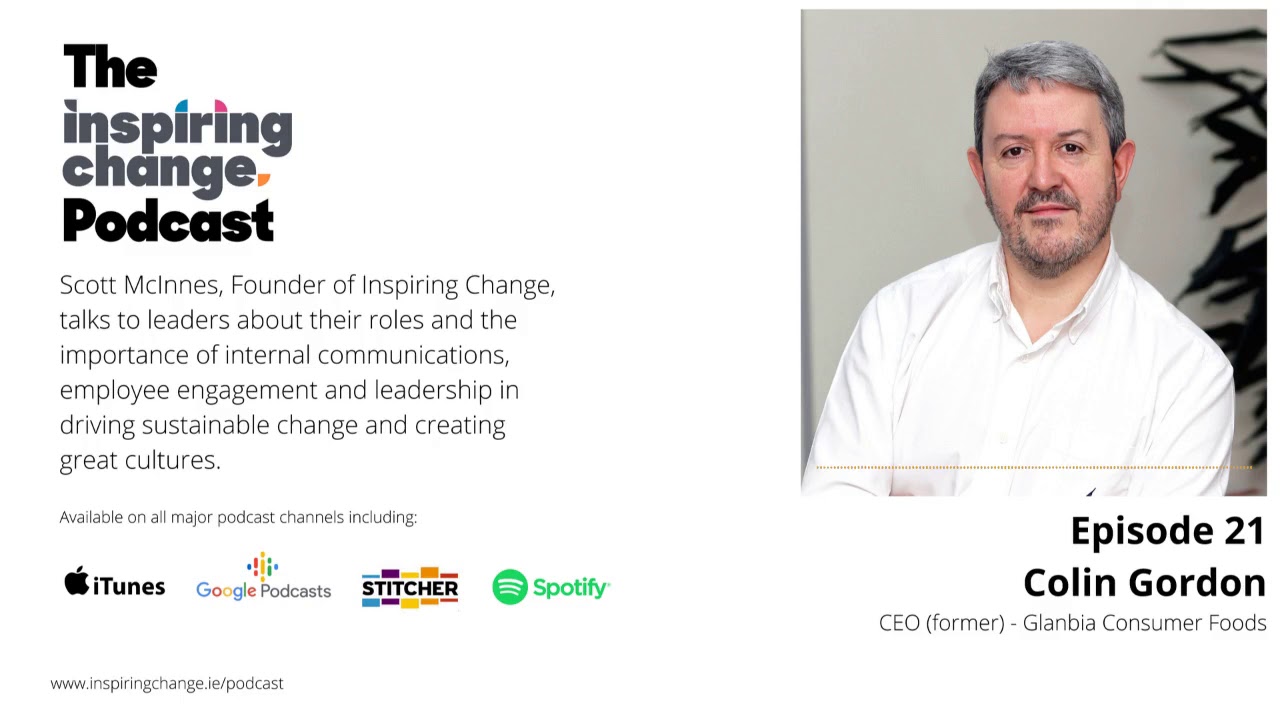
In this episode of the Inspiring Change podcast, host Scott McInnes interviews Colin Gordon, the recently retired CEO of Glanbia Consumer Foods, to explore the Irish food and drink export sector, Glanbia’s consumer‑goods operations, and Gordon’s views on leadership and engagement in fast‑moving consumer goods (FMCG). Gordon outlines the scale of Ireland’s food‑drink exports (64% growth since 2010, €12.1 bn market, €4 bn dairy), describes Glanbia’s key brands (Avonmore, Kilmeaden, Yoplait) and its high‑service model (2.5 m items shipped daily, 99.8 % service level). He explains the “All‑In‑All‑Out” merchandising program that immerses staff across sales, production, distribution and marketing in the product’s journey, fostering engagement and a shared purpose. Gordon emphasizes a leadership philosophy built on simplicity, clear strategy, empowerment, and storytelling, and details Glanbia’s communication ecosystem—from town‑hall meetings to the network of 400 milk agents. He discusses the company’s strategic expansion, adapting Irish expertise to Asian, US and Middle‑East markets while retaining core brand and service standards. The conversation concludes with Gordon’s leadership role models and advice to his 20‑year‑old self: pursue formal training, have fun, and build resilience in the demanding FMCG environment.
Chapters
Welcome to Face Forward, the inspiring change podcast on all things internal communications, engagement, leadership, and change. Hi there and welcome to this edition of Face Forward. Food and drink exports in Ireland are absolutely critical to our economy. They've gone up by 64% since 2010, and last year the market was worth over €12.1 billion. The sector employs over 10,000 people, and we export our products to over 180 countries. So really, really critical to the company, to the country and the economy. Dairy makes up around a third of those exports, so around €4 billion, and it's not massively surprising we have such good dairy. It was Chris Hadfield, the commander of the ISS, who would often say that when he was flying over the Atlantic, the first part of Europe, you would hit was Ireland, and the green of Ireland just shone through like a beacon. And of course, those of you who have visited here and those of you who live here know that we do get our fair share of rain, but of course, rain means great grass, which means great cows, which means great dairy. So I was really happy just before Christmas to be able to sit down with Colin Gordon, who was the recently retired CEO of Glanbia Consumer Foods, one of Ireland's biggest producers of food. We spoke a lot about the sector, and we spoke a lot about leading and managing an FMCG. So I hope you enjoy this episode. Please, as always, if you have ideas of other people you'd like me to interview, please get in touch. And your feedback on iTunes or on your chosen podcast platform is always welcome. So enjoy this. Here's Colin and I having a chat just before Christmas 2018. Colin, thanks a million for having me.
Hi, how are you?
I'm well, thank you.
I'm well.
How are you getting on?
Very good, very good. It's getting busy towards Christmas, which is a pretty frenetic period of time for the food industry generally. But yeah, good form.
There's a lot of cream going out the door, I believe.
Cream is our major focus. We put out the equivalent of about 8 to 10 times the average daily— the average weekly sell-through goes out in about 3 days. Wow. So it's all— we have a program in here which is called All In All Out. Everyone who's in the business who isn't required to be at their desk is expected to go out and do merchandising, check on availability, check on dates because it's a fresh product, it's turning over all the time. We just make sure that it's in the best possible condition, make sure customers are happy, make sure consumers are able to get hold of the product. Yeah, it's a really good It's a great sense of team and a great sense of singularity of purpose, and it gets everyone really focused in one direction, which is fantastic. What a great way to connect your staff to your customers and our staff to each other. Yeah, so it means the sales guys actually see our product happening in real time, so do our production guys, so do our distribution guys, all our marketing guys. So everyone works on one common purpose, which is a really, really important way of just getting people engaged, and they understand the business better at the end of it, and it lasts for a long period of time.
Yeah, absolutely.
Yeah, absolutely.
So actually, that's a beautiful segue into my first question about the business. You know, obviously I have to add a few stats there that the Board BIA had on their website, but maybe perhaps tell me a little bit about you, your career, where you've come from, and a little bit about Glenbia for people that don't know the company.
Sure. So I'm running the consumer business here for the Glenbia organization for the last almost 13 years. I've worked in consumer marketing since about the early '80s. So is that a long time or not? I'm not quite sure which.
It depends on how old you are.
Absolutely.
For some people that would be like a lifetime.
So I think my first job was actually in health and what was known as professional products, which basically means dealing with doctors and nurses and healthcare and wound management, which was quite interesting—bed sores and Burns. Then I moved into, I moved into cigarettes, then I moved into soft drinks, alcohol, waters, and now I'm in dairy. So I've moved through a number of different consumer goods areas. Started off in marketing, that's my, my college qualification, and I worked actually in college for a year after qualifying, which was very useful and very good for just building up the sense of the other side of the college fence, as it were. But I've worked effectively in marketing and marketing management for the last 30-odd years. And the reason I got involved in marketing is I think marketing is actually quite misunderstood. And marketing is not just about communications or just about advertising or just about the 4 Ps as people might know them. And I can come back to that if you wish. It's much more about how to put the consumer or the customer at the centre of the business. So if marketing works right, it's working with planning, it's working with production, it's working with innovation, it's working with finance, it's working with legal, it's working with the customer, it's working with consumers, it's obviously working with sales. So marketing is, if it's done right, if it's seen right, and if it's understood by other functions correctly, is actually one of the central roles in a business rather than something which is detached and somewhat unearthly, which sometimes it can be. So I spend a lot of time trying to make sure that marketing is at the heart of business and commercial is at the heart of business rather than just the end result of some other things. I'm lucky enough to work in Glanbia. I think one of the big advantages of Glanbia compared to other companies I've worked in is I can look out of one of our factory windows and I can see the cows being brought in for milking, and I know that our product will be on the shelf of a local supermarket sometimes that evening and certainly the next morning. That's incredible. And that's very, very, very empowering. It's very humbling in many ways as well. So it's different from working in soft drinks where syrup is brought in and lots of things are added to it. Ours is, it's milk, it's cream, it's butter, it's cheese. It's soups which are made from vegetables and chicken stock and creams and various seasonings. And our soup plant that we have, which is the biggest soup plant in the country, is basically like a big kitchen. There are kettles. Now, they're big kettles, but there are kettles. So it's a very grounded business. You are doing things with product that you know will make a difference to people's time of day and sometimes, you know, have a profound impact. Care is really important, safety is really important, really good nourishment is really important. But even on a kind of a slightly alarming way, how often have we all had calls from significant others saying, 'We're out of milk, will you get some milk on the way home?' So milk is actually a distress purchase in many ways.
It was only last evening in our house actually.
There you go. Yeah. Hope you got the right brand on the way home. So people have to have milk. Ireland has a huge per capita consumption of what we call liquid milk, which is in other words not dried or powdered for export. So in Ireland we have very high per capita consumption of a whole range of different products, particularly of milk. And therefore, if we don't have it for a cup of tea in the morning, for a cup of tea at night, we don't have it for our cereal, it's a distress. So having availability and having extremely high levels of service to the trade is an absolute grounded rule in this business. So we have fantastic focus on quality, fantastic focus on service, fantastic focus on making the product in every possible danger of being sold or rebought. That's what we try and do, and that's great.
I love it. Brilliant. And tell us some of the brands that sit within the Glanbia consumer stable.
So the best-known brand will be Avonmore. Avonmore is a brand that was invented or created about 40 years ago or so. It's now Ireland's biggest brand. It exists in butter, cheese, cream, and most obviously milk. It's— we have other forms. We have it in soup, in fresh soup products, and we have it in orange juices as well, although the orange juice is relatively minor. So it's Ireland's biggest brand, it's bought by more households more often than any other brand in the country. It's a national brand, which is quite unusual in Ireland for a milk business. Quite often it's regional or local or even town-based, and it's performing very well. It's well up year on year. Some of our key brands within the overall family of brands that is Avonmore are up double digits in a tough enough market. We also have Kilmeaden, which is Ireland's biggest cheese. We distribute and work with Yoplait, which is obviously a big fresh yogurt business. And we have a whole range of contract manufacturing, private label, and other distribution agreements that we operate to. So we're And these all sound like very sort of vainglorious claims, but it does matter in the food business. Scale is really important. We're probably Ireland's— we are Ireland's largest consumer foods business. We ship about 2.5 million consumer sales items per day with a level of service of about 99.8%. So big numbers which work for you if you're doing them well and work really, really badly against you if you do it wrong. If you get any of those percentages wrong, or any of those absolutes wrong. It really does matter. So big-scale business, that's what food is about.
So when you think about the volume of, of product that's going out every day, when you think about keeping that level of service up at that high 99%, when you think about the brands that are coming through here and, and continue to build and maintain those brands, leadership and your leaders in the organization must be at the very core of that. So what for you is it makes a great leader in a business? I've been really lucky.
I've worked for some really good role models, great leaders in their own right, and people who I've been lucky enough to be able to get a lot of life lessons and professional lessons from. Keeping it really simple, keeping the strategy simple, keeping the message simple, keeping your approach simple. Your communication is simple. Keeping it simple, I think, is really important. Empowering people is really important. In other words, once you know what you are going to do and you have managed to engage people in that, then let them get on with it. They should know that they are doing the thing that has been agreed. Let them go and do it. I guess the difference between a leader and a manager is managers tend to do the doing, leaders tend to be doing the thinking and the strategizing and the pathfinding. Clearing the way on that path. And quite often they are merged. Leaders can be managers, managers can be leaders, but in the role of leadership, you need to understand that you need to work out when you need to stand back and when you need to step in. So keeping it very simple. Role identification, all that kind of stuff is to my mind where it is really important. The single most important thing, however, is having a really, really, really clearly understood strategy for the organisation and keeping at it. It's very simple. A lot of companies have 3-year strat plans. 5-year strat plans, 10-year horizon plans. I remember working for one organization who said it used to be a 2-year plan, then it was a 5-year plan, now it's a 3-year plan. Whatever it is, group head office wants it.
Well, that's a great way to motivate people. And that is not—
that is exactly right. It's a way of, you know, of motivation to the power of minus 1. It's just to turn everyone off. We just— you go through the motions. Yeah, we actually very rarely revise our strategy in here, and we do it because we do— we do it so rarely because we know it's right. We tweak, we may well add, we may add emphasis, but we don't change because we absolutely believe what we're doing is correct. We did a root and branch review 7 or 8 years ago. We're absolutely convinced, research supports it, performance measures support it, market share numbers support it. All of the external and indeed internal measures support what we're doing, and we would be very, very, very reluctant to change it. The one change we made a couple of years back was we decided that we needed to bring the expertise that we built up in the Irish market to other markets. And that was really adding to the strategy rather than changing the strategy. So we got much more involved in bringing consumer products in consumer-ready formats to Asia, and increasingly now we're going to the States. States, and we're into the Middle East as well. That's— it's a different product range because we're now looking for moving from 14, 15-day shelf life in most of our products to multi-month shelf lives. Different factory requirements, different shipping and distribution requirements, different distribution require— distributor requirements. But we know what we're doing with the brands. We know what we're doing with our service and our quality standards. They transfer from one strategy to the other very easily. So again, simple. We're just adding on to what we know we're good at, what we know works, and we're bringing it to other consumers and customers.
Okay. I completely agree on the strategy piece, that keeping it simple, keeping it consistent, just keeping banging the drum. And I can't remember who it was that said it, but it's you know, it's around the time that you get bored of telling somebody something that actually probably lands with them. And I guess like many organizations, the strategy is created at the core and then pushed out. What do you see when you talk about leaders keeping strategy simple? What do you see as being their role day to day in terms of helping their people to see that link between what those people are doing perhaps in the soup factory or bringing in cows to be milked how what they're doing is linked back to the strategy and success for the company.
Yeah, it's like the old story of, in John Kennedy's era, about someone went to visit a factory and there was a guy sweeping the floor. 'What are you doing?' He said, 'Well, I'm working here in an aerospace industry. I'm helping put a man on the moon.' So yeah, I think engagement is the biggest single thing. We work quite hard. I think we work really well and hard. On building engagement. And the engagement is— I am very strongly of the belief that people don't check in their personalities and their capabilities at the front gate. And nor should they, I agree. No. So they are— how do you make sure that they are committed to the one cause, to the simple strategy, realizing that there is a lot of complexity behind it, which is the nature of business, and the fact that some of the demands and some of the externalities can change all the time. But how do you keep the strategy simple, recognising all the dynamics and making sure that that person, he, she, them are fully engaged? And the engagement piece is really important to us. And that allows for common language, common narratives. It allows for literally storytelling, which is important. Communications is really important. It means if I go into a factory, if I go into an office, if I go into a meeting, I kind of know, I might not know exactly about that meeting or exactly what's going on at that point in time, but I know where we're all going and I can instantly begin to have a conversation with anyone about what we're trying to do, knowing that they will be on the same page. So it's making sure the simple can actually be communicated down and people can feel engaged with it. And I'm using the word simple not to confuse with simplistic or even silly, but how do you make a very big story very simply told? Keep at it. I remember, maybe slightly somewhat differently to the question you're asking, but I remember doing research into a previous brand I had, which was into high double-digit growth every year, every year. And we did market research into it, and the research came back, was seen as, the ads were seen as boring, the labeling and product formats were seen as very traditional and not exciting, and people wanted an awful lot more jizz and jazz in what we were doing. They wanted more, I don't know, strident promotions, they wanted more events, they wanted more active ads and overall communication strategies. And we made a conscious decision, which is we actually don't care what the research is saying. That sounds very dismissive because the performance is actually delivering a different result. So the underlying message was getting through is the point. The underlying core message of what we were trying to say was getting through and working. And all the other stuff is just noise. So how do we make sure the underlying message of what we're trying to do here in the business at a strategic level, rather than even at a brand level, is cutting through, is getting through, and people can understand it? And there may well be a lot of noise around, and there may well be discomfort, there may well be issues at any one time. Of course there are. It's a fast-moving consumer goods business. But how do we actually make sure that the noise doesn't distract from the core message going through. And that's really important to us.
And I guess for me, a key part of that is where leaders come into play. So those people on the ground, as we were talking about before we started recording, the fact that, you know, that the strategy can come from the top, from the head office, but actually it's the managers, the leaders, the team supervisors on the ground that are the ones that are able to take your strategy and make it relevant and contextualized for their people in language and through story that they can relate to.
Absolutely. Yeah. And by the way, celebrating. So we communicate and, you know, you can, I could spend the rest of this talk talking about communications generally, engagement around the strategy and around the day-to-day activities through great communication, great celebration where appropriate is really important to us. So we've put a lot of effort into finding the best way possible of engaging with staff throughout the organization continuously. And it's all the way from formal town hall meetings with, you know, kind of a big presentational style to message boards and everything in between. And neither of those two extremes are new. It's actually what's happening in the middle that is new. So we have— we've employed Engagement Management to work with us to help make sure that across the different factories we operate and the different depot systems we have and the head office here and the people who are out in the field who don't necessarily— out in the sales force and the distribution staff who aren't necessarily in any one location, they all can feel involved in what we're trying to do and understand that even though it's a very large fast-moving business, they feel some connection with it on a daily basis.
And I think that's something that's so critical. I think particularly when you work in a business that has a distributed workforce, whether that be through depots and farms and production facilities, or whether it be in a branch network in a bank.
But we also got 400, just about 400 milk agents, the old-fashioned milkmen. Okay. They are part of our communications audience, they're part of our workforce indirectly. How do we work with them? How do we make sure they understand what we're trying to do? How do we make sure that when they're in front of a customer delivering product in, be it on someone's front door or a shop which they would distribute to, that they are part of the communications purpose that we have? Because if they're— if any one of the group of people, of the roughly 1,000 people who work in the consumer business, including the 400 the milk agents, if any one of them are actually saying a different story to what we're trying to, that's not good. If a lot of them are saying a different story, that's really quite bad. So we need to make sure all the different elements of the business are pointing in the one direction, and not just saying it in a parrot-like way, but saying it because they believe it. They know this is actually the way we want to operate and it's working.
Yeah, and I think actually I'd completely forgotten about the milk delivery business, of course, that you have. And that gives, that must give you a really, really good insight into what consumers want, because probably does any other manufacturing company in Ireland in the food sector have that touchpoint of the end consumer?
Bread might, but not that level of workforce. They'd have, and they might have, I don't know, a third of that number. Some of the big guys would have about a third of that number, but no, the rest tends to be through large distribution depots where large trucks come and take everything away. Ours is, we have a whole series of depots. We have 5 very large depots. We have 80 smaller depots around the country that people actually use for their, for stockholding while they bring it to smaller towns and villages and nightclubs and clubs and hotels and guesthouses and care homes and all the rest, all around the country all the time.
Okay, interesting. And that gives you, I guess, that sense of feedback from the end the end, end, the actual customer. I remember when I was working in AIB, I used to spend a lot of time with the support functions, so the likes of legal and HR and finance and risk and compliance, all those people. And they'd often say to me, "Well, it's very hard. When you talk about customer first," which actually I don't actually fundamentally agree with. I believe that you should put staff first and allow them put customer first. Maybe that's a conversation we'll have in a second. But they would always say to me, 'But my customer is internal. My customer, if I work in legal for somebody in corporate banking, my customer is internal.' I used to say to them, 'No, no, no, no, you can forget that, because actually the customer is the customer. That doesn't change.' Yeah. The person who wants the loan to buy a business doesn't change. If that's a very time-bound transaction and you don't pull your weight and you don't do the thing that's needed to be done in order for that person in corporate banking to be able to do their job, then we fail the customer together.
There's a broken chain. Well, yeah, and that's an interesting point because there's a huge difference within marketing. There's a massive amount of debate going back, I don't know, Peter Drucker and loads of others over the years. What is the definition of marketing? And there's lots of ways of defining it. But my way, which I haven't seen elsewhere, but I do genuinely believe this, is marketing and all the other functions you're referring to, legal support staff, admin, in my business, distribution, production, innovation, is to make selling easier. That's why everyone's here. It's why I'm here. I mean, my kids quite often ask me, 'What do you do today?' Especially when they were younger. And you say, 'Well, actually, I have meetings, loads of phone calls, a couple of conference calls.' 'Yeah, what do you actually do?' So what we do is not physical. It might be tiring and exhausting, and it might be rewarding, whatever way it might be. But it's not physical. We don't actually make milk. I don't make milk. I don't make cream. I don't drive the trucks. So what do we do? And it has to be about making selling easier. And that's real leadership. So whether it's me or the legal team or the innovation team— innovation includes continuous product improvement— it's making selling easier. It's putting the product in every possible danger of doing better and better every day. That's what we're about. And that product can be a service, that product can be online or offline. So it's, what are we trying to do? We're trying to make money. Don't make any apology for that. We're trying to make money for our— I guess everyone talks about the shareholders. We're also trying to make money to be able to pay all our wages every week and pay all our obligations. So we're trying to make money, and everything we do is trying to make selling easier to make more money. It's as simple as that.
And I think, to talk back to the point you made earlier about storytelling and leaders telling stories, it was only when, in that legal example, when you sat them down and said, but if this customer does this and you don't do this, and this happens and the whole thing falls over, you can see the light bulb going off.
And they suddenly go, oh yeah, I hadn't thought about it like that. Well, in the case you're referring to there, that legal person is trying to make the granting of a mortgage easier. Or not, because it's a bad risk. But they're trying to do a job to make the person in front of the customer be able to do a better job.
So of course, it was Branson who said— to talk back to the customer-first piece— it was Branson that said, interestingly, it shouldn't be about customer first. It should be about staff first. And then we'll allow our staff to look after our customers. And they'll do a really, really brilliant job at that. What's your take on that?
I think customers, trade customers, have a really, really, really difficult job, particularly in FMCG, particularly at the moment with so many different dynamics taking place. Sometimes we need to put our feet into their shoes and understand. So when they're actually— when there is an issue, and when there is maybe a bit of conflict, understand what they are trying to do. We are probably better briefed on our products than they are. Not probably, definitely, almost all the time. They are very well briefed on their own total business, but not necessarily on our product. And they therefore have a relatively narrow view and relatively short-term view to try and overcome an issue. That doesn't mean they are always right. And if the strategy is credible and believable and you stick to it, you should be able to say to a customer, 'No, you are not right on this one. I am doing what I believe is right for the business.' Even if that means you are going to walk away from business and walk away from opportunities. If you believe in the strategy, you have to have the confidence to go and do that. Otherwise, what you are is you are into volume or you are into short-termism. To satisfy their particular issues, and margin gets lost all the way along the line. So that's a big, big, big piece of leadership. It's a big piece of getting people to really buy into the strategy, because you have to trust. I'm always minded by the idea that salespeople, key account managers and salespeople generally, operate on trust. You give them all of your key secrets, your brand plans, your promotional plans, your pricing programs, quite often your recipes, and you send them out and you might not see them from one end of the week to the other. And they're out there doing something. It's not a clock-in, clock-out system. They do have targets to meet, whatever, but they actually could, you know, theoretically meet them all on the last day of the year by one huge order. It wouldn't happen in our business because we have short shelf life product. But so it is based on trust. And you have to trust that they're actually saying in front of the customer what you want them to say in accordance with strategy and have the confidence to say no. And sometimes we as senior leaders will actually go along to meetings to make sure that the customer knows that we're supporting the key account manager or the salesman, saleswoman, to make sure that they don't believe that if I go up higher, I'll get a better answer. So again, it goes to that simplicity. They need to understand that they need to buy, they need to be able to communicate that in quite often quite fraught, intense meetings very simply, very succinctly, and believe it themselves and move on to the next item.
And that of course means them feeling extremely empowered and you within Glanbia Consumer having a culture in which those people—
but Scott, they are the leaders then in that meeting at that time in front of that customer who could be a senior commercial operator for one of the biggest retail companies in the world and one of the biggest employers in Ireland, and they've been trained to be able to go and, you know, do their job, they are leading your business at that moment in time. Yeah, that's— so it is trust. As much as we trust the delivery guys to not just to leave the stuff, you know, throw it down and walk away from it, that they actually look after all the way to the back door. So leadership happens at almost every step of the value chain. There may well be a leader at a point in time, there may well be leadership talked about, but leading happens all the time. Lovely, really nice.
You touched earlier when we talked about your definition of what makes a great leader about the fact that you have had some really, really good leaders that you've learned a lot from. Who are some of your leadership role models, and what were some of the things that you took from them?
Professor Tony Cunningham in UCD, when I was, when I did my master's, was— he asked me to stay on and to work for him for a year. One of the big things I see from him, from Gerry Grogan, who ran Imperial Tobacco here here in Ireland and worked for him as head of marketing. And then when I worked in alcohol and soft drinks, Tony O'Brien, who headed up the Cantrell Cochrane organisation, and then John Maloney, who employed me here in Glanbia, and Siobhan Talbot, who now runs the Glanbia operation. They all had trust and they all empowered you. And never did I get a sense that if I came up with an idea or if I made a suggestion that it was going to be considered to be, well, that's from the new guy or that's from someone in marketing. They took it on board validly, they tossed it around, and they incorporated it if it was appropriate. So you always felt that you were listened to, you always felt that you were trusted, and that you were empowered. So they're not easy attributes. You know, someone, at least one of those people, had effectively run the company as, in this case, his own for many, many, many years. And to go in there as someone with loads of highfalutin ideas was always going to be not difficult, but it had the potential to be awkward for someone to actually go, 'No, I'm listening to you, that's fine, go and do it.' Even when you were doing something which might not have been in their mind over the previous couple of decades when they were setting up the company and running the company, that was always going to be a moment of truth, and it came through. That sense of 'let them do it.' 'Yeah, I've empowered you to do something, I've employed you to do something, I'm going to empower you to go and do it.' 'Keep me informed.' Yeah, it's really interesting when you talk about the kind of the owner-manager having run it themselves for the past 20 years, and here comes this young buck with all their new ideas.
It's actually, you know, and we know, and we've both seen those organizations which are doing well, yeah, but they don't go interstellar, yeah, because that person just won't let go. Yeah, they won't let the—
you and your peers come in and say, 'Here's the way we should be doing things now.' It's a great expression I heard from someone once, which is every now and then we need to learn to say yes. And quite often we're programmed to say no, or what about, or have you not thought of, in some way saying no, hesitant, somewhat building a block rather than actually opening a bridge. Sometimes we need to learn to say yes.
Yeah, I love that. I'm not going to let my kids listen to this podcast, obviously, actually purely just for that last 10-second little clip there. They're not going to get to listen Listen to this. Kids, I'm never saying yes, by the way. So tell me, this is a question I ask at the end of all the podcasts. And I think I'm actually going to put together a podcast just of this. Of the end.
Just of the ends. The end of the ends.
The end of the end. I'm going to use that. I'm copywriting that really quickly. What's the one piece of leadership advice you would give to your 20-year-old self, knowing what you know now? Yeah.
Do you know, that's a very good and which is code for not very fair question. I've had fantastic fun. I can't say have more fun because I've had fantastic fun. I think laughing and friendship is really important. The FMCG business is very collegial. You don't go into it for an easy time. It's actually quite— you need a huge amount of resilience because it's big numbers repeated every day, including Christmas. So it's a very, very, very repetitive, high-stress sort of environment. And whether we're selling cigarettes or alcohol or soft drinks or cordials or dairy products, it's the same. Same thing. And no matter what size you are, you still need to have a very good service level repeated every day. Now, I know other companies might say that's the same for them. It's the kind of the— it's the fact that you're actually putting food into someone's mouth every day, or food or drink, is what actually just makes it really quite particular. So I can say have fun because I've had fun, because one thing about the FMCG business is it actually builds a collegial thing. People come in and they kind of stay around for a while within the sector, maybe not within each company. I can't say, um, you try different things because I've tried loads of different sectors, I've tried loads of different geographies, I've tried loads of different companies. I've got involved in franchise management, distribution agreements from some of the largest companies in the world into Ireland and out of Ireland. I think spend more time educating myself. I found myself the other day signing off a piece for one of my colleagues and saying, "I think you should do this program." And I actually said, "Why wouldn't I have done that?" One of the shortcomings I've had, notwithstanding the fantastic words I'd say about almost all my bosses that I've been lucky to work with, you know, bar one or two, I've been very, very fortunate, was that they didn't necessarily do a lot of formal training, so you learned on the job. That's very exciting, and you really get a sense of, you know, the dynamic of life. But I think I would have done better, I would have enjoyed more intellectually the discipline of more formal training. So at the age of 20, I was still in college at 20, but if I was, say, 30, I would have gone, I need to do more formal training. I need to be continually developing myself formally rather than just relying on on-the-job training. Okay, so that would be it.
Do some formal training and have fun. That's it.
Is that what we're taking from that? That's it, exactly.
Excellent. And that wraps up my questions, Colin. It's been really good fun.
Well, thank you very much indeed. It's been a great opportunity. Thank you. I wish you and everyone listening the very best going forward.
Thank you very much. And hopefully the run into Christmas isn't, isn't too bad for you. And thanks for giving up your time.
Not at all. Thank you very much indeed. Thank you.
Thanks for listening. If you enjoyed this podcast, please take a minute to rate it and maybe even leave a comment. To learn more about Inspiring Change, to read our blog, and to hear more podcasts, please visit our website at inspiringchange.ie.
More from Scott

Leaders can't assume connection happens automatically #LeadershipLessons #EmployeeExperience

The hidden reason your remote team feels disconnected #TeamConnection #HybridWork

This is why people actually stay at their jobs #workplace #culture #retention

156 | Inside Disconnection at Work: Bridging the Connection Gap Report with Sadhbh O'Flaherty




155 | The Overlooked Art of Building Connection at Work | Scott McInnes with Christine Armstrong


