Episode 26 | JULIE SINNAMON | CEO, Enterprise Ireland
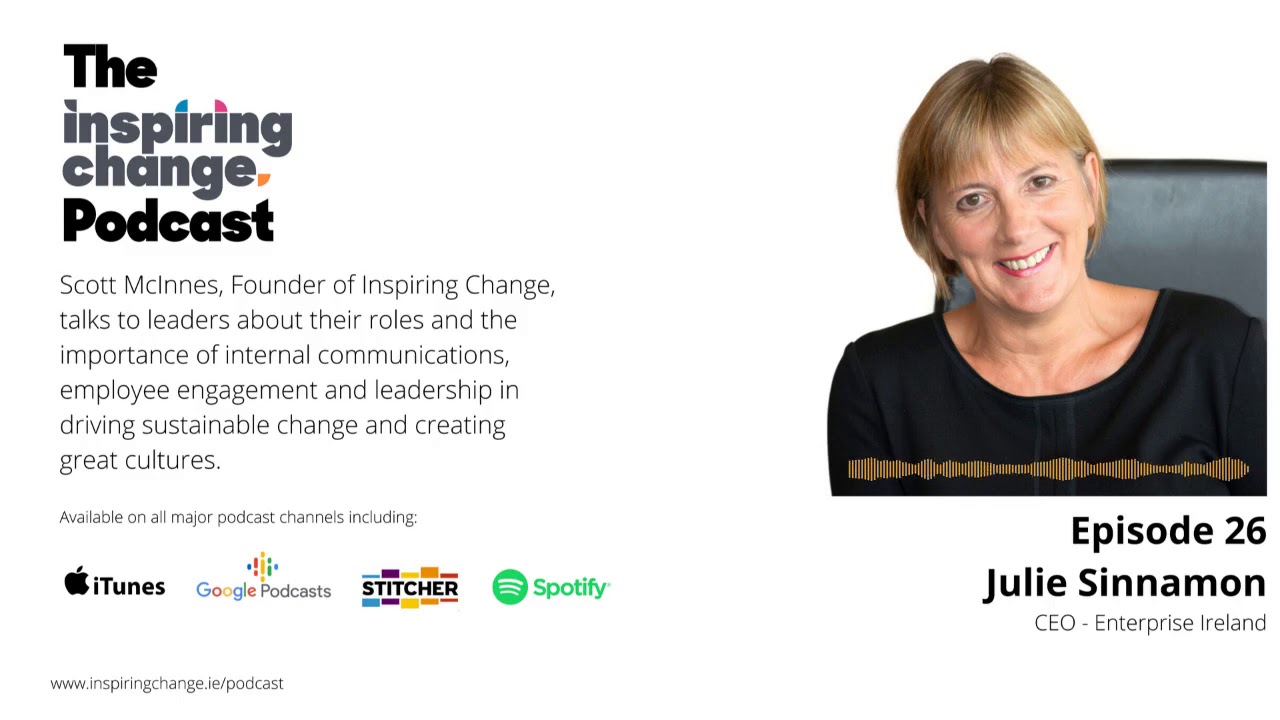
Julie Sinnamon, CEO of Enterprise Ireland, discusses how SMEs make up 99.8% of Irish enterprises. Brexit cut the UK's share of Irish exports from 44% to 34%, forcing diversification. She emphasizes that great leaders need vision, storytelling, and purpose, and notes that only 10% of global tech founders are women, though Enterprise Ireland's recent cohort reached 24% female representation.
Chapters
Welcome to Face Forward, the Inspiring Change podcast on all things internal communications, engagement, leadership, and change. Hi there, and welcome to this episode of the Inspiring Change podcast. When I spoke to Colin Gordon, the former CEO of Glanbia Consumer Foods, a couple of episodes ago, we talked a lot about the importance of the food sector, and particularly in export, to the Irish economy. And of course, as a small island nation of 4.5 million people, exporting our products and services is absolutely critical to our national success and the success of those businesses that actually trade on this island. And when you look at this island, we are a nation of small businesses. That's what we do. When you look back at some stats— and they're a few years old now— from the Central Statistics Office here in Ireland, SMEs account for 99.8%— of total enterprises. That was back in 2014. And nearly 70% of all persons in work work for an SME. They generated 56.1% of total turnover in the economy, and just under 50% of gross value add was attributed to SMEs as well. So they are so critically important. But of course, there are many areas in which SMEs don't have strength— funding, knowledge, development. And that's where government agencies like Enterprise Ireland come in. So I'm really pleased to be here today with Julie Cinnamon, who is the CEO of Enterprise Ireland, to talk a little bit about that and to talk a bit about leadership and engagement within the context of a department like Enterprise Ireland. So Julie, thank you very much for having me.
Delighted to be here, Scott McInnes.
Brilliant. Why don't we kick off with the question we always kick off with, which is why don't you tell me a little bit just about yourself and your career? Where you've come from, and then give us a little bit of a background on EI and what it is you do.
Okay, well, let me go back a little bit in history. I'm from County Down, as the accent may suggest, and I studied business studies in the north. Well, I'm with a family business, which I think is pretty important in terms of the conversation we're going to have, because from an early age we all got involved working in the family business. We were in the poultry business, And then later we were in the retailing, and we had a petrol business, and we had a load of sisters who all worked serving petrol. And it was, uh, uh, we, we were rooted from an early age. There was no child protection legislation, and we all had to do our bit for the family.
And as you told me then, you had, you had quite the staff in your—
quite— we were, we were able to staff the business ourselves. We didn't have to employ anybody else. Um, so then I went, uh, and studied business in Ulster University. And came to Dublin, and that was in 1979-1980. And arriving in Dublin, what really struck me was Dublin was full of multinational companies, and that was a pretty lean time in Northern Ireland for companies. One of the few successes we got over those years was DeLorean with those beautiful winged gold cars, which didn't last for too long, which cost a fortune, and it's a collector's item today. So I came to Dublin, I was really interested Subsequently, when I was back during my last year of study, I did a thesis on multinational foreign direct investment location decisions and compared Northern Ireland, the Republic, and Scotland, and got involved with IDA at the time. Then I subsequently was back living in Dublin, and IDA approached me. They were recruiting, and they asked me would I be interested. So I joined IDA because of my interest in foreign direct investment, and actually when I joined, I was put in the regional division and in the food division and worked with Irish companies, and that's where I really got my kicks in terms of working with an entrepreneur coming in with an idea and working with them on that project building side and helping them and seeing those companies grow and mature and become large companies. So Really working and seeing how entrepreneurs were changing the landscape in Ireland was something that I really enjoyed, and hence have worked in a lot of different areas in IDA. Government then subsequently decided there should be a separate agency working with Irish companies than they work with foreign direct investment, and that was an easy decision for me then to, to stay with the Irish side and to join an organization which subsequently became Enterprise Ireland.
Interesting. And of course, it's not all about funding. There is funding there available for organizations, but there's much more that you do as well.
Yeah, we're working with companies from the start side right up to scaling. The key metrics are jobs and exports. So with 34 offices around the world, we're helping Irish companies grow internationally because you can't grow large companies if you're only supplying the domestic market. Food is the largest sector we deal with, 55% of our exports would be food, and we're working with them. Probably one of the biggest impact things we do working with companies is leadership development, working with entrepreneurs, trying to drive the ambition level within the companies, and then working on the development of the capability of companies to set a stretch Ambition, and then develop the skills and the team to be able to deliver on it.
And do you see that in— because it's something that I see in owner-managed companies is that they don't necessarily have those leadership skills because it's been an idea they've had in their head. It's grown up maybe in their bedroom or their kitchen to 10 or 12 or 20 people, and suddenly they're the boss and they're kind of— they're lacking ever so slightly in those skills because they've never actually been taught them, and it really holds them back.
That's right, and that's why we would do a lot of work working with them, both in developing their own capability, on encouraging them to see the, the need for that wider skill set to be within the company. And for some smaller companies, they'll bring that expertise in either on a temporary basis or through board members coming in to add that strategic lens to the company, or bringing strategic HR skills into the company, depending on the size of the company. But the skills development area is really critical, in my view, to the growth of the companies.
Yeah, yeah. So it's not just about throwing money, it's about how you upskill the people that are actually bringing those businesses to bear. And I guess right now, you know, it's— what is it— March 2019, and we're in the teeth of— can we say the B word? Should we say it?
Should we go mad? The B word has changed my life for the last 2 and a half years, so yeah.
Is that going to have a— do you think, do we know really, Brexit, what impact that's going to have on Irish export businesses?
Yeah, I think it'll have a pretty— if we ended up with a hard Brexit, it would have a pretty dramatic impact on Irish companies. Two-thirds of the employment in Enterprise Ireland clients are outside of Dublin, and many of the traditional sectors are heavily leveraged in the UK market. So it is our number one market. We have reduced our dependence on the UK. It was 44% of our exports. Of Irish companies 10 years ago. Today it's 34%, but for some sectors it's 70%, 80%, 90%, or 100% of the exports.
Yeah, and it's tough for a company. And I know from just, you know, being on LinkedIn a bit that you're doing a huge amount of really good work helping organisations to become Brexit ready and actually think a little differently. You know, do you look to Spain? Do you look to Portugal? Do you look further afield to try and reduce that reliance on the UK market?
That's right, and you know, last week we had St. Patrick's Week and we were in the US. We had 110 companies with us in the US for the week. We were in, you know, I think 55 different countries that we were operating last week with ministers and with trade events, and from Australia to the West Coast of the States and everywhere in between.
Brilliant. I think it's interesting that, you know, the government, the ministers will get knocked when when they go off on their St. Patrick's Day trips, but they're really important.
Yeah, but actually this year I thought there was a different tone in the media coverage of it where there was a recognition that this was really making a difference and that ministers were using the event to really open doors and help Irish companies to grow in global markets, and that's what we have to do.
Interesting. So let's look at this Irish company. Let's look a little inside Enterprise Ireland. And get your thoughts on what you believe makes a leader a great leader.
Well, the first thing I would say is vision. That, you know, a leader has to have a strong vision for what they're trying to achieve with the organisation and be able to set that out in a way that people are inspired and want to follow that vision. So the vision, I think, is the starting point. And the same in all of our companies, which is why I'm saying if you don't have the ambition, then you're never going to achieve the maximum potential that you can achieve. So I think the vision is the first area. And then having set that vision and communicated it clearly to staff, it's talking about leading by example. What are you actually, you know, to show staff that what you're asking of them and Inspiring them, I think, to give that extra 10% and to give of their best, but that it's something which, you know, you're prepared to muck in there and that, you know, everybody is in this together. So you're supporting and unblocking staff, so you're not at the top of a pedestal and giving orders. You're effectively setting out a clear vision that you're really committed to, and staff can see that you're there to support them to achieve what you're all trying to achieve. In terms of an organization like this, anybody coming in the door of Enterprise Ireland is coming in, it's a development agency, and they expect to be energized and meet people with passion. And I think, again, the leader of the organization has to have that energy and passion and be really, you know, enthusing people. You know, many people will talk about You know, one of the things that today people are increasingly looking for from the workplace is a sense of purpose. And they get that in spades in Enterprise Ireland, which is why I very often say I have the easiest job in Ireland, because actually what we're trying to do is create a better Ireland. We're really trying to give people choices. If someone wants to go and live in Australia or America or the UK or Europe, so be it, that's a choice that you can make, but you shouldn't feel that you have to leave your community and go and live somewhere else because there aren't opportunities at home. And hence, you know, the two-thirds of the employment that we're creating, which is outside of Dublin, is allowing particularly rural Ireland to have choices to allow people to stay at home. So enthusing people within the organisation of what you're trying to achieve and setting out that purpose and, you know, continuously communicating and making sure people realize that we're actually on message, that we're actually delivering against whatever we set out to do. So that energy and passion and sense of purpose, I think, is a key role for the leader, both internally and externally. I mean, because Ireland has been so successful as a base for multinational companies, very often Irish companies were in the shadow of the wonderful multinational companies that have come to Ireland. And yet, if you look at the room we're in today and the pictures behind you of all of the great entrepreneurs, companies like Combilift in Monaghan creating hundreds of jobs and exporting at this stage to 85 countries around the world, Chanel in Galway, Aerogen, I mean, we have hundreds of these fantastic people who have changed the fabric of Irish society And it's such a pleasure for me to accompany them around the world and see them getting success, which is actually helping to build a better Ireland for the future. That's what it's about.
Great. And it's only when— and actually until you said that, I hadn't turned to look over my shoulder to see them— but it's actually, you know, it's— they're fantastic stories.
Yeah, every story. And actually it's all about stories. I can stand on a platform and talk about how we're going to build a long-term sustainable strategic competitive advantage for Ireland, and what does that mean for somebody in the west of Ireland who's saying more gobbledygook from Dublin, right? Even though I'm not from Dublin, but I get accused of that.
You are not, you are not.
You know, but if you can— and you know, one of the things that the most powerful thing that I think any leader can do is talk about stories of success both within Enterprise Ireland and fueled by the companies, and then other people can say, can see, well, if he can do it, I can do it. And setting out stories of people that other companies can relate to— take Brexit as an example. If we're trying to get companies who are heavily dependent on the UK to, you know, move into the eurozone or into the Asian market, and if you can tell stories of other companies similar to them who were totally dependent on the UK market and have now developed a strong niche in Germany or France or Japan or Italy or wherever it might be, then other people will follow. So all of those abilities to, to, to set the vision and then tell stories of success, which are actually milestones along the way to achieving that vision, which will help build that momentum. And it's the same whether we're talking about entrepreneurs, female entrepreneurship is an area which we've done a lot of work in the last number of years. And again, it's putting a spotlight on people who are actually doing what we're trying to get other people to do. So those are all, uh, aspects— come back to your original question, Scott, in terms of what, what makes a leader. I think it is having that vision, bringing people with you on the journey, having people who want to come on the journey that you're enthusing them as opposed to having a big stick to force them to come on the journey. And that's where you're going to get the best out of your people, and people are the biggest resource that we have in Enterprise Ireland. So developing the people within the organisation and actually making the most of those people and developing them in order to deliver on the job of the organisation.
I did a piece of work actually for Enterprise Ireland about God, I'm showing my age now. Probably in about 2002, actually. It was when you were around, you were starting to try to get companies to be more digital, to start websites, to think about ERP, that kind of thing. I was out and I did about a dozen case studies that came out, about 10,000-word case studies that came out in these books. It struck me as exactly that. We were down with furniture companies in West Cork who were literally the back arse of nowhere. Literally, they weren't near anything. But they were the ones that were doing all the furniture for huge hotels in London. And being able to tell those stories so that somebody else in the west of Ireland can say, well, I'm a furniture manufacturer, I can do that too, was really powerful.
Yeah, that's what it's all about.
Yeah. I think when you think about change in workplaces, and I think these days more than ever before, change is to nick a Netflix line from their playbook, you know, "Change is for me is the new black." If you're not changing effectively as an organization, you're dying. And I guess you must be at the forefront as an organization, you must be at the forefront of helping organizations that you work with to change. But if you're looking back internally, what do you see as being the role of leaders during change to try and get them to bring their teams with them? What are some of the things are the things that they should be doing?
Well, the first thing is to convince people within the organisation of the need to change. And very often, you know, if, you know, and I look back and one of the jobs I had around 2003-2004 was running the change team within Enterprise Ireland. And at that stage, you know, you know, people were heading towards full employment and saying, do we need Enterprise Ireland? What are they doing? And therefore, you know, and organisations at present, we are now heading towards full employment. So again, people could ask the question. Of course, we have that awful B-word Brexit, so I think we have a very clear focus at present. But if Brexit disappeared tomorrow as an issue, what would we be talking about as an organisation? And the rest of the world is moving on with technology changes. There's disruptive technology coming down the road that's going to change the way people do their jobs. We've seen a lot of change in the last decade, but I think that's small compared to what is ahead. And we have a key role in terms of getting companies to change and to be ready and future-proofing Irish enterprise. So the first job in change is actually to convince people of the need to why do you need to change? And, you know, sometimes people will talk about the burning platform, but why do you need to change at all? And if you don't achieve that, the rest of it is a waste of space. And the second thing I would say is, having convinced people of the need to change, it's actually setting out a vision of what, you know, what is the benefit of that change for the individual? Why should I buy into this change? It has to actually be worth the effort of making the change if you're going to get people to go on that journey. And then it's about setting out milestones along the way in terms of encouraging people that we're on track, that the change is happening today, it isn't something that's 5 years down the road. You've set out a path of what that change journey is going to be like, and then we're tracking success along that journey relative to what we said would be achieved. And sometimes you don't have full clarity, but at least you're setting out as much as you can see in terms of what we're trying to achieve. So I think the role of the leader is, is setting out the need for change, setting out the milestones, and setting out the pathway, and encouraging people that it's possible to make the change. And it's not only possible, but actually this is something which would be a better place to be than where we are at present.
And what can leaders do, do you think, or what have you seen work really well from a leadership perspective in terms of helping to, I guess, link people to the change that's happening and be able to show that red thread, as I like to call it, between what the person is doing on the front line and in this instance in Enterprise Ireland, what you're trying to achieve as CEO. How do leaders do that bit?
Well, you have to show some connectivity between, you know, the whole— the— it's the end-to-end piece, how the cogs in the wheel fit together. How, if you're in the communications area in Enterprise Ireland, how does that fit with us saying we're going to create 60,000 jobs and we're going to sustain 200,000 jobs and we're going to reach exports of €26 billion? And what is that line of sight between the individuals what you're actually trying to achieve. And that's something which isn't— sometimes it's easier than others, but everybody has to be able to feel that they have a contribution to make which is relative to what the organization is trying to achieve. It's a little bit like the story that's often told about JFK and the guy, you know, brushing the floor, saying, I'm going to help to put a man on the moon. And that is very simple, but everybody in this organization whether they are welcoming people in reception, they are the front face of this organisation. And from somebody walks in the door here until they get a cheque, or they go on a leadership programme, or they, you know, they, they work on a research and innovation project, all of those parts are what Enterprise Ireland is doing for Irish enterprise. That's everybody's reality when they think Enterprise Ireland, as to what was their experience. And everybody needs to see what contribution they're making to that and feel part of it.
Yeah, and from my perspective, that connectivity is not something that you, as CEO, can really do. You can set the broad corporate narrative, the broad direction, the broad purpose. But actually, for me, it's that line management structure all the way down to the frontline that can really help to bring that to life. People because those bosses, those line managers can help to translate, they can help to contextualize in the context not just necessarily of their team, but of the people in that team on that particular day. Because perhaps we've had a death in the family, perhaps we've got a new puppy, perhaps I've just had a baby, perhaps something good or bad has happened in my life and therefore as a human being I'm going to be in a different place on that day receiving that message than maybe I was yesterday or I will be tomorrow. So there's a huge role for line managers, I think, to—
Yeah, cascading that messaging right down and that connectivity. But also there's a role in terms of putting a spotlight on the successes in different parts of the organisation which don't always get a spotlight. So it could be somebody in here, you know, who's arriving at 7 o'clock in the morning to meet with a staff member, and, you know, the guy in the car park welcoming them and bringing them in and making sure they get to whoever they're trying to see. So that it is, it's recognizing when people are going beyond the call of duty and actually having that publicly acknowledged, which encourages other people to do likewise.
And back to your earlier point, I think that if people feel really enthused and connected and aligned with the purpose of the organization, they will bring somebody around from the car park, they will go and get somebody a cup of tea or a glass of water when they're waiting in reception for 20 minutes because or somebody was delayed. It's that extra little bit that people do that makes a difference.
That's right. Yeah.
I remember we had friends here a couple of weeks back, and the kids wanted to go swimming, so we dropped them at Portmarnock swimming pool. And I said, "Come on, listen, I don't want to sit and watch kids swimming. Let's go for a walk." And we walked down around Malahide there, and at Malahide United Football Club, they have a café. It's all very nice, lovely. We walked in there. The thing that struck me the most was that 5 separate staff members— it was busy, it was a busy day— 5 separate staff members walked past us and not one of them spoke to us. Not one of them. Not to say, "Hello there, you're very welcome, just a minute, sorry for the delay." Things that they could just say as they were walking past. Not one of them spoke to us. And to me, that's just a workforce that is disengaged, is disinterested, is not focused on the customer, doesn't have any particular purpose. And it's easy to say say, you know, well, they're just people that work at a cafe on a Saturday afternoon. But I think everybody needs to have that sense of, we want people to come here and have the best coffee and a relaxing time.
And people say that staff will treat their customers the way the staff are treated themselves. So actually, you know, that's something. If you treat your staff well and you're saying hello to them and, you know, welcoming them, you know, the likelihood is that's going to follow through to the clients as well.
Yeah, yeah, no, you're absolutely right, absolutely right. Um, tell me a little bit about, you know, we talk a lot about employee engagement, and I think it's become one of those kind of dirty terms that people tend to roll their eyes at, like, oh, not more of that management stuff coming out, coming out at me. You know, for me, it's just about, and I think, I think you've touched on a few of the points already, about getting people want to do that little bit more, about that bit of discretionary effort, about the guy walking someone around from the car park, about being aligned with purpose, all that good stuff. But what's the role of the leader in creating that more engaging workplace, do you think? What are some of the things they need to be doing?
Well, I think the first thing is actually translating that high-level vision to something that the staff across the organisation feel part of and actually feel that they want to do it. Most people arrive at work and they want to give of their best, and they want it to be recognised when they have gone beyond the call of duty. And very often, you know, when you're— you know, when I look back over my career, I can count on one hand probably the number of times that somebody really recognised something and took 2 minutes, a little note to say, 'Notice you did this.' 'Well done, thanks a million.' Isn't that incredible? And that is something which is so simple in this era with all the technology, but for, you know, a scribbled note doesn't need to be, you know, people talk about all the things in order to, you know, reward systems and all the rest of it.
Recognition programs.
But a simple thank you, somebody lifting the phone and saying, 'Well done.' 'Notice, and it actually was a job well done.' That's all it takes. Yeah, you know, it's— we're all quite simple in terms of— and you remember when people actually take the time, be it in a shop or in, you know, the restaurant or whatever, and make you feel good about yourself. And I think that engagement starts with how people are treated within the organization and whether or not they feel valued.
Yeah, I completely agree. It's funny, when I was in AIB for a few years on the common engagement team there, I used to talk to new leaders about recognition, particularly about their role recognizing their team when they do something great. And, you know, I said to them, what's the best form of recognition? And literally people would look at me and I would say, just to say thank you. That's all. And exactly that, you know, I remember in that role, you know, I came back from a having run, quite early in my career actually in there, came back from having run a town hall for the head of legal and came back and there was literally a piece of paper grabbed out of a printer, scribbled with a highlighter that was on my desk, "Thanks very much, great job." And that went up beside the desk and that was there. And I used to bring that as an example of here's what really good recognition looks like. It doesn't look like a program or a gala black-tie dinner or, and it looks like this. This is what it looks like. So really important. Tell me a little bit about who your leadership role models are.
Well, when I go back to my early days in IDA and the chief executive at that time— in fact, he wasn't the chief executive, he was my director and he subsequently went on to become the chief executive of IDA— was Ciarán McGonagh. And he is somebody who, when I'm talking, Kieran is the face that I always have in my head.
You're just channeling his words now.
He was the guy who would scribble the two lines on a Post-it note and put it on your desk to say, well done. Simple, you know. He was the guy who never asked you to do anything. That you didn't think he would be prepared to do himself. So he was authentic in terms of what he— how he operated. He was trusted by people. He was inspirational in terms of, you know, and always encouraged you that you could do whatever was being asked of you to do, and that he would do whatever he was asking you to do. So Ciarán McGowan is somebody who who certainly was a key player as I look back in terms of the organisation. I was very lucky to have a lot of direct bosses who were really very influential in terms of supporting and encouraging me to go, you know, and pushing me out of my comfort zone. But Ciarán is one guy, and across Irish Enterprise People who come in and really, you know, didn't even have an idea and went off and then took an idea and developed, you know, people like Ronnie Wilson in Monaghan, you know, people like Neil McHugh in Green Isle who come in, you know, working in Tesco and decided to go into pizzas and to do it. So I feel every day of the week I was exposed to to Martin McVicker in Cambrylift. Again, you know, just somebody who has a passion for what they were doing and really, uh, you know, have achieved what might be considered to be the impossible in terms of exporting to 85 countries with forklift trucks out of Monaghan. Like, I mean, it, it, it is, it is quite incredible. So, uh, and they were people where it was really the the vision and the passion and the energy and bringing everybody with them and that, and enthusing everybody to come on the journey with them. When I look beyond that, I mean, obviously internationally, people like Christine Lagarde I've always had as a great hero in terms of a woman who had a very clear vision and a very, very capable and is a great role model for many women across the professional world in terms of looking at her operating.
And what about— we talked earlier about you, you coming from a large family and through the family business.
Yeah.
Growing up in that kind of atmosphere, because I don't think there are probably many kids that grow up in such a large family with north of 10 siblings, and and grow up in that kind of that business world, what rubbed off on you when you went through that experience?
First of all, I was number 7.
Slap bang in the middle nearly.
In the middle, in the middle.
There's always a middle child.
I had 6 older sisters and 3 younger sisters and 3 younger brothers. So you were literally slap bang in the middle. Literally in the middle. And obviously working in the business, the 6 older sisters, my mother was a teacher, 6 older sisters went off and became teachers, and I was the one who always had a very strong interest in the business and broke the mold in terms of not following all the other sisters to become a teacher. And my father was extremely encouraging. He certainly, he was delighted when I decided I was going down the business world, and he encouraged great confidence, and he didn't think I was good, as good as everybody else. He thought I was better than everybody else, and I actually think giving people confidence is really, really important, and there's a lot of conversations today about young people and whether they have too much confidence. I actually think instilling confidence is really critical for people along the way. My mother's family were all in business, as were my father's family, and my grandmother worked a real— like, she was a businesswoman ahead of her time. So, you know, you don't realize it at the time, but to me it was perfectly natural for women to work in business, having seen it throughout my childhood. So that's something which, um, the influences of that, the running a family business is something where it doesn't stop at, you know, 6 o'clock at night. It's, it's an all-encompassing business in terms of a growing business and the conversations at the, at the dinner table and just being aware of the issues that are going on. In the poultry business. You know, when you have thousands of young chicks growing to become chickens and they— you have a disease in a poultry house, you begin to realize the impact of these things that today you might hear on the radio and that you're really concerned about the cash flow of the business and what's happening in the business and how it's going to survive. So you're growing up and this is being instilled from an early age.
What a brilliant foundation for the rest of your career.
Yeah, and it's something which I certainly, when I came to Dublin first, many people laugh and say a lot of people saw the bright lights of Dublin, the business side in this city, and the success of Ireland at attracting all the multinationals, and the growth of the indigenous side in recent years were You know, today, you know, there's a couple hundred thousand people employed in all the multinationals, there's a couple hundred thousand employed in the Enterprise Ireland clients, and to see these young companies growing and going global and, you know, with really great technology, and the innovation agenda is massive. When we were in China a few weeks ago, we had one of our young companies that has a monitor for mother's breastfeed. Feeding to be able to measure how much milk they're getting. And we went into the largest maternity hospital in Shanghai, where you have 33,000 babies born a year, where the intensive care unit was, you know, ward after ward after ward, 10 sets of premature twins. And you've Irish technology that will allow those mothers to feed their babies and to be able to actually see that they're getting enough milk grow, because with tiny little premature babies previously they just say no, we need to know that they're getting 40 grams or 30 grams or whatever. It can be measured, and that's Irish technology which is changing the world. And that to me is something which every day of the week I see examples of it which energize me and just encourage me to work with the next batch of companies.
Brilliant. I'm sure that's the same for everyone that works, works in this organization. It makes you want to get out of bed in the morning and see what's next.
That's great.
Yeah, super. Very last question, conscious of time. Um, what's the one piece of leadership advice do you think you would give to your 20-year-old self? But of course, in your case, you were an old hand at business by that point, so there probably isn't anything. You've been rearing chickens since you were 5.
Absolutely not. Actually, one of the, one of the areas that we spend a lot of time on is the area of female entrepreneurship, and I have worked with so many great females that have, have, have, have not set their ambition level as high as they might, and they hold themselves back in terms of saying, I'd never get that job, I'd never be able to do that. So I'd be saying to my 20-year-old self, or to any of those women who are across every organization, to go for it. That is something which I think You know, only 10% of technology entrepreneurs globally are female. So there's masses of talent which is not being used. In Ireland, over the last 3 years, our average is 24% of our technology entrepreneurs are female, and that's by working on the whole role modeling, on the networking, on the access to finance, on the ambition, on the confidence, all of the issues that are holding them back.
Stories.
Stories of success. So I would be telling some stories to my 20-year-old self and encouraging me that it can be done.
Brilliant, brilliant. I think that's a really good note to end on. Julie, thanks very much for having me in and thanks for talking to me. I've really, really enjoyed the chat.
Not at all, Scott. I enjoyed it. Thanks a lot.
Thanks. Thanks for listening. If you enjoyed this podcast, please take a minute to rate it, and maybe even leave a comment. To learn more about Inspiring Change, to read our blog, and to hear more podcasts, please visit our website at inspiringchange.ie.
More from Scott

Leaders can't assume connection happens automatically #LeadershipLessons #EmployeeExperience

The hidden reason your remote team feels disconnected #TeamConnection #HybridWork

This is why people actually stay at their jobs #workplace #culture #retention

156 | Inside Disconnection at Work: Bridging the Connection Gap Report with Sadhbh O'Flaherty




155 | The Overlooked Art of Building Connection at Work | Scott McInnes with Christine Armstrong


