Episode 32 | ORLAITH CARMODY | Coach & Leadership Consultant
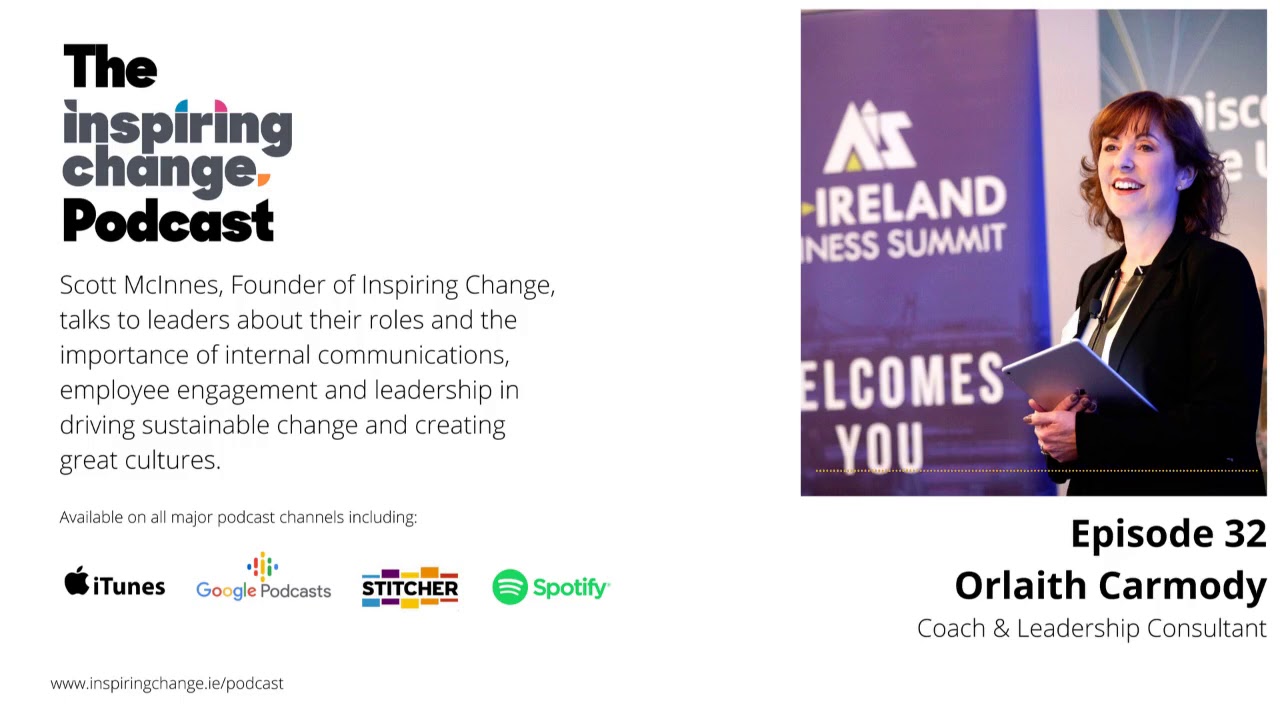
In this Inspiring Change podcast episode, host Scott McInnes interviews leadership coach and author Orlaith Carmody. Orlaith shares her career trajectory from broadcast journalism to a communications consultancy and finally to executive coaching, highlighting how a thread of communication has underpinned her work. She argues that great leadership today is rooted in emotional intelligence, authenticity, and purpose. Using vivid anecdotes—such as Fergal Quinn’s trolley‑gathering habit and the contrast between a founder’s sunny demeanor and his son’s “thundercloud” attitude—she illustrates how genuine, people‑focused behavior drives employee engagement and retention. The conversation delves into the pitfalls of superficial mission‑vision‑values statements, emphasizing that purpose must be lived daily and reflected in language and actions. Orlaith explains the shift from a commander‑style hierarchy to a coaching culture, describing concrete day‑to‑day practices: listening more than speaking, light‑touch meeting facilitation, empowering staff to own their work, and using coaching conversations to surface solutions. She discusses how cultural change can be seeded by middle‑level champions, citing a bank coach who is rippling the approach upward. The dialogue also covers the importance of clear, user‑friendly language in internal communications, the role of storytelling, and the need for leaders to model authenticity. Finally, Orlaith offers advice to younger leaders—believing in oneself and seeking coaching or peer sounding boards—to foster continuous development. The episode promotes an upcoming “Power of Purpose” event and Orlaith’s book, Perform as a Leader.
Chapters
Welcome to Face Forward, the Inspiring Change podcast on all things internal communications, engagement, leadership, and change. Hi there, and welcome to this edition of the Inspiring Change podcast. Before I introduce today's guest, I wanted to just take a couple of minutes for those of you who are listening to this episode in real time. It's now the beginning of September, talk to you a little about an event that I've got coming up in 4 weeks' time entitled The Power of Purpose. It's an event in partnership with AIB here in Dublin where we're going to be talking about the power of purpose in organisations, both from the bank's perspective and talking about their journey, but also from the perspectives of some senior executives from the likes of Google, from Skillsoft, from Sodexo, and from Special Olympics. So a really exciting event. It's on, on the 9th of October. From 8 to 10 AM. You'll get breakfast and a chance to have a chat with some of your peers as well. So hopefully you can make it along. You'll find more details on the website at inspiringchange.ie/powerofpurpose. No gaps and no gaps, no caps, as my 11-year-old said to me last night. So on with today's interview, and I'm delighted to be here with Orla Carmody, who's a coach and leadership consultant. Both subjects are very close to my heart. She's also a published author who's written a book entitled Perform as a Leader, which has tons of great tips in there for how leaders can become more authentic and better leaders in themselves. I have my copy here. I'll be getting you to sign that after.
Will do.
So good morning, Orla.
Great to be here.
Thank you for joining us.
A pleasure.
Thank you. It's a beautiful day here in Dublin again. I think we're getting the tail end of the summer.
Indeed.
Yeah, I tell you what we'll do, we'll just kick off perhaps by just asking you to tell the listeners just a little bit about you, your background, where you've come from and what you do.
Well, it's interesting, we talk so much these days to young people about the sort of 5 or 10 careers they're going to have, the millennials and Gen Z compared to my age group. I'm a bit, I'm a baby boomer at the sort of tail end of that, but I've had about 5 different careers, so maybe I was a little ahead of the posse. I started out in journalism I was a broadcast journalist with RTE. Previously I'd worked in the local radio station where I'm from in Drogheda, LMFM. I'd also worked with Century Radio, for those who remember Century. But then obviously I took some time out with my family, and in the meantime I set up a communications training consultancy with my husband and business partner Gavin Duffy. So we have, it's safe to say, coached, trained, and developed thousands of business and political leaders in in all the years we've done that business. And I suppose then I transitioned from that, we broadened out the kind of the straight media communications training piece, which is what we founded our business on, into a whole leadership development piece, a talent development piece, and in recent years I've focused very much on executive coaching. So I've always been in people development, but it's been in different iterations, and it came from a good foundation of communications, which you learn as a broadcaster, you learn as a journalist, you learn as a communicator. So today my work is very much in coaching and developing people, and I'm just fascinated by all the changes that are happening in the workplace nowadays, what we're seeing, the sort of issues we face around retention, how do we keep people, we keep them with purpose by motivating them, by allowing them develop themselves, take ownership of their own development, their own career trajectories. So that area just really floats my boat, that's my thing.
Okay, brilliant. And it's really interesting, you talk about how there's been that thread of communications through your career. It was only when I found an Inspiring Change a couple of years ago that I had that kind of penny drop moment where I said, actually, that's been something which has featured as a red thread through my career as well, actually more so nearly the written word and how you can use the written word in so many different ways, whether that be through whether it's in internal comms, whether it's in external comms, and actually how we write words will elicit a different response from people. It's really interesting.
Well, you're so right because, you know, we keep talking about transformation and organisations transforming and what does that actually mean in real terms. And in real terms to a lot of people working there on the ground, the people we want to inspire and motivate, it means how do they feel about this organisation they work with. Do they enjoy going to work every day? Do they feel valued? Do they feel trusted? Do they feel empowered? You know, the old sort of mushroom theory we used to hear about years ago, you know, feed them you know what and keep them in the dark. I mean, it's just gone, and leaders have to be open, organisations have to be open, because that is what will inspire the kind of people we want, and our organisations are our people, let's face it. And I think it's really interesting to see as well the Big Four organisations. I was having a lovely conversation with a few people in EY yesterday, and it's very interesting to see how the the whole people and talent development advisory thing has grown so much in those organisations where they were audit and tax and assurance and numbers people, and they've realised when they get into an organisation and get under the hood, well, the first thing you've got to work on is the people or you'll get none of the other work done. So they're really developing and growing their people advisory type of business because it is so essential to what we're doing nowadays. So it's a really exciting, interesting space we're in. You're in it, I'm in it. It's a brilliant space to be in, and it's just So there's really interesting things happening.
Yeah, great. You touched there on a couple of elements of this next question, but I'm interested in knowing from you, what do you believe makes a leader a great leader?
I think it is what we're calling nowadays emotional intelligence, and we probably in previous years, if we looked at great leaders, we didn't maybe define it as such, but I think now that's very much what we define it as. So I'm thinking of somebody like Fergal Quinn, who I know was a previous featured on your podcast, Danny. I knew Fergal going back many years, very, very interesting man. And I remember years ago doing my shopping out in SuperQuinn in Bray and pulling into the car park, and Fergal pulled in near me and he hopped out of the car, and the first thing he started doing was gathering up the trolleys, right, and gathering up the trolleys around the car park and having a little rap with the young lads who were doing that job and asking them their names. Who are you? Are you John? And what 'do you like gathering up the trolleys here? Come here, we'll do it together,' and I thought, 'Wow, what a leader!' You know, he just understood how to motivate people and understood how to develop them, and I think that sort of integrity, that do as I say, not do as I do, or do as I do, not do as I say, authenticity, authenticity. We have to see somebody if we want to follow them. We have to know who they are, and they have to have the confidence to reveal themselves to us. And that's what an authentic leader is. They absolutely— you know them, you get them, you see them every day, you see what they work at, you see their style of leadership. I'll give you another example. A young person I was talking to recently who had a summer job described working in this area and the founder and owner, the entrepreneur who had set up this business, coming in around the business several times a week, an array of sunshine, and he would say, "Hello, my name is John. Who are you?" "Get to know everybody. Do you enjoy working here?" And he was absolutely, you know, as I said, a ray of sunshine. But the next person in the pecking order, in that order, was this gentleman's son. We'll call him John Junior. John went around like a thundercloud. He never looked up, he never made eye contact with anyone, never spoke to anyone. He always went through the business with this tension all over his face. So the next layer of managers and the next layer of supervisors all went around like thunderclouds shouting and roaring at these young people, disrespecting them. And you know, they're only summer workers, does it matter? Yes, it does matter, because the whole reputation of this business is going to be spread by those young people who are working there. But it was just such a disconnect between the founder, who clearly understood people, and the next in line, his own son, who didn't, and then the rest of the organization taking their lead from that young person. I thought, what a pity that somebody can't go in there and just correct that for them. Because it's the whole reputation of the business is going to be based on that and the retention and holding on to young people and how they look at the world of work and for a lot of those young people it's their first job and is this going to colour what they think the working world is like? Such a pity.
And back to your original point about EY now focusing more on leader upskill, that you You know, when you think about that example, the impact on the customer experience must be incredible when those people are not being led in a positive, authentic way. What type of face are they then presenting to the customers in that business? You know, when you think about this whole idea that, you know, if you look after your staff first and let them look after your customers, and that's then what will help to generate the profit, because I might spend a few more euros in your shop, I might buy an ice cream from your shop, whatever it might be. That's where the money comes from. The money doesn't come if people don't feel loved and don't feel as if they're having a great time.
And I think that probably again was kind of dated thinking, put the customer first, put the customer first, and the employees were nearly not important. And now, as you say, we completely realize, well, if you look after your employees, you know what, they look after the customer. So look after your employees, and if you have a happy, contented employee pool, you know, pool there. They will do the business for you, but it's back to that thing of trusting and empowering your people, because nowadays we realize the value of flexible working hours, remote working, home working, shorter hours. We are expecting people— people need this, they need this to make their lives work. And in order for employers to actually understand that you can do that, of course you can give people flexible hours, of course you can give them They will do the work because they want to do the work if they understand and feel aligned with the purpose of the organization. But you have to know the purpose of your organization if you're the owner, the entrepreneur, if you're the founder. You have to have defined your purpose in the first instance. A lot of the work that I would do, and you probably do yourself, Scott, with organizations when you go in first to do your discovery and get in under the hood, the first thing you want to look at, well, what is your mission, vision, and values? Do you actually have those defined? I would often do an exercise with organizations to define them. So you get them defined and you get them up on the wall in lovely posters, but that's not all. It's not enough to define them and put them on the wall. Everybody has to understand this is what we live every day. That's purpose. Do we actually live these values? Do we live this mission? Do we live this vision in every single thing we do? In how we speak with each other and how we respect each other and how we respect our customers and how we respect our clients. In how we actually conduct the whole business of this organization. And you know, funny, people who join an organization and feel aligned and feel valued, they really thrive in that business. And you know, we used to always, when we were recruiting, we used to always tick all the boxes on the CV and have they this qualification and have they this experience, and even the purpose of the interview was to drill down and find out, do they have that experience? It's really to interrogate it. Do they actually have that experience they say they have? And now we know that's only a part of it. We really have to find out who is this person, what makes them tick, what floats their boat, what are their values, and if they're aligned with the organisation in the first instance, you know what, it's going to be a happy partnership.
Because you can, I think you can teach most people most things when it comes to the experience piece, but actually if they come with the wrong attitude, or not even the wrong attitude, an attitude which isn't aligned with the overall organizational— call it attitude, call it culture— then that's going to be, that's going to be a problem. It's interesting when you talk about the values being up on the wall, and I, and I 100% agree with everything, everything you've said in terms of kind of setting that North Star, having that purpose, mission, vision, and then the values as the map and how you're going to get there. And I was working with a client recently, and they had, they had done exactly that, and they had set 7 values, which I said to them first of all was too many. But they were written in a way that made them really hard for their staff to bring to life.
Or to live.
Yeah, exactly. They weren't written in language. And again, back to that piece about the written word. They weren't written in language that people could maybe understand or get or connect with. And one of theirs was respect. And I did a workshop with them and they said, well, you know, we don't feel really we don't feel respected because of X, Y, and Z, and give me a few examples. And I said, gosh, I can understand why. And I said to the management team, A, you should just be respectful anyway, but if you're going to put respect up as one of your values on the wall, you're just setting yourself up for a fall because you've now set an expectation among your staff upon which you're now not delivering. And all you're doing is creating a say-do gulf between— we're saying that, you know, respect is a value, but actually we're doing things which are completely not aligned with that value. And that's a huge problem because it breeds mistrust and it breeds that, it just breeds that inauthenticity.
Well, that's fascinating because, you know, it's often said that, yes, mission, vision, and values are the statement that's on the wall, but culture is all of the little exchanges in between that happen every single day. So it's not what's happening around the boardroom table, it's the little conversation on the side, it's the water cooler moment, it's the chat in the canteen, it's when Mary is saying about Johnny, it's what Johnny is saying about Peter. That's culture. And if they're all saying, 'I don't feel respected, I don't feel respected because you know what was done to me, you know what was done to me,' you're absolutely right, there is this huge disconnect and there's now a distrust between management and staff. And, you know, it's so interesting in an organisation to get in there and find out what's going on, and as an external consultant who goes in, you know, you can actually facilitate in a way that sometimes staff are much more comfortable talking to you because you're external. So, and obviously you offer confidentiality within the room and nothing that you do in the room when you're facilitating is going to be reported directly back to management. You're going to report the overall feeling but no individual names are ever going to be mentioned and you have to give that confidentiality. But it's very interesting when you hear a room full of people opening up and being very free with what they want to say about the business and if you set the groundwork before you facilitate that session and you say, "I want everything here now to be positive. We all want to make this better. Management want to make this better for you, so be honest, tell us what's going on in a nice constructive positive way." And again, managing the language. I don't like negative language or I don't like any insult or any of that. I want it to be all constructive and positive. No Pollyanna stuff, but just constructive and positive and take out of that room all of this great intent from these great people who who just want to make things better for everybody. And if you can align that then with management and bring that back to the senior leadership team, what's being said, and the plan is focused, and you come out at the end with some change and some— it's wonderful. And it just makes things so good for everybody. But that's, you know, sort of for you or for I or people who work the way we do, we sort of see ourselves as the oil in the wheels. And you put the oil in and then the wheels turn.
Absolutely. And, you know, for me, when people talk about, you know, and same as you, people will call me and say, "We need to change our culture." My response to them is always, "You don't directly change your culture. You change the way you do the things you do, and in doing so, that has an impact on your culture, whether that be positive or negative." Yes. But the culture is nearly just— we're so focused on culture these days. For me, culture is just an output, or nearly a byproduct of the things that you do. It just kind of happens.
Yeah, and if you focus too much on trying to fix culture, as you say, culture is a bottle of smoke really. How do you even define it? And I know there are some companies who come up with, you know, products that they feel will, you know, software that will measure culture, and it's looking for language and it's looking for sentiment within all of the communications that go around a business, and that's very useful, and you can pick out with the software a lot of things that are going on, but it takes a human to interpret it and, as you say, to look at the things you're doing that are creating this culture and to change those things and to change the way people relate to each other. As a coach, obviously, I am a firm believer in the coaching culture, and so many organizations are moving towards the coaching culture. In my book, Perform as a Leader, I have a chapter, and I titled it 'From Commander to Coach.' because I always envisaged the commander on the bow of the ship with the spyglass up to his head. I'm sort of looking at Russell Crowe in that wonderful movie Master and Commander.
I can see the tricorder hat and everything.
You can see it. I always picture Russell Crowe there and I'm the guy, I have the map written at the back of my eyeballs, just follow me, don't ask any questions, keep rowing and we'll get there. And you know, organisations were run like that in the past.
And still are.
And still are.
By the way.
And still are. And it is just not going to work with Millennials and Gen Z because you know what they'll do if you bark an order at them? They'll put a little rucksack on their back and they will head off to Australia. People are staying for 2.2 years now in organizations. That's it. That's the time span. And retention is a huge issue. You expensively train and develop your staff and you know what? They up and they leave a year later. And you know what? It's your fault because if you didn't make that environment interesting for them. But this thing of from commander to coach, the coach is a much different style of leader. The coach is the leader who has that integrity we spoke about, who has that empathy, who is genuinely interested in people, genuinely wants to bring out the best in people, wants to develop the team, wants the team to be, you know, is open, is transparent, says let's do rather than I'm doing and you follow. You know, this let's do, let's roll up our sleeves and get stuck in here, and people love that. But the coaching culture is hard enough to introduce if you don't have buy-in. You've got to get buy-in to this. But you can actually change a culture within an organization by putting, you know, a number of leaders on an introduction to coaching or a coaching for managers or coaching for leaders day-long program, for example. And I've done this in organizations where I've put maybe a team of 4 or 6 groups of maybe 10 people on this program. And the idea— nobody wants, not everybody wants to go off to, you know, IMI or one of the places and do a coaching diploma. It's not for everybody, but everybody can hold a coaching conversation with a report that will elicit so much more of the kind of work we need today from that report. Because, and that's why an introduction to coaching really can change things, because people say, 'Oh yeah, I can do that. I can have that conversation about what do you think 'How should this be done?' 'Have you tried this?' You know, and ask those questions of people rather than telling them what to do. Nobody likes being told what to do, let's face it. And if you can get that culture going within an organisation where people have a very interesting, positive, respectful conversation, it not only empowers the person to do what they want to do, but it makes them want to do it, it motivates them, they feel valued, they feel listened to, they feel heard, they're going to work much better.
Tell me a little bit about what that whole idea of becoming a more coaching-focused leader, what that looks like on a day-to-day basis. I love in these podcasts that when people have listened to them, they can take away some just little nuggets that they can even apply this afternoon in a team meeting or tomorrow. So what kinds of things are those coaching-led leaders doing that maybe those guys on the prow of the ship aren't doing?
I think sometimes a really strong coaching leader has understood the value of listening an awful lot more than speaking. They will often come into a meeting— now they're chairing this meeting, but they're light-touch chairing— so they come into this meeting and instead of saying, 'Right folks, here's what we're going to do today, and you're to do this, and you're to do that, and you're to do the other,' they come in and they say, 'Talk to me, folks.' 'What are you working on? What's happening? What are the problems?' And they listen and listen and listen, and at the end of the meeting they go, 'Okay, I understand now where we're at, and it seems you have it under control, and I'm happy with this. Maybe we could change that.' There's a few light-touch directions, and everybody goes away with a little spring in their step because they felt heard. But the kind of meeting you have to go to every Friday— and this meeting is only called because it's a Friday and you go to this meeting and you go, "Oh, I have to go to this now and I have so much at my desk, just going to listen to a load of PowerPoint rubbish here now and I'm going—" You know, people are resentful even going to that meeting because they're going to be issued with a load of instructions. I think a coaching leader really understands that you empower people by letting them do the job you hired them to do and really just checking in and saying, "Is there anything I can help you with? Do you need to talk about that. Have you any problems with that project? How's it going? Great. Off you go, do more of it. Great. You know, that idea of looking for what's going well and doing more of it rather than spending the meeting talking about the problem, if that makes sense. It's that sense of just allowing people to do what you pay them to do. And how important is it?
Because I mean, I'm in organizations all the time and back to your point earlier in the chat about the leader who was the ray of sunshine when he walked into the room. Yeah, John Junior was the one with the thundercloud hanging over his head. How important is it, do you think, when you're trying to say— when you're trying to change to a more coaching leadership culture in an organization, how important is it that that is from the top down?
Yeah, it's a very interesting one. And in those traditional organizations, you will find that a lot of the learning and development is focused at mid and junior levels. It's like training is not for me, it's for everybody else. And unfortunately in an organisation like that, if you have a raft of leaders at the top of the pile who think they are fully cooked, it's going to be very hard to change that organisation because none of us is fully cooked and we know that now. It's about lifelong learning, it's about every single day developing and adding new skills to our armoury of of things that we do. And, you know, a leader who really feels they have all the answers is going to alienate people. But sometimes I think you can actually change the culture by finding an advocate within the middle of an organisation somewhere, and you will very often find a very strong advocate somewhere in the middle who says, 'Look, things have to change here.' And in fact, there's a lady I supervise who's a coach herself, and she works for a bank, not in Ireland, and she began— it's a wonderful project— she began coaching her 40— she went off and did a diploma in coaching herself, and then her 40 mid-level layer, she has begun coaching them one-on-one. Every Friday she blocks out her day to coaching one-on-one, and she is actually using those not only to coach them but to allow them understand how powerful a coaching type of leadership is. They're learning by doing. They're learning by doing, and they are now doing that throughout the next layer within that bank. And already she's having the senior leadership team asking her, 'What's going on? What's going on? What's happening? What are you doing? What's happening here?' There's a big change occurring in the middle, there's a little ferment happening, and they're beginning to come down to her and say, 'What are you doing? What is changing here?' And actually she's been discussing with me the possibility of going over and doing one of these a series of these one-day coaching for leaders programmes in order that we can actually spread it. But what you would hope is that a mixed level of people would turn up for these programmes, that you would get one or two woke senior leaders who would actually go on the programme along with the middle level, along with whoever, that would be right across the organisation. And if that occurred, then I think you'd begin to see some change. But often it takes that one person. She is just doing a great job of changing by doing, and it's kind of rippling out. And I'm watching the space with great interest, put it that way.
And it's a great— I often will have chats with clients, and they'll say, well, we need to do a presentation to the staff, or we need to now present our corporate narrative, or we need to present our change program. Scott, you're the expert, you should do that. And I used to. And in fact, now more recently, talking about lifelong learning, I've actually kind of rolled back from that a wee bit. And I've said to them, well, listen, why don't I coach you to deliver it in a way that's perhaps a little more human, a little more compelling, using language and words and tools and not 50,000-word PowerPoint slides that make you a bit more human and let you connect to people? Because actually, It is way more powerful, a bit like your coaching example there, way more powerful that you guys do that to your teams yourselves internally than I come in. Because all that signals is you can't do it. It also means you're not getting any upskill. It also means you're not bringing, you know, it's not about we or us, it's about Scott and the team versus the management team. And it can actually create a bigger gulf. So that whole idea of, of internally coaching is incredible.
Very powerful, very powerful. I worked on a program last year with a pharma company in Cork and it was really interesting. It was a trust and respect at work, so it was in the whole diversity and inclusion space, but it would be touching on behaviors around bullying and that, that's quite sensitive and nobody likes to talk about these things. So the way we worked on this program, the HR people who commissioned me to work on it with them exactly around the language. We designed the program and I put very user-friendly language on it because they came back to me with the way they thought it should look and I kind of adapted it completely to make it very, very user-friendly.
That's a very polite way of putting it.
Yes. You adapted it. Adapted it, adapted it to make it really understandable. But then what we did was we, um, I devised a training program and I put 20 of their team leads on this training program, and basically it was a kind of a train the trainer. I was training them how to deliver this message out into the teams. So we had guys who were like the supervisor on the factory floor, and somebody from management, and somebody from accounts, and somebody from— a real mix, a raft right across this business. But the idea was that if I could get them to stand up and deliver in a way that was just Paddy being himself, not trying to be, "I've been asked by HR to deliver this talk to you and sorry lads, but I'm going to have to—
you're going to have to sit here for half an hour and listen to it." While I go through the slide deck that they've prepared for you and I read you the slide notes.
Exactly, and I was trying to get them to make it themselves and when we talk about authentic leadership, authenticity is about being absolutely yourself and not changing because you're standing at a podium delivering a talk, so I wanted them to just to be themselves, and I was giving them permission to let their characters emerge. And some guys are humorous and tell stories and jokes, and other guys do other stuff. And it was a whole raft of different people, and everybody has their own style and way of doing it. But I wanted them— exactly as you've said— that the message coming from one of their own is a more powerful message than coming from this consultant coming in from outside, but coming in a way that they had never seen talks or presentations or workshops facilitated in this organization before. So I wanted them to be just really empowered to have a bit of fun with a serious message and have their personality deliver a serious message and empower the people to get on board and say, "Sure, Paddy, of course we'll support you with that. It's an obvious one. We've got to respect each other and we've got to speak in a way and we've got to be careful about those jokes in front of people who might—" whatever, whatever it might be. And it just, it worked really, really well and I felt, yeah, I felt that they had actually taken ownership of this message in a way that was going to be quite powerful in the delivery.
And it turned out to be so. Yeah. And it's so, so much more powerful than just simply throwing us, you or I, or anybody else on stage. So much more powerful. Yeah. Talk to me a little bit more about the authenticity piece, because it comes up time and time again. I think this is podcast episode 32, probably in two-thirds of the podcasts, if not more, we talk about authenticity. But if a listener is listening to this right now— hello, by the way, if you're listening— if they're listening to this right now, and they are, and they have enough self-awareness to recognize themselves as that Russell Crowe character, that commander-in-chief, what are some of the things that they can do, do you think, to be a bit more of an authentic leader? What are some of the specifics? What do they have to be doing or saying or thinking?
Self-awareness is a huge a huge thing, and it's back to what we said about emotional intelligence. We have to be aware of our own abilities, our strengths, and a lot of us are, but sometimes we're not so aware of the things we're not good at. So maybe somebody who is the commander style of leader says, "Oh look, that's the way I've always gone and it's worked fine, and I don't have the time to look at doing it another way." Well, I would suggest maybe you should take the time, and maybe a bit of personal coaching is the way to go with it. And when I get invited by a sponsor in an organization in to work with a few senior people in terms of coaching, I always say, look, this has to be presented as a gift. Please don't say to them, I'm sending you to coaching because you're broken and we need to fix you, because it's just not going to work. I always say, you know, if you were a mad keen tennis player, for the sake of argument, Scott, and your wife said to you, guess what, I've got you a present of 4 coaching sessions with Ireland's top coach, you'd say, oh, 'Oh wow, thank you darling, that's brilliant.' It has to be that, and you have to present to somebody, and the more senior somebody is, you know, you have to present it in a way that, look, here's a way of you just taking personal time for yourself to work stuff through and to find out what it is you might possibly do better. Coach is never going to tell you what to do, you're going to decide that yourself, but it's just the space and the time to do that. And when I've worked with somebody for an hour or an hour and a half or whatever, and they finish up by saying, 'Oh, that was great, I really enjoyed that session,' I think Great, they had an hour and a half of an enjoyable conversation where they worked through some things that they want to do themselves. And I mean, you never tell somebody what to do, as I've said, they have to work it out. So first of all, yeah, for a senior leader, I would say maybe look at a bit of coaching, maybe look at a bit of personal development, maybe just ask your confidant, whoever your confidant is in the business with you, your COO or your CFO or whoever your buddy is in the business, Just say, look, am I reaching the folks properly here? Is there more I could be doing? What could I do differently? Just ask somebody you trust and they may tell you that. But sometimes somebody can't do that within their business because they have to kind of maintain a distance or whatever, and that's where sometimes it's helpful to talk to somebody external to the business. And one of the things I've done in my past is I was a member of the Entrepreneurs' Organization here in Ireland, and myself and a number of friends and colleagues brought EO into Ireland, and I was president of EO in year 2. And one of the interesting things about that organization— and there's about 50, 60 members now, member companies in Ireland, and they'd be all very strong Irish indigenous SMEs— but every one of the entrepreneurs, the leader, the owner, the founder, would say it's a lonely place. It's a lonely place up at the top because you might really get on with, as I said, your or your CFO, your CTO, but there is a bit of a distance because you're supposed to have all the answers. And where EO was very beneficial to those people is that they would go to a monthly forum with a group of their peers, and it was behind closed doors for 4 hours once a month, and you downloaded your stuff and you shared it with your peers, and you— nobody gave advice, but they could share experience with you. So the idea being, if you have a problem, you say, oh look, I have this issue, I'm I'm trying to lose this person, or I need to get finance for this. Nobody can tell you what to do, but the peer would say, you know what, I had a similar issue last year, here's what I did, and you can take it or leave it. And that experience share is very valuable, as opposed to somebody telling you what to do. So I would sort of suggest to the senior people in corporate or in entrepreneurship or wherever you are, you need to have a sounding board. It doesn't matter who you are, how talented how great you are running your business, you need a sounding board and you need to find that sounding board and wherever it may be and whatever route you choose to it, but that's the way to get that self-awareness, that's the way to get that reflection back to you which we all need. We need reflection back of how we're going. But I think an awful lot of the younger leaders we're seeing emerging are so much more aware of this, they're more aware of the need for work-life balance, They're more aware of the need to even acknowledge that you have a family. I was on a board, a state board, a number of years ago, and there was a few young men on it with young families. And, you know, the board meetings would be quite formal, but I would arrive in and the first thing I'd always say to them is, "How are the kids? All going well?" I just wanted to allow them to talk about their children. And they'd say, "Great, absolutely great. Do you know what I made the other night for them? I made chicken burgers and I was thrilled with myself, they turned out great. You're just giving people permission to be normal, you know, and sometimes I think we have to do that. We have to be aware of we all have complex lives and the younger people, certainly younger people coming up along, are aware of that. They will talk about wellness, they'll talk about mental health, they'll talk about work-life balance, they'll talk about doing their Ironman at the weekend as you do, Scott McInnes, or whatever people do, and in a way that In the past, maybe none of that could be talked about at the boardroom table. Well, it can actually for a few minutes, just till we loosen up and then we'll get going with the business, you know. Or at the coffee stage at the side, of course it can, you know. So I think we're more aware of that now.
I think probably the whole Ironman thing people are sick of hearing about because I actually haven't stopped talking about it since Sunday. Good, good. But anyway, I'm going to stop talking about it now. Conscious of time, We're kind of out of time actually, and it's always amazing on these chats because time just flies. Last question: what leadership advice would you give to your 20-year-old self knowing what you know now? What would you have done differently? What would you tell them to do differently to save them having to go through that mire? Oh my goodness. One thing.
One thing. Youth is wasted on the young. Do you have any idea how capable you are? You know, young people, I see them and they've no idea. My own youngsters, I have 4 young people myself, and They have no idea how brilliant they are, how clever they are, how capable they are, how strong they are. And I suppose, you know, life tests you in lots of different ways as you go along, and possibly by age 20 it hasn't. If you're lucky and you've had a normal, relatively straightforward upbringing, it hasn't tested you. So maybe you don't know the depth of your strength. So I would just say to young people, you know, you're capable of so much more than you ever will imagine. And, you know, really and truly, I would just like young people to believe in themselves. And I would say to my 20-year-old self, just believe in yourself because, you know, life shows you that you can do incredible things if you try. But yeah, that's about it.
Believe in yourself. Brilliant. Orlaith, thank you so much for having the chat. It's been a pleasure. Really, really enjoyed it. I'm going to get you to sign my book. Will indeed. I am going to just say now, so I presume that's available on Amazon.
Still on Amazon. It's been out a couple years now, but it's still on Amazon.
It's called Perform as a Leader. If people want to go pick that up, they can do. And all that's left for me is to say thanks very much.
Thank you.
Thanks for listening. If you enjoyed this podcast, please take a minute to rate it and maybe even leave a comment. To learn more about Inspiring Change, to read our blog, and to hear more podcasts, please visit our website at inspiringchange.ie.
More from Scott

Leaders can't assume connection happens automatically #LeadershipLessons #EmployeeExperience

The hidden reason your remote team feels disconnected #TeamConnection #HybridWork

This is why people actually stay at their jobs #workplace #culture #retention

156 | Inside Disconnection at Work: Bridging the Connection Gap Report with Sadhbh O'Flaherty




155 | The Overlooked Art of Building Connection at Work | Scott McInnes with Christine Armstrong


