Episode 37 | Jane Sparrow | MD, The Culture Builders
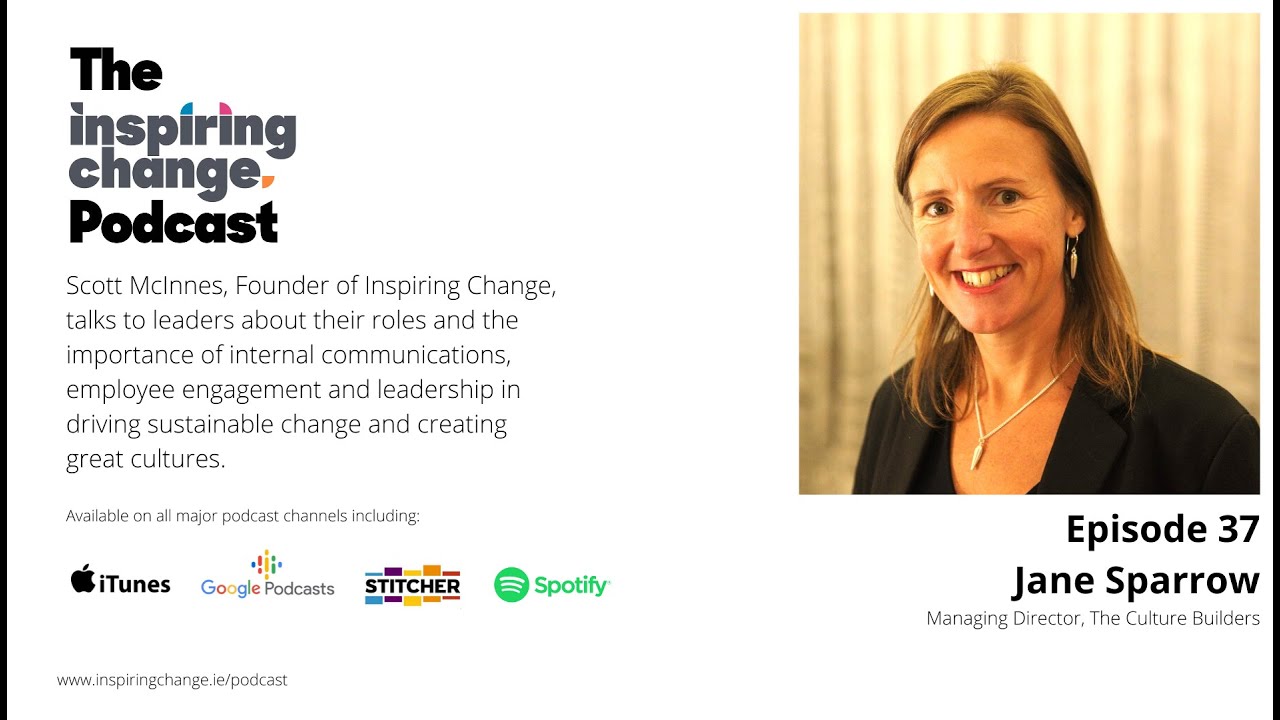
Jane Sparrow, author of Culture Builders, talks about leading remote teams during lockdown. She introduces the "Bank of Me" framework: five areas (physiological, emotional, focus, motivation, personal growth) leaders can use to manage their team's wellbeing like deposits and withdrawals. Leaders must care for themselves first, then intentionally build human connection beyond just tools and information.
Chapters
Welcome to the Inspiring Change Podcast on all things internal communications, engagement, leadership, and change. Hello there and welcome to this edition of the Inspiring Change Podcast at a very strange time in our lives. We are in Ireland here now a week into full lockdown. Do not leave your house unless it's a complete emergency. Everybody working at home, and obviously as a result remote working having gone through the roof, and I think probably lots of leaders struggling with some of that. I've been doing a couple of webinars, one of which you'll actually find on the website if you go to inspiringchange.ie/webinar-video, or just go to the homepage of the website and click the link there. A webinar just helping leaders and giving them some hints and tips and really practical advice on how to lead teams as we go through this slightly strange episode that I don't think any of us globally have ever faced before. Of course, that could also have a massive impact on culture, and when we see negative impacts on cultures, we tend to start seeing negative impacts on individuals, on motivation, and importantly on productivity. And for me right now, making sure that we try and maintain as much productivity as we can in businesses is going to be really important because we're hurting enough already. So I'm really excited. It's really funny, again, a little like Will McInnes in the previous episode of the podcast. Today's guest has actually been on my radar for a number of years. She's actually been on the podcast list, and we've just never gotten around to having this discussion. Jane Sparrow, who is the author of a book called Culture Builders— it came out in 2012, it's as relevant today, if not more relevant today perhaps, than it was then— is also the founder of a company by the same name, The Culture Builders. Jane, it's really nice to have you on.
It's great to be here, Scott. Thank you.
Thanks very much. So you're working at home in your home office, I'm working at home in my home office, and today we're going to have a chat about culture. It was interesting, there was an article that I'm sure you'll touch off of. Anybody, if they want to have a look at it, if you go to the IABC website or indeed to the Culture Builders website, there's an article there about the third culture. So we have our personal or home culture, we have our work culture, and one of Jane's theories in some of the writing that she has been doing recently is this whole idea of a third culture, one that exists perhaps in the remote working or online virtual world. So we'll talk about that hopefully in a little while, but first of all, Jane, just to get you all settled in, why don't you tell me a little bit about you, about your career, and about the Culture Builders?
Yes, let me do that. So my career started in corporate world, and I worked for many companies, including a few years at IBM and then at Sony, and at Sony was Director of Engagement and Change for many years and did lots of work across the globe, which was fantastic. We set up the Culture Builders 10 years ago and have been working across the world with all sorts of wonderful clients and people, everything from HSBC, the BBC, Sky, through to smaller organisations and charities like Pancreatic Cancer. So what they all have in common, of course, is people. And so over the few years— I won't say many years because that'll age me— but the few years of my life, we've built up a lot of experience around culture, around people, around performance, and of course never before has that been so important as it is right now.
Yeah, definitely, I couldn't agree more. And when you think about that, and you alluded to it there in terms of, you know, where we are now and how important that is, we are in the midst of a global pandemic, and pretty much overnight, and certainly here in Ireland, and I know similarly in the UK, you know, last last Friday at midnight, the lockdown started. Nobody went to work anymore. Everybody started working at home. So overnight we went from the regular run-of-the-mill traditional office setup with, you know, people in teams sitting at desks all looking at each other for 8 hours a day, and that all changed overnight in literally the click of, you know, the click of a finger. You talked recently in your article about the whole idea of a remote working trap. What is that and why is it important?
Yeah, it varies depending on you as an individual, you as a team, and you as an organisation, but really what we know is that for all the years we've worked with culture, one of the things that often comes up and we work on is how you create a culture that thrives when some people are remote. Now, of course, what we've got now is a huge number of people working together that are remote, whether that's colleagues, customers, suppliers, and so on, and so there is a real danger that you get into the trap that we see anyway with remote working, but we're going to see it even more given the context we're in. And what that really is, is that we focus on just one dimension of equipping people rather than three. So let me just explain that, Scott, because it's probably easier if I bring it to life and say that when we look at culture, we look at what we call the three pillars. So what we believe, how we behave, and what we use. So the belief being what we all believe in as a team or as an organization. Behavior, of course, being how do we behave so that we're aligned with that belief, and then finally, what we use is the tools, the systems, the processes, and the tech. Now, with remote working, what we have seen with a number of teams and organizations is that there's been a huge kind of scrabbling around to get the right tech in place for people to be able to work at home, but of course, what we also need to pay huge attention to is making sure enough conversations happen around the belief that that a team have in this third culture that you mentioned, and also the behaviours that we're all going to adopt, because it is complex. Everybody's situation is different, and so it is complex, and the trap is that you just go to tools and techniques and, you know, the wealth of tips that are out there. Of course, you and I have both written those ourselves too, but that's not enough, and so some of the conversations that we've been having with leaders about how they're going to lead through this and bringing in some of the work that we've done in Asia supporting companies over the last 3 months that, of course, are at a different point in the curve is really important to avoid that trap.
And what are some of the things that you've been talking to— I mean, obviously your Asian clients are further ahead than we are on this journey, and arguably, although China are starting to reintroduce some of the things they'd relaxed, you know, they've been on a journey that we are probably about to go on or in the midst of. What are some of the things that they're doing or have done to bring staff on that journey?
Yeah, it's a good question, and of course they're still in the journey, aren't they? Because although there is a relaxing going on in some places in China, at the same time the companies we're working with in Hong Kong have actually got the opposite, in that just this week the bars and restaurants have been closed there for the first time, because what they're finding is that they're in a second wave of this situation. So what we do know though is that that organizations, teams, tend to go through phases, and at the beginning there's a huge hiatus to get everybody set up, and there's lots of conversations and lots of video meetings, and there's a real energy behind all of that, and an energy among individuals very often, either positive or negative, and I don't know about in Ireland, Scott, but certainly in the UK, it's a bit like a snow day at the beginning, you know, it's snow, suddenly you can't get to work, and it's all very exciting, and then suddenly, you know, that drops, And then once people have got into this kind of realisation that this is going to be for a while, what you see if you don't intentionally manage it is that the productivity and wellbeing curve starts to drop. And over time, and what I predict in Ireland and the UK in the next 3 weeks or so, is what we'll hit is a point where we need to be much more mindful about where people are emotionally, because the kind of dawning realisation and perhaps overwhelming realisation that this is going to go on for some time is going to hit people at a different level. And then, of course, as we progress through, what we've been seeing as we've been supporting clients in China and Hong Kong is that then you start to support them as they start to see more hope, and now starting to reimagine what does the future of working look like, and what does that mean for culture and performance and people.
Yeah, absolutely. And, you know, I think you're right. It's that thing in a few weeks' time, you know, we're all kind of comfortable now and it's fine and it's all, you know, fine and dandy a couple of weeks in, but yeah, in 2 or 3 weeks more, when we've had our fill of our partners, our kids, of not feeling connected to our teams anymore, you know, I think that will definitely start to bite. What's the role of a leader? Because, you know, we've often talked, and you talk to your clients as much as I talk to mine, about the whole managing versus leading thing. What is the role of a leader when it comes to that whole issue of people's emotions and people starting to feel emotionally stressed and that impact on well-being? What are some of the things that leaders are going to be or should be doing?
Yeah, I mean, I think what we know from our experience in Asia here is that this is a totally different ballgame for leaders, and understanding that the way you lead in this situation, because of context as well as the remoteness, is critical, and the support that leaders need because they're human too. And so, you know, it starts, I always say, with leaders around, you know, look after yourself first, make sure that you are doing what you need to do to be productive and healthy and motivated, and then start doing the same with your team, because if you're not in good shape and if you're feeling anxious and frustrated and disconnected, that will immediately show, of course, with all of your team and your colleagues and your customers more widely. So it really does start with you as a leader. Get yourself in good shape, get the support that you need, and not just once, but keep it going as a drumbeat, and then start to think about how you lead your team. And one of the big things— I mean, there's lots in this— but one of the big things that we know is that leaders are going to require a lot more intention around connection with people at a human level. And I'm sure, Scott, that you share the same view as I do, that very often when we work with organizations and they'll say, 'Can you help us with our communication?' and you start to dig beneath the surface— and we certainly do this when we do cultural audits— and we find that actually people aren't after more communication, they're after more connection. And therefore, at a time like we are in now, never before have people needed to feel connected, and so there's a real leadership role here in terms of both keeping people focused, particularly those that perhaps are less self-disciplined, but also to keep people connected in different ways and really mixing it up. Because one size is not going to fit all for the duration of this new way of working.
One of the things I was just— I was running a webinar this morning, the one that I alluded to earlier on, but I was running it here for IBEC, which is one of the business representative bodies here in Ireland, and one of the things I said to them was that mixing it up is so important because it's all well and good getting some information emails or some content from on high in an organization, from the CEO or the COO or the head of HR, But actually, it's only when that information is contextualized or translated by your leader into, what does that mean for us? How does that make you feel? What are some of the things that we can do differently or start, stop, and continue doing based on that communication that just came out? That it really becomes real for people.
Oh gosh, you're so right. And did you know, all these years, when I wrote the book, the motivation was to get down on paper, and then lastly, obviously electronically, things that would help our middle leaders, you know, middle layer manager leaders, team leaders, and so on, because a lot of my career when I was in corporate world was equipping leaders of people at every level to be able to lead well and communicate well, and I always talk about this miracle in the middle, that there's a huge potential that if you get that middle group working well for you, miracles truly do happen. And again, you kind of look at that and think, gosh, never has that belief that I have been more true, because it's not, you know, Yes, it is going to be the senior leaders being visible that is important, of course it is, and you know we've done lots of vlogs with leaders in Hong Kong and China, you know, as a result of the situation we're in because they're remote, and they've gone down a storm, so that's great, it is leadership visibility, but as you say, it's the everyday connection to your team lead, to your people lead. If you're a project leader, you know, making sure that you take a kind of pastoral care approach as well to your project team, even if perhaps they're not a direct line report. All of this is just so, so critical, and will become more critical 3 or 4 weeks from now.
And these are things that— everything you've just said there are things that you and I have spoken about, and other consultancies and HR teams and leadership gurus have been speaking about for years. And it's only now that leaders have been now basically thrown into the situation where they have to get better at this stuff. And I love that idea of miracle in the middle, because quite often, you know, that layer is referred to maybe in less kind or friendly terms as the permafrost or the marzipan layer or the flabby middle, where they're getting a push from above, tell your people these things, they're getting a push from beneath from their teams and their employees, and they're kind of stuck in the middle. But you and I both know, as do many of our listeners, that it's those people that make a huge difference. There's a when I'm running some leadership courses, there's a slide I use with David Brent where I talk about, you know, when he said, you know, to assume is to make an ass of you and me. And I think that one of the big assumptions that we make is just because somebody is a really good risk person or a really good legal or IT or even HR person, that they're going to be a really good people leader, and that's just not the case.
Yeah, you're absolutely right, and it is this, the fact around being emotionally intelligent with people. And also, in terms of when you're communicating, to your point around kind of don't assume, the other thing that we've really found with the teams that have excelled in China and Hong Kong versus those that have struggled is the fact that the leader of that team understands that you don't just communicate a message once and assume it's done, but that you keep coming back and talking about it in different ways and getting people to play back that message. Because, again, logic will tell you that if you're giving a message out and somebody is not in a positive emotional space, then they're not going to understand it, absorb it, and interpret it in the same way as they might if they're on better form. And, you know, every day people in teams are going to be in different emotional spaces because, you know, maybe they're feeling frustrated today, that they're feeling disconnected, maybe their relative has just, you know, been hospitalized with COVID-19. It's such a roller coaster, and so You know, this element of communication, which of course I realise is only one element of leadership, but just thinking through, don't just assume because you've communicated that then everybody's gotten the message. You're going to have to do a much more kind of clever and creative and thorough job than you might do normally.
There's a very big difference between what a leader says and what the teams hear, and you're absolutely correct in that, you know, that depends wholeheartedly on the situation and the context they are in. One of the things I've been saying to to these groups that I've been talking to is a really nice little tip, because people now are hopefully— and if they're not and you're listening and you're not doing this, you should be— checking in with your teams every day. A really quick and easy way to get to the nub of how people are feeling is just to do a quick round the room, in inverted commas, around the Zoom or around the Microsoft Teams screen, and ask people to describe in a word how are you feeling right now. And that will just give you just a bit of an idea as to as to where people are at, and perhaps allow you in that moment to perhaps change or tweak or flex your style or how you deliver a message in that moment.
Yeah, you're so right, and we're doing that with our team because obviously we're all, we're all home working and we're actually distributed across the world, so we are doing that every team huddle we have, which is on a regular basis. The first 10 minutes is how we were feeling, but we also have a rule, okay, that you're not allowed to say 'fine' or 'good,' because 'fine' is what the weatherman or the weather lady used to say when I was a child, and it was kind of that in-between type of thing. It doesn't really tell you much, so we say, 'You're not fine.' And 'good,' you know, 'good'— why? Are you feeling good because you've just had a run? Are you feeling good about the day ahead? What is it? You know, so I absolutely agree, starting every meeting with a 'how's everyone feeling,' quick whiz round, but making sure that it's descriptive enough that you get what you need from it.
Yeah, and I think for a leader who's sitting there, you know, the other end of the phone, you know, being able to just even take a tally down of, you know, are they more negative words or are they more positive words, and that giving you a bit of an indication of maybe the group dynamic as well.
Yeah, and you know, that makes me think, Scott, the other thing that we're doing with our clients at the moment that's worth mentioning is getting them to really use all of the development work and the language that they've had through that development work in the past. In where it's relevant, of course, now. So one of the things we do is we run a managing emotions workshop, and that has some specific language that is so relevant to where people are right now that we're getting those groups together and helping them think about how they use that. So I think that's something I would encourage, you know, if you as an individual or as a team have had any kind of management leadership development over the years, really challenge yourself and say, am I using all of that? Because so often you go on the course and then, you know, you use 5% of it and forget the rest. Well, this is the time to kind of dust down those books metaphorically and real time and say, what else do I already know that I could be using here? Because again, it's not what we know, it's what we do with what we know that's so critical.
Yeah, absolutely. Building on that, a beautiful segue into what we know and what we do. Let's get really practical because, you know, for me over the past week or two, the things I've been trying to do through blogs or the webinar or through this podcast is try and give people some really practical hints and tips and advice on things they can do to perhaps mitigate the potential for a drop in productivity or a drop in well-being. And maybe if that's going to happen anyway, how do we try and lessen the blow? Because I do think that companies are really hurting. Almost every client I'm talking to is talking about pay cuts, although it's very interesting actually this morning, as a minor segue, when we talk about communications and leadership, I said, you know, there was a discussion this morning with a client around pay cuts, and I said, you know, so have the team leaders had the conversation with the teams before the big general organizational communication goes out? And the answer was no. And still, even today, I go, come on guys, we've got to do better, we've got to pull our socks up, and we've got to lead. And that means putting people first. So I wonder what, you know, from the new— and I know you've just published a new book, this is your opportunity to plug the new book. If you want to read out an ISBN number for people for Amazon, feel free. But, you know, I wonder what are some of the practical things? Give me give me a handful, half a dozen really practical things that leaders can do to perhaps try and mitigate some of that downturn or that hit on productivity and well-being that they might see.
Yeah, well, thank you for the opportunity to plug the new book, Scott. I am ever in your debt. But yeah, so the new book is called Bank of Me: A Remote Working Special Edition, and it is on Amazon in ebook and physical book. But what it does is it's a group of of tips and practical insight, thoughts, and stories, which is designed to be something you can pick up and say, "Ah, I'm going to try that today." So I will absolutely bring some of the tips forward from that, and tools. And what we do is— the reason we talk about Bank of Me, just to give a bit of context, is we talk about the fact that we are all human beings, and we all have a human bank account. And we do things every day that put our bank account in the red or in the black, so a withdrawal or a deposit. And those things fall across 5 areas. The first is physiological, so what we eat, how much we sleep, how much we move. The second is emotions and how we manage our emotions and other people's. The third is our focus and the degree to which we focus or not on what's important. The fourth is motivation and making sure that we're doing enough that motivates us and helping others do the same each day. And the fifth is personal growth and the, the whole notion that we as humans need to feel like we're growing all of the time and that we're not stale, otherwise that affects our mindset and our well-being. The thing here is you need all 5 working for you, you need deposits in all 5 because one is not enough. So the tips really fall into those 5 areas, but I set it up like that because it's easy for leaders, for themselves and their teams, just to think in one of those dimensions, but it really is worth thinking practically about all 5. So shall I give you a few from each of the different areas, would that be be helpful?
That'd be really brilliant, yeah, really, really useful.
All right, so let's go physiological first. So the big thing here is to think about, you know, you as a leader making sure that you are doing practical things like moving regularly, which sounds ridiculous, but believe me, if you've been like a lot of people where you've been on video calls from the moment you start till the moment you finish, you realize you haven't moved apart from to go to the toilet twice. So moving regularly, standing up, moving your body, that kind of thing, critical for you, but also thinking about that for others. So we've got one team we're working with which are doing a challenge, a 14-day challenge, where they all at 12 o'clock as a team down tools, and this includes the leader because the leader's supporting it and championing it, and they go off and they do something physical for half an hour, and they can choose what they do but it has to be challenging for them. Then they come back and they have a quick chat online about what they did and how they're feeling.. And this is going on for 14 days. Really simple, but a brilliant way to really connect with people in a social way too, as well as helping their well-being. So that's a physical one.
With the amount of cake that I'm eating right now, I'm going to need 114 days of that, I suspect.
Yeah, do you know what? I think the interesting thing is it's about if you're going to need to eat more because that's kind of your little reward, make sure your fridge and your cupboards are full of healthy snacks. Because otherwise the mind would always go for the cake over the carrot.
I can attest to that, yeah.
Yeah, absolutely, so and then of course that affects your emotions, so our emotions piece for leaders is really being mindful. Some of the things we've talked about like asking, 'How do you feel?' but also thinking about how do you show you value people, really, really critical. So, you know, a really easy habit to adopt as a leader is making sure you value somebody each day, you celebrate a little piece of success by saying well done to somebody, you thank them, and do it in different ways, you know, get a card and write a card, and while the postal service is still working, use the postal service to say thank you to somebody, or record a little video that says, hey, I just heard that you made a great contribution to that project meeting, just wanted to say that made a difference because— so really upping your appreciation because The thing here is that we need 6 positives for every negative, and in a world where social media in particular is full of negative stories, we need more positivity to be able to balance it out. And so, you know, let's not make it up as leaders, but certainly let's make sure we dial up the level and amplify that, that helping make it, making people feel valued. So there are a couple I could give you, give you more from the other areas of the book, but they're a good start up at 10.
Yeah, I was gonna suggest feel free to give us a couple more. I think that whole idea of just practical hints and tips and advice is really good. And a bit like what you were saying about messaging to teams, I think when we're messaging to people like this, to leaders, it's probably not until they hear it 3 or 4 times from various sources that they think, you know, maybe that is something I should try.
Yeah, that's a good point. So I'll carry on. I could talk about this for several days, you see, Scott, probably like you. So I have to just be mindful of the person listening. So we've got physical, we've got emotional, you know, needs there, and then our third that I mentioned was focus, and again this is so, so important for us as individuals and as leaders to think about how do we make sure we keep people focused, and again, you know, come 3 weeks' time, 4 weeks' time, 5 weeks' time, it becomes even more important. A little story here rather than a tip but then I'll give you a tip, is someone I was coaching in Hong Kong, actually, at the beginning of the journey they've been on. And one of the things we did to get her set for success with remote working was talk about the preferences and the way of working of each of her team members and stakeholders. And I literally helped her map out their levels of self-discipline. And what we did was we mapped theirs and then we mapped hers. And picture the scene, I'm drawing it on a piece of paper and holding it up to the screen at the time. And what we noticed was that her level of self-discipline was huge. Now, that had a huge risk to it because it meant that she was never moving from her desk and her poor children weren't seeing her, so that was one thing we had to readdress the balance on. But the second was that what she realized as well was that the natural self-discipline of many of her team was lower than her, and so what that meant was that she needed to flex her leadership style from being the normal coaching, you know, enabling style to slightly more authoritative and directive, and bringing her team together each morning and saying, "Okay, let's go for this today, we're going to achieve these two things as a team, these are our non-negotiables," and then swarming back together at the end of the day to see how they've done. And to her it didn't seem very natural at the beginning because it wasn't her style, she liked to treat people as adults, but what she realized after a month when she stopped doing it and productivity dropped was that actually it's what her team needed. They needed some help to be able to really focus on what was most important. So as a leader, you know, don't be afraid to be a little bit more directive, but maybe just say why you're going to do that. Just to keep us all focused, I feel it's my responsibility to really make sure we've got our focus of the day or focus of the week really clear. Now, that fourth area I talked about is motivation, and again, think of yourself as well as your team here if you're a leader, but what is it that really fires you up and makes you feel fulfilled? And you as an individual, how are you making sure that you do at least one thing a day that is going to give you that real lift and feel, you know, feel when you get up and you start that, hey, today is going to be a good day. And again, you know, it sounds obvious, but if you're not intentional about it, it's very easy to get to the end of a week, and particularly as a leader that's been having to spend a lot of time talking to people about how they're feeling,. You get to the end of the week and you think, gosh, what have I really achieved this week? And so being very intentional again on your things-to-do list about what is it I'm going to do that really floats my boat and gets me going this week is critical. And then the fifth area is personal growth, and this is fascinating because I'm seeing some of our clients at the moment are really seeing this, thankfully, as an opportunity to invest in their people for the future and help them grow. And really using the time to help people get personal development plans sharpened up, to get them to think more creatively about how they can learn and grow through this period, both formally and informally. And so to me, as leaders here, there's a real opportunity to help people to see how can you grow through this period, and that doesn't have to mean a lot of money, but it's helping people think about is there someone they could mentor maybe within another team that allows that knowledge to transfer and allows people to feel the positivity. So they're just a few samples of what's in the book available on Amazon, as I said, The Bank of Me, the remote working edition.
That's enough cheap advertising.
I know, I know, but loads more, Scott, isn't there? There's just so much, and I think the thing is it's about being practical and saying, okay, I'm going to try one thing this week as a leader, because otherwise you try 15 of the tips that have— I mean, gosh, there's so many tips out there online, but try 15 15 of them, you'll never succeed because it's just too many on top of what you're trying to just keep in the air anyway. And so just saying, you know, each week I'm gonna try one new thing that's gonna help me as a leader, I think is a really healthy approach.
And for me, around that personal growth piece, which is so important, and you know, it's funny because people's immediate go-to place is, oh, it's great because I don't have the commute, or because I'm spending more time at home, or I don't have all the meetings and everything else, I'll have some time to do some LinkedIn Learning or catch up on some online courses I was gonna be doing, because people still have that whole idea that if I haven't done a course or haven't been sitting in a classroom or in front of some slides, then I haven't been doing learning. And, you know, for me, I think particularly for leaders right now, having the self-awareness, which is something I talk about a lot to leaders, having the self-awareness to recognize that what they are going through now is a massive learning curve. How they are doing things now compared to how they did them before is huge and will set them in really good stead, because some of the things that they're having to do now, perhaps as remote leaders, are no different really to what they should have been doing anyway when their teams were sitting in front of them or across an office. So I think that if people can keep their minds open, if leaders and listeners to the podcast can keep their minds open to the fact that, you know, there is a little learning in everything you do, that it's not all about classes, it's not all about courses, but it's about the experiences and things that you're having to think about or do differently every single day. That for me is personal growth.
Yeah, and you know, and as you're talking about that, it reminds me, of course, that there's the growth professionally but also the personal growth if you are at home with your family. I know not everybody has families, but you know, I've got a 9-year-old daughter and she's struggling struggling with a lack of social interaction. Structurally, she's a huge extrovert like I am, you know, she gets her energy from other people. And so she's struggling, but I'm learning how to do things with her for the first time for me as well as for her in different ways. And so it's embracing the situation we're in and learning from every possible direction and being mindful, as you say, about it and chanting it. I mean, I have a thing every, every night when we do bedtime and I do She did this before where we are now, whenever I was at home, but at bedtime we would have a conversation, her and I, about what have you— what was good today is my question to her, because if I ask her what she's learned today, that's a lot, right? So what was good today? And then she asks me, what did you learn today? And we've done it for about 2 years. Every night when I put her to bed, that's what we do. And I'm noticing at the moment it's even more important to be doing that for both the Jen, I think I lost you there. I'm here.
You are there, sorry, you disappeared there on us for a second.
I'm here, yes, so the bedtime routine is a good one to think about. What did you learn today and how are you growing?
Yeah, and we have a similar question which is, what do you know today that you didn't know yesterday? Yeah, because I think when you ask kids, you know, what did you do today at school, or what did you learn today, the answer is stuff, things. I've got— I'm in the lucky and privileged position, with no sense of sarcasm, to have a 14-year-old in my house. So questions like, what did you learn today, just don't work. But what do you know today that you didn't know yesterday can be anything. And I think you're absolutely right, opening ourselves up to that personal development piece as well, outside of work, is really key. They say, and something that I've been saying to teams, and it's hard maybe right now for people to listen to because of everything that's going on and all the worries they have, is that every cloud, I believe, does have a silver lining. It might just be for some people microscopically thin right now, or even non-existent. They may not even be going there at all, but I think there are going to be benefits from this remote working revolution for individuals, for leaders, and for organisations. I wonder what your take is on that, and how do you believe that the learnings we take from this might ultimately benefit business?
Yeah, I'm very sensitive to the fact that this is not a great place to be for many people emotionally and personally with health, and that comes first. So I put that out there because what I'm going to say is against the context. I'm not, you know, I'm not non-sensitive to where we are, but I do feel optimistic for the future in in terms of the change that is going to happen as a result of us working differently and interacting differently. I think we'll, as a society, we'll absolutely appreciate one another more, and I just hope that that lasts and that we don't just see it have, you know, appreciation of one another for a bit and then kind of revert to type, but I hope that that will help us. And in terms of the way that we work and the way that culture therefore looks in organizations, I really am hopeful that what this will show people is that people can work from home and give people the confidence that actually maybe not 100% of the time because we are social animals, but there are ways of working differently. And that means that then we can include so many more types of individuals in teams and conversations and a completely new way of thinking about talent because suddenly people that perhaps wouldn't have been considered because they're in a different area of the country or even the world to work in a team. Suddenly, maybe now, and so I think what we'll see is a real rich shift towards the way that we bring together teams, the composition of teams, the kind of working hours people do, the way that we can include people in a much more creative way, you know, perhaps people that could only work part-time that wouldn't have been considered before but now will be because they can work from home and they can contribute that way. So I think we are going to see a very different way of working working and interacting. And I think it'll be interesting as we see people transition as well. And one thing I would say is the hope I have is that leaders and teams will pause once we start to come to the green shoots of hope with all of this and say, based on what we've learned and based on the current environment and the likely future environment, let's reimagine how we work. How do we want to work in the future? Because what this has enabled us to do is pause and say, what is the right and best way for us moving forward, in a way that never happens when you're trying to incrementally do it. And what I would be very sad about is if we look back on this period and either personally or as, you know, groups of organisations and cultures say, oh, do you know, we really had that opportunity to change things and we didn't take it. And so that's my hope for the future, is that this is the springboard for for new ways of working and a totally new appreciation of things like well-being as a real cornerstone to culture rather than a slight add-on.
Yep, and to be perfectly honest, and I'm looking at the time, and I don't think there's anything more I can add to that. Let's hope that this does act as, and I hate the term, burning platform, but let's hope this acts as a burning platform and a way for people and leaders and organisations to change the way they do things. I think that's absolutely key. Jane, it's been really nice chatting to you. Thank you so much for coming on the podcast this morning. I've really enjoyed the chat. I think the hints and tips have been brilliant. I think that people were going to get more from the book if they want to pop along to Amazon and grab that for a spare few minutes that they may have in their day. But for now, it's just up to me to say thank you very much for joining me, and you have a great day.
Thank you, Scott McInnes. Been great to be with you. Bye-bye.
Thanks for listening. If you enjoyed this podcast, please take a minute to rate it, and maybe even leave a comment. To learn more about Inspiring Change, to read our blog, and to hear more podcasts, please visit our website at inspiringchange.ie.
More from Scott

Leaders can't assume connection happens automatically #LeadershipLessons #EmployeeExperience

The hidden reason your remote team feels disconnected #TeamConnection #HybridWork

This is why people actually stay at their jobs #workplace #culture #retention

156 | Inside Disconnection at Work: Bridging the Connection Gap Report with Sadhbh O'Flaherty




155 | The Overlooked Art of Building Connection at Work | Scott McInnes with Christine Armstrong


