Episode 4 | Fionnuala Meehan | VP EMEA Google Marketing Solutions, Google
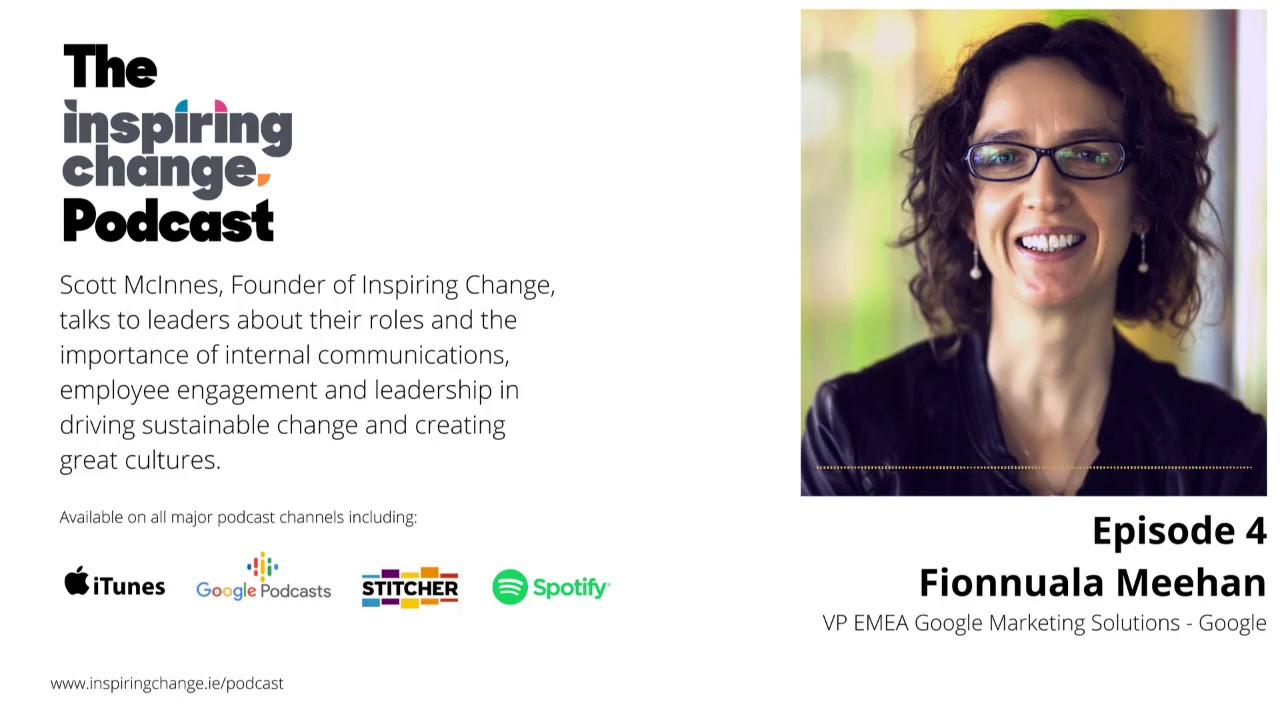
Fionnuala Meehan, VP of Google Marketing Solutions for EMEA, spent 13 years in roles across learning, sales, and operations before leading Dublin. She talks managing multi-generational teams, the cascade of communication from message to regional delivery, and why psychological safety and frequent feedback matter more than ever.
Chapters
Welcome to Face Forward, the Inspiring Change podcast on all things internal communications, engagement, leadership, and change. So here we are. Welcome to Edition 4 of Face Forward, the Inspiring Change podcast. It just seems to be recently that we've had amazing views, amazing weather, amazing everything when I've been out chatting to people. And that's no different today because I'm here with Fionnuala Meehan, who is the VP of Google's Marketing Solutions Department for EMEA, up on the 13th floor of Google Docks. And I will post a photograph of the view from here, which is phenomenal because you don't get high up in Dublin very often.
You don't, you don't. But it is one of the perks of the job. And it's lovely to look out on Dublin. Sometimes I look at that and go, is that really— is that Dublin? Is that my home city? Because it's looking fabulous.
It is looking fabulous today. So tell me, we'll kick off with an easy one, a little bit about you and your role here in Google, where you've come from.
Yeah, so I've been in Google coming up to 13 years and I started at a time when this office was getting established very scrappily. And so that was a time of doing various different things. The learning and development team, the telecoms team, the project management team, all sorts of different teams. Um, I had come from AOL where I'd done a lot of kind of customer service operations, and AOL was a really good place to have worked before Google because it had kind of the whole tech online, online vibe as well. Um, so, so after a few years of doing a bit of, you know, uh, working, working in wherever I needed to be, um, I, uh, kind of settled into advertiser operations after a few years, which was customer service around advertising for various markets. And then a few years ago, that turned into sales. And so I've been doing sales for EMEA for 2.5 years. And that's the day job, which is incredibly interesting, dynamic. So the entire EMEA region, so there's kind of 5 clusters within that. And then from Dublin, so the entire team is based in Dublin. We work with small and medium-sized businesses of all shapes and sizes, you know, indigenous brands, we work with agencies, and really I suppose broadly speaking it's help them stay ahead of the curve when it comes to online. Obviously advertising is a huge part of that, but it's also helping them to understand, you know, things, how they manage their customer journey, how they manage their customer data, you know, how they show up on mobile versus desktop. All sorts of things. So I think, you know, if you ask the team here, you know, that's why people get up in the morning is to, is to work with these businesses. A lot of them are— you're working with the owners, the founders, um, and again, it's kind of how can they be successful. So, you know, I think we feel we're successful when they're successful. And, you know, we— every week we round up the stories of, you know, which customers have we worked with this week, have they been able to expand, you know, how you know, how we've been able to help them. So that's the day job, and then, you know, just over a year ago I took on the site lead role, which is a much broader role, and that's working with the broader Dublin leadership team here, so the heads of functions for everything— engineering, HR, the other sales organizations, the teams that work with publishers— and, you know, basically thinking about a site strategy, for want of a better word, So how do we stay connected as a site with all of those different business functions reporting to different areas? And how do we connect with what's going on over on the West Coast? And how do we connect to our local community? So those are some of the things that we look at.
Okay, interesting. And I guess when you talk about Google Advertising, things like AdWords and those types of platforms that you guys would run?
Absolutely. AdWords. Yeah, I was saying this at an event during the week that, you know, when I started it was basically get your keywords right.
Yeah.
It's developed into a lot more than that. So measurement, audience, attribution models, obviously we have video now and display, which are, you know, which will represent the growth in advertising online over the next few years. It's actually a lot to do with the display video formats. Search obviously continues to be our hero product. And so, yeah, it's all of those things. Yeah.
Okay. It's quite funny talking about Google AdWords because I know back in the mid-'90s when I first started working in London— I know I don't look that old. Don't laugh. That's very unfair. But we used to do work for clients back in the very early days of SEO, and that was back in the days where if you put the keyword many, many, many times in white on a white background buried on the page, that would get you up the rankings. That would actually help. Are we cleverer than that now?
No, I'm not sure you're supposed to be doing that, Scott. I think I won't comment on that.
That was in a career long gone. Okay. Interesting. And you know, it's great being here at Google because I think that Google is one of those brands that is really aspirational. And that people look at really hold up high. And you can see that in the number of times that Google appears in the lists of places that people want to work. And I was only having a goo this morning at that, about the number of times that happens. And it's number 1, number 2. What do you think makes it such an aspirational brand and a place for people to want to come and work?
Yeah, it's a high bar. I have to say it's a high bar to live up to. I think it goes back to the, the mission. I know that sounds pretty, um, you know, obvious, um, but if you actually go back to the founder's letter and what they wanted to do— make information universally accessible and useful— um, like, that is something that's relevant to every person in the world. And if you think about how that's revolutionized access to information, you know, across the board and, and kind of level that playing field. Um, it is something that everybody can relate to, I think. Um, and because there was just that, you know, relentless focus on getting that thing right and then taking that idea and thinking about, okay, well, how do we use what we did in search to help with email, and how do we use what we did in search to help with Maps, and etc., etc. Um, and I think it's evolved over the years to, you know, how can we use technology to solve some of the problems that people come up against every day. And so, I think because there's that kind of clarity of thought around that mission, I think people look to that and see that it actually makes a difference to them in their daily lives. And I think as a company then, again, if you read the founder's letter and the way the company is set up, we're obviously a much bigger company now than we were 19 years ago, but I think to a large extent, stuck to those values and that culture. And that's harder and harder to do as the company gets bigger, but it's just, it's still there. It's in the DNA. It's in the air. And I think that comes through in terms of the products, but also how it's viewed as a place to work. And I suppose as a place to work, again, there's a huge amount of thinking put into that. We're a data-driven organization, so everything, everything is analyzed, right? So what makes the best— what, like, what makes a great manager, you know? Or what— when we say diversity and inclusion, what really matters, you know? When we look at communication, what really matters? Is it the Spanish controller, or is it layers in an organization? Those kind of things. And, and, and, you know, then we've, we've started to share that. I mean, if you go into the rework website, there's, you know, a lot of the things things that we have been researching over the years when it comes to the— those types of areas, we've actually just kind of said, okay, look, here it is, you guys learn from it and take it. You know, we've got our great, um, data scientists in-house doing all this work, but we've also shared it. Um, and, and, you know, that sounds like a very, you know, scientific approach to something that feels it should be a lot softer and a lot more about the art than, than the science. But actually, data tells you a lot because, I mean, people tell you in various ways, whether they're happy or not happy. And you can derive a lot of that. You can derive a lot of information then in knowing, well, what do people find important? What makes them happy? What makes a great manager? Those kind of things.
And what does make a great manager in Google? What are some of the traits that you look for in your managers when they're leading people?
Yeah. We have a very specific set of attributes, actually. And again, that is based on analysis of, you know, when we look at the people who are most happy in our employee survey, what do they value the most? It's a lot about giving great feedback, being a great coach, being able to make tough decisions, not micromanaging. I know I'm going to miss a few, but I mean, you're getting the general idea. It's, you know, somebody who can deliver great results but equally also build a team. And I think more recently, you know, the term psychological safety is which is kind of a term that's used to describe what a manager can create in a great team, which is a team where you feel, you know, there's a trust level and you feel your voice is being listened to, even if you're not necessarily agreeing with everybody and that will be respected. And again, there's an art in creating that psychological safety as a manager, right? And being kind of an inclusive manager. So we look at it like there's kind of base attributes that again are what you would expect them to be. But even though they're obvious, that doesn't mean that people do them all the time.
Sadly not.
Sadly not. And then there's kind of the more recent kind of focus on inclusion, right? And, you know, are you in a team where you feel you can voice your opinion and your opinion is going to be listened to even if you are a different gender demographic or have a different style or cultural background from everyone else in the team.
Okay, interesting. And from a communications perspective, easy for me to say, how do your leaders, how do you work with your leaders to ensure that they're the best communicators that they can be?
Yeah, I suppose we spend a lot of time thinking about what we are communicating.
Which is a very, very good starting point. A lot of organizations don't think about that. They just get out of the traps quick, let's go, and they don't really put too much thinking into the what.
Into the what. So a lot of time that I spend with my senior leadership team is, you know, where, you know, what is, what's the message, what's in it for people in the team, what and how do we deliver that? What's the tone of the message and where do we need to be really— where is it really important to be really consistent? There's definitely kind of a cascading thing that works in the organization, you know, where things that are important or messages that need to kind of get down to the people in the frontline doing the job There's a very intentional way of cascading that, which I think is very important. And then I suppose what I do personally is, you know, we spend a lot of time discussing communications plans. I would also kind of observe my team as well, like when they're doing their all-hands or their team meetings. I actually observe some of that to just to get a sense of, well, how are they talking about the things that I've been talking about and and play that back. And, you know, when I do that, always learn about a better way to say something. But also, you know, how does it land in the Northern European cluster compared to the Erfreit cluster or the UK I cluster? Because there can often be different emphasis points, you know.
And when you think about Cascade, because I think that the whole Cascade thing can be and has been very much vilified in terms of, well, it's just, you it's a lazy way to do communications. I personally don't believe it is because I think it gives local leaders, as you go down that waterfall, the opportunity to bring it to life for their people in a way that lands most resonantly.
Yeah, but I mean, things are changing so much. I mean, I think you can't kind of start at the beginning of the year and say, here are the things we're going to talk about this year, full stop, you know, see you in December. And things change all the time. So fast-paced, I think every sector is fast-paced. This sector is definitely fast-paced. And it's really a way of, I think, transmitting like what is important at the moment for us, you know, as a company, like what is my boss saying, you know, that I need to talk to my team about. And yeah, so I see it as kind of an empowering thing and helping people hear or feel connected, right? So if I hear my manager talking about something and I know that I also heard Sundar talk about it at TGIF, you know, then I know what I do is related to that in some way, you know.
That red thread.
Exactly, yeah.
And what do you expect when you're doing that cascade, what do you expect your leaders to be doing with what they receive when they go into that briefing with their teams?
Owning it and listening. I think listening and probing for understanding and I think What usually happens is they will come back with, you know, this is the bits that people understood and these are the bits that people didn't like or didn't understand. And then there's another process that kicks off, and sometimes that means you have to go back and redesign things, or sometimes it means you just need to clarify.
I guess having that feedback back up the cascade is very, very useful for you for the next time in that ongoing learning piece.
Yeah, and it's kind of— it's not like it's a business process that has a name. Maybe it does, maybe it does or doesn't, but it feels to me like it's the It's like the blood circulating through the system, right? I mean, you need, you need to be moving them out, you need to be moving that around, but you also need to be seeing what's coming back and it's kind of a constant flow.
Yeah. Okay. Interesting. Now we were chatting just before we kicked off about the whole millennials thing.
Yes.
And you know, you can read on the web about millennials. Is it a thing? Is it not a thing? Is millennials a thing?
I mean, I think It is a thing. There, there are quite a lot of things that are similar, similar in that generation to every other generation that came before it. Um, there are quite a lot of things that I admire about that generation that I certainly don't think I felt or aspired to when I was that age.
Things like what?
Um, things like, um, having a very open view to careers, things like, um, wanting to balance their lives. Between personal and professional, and thinking about that quite early, you know.
Work-life balance.
Yes, yes, yes. And but being quite, being much more thoughtful. Like, I mean, when I was at that age, I don't think I was thinking about that. I was just thinking about doing my job really well, you know, whereas much more, I'm in this, this is a marathon, not a sprint. I'm going to, I don't know how many jobs, are you going to have 10, 13 jobs or something? Is that what they say? I think there's much more of a sense of, um, I've got this runway ahead of me and I need to be intentional about it. And I'm going to move many times and I'm going to do many different things. So, you know, what am I learning at the moment? What's in it for me? Um, how am I having a fully rounded life? You know, not just learning, you know, learning things and working really hard, but what is that? What else is going on for me? Um, and I think also looking for What difference am I making? Like, what's, where's the meaning in this?
Purpose.
Yeah. Which is, which I think is a very big thing. And then I think there is a set of things, you know, where they, you know, and again, making a wild generalization where expectations are very high around the type of, the type and regularity of feedback that you give, the amount of personal development you will give. And, and so that means as a people manager, I think the stakes have probably gone up significantly, right? Because it's not just about driving results, it's really about tuning into each individual in your team. They're all going to want different things. It's about connecting with them on that level of like, not only just are they doing the job, but what are they learning and what's their own personal development plan? And they're all good things. It's just that's a lot to take on as a manager. And I suppose, again, stakes are much higher and that demands more emotionally of managers, I think, as well.
I think when you've built from the ground up like you have done in Google and some of the other tech companies around the world, that's probably easier to do because you've grown up with that, arguably, whereas some of the older organizations, the banks and financial services and the older tech companies, the IBMs or the Hewlett-Packards that have been around for 50 or 60 or 70 years, that's harder.
Yeah, I think it is because You know, there are a lot of things that are in our, you know, I suppose to say, in our DNA as a company, you know, how transparent we are, how much information we share with employees, the amount of forums they have to ask questions and challenge, um, the, the access to— they have, you know, to senior levels. I mean, you know, their hierarchy thing kind of isn't really there. Um, and, um, that's kind of built into that's built into the way you manage. And, you know, I do notice that when we hire people who have managed extremely successfully, you know, 10, 15, 20 years in other places and they come in here, I do always have to sit them down and say, I know you've managed people before, but it's different. And it's different because of that, because of those values that we have. So I don't envy people joining sometimes because when you've learned your defaults as a manager in another place, it's quite hard to switch them.
It is difficult. And I guess when you look at an organization where, I think we were saying beforehand, half are millennial generation, that's tough.
Yeah, it is. And actually, there's the whole idea of kind of multi-generational teams as well, because people are at different stages of their life, of their lives as well. Yeah. And this is a something we spend a lot of time trying to equip our managers to do it because I said, you know, half the job is delivering the results, but at least half of the job is caring for the individuals in your team and thinking about all of that. Yeah.
And from my perspective, they're definitely the ones who are best placed to do that. You know, with the best will in the world, you are not going to know everybody that works on this site, but each of those people leaders within the hierarchy does, and they're the ones that eventually can provide that caring environment that you talked about.
Yeah, in the end of the day, it's the person you meet every day in work, you know, who you're having those daily interactions. I mean, they're your manager, is it, right? Yeah, I completely agree. And it's a privileged role, you know, it is a privileged role.
I'm not sure they may think that the whole time.
Yeah, well, you know, I think we're managing a team in here of the highly motivated people that we hire from right across the region. I think over 1,000 universities we hire from in our graduate hiring. There's obviously a challenge in that in managing across cultures and things like that as well, but it is, at the end of the day, I think any person managing here after a few years, we'll look back and go, yeah, you know what, that was formative.
Yeah, yeah, totally. What would you say are some of the things, just carrying on the millennial theme, what are some of the practical things do you think that other organizations listening to this who have that mix of, because I think there's 5 generations in the workforce now, what advice could you give to some of those organizations where they have that kind of multi-generational workforce to help make sure that everyone's pulling in the same direction?
Yeah, I I mean, I, I think all of the good practice applies in terms of knowing what your message is, being consistent on your themes, being accountable. Um, I, I, I think then you need to, you, you need to think about different ways of communicating though. And again, I'm sure, not sure that's a new concept. People have different styles and different ways of absorbing information.
Basic stuff that necessarily people aren't doing.
Yeah, but, but again, I would think about, you know, email is which is probably, you know, in many ways the laziest form of communication. You know, some people like reading email, but a lot of people don't. So increasingly internally for our communication, we would use videos or podcasts or listening sessions or just in more informal chats. And so just thinking about how the message is being understood and absorbed at every level within the organization. And I think as a leader, like for I would say 90% of my job is people and communications and just getting out there and thinking about the different ways that you're delivering the message and that it is consistent in all of the different ways that you're doing it. I think if you're going to engage in social media or more social kind of ways of delivering messages like that internally, My experience is, again, particularly with millennials, is you have to commit to it, right? You can't just dip in, you know, so if you're gonna do it, do it, but have a plan and do it properly. Don't just dip in and plus one or like something and then go away and never be seen again, because again, I think people just see through that. I think, you know, the other thing generally is getting that group involved in problem-solving, and, you know, I think that kind of feeds that sense of purpose that they want to have. So whether it's problem solving in the day job that they're doing or problem solving in something maybe from the point of view of corporate social responsibility, it's actually trusting them to actually, you know, giving them a problem, giving them a big problem to solve and challenging them in that way. I think is, yeah, I think that's also another really good thing to do and just kind of Put something out there and see what comes back to you. And every time I've done that, I've been really impressed.
I think that for me, when you go out and ask for feedback, when you ask for people to get involved in solving those big problems, even if the solutions they come up with aren't the solution that eventually gets put in place, that gets deployed, actually the big thing for me is having been asked.
Yes.
You've asked me, you've looked at my feedback, you've taken my feedback on board, you've considered my feedback, you haven't gone ahead with it.
Yeah.
But you explained why.
You explained why.
I understand.
Yeah, you do have to close the loop and explain why and explain why you chose to do what you did. But I think being listened to, being involved in problem solving, again, I think with the millennial group, my sense is that they want to solve, they want to contribute and they want to solve big problems. And God knows, you know, in a business of this size, we have many problems to solve. Solved. So, you know, using them as a source of ideas, particularly because they're so close to customers as well and have a real sense of that, you know, a real sense of how they show up for customers. And that closeness, I think, can mean they are often the best people to solve the problems, right?
Of course. I spend a lot of time talking to clients about employee engagement, and I think in many cases employee engagement is still a bit of a thing. I often hear the term, and I wrote a blog about it the other week, have you done your engagement yet? I'm doing that two thing. For those people listening, I'm doing that thing with my fingers, the two things. I guess in a culture like Google, the way the culture has been built from the bottom up, you don't necessarily have to put a huge focus on employee engagement because the way the culture works, the way you hire, the way you train leaders, Does that create an engaging culture or do you have to work at it?
I still think you need to work at it. Okay. Yeah. One of my colleagues here has a great saying, which is culture is like French bread. You need to bake it every day. I stole that one.
I shall re-steal it.
You can re-steal it. No, I think you still need to work at it. I think you still need to work at it. Because it doesn't just— I think the moment you think it's just going to happen is the moment when it stops happening. Yeah. Because the thing is, it's the signals you're sending. Do you know what I mean? And you send a signal in everything you do. And if you start to move away from that, you get lazy and you fall back on your defaults and, you know, and then people get confused and that becomes toxic. Right. Because then people, you know, who have high expectations from you as a leader will say, oh, well, you, you said this and you said this was important, but now you're not saying it anymore. Uh, why is, is it not important? I often get that feedback, you know, you haven't talked about this in a while, and I'm thinking, oh my God, I thought you were sick. Did you remember that? Yeah, but you know, I'm saying it so often like I'm sick. It's, you know, the way sometimes you're saying something so often yourself you think thinking I must be boring the hell out of everybody. But then you get feedback that you haven't said it, or, you know, is this not important anymore? So you, you have to think about everything you do being a signal, you know. So, you know, even every email I send out, I'm kind of checking back to think, okay, well, what's the reference point somebody would have reading this? You know, I'm not just to send out a, here's an update, but here's an update that relates to that thing that I said was important at the start of the year, remember?
Lincoln Label.
So, you know, you know, this training I want you to do, I'm not just I'm not just nagging you to do this training. Remember we said this is important for our customers at the start there? So yeah, I think it is, we have an incredibly strong culture and it's a wonderful place to work, it's a wonderful place to lead, but it still requires you to work at it every day.
Yeah, okay, interesting. So tell me a little bit about your leadership role models. Who is it that you look up to?
Ooh, um, I don't know that I have like, you know, specific people or, you know, a book I've read about somebody and I think, oh my God, I want to be that person, aren't they wonderful? Um, I like people who have their non-negotiables and stick by them and are consistent with them. Um, and, um, I like people who are good coaches You know, because I think you can report to people who are great leaders and managers, but they don't necessarily, you know, they don't necessarily sit down and put the effort into personal development that that requires. Right. And I suppose over the years I've had a few different people who, you know, at certain pivotal points in my career have been great role models. Have given me great feedback or been great role models. And so it's more like a pastiche, you know, so it's not like, you know, one individual person represented everything for me. But, you know, I know some of the earliest managers I had in AOL, female managers certainly for me, were role models around, you know, just being able to do a job that was very demanding, but, you know, also do a really high-powered job but have kids, but also have a life that you would want to have. Do you know what I mean? Because sometimes you look at people and think, I know you're managing it all, but I wouldn't want that life, you know. And so there have been some times, you know, when, when at pivotal moments I've seen people do things and think, yeah, okay, well, that means I could do it. Um, and, you know, in Google I've had plenty of different leaders that I've learned from. And, um, I think just Leaders who have strong values and they're non-negotiables for them and they stick to them, that consistency builds trust in an organization. And sometimes, you know, sometimes you might not like it, but you get to know it. And that trust is really important actually, because then people get to know what to expect.
Sorry listeners, that was me pulling the microphone over with my headphone lead while Fionnuala was in the middle of talking. Let me ask you then, just we build on that just very quickly. What are some of your values? What do you hold dear?
Yeah, I'm honest hard work. I do believe hard work brings you luck. And so, yeah, I would live by that myself and look for that in the people that I work with. I like honesty as well. Just, you know, I like people to say what they mean and follow through on the stuff that they say they're going to follow through on. Um, and I suppose, um, in work, you know, like to acknowledge that people have lives outside work, you know. So, um, and for that to kind of mean something in terms of giving people the space when they need space, you know, because again, you're managing a team of people at different life stages and people need different things at different times. I think that one of the most powerful things you can do is to acknowledge when people need a break or need time off or, you know, just, you know, need to do something different or just need a little bit of breathing space. I think that's, you know, because if you're in a job and you don't think you have that, that's incredibly stressful.
It is. It can add to an already sometimes stressful situation, as you say, with people at different life stages, for sure.
Yeah.
Very last one. And I like to ask everybody this question. What leadership advice, what one piece of leadership advice would you give to your 20-year-old self?
If you look back, speak up more.
Speak up more.
Yeah, absolutely. Yes. I think I only started speaking up halfway through my career. So, yeah.
So there you go from Fenella Mehan, speak up more. Listen, thanks really for having me.
It's a pleasure.
It's been really, really nice talking to you. I really appreciate it.
Thank you.
Thanks. Thanks for listening. For more on Inspiring Change and to read our blog, please visit inspiringchange.ie.
More from Scott

Leaders can't assume connection happens automatically #LeadershipLessons #EmployeeExperience

The hidden reason your remote team feels disconnected #TeamConnection #HybridWork

This is why people actually stay at their jobs #workplace #culture #retention

156 | Inside Disconnection at Work: Bridging the Connection Gap Report with Sadhbh O'Flaherty




155 | The Overlooked Art of Building Connection at Work | Scott McInnes with Christine Armstrong


