Episode 9 | TARA O'SULLIVAN | Chief Creative Officer, Skillsoft
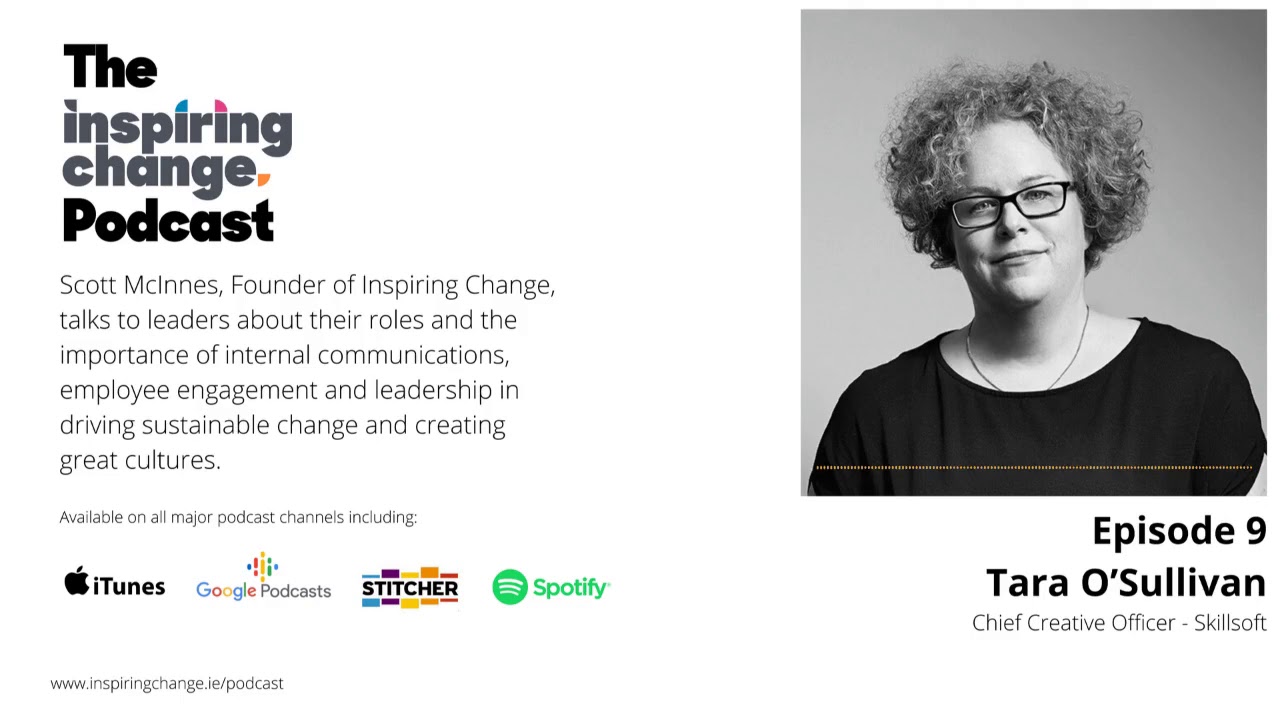
Tara O'Sullivan, Chief Creative Officer at Skillsoft, discusses the company's shift to scenario-based learning through its Percipio platform and mobile app. She covers leadership through authenticity and radical candor, gender equity work that requires senior men's involvement, and replacing mentorship with sponsorship for women. She also advocates for bite-size leadership training delivered when leaders actually need it.
Chapters
Welcome to Face Forward, the Inspiring Change podcast on all things internal communications, engagement, leadership, and change. So hello and welcome to episode 9 of Face Forward, the Inspiring Change podcast on everything communications, engagement, change, and leadership. Really good podcast, podcast 8, with Pedro Angulo, and in closing he talked about his advice for his 20-year-old self, which was to learn, learn, learn, to always be learning, to always be somebody who, as he said his father told him, be somebody who's looking at everything, read everything, listen, learn everything, and then make your own decisions. Make your decisions about who you want to be and what you want to achieve. So learning is the theme of today's podcast. I'm really pleased to be here with Tara O'Sullivan, who's the Chief Creative Officer from Skillsoft. I'm going to let Tara talk a little bit about Skillsoft in a while, but just for some big stats, the world's largest e-learning company. Yeah. Over 150— sorry, over 40 million users worldwide and 150,000 pieces of learning content. Huge, absolutely huge. And obviously learning is at the core of what you do, the very core of what you do. So it's a pleasure to be here. Thank you for having me.
Thank you very much. Great to be here.
Why don't we kick off, as we always do on these podcasts, with you telling me a little bit about yourself, about your journey, about your role in Skillsoft?
Sure, so I'm the Chief Creative Officer, which I think the only other place that has a Chief Creative Officer is Tom Ford, so that's kind of cool. The Chief Creative Officer, basically what I do is I look after marketing, and I also looked after a lot of the content when I came here first. So my role is changing a little bit now to Chief Marketing Officer more so, because that's where my absolute focus is on. Skillsoft has gone through a lot of transformation in the last couple of years, and We rewrote all our content. We changed it from being very instructor-led to be much more scenario-based. We've done really cool work with MIT and Accenture where we test people's recall in MRI machines to see what works better. Really, really cool, really interesting. But we transformed everything we did. So we did the content, we built a brand new intelligent learning platform called Percipio, and we also re-platformed our LMS as well. So it's been really busy. It was very much like a family here, and it's been around for 20 years, and so making those changes was very, was very interesting and very challenging. So that was, it was a really, really interesting 2 and a half years.
And what do you find yourself doing day to day in your role?
So I suppose at the moment an awful lot of my focus is on the internal communication for the for the organization. We do an awful lot of sales enablement work with the salespeople because we've obviously changed a huge amount of how we talk about ourselves and how we position ourselves in the marketplace. So we wouldn't have ever been very focused on kind of blowing our own horn or anything like that because from a Skillsoft perspective, we were the market leader, everybody knew it. But about 5 years ago, a lot of people started coming into the market and kind of nipping at our heels. So we need to position, allow the salespeople to position the company much more as a leader and as the innovator specifically, and in the past we wouldn't have done an awful lot of that. So that's a lot of my day. I think about how we position ourselves against competition a lot of the time. There's an awful lot of product releases coming out all the time that we work on and figure out how we include that in the story of what Skillsoft is and who we are. But we've spent an awful lot of time, we just actually did a town hall 2 days ago from the K Club, and we spend an awful lot of time talking to the staff and communicating with the staff and telling the staff what's going on and why we're doing what we're doing. And I think that's been a key focus for me for the last 2 and a half years.
I think particularly as you were going through, as you said, a big change in the organization.
Absolutely. Yeah, yeah.
Tell me a little bit about your views on what makes a leader a great leader, because I know that you're extremely passionate about women in business.
Yeah.
More women, particularly into leadership locations. But what is it in general that makes a leader a great leader in your perspective?
I suppose I've been blessed to have some really, really good bosses, and the big thing that really resonates with me is authenticity. So being brutally honest. So there's this phenomenal book called Radical Candor by Kim Scott. She worked with Sheryl Sandberg at Facebook, and she talks about this idea of being really open with each other to make each other better, right? So not to criticize, to put you down, to say you didn't do that well because— it's all about elevating everybody, elevate the team. And I think that authenticity about direction, but also about what we need to do and why is really, really important. So that's a big one for me. The other thing is that I think, you know, when I come into something, and especially when I joined Skillsoft, there was a huge amount of work to be done on the brand, and there was a massive amount of work to be done on content. My boss at the time, Bill Donoghue, always said, "You can do 3 things. So these are the 3 things we're gonna do." And I'd come in with a list of 57 things, and he'd go, "No, no, no, no, we're gonna do 3 of those, then we're gonna go to the next 3, then—" Because otherwise your energy just gets dissipated, right? And I think pulling that energy and really focusing the person's energy in the right place that's going to move the business. That's another really critically brilliant thing good leaders do. And the last thing, I suppose, is that I think they really understand when you need support, you know. So I ask people all the time, "What do you need me to do?" at the end of my one-to-one calls. "What is it that I can do to help you this week? Is there something with finance? Is there something with legal? Is there, you know, do you need somebody else to work on your team? What is it that I can do?" because I want to make sure that I'm supporting people. And that's what really helped with me. But the authenticity above all else, understanding what direction we're going, why it's that direction, and what I can do to make sure we get there faster, cheaper, quicker, whatever.
And I remember when I was doing my homework on you, like a little stalker, digging around Google. That's okay. One of the things that popped up was this whole idea of you hating politics. I really do. And that whole idea that somebody's saying one thing in a meeting and then somebody else, somebody's saying something else when they leave.
Yeah, yeah, yeah. And it drives me crazy. And I think there's a couple of issues with that. One is the energy it dissipates. So again, you're spending energy bitching and moaning, right? Or saying something else. Whereas I think you, and I mean, maybe in a full meeting isn't the time to say it, but you have to say it. And I would be well known for being very open and opinionated in my views, and I expect people to do the same. But what's been really interesting with me as a leader is that there's people on my team who would not be very— and it's not even a confidence thing, it's just that's not naturally who they are, and you really have to pull it out of them some way. You have to find a way to pull it out of them. So yeah, I do, I hate politics. I think it is a It is vampiric in its energy. I just think it is. If you have people on your team who are doing the kind of, you know, the Negative Nancy thing, I think it's very difficult.
Yeah, because it's catching. It's like the flu.
It is. It's like a cancer. It is like a cancer in the organization, and they can turn great people bad. Nothing to do with even what they're saying, but the fact that you're around that kind of negative— and I have a— we're moving offices soon, And one of the posters I'm putting up is, "You're responsible for the energy you bring in here." Because I really do think, you know, if you're coming in to bitch and moan and whine and all that kind of stuff, you're destroying me because I'm sitting here, I'm really busy. But you're also then, what are you doing when you go outside here? You know, so, yeah. And I suppose I feel at the bottom line, people should love what they do. Because I'm away from my kids, I'm away from my husband, so I need to be doing something that is absolutely compelling and really interesting. And changes the world a little bit, otherwise why would you do it? You know, so that's a big thing for me as well. And I also think, you know, if there's somebody who's there and they're, you know, a little bit negative or whatever, there's a better job for them and I have to help them find it in the organization or I have to prep them to leave the organization. And I think that's really key, is that part of my job as a leader is to make sure that everybody in the organization is where they should be and the right fit. And sometimes we have to move people out who aren't into other departments or out of the organization for their sake as well as for ours.
And I think that those hard conversations are not conversations that we have easily, particularly in Irish culture. I found over the past 18 years, it's not something that hard conversation, not something we're good at. We'll maybe pick up on that later. What was interesting was your point about we should be doing something that we love. And for me, leaders have, are so at the core of that because your leader is the person that you closest with every day, aside from your teammates. They're the person you probably trust the most. They're the person you're looking to for, for direction and support. So I wonder, from your perspective, what is it that— what's the role of a leader in creating that engaging workplace and creating that place that you want to be to do your best every day?
So I think a lot of it is figuring out how you're doing. So as the leader, figuring out what you need, where you need to be pushed, or where you need to be protected. What your weaknesses are, what your strengths are, and backing you up. So I always feel like I need to get people out of people's way, right? So I need to figure out all the stuff I can do to offensively or defensively get people out of your way. So you can do— exactly. And so my job is to clear the path for whatever it is I need you to do, rather than— so if you're getting mired down in you know, politics or legal or finance or whatever, my job is to get that out of your way because I can do that very quickly, whereas, you know, that can take you a bit longer to do. And then I think also it's really important, um, you know, if there's, if there's, if, if there's improvements you need to make, that we give you the training to do that, or we give you the mentoring, or we give you a, um, somebody from the outside who's going to help you do that, because nobody's perfect, right? We all have things that we need help on, and I think that's really important as well. I think that's part of your job. It's like being, you know, it's slightly parental in that you know your kids' strengths and weaknesses, and you know where they're going to need a bit more quarterbacking versus where they're going to, you know, be absolutely fantastic.
And given your thinking on women in business and your perspective on that, what is it that leaders should be doing more of or doing differently to perhaps engender a bit more balance in an organization?
Yeah, so there's lots of things that leaders can do, and the thing I think that an awful lot of women's groups in companies and things like that have forgotten about is that you have to involve the old white guys because they are the ones running the company, right?. And if you don't have a conversation that involves them, you're just gonna— you're gonna provide a really good group of women that you know really well and will support you, but if you don't involve the old white guys, it's gonna go nowhere. You know, you aren't— it's very difficult to make absolute change unless you have that. So I think a lot of it is you need to— as human beings, we're We're drawn to what's similar to us, right? So I like hiring women, right? You know, a lot of men like hiring men because, you know, that's what they do. And I think it's really important that, you know, we had talked about unconscious and subconscious bias, and my thing is conscious bias, right? When you think about the Starbucks incident, that's nothing to do with unconscious bias. That is completely conscious bias. And shocking. It is. But I think in Ireland there's still a real sense of conscious bias with people. So, you know, if you think about Lean In Organization did a piece of work in the US where they changed the name on a resume and the men's got 61% more take-up or something like that just because of the name, right? So there is, and that's in America where there's a huge amount of diversity awareness, there's lots of training, whereas I think in Ireland there isn't as much. So I think a lot of it is You need to make sure you have a balanced team. Diverse teams do better, they make more money, and customers are happier because you've got more ideas, right? Who wants to walk into a room and just have 5 of you talking back to you and going, yeah, yeah, yeah, great, great, great? You need diversity in age, in ethnicity, in, you know, gender diversity, everything. So I think that's a huge piece. I think in a lot of cases you need to fight for pay equality. That's the other thing. I think there's an awful lot of men out there today who know that women on their teams are being paid less, and I think that they should not be able to sleep at night, in my opinion. That's the other thing I think is really important.
There was a really powerful film which I will— I'll find and include a link to in the show notes from the podcast this morning, from— I think it was in some Scandinavian— it's kind of Nordic— from a bank around exactly that, where they brought in some groups of children, some pairs of children, a boy and a girl, a couple of girls, and they asked them to do a job, which was to pick up some balls that were on the floor and put them into 2 glass jars. Same number of balls, same size glass jars. Half the balls are pink, half the balls are blue. 2 things struck me. One, when they said, can you just pick up, pick up the pink balls and put them into one and pick up the blue balls and put them into the other, not directing that to anybody. The boy, of course, picked up the blue balls and the girl picked up the pink balls. And I went, "Oh, that's interesting." We got to the end of the film. When they'd done the job, they were asked to close their eyes and hold out their hands, and they were each given a glass. And this is their payment, their reward. One of the glasses was totally full, jam-packed with sweets pouring at the top, given to the boy. And the same size glass but half full with sweets. Give it to the girl. Open your eyes. Which then, outside of the looks of astonishment when suddenly they realized what had happened, a little girl, she was maybe 5, a little girl who'd realized, and then she'd go, but why did he get more than we? We did the same job. And why did— That's really interesting. What was really powerful was the boys were then going, but, but, 'Girls aren't any different to boys. Why is she getting less?' And actually the boys then taking stuff out of their cup and giving it to the girls to make sure. And loads of the couples were sharing and giving more and taking a biscuit and putting it back or taking some jellies and putting them back. It was just a really powerful way. And I think the closing line was, you know, 'Kids don't understand why there isn't diversity. Why are adults still doing it?' Really powerful. Really, really powerful. 2 and a half minutes. I'll share it with you. As I say, I'll share it in the show notes as well. But it was just really, really good. Let's talk a little bit about learning. Yes. Because that's obviously what you do. Yes, absolutely. And the role of learning in driving business success, because it's changed dramatically over the past few years. I was in, I joined the IB in 2012, just before we put in proper decent learning management systems and all that good stuff. And it was still very classroom-based, very talk-to, very man at the front giving the lecture, or lady at the front giving the lecture. And then you left the room, and that's that. I don't know, you'll be able to correct me on the exact numbers, that you forget 80% of the learning in the next 3 hours. Seems to be moving much, much more to on-demand learning, and a platform like yours, obviously, that's exactly what you're pushing. So I just wonder, from your perspective, what is the role of learning in developing and driving business?
So there's 2 different kind of modules that we think about. 2 different use cases, right? So one is, I need to know how to do a pivot table in Excel. How the hell do I do that? Right? And that's a 20-second piece of information I need in order to do my job straight away. And then there's another one which is slightly longer, which is, I'm really interested in learning about, or I've become a new manager and I want to get into a deep dive, right? So the thing we talk about an awful lot is learning in the flow of work and learning in the flow of life. So this idea of stopping what you're doing and going and doing learning is no longer the case, right? It is as you're happening with your day, basically, you need to be learning at these times. So, so one of the things we have is we have Principia, which is on your phone. So I'm driving in the car, I listen to an audiobook and I get into the office, I pause the audiobook and then I listen to it on the way home again. If I'm looking for my pivot table, we have a plugin for Chrome that allows you to do a search on Percipio. So if I'm sitting there, I don't understand a term in a document or in a webpage, I can just do a search for that and see what kind of learning we have. So I think that's really important, is the learning and the flow of work. And there's a really famous HR guru guy called Josh Berson who we work with, and he reckons that this is the biggest thing. Because, you know, it's no longer enough to do 3 days a year outside of the office on something. Your level of fall-off is like 90-something percent. And the other really important thing is relevance, right? So this idea of an awful lot of e-learning at the beginning of time was recording instructors standing at the top of the class, right? And that does not get you— it does not increase the learning in your brain.
You're not bought in.
You're not engaged. You're not at all. It's something you have to watch. So you really need to have emotion, you need relevance in order to make it stick. That's really, really important. So an awful lot of the work we've been doing over the last 2 years is putting in more scenario-based. So you're in the room when the transgender woman is being sexually harassed and you see the aftermath of that when she goes back to her desk and has a conversation with the HR person., right? So it's much more— it's like watching a Netflix program, actually, is what it is. You get to know the Ken guy, who's the main idiot who makes all the mistakes and says all the stupid things, but you also get to know how the rest of the team either protect Ken, because a couple of them protect Ken, and there's other people then who call him out and get in trouble for that. So that's much more compelling, and it increases your learning, but it also increases your recall an awful lot more. But even, we've done a new leadership development program that we just launched and one of the things we're looking at is if we get you to think about for like 20 seconds, so you don't write anything, there's just a gap to think about a time when you had a real problem with a leader. Back then, and we then tell you a story, we show you the scenario-based, it's all narrative pedagogy and that goes, that gets wrapped around that memory you have of the bad leader or the good leader or whatever it is so that we increase recall even more.
And it cements it. Absolutely. I think storytelling is a massively important part of my life and the work that I do for exactly the same reason. Exactly. You're cementing thinking, you're cementing memories, and you're driving recall. And I think that whole 70-20-10 model of learning where we've been told for years that 70% of learning should be on the job. Correct. I guess that's exactly what you're doing. You're aligning learning with your job. Yeah, yeah, exactly. Yeah, yeah, yeah. I was interested in reading about your program, Women in Action, where you've created learning specifically more targeted at women. Yes. Something that you started to do here in Skillsoft, but then actually went, hmm, perhaps this is something that our clients might be interested in too.
Yes, absolutely.
Tell me a little bit about that.
A lot of our clients were asking for specific things for for their hypo women in the organisation.
Why does it have to be different to the hypo men?
Because it's interesting, women do things that— so when I always talk about this, there's a lot of stuff the white men need to do, so you know, stop mansplaining, promote more women, you know, make sure it's 50/50, all that kind of stuff. But women also have some things that we need to do. So really simple things like where you sit in a meeting. An awful lot of women will gravitate towards the end of the table rather than the middle of the table where a lot of the action is, right? An awful lot of women will say, "Sorry, sorry, do you mind? Sorry, sorry, is it okay? Do you mind?" And they will use language that is, um, that questions their authority. It's differential. Yeah, it is very differential. Exactly. So actually Google came up with a plugin on Chrome called Just Not Sorry, which would tell you If you were using words that were, "What do you think of?" "Do you mind if?" "If I might suggest?" Right? Because women use an awful lot of those words, right? When we speak, they use an awful lot of those words. In emails, amazing amounts of written communication by women is, "Do you mind if?" "If I might make a suggestion?" And I think that's really important. The other thing I think we need to own our own success, right? So I think in the past, when you had, when women would do something and get, you know, applauded for that and they would say, "Oh, it's the team," or, "Oh, you know, it's the whole group," or whatever, whereas guys will go, "Yeah, thank you." You know, we always involve everybody and it's probably true that it was a group thing, but we definitely need to own our own success. And the last thing is in meetings, and women can do this for other meetings and so can men, is that when a woman comes up with a great idea, oftentimes she'll be interrupted or she will be talked over. And then 5 minutes later a guy will present the same idea and they'll all go, "Oh my God, that was amazing. That was so great, Paul." And all the women are sitting around going, "Didn't Sarah just say—" What? What? 5 minutes ago? Yeah, yeah, yeah. Did nobody— is anybody taking minutes? Has anybody recorded this meeting? So that's really important that other women will say, sorry, can we just listen to the point Sarah is making? Sorry, I think that point is really interesting. So she is heard. And I think that's incredibly important.
And the importance of actually calling, calling that out.
Yes. Yeah, very much so.
I think from a leadership perspective, supporting— I think people have to own their own personal development. And that was something that we spent a lot of time talking about in AIB. On the HR team there. It's not something that you sit there and go, "Right, boss, tell me what I should be developing now." It's actually something you own yourself. What are your thoughts on what people can be doing more of to drive their own personal development?
Yeah, so I think we did a piece of research last year. We have books as part of our program, and I love books, and I love listening to books, but I also love reading books. And one of the questions we had is how relevant were books now, right? Because everybody is looking for the 3-minute video, everybody's looking for, you know, the one-page summary. And actually what we found is that books are really relevant to everybody, my generation, but they're especially relevant to millennials because lots of people are saying, "Oh, millennials don't really read books," and it's not true. What millennials do, which is really interesting, is they deep dive, right? So if they're interested in a topic, they will go really, really deep and they'll read multiple books about it. But from your own personal development, I think that's about what you're interested in. I think it's really important looking— obviously I'm in marketing, so I would spend an awful lot of time reading about agile marketing, which is all the new thing that they're talking about, and it's like, you know, it's becoming almost like software development. But I think it's really important to make sure that you have focus on what makes you a better manager, What makes you a better employee and also what makes you a better person? And I think a lot of it starts with me, about me being a better person. That's the big thing for me. It's not really about I want to be better as a manager. It's that I want to be, you know, I want to be more efficient. I want to be more effective. I want to be happier. It's all of those things, you know, and that will then spill over into work.
Something we were talking about just before we started recording, and I think it ties in really nicely into that whole idea of owning your own development is something you mentioned, which was a democratisation of leadership. Talk to me a little bit about that and your thoughts on that.
So this is a really big thing for us at the moment in Skillsoft. You know, I think the days of where you took your hypos, you know, your high potential people away for, as I said, 3 days once a year with a mentor are gone. They have to be gone, right? Because now you have multiple generations at work. So it's not based on seniority, so you don't know that I'm the manager because I look older, or you know, you don't have that anymore. And you have young people in their 20s being put into positions where they're running a cross-functional team, right, because they have the most knowledge about it or they're driving it or whatever. And they need to be able to manage that, right? And waiting for them to become hypos when they're in their late 20s or early 30s and bringing them away in a 3-day is BS. It just doesn't work anymore. So you have to democratize learning. You have to democratize that leadership training, and you have to give it to them at their moment of need, and it has to be when they want to take it. So they have to decide that, oh, I've got a big leadership meeting tomorrow, or I've got a big event tomorrow, I need to just go and do some training around that to make sure I am where I need to be. I've got a presentation that I want to make sure I get all my presentation skills down pat and all that kind of stuff. And I think the issue is that when you think about it, there's a massive skills shortage, there's a massive talent shortage, right? We also then have trying to keep the right people is really hard. People do not leave businesses, they leave managers. Absolutely. It is impossible walking in there every day and seeing that person and that person driving you crazy or being ineffective or whatever. So the more you train brilliant leaders, people will lie down and die for leaders. I have seen it. They will do whatever it takes to make that leader a success. And it's not, the business is a secondary thing, it is about the leader. So if you can produce leaders who are, I think authenticity, I've said it, is hugely important. Being honest is hugely important and being a really good communicator. And I think they are all things that can be taught. You know, this again BS of like you're born a leader or you're not, I actually think you can teach a large proportion of them. You can certainly teach them to be brilliant managers, and that's what democratization of leadership training is about.
And I think we've all had leaders, you know, some of whom you would take a bullet for. Absolutely. And others of whom you would always send, if they asked for a document, you would always send the PDF.
Yeah, yeah, yeah, exactly, so they can't change it. Exactly. And put their own. Correct, that's exactly right. That's exactly right. But even the fact that you're thinking that while you're sitting there, I'm gonna save it as PDF so I don't have to It's just— but even having that karma sitting around, it's just, it's awful.
Yeah, it is. Um, one thing you talked about in a couple of the articles I read, again, when I was, when I was stalking you on the internet, um, was around, um, the power of mentors and coaches and somebody having your back, having a sponsor, I think you referred to. Yeah, because I, I—
yeah, because the mentors to me is, I think women are over-mentored to be be perfect. I think everybody wants to mentor a woman, right? I really do. And that's there. It's really, it's like, you know, it— I really— it's like giving to Dogs Trust, you know. It's just, I'm mentoring a woman and I'm really good and I meet her for lunch every 3 weeks and all that. What we need is sponsors. We need people who, when we're not in the room, they are speaking for us and they are saying, actually, Tara would be brilliant at this, we should give this to Tara. That's what we need, you know. Because I just think, I, I just think mentoring is such a I think it can be helpful, especially for very young leaders as they're coming up, but I think what actually women need is sponsorship.
They need to be sponsored. And I love that idea of somebody talking about you and having your back when you're not in the room. Correct. That being the big thing.
Yes, yeah, good or bad. When there's bad stuff happening, but also when there's opportunity, that they kind of say, I actually think you should talk to blah because she's brilliant, you know, instead of it just being a standard thing of the obvious guy gets to, you know, gets the job. So yeah, I think that's really important.
Interesting. Just in kind of wrapping up, tell me, last couple of questions, who would you look up to as your professional role models, or who have you learned the most from over the years?
I think Sheryl Sandberg is amazing. I think her Lean In book was— I think it absolutely brought to the fore the, um, the question of, um, inequality for women. And I think what she did, which a lot of other people haven't done, is she called out women as well as men. And she actually said there's two sides to this. Men are— yes, men are doing all this stuff, but women are also not helping other women. And, you know, an awful lot of women I speak to would say their major issues have been with other women, where they're in competition with them more, or, you know, and when we're not helping each other. And Madeleine Albright said that there's a special circle in hell for women who don't help each other, and I believe it. I believe that if you don't, as part of your day job, and I'm not just talking about women, try to bring other women up with you, you, you, it's, it is a sin. I think it's a sin. And then her husband died. Sheryl Sandberg's husband died.
Chris Whitman.
Yep, and she wrote this book called Option B with Adam Grant, who's one of our, the guys we use in our leadership program. He's an amazing, amazing speaker, but he's a really amazing writer, and he wrote the book with her. And she basically talked about how, you know, this cataclysmic event happened to her. She spent a while being really angry, you know, going through grief and all that kind of stuff. But her brother-in-law, who was really— they're really close— said to her, um, you know, option A is off the table, so we're going to kick the shit out of option B. That's what we need to do. And, and it's that, it's that pivot which I think is really important because I think an awful lot of people are, "But it's supposed to be like this and I'm really annoyed and it needs to be like this," whereas actually if you can go, "Well, yeah, but that's gone now, so now let's figure out how to make this as best as is humanly possible." So I really like Sheryl Sandberg. Jack Welch, who we would have worked with before, I think is a fascinating individual. I got to meet him. He's a fascinating individual. I mean, a lot of his management style, I think, Some of it really still holds true in manufacturing. It's all about efficiencies. It's all about efficiencies. I think with AI and things like that, I think people will maybe go back to some of that. Really, really interesting. Yeah, they'd be the main ones.
Okay. Interesting. Finally, a question I ask to everybody on the podcast. What is the big idea, the big piece of leadership advice that you would give to your 20-year-old self looking back?
You are enough. I think I spent an awful lot of time really thinking that, you know, you know, there's this, there's this statistic that say that men will apply for a job when they have 60% of the, the credentials, whereas women need 100%. And I actually think a lot of women need 120%. I, I would think that would be the big thing with me is that I think for years, you know, it wasn't, um, the authenticity and the honesty was something that that wasn't in vogue, and I really tried, I think, at times to kind of go along with the main way of leadership, and I think doing it my way is just— has worked much, much better for me. And I think as you get older, you get more confident in kind of, you know, I'm not gonna— it's either gonna work or it's not, you know. And I also really feel that there are some companies that I would be really suited for, and there's some companies that I would absolutely not because of the politics and because of the way, you know, it's all set up. So, you know, doing it my own way and you're enough. I think that's, I think that's, you know, I think that's the real advice I'd give my 20-year-old self.
Brilliant. What a great way to finish. Tara, thanks very much for talking to me. I've really, really enjoyed the past 30 minutes or so. Been great talking to you. Thanks so much. Thank you very much.
It's great to be here.
Thanks for listening. For more on inspiring change, to read our blog and to listen to other podcasts, Please visit inspiringchange.ie.
More from Scott

Leaders can't assume connection happens automatically #LeadershipLessons #EmployeeExperience

The hidden reason your remote team feels disconnected #TeamConnection #HybridWork

This is why people actually stay at their jobs #workplace #culture #retention

156 | Inside Disconnection at Work: Bridging the Connection Gap Report with Sadhbh O'Flaherty




155 | The Overlooked Art of Building Connection at Work | Scott McInnes with Christine Armstrong


