#ICPODCAST | Episode 41 | Carole Ann Clarke | Chief Experience Officer, I Am Here
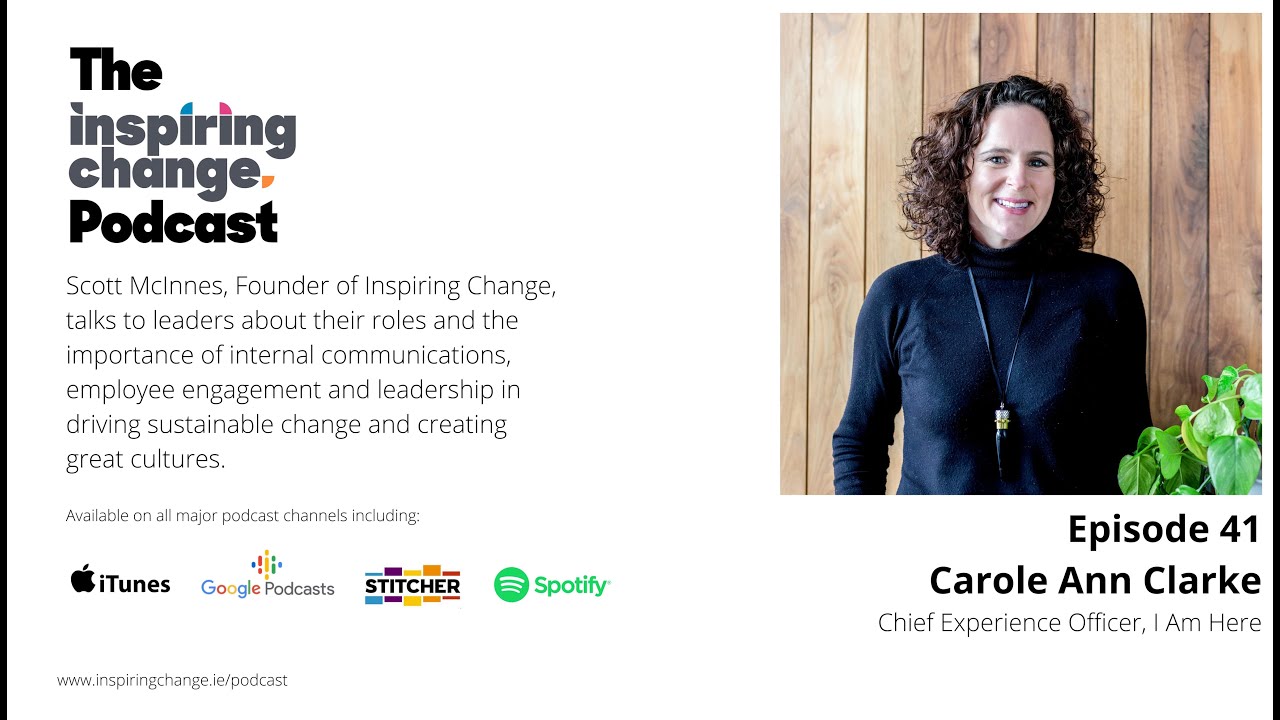
In this Inspiring Change podcast episode, host Scott McInnes interviews Carole Ann Clarke, former Irish women’s rugby captain and Chief Experience Officer of I Am Here. The conversation begins with Clarke’s diverse career path—from studying applied languages, through roles at Diageo, advertising, Coca‑Cola, and a personal burnout experience that led her to become a mental‑health and resilience coach. She explains the origins and structure of the I Am Here program, a fast‑growing, 360° mental‑health and wellbeing initiative powered by Pulse Learning and first deployed with Woolworths (200,000 employees). The program combines online content (Why, Tribe Member, Ambassador), community platforms, webinars, and visible cultural cues to shift beliefs around mental health, emphasizing that “it’s okay not to feel okay” and encouraging help‑seeking. Clarke discusses why mental health has risen on corporate agendas: changing employee expectations (especially Millennials), clear business benefits (e.g., Accenture’s 8 % engagement lift, 9,000 hrs reduced absenteeism, 3 % productivity gain), and the COVID‑driven compassion surge. She stresses that leaders must model self‑care, embed wellbeing into strategy, and create psychological safety through vulnerability, visible commitment, and cascading responsibility. Practical resilience tools are shared, notably the CIA model (Control, Influence, Acceptance) and the Me‑Us‑It framework, plus exercises on personal “super‑powers,” big‑picture thinking, and fact‑based communication. Drawing parallels from her rugby captaincy, Clarke highlights listening and empowerment as core leadership behaviours that translate to business. The dialogue ends with reflections on a “better normal” post‑COVID and advice to younger selves to know their strengths and values earlier. Listeners are directed to www.iamheretribe.com for more information.
Chapters
Yeah, WHO have already said mental health is a crisis within a crisis. The UN have come out with a statement saying that we've got to get to grips with the mental health tsunami that's coming. We had a crisis before COVID and this is going to accentuate it.
Welcome to the Inspiring Change podcast where we talk to leaders about all things internal communications, engagement, leadership, and change. Hi there and welcome to this edition of the Inspiring Change podcast. Um, like many people and communities and countries around the world, um, here in Ireland we are starting to come out of the hibernation that was COVID lockdown, and, and countries are slowly trying to get back to some semblance of, of whatever normal looks like. And I do get a sense that there is an anxiety among people and there is a stress among people. I know for sure that when I went out to the shops the first time properly after lockdown, because my wife was our designated shopper for that period, that I wasn't stressed and I wasn't anxious, but there was definitely something in there that was certainly a heightened awareness. And I think that probably most of us, if not all of us, are carrying some level of that stress or anxiety, perhaps not just in our personal lives, perhaps into our work lives as well. So I'm really pleased today to be joined by Carolanne Clark, who is Scott McInnes. I'll let her do the big intro for herself in a second. Former Irish international rugby captain, ladies rugby captain for 4 seasons. Now the CEO of I Am Here, which is an organization that helps people, helps organizations with mental health and with resilience. So I thought that that might be a really interesting topic for today's podcast against that backdrop maybe of us getting back to some sense of, as I said, that normality. Whatever that's going to look like. So Carol-Anne, good afternoon.
Good afternoon, Scott. How are you today?
I'm good, thanks. I'm all good. The sun is shining, the rain has gone off. My kids, two of my three kids, are now sailing.
Lovely.
We've got rid of them for three weeks. That's probably as good for them as it is for me.
I think everybody needs a break at this stage.
Yeah, tell me about it. Tell me about it. So, so I did a fairly, I did a fairly kind of poor job there of introducing you. So why don't I hand over to you for the first few minutes and let, let you maybe tell the listeners about about yourself, maybe a little bit about your background, and yeah, let you kick off.
Yeah, so I suppose I generally introduce myself as a little bit of a mixed bag in that I've had quite a varied career. I actually studied applied languages and business in college and very quickly realized that I didn't want to be an interpreter in a booth in Brussels, that I had too many opinions of my own. So I actually went and took the graduate program in Diageo You know, so I went from— could have been earning €100,000 to €8,000 by that choice. And I was in sales first and then moved along into marketing. And then I spent a good number of years in the advertising industry working on lots of global brands. And then I went back client-side in 2011, where with Coca-Cola in Europe, and I headed up experiential there and, you know, worked on the Olympics in 2012 in London and then took over as head of digital. And I suppose it was probably 2013, I became unwell myself, you know, burnout and probably things I hadn't dealt with in the past. And I left Coca-Cola in 2015. I went through coaching myself and then I decided to become an executive and leadership coach and then a mental health and wellbeing coach. And then I studied resilience coaching and I'm currently doing corporate wellbeing coaching as well, which is really working with leaders and CEOs in making the case for change and integrating wellbeing as part of your business strategy. So that's been very exciting. So it's been a varied journey. I think I always had a big sense of purpose since I was in school from the things that I did, but it was really only in recent years that I guess I was brave enough to, to listen to myself and make a complete change. So yeah, Yeah, so that, and then obviously I Am Here started in 2018, which we can talk about, which really is all around culture change within the organization, but we can talk about that a little bit later. Obviously, as you said, rugby is a big part of my life. I was also an interprovincial hockey player. I'm back playing hockey now, actually, and I coach kids rugby at the weekends as well. So still a big part of my life as well. Yeah.
And how long were you playing for the Irish rugby team for? I think it was, was it 4 years you captained?
Yeah, actually, I got, I was made captain after my second cap, which was, I think it surprised me as much as everybody else. So I was actually captain from my second cap right through to 2001. So I think I started in 1996 and then through to 2001. Yeah.
Okay. Okay. Interesting times. Interesting. So we're going to talk a little bit more about that later because I think from a leadership perspective, as we both know, there are huge crossovers between business and sport, I think, particularly in that leadership role.
Exactly.
So you touched on I Am Here just now when you were doing your intro. Tell me a little bit more about that. You initially said it's about culture change. I know there's a bit of mental health in there and some resilience as well. So why don't you give us a bit of background on I Am Here and what it's about?
I will, of course. I Am Here is essentially the fastest-growing mental health and wellbeing program in the world that's showing incredible results in a very short period of time. And maybe if I just tell you the story of how it came about. So Pulse Learning, which powers I Am Here, is a very well-established and global leader in e-learning, founded by Jim Breen, who also set up Cycle Against Suicide. And they have a client called Woolworths, which which we all remember, well, some of us will, of a certain age. But they are huge in Australia. They have 200,000 people across 3,500 sites. And they came to Jim and said, look, we've been running tactical programs over the last few years. We're not seeing any impact. You know, their usage of support services are incredibly low, particularly when it comes to mental health. And we really need to create something that will have an impact across the whole organization. And that's where it was born. I met Jim in October in 2018. I had just done work for Accenture on digital transformation, big global client, and at that stage I had decided that I really wanted to do something at scale that would help evolve company cultures and put people at the heart of the business and look after their mental health as well and well-being as well as the functional competencies that are driven in terms of personal growth within organizations. So that's where it came from. I think we are incredibly lucky with Woolworths because with 200,000 people, it was essentially a social experiment, I guess, in that 5 generations of people, multicultural, multi-socioeconomic groups, different education ages, and, you know, so, you know, from kind of from first-year school right through to PhD. So we really did need to create something that was universally relevant and something incredibly simple as well. So I Am Here is essentially a program that positively disrupts beliefs and behaviors around mental health and well-being by instilling the belief that it's okay not to feel okay and it's absolutely okay to ask for help. And we say that it's okay not to feel okay, and that's a very important nuance because if you're not okay, that's not okay, and it means you've reached crisis point. So what I Am Here really does is help demonstrate the diversity of normal issues that people face. So whether it's grieving or, you know, bullying, you know, there was a big report in the paper the other day about how much bullying is costing businesses at the moment. It can be, you know, if you're having issues with your teenage kid. It's really by saying, look, we all go through this stuff, it's absolutely normal, and we are providing you a caring and supportive environment to come into work. And you'll be looked after. So it's a program that runs through the entire organization. It's a voluntary program of different stages. So we've got content that goes out to all organization called I'm Here: The Why, which kind of sets the tone and starts to talk about the different language of it's okay not to feel okay. And also our clear skills around compassion, listening, empathy, acceptance, and being real. And then you become I'm Here tribe members, and that's the 20 2-minute course, and that really is about providing the tribe member with an understanding of what their role is and also what the ambassador does. And the tribe member is really all about living that belief. It's about advocating the program. It's also about, you know, in time becoming a referral to ambassadors. So, you know, it could be like, you know, hey Scott, you know, I was talking to Carol Ann and she wasn't feeling too well and I think she might need a virtual cup of coffee. So over time they do become a referral. And then finally, then a smaller percentage of people will stand up and want to be ambassadors. And these are people that we empower with what we call courage, confidence, and skills to create a compassionate connection or a conversation with somebody and show they care, ask them the right questions to reveal how they're feeling, and then most importantly is guide them or signpost them to help that is available to them, both internally and externally. Because when we talk about the diversity of issues that people face, it can be anything from finance to LGBT to relationships, you know, so, or it could be just somebody needs to go home and have a chat with their spouse, you know, they don't always need a next step. So that's the online component, but in order for it to work culturally We've several other components to the program. So, you know, visibility is important, so it lives and breathes, you know, when people are in their canteens, you know, merchandise, signifiers for the ambassadors. We also have the arena, which is a community platform where people go to share stories, participate in forums, have access to subject matter experts and blogs. And we also have our own I Am Here Connect webinar series that people get invited to. So it's an all-encompassing 360 program that we work in partnership with clients, you know, over hopefully a 3-year period, essentially.
Okay, brilliant. Very, very interesting. I know you have a number of other clients on the go as well, but it was an amazing win, I guess, to get Woolworths, one of Australia's largest employers, in the, in the bag at the very beginning.
Yeah, and look, we are grateful every day because they haven't just been a client, they've been a partner, and they've been very much a at the center of our evolution. And I mean, we're on our 4th iteration of the Tribe Members course, for example. You know, we move incredibly fast, evolving with the VUCA world that we live in. And they've been an incredible partner along the way and continue to do so as well. So we do not underestimate the role that they've had in our, in our growth.
Brilliant. I love the idea that you touched off the fact that it's all fine doing the online stuff, but it's not until you bring it to life in an organization that that it can really start to take legs, that you give that, as you said, that 360 view. I think for me what's interesting is that the visibility piece is key. And I think lots of organizations can suffer that whole piece of doing it the wrong way around, particularly when it comes to values, because I guess a lot of the work that you're doing is, albeit specifically around perhaps mental health and supporting and culture change, but a lot of that is embedded in an organization's values. And I think often, and I was only having this discussion a couple of days ago with a client where they've actually purposefully not put their values on the walls because they didn't want to go down that rat hole of, well, you know, they're on the walls now, we're done. You know, it had to be lived, and that was, that was the really, really important thing for them. And I wonder, you know, that whole area of mental health now just seems to be so much higher on corporate agendas, and I wonder why. I wonder why that is.
I suppose that there's, there's a, there's a few reasons. I mean, the first and most simple one for me is the fact that we're all human beings, and I don't think We've been treated like human beings in the last 40 years because, you know, that drive for short-term profit, stake, you know, shareholder gain, it's all been driven productivity, productivity. And we very much focused on the hygiene factor, you know, policies and governance. And, you know, personal development was based on your career progression as opposed to looking at you as a whole person. So I think it's time that, you know, we have what you call conscious leadership, which we take the whole person in mind. So that's a very simplistic and maybe an idealistic view, but I think there's two other things, factors that are important. One is that, you know, employee expectations have changed, you know, particularly the, you know, the millennials who are coming through, who I have great admiration for, because they've got a better sense of what life should be and what balance should be. So I think their expectations have changed, and they are looking for companies that are, you know, have that supportive culture, live their values, are more purposeful, and they feel safe and supported. So I think in terms of talent attraction and retention is important. I think the other point is though, is that it's good business, you know. A lot of people talk about, you know, everybody knows the issues out there in terms of the stats around mental health and burnout and absenteeism and all that. But, you know, what we try to do is flip that and say, well, actually, what if you approached it from the opportunity that mental health and well-being brings your business. And I know companies like Accenture who've invested quite heavily in well-being have already seen an 8% increase in engagement. They've seen a 9,000 hours, you know, reduction in absenteeism and a 3% increase in productivity. So it makes business sense to create an environment where both the business thrives and your people thrive. And then I I guess last but not least, I think COVID has shone a light on the fact that people are more compassionate. There's been a lot more vulnerabilities. You know, we joke about the fact that, you know, when we're having meetings with people, you know, I've seen everything from chickens to hedgehogs to horses to dogs to children.
And that was just— and that was only in my garden.
And that was only in your garden. Exactly. Exactly. You know, people have become more human and accepting and more compassionate, and I think COVID has given us a marvelous opportunity to reflect on how we can take really solid and positive learnings from COVID in terms of how businesses want to function and thrive in the future. And I think, you know, and I'm sure we'll talk about the role of leadership, but I think that's a marvelous opportunity for leaders to kind of say, well, what worked for us in COVID? At the most vulnerable time, I think we find a lot of businesses' productivity hasn't suffered, and some it's actually gone, you know, they've had, you know, people are working harder in some businesses than when they were in the office. So I think there is a lovely opportunity to kind of go, well, actually, let's do things differently, because it certainly wasn't working before COVID anyway.
Yeah, yeah. I think for me, you know, that just what you just said there triggers a few different thoughts. That one, you know, the trust deficit that we know exists globally between employers and employees, We've kind of put that up to employers and said, "Look, I don't believe—" and listeners, do contact me, Scott McInnes, at inspiringchange.ie if you know this to be a lie. I suspect there isn't a business that has gone bust because their people have been working at home. There are many other reasons they may have gone bust, but it's not because their people weren't in the office sitting at desks in a kind of an Ebenezer Scrooge kind of setup with the boss at the top of the room. I think that's a huge area for me. I think a lot of the things that you touched off there around expectations, particularly of millennials, attracting and retaining the best talent, you know, for me it's all around building a really, really good employer brand. Because if you don't have a good employer brand, you're not going to attract the best people. And I think things like, you know, looking after people's mental health, their well-being, you know, helping them to build resilience, all those human traits, um, is really important. And then finally, I think for me the whole, and I've always said this on probably half the podcasts that I've done, I am a believer of the Richard Branson school of thinking, which is put your people first. Don't put your customer first, put your people first and let them look after your customers. Because generally in organizations where the customer is first, the employees are just a second thought and tend to get left behind. And you get the opposite of all the good stuff that you just outlined there. So certainly a few thoughts there that kind of crept in for me.
Yeah, and some of that has been evident I think through the current, I suppose, chaos that we're seeing out there. And I won't name companies, but, you know, I've seen a few examples of companies where, you know, they're seen to be supporting their customers and their trade, at the same time they're letting their own staff go. I mean, what's that about? You know, that they're all outward focusing, 'Oh, we can help everybody else,' but actually they haven't taken the time to look internally to support their own people. And I think, and, you know, as I said, I won't mention those companies, but that's still happening today. So I think, I think we, I think we need to see a bigger shift in thinking over the next couple of years. I mean, if you look at the data, without going into too much data, you know, only 9% of the global workforce have access to employee assist programs. I mean, that's absolutely tiny. You know, that's 300— I mean, people go, well, that's still 300 million people. I'm there going, but it's only 9%. You know, like, what are we doing? So, you know, I think, and it sometimes reminds me of, you know, having worked in digital transformation, is that people know they have to do it. But, you know, they're just sticking their head in the sand a little bit and hope it'll go away. Well, it's not. And all the data will say that. And what COVID is going to do is going to accentuate that. WHO have already said mental health is a crisis within a crisis. The UN have come out with a statement saying that we've got to get to grips with the mental health tsunami that's coming, and we need to look at it from a societal approach in terms of, you know, making sure we've got the supports there for people to access them, you know, because we were— we had a crisis before COVID and this is going to accentuate it. And I think people will see a lot more data around that over the coming months, you know.
And I think, you know, for me, if you look at, you know, stats from the WHO and you're looking at, as you say, that crisis within a crisis in a work setting, the biggest people, some of the people at the core of that obviously are leaders in the business, are your manager. And for me, one of the big things about being able to open up, being able to say, "I'm not okay," because I think the words, "It's okay not to be okay," is fine and good. But if you work in an organization where that really isn't the case, where you don't feel perhaps psychologically safe, safe to be able to have those conversations, then you're on a hiding to nothing, nothing's going to change. So I wonder, particularly from a leader's perspective through maybe a big organization like Woolworths, or maybe a big bank or whoever it might be, what's the role, do you believe, of leaders in creating that psychological safety in their team?
Yeah, so I think the first thing is they need to look after themselves, importantly, which I think not enough leaders do. And, you know, and we know that people don't leave jobs, they leave their boss. And I think leaders have become an isolated rank, I think, in that, you know, they haven't looked after their own mental health and well-being. We know that 80% of CEOs suffer from stress. And so I think the first point is that they need to look after themselves, because if they're looking after themselves, they'll understand the benefits of looking after everybody else. I think the other, the other thing is that for leaders is, you know, well-being needs to be part of your overall business strategy. You know, it can't be an add-on. So, you know, Woolworths were very vocal in putting mental health and well-being as their number one priority, which they announced in 2018. And the CEO stood up publicly and said that. That. And that was a very brave thing to do, and they've done that. So I think the leadership piece in terms of the permissibility can't be underestimated. And I suppose that's what I Am Here is all about, because it's voluntary. You know, we show scenarios, for example, in the course where a line manager isn't, isn't well and one of their team members is approaching them. So I think You know, the leader needs to show vulnerability by saying, you know, it is okay not to feel okay and it's absolutely okay to ask for help. And then they have to drive it. I mean, one of our new clients, GFG Alliance, when they launched last week, a letter went out to everybody all over the globe. And I think there was 12 leadership signatures on the letter. And that's incredibly powerful. And the other thing that some of our CEOs do is do like a a 2-minute video where they're talking to the organization saying, look, mental health and well-being is a priority, and it's not about tactical tools and wash-and-go programs. You know, we are going to look at it from our hygiene to our policies to our governance to our health and safety, and then providing you with a program where we're all supporting each other. And that sense kind of driving that community piece around it and collective responsibility around mental health wellbeing is really important. And it's not about a cascade approach, it should be done at every level. So I think their role really is about driving the agenda. And then finally, what I'd say there is that a lot of companies— and look, it is an emerging area, and this is something that we help companies with— is to that whole piece around those tactical and what I say, the tactical wash-and-go programs or apps and all that, which they play a role, but they're not laddered up to a strategy.
Yeah, it's better than nothing, but maybe doesn't have the impact it could have.
Exactly. And what I'd say to leaders is, look, get to know your team members, you know, the likes of, say, Workday, who are a fabulous organization. They send out a weekly survey to check in on their team members. So they know exactly what the needs of their people are, and understanding what's important to your people is probably the most important thing, because then you can create the right strategy that reflects the dynamics of your team members. And we know that we work with across all different sectors and industries now, and everybody's different, and every company is unique depending on the needs of your people. So yeah, so get to know your people first.
Yeah, yeah, no, I think you're absolutely spot on. And I think being able to— that whole idea of vulnerability in that 2-minute video a CEO does, where maybe he says, I have bad days too. You might all look up the hill to me at the top of the hill. I have bad days as well, the same as everybody else, and I need to learn to manage those too. And I think that can be extraordinarily powerful. Your feedback's important to us, and I'd really appreciate it if you could please take a couple of minutes to rate this episode of the Inspiring Change podcast and perhaps leave a few words words of feedback. Thanks so much. We touched off COVID, we've talked about change, we've talked about new ways of doing things, we've talked about new normal, which by the way is a term that I hate.
I call it the next chapter.
And I'm actually starting to call it a better normal. I think we do have an opportunity for a better normal. I really like that.
Yeah, I'm gonna— can I borrow and steal that?
You can borrow that, it's a fiver or a throw. Put the money in my Revolut. So, I do think there's a lot of change going on. And I know that from your qualifications and experience around being a change coach, you have a lot of experience of bringing people through that change. But I wonder, what are some of the things that practically people and leaders and organizations can do to help their people build resilience through a change like this COVID, or as you said, a digital transformation or whatever the project might be.
Yeah, I look, there's loads of tools that we can use, and I was thinking about it even coming in today, and there's a couple of tools actually. One that is a mix between something I learned in Coca-Cola and some from my coaching days. It's two things. One is the CIA, which is control, influence, and acceptance. Accept. And that's— I use that all the time, you know, because it's just so simple and so powerful. And that's, you know, it's really looking at what's going on around you and saying, well, look, what can I actually control here? Well, I can control myself, I can control my behaviors, I can control how I respond to somebody, I can control what my next steps are going to be. And then the next one is, well, what can I actually influence in terms of the outcome of something? And that's particularly particularly paramount in a work scenario when you've loads of things going on and you have the opportunity to influence the outcome. And then there's the third, which is accept, which is, well, look, you know, it's a bit like us and COVID, like we just had to accept that it was happening and there were certain things that we just had to get on with. So that's the CIA. And then what I mix it in within the corporate environment. It's called the Me, Us and It model, and that's again kind of thinking particularly for bigger organizations where, you know, we all use language like, we're like, we need to be doing this and we need to be doing that, and, you know, the company needs to be doing this and all that. And so there's a different way of doing it and say, well, actually, what can I do first? And using the CIA model, what can I actually do to influence the change that I'm looking for? And because that whole, you know, we need to, like, who does and who's the somebody and all of that. It's just so vague. So taking responsibility yourself for actions that can influence change is a starting point. Then it's about sitting down with your team and saying, look, as a team, like, what are our strengths? What are our values? What do we stand for? What are the things that we want to do as a team that will help influence the department that we're working in, that will ultimately then impact on the organization? And then it's the 'it,' which is the company-wide piece as well, and knowing, well, look, that's— they they can deal with that bit, you know, in terms of, you know, the leadership team or whatever. But actually, as a team and me, these are things that I can do. So that's one thing that I've used quite a lot with teams and sitting down with teams and going through that process with them and then giving exercises for people to do individually. And then a couple of other things that people can do individually is we call it like, like, what's your superpower? So in difficult situations or change, you know, what strengths can you tap into that can bring you to the other side? And again, COVID is a good example where, you know, people, you know, who had retired suddenly came back and went into work, but actually other people, you know, set up a support website, other people just baked cakes for their neighbors. It doesn't really matter what your strength is, but like, what can you bring to the party? Or what can you— what strengths can you pull out of? And sometimes a good way to understand what your strengths are is looking back on previous tough times and sitting back and go, okay, so I had that tough time. What were the things that I, you know, used and leveraged to get me to the other side and help me recover quickly from that? And that can be anything from support that you had from somebody. It could be, you know, the fact that you exercised more, it could have been that you changed your diet, it could be steps that you did. So, you know, think about your whole wellbeing piece as opposed to anything specific, and you can do that in a little exercise on a wheel. And then 2 other quick ones for you is think of the big picture and the full picture, because sometimes we can hone in on only a small percent of what's going on and we get caught up in that. So it is important to think about, well, what's the full picture? 'Here, so I get a full understanding of it.' And then linked to that is stick to the facts and not assumptions, you know, and that's a hope, you know, like we talked about that with social media is, you know, always look for the facts. And we know within change in organizations, there's always, you know, 'I assume this is going to happen,' or there's gossip, or people are kind of coming to their own conclusions. Stay away from all the drama, focus on just looking for the facts all the time, and I think that just helps even manage the emotional impact of what's happening and stops the catastrophizing and panicking as well. So there's just a few things to think about. There's lots of others, but I think there's some simple things that people can do quite easily.
Yeah, really good, really, really, really interesting tools and techniques, and I guess that people can pick up more on some of those on Google. The CIA one was interesting. I remember back in 2007, 2008, when the financial crisis was going on and my mom rang me, who would be really more of a worrier than I am. And I think that's just what moms do. And she said to me, you know, have you seen how the euro has fallen today? You must be in bits. And I said, why? What can I do to fix global exchange rates right at the moment? What I'll do is I'll just focus on the bits that I can, you know, focus on the controllables. I'll focus on the bits that I can make a difference of. And actually, On that, in that same vein, when I had Ryan Campbell on a couple of episodes ago, he came up with some stats and I can't remember the exact number, but something like somebody done some research and something like only 7% of things you worry about, you can actually do something about. Yeah, we worry about a whole load of stuff. Yes, we do. Good God, imagine I'm worrying if it's going to rain. Well, you can't control that. You can put in things to work around it, but you've no control over the weather. So it's just, it's very, very interesting that we do tend to spend time kind of thinking about, worrying about, and getting anxious about things that actually we can't do anything about and might never happen. Exactly. Yeah, interesting. Exactly. Yeah.
So that's what fear means, Scott. Do you know what fear means? Future events appearing real.
There we go. There we go. I've got a new acronym to add to my acronym suitcase. Thank you very much for that. You're very welcome. We said we're going to touch off rugby. Yes. And we are, because I know that's been a big part of your life, and I think that it's an amazing achievement, and congratulations. An amazing achievement to cap— for anybody to captain their country in anything. Um, but I think that's, uh, that, that must have been a, an emotional feeling running out on the pitch that for that very first cap as captain. Um, I wonder when you look back at your time, particularly playing rugby, and probably moreover in that captaincy role, that leadership role, because I think unlike soccer you know, a rugby captain does have a very particular role to play in leading a team. And I wonder, is there maybe one thing that jumps to mind for you as something that people listening to the podcast could take from your experience of leading a team on a rugby pitch that they could perhaps take back to a more corporate setting as business leaders?
Yeah, there's probably two, if that's okay. That's fine. I think the first one is around listening. You know, rugby is a complicated technical game. And, you know, I'm talking about on the pitch now, you know, you've got forwards and backs. I'm a back. And when you're captaining from the back and you've all the people up front, you know, you just spend a huge amount of time listening to each other and what's going on and then having to re-strategize very, very quickly. I think that became apparent very quickly for me, is the power of listening. And then off the pitch, again, it's about having that one-to-one relationship with the players, you know, talking to them face-to-face on their own as well as being in a group and listening to people so that we could create that kind of right environment to have the winning mindset. So I think listening is probably the one thing that none of us do enough either. You know, I think I wrote a blog last year about can we all please stop interrupting each other, you know, that, you know, everybody's so ready to have their own point of view and get across. So I think a leader who can— and look, we're all leaders, you know, at every level— and so I think really listening to people and then clarifying what they're saying, summarizing what they're saying as well, so people feel listened to as well, is incredibly important. And then the second point is around empowerment. Empowerment versus telling. So again, you know, and this isn't just about rugby, you know, a coach will always talk about the fact that they can only do so much, but actually when you're on the pitch, you know, as a team, you're on your own. So really it's all about empowering your team to make the best decisions on the day, having a trust in their ability. You know, there's a reason why you've been picked for rugby or you've been selected in your role, and there's so many leaders out there who continue to tell their team what to do, rather than empowering them and trusting that they'll do a great job and feeding forward often as well, so that people are getting the right feedback along the way. And I think, you know, again, in sport, we're quite lucky because of the analysis that is done, you know, to your tackling, to your postures, to everything. So it's that constant empowerment, Pete, and improving as you go. As well. So they're probably the two, listening and empowerment.
Yeah, and I think if there was ever a time that I'm back to a comment that I made earlier about trust and how, you know, companies haven't gone under because their people have been working at home, that I think in organizations where their people are empowered, and perhaps on a rugby pitch, you know, you're A, empowered to do your job, you're B, maybe you're empowered to help score tries, and C, overall as a team, you're empowered to go out and win, go out and win the match. That's the ultimate aim for this team is to win the match. And however, between you, you need to do that, just get on with it, just make it happen. And I think if there's a really strong parallel for me between that and where we've been over the past 3 or 4 months with COVID that, you know, just saying to people, listen, you know what you've got to achieve, you know, as a team what it is we do and the standards we expect of each other. So whether you're in Lish or in Barcelona or on the moon, I frankly couldn't care less, as long as you're available when you need to be available. And we all do a really good job.
Yeah, no, I think you're spot on. I think that goes back to my point earlier about, you know, that opportunity that business leaders now have. So what are all the positive things that we've learned over the last few months? And if there was one thing I'd say is that trust piece, is that leaders— I mean, I really hope they're standing back going, wow, look at what my teams have achieved against all the odds, with kids running around, with, you know, looking after parents, neighbors, and they've still managed to put in a solid day's work and we've got great results. So I really do hope that we see that from leadership, that they do take this opportunity because it is a gift, you know, it is absolutely a gift.
Yeah, yeah, leaders take notes. Carol-Anne said go out and say thank you to your people and realize and recognize what they have done, and I couldn't agree more. Last up, very, very final question, and I ask this to all my guests and I keep saying I'm going to do an episode episode just on these responses, and I haven't done it yet, but I will do it, I promise. In 30 seconds, what's the one piece of advice that you would give to your 20-year-old self? Something that you know now that you wish you had known then.
I'm gonna give it to my 13-year-old self, if that's okay, because in 30 seconds, um, get to know myself much earlier, understand my strengths, values, everything, because I didn't realize that till I was in my 40s. And I tell you, I would have been a lot braver in my decisions in life, the direction I took, the jobs I took, and my career I took.
Brilliant. Get to know yourself. Carolanne, if people want to know more about the work that you do with I Am Here, where will they get more information?
They can log on to www.iamheretribe.com.
Great. And everything's there they need to know? Everything's there and my contact details as well. Fabulous. Well, listen, it's been really interesting talking to you. Thank you so much for coming. Thank you for having me. No, thank you. And we'll, and I think I think we'll leave it there. Thanks for listening. To hear the views of other leaders in our podcasts, to read our blog, or to find out more about Inspiring Change, please visit our website at inspiringchange.ie.
More from Scott

Leaders can't assume connection happens automatically #LeadershipLessons #EmployeeExperience

The hidden reason your remote team feels disconnected #TeamConnection #HybridWork

This is why people actually stay at their jobs #workplace #culture #retention

156 | Inside Disconnection at Work: Bridging the Connection Gap Report with Sadhbh O'Flaherty




155 | The Overlooked Art of Building Connection at Work | Scott McInnes with Christine Armstrong


