#ICPODCAST | Episode 53 | A Covid Christmas Cracker | Part 2
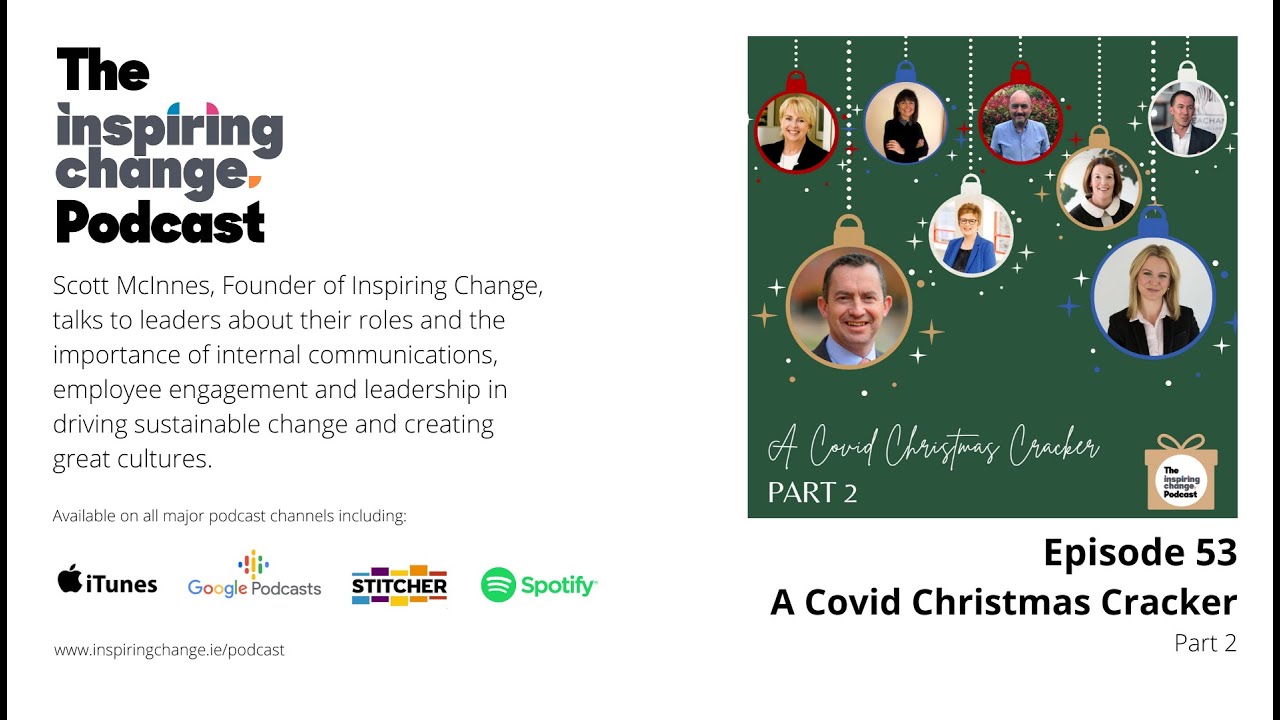
In the second part of the "Covid Christmas Cracker" series, host Scott McInnes interviews eight senior leaders from a mix of non‑profit and commercial organisations about how they are maintaining connection, culture and wellbeing as they move into 2021. The discussion covers a range of practical actions and strategic mind‑sets: Denis Doolan (Special Olympics) stresses the acceleration of technology for both communication and service delivery, flexible office attendance and recreating informal "water‑cooler" moments through virtual celebrations and personal touches. Margot Slattery (Sodexo) highlights transparent expectation‑management, continuous senior‑leadership webinars, mental‑health programmes and the need for leaders to model caring behaviours. Leóncha Fannin (Permanent TSB) describes the challenge of preserving culture when the physical "here" disappears, and outlines new channels such as a staff podcast, virtual People‑Leader Summits, a People Experience Council and partnership‑driven leadership round‑tables. Brendan Foley (SeeChange Now) proposes uniting teams around a Big Hairy Audacious Goal, letting employees act as "architects" of the new way of working, and emphasises bottom‑up cultural evolution. Carmel Doyle (Jack and Jill Foundation) shares a two‑year rolling COVID response plan, regular staff calls, one‑to‑one check‑ins (even in car‑park drop‑ins) and a focus on up‑skilling staff for digital work. Pedro Angulo (AIB) reflects on personal habit disruption, the importance of weekly self‑review to prune low‑value activities and create space for wellbeing. Denise Black (Invest NI) introduces a "People Pandemic Evaluation" (PPE) using focus groups across employee segments to shape future blended‑working policies and reduce uncertainty. Lisa Melody (Ornua) outlines plans for hybrid/agile working, continued virtual hiring and learning, a new wellbeing platform, and celebrating achievements in‑person when possible. Across the conversation, common threads emerge: the need for clear, two‑way communication; intentional recreation of informal social interaction; empowering teams to co‑design the future of work; and balancing the benefits of remote flexibility with the human need for connection. The episode ends with a call to action for listeners to reach out for support in implementing these ideas.
Chapters
Hello there, my name is Scott McInnes and you are very welcome to this episode of the Inspiring Change podcast. It's the second part of our COVID Christmas cracker. Hi there and welcome to episode 53 of the Inspiring Change podcast. This is the second part of our COVID Christmas cracker where I've been talking to previous guests and other leaders from organizations large and small in the commercial and non-commercial sectors because I wanted to find out what they've been been doing for the past 6 or 8 months to maintain that connection with their people that's all so important at a time of crisis like this. And why did I want to do that? Because I wanted to try and unearth some best practice, some ideas, some initiatives, some things that other organizations that, that have done that perhaps you can pick up and run with as we head into 2021. Because let's be honest, the chances of anything changing significantly, certainly in the first half of the year, are fairly slim. So the more you can do to maintain that connection, which is getting harder after 8 or 9 months of same old, same old. Anything you can do to maintain that connection is really, really powerful and really necessary at the moment. People need that, knowing that we're heading into 2021 with a plan. So I'm hoping that there'll be a few seeds of ideas here, a few things that you can take on. And in this episode, I asked my guests to very much think about 2021 and the fact that this is going to go into next year and what they thought the challenges were going to be. Particularly when it came to maintaining connection with their people. Also, I asked them to think about what more they think they'll need to do and some of the practical things that they're doing to maintain that connection. First up is Chief of Organisational Excellence at Special Olympics, Denis Doolan.
I think there's 3 things that jumped to my mind when I was thinking about this. So the first, it's obvious but it's still a big change in so many ways, is accelerating use of technology. And not just for communications, I think it's for operations as well. It's for delivery of, in Special Olympics world, programming, right? Getting people to do maybe virtual competitions, virtual training at home. In my own area that I look after, we're going to be doing more and more virtual leadership development interactions and opportunities. So I think that's going to be something that's going to stick as well. That's not just a temporary thing, that's something that's going to become part of the way we do things. The second thing we're going to have to look at, I think, is just being more flexible about whether or not to be in the office, how much time to spend in the office, etc. I just think that's, that's a world that people are going to find difficult to go back to from a 9-to-5, Monday-to-Friday type of idea. Not that that ever really existed for us anyway, but I think it's even going to be tougher now. And the last piece, but certainly not the least, I would say, is thinking about the personal or social aspect of staying connected. I think it's very easy to put in place webinars to talk about work, to put in place technology and tools that enable work. But what people have lost, and I hear this more and more now that we're, you know, in this for longer, what people have really lost is the water cooler conversations. It's the chat, you know, as people are going in or going out of the office that they bump into to each other, maybe they go for a coffee. That's what people are missing a lot. So I think it's trying to recreate that as much as possible in the first 6 months of next year when we're still in this situation. So it's things like virtual birthday celebrations, virtual lunches, maybe sending someone a card in the good old-fashioned post so they know that you're thinking about them, or a small gift or something like that. But I think a personal touch is going to be really, really important.
I couldn't agree with Dennis more, and I think that fatigue and that frustration has actually probably set in in many ways already, and it's going to be a real challenge for organizations going forward into 2021 to try and overcome that. I think particularly around the piece, the other piece that he picked up on around that, the balance of, of going back to work. How do we do that safely in a way that's right for the organization and for the individual's concerns? So both really, really big things to think about. Next up, is Margot Slattery, the Chief Diversity and Inclusion Officer at Sodexo.
As a leader, I think it's really important, first of all, to manage the expectations of our people and to be really clear that, you know, it's going to take time because we've also got to have that communication. I think, you know, it's very important to manage that both up and down so that, you know, as some parts of our business and some parts of the globe are really returned to work fast and everything, and I, you know, we've all been working in different ways, but that in-person are in the office scenario. There will be parts of the world that won't be. There'll be people who don't go back quite as quick, or it'll be different. And there'll be people who've left our organization. So you have to manage all the sort of expectations around that. I think firstly, so it's managing the expectations of our people, a communications plan that is incredibly transparent and clear about that, and then making sure that we're keeping up that voice, that pulse, that connection with people, and feeding back the results of that. So that it's kind of almost circular. You know, we asked, you said, here's what we're doing, and that keeps happening. And then playing out that that is different things in different parts of the world. So my experience at the moment is, for instance, that APAC, particularly China, has been quite back at work or back in the field, and things are maybe speeding on there. Whereas if you take NORAM as a region, you know, it's been in, it's been in much, I suppose, disarray for that. And Europe's struggling to find its way through, and yet some parts of Central Europe will go back quite quickly now. So it's that sense of it's not one thing suits every part of the world, and it's that listening again. What's this telling us? What are our people saying? Um, and I guess, you know, if you think about the tools around that, or personalizing them, bespoking them to the region and understanding the particular, even the business, and what's impacting as well. So, you know, if you have harsh regime, or there are things that are feeling very hard for people, I think we need to listen to that. People are very much— I can certainly feel at the moment people are looking forward to a Christmas break. That obviously won't be all of the world because, you know, different parts of the world, different religions, etc., all have different things. But the world needs a holiday. I think a lot of the world will come down. But then there's this, 'Oh my God, I'm back in January and I'm going to be kind of going back to business as normal and life as normal,' and that's not necessarily going to happen. So we will have to manage and phase out that kind of expectation. And I think more importantly, to keep talking to people. So we've really upped our senior leadership webinars. And then we— and every leader is also doing that with their own teams. So I'm personally having a lot more connections with my teams. And we're also doing it at a high level so that we kind of make sure that people are constantly in that conversation.
So you're effectively giving— so the global message is coming from the global leadership team, but then more locally in regions, and then down the teams, getting your leaders to step up.
Yeah.
And be the voice of the organization and be that connection.
Yeah, yeah. And I mean, I'll give you an example. You know, mental health is coming up for so many people everywhere and mental wellness. So we're really kind of, I suppose, coming really strong on that and putting a lot of emphasis and talking to people that it's more than just sort of clicking in with your EPA or your provider who gives you some assistance there. It's deeper than that. And we're saying, you know, These are initiatives we're saying to teams, things they should do. We're talking to leaders about things that they need to lead on this as well. So, you know, taking it to the next level. So it's not just a kind of a cascaded-down responsibility, it's owning the responsibility around that.
Yeah, and I think when you, when you put a program around something like mental health or mental well-being, then it does mean that people feel as though they can step back because there's a program that's looking after that, whereas actually just saying to somebody, giving them a ring out of the blue. How are you getting on? It's Margot here. I'm just calling to check you're OK and just calling to check in and have a chat, really. And I think that leaders making time to do something seemingly as small as that can make a gargantuan difference to people's mental health.
No, I agree. Something I saw this morning— and just make it quick, but I thought it was very powerful— and it was somebody who sent something out in our own organization, was to actually look at email and talking to people about how do they use mail and that type of connection. Do you keep copying everybody? How many mails are you sending to people? Are you sending something late at night? You want to work the weekend? And we all know there's reasons why people do these things, but to think about the impact on, on everybody, because, you know, most of us are spending 12 hours a day sitting at a computer all day. So something pings when you're having dinner with your family, you feel this pressure. So being very mindful about what's my personal responsibility here as well. And how am I making others feel? And, you know, I think that's probably one of the biggest areas we can all lift up is our own personal responsibility.
Margot is absolutely correct, and that whole idea of managing people's expectations is going to be key, particularly when we start to hear more and more about vaccines coming out and them being the great saviour and changing things. It's not going to happen overnight, so ongoing clear and transparent communications, continuing to listen to people, continuing to listen to your staff, and making sure that any feedback is linked back to action so that people know their voice has been heard, that it's made a difference. They're really, really huge things. Let's move on. And up next is Leóncha Fannin, who is the head of corporate affairs and communications at Permanent TSB, one of Ireland's top 4 banks.
When I think of the challenges, I think the biggest thing for ourselves and for any organization would be maintaining our culture and our sense of community. And actually, my boss shared a quote with me recently that really resonated with me, which kind of sums up the challenge ahead. And it says, "If culture is the way things are done around here, what happens when there is no here anymore?" So a hugely, hugely thought-provoking quote, I think, in terms of how we're thinking about the future, definitely from a leadership and communications perspective. And I think we're going to have to continue to evolve. There's no doubt about it. And there's a couple of things that we're doing and a couple of ways in which we're thinking about the future. We haven't cracked it for sure. And I think it's a learning, a learning, a learning period for everybody. But I'll just give you a couple of examples. So from a communications perspective, we're evolving our channels to adapt to the new way in which people consume information. So we're all on Zooms, we're all on Teams, we're all on screens all day long. So people don't really want to be watching more screen time and more videos. So we've introduced a new podcast channel as an example, and it's called The Bank Balance, aptly named, and it's more focused on health and wellbeing type initiatives for colleagues as opposed to very strategic messages to align business, albeit there is a business element to it, but it's more focused on broader health and wellness topics because it's really important, particularly at the moment. Leadership visibility will continue to be very important, but also I think creating those informal engagement opportunities. So we don't have the water cooler conversation, you don't have the casual conversations that you would have had in an office environment anymore. So creating an avenue for that to happen and creating a channel for that to happen, albeit it may feel a little forced, I think it's important to have that thought process around how you might actually do that. Then it's about finding new and innovative ways to communicate those strategic business messages that you need everybody to know about. And we are holding our first virtual People Leader Summit at the end of January next year. We would have done this in previous years, but of course we would have done it in person, around 500 to 600 people managers from across the organization. So we've really got to think differently about how do we land and communicate that message effectively. And doing it through a screen is a lot more challenging than doing it in person, particularly because people don't want to be spending a full day on a Zoom meeting. So we've really got to be very targeted about what messages we want to communicate and how we keep people engaged in this whole new world. Then profiling success stories and profiling people across the organization and making sure that we're giving airtime to those success stories and the people who are really living our values in a way that is connected to our culture. And our Values in Practice Awards, named the VIP Awards, received over 900 nominations this year, which is phenomenal for an organization of 2,500 people. It is, and it is the highest level of nominations we've ever had for our Values in Practice Awards, which has been running for 4 years now. So continuing profiling those success stories aligned to the behaviors that we're really looking to embed in the organization to to fundamentally shift and evolve our culture for the better will continue to be very important. One of the last points is around making sure that all voices are heard. So getting the opportunity to be heard, whether that be through informal or formal channels, and focused on listening to what colleagues are telling us about what's working and what's not. And then the willingness to adapt our approach through that. So we've established a People Experience Council, which has members from across all levels of the organization, all different parts all different functions to really help us understand what's going on on the ground and how people are feeling, how they're consuming information and how we may need to respond and how we may need to change our approach in order to meet those new requirements in this new world. So it's no one thing and there's no silver bullet to this, but it's important that we continue to learn and evolve as we move forward. The last thing I want to say is we've partnered with Lift Ireland. Which is all about leading Ireland's future together. They're, they're a non-for-profit organization, and we are running virtual leadership roundtables which are all focused on embedding the right leadership behaviors in our organization. And that is being run by senior leaders in the organization hosting these leadership roundtables for colleagues across all areas. And it's really important for us that we continue to maintain that focus on values and driving the right behaviors in the organization. So this isn't just normal, Scott, I think it's the new necessary and we must all continue to evolve our approaches in order to maintain that employee engagement with colleagues throughout the organization.
It's not the first time that I've heard a leader talking about the challenges of maintaining culture when you're in a remote working scenario, but look, there are lots and lots of organizations that are remote working and have been remote working way before before COVID even happened, and they have great cultures. For me, it's just about how you change what you do in order to maintain that changing culture. And absolutely, Leontje mentioned things like, you know, how do you maintain those water cooler moments for connection? How do you make sure you tell stories of how people are bringing your values and your purpose to life? And how do you make sure you continually listen to people in the organization to make sure that the things you are doing are the right things, to make sure that you're adaptable, and you can change based on that feedback. So all really, really important and useful things. Let's pop over now to Brendan Foley, the founder of SeeChange Now.
Yeah, so this is the crystal ball moment, isn't it? If we gaze into the future, what does the future hold? None of us know. The vaccine could speed things up in terms of clearing away the virus, or it could linger for a while. We don't know. So we've got to be as prepared. And I think— preparation is the best technique in this case. And it's to say, OK, what's the worst-case scenario? And then plan for that. Because anything else is going to be a bonus. So if we know that in the new year, people find it hard to get back into work, one of the things that's really, really powerful is to unite the team around a goal that they can definitely achieve. OK? So and go for that BHAG, you know, as the Americans call it, that Big Hairy Audacious Goal. Go for something that would really be compelling for the team that will create an energy and lift them, because that unites people. As soon as you create something for people to go in together on, it's brilliant. Unfortunately, an awful lot of the— you know, I think Bain call it the tyranny of the matrix— means that there are so many different sets of objectives that actually people end up, you know, siloed. Get away from that, folks. If you want connection, zero in on some big, hairy, audacious goals that you could go after, and that creates an energy and a connection with people. The other thing I think you've got to do is, as an individual or as a group, is you've got to become architects. You've got to say, okay, we're now entering into a new part, a new phase of working life. And what do we want that to look like? Because I think people have kind of sensed up to now that this has been a temporary sort of situation. And I think we need to expand our thinking beyond this. It will never go back to the way it was. Something new is coming and we need to try and define what that is. And I think the sooner we start that conversation about what does best look like for everybody here, we can actually create connection around that as well that we could architect together. So rather than it being, I suppose, a HR department or an organizational development team who come and say, this is what we think you should all do, start the conversation with the team and say, how would we get all our work done, stay connected, have that flexibility, and maybe, you know, take away the travel commitments and the different things that people have really benefited from? And say, okay, how do we make this work? So become the architects. And what a cool way to start 2021. 2021 with a brainstorming session to say, hey, what would we like this year to look like from a working perspective? And I think that's a really energizing and engaging place for people to go. And of course, there are a few people who might be able to facilitate that, namely people like Scott or Brendan or people like that.
People like that. And I love, you know what, I love it. And it reminds me of a quote that I heard once that people don't mind change, they just don't like being changed. And I think that if you put if you put the ball in the court of the teams, it allows them to write their own future, if you like, within the confines of a company framework, if you like. But within the framework, how can we best organize our team? How can we best organize ourselves in order to get the work done in a way that motivates us, makes us productive, drives engagement, you know, drives motivation, all that good stuff. And imagine if you can do that with 100 teams, the benefit of that as it rolls up an organization is huge.
Oh, look, it's, it's, it's electrifying. And actually, there are a lot of clients that we're working with at the moment who are actually getting really excited about next year because of this, because actually they say, you know what, a lot of the things we've tried to do for a long, long time that were sort of stymied or stuck because of organizational behavior, because there's so much flux and change, actually now is our time. And what they're actually saying is if we can get ourselves organized, if we can create certainty in our approach, if we can then share that with our stakeholders and show them how we can help them get results too, now we're on to something powerful. And I think the teams that get the march on this early are going to be the ones that everyone's going to be looking to say, "We want what they're having over there." And that's how cultural, you know, vibrancy occurs. It's how cultural evolution happens. It happens from the ground up. It's not pushed from the superstructure down from the executive committee to everybody else. It's got to be a ground-up thing. And if it is, it'll last and it'll prosper.
Yeah, for sure. And I think that probably the one big role for me that that executive committee has, or the CEO or whoever it might be, is to set that North Star, is to set that purpose. This is where we're going, this is what we need to achieve. How we achieve that, you people tell me, you teams tell me.
100%. And look, I think the war for talent is going to become so interesting because I think In a way, we would never have thought about people in different geographies being so able to do knowledge-based work. But the reality is right now, if I've got a knowledge-based team, I could reach out to anybody on the planet and remotely they could become part of my team. We had not got that in our consciousness really until now. And I think we're going to see is a lot of talent is going to move around. People are going to be picking culture over everything else. They're going to say, what is the type of place that I want to work? And so if you're an employer, you need to be thinking, okay, how do I hang on to my staff by creating a brilliant culture? And how do I attract the best? And, and if I do that, then wow, is my culture going to pay off for me.
I love that idea of letting your people be the architects of change, letting that change happen right down in the bowels of an organization by the people that do those jobs every single day of the week, by empowering them empowering them, you're letting them know that you trust them. Bingo! By empowering them, you're probably actually getting a better result than if the, the whole change program or the plan for the future was developed and rolled out from the center. You're going to get people more bought in because that's what happens when people have been part of the decision-making process. I once heard somebody say, you know, we don't mind change as human beings, we just don't like being changed. So if you put them in the driving seat, let them drive the change, by God, the difference that will make in your business. Amazing, amazing advice from Brendan there. Let's move on now and hear a little bit more from Carmel Doyle, the CEO of the Jack and Jill Foundation.
This is all about a rolling crisis. We've got a 2-year COVID response plan now, and our staff know all about it. So we've kept our staff informed through the managers about Jack and Jill's response next year. The biggest challenge though is to maintain the sustainability of Jack and Jill because it's a big ask. Every year we have to raise over €4 million, so despite COVID we've kept going, but my fear is the 1st of January people might just think, 'Oh, it's a blank sheet again and here we go again.' Well, really it's not. This is a 2-year COVID response plan and we have to give that to staff. We can't just expect a team that has that has kept going in this year like no other, that's fatigued, that has worked like this, to just start again with a blank sheet. So it's a 2-year COVID response plan we have. But the challenges we have is to keep— it's like anybody else, it's a rolling crisis. It's to assess the situation and to keep going and to make sure that staff understand it. So we do everything like we have a weekly call with all staff so people can be up to date with campaigns and how families are faring through COVID. I do a weekly email out to staff so everybody knows what the key things are, who our new partners are. We need a new partner for Incognito. We're currently in talks with some people, so we will find that. We need a new sponsor for Incognito. But the key thing with staff is to invest in them and is to ensure that, you know, people who are working from home, who've now found themselves in this hybrid model of working from home and in the office, you know, does it work for them? Do they have the skill set? Do they have the digital training they need? So there's a big emphasis in 2021 in Jack and Jill on upskilling our staff and making sure that everybody is familiar and can use digital as a real tool. So that's a given, an absolute given investment in people, but it all comes down to the one thing again, regular communications. And we can all have all the Zoom calls we like and the structured meetings, but there is no substitute, and my management team always says this, there's no substitute for setting aside a couple of hours and phoning your staff members or just having that one-to-one where you're saying, 'How are you? How's it going?' Because people are not just coping with day-to-day work, they're also coping with the worry maybe of family members, elderly parents, and so you just need to give staff that time to just catch up with people and just say hello before we launch into the basic business agenda.
And I think that's particularly, particularly important in the case of the work that you do because, you know, emotionally it's very, very difficult because much of the work that you do, particularly with the recipients and the home calls, is life and death, or could be life and death. And that's hard for people. So I think that decompression becomes even more and more important. And I know that you said to me before on the phone call, it's absolutely, I think, that we need to be doing more of. But I remember you saying to me before that, um, that, you know, turning up in car parks to meet people in a car park for a quick face-to-face, hello, how are you getting on, you know, the thing, little things like that can make a huge difference, can't they?
Exactly.
Taking the time, um, you know, when we're delivering something somewhere, you're meeting somebody in a car, you don't just drop it off, you you make sure you stand apart, but you stand together and take that extra 5 minutes and say, 'How's it going?' Yes, we're all very busy, but that human connection one-to-one, whether it's a walk— I mean, we've actually taken it to that point where I've got a fantastic management team and I'll often do reviews and actually walk around with people in terms of feedback. So one of the things we will keep going— and we kept going last year, and we kept going through COVID, and we keep going next year— is staff reviews and actually talking to people about how they're coping, their skill set, what they need. Because, you know, this crisis has brought out the best in many people, and this adversity, you know, it makes people brave and honest and really pairs everything back to what's the difference our service makes and how are we going to find the funding to make that happen.
I loved Carmel's point there about just getting the basics right because I think it's so easy to jump in situations like this, to jump to things like, you know, we need to get an app and we need to do Zooms and we need to have conferences for people leaders and we need to do all this brand new highfalutin stuff, which is important, granted, it absolutely is. But actually getting the fundamentals right is actually more so. And picking up the phone, ringing somebody, asking them how they are. Back to, back to episode 51 with Jenny Field, we talked about that a lot. And we said, you know, we've just lost the art of picking up the phone for fear of bothering somebody, which is madness at the moment. So if anything else I took from Carmel's piece there, it was that. Pick up the phone, give somebody a ring, check out how they are. Next up is an old friend of the podcast, Pedro Angulo, the head of leadership development in AIB.
It's funny, I was reflecting on the, on the last 8 months, and the thing that I have found most challenging is resetting my habits and resetting my rituals. So before COVID I was walking 30,000 steps. I was doing a workout. I was doing everything. I was a monster. I was amazing. And now as I'm working from home, I had to change all my habits. And to be honest with you, to reset all those good things in a different environment, I have found very, very difficult. To the point that actually some of the new habits are actually habits that are not serving me properly, or my family, or my colleagues properly. So I'm finding that I found myself, you know, that I'm doing a couple of things that really is not good, or not as good as they could be. So I have found myself having to stop doing that and trying to reset or do something else, something positive that will help me, yeah, just, just, be the best I can be at home. But the resetting those habits, I have found that quite difficult. And for me, the key thing is that we need to find those bad habits quickly, because otherwise they become deeply ingrained in our brain, and then they become really difficult to change.
And given that this is going to go forward into next year, likely, we're looking— yes, we've seen a couple of things about vaccines, but nothing is really likely to to change in the next 6 months. What do you think people can do? 'Cause I think we're all struggling with a bit of that, a bit of resetting of habits. What do you think people can do over the next 6 months to try and just try and get some of those better habits in place? What are some of the practical things they can do?
So that's a great question. The first thing I would say is, at the end of every week, look at your schedule, look at your calendar. Where do you spend time? What did you do? What do you do during work? What do you do after work? And where do you spend your time and your energy? And out of all of those things that you did, what were good things? What did those things help you achieve? What did you learn? But equally, what were those things that maybe that you did that really, it was a bit of a waste of time, maybe it was an urgent thing but not important thing, and how to find ways of stopping doing those things so that you create a space to do things that are better for you. And that's the trick, is every week, look back, learn about what's working, see what things can you stop or do less of to create a space to do better things for you. And every week, reset yourself for the next week ahead so that every week you try to be that one 30 minutes better than the last week or that hour better than last week. But to me, that's the key, is about looking back to learn about how you can be even better going forward.
I feel as though I've said it 50 times this week, but that whole idea, and it's a statement a statement that I love because it brings all of that stuff into perspective, and it's this: awareness precedes action. So you're absolutely right, taking that time at the end of the week to think about what's worked, what hasn't worked, what's gone well, what hasn't gone so well, what can I do better. We have to understand that stuff before we can understand how we can proceed to action to make things better. We have to have understood what the problems are.
Absolutely. And, and Scott, this is very practical, right? There are things that we do that are serving us to no purpose So instead of watching 6 episodes on Netflix, just watch 1. That's 40 minutes instead of 3 hours. There you go, you created 2 hours plus space to do something else.
That means you have to spend 2 hours talking to your wife then, or your husband.
Or your animals. But you know, like if I look at things where you spend the time, you know, for example, like most of us spend over 2, 3 hours checking emails. We need to stop that. That's crazy. That's just following urgency rather than importance. There are things that we are doing because we're under pressure to do and look fine. But there's surely a lot of things when we look back at our calendar, not just on the week, but at the end of the month, look back and say, where did all my time go? And surely you're going to find things that you could have done better. You could have done less of, you could have maybe pushed away and say no. And all of that, what is that doing is creating a space for you to spend that extra time, that new time that you have created on something that is going to be better for you, more meaningful to you, and it's going to make you more resilient and happier.
Some really interesting insights from Pedro there. And I think that that whole idea of, of habit forming is so important just personally or for the people in your organization. When you do a really quick Google search on the time it takes to change a habit, the results suggest that it's anywhere from takes from 18 to 254 days to form a new habit and an average of 66 days for a new behavior to become automatic. So it is worth taking the time to think about what your habits are, where you're spending your time, and how you can change how you do things. One of my favorite sayings is awareness precedes action. And that level of awareness of what you're doing and what you're not doing is really important before you can even think about changing things. Let's move on now and hear a little bit from Denise Black, the head of HR in Invest NI.
I think building on the success of the last survey I mentioned there, I sort of moved on to look at what I'm calling the PPE initiative because it's a very in vogue term at the moment, PPE, but my one is the people, a people pandemic evaluation I'm calling it, and it's sort of again building on that piece about involving staff I think a lot of the anxiety and stress all of us are feeling is because there's no end date to this, there's no certainty. And I remember way back in my counselling course days, they talked about the definition of stress is about things that haven't happened yet. So what I want to try and do is give as much certainty as I can to staff of what the future is going to look like. So these people pandemic evaluation, how am I going to do that? I'm going to do it through questions but also focus groups. And the feedback that I'm going to do from these focus groups will feed into our future ways of working so that when we go back, we go back into the new world. We'll not go back into 100% occupancy into our offices. And the reason I'm going to do it with 4 specific focus groups is because I think there'll be a different impact. So our client-facing managers will have a different impact, our line managers, our administration staff, and then we have a group of employee champions who are advocates that I want to look at separately. What I'm going to do is I'm going to look at certain themes that I think will be very relevant in how we look at working from a sort of blended, um, remote and in the office. So now that we're 7 months in, I want to ask staff what are the opportunities and the challenges around the following themes, like leading as a line manager, about the impact on team engagement, about the impact on decision-making, about coaching and mentoring, which I'm a huge advocate of but which I fear for in a remote environment, and the client-facing roles, how they are going to be impacted, and on communication generally. And so on the sort of focus groups and through them, I want to make sure we get some real tangible evidence of things that we want to dial up and things that we want to dial down, and then that will then form part of our new future ways of working and decide what way we do that. How many days a week will we ask staff to stay at home and how many to come into the office? So that's a really key next stage for me in looking at that, and I think one that the staff will be very receptive to get involved in because they're shaping their own future then, you know.
I think what's really nice, you know, we've been talking about the future of work for ages, and I think that on March 12th health, certainly in Ireland, it arrived because I think the future of work landed. And what's great is that you're now using the experience of the past 7 or 8 months to shape, well, what were the good bits of that and what were the rubbish bits of that? And how do we do more of the first one and less of the second one in order to create a workplace which really is fit for purpose for you and for the company?
Absolutely.
And just on that point, because I think the comms here is so important and we've all no matter where you are in the world, the tsunami of the reality of the negative of COVID And so in trying to sort of turn that on positive, reframe as much as you can, you know, there's a couple of points I think that have come out of this for me personally that I'm sharing with, you know, the staff, and we'll bring to the fore in these survey groups. And here's a few of them that I think might be useful to share. I believe we are all now master practitioners in change management. We have never in our lives had to personally or professionally manage change so well. So, you know, we have survived and to hold on to that. We are also, for some of us this may be more dialed up than others, technology experts. I know certainly for me, my skills in Zoom or whatever medium you use have had to ramp up. I also think we bulldozed through months or years of bureaucracy and persuading on some initiatives that maybe some leadership teams and even staff would not have bought into. Before, so surviving without paper, that whole building trust piece about, you know, you don't need the presenteeism piece, you know, work as we know is an activity, it's not a location, so, you know, it's about making sure people are clear about what they're doing. So I think those are some— I think that's very important as well in looking forward, as you say, to keep on emphasising some of the positives and the learnings that COVID has brought, because it is hard to find the positive side of it. So, and those ones have just come to mind recently that I think are, are good to amplify.
It was great to hear there how Denise is focusing on bringing out maybe some of the more positive elements of the, the pandemic because they are there. As I've said lots and lots of times, every cloud does indeed have a silver lining. And it was also great to hear her building on some of the thoughts and advice from earlier guests, that whole idea of continuous communications, listening to people, and actually letting them shape their own future. In her case, through a number of focus groups with different groups of people across the organization to find out what they should continue doing from the past 7 or 8 months, and maybe what they shouldn't do quite so much of, um, in order to build a really, really compelling future of work for everybody in that organization. It's really, really good stuff. Last up, but by no means least, here's the Head of Talent and HR Transformation, Lisa Melody from Ornua.
I think going into next year, as you say, absolutely, I think we're planning that life will be like this or a version of this until probably quarter 3 of next year. So I suppose we want to maintain some of the great programs we have underway under, for example, the Stay Safe, Stay Connected banner, that constant and regular but not over-regular communications from our leaders, and that two-way piece is going to be really important. And actually, what we're starting to plan for is how do we start to get people into the zone of when we get back to more normal times. And we'll definitely— we've done some work around agile working before all this happened, so it's a great opportunity to introduce that again, get people mentally ready for what it's going to be like when perhaps we're back working part-time in the office or on-site versus part-time working from home. So trying to keep the benefits of what we had in this current time is balanced with that social interaction, that informal conversations, collaboration that happens kind of at the water cooler, etc. So how do we kind of get ready for that? So that's probably a big priority for us in terms of preparing for that. Let me think, what else are we having a look at? I think we talk a lot about this year how we've an awful lot of things to celebrate in person. We've done a huge amount of things virtually. We say, for example, two key leaders in our business retired recently, along with lots of other big milestones in our business. So we certainly want to celebrate in style when we can in person, and our CEO has talked directly about the big party we will have when we're able to. So there's a piece about celebrating getting through this that I think is going to be important for us as an organisation and thanking people in person, face to face, in a very meaningful way, that we don't just go through all this and not recognize what we've actually achieved through all of that in terms of the business is doing really well, people are working exceptionally hard. And more in the short term, it's going to be keeping a really close eye on ways of working, work-life balance. We have a program on at the moment, a kind of winter program in particular, which has themes really actually encouraging people people to stop working and to take breaks and to get outside and get some fresh air, get a break from the screen so that people can kind of recharge their batteries and renew their energy. So that on the short term will be a big focus until we get back to more normal times. We're also about to launch a new wellbeing platform and app that people can tailor to what's important to them. So is it that struggle with missing colleagues? Is that social piece they're missing? Is it They feel they're sitting at their desk too much, they're not getting out to exercise. So what do they want to invest in and look after in themselves? So we're hoping that our work on wellbeing will really help people tailor and focus on the things that are important to them that they want to go after in the new year too.
Great. I mean, I think a lot of companies are struggling with, or think they might struggle with, the whole getting back to normal. And I'm doing that thing with my fingers because actually I don't think there will be a normal anymore. But I think there's definitely learnings. I think there's definitely been positive things that have come from the past 8 or 9 months, aren't there, that you can then learn from and take forward?
Absolutely. I mean, in my role, I have responsibility for things like development and hiring. So for example, we've just run our graduate assessment centers this week, all virtually, and we're hiring for roles across the globe. So I don't think we will ever go back to in-person assessment centers, especially when we're looking for a global range of positions. It doesn't make sense to fly candidates and assessors around the world for this. So I think that will definitely stay in the virtual world. We've had some real success running learning virtually. I participated in our Global Leadership Programme. I spent a week that was supposed to be a nice residential week in a hotel in Malahide.
That would have been dreadful, wouldn't it, getting away from the family and the children for a week?
Seeing lovely restaurants. So that piece you can never replace, the social piece, I think, but we ran a really great week, kind of an immersive intensive week where we did work with a FoodCloud, a community partner, a project for them, and I think people were really surprised at how well it worked. So I think the smart things that we need to keep from that, and definitely I think for all of our hiring, first round interviews would definitely be virtual, and so actually speed of hiring is a lot quicker, and because you don't have all that piece involved. So I think on a work level, there's some of the things that we will definitely retain, and I think for people's ways of working, I think it's great for people to have more time outside of work to themselves because they don't have a commute if they work from home more. They get more time doing the things that they want to do or looking after their families or spending time with friends, getting outside. So I think that's all positive. So we need to make sure we keep all of that too.
So a couple of interesting things that I picked up on there from Lisa, the whole area of recognition of next year's just setting aside some time to recognize the achievements of the whole organisation, of everybody in the business and what they've gone through this year. And when we come out the other side, hopefully recognising all the effort that people have gone to is so, so important. And of course, with Lisa's talent hat on, bringing people on board, how COVID has changed that experience, that now, you know, bringing people in for first interviews might not happen anymore, that might just happen on Zoom. And that's the same in lots of organisations, saving time for those organisations organizations and for candidates alike. I think the same goes for online learning, and though I hate the term burning platform, I really do think back to Dennis's point earlier on in this podcast about how they're now using more online learning to reach larger groups of people through that organization. Lisa is the same, and many other organizations will follow suit. So really interesting insight there. Well, that brings us to the end of the second part of our COVID Christmas cracker, and hopefully you've gotten some of those, as I've said a few times now, seeds of ideas or things that you think you can take from our 8 guests and apply in your own business. As I said at the tail end of the last podcast, if you're thinking, that's a great idea, but I haven't got a clue how to go about doing that, um, then give us a call. That's what we're here for. We'd love to help. We love working with organizations that are really passionate about putting their people first. So if you want to get in touch, if you think we we can help. I'm starting now, sound a little bit like the A-Team, but if you think we can help, then you'll find more information on how to get in touch with us on our website, which is inspiringchange.ie. That brings this to a close. Thanks very much for listening. I hope you've enjoyed the podcasts this year, and all that's left for me to do now is to wish you a very Merry Christmas and a Happy New Year. Thanks a lot for listening. Bye-bye.
More from Scott

Leaders can't assume connection happens automatically #LeadershipLessons #EmployeeExperience

The hidden reason your remote team feels disconnected #TeamConnection #HybridWork

This is why people actually stay at their jobs #workplace #culture #retention

156 | Inside Disconnection at Work: Bridging the Connection Gap Report with Sadhbh O'Flaherty




155 | The Overlooked Art of Building Connection at Work | Scott McInnes with Christine Armstrong


