#ICPODCAST | Episode 57 | How to Have Strategic Alignment Within Your Organisations | Zora Artis
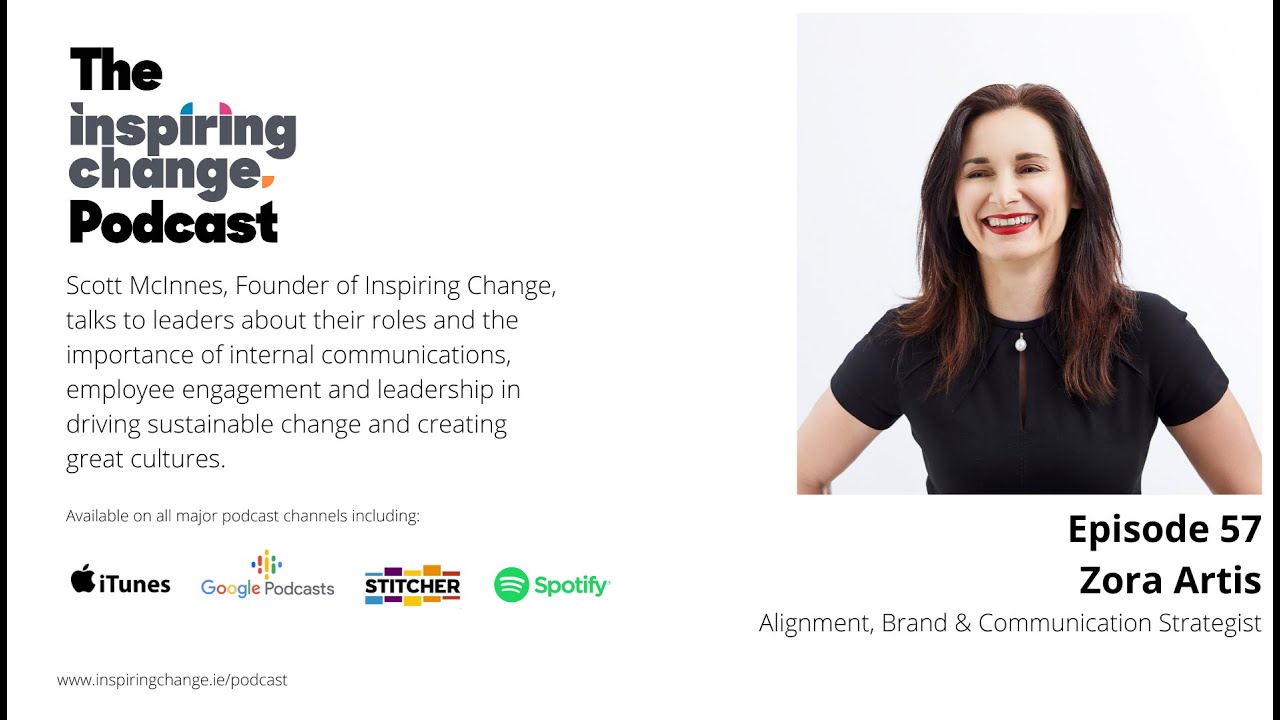
In this Inspiring Change podcast episode, host Scott McInnes interviews alignment strategist Zora Artis about the concept of strategic alignment and its impact on organisational performance. Zora shares her career path—from tourism sales to agency branding, internal communications, and consulting—highlighting how each role shaped her understanding of alignment. She defines alignment as the unity of purpose, strategy, capabilities, culture, structure, processes and systems, and explains why it matters: higher employee engagement, lower attrition, stronger brand, reduced marketing costs, smoother transformation and overall better performance. Zora cites research showing that while 96% of senior communications leaders deem alignment critical, only 13% of organisations are truly aligned, often due to lack of executive commitment and unclear diagnostics. She introduces the “Road to Alignment” framework, a four‑step diagnostic tool underpinned by five principles, beginning with “know your enemy” – identifying gaps through surveys, engagement data and cultural audits. The conversation explores the pivotal role of senior leaders (e.g., Satya Nadella, Albert Bourla) in modelling alignment, the need for personal storytelling to make the purpose tangible, and the importance of co‑creating narratives with employees rather than top‑down generic messaging. Zora stresses shared responsibility: every employee should question whether their work aligns with the organisation’s purpose. Practical advice includes using employee‑engagement surveys to surface understanding gaps, facilitating safe conversations to surface mis‑alignment, and embedding stories and visual artefacts in daily routines. The episode concludes with a light anecdote about Zora’s 15‑year‑old, underscoring the everyday relevance of shared responsibility in alignment.
Chapters
Welcome to the Inspiring Change Podcast, where I talk to leaders about internal communications, engagement, leadership, and the role they all play in creating amazing cultures.
Understanding that the impact that what— that they have through their day-to-day is really important. It's about aligning all those experiences to create a stronger brand and in the end, a stronger business that's got more longevity and is more sustainable and as a whole, as an operation. Hello there.
Hello and welcome to this episode of the Inspiring Change podcast with me, Scott McInnes. I hope you're all keeping really, really well. I've long been intrigued by the whole idea of alignment, of making sure that people understand and can see the red thread between what it is they do every single day and the impact that has on the overall organizational effectiveness or organizational delivery of strategy. And, you know, for me, it's one of those things that when you look at it, at a very low level, people knowing and understanding that what they're doing every day, more often on the very, very front lines of a business, is making a difference is massively motivational. And when I think about it from the perspective of employee engagement, knowing that you're making a difference and feeling that you're making a difference is a really powerful thing. We talk about getting that little bit of discretionary effort from people. We talk about getting people to give that little few percent more each and the difference that would make in the organization's productivity in success. And for me, alignment is one of the great ways that we do that. The flip side of the coin, of course, as well, is that as well as everybody feeling that they're doing the right stuff, it means you're actually doing the right stuff. If you've got a really good idea of where the organization's going, then you're going to be doing the right things to ensure that you get there, doing, I guess, the right things for the right reasons. So I was very intrigued to read a couple of pieces of research recently by Zohra Artis, who is an alignment strategist based in Melbourne. And I thought, wouldn't it be interesting to have a bit of an in-depth discussion around alignment? So let's get Zora on the podcast. And today, I'm really pleased that she's here. Zora, good morning.
Evening. How are you?
I'm sorry, good evening. Yeah, you know, this whole— even at the ripe old age of 47, I still get confused by the whole time zone thing.
I'm still a spring chicken, Scott.
How are you getting on?
Very, very well. We're out of our— third circuit breaker lockdown. So we're in a relatively almost COVID normal state in Melbourne.
Excellent. Well, that's good to hear. That's good to hear. Listen, why don't we do this to start with? Why don't you just give us a couple of minutes on you, where you've come from, and what you do now, just to get you warmed up.
Okay. Well, I started my career in the tourism industry quite a while ago. 3 decades ago now, and in sales and marketing, and moved into my first management job in my mid-20s when I thought— I had a particular perception about what management would be like. When I was at university, I remember being asked in my final year by a guest lecturer from the tourism industry 'What do you want to be in 5 years' time?' And I said, 'I'm going to be in management.' And that was my goal. And so I was in my early, early 20s. So by 26, I was a manager with, um, 12 staff, um, a multi-million dollar budget, and really only knew, uh, how to manage based on what I learned, um, at university and just what I saw from the leaders I had worked for. So it was a huge learning curve for me, and I did that role for a number of years. So I worked in the tourism industry for about 7 or 8 years to start with. I had a degree in tourism, and then I, I took a leap of faith and I ended up working in an agency environment. So I ended up working for a below-the-line agency, a creative branding agency, and our biggest account was Adidas across 15 countries in Asia Pacific, and it was their main account. And they asked me to come in and diversify the customer base. And I knew nothing about working in creative agency, so I learned from scratch, um, just by doing and observing and just doing deep dives, um, into different industry sectors and just learning all about branding, um, you know, from the basics. I mean, I had a marketing degree, but I really learned on, on the job and Doing that was fascinating. We were bought out over time. We were bought out by a fully integrated firm from the West Coast of Australia. They thought that they could expand nationally and it would be very easy for them. It was quite foolish because one side of Australia is not like the other side of Australia. The East Coast is quite different to the West. I worked really closely with the Managing Director whose background was in psychology. He was a strategist. And he and I got along really well, and he taught me a hell of a lot in terms of strategic thinking and really understanding behavior change and understanding how people think. And so I ended up working closely with him. The agency was one that had— it was a full-service agency. It had its own in-house digital team, in crisis management. PR, advertising, branding, the whole piece. And so my role was to, as a, I was a group account director, so I was selling the whole kit and caboodle. And he used to say, look, Zora, it doesn't matter what service we're selling. What matters at the end of the day is the behavior change that you're trying to achieve. So people are either doing something for the first time, the last time, more of it or less of it. So you work out what that is to start with, and then you put the rest of the pieces of the puzzle together. And that stuck in my mind quite a lot. And so I learned a lot from him. And then I ended up also getting a master's in marketing and doing a thesis in what is— was based on Net Promoter Score at the time, and also did a master's in commerce. So I've got I've got this thirst for learning that is something that stayed with me throughout my life. So I keep looking for new ways of picking up knowledge all the time and looking beyond where I— beyond the area that I play, you know, outside my own little sandpit, so to speak. And so I picked up lots of different skills over the years, and I had my second child and I decided that I didn't want to stay in that industry anymore. And I walked away. And I didn't— I was on maternity leave and I just resigned. Then I was offered a position in another agency which was a specialist agency in the property sector. And I wasn't particularly interested in it, but they talked me into it because the managing director said, "Look, Zora, I want someone who is a thinker. I can't do it all." I need someone else like me. I need someone who can work on a whole variety of different things. So that appealed to me. So I did take that on, um, and I stayed there for about 4 and a half years, learned, learned lots, worked across a whole range of different areas. Again, I expanded their, um, customer base as well to include, uh, tourism, industrial clients, financial services clients, government, a whole range of different sectors. So I ended up getting a really broad range of experiences. And I— that's where I first started working on internal communication as well, just by coincidence. And that was with AIG. So it was at the time of the GFC. And AIG's business in Australia was called AIA at the time. And they basically wanted to carve off the Asian business from the American business because the Asian business had already been through through their own crisis, and I worked really closely with them on that. And there was a whole range of work there where I really learned the differences in working across different cultures. So even though I had worked with Adidas before across different countries, working with AIA was really interesting because I remember there was an incident where with the rebrand in Asia Pacific and they were carving off the business so it would go through an IPO. A public offer in Hong Kong, they needed to rebrand. And out of Australia reported into Hong Kong instead of where it used to report to New York. And we ended up— they were trying to make us change. When I say us, I mean us with the client— rebrand the Australian business to be exactly like the rest of the Asian business. And it was one of those situations where that just wasn't going to work. So, and the reason it wasn't going to work is they had this campaign which was called We Are Asia. And the face, the terminology, the We Are Asia was filled with lots of faces and they were all Asian faces. And I don't have, I looked at it and I thought, well, Australians are really diverse. Asia Pacific is really diverse and Australians are really diverse. If you show advertising in Australia that's going to be all, you know, of a particular type, it's just not going to connect. You need to show— it needs to resonate with the people that you're targeting. And we also didn't have an above-the-line budget, so it was going to be much more difficult. So I remember working on a piece of work which was to convince their head office that culturally it didn't fit and they had to give us space to do what we needed to do. So I had to— I learned how to create— it wasn't the first time, but I created a business case for them. I went back to what you might recognize, Gert Hofstede's cultural dimension studies, all that sort of stuff, and actually explained why it's not going to fit in Australia, looked at our population breakdown, all that sort of stuff. And it convinced them. And they gave us the leeway to take that overarching campaign and adapt it locally. And it was because we understood how to make the case and the business case. And that thing about learning how to create a business case has stuck with me since, you know, I was in my 20s through to now, because it's really important if you're going to get executive buy-in, you need to understand how to use the data, how to use the right sort of insight, to create the right business case. So I learned really early on about the business side of things, and I did that for quite— for a while, and I walked out of that job and I started my own business as a consultant. And the first project I got to work on was a comms project, which was internal communications for GSK, and that was through an agency. And I ended up working with them on different programs, for about 5 years, all sorts of ones. And when you step out on your own, you realize that you really have to get out there and put yourself out in the market. You have to network, you have to get to know people. Um, so I joined a whole range of different industry associations, um, networked, found the ones that suited me. And the one that happened to suit me is, um, the International Association of Business Communicators, IABC, which is all about comms. So I had my marketing background, my branding background, my advertising background, and then I brought in comms. So I ended up having this holistic perspective and then ended up working with— at one point I was doing mentoring for a director of a creative agency. She asked me to help them on their business strategy, which I did, and then they just sat on it for a while and I asked them I said, why are you doing that? And they said, we just don't know how to implement it. So I was offered the CEO role to go in there and transform the business, which I did. And I did that for a few years and finished there a couple of— now almost 2 years ago and have been running my own practice. And through that whole experience, I've learned that there was just— as a, as a consultant or even working in agencies, sometimes you get frustrated because you, you might write an amazing strategy, you might do an incredible campaign whatever it is. But sometimes you just see that the client hasn't done something right that gets the result that it should. So there was a frustration and there was— I recognized that as an alignment issue, and I recognized that along with another colleague of mine that I knew through IABC. So we did a global study in 2018 looking at strategic alignment, and it was the first study ever done on strategic alignment and the role of communications and leadership. And I basically found my passion there for alignment, and I've really dug deep into it. So that's the area I work a lot in. I work a lot in brand strategy, communication, marketing, and in alignment, and I pull it all together. So there you go in a nutshell.
Thank you.
Long nutshell.
Brilliant. That was a big nudge. That was a really big nudge.
That's a huge nudge, isn't it?
Define alignment for me. Define what you see as alignment.
I think of alignment as unity, pretty much. It's getting people on the same page, making sure that they understand what we stand for, where we're going. What we're about, how we're going to get there, and what their role is in doing that. So they understand what the story is. They want to buy into that story. They own it and they can share it as well. So it's about getting your ducks in a row. There's a— there are— you can look at alignment from, you know, quite narrow narrow perspective, like you can look at alignment within a team, for example, which is, you know, I know that you interviewed Lindsay from Mira Mira and I work with her in that space. So there's that sort of more really tight alignment, or you could look at it more broadly, like alignment to a strategy, for example, or you can look at strategic alignment, which is enterprise-wide. So, that's where you've got the different elements in what's called the enterprise value chain. So, you've got your organizational purpose. You know, why do we do what we do beyond making money? What is that? You've then got the strategy that needs to fit with that. How are you going to, you know, actually get there? How are we going to fulfill that purpose? How are we going to deliver on our promise? You've then got the piece that's around your organizational capabilities. So what is it that we're really going to win at? Just today I was listening to Jim Collins. So I was at a seminar with him and he was exactly talking about, you know, what is that that you're going to win at? And the most important part of that is who. Who is it that you're going to have? So if you decide on what your capability needs to be to win at X, in the market. What does that capability need to look like? You'll have those, you know, you'll have those, you'll have the hygiene sort of capability that you need just to run the business, but there are all those elements that for you to win, you really need to ascertain what that is. So who are the right people that you need on board and how are you going to bring them along with you for the journey? And then, as he puts it, then you decide who you want on the bus and then where that bus is going to go and what that bus is going to do. And then you've got all the pieces around that. So you've got the culture, you know, the structure, the processes, and then you're looking at all the systems that need to support it. And, you know, they say that you're only as good as your weakest link. So there's all sorts of elements in there that can impact alignment across a whole organization or an enterprise, if you want to call it that.
I guess it's a bit of a cascade because I mean, at the end of the day, you want to pick that North Star. Let's go for purpose. This is our purpose as an organization, which is fed by strategy, which is then fed by implementation, which is then fed by people. And I wonder when you get all that right, what's the benefit? So why? So somebody listening to this, they're thinking, well, why would I bother? We're in a bit of a hole at the moment. The whole COVID thing, big global downturn. Why is now the right time to be thinking about this stuff when my boat is half on fire? What would you say to them? What's the benefits?
When you said the boat half on fire, that reminds me of an interview that I heard last year with Brian Chesky when he was talking to Kara Swisher on a podcast. And it was early in the pandemic environment and he said he felt like he was is building its house while it was on fire. And he said what they did at Airbnb was to go back to their core, go back to understanding why they exist at all. So he drilled back down to purpose. He stripped away everything and decided what are those core things that we really stand for and what do we need to be really good at at this time. And he created these guiding principles and that's how they went through that early phase of the pandemic before they had their IPO. And it's really quite interesting that you say that. So, you know, to me, it's being aligned equals being— equals performance. So it not only— if you can get your strategic alignment right, then you can have people who are more engaged at work understand what they're supposed to be doing at work. They're also happier. You've got less attrition in terms of talent. You can have a stronger brand as well. You can align your internal brand with your external-facing brand, so your employee experience with your customer experience and then that digital experience that we're all on about now to create the right sort of brand experience. You've got a stronger brand. Your costs for marketing go down. You can attract the right sort of people, transformation is better, change should theoretically also work better as well, and I'm sure you've got an opinion on that. And so there's a whole range of different issues. So alignment equals performance whilst misalignment equals risk. And if— just imagine if all the organizations around the world were actually able to deliver and fulfill on their fulfill their purpose and deliver on their promises would be in a much better state. The world would be in a better place. And that's—
yeah, for sure.
I mean, that's, that's a, you know, a BHAG, as Jim Collins would call it. But you need to have that something out there, that North Star. The purpose is probably something you're never really going to achieve. The vision and mission you do, but the purpose you don't. Your purpose doesn't change. Your articulation of your purpose changes. And that articulation of that purpose needs to mean something. It needs to be understood, but it also needs to have meaning to your people, which is really critical, which is where comms comes into play.
I think where anybody who's listening to this and thinking, well, right now, as we're in the midst of all the things we're in the midst of and the changing world of work and everything else, this is not the time to be thinking about this. I've got too many other fires to be putting out. From my perspective, and I suspect from your perspective, this is exactly the time to be thinking about this, because what we want is to put in place something that glues everybody together. If there was ever a time that we needed a sense of connectedness, a sense of all rowing in the same direction, a sense of all pulling in the same direction, it's right now when we're not all sitting beside each other, when we're out in, instead of being one office location with, with 10,000 people. We're now effectively in 10,000 office locations, and that will continue. So I think we need that more now than, than ever before. At Inspiring Change, we help our clients to implement sustainable change and drive business performance by putting their people first. We do that through a focus on strategic internal communications, employee engagement, and leadership consultancy. If you're struggling with change or getting your people aligned behind your purpose, vision, or strategy, then get in touch. Simply visit our website at www.inspiringchange.ie for more. So that leads me then to the $10 billion question of how do you do it? So I'm sitting there in my company, I've got a few hundred people, and I'm saying, well, that's great. I want to be aligned. I want to do alignment. Where do you start?
It's actually a really good question because the work that Wayne and I did a few years ago showed that, you know, we were— we surveyed and then also interviewed, but we surveyed 230 or so senior comms people around the world, um, and the figure was something like 90 96, 97% thought that strategic alignment was important to achieving organizational goals. Just over 50% thought that their organization was aligned, but in reality, only 13% actually were, like, truly aligned, which is frightening. So it was a blind spot, and the, the biggest issue around it was lack of commitment from communication professionals but also from CEOs and leadership. I think that comes down to they either don't know how to do it or they don't know where to start.
Or they don't know what questions to ask.
Well, that too. I mean, that's why that team alignment piece, for example, understanding— Wayne and I have created a model tool that's in our latest paper called Road to Alignment that looks at the 4 steps that you can utilize to create alignment from a comms perspective and the 5 underlying principles. One of the first pieces in that principle is know your enemy. Know your enemy is about understanding where your gaps are.
What is it?
So what's that current state? What does that look like? So asking the right sort of questions, even looking at the sort of information that you've got. For example, one of the common things from an internal comms perspective is the employee engagement survey. You know, if there's a question on there, the simplest thing would be, you know, how well do they understand the strategy? Yeah. You are most likely to get ELT to be really high, obviously, because they're the ones who put it together. Senior leadership a bit below that. Your middle management and the rest of them are going to be way below that. And that's a clear indication that there's something missing, that you've got misalignment in the organization because you need that middle tier to actually be on board. You need those team leaders to be enabling people to actually understand and have an appreciation of what they need to do. They need to be telling the right sort of stories. So actually going through and understanding what the gaps are to start with is an interesting piece. Like the work that I do with Lindsay, I did one of those Mirror Mirror pieces last year with a smallish firm that works in— they work in the oil and gas sector. Globally, and they're all over the place. You know, they're never together in the one office anymore. And, you know, they're high performers, they're high achievers, they're A-type personalities. And we did this piece of work with them. And so, you know, we've got the diagnostic results, and then I facilitated the discussions and all that sort of stuff. And it was fascinating because we worked out they, they didn't agree on the vision, they didn't agree on their goals, they didn't agree on their strategy. They met every single week. They wanted to, you know, convert business, do all those sorts of things. They knew what the bottom line was, all that sort of stuff, but they weren't aligned. And they didn't realize it until we had that conversation. And I facilitated that conversation in a safe way so they actually understood what it is that was important to them and what they were going to focus on. And then I worked with them after that. And funnily enough, they've actually asked me to do work with them as a coincidence, which is fantastic from my perspective. But understanding the gaps is the big thing. And it's almost like undertaking an audit, asking the right sort of questions. At the moment, I'm working with an organization that's in— I probably shouldn't say, but let's just say they're in the health space. And, you know, it's an organization that needs to transform anyway. It needs to do it because of external factors like, you know, government legislative changes, all that sort of stuff. But it's a major transformation piece and their culture completely has to shift. So, you know, I've been called in by someone who's in the executive team, two people in the executive team, not in comms. People and culture and strategy. They've brought me in to help them redefine, work with them on purpose and vision and how do the pillars of the strategy all fit together and then how do you align the rest of the ELT, the board, and then what do we do to roll it out through the organization. So, you know, you're working with senior people and you're just asking the right sort of questions you're looking for how do you connect all the dots? How do you make them see what needs to fit and what's the order that it needs to go in? So, it's a process.
Yeah, and there's a couple of pieces for me in both those examples you just gave there, the employee survey and showing that people further down the organization are less connected to strategy, but also in the oil and gas example you gave there that even around the exec table. People aren't always necessarily aligned with where the organization's going. And what it does for me is ring an alarm bell. And something that I say all the time is that sometimes people just don't know what they don't know.
Korrekt.
So if you don't know, if you don't know that when you're looking at the employee engagement survey results, that 76% of your people, you know, from level 3 down don't know where you're going as an organization. If you don't know what you don't know, you might just shrug your shoulders and go, go, ah, well, that's because they're so far away from the exec table. And that's understandable that they don't really understand it, as opposed to looking at that stat and saying, oh my God, that is dreadful. We need to fix that because of all the great reasons that you just gave 10 minutes ago. So if you don't know what you don't know, then it's very, very hard to change things regardless of the level in the organization. You touched there on leaders. And I wonder, from your perspective, what role do leaders play in ensuring that their people get aligned? Because I think that certainly in my line of work, in your line of work, we put a lot of emphasis on people leaders in organizations, what I call the glue in an organization between the people and the organizational direction. What role do you believe they play in Is it that important and how do they help their teams get aligned?
Look, you know, if you don't have the buy-in from the top and if it's not led from the top, as a comms pro, it doesn't matter what you do, it's not going to work. You need to make sure that you've got the executive buy-in and support because They're the ones who set the tone from the top. I mean, I've got Jim Collins in my head today. You know, he just is, you know, flywheel and all that sort of stuff. He calls it that multiplier effect, you know, so the leader sets the tone from the top. So, you know, before we kicked off, we were talking about Microsoft and Satya Nadella and, you know, what he was doing, how he transformed Microsoft through, you know, adapting that growth mindset and changing culture. And it started from him and, you know, from learning from what you would call failures. What have you learned from that? And let's implement it and all that sort of stuff. So there's a safe space for innovation or, you know, there's, you know, the guy from Pfizer, Albert Bourla, the CEO, second-year CEO, and he's transforming Pfizer. And it's all about that connection to purpose, why they exist, and giving people permission to— or giving them the opportunity to actually understand what is happening from not just from a strategic perspective, but what their role is in it, and to be inspired to keep achieving that. To try and attain that purpose every day. What is it that— why do you get out of bed every day? What is it that drives you? Why do we— why do we exist at the end of the day? What else can we be doing? So it does come from the leaders. I did a piece of work a couple of years ago with a professional service firm, a law firm, a legal firm, and they had someone who read one of the pieces of work that I did, and she said, look, you know, I'm in as a— I'm on a maternity leave, in a maternity leave position running the internal comms area. The person before me has done a great job, has delivered everything that they want in this organization from an IC perspective. And she's like, but I'm looking at it, it's, it's the SOS, you know, it's sending out stuff. And it can be much more. And I've read your stuff and it makes sense. We need to elevate this function. It needs to be more strategic. How do we do that? You know, so I helped her along the way. So I coached her and we let— we undertook that audit and built the case for elevating the function through better alignment. And at the same time, she had a new CEO 100 days in new strategy, helping him. And I was like, helping Crafter put yourself in the right position. So he's crafting the narrative, not the strategy, crafting the narrative around the strategy. And you're also measuring it every single meeting, town hall, delivery of the strategy. And he's a great storyteller, like, so that worked really well. Check to see how well people have understood it. What are the points they've taken away from it? And so, you know, then you've got some data and you can go back to them and they, you know, she presented a business case back and they elevated the function.
So let's go back to the idea of Red Thread, because I always think that there's a role for internal comms to play, there's a role for senior leaders to play, but the story, the story that senior leaders and internal comms pros can tell is always going to be quite generic because it has to be, because it has to fit the needs of maybe you're, maybe you're an HSBC with 350,000 people, it has to fit the needs of those 350,000 people, so it's never particularly relevant to any one person. So do you not think that sometimes the organizational internal comms, the comms, the messaging coming from the top table, can be too general? How do you get around that?
I think it's important to make it personal. The really good leaders are the ones that are really good storytellers, They know how to connect the values, you know, the reason for change, whatever it is, to a story, to a single personal story that works because we know that it's not just about data. It's not just about logic. It's not just about, you know, doing a set and forget approach to strategy and then people are going to accept it. It's about making it real and making sure that you're embedding it every day. And the way that you're going to do that is by teaching people at leadership and through the line managers as well how to be better communicators, facilitating the conversations, planting them in the right way. You know, I'm sure you've done it, you've seen this as well. Like, I was working on a piece of work where I was validating I was stress testing potential strategic brand scenarios that would then impact the next chapter of a transformation for a large listed company. And, you know, I was sitting in the various meetings and they would— one of the values is safety. And so they would open up every meeting with a safety story. They didn't do it for the other values, which I thought was problematic. But every single meeting was opened up with a safety story. And it just, it just drove that home. So imagine if, you know, at the various meetings that you're holding, whether they're, you know, remote, hybrid, or whatever form they're going to be taking, you know, over the next year or two or three or whatever, you're opening up your meetings with a story that's connected to a value, to one of the reasons, you know, the reason you exist, all of that sort of stuff. Tell it in their own way, but it's a quick, you know, 90-second thing that drives home the message at the end and it connects and people get it and then they can tell it themselves and then they can share.
I love it. And that means that people are actually owning it themselves in their hearts and in their minds, which is it, which is a really, really powerful thing. I think that's when you start to see the real difference being made.
Yeah. I mean, you're going to have your, you're going to have that overarching narrative. You need that, you know, that you need narrative around, you know, why we do what we do, where we're going, how we're going to get there, reason for change, our role in it, you know, a simple narrative around that, you know, and that's consistent and you should have some sort of, you know, artefacts, some sort of visuals that demonstrate that, that you can then reference. You can also just connect with those in, you know, daily stand-ups, all sorts of things. You know, there's ways of doing it. But using the storytelling piece, I think, is really important because, at the end of the day, that connects back to your brand. I'm a big, you know, I'm huge on the brand piece. Making sure that everyone actually understands what that brand is about. What does it stand for? The impact of what they do every day on the customer, whether it's a B2B customer or a B2C customer, or they're in government, so they're working with citizens. Understanding that the impact that they have through their day-to-day is really important. It's about aligning all those experiences to create a stronger brand and, in the end, a stronger business that's got more longevity and is more sustainable as a whole, as an operation.
Yeah, and I think involvement of people in creating that narrative is key. And we did a project with the Institute of Banking here in Ireland, the largest membership body in Ireland, and the finished narrative map had some little pictures in there. They weren't linked to anything. They weren't— and actually, you wouldn't know what they were unless you asked the question. And there was a couple of people standing over a printer. And it's not— and it was just literally— it was just in there. It was just in the narrative. And a bit like a Where's Wally kind of a thing. And it wouldn't be until somebody said, why is that there? What's the printer doing there with the people standing around it? And then somebody might pipe up and say, oh, that's because in the session that we ran when we created this, Zora was telling a story about how we went above and beyond for one of our members who was in hospital. And we used to print the papers for them and deliver them into the hospital so that they could do their exams.. And it's that sense of pride, but also that sense, probably more than pride, that sense of involvement in the creation of that narrative. I am now part of the story of where we're going. This isn't something that was created in a dark room by the SLT or the ELT and then pushed down into the organization. It was created by all of us. It was co-created. And I guess for me, I suppose that brings me on, just conscious of time, brings me on to my last question, which is the responsibility for ensuring that people across an organization are aligned, because I think it's really easy to point at the CEO and the ELT. I think it's really easy to point at people leaders. But I'd also suggest, as a bit of a provocation, that perhaps it's the role of everybody in an organization to ensure they're aligned. We're not just drones. Waiting to be told what to do and where to go. We're human beings with brains. And once we get pointed in the right direction, yes, we have to set purpose and we have to set strategy and we have to set vision. But then isn't it up to everybody in an organization to ask themselves, is what I'm doing aligned with achieving that? And if it isn't, should I not be raising a red flag and at least asking the question to say, why am I doing this if it's not aligned with that? That, boss? Why am I doing that? Is it not the role of everyone in an organization to make sure that they're aligned?
Absolutely. So shared responsibility is definitely key. I mean, even if you could look at it from an organizational perspective, you could look at it more broadly. If you think about COVID there is no success. There is absolutely no success unless there is a shared responsibility And you look at New Zealand, team 5 million or 6 million, you look at Australia and it is shared responsibility. I was talking to my 15-year-old last month, we were driving somewhere and I said, oh, you know, we're lucky here. And he goes, what do you mean? And I said, well, you know, compared to some other parts of the world, we're quite lucky lucky to be in the position we're in. And he said, no, Mum, it's got nothing to do with luck. It's we, we, um, we followed the rules, we understood what we needed to do. That's my 15-year-old. And I thought, well, very proud mother moment, um, very proud mother moment, because I keep telling you, just, you just stick to the rules too much, Mum. But it is definitely all about shared responsibility. But to have that shared responsibility, you know, you have to have that shared understanding, the clarity, understanding of that context, and shared meaning. And that's where you bring the alignment into play. And if that's where the comms— as comms professionals, we're the ones who help enable and facilitate that through the whole thing. That's where that thread comes through. Yeah.
And that is a lovely place to leave it. What a great summary to finish up with a story of your 15-year-old. It was quite funny. I laughed there when you said that I spoke to my 15-year-old last month, and I was thinking, that's probably the last time that I spoke to my 15-year-old as well. It was probably, was probably last month. But hey, that's just 15-year-olds for you. Zora, thank you so much for being on the pod today. I really, really appreciate it. I know that you're running off now to chair a European conference from Australia. God love the time zones. Good luck, good luck with that. And listen, thanks a million for being on.
Thank you very much. Thanks for the opportunity. I really appreciate it.
Thanks for listening. To hear from other leaders in our podcasts, to read our blogs, or to find out more about the work that we do at Inspiring Change, please visit inspiringchange.ie.
More from Scott

Leaders can't assume connection happens automatically #LeadershipLessons #EmployeeExperience

The hidden reason your remote team feels disconnected #TeamConnection #HybridWork

This is why people actually stay at their jobs #workplace #culture #retention

156 | Inside Disconnection at Work: Bridging the Connection Gap Report with Sadhbh O'Flaherty




155 | The Overlooked Art of Building Connection at Work | Scott McInnes with Christine Armstrong


