Convicted killer's story of redemption after prison
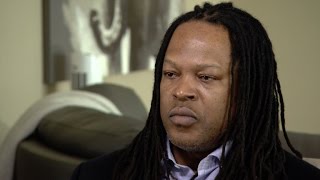
This TV/news YouTube segment profiles Shaka Senghor: his youth in Detroit, the 1990 shooting and subsequent conviction for murder, 19 years in prison (including seven in solitary), and his transformation through reading, writing, and faith. Released in 2010, Senghor wrote Righting My Wrongs and now lectures, mentors at-risk youth, and advocates for prison-reform measures (including an initiative to halve the prison population by 2025). The piece emphasizes personal responsibility, forgiveness (including letters from the victim's family and his son), and the limits of punitive incarceration.
Questions this video answers
19 years
Seven years
Righting My Wrongs
2010
Four fatal shots
Shaka Senghor is a college lecturer and MIT consultant, gives a popular TED Talk and mentors young kids. But his success came after a deadly mistake. He shares his transformation in a new book called Righting My Wrongs. Jeff Glor spoke with him in Detroit. Jeff, good morning, Charlie.
Good morning to you. Three decades ago, Shaka Senghor took another man's life and in the process, forever changed his own. Senghor spent 19 years in prison, including seven in solitary confinement. Today, he is sharing his story on the page and in person, hoping others don't live it.
I used to call this crack stone because of the high level of drug trafficking.
Shaka Senghor is grateful he's not the man he once was.
How often have you been back here?
I've come back over here a couple of times.
Thirty years ago, when he was just 14 years old, Senghor ran these Detroit streets. The honor roll students escaped a broken household and embraced a chaotic life selling and using drugs.
On this block alone, when we were selling drugs, there were multiple of us.
That had been shot, including senghor. Hit by three bullets in 1990. Traumatized and hardened, he started carrying a gun. A year later, he fired that gun into a car.
You fired how many shots?
Four and four fatal shots.
If you're standing on this corner 25 years ago and you see that kid pull that gun out, what do you say to him?
It's not worth it. It's not worth it. That 30 second decision is gonna destroy your life. And there will be a moment where you'll wake up and you'll regret that decision every day. Every day for the rest of your life.
At just 19, Senghor was already a father with another child on the way, and now a convicted killer facing 45 years in prison.
I went from one broken environment, one very violent, volatile environment, into another.
Senghor spent 19 years behind bars, seven in solitary confinement, time he describes in graphic detail in his book Righting My Wrongs.
It was as though I were in most of a vampire, forced to drain blood from unsuspecting victims in order to keep myself alive.
Amid the squalor of prison, Senghor found salvation in sentences from Malcolm X to Plato. Reading took him to places his incarceration could not. There were also two very personal letters, one from the family of the man he murdered.
What I want you to know, other than these painful things that you have brought upon my family, is that I love you and I forgive you.
There were times in the past when the people that you had Hurt badly, had forgiven you, but you still hadn't forgiven yourself.
It was one of the hardest things to do, is to forgive yourself for something as tragic as taking somebody's life because it's such a permanent thing.
The second letter, 10 years into his sentence, came from the son he never got to raise.
My mom told me why you're in jail. Don't kill dad, please. That is a sin. Jesus watches what you do. Pray to him. That was the most devastating letter I've ever received in my life. But it was also one of the most important letters, because that letter helped break through the facade of hood toughness, prison toughness. And it got straight to my heart in a real way. I had to figure out a way to leave a legacy to him that humans are redeemable. And I made a commitment to do that.
Senghor started writing a journal and eventually fiction. In 2010, he was released.
When I got that letter from my son, I began to write a journal.
Today he's speaking out against a prison business that he says leads to recidivism, not rehabilitation.
That we would do away with the lock them up and throw away the key mentality because it's proven it doesn't work. There has to be life skills. There has to be spiritual growth and mental stimulation in a way that speaks uniquely to the person. I'm a firm believer that our human potential to grow and to transform and turn our lives around is infinite.
He mentors kids at risk of following in his path.
I'm gonna drive down to Ann Arbor. Okay.
But his ultimate focus is on fatherh. He has a four year old now, a life he's determined to be a positive part of.
It's just one day at a time to me. You know, waking up, living every day with purpose, like that's success to me. When I feel like I've done something meaningful for that day, whatever it is, it's a successful day.
Senghor is working with a group trying to cut the prison population in half by 2025. It is a controversial issue, but one that is increasingly getting bipartisan support.
That's a great piece. What was it about him that made him and gave him the power to change his life?
Well, it's his eloquence now, the way he can talk about it and reflect. But in prison, it was his discovery of literature and it was discovery of different worlds and different voices that empowered him to believe that he could change his own life and that he could take a different path.
I first heard about him from Oprah who did an interview with him who said that meeting him was life changing and transforming for her. And it just shows you when you hear people's lives, what he said about the ability to change is infinite. What difference he can make and is making. Yeah.
Because he's very honest about everything. And you can ask him about anything and he'll tell you.
Yeah.
And. And he says he's not completely fixed yet and never will be. But as he said at the end there, he judges each day now by how much he did in that day. And if he did something positive, it's a good day.
And he has the credibility and the eloquence to change.
Yeah. He's quite a guy. Thank you. Great interview.
More from Shaka
Joe Rogan podcast Shaka Senghor #shakasenggor #podcast #joerogan #interview #jre #jreclips
Surviving a Shooting at 17 Joe Rogan X Shaka Senghor | Joe Rogan Podcast | #shorts