CROWN FORUM | HOW TO BE FREE | with SHAKA SENGHOR
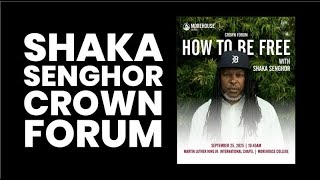
Transcript of a live Crown Forum event (Morehouse College) featuring Shaka Senghor discussing his journey from incarceration to personal transformation. Senghor describes childhood trauma in Detroit, 19 years in prison including seven years solitary, his turn to journaling and reading (Plato, Mandela, Douglass) as catalysts for self-examination, writing, accountability, and ‘inner’ freedom. He addresses responsibility of Morehouse students/professors, healing from trauma, atonement, community work, and practical strategies for resilience and agency.
Introduce us and start us. I'm going to have a seat and we're going to go ahead and get going.
Okay.
Good morning. My name is Lyndon Young. I'm a senior philosophy major from Columbus, Ohio, and I have the pleasure to introduce Mr. Shaka Senghor, who is a globally renowned resilience expert, best selling author, and transformative thought leader whose journey from incarceration to inspiration has empowered executives, entrepreneurs, elite athletes, and audiences around the world. I'm sure we will be empowered in the same way. Born in Detroit, Michigan, amid economic hardship, Mr. Sanghor overcame immense adversity, including 19 years in prison, to become a leading authority on resilience and personal transformation. Mr. Sanghor has received numerous honors, including Oprah Winfrey's inaugural Super Soul 100, Ebony magazine's Power 100, and the NAACP's Great Expectations Award. His most recent book, how to be a Proven guide to escaping Life's Hidden Prisons, offers powerful insights into achieving freedom and personal success. And with that being said, please join me in giving a warm morehouse welcome to Mr. Shaka Senghor.
Wow.
This is so amazing. So happy to be here, Brother Senghor. Yes, sir.
Thank you for being here, man.
Truly an honor. This is like, this is special right now. I feel, I know that I'm in sacred space, but just seeing all these handsome brothers is really powerful. Yeah, it's almost like emotionally overwhelming. Yeah, we know that you're powerful. Thank you. So I think one of the things.
That we'd like to start off with. This is your third book.
Yeah. Number three. Y' all gotta give me a round of applause for that. Number three. Yeah. Yeah.
So I'm curious. For the sake of. Of our brothers who are here, let's start off by just you. Who are you?
Yeah, who are you?
And why is it important for you to be right here in this space at this time?
It's such a great question. I'm a husband, got married a year ago to my incredible wife Liz, who's just, you know, an amazing human being in the world. I'm a dad of two boys. I have a 33 year old son and a 13 year old son. And, you know, I like to think of myself as somebody who was given this opportunity to share a story from an authentic space. You know, I grew up in the city of Detroit, grew up there, and grew up in an abusive household. Ran away when I was a kid, got caught up in the drug culture from like 14. When I was 17, I was shot multiple times standing on the corner of my block and at the age of 19, I made one of the most regrettable decisions ever as I shot and tragically caused a man's death and was sentenced to 17 or 40 years in prison and spent 19 of those years in prison, seven years in solitary confinement. And it's really where my journey as a writer began. You know, I began to start. I started with this essential question. I was talking to some of the young brothers earlier who are in philosophy. And so I started with this question that came from Plato's apology when Socrates said, the unexamined life isn't worth living? And I sat with that for a long time, like, what does it mean to examine one's life? And that's when I began to journal and began to really kind of unpack what led me down that path.
So talk to us about how it is that you. How it is that you were able to not be defined by the pathologies that you actually just kind of listed out for us. Certainly that's not who you are. But we know that within the popular cultural spaces that we exist, within which we, we exist, we know that black folk, folk who are pushed to the margins are oftentimes understood and defined by their pathologies. So we could. You're just a felon, you know, I mean, we could, we could easily. One could easily toss you to the side. So how is it that you. Is it through your writing? Is it because of the examination of your life? How is it that you're not defined by your pathologies, you're able to kind of present this possible asset oriented self to us?
That's a great question. It's one that I think we all should be really wrestling with all the time is like, who has the right to define us? And what I realized is that if I bought into somebody else's narrative, then my life can only have one outcome. And when I started journaling, I called that my write or die moment. I knew that if I didn't write and get to the truth, that I would assuredly die in prison, because that was the narrative that they had for me. And in fact, I had bought into a narrative that led me down that path. So I like to describe it as I was incarcerated before I was ever arrested, but I was free long before they ever let me out. And it was because I chose to go on this journey and fall in love with my mind. And once I fell in love with my mind, I knew that there was not a cage strong enough. There was not a system that was built or engineered that can contain what was ordained. And oftentimes we give up so much agency by letting other people define us. Now, it doesn't mean that it comes without the impediments of having a felony. That's a long lasting impression on one's life. It follows me everywhere, even to the heights of success. I'm still confronted with my past, but what I think is important is that one, what is the story that we're consistently telling ourselves? And because I chose to tell myself a different story, I was able to produce different outcomes. And, you know, it started with now. You know, I'm sitting here right now, like, when I say it's like a very emotional moment is, you know, the first time I even read anything about Morehouse, I was in a prison cell reading Dr. King's writings. And, you know, to be here now in this moment, it took a level of audaciousness that people can't even begin to imagine because 70% of people who are incarcerated go back within a year. And so, you know, to defy those odds, it took a commitment to something that was bigger than, you know, where I started from.
So where does that come from? Because it sounds like such a shift. Certainly being incarcerated is wake up call, right? Something's wrong. You got to do some level setting and some adjustments. But I'm curious, what. And how did you buy into the narrative before that? And then what was the shift that allowed you to, like you said, fall in love with your mind and be able to say, okay, no, I'm more than, you know, the mistakes that I've made or the narrative that was set before me, what set you on the path at first, the kind of this rough road, and then what allowed you to be free from that?
Yeah, yeah. Growing up, you know, I often heard the narrative that you'll be dead or in prison before 21. And then I saw tangible evidence of that. You know, my brothers, my older brothers, both were incarcerated. A lot of my friends that I grew up with ended up in the carceral system. And so the outcome seemed very apparent that these things could happen. And I was also processing that through, like, high levels of childhood trauma, which oftentimes, you know, when you. When you're growing up through trauma, oftentimes you can only see the negative, even though there is some positive around you. And so when I was able to go back and look in hindsight, I was like, there were actual positive people in my community, but through a trauma lens, it's hard to really see that. And, you know, I was lucky. You know, I Think of it like this. Like, sometimes we hear about people who are lucky to be born into a certain family, right? You're lucky if you're born and you grow up to be 6, 5 or 6, 7, or whatever, right? Like, that's the genetic. You hit the genetic lotto. My luck was that I was actually literate, going into an environment where literacy rates are, on average, third grade or lower. And so what literacy allowed me to do was to read other people's story who had triumphed over tragedy, to be able to read Nelson Mandela's book and be encouraged and inspired, that even though this is the moment that he was in, he still was able to go deeper inside and find promise and positivity. And so just reading other people's works, you know, Frederick Douglass being able to see how he rose up from slavery and became this intellectual and this orator. And, you know, so those books really emboldened me to say that, you know what? I don't have to. My story doesn't have to end here. You know, I have agency, I have choice, and I just have to figure it out. And so that's. Through the journaling process, I started to realize I had never completed anything. And so that was my first challenge to myself, was, if you're going to live a different life, you got to finish at least one thing. And so that's when I challenge myself to write a book in 30 days.
Where did that come from, though? Where did your. I mean, what clicked for you? Was it because of the context you were in, and you were just like, I got to shift my mind or I'm going to go insane. I mean, what. What. What kind of shifted things for you?
Yeah, I think it was. It was the examining of my life, right? So when I started journaling, what I would do is I would go back and I read what I wrote about it when I sat down the journal. And I highly encourage this, as you all are on this journey in your life, to really make sure that you're covering your experience and writing it down. But my charge to myself was that whenever I sat down to write, I could only write at the moment in which I was ready to be completely honest and vulnerable. And no matter how scary it was, no matter how embarrassing it was, no matter how. What amount of shame or anger or anything that it brought up, I had to forge ahead. And then I would go back and read that work. And it was through reading that work that I realized, like, I started a lot of things when I was a kid. I wanted to Be a doctor and an artist. But I never finished high school. You know, then I thought about going to the military. I took the test, but never followed through. And so I had a lot of these stars and stocks. And so when I was able to recognize that pattern in my life, I decided that if I was going to move forward into a different way of thinking about my life, I had to finish at least one thing. And that's when I decided to write a book.
So in finishing that book, was that kind of a proof of concept that allowed you to take that next step?
Yeah, absolutely. So finishing the book one, it was the first time I ever finished, Felt a deep sense of pride because I did something positive. And I really followed through and honored my word, and I put myself first. And I was. It was mind blowing to, like, have something that I can hold in my hand. It's like, man, I did it. But the thing is, a book isn't a book until somebody read it. And so I remember getting down on my cell floor and hollering underneath the door like, yo, somebody want to read this book. And the guy hollered back down there like, man, don't nobody want to read that garbage. This ain't Oprah. And I was like, you know what I'm saying? But it taught me a valuable lesson that even when you're on a positive path, you're going to have your detractors, also known as haters, or people who discourage you. But what that did for me is it did two things. One, it showed me that I was on a healing path because I didn't let it anger me to the point where it turned into something else. And then it gave me the way to set up a goal for myself, because it started with a question, what do I actually want to do with writing?
Yeah.
And so I began to write down these goals of, like, what I want to accomplish as a writer, which was. Which included writing more books. And so I started a second book, and I finished that book, and then I started a third book. And then I fell into a bout of depression because I realized this gift had always been there. And now I was in an environment where I couldn't give birth to it. And so it took me some time to work out of that, but once I worked out, I completed that book, and I ended up writing a total of four books, four novels, and then a poetry book and a life lesson book and a children's book. So I had about seven books before I got out of prison. So.
And I don't mean to keep on pushing here. But I'm curious. You talked about, you know, we talk about you being an expert in terms of resilience and being able to kind of be defiant as well, right? This idea of learning from your past and being able to become stronger as a result of it and push forward. But I'm still curious around how it is that you were able to, like, use a motivation. I don't know if that was an actual quote. Like, this isn't Oprah. But to look at your relationship with Dr. Winfrey, what we call her here at the college now, Right? But for your relationship with Oprah Winfrey and how it is that she does so value your words, how do you have. Or how do you get to a point to where you have the audacity to say that my voice is worth something?
That's a great question. So where it really struck me that I was in solitary confinement. And I'll never forget this moment. This officer came to my cell door. And, I mean, this officer was probably just one brain cell short of being a Neanderthal. And I'm like, this is the guy that's controlling my life. Like, he can barely articulate a sentence, and yet he can tell me to go sit on my bunk. He can tell me that they're turning the lights off of my cell. He can strip search me if he so decides, and I'm decided to be complicit. And there was something so striking about having somebody who I knew was intellectually inferior to me controlling my life. And it was in that moment that I was like, I will never, ever give up that level of agency to somebody who is not my intellectual equal or superior. And, like, there was something about that that was so striking to me that here you have a person who is unlearned, uneducated, you know, racist, and this guy is in control of my life. And I had to wrestle that back. And I knew that to wrestle that back meant that I had to take control of how I thought about my life, how I thought about the environment. And so I literally turned my prison cell into a school of higher learning. I structured my days so I would literally study every day. I would set up the day. I would start with, like, world history. I would start with philosophy. I would read African history. And then I would just literally go throughout the day, every day, like that. I would work out in between, and then I would write for the rest of the evening. And so that really was like, I have responsibilities. I always say that freedom is an inside job. You know, it's what's happening internally that really dictates outcomes. And so once. Once I had that reckoning, I was just like, I felt embarrassed, you know, that this man can come to my cell and say, hey, step out. I want to do a strip search. Like, that was so demeaning, so degrading. And I thought about, like, what our ancestors had went through in the parallel of that environment, that this new form of slavery and having been complicit in that. And so it was in that moment that I was like, I would never be subject to somebody who's inferior to me intellectually. And that was the charge to myself. I could never get these people agency over my life. And to this point, I've been out 15 years now, and the only time you'll ever see me going back inside of prison is when I'm going to service up the brothers and sisters who are still there.
That's amazing.
That's amazing.
I feel like we should clap for that for some reason. I'm sorry, I just. You talk about this being kind of an emotional experience for you, being able to see all these brothers out here, and I feel similarly. I know when I first became aware of you, I was moved. But as I began reading your story, more and more, you know, I think about is 91 that you kind of went in. Right. 91 is the year that I came to Morehouse. Right. And so. But. But. But you also think about how, you know, this idea of agency and this. This. This kind of understanding of, you know, I think I come from a very privileged background. Right. But I think that other people who don't have similar backgrounds can be in the same space if they are examining what goals they might have. Right. And also, I think around this idea of purpose I oftentimes talk about with brothers here in Crowd Forum or the classes that I'm teaching psychology, that I do have an agenda.
Right.
My agenda is fundamentally a freedom agenda. How is it that you can be free? How is it that you can understand yourself as being not within the margins, not within the margins, or not defined by what other people say or would place on you? So I'm curious around. What are the responsibilities? And I ask people this frequently when they come in and sit with us. What do you charge the young men who are here in front of you as being responsible for? Because they have privilege. Right? There's a certain privilege, and we would assume responsibility that they have in being at an institution that is Morehouse College. What is their responsibility then? Also, what is the responsibility that professors at this college have. What is it that we are charged to do if we are really invested in this enterprise of being free?
Yeah, that's a great question. You know, when I think about just being here, the thing that's so inspiring to me is just seeing these young brothers who are taking agency over their lives and their stories don't get told, you know, culturally. So many things about the narrative around, you know, black males has been articulated by a media that does not have our best interest at heart. And, you know, what you all are tasked with is ensuring that the wholeness of our stories are told. It's one of the reasons that I write, is that oftentimes the people who are sharing our stories, they don't have a vested interest in the wholeness of our stories. Like, we're not just. Just statistics. We're not just data points. We're full, complex human beings. And then I would say the other thing is that making intelligent cool. Like, there's something about that that I think is missing in our culture that I got a chance to benefit from. When I first, you know, fell in love with hip hop, there was an intellectual element to it that made it accessible, made it cool, made it feel like, yo, I can be empowered. You know, I can. Like, falling in love with my mind is, you know, something worthy of doing. Like, reading, having a. A book collection that's equal to my sneaker collection. Right, right. Like, you don't have to choose one over the other. It's just like, how do you create parody in that way? Right? So, like, you know, you come to my home. I got cool. I got a fly sneaker collection, but also got a fly bookshelf.
Yeah.
You know, and like my son, I want him to have that orientation. And so your responsibility is to really set the standard for him. You know, he's 13 now, you know, and so when I come and do these talks, normally he would be with me, but he wanted to go to school this week. So I was like, that's the right choice. But it's really understanding that nobody can tell y' all's story better than y'. All. And to the brother that's on the right of you, the brother that's behind you, the brother that's on the left of you, you have a responsibility to ensure that. That his story is told as well. These systems are not designed to tell our stories authentically. What I would say is that the professors, what they're tasked with is what y' all do here so well, which is set the Bar so high. You know, the intellectual bar is really high here. Talking to the young brothers, when I walk in, I'm like, this is a whole nother level. And making sure that these young brothers know that it's not just to get the degree and get the job, but it's also to create the movement of what's been established here at Morehouse. And, like, that's such a powerful responsibility to have and such an incredible responsibility.
To have kind of a privilege to be able to have that responsibility. So before I do want to open it up for questions from. From our student scholars, and it's unfair to ask this because you've written a whole book about being free, but how is it that you. How are you able to be free? How do you recognize freedom? And you gave us a little bit in the beginning, so even if you want to kind of double down on that, how is it that we can recognize first that we're imprisoned? You know, the extent to which we are imprisoned, and then how do we re. Break out of that?
Yeah. So the subtitle of the book is A Proven Guide to Escaping Life's Hidden Prisons. And I think those things exist in so many facets of our lives. Like, how do we see ourselves and who taught us to see ourselves that way? How do we see our fellow man? What do we see possible for our lives? And so for me, when I think of freedom, I think of, like, complete agency over how I think and engage with life and what's possible for me. Right. So coming out of prison, literally the day I was walking out, I remember an officer being like, we'll see you back in six months. And I was like, I wanted to say something to him, but I saw that door of freedom. So I was like, I need to get to that other side. But I can tell you what I've experienced in the 15 years since I've been free. Like, nobody would imagine that for me. And the only way I was able to accomplish all these things is because I took all of the impediments off of my mind. You know, I was just at a company. I was at a tech company for three years where I held three executive functions. I trained one of the most incredible sales teams. We went from a company valued at $4 billion that went to zero revenue. And in 18 months, we built that up to $9 billion valuation. And, you know, now it's almost north of a billion dollars in revenue. Nobody would ever been able to say that I would be able to train that team. We decided to change the company's name from Trip Actions to Navon. And I was the VP of Corporate Comms that spearheaded that transformation. So, you know, and I mean, I've accumulated tons of water. I taught at the University of Michigan. I'm a fellow at MIT Media Lab, a fellow at Virginia Tech, and a Kellogg fellow. I've invested in multiple companies. And, you know, this is my third book. Third best selling book, actually.
That's right. Make it plain.
Yeah. And so the reason I share that is not to brag, but I think it's so important for this audience to understand that those things were only achievable at the point in which I said, I can actually do it. I can actually do it, even though the world is telling me what I can't do. My belief that what's possible for me came as a result of really saying, I've seen people come before me. You know, you think about this institution, this sacred ground that we stand on. This was an idea, you know, this was an idea that came up at a time where resistance was probably at the height. And yet here we stand, here we are, so understanding that that's in my DNA. They can't tell me what I can't do. You know, there's nothing they can tell me that I can't do. And so that's freedom to me. It's like when I wake up in the morning, I came to win at whatever it is, you know, I came to secede because the power of our minds, it's like, you know, we're mesmerized by technology. I think technology is incredible. I'm like one of the biggest technology nerds, but it's not as powerful as the mind that created it. And once we really understand that about ourselves, that we are the architects, you know, we're the builders of the pyramids. When I was reading history in there, it wasn't just reading to memorize. It was reading to identify who I am in the grand scheme of the world order. And so when I went back and I was like, my ancestors built the pyramids and y' all think y' all can contain me. Y' all think y' all can define me? Y' all gotta be crazy, because what's inside of me is unstoppable. And so I literally live my life with that orientation. And. And the two things that I talk to my mentors about, like, master your mind, like, that's. It's one of the greatest things you can ever. It's the greatest gift you can ever give yourself. And I'M not talking about academic mastery. That's, that's the easy part, actually. It's the internal narratives. What is the story you're telling yourself about what's possible for you like that, when you can master that, like you are an unstoppable force in the world. There's nothing you can't accomplish. And the great thing is that y' all have youth. Y' all have the, the greatest gift this time. Like y' all are young, y'. All, y' all don't have felonies. You don't have the things that can stand in other people's way. So you gotta, you got a great start. So that self mastery is, is incredible. And then other thing is taking excuses off the table. So those two things to me are the kind of foundational pieces of what it really means to be free.
So for you, for that self mastery and those taking excuses off the table, and I don't want to put a wet blanket on anything, but you made terrible mistakes, man.
Absolutely.
So one of the things that you said in terms of your journaling is being honest with yourself. And I would imagine that forgiving yourself, but also looking at what your responsibility is because of how it is that you compromise another family, much less taking a life away. Because I want to make sure that we don't skate over that and certainly don't in your text. Right. But is part of being able to be free, being radically honest with yourself and also looking at accountability and that allows you to take those excuses off the table and whatnot, Is that reasonable to say?
Yeah, absolutely. So one of the things that I, you know, when I began writing, I knew how important it was to talk about. It wasn't even a mistake. It was a horrendous decision. It was a trauma, informed decision. You know, the cycle of violence that exists in the community I come from is extreme. In my family alone, at least 10 of us have been shot. Several of us have been, you know, to prison for gun related felonies. So the reason that I talk about the honesty, because there is a level of responsibility that oftentimes we don't want to take in our community. Yes, I was a traumatized kid. Yes, I was abused. Yes, all those things are true. That's just a whole story. But it's also true that I pulled that trigger. And it's also true that I have a responsibility to community to ensure that other young people growing up in that environment can make a different choice. Hopefully they can make a different choice. Right. Because they're empowered with the wisdom that we go back to. Right? So, you know, in my work, in addition to coming to do stuff like this, I go into prisons all over the country, I go into jails all over the country, juvenile detention system. I'm in the neighborhoods talking to young people because I would never want anybody to live with a horrendous decision that doesn't go away. Like, despite all the success, I still have to reconcile that, you know, I've caused harm to somebody's family. And so that. That mastery starts with responsibility, with accountability. Setting my class up, my sale up as a class, that was part of the accountability. How am I going to lead this place a better person? I have to change how I think. I have to change how I engage with other human beings. And that was hard work. It's hard to undo trauma. But I knew that if I. If I wanted to come out on the other side as a better human being, like, I had to do that hard work. And so it was. It was looking at the ugly things. You know, here's the things that happened to me, but here's the things I'm responsible for. And then how do I make amends for the things I'm responsible for? And the way that I defined it was acknowledgement. First you gotta. You gotta say it. You gotta just call a thing what it is. Then it's apologizing and saying, hey, I know that this harm I caused was devastating and I truly apologize. But the third part is probably one of the most important, which is atonement. How do you make amends in your community? Like, you know, the centers I served in the cell, that was for the state. My responsibility was to my community. It's to those young brothers and sisters growing up in the environments that I grew up in. How do I aid them in making better decisions? So writing has been a part of that, but the other part is working on policy, working with different organizations that serve our community. And it's something I wish I could have did it without all the trauma. And it's something that I hope that as you all embark on the next level of your life, that you think about how do you contribute in a way that's preventative. But, yeah, that was the hard part of the work, you know, is to really confront yourself, you know, and that's why I say it was my right or die moment, because I had to be so honest with myself. And it's really hard to do, you know, it's hard to say, you know, what, I failed. I've caused harm you know, I've devastated a community and a family. Like, I did that. I'm responsible for that. But it was one of the most important things that I've ever done in my life.
Thank you for that.
Thank you.
So we don't have any microphones, so I'm going to. I'm going to ask anybody who has questions if you could stand up and just line up in this aisle. We'll do one aisle, and I'll try and be effective. And it seems like I shouldn't say this out loud, but it seems like one of the responsibilities we might have as an institution is make sure you're a fellow here in some capacity.
You know, man, I would. I would truly be honored.
We'll have to work that out. I said it in front of everybody, so we'll see if we can make that work.
Yeah, MIT trying to get me back. Now I'm like, I want to be here.
Yeah, we can. We can. We, we, we, we, we. We'll chop it up.
Yeah, absolutely.
Let me get. Brother, if you can. Come on and up your. The. This isn't too long, but I want to make sure you're on the mic.
Here you go. All right.
Can y' all hear me?
Sir, I was mean to ask you, how do you keep a sane head while going through seven years of solitary confinement? Yeah, that's a great question. So earlier, when I mentioned being lucky because I was literate, I read this book called Cages of Steel. And in the book Cages of Steel, there's a psychiatrist that explains what solitary confinement is designed to do to a mine. And they were designing this at the time where they were trying to break the Black Panther Party down, break the Black Liberation army down, is they used solitary confinement in maximum security prisons. And they did. Everything that they did to them was based on this psychiatrist explaining how it should impact them. And because I was aware of that, whenever I felt myself, you know, struggling or navigating, I would come up with a place. So one of my plans was I would fast for three days so that anything that they did didn't cause me harm. So if they decided to deprive me food, I was already emotionally and mentally, spiritually strong enough to resist that temptation to fall apart. And then the other thing is that I would just turn to books whenever I felt myself getting. You know, it's tough. You know what I mean? It's tough to be in that environment. You know, I would pick up Malcolm X's autobiography, Assata Shakur, Nelson Mandela, People who have been through Tough stuff. And just reading their work was enough to get me through. Great question. All right, man. Thank you for coming.
What role, if any, did belief in a higher power have in your journey of breaking out of your mental prison?
That's a great question. So the role that I would say a belief in a higher power has for me even now to this day is recognizing that our existence is divinely orchestrated and that all the wisdom that we can ever contain or even seek to have already exist in the universe. And I'm reminded of that, you know, when I do my meditations and I put my, you know, my energy and affirmations to the universe. The expectation to receive abundantly is based on the belief that everything that I'm doing is divinely aligned. Thank you. Thank you for the question. I appreciate your writing philosophy when it comes to honesty. So my question for you. What are some questions that you ask yourself that helps guide your writing? You say, what was. What are some questions that you ask yourself that kind of helps to guide your writing? What are some questions that I ask myself that kind of guides my writing? So I'm actually, I'm happy you asked that question because I love talking about the craft. You know, I'm always very critical of. Of my own writing because I wanted to. What I knew that I wanted to do when I actually began to take writing serious is I wanted to be one of the best in the world. And so whenever I write a sentence, I'll always be like, would Toni Morrison approve of this? Would Baldwin be proud of this? Like, what would they say if they were critiquing my work back then? Would this body of work fit in with the Harlem Renaissance writers? So always think about those who come before me when it comes to the craft. So, yeah, it's a great question. Thank you. Yeah.
Greetings, sir. It's an honor to meet you. I'm John Jalen.
Gwen.
I'm a junior chemistry psychology double major on the pre med track from Hartford, Connecticut. And I have a lot of questions for you. But in respect to everybody's time, in the beginning of this book, it says we all have hidden prisons. And it also says, no, no matter how powerful the prison is, there's always going to be a door, let's say for those who are not self aware, might have a privilege outside. How do they recognize not necessarily the door, but they might be the walls, the prison itself.
Yeah, that's a great question. I think the book really outlines how some of those things show up. The way that you recognize it is Are you achieving at the level that you know you're capable of? And if not, why. And usually that why is where that hidden prison is at, right? Are you distracted? You know, are you, you know, caught up in a narrative that no longer exists from your past? Are you anxious about the future that hasn't arrived yet? Are you feeling to be, like, completely present with yourself? And usually, wherever the resistance is at, there's an attachment to something that's a limiting belief, and that's typically where the hidden prison exists at.
Thank you very much.
Y' all coming with the heat. I love this. This is. This is my vibe right here.
How you doing, man?
I'm amazing.
Your eloquence is inspiring, my brother. I appreciate you. I'm Ashton Brandon. I'm a senior psychology major from Flint, Michigan. Shout out to me.
What up?
And a lot of your story was really resonating with me. A lot of what you spoke on about your community was extremely resonant to me. One note I made of what you said was you saying, I can be black and fall in love with my mind. I think a lot of the space of where I came from, a lot of the people that I know were living in survival mode where they did not have the opportunity to fall in love with their mind. You know, consistently living in that mode of, I gotta get that next meal, I gotta get that next check. And, you know, entering this space helped me realize that there's a lot of privilege of having a thriving, thriving mindset. There's a lot of resilience that comes with that. My question with you is, with your books and through, you know, joining a space of thriving, how do you continue the dialogue and, you know, spread the dialogue of thriving within communities that are bent on the survival mode?
Yeah. Yeah, that's a great question. And, you know, when I think about how do I continue to spread that work is exactly. This was happening now, right? Like, I'm really counting on y' all to be ambassadors of this message. You know, when you talk about the community we come from, I know exactly what. What it feels like when most of the people around you have subscribed to a survival mindset, and you don't see a lot of people who are aspirational or dreaming big or think that they can make it out of that environment unless they're, like, hooping or your music, right? So this is where. This is where the real work of testimony comes in, is what I'm saying, is that I've done the hard work, you know, and if I can make it coming from the start that I had, there's no excuse possible for anybody to have right other than you got to shift the way that you think about your outcomes and your opportunities. And, like, we're going to need you all to really, you know, blow that message up and continue to spread that. So that's the way we're going to do it. It's going to be collaborative. And that's why I come to spaces like this. That's why I go back into prisons, because we truly need ambassadors.
All right, Shout out. You man.
Thank you. Thank you.
It's a pleasure to have you here. I'm Orell Roberts, senior psychology major from San Bernardino, California. And my question is. In your TED Talk, you described the shoot or be shot mentality that shaped your early decisions, survival logic born from trauma in your environment. How did you begin to deconstruct that mindset while incarcerated? And in what ways had that same intensity of thought, once rooted in fear, been reproduced to fuel your work in healing, storytelling, and justice today?
Yeah, that's. I mean, it was. It was really tough to even recognize that I had been traumatized, that I really had ptsd, because we don't. We don't talk about it relative to black gun violence in our communities. You know, we see what's happening in the nation when somebody goes and shoot somebody in a predominantly white environment and how the Lilly assembly to action is immediate. They're trying to figure out how do we solve problems, how to make sure that support structures in place. When I got shot, one of the things that I never forget is that not one doctor, nurse, psychiatrist, therapist, anybody came and just said, hey, you're going to have all these feelings as a result of what happened to you. Nobody even came and said, hey, that shouldn't have happened to you. So at 17 years old, I literally was left with, like, trying to understand why when I stood on the corner of my block, all of a sudden now I felt nervous and anxious and that I only felt comfortable when I carried a gun. And so I had to really unpack a lot of that through journaling and realizing that what happened was an isolated incident. It wasn't the totality of my life. That's a lot for one human being to unpack by themselves. But I was fortunate to be able to do it because I was able to read books that kind of guided me. But it's tough, and it's some of the most important work that needs to be done in our community. It's trauma, informed care.
Thank you.
Thank you.
Mr. I just want to start by saying I appreciate you coming to talk to us today. I'm Joshua Myers, polysi freshman from Atlanta, Georgia. And my question is. It's more of a logistical question, but just, you know, after being away for 19 years, like, what were you surprised, like, how the world had changed when. As you were gone?
Oh, yeah, yeah. When I came home, it was like I described it. And it's probably too young. I mean, y' all probably too young to understand this, but, you know, I grew up watching a cartoon called the Flintstones about these caveman characters, and then also watched the Jetsons, which was about the future. It was literally like caveman walking into the future. I was so mesmerized by technology, and, you know, you can talk to people. Back then, it was like Skype and, you know, social media, all these ways we interact. So it was mind blowing, you know, but it was also exciting and made me really curious. But I do know a lot of people that get out of prison, they really struggle with catching up with technology because the world is moving way faster now than it did way back then. But for me, it was exciting. I was ready to dive in. And, you know, now I'm pretty proficient in a lot of things technology based. Yeah. Thanks.
Great to.
Good morning.
How you doing?
I'm blessed. I'm blessed.
All right.
My name is Cameron Motley. I'm a creative and motivated senior sociology major, public health minor, from the city of Flint, Michigan.
Oh, that's what's up.
My question address is it's a spoken word. You had on one of my favorite songs by Nas, Composure.
Yeah, yeah.
You go, what you believe is everything, and what someone believes about you is nothing. Towards the end, I believe. And that kind of hit me hard as someone who's constantly fought stereotypes about Flint and just about being a black man.
Right.
So my question is, how did you personally learn to block out those outside perceptions? And what advice would you give to someone like me who's trying to protect his sense of self while carrying community.
Responsibility, man, that's such a powerful question. So, first of all, thank you for checking that song out. So there's a song I did with Nas on King's disease 2 called Composure, which was like, the wildest story ever. I have to tell you all that I actually told the story in the book. What I would say to this is, it is tough for us to separate ourselves from where we come from. That's one of the reasons we take so much pride in it, in the grit and the determination. And so for me, what I did was like, you know, at the time when I came home, Detroit was going through a crisis, right? Everybody was coming in like, oh, Detroit is trash. And blah, blah, blah. And what I just reminded myself of is that the people there are really resilient, you know, And I take pride in that. And I'm happy. That's where I came from. And then what I realized is that. That all of us are living a version of our ancestors wildest dreams. You know, we hear that on T shirts all the times. But this really is it, right? Because we get an opportunity to kind of figure out life and to really embrace all parts of us. You know what I mean? Like, it's not going to be all good, but it's also not all bad. You know, there's so many incredible things that can happen in Flint. So many amazing people that come out of that environment. And so you just. Sometimes you got to, like, connect to that energy, right? Like, you know, who are my people? That gives me a boost. But then you look around and you see all these brothers. And all y' all may have come from different walks of life, but here y' all all are together on this sacred journey. And just really leaning into, you know, the European mindset of separating us by geography is something that is hard for us to fight. Because so much of how we define ourselves is rooted in that now. But if you constantly remind yourself that we are whole people. We're not this segmented idea that they've kind of created through the way that we've been dispersed throughout the world. And just constantly remind yourself that at the end of the day, you know, we all from the motherland, you know what I'm saying? We just got dropped off in different spots. And all of our contributions matter. Thank you.
So we're going to pause in the programming quickly so that we can end formal crown forum. But certainly I want brother brothers to be able to ask their questions. So Brother Senghor, is gonna you sit with us for a little longer?
Absolutely. I got one favor to ask, Please. So I've been on. I've been on book tour for like four weeks now. And one of the things I've done at every stop, because this is so special to me, is I do like a video selfie with the audience. And so before y', all, whoever gotta leave, I know y' all gotta leave. I just want to do this video selfie. And then I'll just ask y' all to say the phrase how to be free. And y' all cool with that? Y' all don't sound like y' all cool with that, man. What we talking about up in here? Yeah. Oh, and listen, I know we. I know we got some Oprah scholars in here, and she gave me a special mission to make sure I get photos with it. So I. I just definitely need the love to be super loud on. On this video. So we're gonna do it, right? Yeah. Yeah, yeah, yeah. Let's get it.
So after that, we'll go into the singing of the college hymn.
Okay.
All right.
On the count of three. One, two, three. Yeah. Wow, look at that. Look at that. Let's go, Morehouse. Man, I love this. Yeah, I love that, man. This is beautiful. This is beautiful.
All right, folks, let's stand up and get ready to sing the hymn. Please.
Give ourselves in loyalty True forever True forever to no more house may.
We be.
So to my other.
More from Shaka
Joe Rogan podcast Shaka Senghor #shakasenggor #podcast #joerogan #interview #jre #jreclips
Surviving a Shooting at 17 Joe Rogan X Shaka Senghor | Joe Rogan Podcast | #shorts