Shaka Senghor (author of Writing My Wrongs) at the First-Year Experience ® 2017 Conference
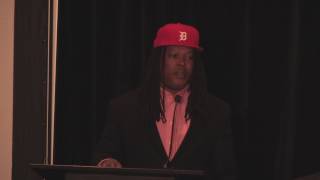
A personal narrative by Shaka Senghor recounting his childhood in Detroit, descent into the drug trade, conviction for manslaughter at 19, lengthy incarceration including seven years in solitary, and his transformation through mentorship, literature, journaling, and forgiveness. The talk traces three pivotal ‘miracles’ (mentors and books, a letter of forgiveness from a victim’s mother, and a letter from his son), his self-education in prison, the publication of his memoir and subsequent public achievements, and argues for the potential of redemption and the wasted human capital in the U.S. carceral system.
Imagine the smell of burning human flesh. Imagine the scream of a man who have just cut himself with industrial sized staple just so he can be taken to a hospital to feel the human touch. That was my day to day life while serving a total of seven years in solitary confinement during a 19 year prison sentence. But that wasn't always my life. I grew up in a household in Detroit that on outside looking in was the model for middle class black America. My father was in the Air force, my mother was a homemaker. So on the outside looking in we almost looked like the Huxtables before Bill got to trippin'. But unfortunately, what was happening inside our household was all too familiar. My mother was extremely abusive and she beat all six of her children. At the age of 14, I decided I no longer wanted to be subjected to her abuse. And so I ran away. I was a naive 14 year old honor roll scholarship student with this little handsome, cuddly little face. Still, I think it's all right. And like many teenagers, they found themselves in that vulnerable space. I was taken advantage of by older seasoned street veterans and I got seduced into the crack cocaine trade. In the first six months I experienced every imaginable horror that comes with that culture. My childhood friend was murdered, both of my older siblings were shot. And eventually, three years later, on March 8, 1990, I myself was shot multiple times. When I got shot, my 18 year old friend took me to the hospital because the ambulance never came. He had been shot the prior year. I got to the hospital, they extracted two of the bullets, left one bullet in, patched me up and within days I was back in my same neighborhood, on the same corner. Not one adult thought to ask me how I felt or what I was thinking. Now one adult thought to offer to me what I believe is the simplest human gesture of compassion and empathy. A hug. So at 17, I went back to my neighborhood with this volatile cocktail of emotions. I was angry, I was bitter, I was paranoid. And in reaction to that, I did what I saw. I began to carry a gun every day. Sixteen months later I found myself in a similar conflict. And this time I decided to shoot first. Tragically, it ended with me taking a man's life. I was one month past my 19th birthday. I was charged with open murder and sentenced to 17 to 40 years in prison for second degree murder. When I entered prison, I was bitter, I was angry, I was frustrated, I was confused. And I found myself getting in more and more trouble. In my first five years in prison, I accumulated a total of 25 misconducts that ranged from dangerous contraband to assault on inmate and assault on staff. I was hell bent on destroying what I believed to be the rest of my life. But it was then that the first of three miracles happened when I met some of the most incredible mentors that I've known up to this day. These are men who are now dying in prison. Some have died. They're all serving life sentences. They saw something redeemable in me even when I didn't see it in myself at first. They would come to me and say, youngblood, you messing your life up. And I would say, go on, old head, I'm a dying here. And they would say, no, you're not. But I didn't believe them until they gave me Malcolm X's autobiography. And it shattered all the misperceptions that I had about myself. And it showed me that there can be a second chance if you're willing to put the work in. But that wasn't enough. I was still getting in trouble. And it was kind of weird. It's kind of like you remember the cartoon where you had the angel on one shoulder and the devil on one shoulder. So Malcolm was like my little angel. And then my old self was the little devil. And Malcolm didn't always win. Five years in, I received what I believe to be the second miracle. And it came in the form of a letter written to me by the woman who raised a man whose life I was responsible for taking. And she wrote me and she said, here's how you've devastated my family. But despite these things, I forgive you. And furthermore, I love you, because that's what God would want me to do. I wasn't emotionally mature enough or evolved enough to fully embrace the idea of forgiveness because I had yet to forgive myself. But it started breaking through some of that hardness that I had. I continued on my journey to prison. At eight years in, I landed in solitary confinement for what turned out to be four and a half years straight. That's when the third miracle happened. And that came in the form of a letter as well. But this time the letter was from my son. And he said, dear dad, my mom told me why you were in prison for murder. He said, dad, don't kill again. Jesus watches what you do. Now, I wasn't religious then, nor am I religious now. But it was something about those words coming from my child that broke down the tough prison yard savvy, the tough street, the street toughness. And I made a decision right in that moment that if I couldn't give my Son, anything else that I had a responsibility to give him a father that he can be proud of. And so I looked around my spartan cell and said, what can I do? And the only thing I had available to me was a pen and a pad. And so I started journaling because I had to ask this question. How did I go from an honor roll scholarship student with dreams of being a doctor to serving out my most promising years in prison? And as I began to do this journal, I also began to structure my days as if I was at university. So every hour, I would study a different subject in the morning to be African history, political science, and philosophy. Now, the philosophy part was tricky because my older mentors, when they first introduced me to philosophy, I was like, this is about to be the most boring stuff in the world. But what I realized is that if I change the names to urban names, that it kind of got cool. So it went from being glaucome to Tyrone. It went from being a cave allegory to the basement allegory. But there was something I read in Plato's in Socrates apology when he said, the unexamined life isn't worth living. And so I began to examine my life, and I made a commitment. I said, if you're serious about transformation, write a book, but write a book in 30 days. I now realize how stupid that was. But I took this pen, and they don't give you, like, a regular pen in prison when you're in solitary. You get, like, this little flimsy pen. And I was like, there's no way I'll write a book in 30 days with this pen. But I took that pen and I began to roll it up in paper. And I had a little bit of experience rolling things up in paper. There's no judgment here. And I wrote the first of what turned out to be six books. Fast forward. I get out of solitary confinement, and I type all those books up on this thing called a word processor for you young people, it's this big machine. And so I type these books up. I publish my first book from prison in 2008. Then I get sued by the Department of Corrections for the cost of my incarceration, which they touted to be close to a million dollars. And I was just as shocked as you guys because I didn't have a million dollars. 2010, I go up for parole. I mean, I actually get paroled after three tries. And on the way out of prison, here's what they told me. We'll see you back in six months. I was like, well, thank you for the pardon gift. And initially I was really upset, but then I thought about it. We have a system that has a 70% recidivism rate. So they were playing the odds. In addition, at that point, I had been gone for two decades, convicted of a serious crime, no work history. So the logical conclusion was that I'll be back. But here's what actually happened. When I got out of prison, I understood the power of literature. So I started two mentoring programs in two high schools in Detroit. And I ended up winning an award called Black Male Engagement Leadership Award. I went from that award to winning a fellowship at MIT Media Lab in Cambridge, where I started the Atonement Project, which was nominated for a TED Prize. I was one of 20 finalists. In 2013, I was afforded the opportunity to teach at the University of Michigan, where I taught for three semesters. I was the coolest professor there because I always had the flyest kicks, as you can see. In 2014, I did a talk at Ted's 30th anniversary, which was named one of the top talks of the year. 2015, I won Manchester University Innovator of the Year award. And in 2016, March 8, 26 years after the day I was shot, my memoir, Right My Wrongs, debuted on the New York Times bestseller list. But it got even more fun. I got this call from a friend who asked if I was available to fly to Hawaii to be interviewed by Oprah Winfrey. I was like, well, let me look at my schedule, see if I can work this out. I ended up getting a call back and said Oprah didn't want me to fly to Hawaii. Instead, she actually wanted me to come to her home. And so I went to her home to have a 45 minute interview that turned into a three and a half hour conversation, which she wrote about the following month and said it was not only one of the best in her career, but one of the best in her life. Even though they said I would be back in six months, 2017, I had this great experience of being one of the many participants in a documentary that has now been nominated for an Oscar award. Even though they said I would be back in six months. So why does this all matter? Could it be that I'm bragging a little bit? A little bit. Every now and then you got to give yourself a pat on the back. But it matters because we live in a society where there's over 2.2 million men and women who are incarcerated who were thrown away. My friend Van Jones said, it's wasted genius that we continue to discard. And so, in sharing my story, what I'm sharing is the power and the potential of redemption, the impact that literature can have on lives when it connects with people based on where they're at. My memoir, Right and My Wrong embodies three things that I think are really important. One is the ability to rebel against a system that is broken and doesn't work. When we were incarcerated, when I was incarcerated in solitary confinement, anytime that we saw or heard another person being brutalized by the officers, we would rebel. And it took the form of us flooding the tear. We would stuff seats in the toilet, and all of us would agree to flood the tear. Now, it didn't do much harm to the officers, but it was a means by which we can voice our displeasure. The second thing is the power of resiliency. We're in some tough times right now, and it's going to take the resiliency of the human experience to get us through these tough times. It's going to take our collective wisdom, it's going to take empathy and compassion and a little bit of know how to get us through what we're going through and what we're experiencing in our country right now. And the final piece is the power of redemption. How many people in this room have had a moment, one moment that they're not proud of by show of hands? How many people in this room would never want that moment revealed to the rest of the world? How many people in this room would never want to be judged by that one moment for the rest of their life? This is why we have to stop doing that to others. Thank you for your time.
More from Shaka
Joe Rogan podcast Shaka Senghor #shakasenggor #podcast #joerogan #interview #jre #jreclips
Surviving a Shooting at 17 Joe Rogan X Shaka Senghor | Joe Rogan Podcast | #shorts