Shaka Senghor on "Writing My Wrongs" at the 2016 L.A. Times Festival of Books
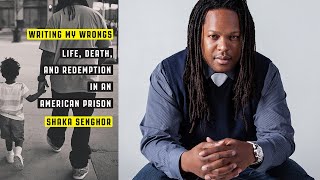
This is a televised interview with Shaka Senghor about his memoir Writing My Wrongs (also referenced as Righting My Life, Death and Redemption in an American Prison). Senghor describes his Detroit childhood, early entry into the drug trade, killing a man, and nearly two decades in prison, and explains how pivotal letters from his son and engagement with literature and writing catalyzed his transformation. He uses the memoir to expose prison brutality, argue for rehabilitative approaches, and promote literacy and anti-violence work in Detroit.
Welcome back to Book View Now. I'm Jeffrey Brown and I'm joined now by Shaka Senghor. His new book is Righting My Life, Death and Redemption in an American Prison. Welcome to you.
Thanks.
Let me ask you first, why did you write this book?
I thought it was really important to help people understand what's happening in the inner city with young men and women who are ending up in the prison system. But also I wanted to blame people as close to. To the prison experience as possible without them having to actually get arrested. Because I think, like, in order to solve a problem, you have to be in close proximity to it. And I just think the book brings you right there front and center.
You are bringing us close in, aren't you? I mean, that was important to give the detail both outside and inside.
Yeah, I mean, like, you know, our system is a mystery to most taxpayers and it shouldn't be. Like, I think that we should know as much about the prison system as possible, considering that the society has been so deeply impacted by what's happening within the system.
You write about in your own childhood, dreaming at one point of being a doctor, and yet that didn't. That obviously didn't happen. Tell me a little bit about your childhood.
Yeah. So I grew up in the city of Detroit on the east side, in a household that on the outside looking in, was the model for middle class black America. Unfortunately, what was happening in my household, which is all too often the case with young men and women who end up running away, is my mother was being abusive and I decided to run away. And that's how I got seduced into the drug trade at the age of 14.
Drug trade, which led you onto the streets, which led you to guns.
Yeah. So, I mean, when I first got seduced into that culture, I had no idea, like, everything that that entailed. And it was relatively short amount of time that I experienced every imaginable horror that comes with, you know, drug culture, including the childhood friend being murdered, both my older brothers being shot, and eventually myself being shot at the age of 17. Being shot multiple times at the age of 17. And that's the world of street culture. And I wanted people to really understand what's happening in that space, why it's happening and how we can stop it.
And it led eventually to you shooting someone. Shooting and killing someone.
Yeah.
When you say people understanding, did you understand at the time? I mean, right. No. Right and wrong.
And I mean, there was a understanding of what was legal and what wasn't legal and what was you know, there was. You know, obviously I grew up with a moral compass to differentiate between right and wrong. However, when you're immersed in the psychological trauma of high levels of gun violence, those decisions aren't always easy to make.
Mm. It's not on your mind at that.
Because it goes from right and wrong to what? Survival. And when you're operating out of survival mode, the rules change. Mm.
What did you expect prison would be like before you went?
I expected it to be a horrible experience of human misery, and it proved to be true. When I went inside prison at the age of 19, it was really one of the most volatile, dehumanizing, degrading environments, you know, in modern society right now.
And you write about the brutality there in detail.
Yeah, I mean, I think it's really important for people to understand that this is happening on our watch. You know, when I got out of prison, you know, I could have went on with my life and, you know, never had to look back. But, you know, all of my friends are in prison. The men I grew up with, from the time I was 19 till I got out at the age of 38, are people who I grew up with. You know, my best mentors are serving life sentences in prison. And so for me, it was really important to articulate the reality of their world and their environment.
It was a letter. You write about a letter from your then 10 year old son, right?
Yeah.
It helped transform you. Tell us about that.
Yeah, that letter was one of two pivotal letters that I received throughout my incarceration, and they were definitely integral to my transformation into who I am today. And that letter was the first time he wrote me about understanding why I was in prison. His mother had explained to him what I went to prison for. And he really talked about how it made him feel as a child to know that his father was in prison for murder. And as a father, you know, my responsibility is to provide and protect. And I was failing to do that by being incarcerated for a very serious crime, and one in which my child was growing up to look at me as a monster. So I knew I had a responsibility to turn my life around in such a way that he can understand that even though I made a poor decision, that doesn't totally define who I am as a human being.
You know, there are going to be people who watch this and say, you killed somebody. Right. Prison is not supposed to be a good experience. Right. You're being punished. So what's wrong with what happened? You know, what's the response to that?
So here's the response TO that is 90% of people who are incarcerated will at some point get out. And we have to decide what kind of men and women we want to return to society. And the idea that you can punish, degrade, dehumanize somebody and then expect positive outcomes is ridiculously absurd. It just goes against logic because you get out of people what you pour into them. And so my position is that while I had a horrible experience, I'm okay today because I was able to do things to ensure that I left with my mental faculties intact and my psychological faculties intact. But that's not the normal case. And so to think that you can dump more hurt on the people who are already broken and fractured, who come from deep backgrounds of abuse, psychological childhood abuse, sexual abuse, substance abuse, and to think that to do more of that to them is going to somehow fix the problem. It's proven not to work. I mean, we've had this tough on crime mentality for decades, and only thing that's led to is an explosion of the prison population and more violence in the community. Whereas if you really can be smart about these things, you'll see a complete turn around in a different way of doing things.
Part of how you did it was through reading and then writing. Right. Had you been a reader or a writer before all this?
So those were the classes that I always excelled in. They were things that I loved. I learned how to read when I was four years old. I've always had an appreciation for the written word in terms of actually becoming a writer. That didn't come till later on when, you know, I just decided to journey into the world of literature and just started writing fiction and things along those lines.
So fiction was the way in.
Yeah. Fiction was the way in.
Yeah.
And fiction, for me, writing, because I was in prison when I started writing fiction, it allowed me to explore different worlds. It allowed me to examine, you know, different aspects of who I am as a person. And I think sometimes you can tell the deeper truths through fiction because it's not as antagonistic, you know, it's not as personal. Sometimes it gives you enough distance to really kind of think about things differently. And so literature played a profound role in, you know, turning my life around, but it was also journaling as well, like, being able to really write and ask myself those tough questions, like how did I go from wanting to be a doctor to serving all my most promising years in prison?
Yeah.
And, you know, the discoveries that I had and epiphanies I had along the way helped me course Correct. And really rethink what I wanted to do with my life.
Were you writing about. Were you writing about prison experience in the fiction or about things outside as a way of getting outside?
Mostly things outside, but some of that world, you know, was incorporated into some of my fiction books. And I mean, I think it's a great landscape for a writer. It's a place of, you know, a multi dimensional place. And so I think it makes a great landscape for really good writing.
So now you're out, you've published this memoir, and you were telling me before we started about getting involved with literature literacy programs in Detroit.
Yeah. So I grew up in Detroit. I do a lot when I'm home to work with young men and women who are growing up in similar circumstances that I grew up in. And I found that when you can introduce them to literature that connects to their reality, that they're a lot more receptive. And I also do a lot of work with different foundations in the city. You know, they call on me to do panels and speak at schools and do keynote addresses. And I just feel like, you know, a collaborative effort of us getting the book in the hands of as many students, high schoolers in Detroit to read during the summer would just be a phenomenal way to have a conversation about ending gun violence and disrupting the prison playground to prison pipeline that's so prevalent in inner cities.
Do you see any changes happening? I mean, as we sit here? Are you any more hopeful about the situation?
I'm extremely hopeful. Our response to the book has been phenomenal. And the type of conversations that the book is generating has just been so humbling and mind blowing, but also expected. I mean, you know, I think we're at a pivotal moment when it comes to criminal justice reform. I think we're at a pivotal moment when it comes to racial dynamics and inner city gun violence. And people want change. And I think the book allows people to really examine how we can go about fixing things and turning things around.
The book is righting my wrongs. Shaka Senghor, thank you so much.
Thank you so much for having me.
More from Shaka
Joe Rogan podcast Shaka Senghor #shakasenggor #podcast #joerogan #interview #jre #jreclips
Surviving a Shooting at 17 Joe Rogan X Shaka Senghor | Joe Rogan Podcast | #shorts