TheGrio Weekly: Gov’t Shutdown, Viral Teacher Video & Bad Bunny Super Bowl + Shaka Senghor Intv
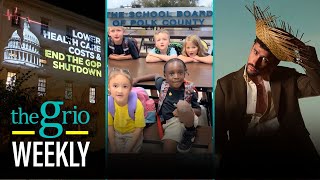
A Grio Weekly YouTube panel and interview covering current events and culture: the 2025 federal government shutdown and its impacts (including effects on health care and federal workers), a viral racist classroom incident in Polk County, Florida involving a six-year-old boy, the announcement of Bad Bunny as the 2026 Super Bowl performer and its political context, and an in-depth interview with Shaka Senghor about his new book How to Be Free (a practical guide to healing, forgiveness, and escaping ‘hidden prisons’). The episode closes with light-hearted "Black Joy" cultural moments and promotion of the Grio Book Club.
Foreign.
Hey, Griot family, welcome to the GRIO Weekly. I am your co host, Natasha S. Alford.
I'm Panama Jackson, an editor and cultural commentator here in D.C. and I'm Jerry.
Key, the Gaynor White House correspondent at the grio.
Yes. And we are so glad that you're here with us for another week of news, culture and conversation that matters to us. All right, so Panama, I think you're going to kick us off this week.
I sure am. And we're going to start with the story that you couldn't get away from whether you wanted to or not. The federal government has shut down. Washington is in gridlock again. Millions of Americans are going to feel the impact of this. There's a lapse in funding that has Democrats and Republicans kind of playing the blame game against one another about who's at fault here. So the law requires agencies to furlough their non essential employees and essential employees, which includes those who work to protect life and property. Think the FBI, CIA, air traffic controllers, they get to stay on the job, but they're not going to get paid until after the shutdown ends. Now, there are functions of government that are going to continue. For instance, all the mandatory spending in the government for those who aren't familiar with what that means, that means payments that have to be made. So think Social Security, think veterans benefits, think of veterans healthcare, things of that nature. Those things are still going to be ongoing. So if you're a person who receives a benefit check from the government in some way shape or form, you should get the man, you should get the ones that you are, you are, you're are based on your eligibility to reach them. So this is what people are talking about. I live in D.C. jaren's here in D.C. jaron's been reporting on this specifically. And I've actually lived through a shutdown. I was a government employee back in 2013 and my enduring memory of that was that I watched almost every season of Scandal at that time. I didn't go anywhere. I try not to spend any money because I wasn't sure if we were going to get paid. That's before they passed a law saying that you're always going to get paid back. Back then there was no guarantee. We were all waiting to find out if we were. And it's kind of gotten. I have a lot of friends who work in the government because I'm here in D.C. and the conversations with them are very interesting. Like people are just trying to figure out and navigate this space. You know, the longest federal shutdown was in Trump's first term, which lasted for 35 days from December 22, 2018, to January 25, 2019. So let's, let's talk about it. Jaron, you've been doing a lot of reporting on this. Like, what are your thoughts? Where, where are we with this? What are black lawmakers saying about the government shutdown?
Well, this is a really interesting debate that's happening because who is to blame really depends on what the public believes. But Republicans are, you know, blaming Democrats for the shutdown, saying that they're holding up this bill to fund the government because they want to provide health care for illegal immigrants, or as we would like to call them, undocumented immigrants. But Democrats say that this is about healthcare, and it's not about immigrants. It's about the American people. Roughly 16 million people could lose their health care or see their premiums. If you have Obamacare, or it's technically called the Affordable Care act, if you have health care in the public marketplace, you can see your premiums go up by November 1st. And so Democrats say that this is to protect health care. This is also about Donald Trump's signature. One big, beautiful bill is a $3.8 trillion tax cut that experts say are primarily benefiting wealthy Americans. And in order to pay for those tax cuts, they had to make cuts in other areas of the federal government's expenditure, which happened to be Medicare, Medicaid, and Medicare. So over a trillion dollars of cuts to Medicare and Medicaid. Republicans are saying that Democrats could wait to have this debate on health care later on. But Republicans have shown Democrats that they don't always work in good faith. And so Democrats don't trust that Republicans are really going to work with them. And so they're trying to claw back these cuts. Democrats say that if these health care premiums are, and these cuts to Medicare are not restored, that people will actually die, that estimated tens of thousands of people will die every year without this health care. And we all know how expensive health care is in America. Obamacare has been this big issue for Republicans. They tried to repeal Obamacare unsuccessfully during Trump's first term. For black Americans in particular, there was a surge of black Americans who became, who had, who became insured because of Obamacare. And so that is at the heart of this shutdown. Many people who were critical of Democrats have been saying that they weren't doing enough. They're not, they're not fighting back against the MAGA agenda. And so some people feel like this is a political battle where Democrats are Trying to show the American people that they're trying to fight for them. But obviously, many people are going to be hurt by this shutdown, particularly black workers, because black people represent a higher share of the federal government than their total population. So they make up about 13% of the population, but they make up, I believe, over 20% of the federal government workforce. And so I know people like Panama, people who have been furloughed, people who are deemed essential workers but won't get paid. And so this is impacting people's pockets At a time where the black unemployment rate is. Has been skyrocketing at 7.5%.
I just want to put a dollar amount to what Jaron was breaking down, because sometimes policy can feel very convoluted and it's not really clear. And it's like, how does this affect me? Or how does this affect the other person? Once these tax credits expire, somebody. This is my Source here is KFF, somebody who pays no more than 3, $325 towards their, you know, ACA health insurance. After that tax credit expires, they could pay $1,682. So we're talking about going from paying $325 towards your health care to $1,562. That is insane. Okay. People are literally counting dollars, you know, counting change, trying to find side hustles, seeing their bills go up everywhere, from childcare to the grocery store. So when we say every dollar matters, it truly matters. And so I think Democrats have picked this fight because the impact is real. It has a face to it. Right. People who normally wouldn't have had insurance coverage, who now have it, who now you're. You're making it impossible for them to pay it. I think Senator Bernie Sanders quoted it at 50,000. An estimated 50,000 people a year could die without that healthcare coverage. Right. So when you put it like that, it does seem like a worthy fight, right? It does seem like a fight where this is not just about some, like, philosophical difference between Republicans and Democrats and how they want to run the government, but we're talking about people's lives on the line. The other thing that's really interesting, Jared and Panama, have you seen the president talking about this on tv? Well, I know Jaron has because you're there, but have you seen him? He's like, this is an opportunity, you know, like, we just gonna fire people. He was already firing people. So he's like, all right, well, you want to shut the government down? I'm going to instruct various departments that it's okay to do a reduction in force. Right. So you're not just going to go away temporarily and be furloughed. You're just never coming back to your job. So this is part, this sort of, they're, they're gloating because they see this as a chance to continue advancing their agenda, which they already, you know, wanted to do. Right. Reducing the government and replacing public servants with loyalists who believe in what they believe in and just, you know, worship Trump, all of that. That's what they see happening. And they think Democrats are going to lose the political fight.
Yeah. And it also speaks to how governments should work when you have two parties. Republicans might control the White House and the House, but they don't have the necessary votes in the Senate. They need seven Democrats to vote for this spending bill to fund the government. And so it requires negotiation, it requires bipartisanship. And while President Trump has been taking this approach of, you know, it's our way or no way, Republicans are not the only ones who represent the federal government and control the federal government. And it's unfortunate that we are in this state, in this country where the two parties cannot sit and have good faith negotiation, where each party has to have a give and a take. And it seems like President Trump and Republicans are refusing to have to be able to give something up in order to have what they want.
And can I quickly say, before we go to the next topic, I mean, just go to the government website, right? It says the radical left, the radical Democrats have shut down your government. So how do you even sit down to negotiate with a side who has demonized you and is demonizing you to the public or trying to. Right. It's just, again, we are in unchartered.
Territory and it's unconcerned about how it looks from any angle. Like, it's genuinely. When people keep saying they keep stepping all over the Constitution, it's really, it really does feel that way. Just, it genuinely is like, we'll do what we want, and if we have to claw it back, maybe we will, maybe we won't.
Boots on the Constitution step in anyways. Okay, so let's talk about another story that actually really made my blood boil. This story. Story comes out of Florida. Florida. See, I didn't even know what state this story was from when it made me upset, but now I'm even more upset. A video has gone viral in from Polk County, Florida, of a teacher who recorded one of her students and she was singing Happy Birthday to Him in front of the class, supposedly, you know, normal thing. Except the child was black. Okay? Majority of the class non black. And she says to this six year old boy, Legend Whitaker, happy birthday to you. You live in a zoo. You look like a monkey and you smell like one too. So Legend's mother was rightfully very upset about this. Her name is Desiree Prather and she says that her son was humiliated, which is heartbreaking. He's now too upset to return to school. And so she's filed a complaint. She shared the video online. It's gone viral. As, as, as a mom, as a boy mom, I'm ready to square up. But just as a human being, you know, who, who believes that children are so pure, right? Like they come into this world without all of this baggage, and it is the adults who are responsible for protecting them. And in this moment, clearly Legend was not protected. Pamela, gonna start with you. What was your reaction when you heard the story?
I mean, it was huge size. Just like, come on. Like, this is, this is what we're doing it. Also, she, the teacher, shared this video with the mother. Right? We all know this is part of the story, which means she didn't think that she'd done anything wrong or she, she did not see how it could be seen as inappropriate. Right? And it's one of those, this is part of the black experience. And, and I hate to say this, but it is like you don't really know if people are being straight up with just like this gaslighting that happens. Maybe she was oblivious to the fact that how this could be construed though it's 2025. I mean, this is a teacher, right? We've gone through George Floyd and all these things where all of the discussions about this were front and center. Even if you didn't want to be a part of them or have them, they were in your face for years, right? That we might be turning a corner in a negative direction when it comes to that, but that's where we were for years. I don't know how old this teacher is, but I would imagine she's aware. But then there's the other side where maybe she knew what she was doing and just thought maybe the mother wouldn't notice she was doing her subversive. I'm just going to be a little bit racist and maybe she won't get it. I can get my racism off, right? And you really. That's like, there, there's that black experience. You really just don't know. Look, I come from a Interracial family. My mother's white. I cannot tell you the amount of things that have happened in my own family where people have done things where I'm like, did you do that? Like, you thought? Like, were you being. Are you being unintentionally racist or you just that obtuse to think that this is something that you should give me, that you would never give to anybody else? Like, it's all of that type of stuff. So, yes, as a parent square up, I would have done exactly what that mother did. Gone straight to the school, straight to the administration, and then gone straight to social media and put her on blast. Nowadays, these things get you. You lose your job over stuff like that. But you also, unfortunately divide everybody because then a bunch of people on the other side are going to be like, it was just a harmless thing. What are you talking about? It was just a harmless thing. Singing a song that we've all heard before to this little boy for his birthday. Like, he shouldn't be so sensitive. Why are you all being so sensitive? So it's frustrating to see this type of stuff happening to babies and little kids who don't deserve it, who have to deal with this, who have to become the face of something they never asked for is his birthday. Sing Happy Birthday to the kid. Singing in a different language, do whatever else, but you do not have to call him a monkey. You don't have to find the one. Of all the available songs to sing. You decided to go that one. And what she said was, do you want to sing the fun song? Right, the fun song. Like, I wonder, do they sing this to all the kids? Is this, like it? All these questions that I don't want to have to think about for this child who didn't deserve that is. Is where I am with. Incensed, infuriated. Exactly. Where most of us who are parents and most of us who aren't parents are seeing stuff like this.
Yeah. And I think that was the heartbreaking part, is seeing his little face and knowing that it's gone viral for this reason. Right. So you can sense the embarrassment and discomfort in this little child's face. And now it's been spread all over the world. So it's like in trying to get justice for him, we are reliving his humiliation. We're amplifying his humiliation. And I just. I hate that he had to experience this so young. I remember this song, but it's a song that kids sang to. To each other, to tease each other, to be kids. It's not what Adults would actually sing to a child. Jaren, do you remember the song? And what do you think, having been a, a child yourself at one point?
Like, I, I had not heard this song until this viral video.
What?
Yeah, I mean, I guess, I guess, I guess.
I don't know.
I don't know. Because in Brooklyn they'll be scrapped, right? But no, for me it's like regardless of whether or not it's a common song or not, you are a teacher, you are an educator, you are an adult and you're a white woman in America. And you don't know that comparing a child to a monkey and that he smells like a monkey is not wrong and racially insensitive. Like, this is the reason why cultural competence is important. And in this climate, it shows why. Discussions about race and equity and black history and knowing your history and not just black people knowing their history, but Americans knowing their history and the history of race in America. This is a perfect example as to why this is important. Because now this kid has to have this video live on the Internet forever and could be scarred for, for a long time, if not throughout the rest of his life. And as a dark skinned black man who has had my own issues around colorism, I really feel for this child and worry for the impact on him and his self esteem. And I just don't understand why this teacher didn't. Whether or not she knew or not, why it didn't resonate for her that this might not be the appropriate thing as a teacher to do. And it's just a reflection of where we are in America and we gotta do better. It's just, it was disgusting.
Yeah. When you say that, it makes me think of how many micro and macro aggressions black children go through throughout their lives. Where people are telling them, oh, we didn't mean it like that. And then they're left to have to sort through and sit with those feelings. Legend, you are a beautiful, handsome young man. You are wonderful. I love, I love your hair. I love your style. I hope you had the best birthday. And we'll have many great birthdays to come, even if this one didn't feel so great when you were at school. We love you, Legend. Sending you some love. Okay, we want to bring in a special guest on the show now. He is a bestselling author, motivational speaker all around powerhouse, Shaka Senghor. Shaka has a new book out called how to Be A Proven Guide to Escaping Life's Hidden Prisons. And the book covers his journey from redemption to his insights on healing and transformation. So, Shaka, welcome to the show.
Thank you all so much for having me. I'm really excited to be here, and it's always great when I get a chance to spend time with somebody who loves my work.
Yes, absolutely.
Yeah, brother. So, obviously, thank you for being here. We're all big fans of your work. Speaks for itself. And I have to say, having read it, I'm a person that loves quotes. So all the quotes you have through seem to be so perfect. And I want to. I want to start out with the quote that opens up the book, because it is, like, the most perfect thesis.
Yeah.
Toni Morrison, Song of Solomon, where you say you want to fly, you got to give up the stuff that weighs you down.
Yeah.
And, you know, when I read that, I'm like, if there's no more perfect quote for this book as a whole.
Yeah.
So let me just ask you, based on that, what made you decide to write this as a literal guide? Because I've seen books that say a guide to something, but it's really kind of memoir format or people telling their story. You kind of got to take the lessons. No, no, this book is about lessons. Here's what you take this. Do with this. You even say how to use this book. What, did you write the book that way?
That's a great question. So the. The. The. The.
The.
The funny story is I wrote a second book called Letters to the Sons of Society, which was these letters I wrote to my youngest son, who's 13, and my oldest son, who is 33. They were about 10 and 30 at the time. And I remember, you know, I would share it with friends, you know, the early reads of the. Hey, check this out. And I shared it with one of my friends, and. And Ben was like, dude, this should have been a guide book. It's so many jewels in here about life and lessons. And I was like, don't panic, bro. That's the next book. But the reason being is I get hit with the question of how, you know, how did you go from 19 years in prison, seven years in solitary confinement to living a life where if no one knew your backstory, they couldn't even remotely imagine that you lived through such traumatic, you know, childhood experiences and life experiences and then came out on the other side with a level of positivity and perspective and, you know, insight that most people couldn't imagine. And so I knew it was time for me to share that story. And what I saw was people suffering around me who look like they had it all. All the money, all the social accolades, all the, you know, the, the things that people think makes you unhappy. And I saw those people were trapped and I was like, you know, what if I don't know how to do anything else? I know how to get out of prison. And I'm going to show you how to get out of your own prisons.
You know, I, Shaka, I love this concept of the imprisonment of the mind and of the spirit. Talk to us about why do you, what do you think is the root cause of these, these philosophical shackles and for our viewers, sort of give us some of the, the breadcrumbs to freedom in terms of how we fight our own individual freedom.
Yeah, that's a great question. And you know, in, in the source of, of these kind of hidden prisons vary, right? Social expectations, childhood trauma, parental dysfunction, you know, all the things that really make up the whole of our existence we're being influenced by from a very early age. And for everybody, it looks different, right? I mean, I had the most extreme forms of a lot of these things, you know, the childhood trauma, the abuse at home. And what I, what I realized is that we all have our own things that we're navigating. Even if you have the most amazing parents in the world, there's still the pressure to live up to the idea of what it means to have those as your parents. And those imprisoning thoughts can lead to low self esteem, low self confidence over criticism of oneself. And I've literally seen it in my work life, in my personal life, where, you know, people walking into these tech companies and they have imposter syndrome because they're so caught up in an old narrative that no longer exists, that they can't even be present in the fact that they've got themselves to that point and actually belong in the rooms that they put themselves in. And, you know, as you go through the book, what you'll see is that there's all kind of hidden prisons. You know, there's even the well intended ones. Right. Helicopter parent. Nobody really thinks that that parent is out to do their child harm. It's like, oh my God, this parent is trying to protect and care. But in reality, the child doesn't build up resilience. The child doesn't get a sense of confidence. And it's all these little kind of nuanced things that we often walk right past and don't see how they're holding us back from living the life that we want to live.
Yeah, Shaka, when you talk about wanting to live the life that you want to live. There's an obstacle to that for many of us, and that's anger. And I feel that America right now is struggling with anger. We see these outbursts all the time. The mass shootings, you know, the violence. And you. You talk about being imprisoned and having guards literally mocking you, taunting you, leaving you out freezing in the cold, you know, just to r you up, other prisoners doing things in order to rile up that anger. For somebody who does not know what to do with just anger. Right, because it's kind of righteous when you're being mistreated to feel some type of way about that. How do you manage and work through it so that it doesn't destroy you?
That's such a great question, and one that as I was on this path of discovery, I realized for myself, anger is one of the most important emotions we can have. Because what it does is it signals that something is wrong and something is egregiously wrong. I think where we get ourselves in trouble is when it's mis. Misplaced anger or. Or anger that doesn't align with the actual grievance itself, which means that it's typically something deeper. And what I found for myself that a lot of the things that. The times where I found myself in deep anger, the more I dug, I was really navigating shame and sadness and. And what I. What I would say to people now as we navigate these news cycles and doom scrolling is like, at some point you have a choice is that you're gonna. Are you gonna allow external factors to dictate how you presently feel? A lot of my anger was things that in the past which I no longer control, or imagining the next assault on my being to come that hadn't arrived yet, and it didn't allow me to be present. But once I began to work that out, for me, journaling and just writing it down and saying, hey, here's how I feel, and then being able to go back and examine, like, was that really anger or was something else going on? In the instance when those officers left us out to freeze in the cold in those cages, like, that was righteous anger. Being upset at my. My neighbor and wanting to cause him harm when he blew the power out in the cell, that was an inconvenience. But what happened is I sold those things together. As we often do. One thing spirals into the next, and then we find ourselves out of control. And for me, it was really writing it down, bringing myself back to mindfulness and then present in the moment, and it's the Same thing with these news cycles, like what we're seeing happening, you know, with the mass shootings. Like, you know, I mean, you can name the things that's happening socially that are enough to anger anybody that has a sense of what it means to be human. But how do we reconcile it, you know, how do we show up in a way that actually is like, hey, what is really driving this? Because we get, we get caught at that surface level, and it seems like we never really get out of that. But when you get deep beneath that, people are hurting, and people who are hurting hurt other people. And if you can make space for understanding, you don't have to be. Be compassionate toward them, but if you could just make space for understanding that no one wakes up and just be like, you know what? I decide I want to be a harmful, hurtful person. Usually there's a backstory there and a lot. And we don't do a good job in society as getting to that backstory.
Yeah. And as, as a follow up to that. You know, I grew up in a household where there was a lot of anger. Like, you're, you're constantly trying not to upset, you know, a certain parent, or you could just feel it, like, kind of lurking. And I start to realize as I got older, I never got a great example of like, repair. Like what you do once somebody is angry, to repair the relationship is just. People get angry, they stop talking to each other. Like, that was the only example that I had. So what have you learned about, you know, not only just controlling personal anger, but once anger emerges in a relationship, how you repair and move on from it?
Yeah, that, that, that repair. You know, I talk about in a book how in my family we roller skate, pass for apologies. You know, we'd be like, you know, we beefed out, three weeks later we had a barbecue. And we like, you good, you good, and that's it. But we never go back and talk about the thing. And what I, what I've been able to do in my own life is to really go back and talk about the thing. What was really real there and what it's done is, has allowed me to model what healing looks like. It allows me to model what repair looks like. And then you got to be, you know, you got to find good dance partners. Right. Somebody has to take the lead, you know, so, for example, in my relationship with my mother, like, I've. I've taken the lead. You know, I'm leading the dance and, you know, I have, I have a different type of wisdom than she has, but she's also a willing dance partner. And you know, what I. What I try to do is lead that for my siblings so that they can get to a space where, you know, listen, she may not change. And that thing that used to trigger you, like, you're giving it more power than it. Than it should have. And sometimes you just have to call it the thing, the thing with no expectation that anything will change. Because that's a lot of times the reason we can't get to our own healing is because we're like, hey, I'm willing to apologize, or I'm willing to hear your apology, but these are the conditions. You know, now you have to be this person, or now you have to show up like that, make the apology, accept the forgiveness with no attachment. And it's the most liberating thing ever, because at that point, you've really empowered yourself to say, listen, I'm freeing myself up from anything that's not serving me. And, like, those people got to work their own thing out. And that's a lot of times that's exactly what it is, for sure.
I love that.
Gents, what do you think about this? I mean, this is pretty inspirational stuff. Jaron, any reaction?
I just feel like it takes courage to have that conversation when you have a conflict with a family member. And I can personally relate to that. I guess I have a. I guess my question is, what if you have the conversation but you don't want to, you still don't want to have a personal relationship with the loved one, the family member? Like, is that. Is that okay? Like, how do we navigate addressing conflict with. And sort of like being at peace with, you know, not having a relationship?
Absolutely. Forgiveness doesn't mean front row. It doesn't mean that they have to get a front row seating your life. I mean, one of the stories I talk about in the book is the man who shot me. When I was 17, he wrote me a letter, an apology letter, like, almost 30 years later. And my instinct was to write him back. And then I started and I was like, you know what? I don't. I don't owe him that. I accept his forgiveness. The only thing I wanted out of the equation was to know what he looked like. I went to the prison site where he currently is at, saw his face, and I was good. Like he did. He doesn't get access to my life. I don't think anything negatively about him. I've given up all negative energy associated with that outcome because really, the forgiveness was for me, you know, it wasn't about him. And so that doesn't entitle anyone to. To a front row in your life. With my mother, I've chosen that path because I feel like I'm mentally and emotionally equipped to navigate all the things. But that's a special set of circumstances. My mother. And so, you know, I. I felt like I wanted that, I desired that. And so that was my leading desire, was to have a relationship with my mother. Therefore, you know, I did the work to. To put her there. But not everybody warrants that. And not every relationship deserved that, because it really is about you as a human being. And. And to make peace with it. And sometimes we're like, you know, I forgave that person. I'm gonna let them go off. But really, we haven't made peace with it, you know, and it takes courage to get to a space of saying, you know what? I really am good, you know, or I'm getting good. Because sometimes it's just a process of getting good. But that awareness is a game changer.
Wow. This book is a game changer. Shaka, thank you so much for joining us today on the Gria Weekly. Shaka's book is called how to Be Free, a proven guide to escaping life's hidden prisons. It's powerful. Shaka's living the testimony, and we hope the Griot family goes out and gets the book. And it will also be on the Griot book club on thegrio.com you can read more about it.
Thank you all so much for having me. It's been a true joy and pleasure.
So moving on to, depending on how you look at it, an exciting story, but also somewhat controversial. Roc Nation announced the new performer, the upcoming performer for the 2026 Super Bowl. It is Bad Bunny, a global superstar. And this is a major moment for the Latin community in particular. But as someone who's not a part of the Latin community, I just. I'm. I'm excited because I love Bad Bunny. I love his music, even though I can't understand most of what he. What the lyrics are. But you. You feel it, you know it. And unfortunately, it's being met with. It's being politicized, and it's being met with pushback from conservatives. Because Bad Bunny has been vocal about his criticisms of the Trump administration's immigration policies. He said recently that he would not be no longer performing in the US for his global tour, although I think he said that he will add one US Tour date on the tour, but is being getting this pushback to the Point where Corey Lewandowski from the Trump administration said that there would be ice agents outside the stadium when he performs. So really already setting up, teeing up this. This, like, conflict for an event that really is supposed to be about sports and entertainment and enjoyment and is being politicized in this moment. I want to first go to our resident Latina, Natasha, to get her thoughts, because I know that she likely has medi.
I know as the resident Puerto Rican, African American here, I feel like it's been a litmus test. Like, how do you feel about Bad Bunny being at the Super Bowl? I think that this is quite a statement, right? Whether you like the music, whether you know the music, you have to understand what this means in the context of where America is today. Donald Trump at one point threw paper towels at Puerto Ricans after a devastating hurricane. This was in 2017, Hurricane Maria. That was his way of helping Puerto Rico. We had a comedian at a Trump rally called Puerto Rico a floating island of garbage, right? So the disrespect and the disregard for Puerto Rico, this colony under United States rule to this day in 2025 has continued for years and years. If you go into the archives and you look at the ways that Puerto Ricans were talked about, right? There was so much xenophobia and racism in the way that we were talked about. We were not as valued as certain, you know, Latin communities who may have immigrated or, you know, been on or associated with the United States. So to have that Bunny as the performer, I think is a statement. It is a. It is a centering of a people who have too often been disregarded and not centered. People think Puerto Rico is just a place to vacation, when in reality, there's a deep, rich political history there and a really rich culture. So Bad Bunny's a global superstar. He's already earned it. And the fact that he had this entire tour and did not step foot on the continental US Speaks to his power. People came to him, right? So this. This has the potential to be really powerful. If you saw his Grammys performance, it was super diverse. He brought out black Puerto Ricans. He brought out, you know, Puerto Ricans of every shade. They were doing bomba dancing. They had on traditional cultural costumes. It was a chance to really elevate and understand the culture. And I think that a lot of people are going to learn, grow, have fun, because the music is just, you know, like, I think there's a real opportunity here, in spite of all the politics and debate that's gonna be around it.
Pedo. What do you think about the context of Bad Buddy performing next year? When we look at the list of performers that have been performing in recent years since Roc Nation kind of took over the entertainment portion of the halftime show?
Well, to kind of piggyback on what Natasha was saying, there's a whole lot of statements being made. And when you kind of take a look at that list, you're like, oh, okay, I see what you did there. And let me say this. Bad Bunny being named as the performer was one of those things I didn't even know I needed until I got it right. Because if there's a way to fight back without anybody seeing it coming, it's right there. You put Bad Bunny, who, as everybody has said on social media, we hope he doesn't speak a lick of English or say anything in English at one of, like, the crown jewels of American Americanism, right? Like at the super bowl, right? Last year, they already got the people at the super bowl. Already got beat over the head with Kendrick Lamar and all the imagery and symbolism and all the blackness and Samuel Jackson is Uncle Sam and all. I mean, they was big. It was big mad when they could understand it. They gonna be even bigger mad when they have no idea what's being said. And you know Corey Lewandowski saying, ice is gonna pull up. None of us can afford to go to the Super Bowl. We are gonna be watching on TV like everybody else anyway. Ice can pull up. And what they gonna do? Just talk to the people who can afford tickets that are going to be there. Like, nobody is unless you just have money to spend like that. But unless you can genuinely afford to just pull up at the super bowl just to see Bad Bunny, maybe that's gonna. Maybe that's how you move. I will be in my living room with some chips and some dip with my children watching it, doing a fist pump and all that good stuff. Just because I am. I enjoy. Like, I'm gonna enjoy the run up to it and I'm gonna enjoy it in real time. I don't spend much time on Twitter or X, whatever. That'll be one of those days. And I'm going to be trying my best to read all the comments on the other side of the aisle because I just want to see, like, temper tantrums in real time. So. Shouts out to Roc Nation for the Bad Bunny call. Shouts out to Bad Bunny to agreeing to do it and knowing this is a statement and being like, yeah, I'll do that. Let me do this. Like, in fact, I'm excited so I'm all in. Excited for it. Glad it's happening. Love it.
Yeah, he tweeted. He was like, I guess I'll do what he did in Spanish, of course. I guess I'll do one date in the U.S. you know, it's like, slight flex, but it's gonna be the Super Bowl. And it's like, okay, Ice, you can pull up if a bunch of Puerto Ricans who can't afford to go to the super bowl are there. They are American citizens, so.
They are American citizens.
You could. I mean, although they are arresting American citizens. But for people who don't know, Puerto Ricans are American citizens. So. Okay, round us up. You're gonna run. Round us up. You're gonna have to let us go. Hopefully.
Hopefully for it. Yeah.
Yes. Yes.
All right, y'. All. So I'm just, like, constantly reminding myself that in all the things that we cover, which has been really heavy, you got to find joy. It's. It's been something I've been repeating on social media. I've also been talking about community and not just being online, but really thinking about, do you know the people that live around you? Like, do you know what's happening in your city? You know, if you don't live in a big city, wherever you are finding community. So let's talk about what. What made us smile this week? What makes us feel good? What's keeping us going? Jaron, I want to start with you.
For me, it was Brandi and Monica being on the COVID of Essence magazine. This is their. The last time they were on the COVID together was in 2012 when they had a song together. It all Belongs to Me. And this is around the time Whitney Houston died, their mentor. And, you know, there was some acrimony still between the two behind the scenes, but now, you know, they have developed a true, authentic friendship ahead of their the Boy Is Mine tour. And I was watching, like, their. Their interview with Essence, and it's just really refreshing to see these two R and B icons, you know, really, you know, just grow up and. And take the time to get to know each other and understand each other. And I think that that's what we need in the black community more now than ever. We've been seeing a lot of beefs on in the rap. The female rap community. And I think that they can take a page from Brandy and Monica that put down the beef and lift each other up, because look and focus on the real enemy of today, and that is white supremacy, and. And that is trying to take our joy and so I just wanted to, like, shout out my two R&B queens, Brandi and Monica.
Yes, they are definitely going high while the rap girls are going low. The rap girls are actually in hell right now. I don't think there's any way to come back from that. It is a mess.
A mess.
Panama, what about you?
Yeah, so last week, my Black Joy moment was that the show Reasonable Dot was black back. Well, black is black too, but it was back. I love that show. Well, lo and behold, I happen to be looking at TV this morning, and I see Abbott Elementary's back. My goodness. Love that show. And I have a special extra thing that made me appreciate it even more, because we just published an interview that I think K. Wicker wrote that article about Tyler James Williams dealing with Crohn's disease. And in this interview, he talks about how, even while filming the show, how oftentimes how difficult it can be. So now I'm watching it a little bit differently. Like, man, these people really are humans going through things in the real time, providing entertainment, enjoy, and, you know, telling stories and all this stuff. And you have no idea what's going on behind the camera or what everybody is doing in tandem to make sure that they can get the best performance out of everybody. So just. I'm glad. I'm glad Abbott elementary is back. I genuinely love that show. It's one of my absolute favorite shows. And then I just have a newfound appreciation for Tyler James Williams. Watching him perform and seeing him and like, every time he's on screen, I'm wondering, like, bro, keep it together, man. I hope. I hope this was a good day for you. So that's my Black Joy moment.
Shout out to Kenta and Tyler. Shout out to the whole cast of Abbott Elementary. Power of storytelling. I love it.
I love it.
Well, speaking of storytelling, my Black Joy moment, this goes out to the root. Theroot.com Panama Jackson is an alum of the Root, but Ashley Allison, CNN commentator and CEO of Watering Hole Media, is now the owner of the Root. The Root is technically a competitor of the Griot, but we all serve the same community. We have the same mission, at least historically. You know, the origins of the Root, the mission was one of uplift, education, and storytelling. And they had been owned by Geo Media. And so there have been some changes in terms of leadership, but to see it be black owned for the first time in a long time, I think is a really powerful statement. So Ashley's going to do great things over there. So we just want to want to shout her out, shout out the whole black owned media community. We are out here doing it, holding it down frequently, sometimes with less resources than our mainstream counterparts. Because of these structural differences in terms of advertising and how much advertisers give to black owned media, now's the time to do the right thing. So shout out to people who are doing the right thing. But yeah, much love to the root.
Much love to the root. Yes. Congrats, Ashley.
Absolutely. Exciting news.
Yes. Very good. Very good. All right, y'. All. So as always, we appreciate you spending your lunch with us. Favorite us over on Instagram, make us your favorite account, subscribe to the Grios YouTube, share the word. Your support matters now more than ever. And we will see you next week, same time, same place on the Grio Weekly. Bye.
More from Shaka
Joe Rogan podcast Shaka Senghor #shakasenggor #podcast #joerogan #interview #jre #jreclips
Surviving a Shooting at 17 Joe Rogan X Shaka Senghor | Joe Rogan Podcast | #shorts