#2 Shane Mac on XMTP WEB3 Messaging layer, WHATSAPP Security flaw, HAT Giveaway
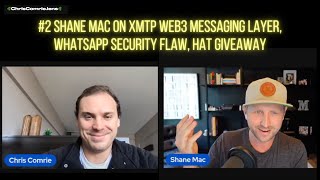
Shane Mac, CEO of XMTP Labs, built a decentralized messaging protocol where wallet addresses are identities and private keys decrypt messages, not apps. Unlike WhatsApp's app-level encryption, XMTP lets any client read your messages if you hold the key. The network has 350+ developers and integrates with Lens, Uniswap, and DAO voting.
Chapters
Hello and welcome to another interview episode. Today we've got Shane Mac, co-founder, CEO of XMTP Labs, which is a super cool project that is powering a lot of what's going on in the Web3 social world. So we're going to talk about messaging, Web3 social, and a bunch of things like that. So Shane, how are you doing? Thanks for joining us.
Hey man, I'm great. It's good to be here, Chris.
Absolutely, absolutely. And for if you're just listening to this, I recommend checking out the video. He's got a sweet hat. XMTP hat on. Um, I don't know if you get those out, but I, I kind of want one.
We do, we do. I'll tell the team to send out hats to anyone who sends me a message, uh, on Converse, which is the app I use for all of my encrypted DMs on XMTP. The link is in my Twitter bio, @ShaneMac.
Awesome, very good. All right, pretty cool, some, some good alpha drop there. Um, so, so Shane, for people who don't know who you are and what is XMTP, Yeah, you know, I'm a technology entrepreneur.
I've been in tech since I was in college back in 2004 or '05 and have always been excited about the ability to communicate with anyone online. Was building on top of the first social networks back in '06, '07, '08, and have been in startups my whole life. Lived in San Francisco for a little over 10 years and just really passionate about the ability to create better communities, better communication, and better ways in which we can all communicate digitally. And XMTP is something about a couple years ago, my co-founder and I, Matt, we were sitting around just looking at this new space, and a couple things happened at the same time that let us think, is there an opportunity to build a Web3 secure messaging network. And usually what happens is a new identity is created, and after that enables communication and messaging to happen. And so the question was, is there a new identity being created, and do people need to communicate with that identity? And around that time, Robert Leschner, who was the founder of Compound, he actually was, uh, he was talking to Matt one day and he's like, listen, I have $11 billion in a smart contract I can't talk to 95% of those people, and I know all of their addresses. He's like, imagine if a bank knew everyone's address and they couldn't communicate with them. He's like, that's a huge problem. And I was like, that's a real— that's a real problem. And so it was clear to me that the wallet address was becoming a new identifier for transactions, people sending things to people. And then the NFTs started happening, and I was like, oh, This is going to turn into ticketing. This is going to turn into identity, how people own identity. This is going to turn into so many different ways that we can own and control our digital data that if it's sent between wallet addresses and you can send $11 billion or trillions of dollars in all of crypto but you can't send an email in a secure way, that seems crazy. And so that really is what kicked off the idea. And I think a couple years later Identity is leading to decentralized social, identity is leading to decentralized messaging, and identity is enabling a whole new use case of crypto that isn't just financial. And that's super cool.
Yeah, I totally agree. So you kind of had this idea in the back of your head for a while, is that how that took off, or did it kind of happen more rapidly?
You know, my last company was a business messaging platform that was the first to bring businesses to communicate with consumers on SMS, Facebook Facebook Messenger, WhatsApp, Apple Business Chat, et cetera. And so I, I've always been working on messaging itself. My first startup, Gist.com, was taking social APIs and data and mapping them together in 2007 to 2010 to build a smart address book that you could know everything about the people you are closest with and all of their identities across all these different platforms. So aggregating identities, understanding more about who you know, building a news feed based on that. And BlackBerry bought that, and I got to work on BBM. So I don't know if you go back and know the BlackBerry days or ever had a BlackBerry, but BBM was really the innovator of messaging. BlackBerry Messenger was the thing that led to the two double check marks for the red states that WhatsApp ended up kind of really adopting. And they innovated on so many things, and that was the new identifier, was the BBM number. You had your PIN back then. And I think working on BBM, being the CEO of a company Assist, and enabling brands to build chatbots and support and talk to people on messaging apps, and now thinking about how do you build a messaging protocol layer, I was really just looking for, is there a new identity that is being created which lends itself to the opportunity to create a new communication protocol? And it became clear after like 2016, '17 with the rise of Ethereum and you saw the Bitcoin stuff happening. And I don't— I've actually been involved in Bitcoin from early on. This guy named Adam Draper told me about it back in like 2011 in SF, and I kind of was in that little SF bubble where I was like, this is cool what everyone's doing. But it wasn't until EVM started happening where you started to see all the developer adoption, different use cases. And then all of a sudden, if people are interacting between all of these different EVM accounts, you know who is interacting with who based on this identity, but you don't know how to talk to that identity. And it became very clear that there was an opportunity here to build the next version of how communication will happen digitally that is driven by a need for it to be decentralized. And I think that was really the shift, was centralized companies— and I've worked with them for the last 15 years— became really clear that them having all the power sitting in the middle of our communication actually has lent itself to a lot of issues, a lot of surveillance, and a lot of things that we probably should change and have a new structure and incentive mechanism by which we build the future.
So for normies, real quick, how does the encryption work? How do you know that XMTP is encrypted?
So XMTP isn't encrypted, and the difference— I'll talk about like what's different, and I think what's different is when you own the application and there's only one application that can access your communication, you don't own your communication. Because the only way to get those encrypted messages, if you use WhatsApp, is to use WhatsApp. So the fundamental shift here is WhatsApp says they're encrypted, and I actually love using WhatsApp, and WhatsApp is encrypted at the protocol layer. But because they own the application where they decrypt your messages, if the device— Apple— or the person who owns the app— Meta, Facebook— decides, or they need to have a key to read your messages, they can get into that application. And so the fact that you have to use that application to decrypt and get to your encrypted messages is in itself kind of— the reality is that it's encrypted at the protocol layer but not the application layer. In this world, the protocol itself is end-to-end encrypted, and the applications— you can use any application, you're not locked into a silo. So if you didn't trust WhatsApp anymore in the XMTP world, you could leave WhatsApp. Your private key is the access, and the only thing in the world that can decrypt your messages is your private key. You can go use a new application and use your private key, access the XMTP network, and you get all of your communication. And so because you can take your communication with you, it's not locked in a silo. You actually can decide who to trust on the application layer or use different types of applications based on their security levels and what they're storing about you, right? Meta stores about you all of your metadata.
Right?
All of it. I mean, that's what they're built on, where Signal doesn't. And so you could choose in the future to use a Signal-like application and get Signal-level security with the end-to-end encryption, if that's what you would choose. Or you could choose to say, actually, the benefits I get from giving Facebook my data to have better targeted ads, it's something that I actually enjoy. So therefore, you could choose to use that. But I think people understanding that and knowing that and seeing what needs to shift here is very important.
So is it fair to say that in effect, even though WhatsApp messages are encrypted, the conversation is not encrypted? Is that fair?
I think you just have to understand that it's encrypted, but at the application layer. If there's a key to the application, which there is, right? If there's a subpoena or request to use and log into that application, whether it's Apple, whether it's Meta, etc., they can access that communication and it is decrypted on the, on the application, on the device.
I see. And then with XMTP, how would that be different than what we have now with, you know, with Converse or, you know, other apps that are going to be built?
So the application layer should follow the local laws which, which they are in, right? So Converse is the team in France. And there will be laws within that that they're going to have to follow, but they can choose what information that they are going to collect about their users, and they can make that public, and they can build the relationship and trust with you, the consumer, just like Signal has done on the application layer. You trust Signal different than you trust WhatsApp because they're telling you and choosing to collect different amounts of information about users. So therefore they actually have a different access level or different information that can be subpoenaed about you. And I think that's just very important to think about. Um, and the private key is very important because if that's the decryption mechanism, not the login— the login is going to a server that they own, the private key is not. And that's a fundamental shift to where this all goes, right? If you're logging into WhatsApp, you're logging into Facebook servers. In a decentralized world, The private key isn't logging into any single centralized company's servers. The private key is accessing a centralized network to get access to my communication, and only I can do that. That's a very different setup for how security and access will work in the future. Does that make sense?
Yep, yep. So my mind went immediately to, you know, So you can have different trust in different jurisdictions and different apps, but you know, like if AI can build your own app, could I just build and essentially host my own app on my own device and not have that risk? Interesting.
Exactly, because your private key is the access to your data. The application is just a viewport, right? And so what we say a lot is we want people to own their communication like they own their assets, right? That's what's happening. The wallet of Essentially is a viewport to the blockchain. In this world, the messaging app is a viewport to the conversational data.
Very cool.
Does that make sense? So that, that kind of changes everything that's possible. And our goal is to make a secure and private messaging protocol to help protect and give individuals more control over their communication.
Very cool, very cool. And then how's it been so far? You know, what is it, what you expected? You know, maybe a little A couple bumps in the road. How's it going so far?
I mean, there's always bumps in the road, right? It's startups. Things are, you know, they wave in and out. But we've set out to— and over 2 years ago now, very, very simply on let's go build a secure messaging network and protocol for Web3. And I think we haven't strayed from that mission at all. And the team is awesome. I think the partners we work with are awesome. The fact that we have over 350 developers now building with the protocol is incredible. Building with the Lens team and all of the apps in the Lens ecosystem has been incredible. Talking to all the other developers— Converse just launched yesterday, which is like a full WhatsApp for XNTP. It's now the messaging app that is literally on my bottom bar next to my iMessage. Right? And I use it for everything. My fiancée, who isn't really in crypto at all, but she gets it— she has a wallet on her phone, she's bought some NFTs. Her and I, like, she has it down there too. And I'm like, hey, let's own our communication and let's use this in the future. And she's like, oh, that's cool, like, that's really interesting. Um, how could I use this for more things? How can I tell people to message me here? And they built in the feature where you can just scan a QR code just like Telegram and WhatsApp and bring your communication over to a platform where you own more of it. And I think For me, 2 years ago, it didn't really feel like a WhatsApp for XMTP might launch. It felt like it was going to be like a browser plugin, or it's going to be some, um, you know, some different, uh, intercom type widgets like it's company Relay built online, or a way for dApps to send messages to all their token holders instead of Discord. And I thought that was super cool, but all of that happened and then a ton more. The fact that like I have a WhatsApp replacement type of app on my phone 2 years later on a decentralized messaging network where when I log in for the first time— I was with someone yesterday who's been in this space forever, literally deep early investor Twitter, and logs into Converse and all of his Lens messages show up and he goes, holy shit, all my other messages are here. And that light bulb of like a portable inbox and you take your messages with you and you're connecting all of these different ecosystems into a single network is so powerful. I didn't think that I would have an app that felt like the most used app on my phone is Apple Messages in the same bar at the bottom of my phone within 2 years of starting this company where it's a consumer-type use case. And that's kudos to the developer community for innovating and building all that cool shit. So I'm just pumped for everything getting built. I think there's so many cool use cases getting built. And now there's starting to be a lot of different content types where you can vote for a DAO, vote inside of a message, you can do a Uniswap widget inside of a chat. And like the idea where your conversations and commerce kind of come together finally, because it tried to do— we tried to push payments into messaging in the past, but because they were separated, they're different identities, different backends, different systems. Now because the private key is the access to your communication as well as your assets, that is starting to shift where I think the idea of a global WhatsApp that can also help with global payments could exist.
Yeah, that's super cool. I'm a huge fan of Paul and what they're building at Converse. And I gotta— yeah, when you first download the app and you open up and all your Lens messages pop in, it's, you know, one of those holy shit kind of hits you in the face moments. You're like, this— now I get it.
Totally. Yeah, I got your messages sitting here in my inbox right now, so I appreciate, uh, you know, you follow me on Lens because I can see that I sent you a note.
Yeah, absolutely. And then, you know, talk about how the partnership with Lens has been. I think that's been awesome for both sides. All the messaging that has come to the applications has been a huge improvement for— from a user. Talk about that.
Totally. You know, we've, we've known them for a long time. I'm a huge believer in new innovative ways to do social, so the decentralized social movement for me is so cool to see new ways where artists, creators, uh, people that want to build a following can actually own it, get value from it, and innovate on it in different ways. Um, and from the moment we like started talking to them, it was clear that the decentralized social mixed with a secure decentralized messaging protocol kind of live hand in hand. And to put that together and really work on that together has been one of the most like exciting and, uh, for me, inspiring things that we've worked on at all at XMTP. And so working with them has been great, but really the community developers around it, you know, I got invited to go speak at the Lens conference in San Francisco and there were 300 people in this room and they're building some of the coolest applications. And to set up Lens and XMTP together in a way where we can enable thousands of developers to create all these types of experiences in a permissionless way. I'm just blown away every day by like the different things people are building, how they're building it. And we're just trying to be as supportive as we can, help with resources as much as we can, and really listen with empathy to know what we're doing wrong. How do we need to get better? How do we need to get faster? Like there are a lot of improvements we need to do across the board and a lot of things that, you know, we need to tweak and work with developers based on what they're saying. Keep getting better together. But overall, it's just been such a cool partnership to be a part of and to watch the Lens ecosystem grow and the momentum they have, and just to be able to be a part of that as the secure DM layer that connects people privately is an exciting thing for us.
Absolutely. And then talk some more about some of the cool ideas that you're seeing being built, and then maybe some ideas that you would like to see be built. And then, you know, some of the things that if somebody is interested in building out one of these ideas, What's the best way to go about that?
Totally. Um, you know, I, I like to start with solving problems. So what I think has been really cool is people going after really specific problems around how do I communicate to all of the DApp kind of DAO holders, or everyone who owns a token, or how do I have a secure DM message I can send out, and you can verify that the message you're sending is from the wallet who they say it's from. Versus in Discord, every single message when you go into Discord says, don't DM me, right? Every time you walk in there, the first thing they say is, don't send me a message, because there's so much spam and so much, uh, spoofing— not even spam, just spoofing happening— where they're like, yeah, this is my wallet, go here, and it's not even the real person. And I think seeing people push the limits on kind of security, identity, and making sure that the message you're receiving is from the support address that you're getting it from. So it's a killer use case. The ENS names, the subdomains go to support.xmtp.eth, and the fact that that can be mapped to a wallet and be verified that you're actually talking to the team at XMTP and the message you got, and you can see what's in the wallet. And also on our side, we can see the person we're talking to and what's in their wallet. So they're not like, yeah, that's my wallet over there, but I'm logged in here on Discord. Like, all those problems come from a disconnection of where the signature and the identity is compared to where the wallet and the assets live. And like, bringing that together is just unlocking tons of use cases. The other things is doing on-chain activities inside of message threads. So we're starting to see a ton of content types around this. We have people building little yes, no, maybe vote buttons that can send a vote on-chain for a DAO governance. Or like I said, the Uniswap widget where you can do swaps inside of a message and I can say, can I, let's just convert that ETH to USDC and it pops in a Uniswap widget right inside of the chat and you can make a Uniswap interaction. Like it's so cool to see stuff like that happening. Payments also like a huge use case. You saw someone do loans the other day and they were literally sending loans back and forth through the conversation because you build trust through the conversation, but then to be able to execute it right there as well is just such a powerful idea. And all the other stuff we see around Lens and you see it around different social networks using it for messaging, Converse kind of doing a WhatsApp use case, the amount of use cases happening and the uniqueness and coolness of 'em all is pretty unbelievable. It's been cool to see and cool to watch. It's amazing what can be built by a group of developers when you align the interest and the incentives to a future where, you know, you can't get rugged, you can't get the API cut off, you can just use the SDKs openly. And we're just super excited about investing more in the developer community and those relationships going forward.
Yeah. And then are there any specific use cases that you're like dying to have somebody build that, you know, if a developer can't think of an idea Oh, we have tons.
You should go to xmtp.org. There's a whole discussion going on always around use cases in the Discord, things people want to see, awesome projects we're highlighting, uh, and we'd love to kind of have the conversation with the community to talk about those because there's so many different ideas that we'd love to see. I don't want to sit here and kind of rip through them all, but we just love people to kind of join the community and come, come spend time with us.
Absolutely. And then, you know, XMTP and Lens are kind of in the same boat here in that, you know, we're both trying to break through into the mainstream. You know, what do you think it's going to take for XMTP and Lens in kind of Web3 social, decentralized social, decentralized messaging to break through?
Crypto has to get a lot easier to use. We have to really, really work on the user experience. The perception of crypto, the token go up kind of nonsense of the last few years. We have to rebrand and recreate this idea that you can own something digitally. We've spent the last 15 years of our lives putting all of our digital lives online and giving up the ownership over all of it, so we don't reap any of the reward or benefits for it. But that's not being felt from people today, right? That's not being clear in how we're thinking about what's about to happen here, um, and finding those killer use cases. Is it ticketing actually on-chain, and it's gonna be something that Ticketmaster adopts and everyone has an NFT in their wallet and Apple and Google Wallet adopts a wallet address and adds it to the iCloud like your phone number and email is. So now that you can actually accept digital items right inside your Apple iCloud that sits in your wallet when you double-click on your phone and now you're using it. Now I used a ticket that's an NFT, but I didn't even have to know it. Like these things have to happen at the application level. To make this shit easier, simpler, impact people's lives better. And our products even have to get better. Like, what can we do to enable use cases that weren't possible before, that are better for people, that change and improve their lives? That's what has to happen in this space. The whole, like, just like— I feel like it's almost celebrated of how difficult crypto is sometimes. It's like, yeah, I could figure it out, so therefore, like, I feel good about crypto. That's got to go. Right? We have to make this easier, we have to be more helpful, and we have to build use cases and get the adoption of the major players and the application layers that people truly love, enjoy, and want to use these products, and they make their lives better. We're not there yet, and I think we have a lot of work to do to get there, um, but the underlying shift where then you end up with thousands of developers building incredible applications on top of decentralized protocols that have the incentives built in to drive a sustainable and long-term, like long-term ecosystem is gonna change the world. Like that's a huge, huge idea that changes the power dynamics of how all these centralized companies run and control all of the networks and data. That is the shift that's happening and it's gonna be a decade-plus long shift and I think you have to think in that long of term to really go after this space. But the use cases and the account abstraction work and all the things happening right now are the underlying infrastructure to enable this to happen. But we gotta, we got a lot of work to do to create the experiences that are gonna make people's lives better so that they're excited and it's easy and it's understandable. And there's something that crypto can do to your life that is not just financial.
And then, so in more of a short term, obviously in a decade, you know, too, what, what can we expect from the future of XMTP in the short term?
I mean, right now we're kind of there, right, where you can use it. It's actually pretty good if you've used the Converse or any of these apps. It actually works pretty well. And I think starting to see creators and artists and people use these tools so that they know they're going to own their network in the future, bring people to them so they know they can always have that relationship and never have a centralized company in the middle of it. I think that's already happening. So in the, in the next 1 to 3 years, I mean, our goal is to be the communication network for Web3, and we want to make sure that the entire network is reachable via XMTP. And that includes getting all the wallets involved, that includes getting all the dApps involved. That includes getting all the marketplaces involved. And we're working really, really, really hard to make sure that that's true, so that if you want to reach an address in Web3, the best way to do it is with XNTP. In the future, I think it's even bigger than Web3, but I think we gotta nail Web3 first to be able to really get into where that goes.
I think the app ideas are interesting, um, And I think people are severely underestimating the impact that being able to message people will have. You know, like, for me, XMTP is, you know, it's messaging. But I think people, when they think messaging, directly go to text messaging and don't think about how much, like, email is used. Like, you know, what are the applications if you have, like, an email type? Or, you know, whether you're a brand or, you know, a creator like me having direct access to all the people. Like, if I could, you know, mass— I mean, I've got, I don't know, 7 or 8,000 followers now on Lens. Like, if I can shoot a message to every single one of them saying, here's my new awesome interview with Shane Mac, the superstar from XMTP, uh, I mean, I think people are underestimating the impact that that could have.
You can do that today, for what it's worth.
Uh, but there's not a great app that makes that easy to do. You know, like I can't message— well, I got a friend working on something, but, um, you can't message— like, I couldn't message all 8,000 of my people right now that I could on something like MailChimp, right?
I can send you a tool for it, actually.
Okay, that's cool.
Yeah, all those are getting— all those are getting built.
Let's talk about hot topic. Lots of bots, lots of spam, like lots of cyber attack. How are we going to deal with spam on XMTP? I—
this is the thing I'm most excited about. After spending almost my whole career in— from email to social to messaging— the opportunity to move from this like private spam filter world where Google's black box is what's controlling your email to an open consent world where if everyone's wallet address is public, right, so the address is public and the identity is mapped to it, um, can be seen on the blockchain, then spam could go crazy. But now you have a public data set and an open pixel that you have more information about individuals' wallets, what they own, what communities they're a part of, who's sending you a message, past interactions you've had, past interactions they've had with people who know you, etc., etc. And what's interesting is I think we're going from a privacy world where all of the communication data was held private— email and phone numbers, etc.— to a consent-based world. Which is we need to innovate on the consent model by which senders can send people messages. And if you think about the start of this, on-chain data now enables you to say, okay, if we both own the same token, skip the request box, land in my inbox. If we both have the same identity and we've interacted on-chain before, let the message reach my inbox. If we are using the same application and we're in the same group, let the message hit my inbox. There's all these new mechanisms with tokens, on-chain interactions, and on-chain data to allow us to start building a consent layer that you think about the request inbox, right? A way to basically skip the request inbox and be in the main inbox because there's a pre-existing relationship or trust built within that. And you could also see where this could turn into economics in the future, where end applications could control 1,000 messages. Say I want to send 100,000 messages to Brand, there could be a dynamic fee at the protocol level that would say, hey, to reach all of these wallet addresses, here's the consent mechanisms of whose inboxes are even reachable at all. And then for these ones, there's a fee that it costs to reach all of these people's attention because you're going to be sending them all a message. And you can imagine each single address could have a dynamic fee, much like you send messages today on MailChimp. But in that future, economics could play into this as well. And so there's all these new consent mechanisms by which senders could reach recipients. And I think what's new, or what's different, is we'll have to innovate on a ton of spam like we always have at this— at the protocol and server level, based on people doing DDoS attacks and all these other things around the just mass sending of messages. But at a consent level, people will be able to control the filters by which who can reach their inbox, which with much more granular data than we've ever had before. And I think that's like a super powerful and big change that wasn't possible because you never knew who this email address was that was sending it, um, or where this random SMS number is coming from, uh, because there's not a lot behind it. And so I'm just really excited by the opportunity to actually create more meaningful interactions of people's attention based on new ways to enable consent mechanisms and control over your inbox using on-chain data and more information from the wallets.
And the fees you mentioned, would that be considered like a sender's fee, like because they're gonna have to go on-chain and pay gas for it? Is that what you meant?
No, that would be like a protocol fee. To reach that person's attention.
So like, if you wanted to reach them, form of advertising, less like gas or postage fee?
Not advertising. So more like on WhatsApp, they have a way for businesses to reach out a day later and send a message, and you have to pay to send that message. But that's a very basic level of interaction because you just have the, the WhatsApp phone number and then the Facebook data. But if you were able to actually do this at scale, you would be able to think about a brand actually having per wallet address pricing in the future and the ability to choose who they wanted to message. And if that person set up the consent where they wanted to be messaged, they're like Sure, I will accept messages from different brands if we have the same NFT, if they're part of the communities, or if they have economics attached to it.
Interesting. Yeah, that, that's super cool. In my mind directly went to like Lens followers, for example, you know, like if, if we both had the same follow NFT of a profile, or, you know, exactly, and/or a creator wanted to, you know, some monetize or partner or something like that, was exactly what I'm fine with.
Totally. I think there's so much opportunity because the follow graph is now on-chain, right? And so all of these things are just different mechanisms by which on-chain data can be used to enable a better consent of who can message you, which is kind of where it scratched the surface today, right? Twitter, if we both follow each other, then the DM is default open versus default closed. Like, that's a basic, basic level, but that's just for Twitter and that's just for the follow graph. And I think if you take that out of what are all the new datasets we have or interactions we have, the, the ability to innovate on this is huge.
Yeah, that's super interesting with the community too, you know, like for example if we held a similar NFT token from the same collection, how you could enable that. That's pretty cool. I hadn't thought much about that.
Yeah, and that's very research and exploratory. Like, we don't— we're not trying to run an ad network. We don't want that to be a thing we do. We're really trying to say, how do we help create more meaningful interactions for the end recipients? How do we help create a better way for people and individuals to own and control their inbox? And I think the consent mechanism and all the different layers that it could be, from the application layer, identity layer, token layer, and economic layer, are a lot of things to think about that can create new ways in which to create better relationships.
And so the way that that decreases the spam is basically it's more of like an opt-in relationship.
Exactly, exactly. It— that's the, the language that really matters is it's creating opt-in relationships versus opt-out.
I see.
And so the spam The spam inbox will still live in that request folder, right? There's tons of work to do to be able to filter through that, prioritize that, understand different, uh, malicious attacks that are happening. Like, there's a lot of work to be done on spam. This isn't a solution to spam per se. This is a new mechanism by which to create better relationships and interactions with an opt-in mechanism because of the nature of Web3.
Interesting. Here's kind of an off-the-wall question for you and requires a little bit of future predicting, so bring out your magic ball here. But if XMTP is the primary messaging protocol and different apps can build on top of XMTP, similar to how we're seeing Lens apps with, you know, LensTube, and then, you know, you've got Orb and Favor, and they all are pulling same data but displaying it, or most the same, they have access to the same data, they're not necessarily displaying it all. Could you see a world in that, you know, if I had like my email app might be different than my Converse messaging app even though they're both using XMTP? For example, like I don't want anyone on my personal phone number, I don't want any brands or anyone texting me, right? It's like I got a dozen people that I want to text me and like everyone else I don't. But like email, for example, like I'm okay accepting a cold email, you know, from somebody that might be trying to get a hold of me. Do you see a world in which different apps are kind of built on top of those different use cases.
100%. I think if we go to be a global protocol for messaging and communication, and there's all these different types of use cases, every app or use case could have different consent mechanisms that I want and different control over that identity versus a different one. Um, but also you think about like account abstraction. So some things I want my bank to have the data, and other people— other times I don't want people to have the data. So that's where like the ZK proofs start coming in. And so all this like infrastructure stuff that's getting built where I'm going to be able to control what has access to my attention and my data on a per-interaction basis from the same identity, or one account is actually obfuscating 5 other accounts because they're all connected so that you can prove that you own this other wallet but you can't see which one it really is. But that complexity is going to have to be managed, simplified, and done at the application layer. And with all of the kind of protocol changes happening right now, um, in the industry, I think like that stuff's all going to be possible and how it's going to work, but the, the amount of work on the UX side to make that usable and simple and understood is, is a huge, huge task.
Yeah. And so do you envision more of like a super app, right? Like a WeChat like China has kind of being built, or do you imagine still different, like, siloed apps, if you will, if you can even call them siloed? This is speculation, you know, like asking you to predict the future here, but I, I see it all.
I don't, I don't really know. I, I really think that, like, people have really different preferences here. Some people love a single inbox that maps all their email to one, and then they have a great filtering and label system. Some people really keep their lives different silos and different, separated in different apps for different use cases. Um, Most people I meet though hate that they have 13 messaging apps on their phone with 13 different identities and 13 different networks and 13— when they all kind of feel the same, right? So for that use case of peer-to-peer messaging, I feel like it would be a better world if I didn't have 12 different ones. If I had secure peer-to-peer messaging and I could access all of them from a single app, that feels like a huge improvement on the world, um, and something that people usually relate to where they're like, why do I have 15 messaging Yeah, and you never know which one to message them on. Totally.
Well, cool. Is there anything else you want to jump into here?
No, that's awesome. Thank you very much for all of your support. And, um, there's nothing I can ever do, let me know. And I'm Shane Mac on Twitter, I'm Shane Mac on all the other platforms as well, on Lens, on Lens, on Linster, um, on Converse. You can message me, ShaneMac.eth, uh, and xmtp.org. We'd love to work with you and build with you. And if you're a developer and you have a question, join our Discord. We're in there all day.
And then real quick, how to get the— how to get a sweet hat?
Message me on Converse at shanemac.eth.
Cool, awesome. Well, Shane, it's been a pleasure. I really appreciate it, man. Uh, for everyone, thank you, listen to us, thanks for joining, and then we'll see you in the next one. Bye.
More from Shane


Sold His Company for $50 Million, Now He's Changing Messaging with Blockchain - Shane Mac - ECS EP35
Sharing the triumphs, trials, and invaluable lessons of being a founder with Shane Mac
Decentralized Messaging: Changing the Game | XMTP (Shane Mac) | Builder Series