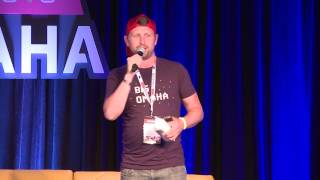
Shane Mac speaks at Big Omaha 2015
Shane Mac traces how a Twitter typo led him to mentors and a seven-year obsession with curiosity as the engine of innovation. He explains the neuroscience behind it: creativity requires changing how your brain perceives things, which happens fastest in environments that celebrate uncertainty and remove judgment. Big Omaha's design of bars and dinners does exactly that.
Questions this video answers
Shane says he’s good at assembling the right group of people in the same room and influencing them, especially around networks and why people join missions. His worst traits are flossing (jokingly), moderation, and pacing himself – he tends to work at 140% speed, leading to burnout.
Shane admits he doesn’t have a definitive answer but suggests focusing on convincing people to join the mission even if you can’t pay them. He notes that funded companies have different budgeting concerns and points to bootstrapped founders like David (DH) for better guidance.
Chapters
Hello! Hello! Can we stay standing for a second? It's getting late in the day, and I want everyone to turn around and give them a round of applause, because Caleb, And Jeff and Dusty and everyone involved with this big Omaha crew is incredible. Uh, hi. I just kind of ruined my entire reputation in the last panel. Uh, I— and it's also hard to come up here sometimes and you are like, what am I going to say? I don't really know if I have anything valuable. Can they get away? And I don't want to be like a preacher and like, you should do this. And so for me, it's just about sharing the last 7 years of my life. And one thing I wanted to say about the music, the reason music is important to me is because it's actually how I got into technology. And my dad was like, go to college, music's not a career. My dad's here, so I can say that. And I went to college and I got a finance degree. And then I played music and the guy was like, you need to make a website. I was like, all right, I'll code it. And I learned how to code. And I built it. And then I got out of college, and there were no jobs. And this lady called from Seattle, and she's like, hey, did you build this website? And then like 3 hours later, I'm like, yeah, I built it. I learned how to code. I kind of like made the website. She's like, yeah, move to Seattle. We'll offer you a job. It's like twice as much as you make now. And I was like, do you want my resume? She's like, nah, it's cool. I'm like, what the fuck did I go to school for? But anyways, that's why I got into it. But today I just want to talk about one thing and share the story of like what I would say is my most personal thing and what I think is now my life's mission. So first off, this photo, this is Caleb texting me worried about my hat photo. So he's like, you're speaking at Big Omaha. Hey, this makes you look fun. I just threw him some emojis and here we are. I just had to throw that out there because I laughed out loud. I was like, is it bad to look fun? It all plays into the thing. This is me. This is my mom and dad. As a kid, the reason I wear hats is because my hair looks like my dad's. I grew up in the Midwest. I'm a Midwesterner. I love the Midwest. And then this is my grandpa, and that's me again with him. My grandpa was an interesting guy. He was a small-town guy. He knew it all. Hardass. He owned a river campground, and if you trespassed on that campground, he literally chased you out with shotgun shooting. He's just like, "Get off my fucking property!" Pow! Just like, whoa. And I'd be like, "Grandpa, is that illegal?" He's like, "Don't ask questions, son." OK. So I quit asking questions. And then you go about your life, and then moments happen, or one person changes your entire view of what you think is true. So for me, that was 7 years ago. I moved to Seattle. My brother was always my biggest critic and my biggest influence. And he said, "You think you know it all, and you have a fucking ego." I was like, "Oh, shit." And he was right, he was really right. And I had this like, "I know how to do everything, I know how to get it done, I'm smarter than you, I'll figure it out." And it stuck with me, but I really didn't know what to do with that. And then 7 years ago, my entire trajectory and path in life changed because of a tweet. This is the tweet. And it's ironically me trying to hit on a girl, terribly. And I spelled coffee wrong. So this girl Kate says, "Get on Twitter." And I was like, "What's Twitter?" And I saw her talking to Jen. And I clicked on Jen. I was like, "Wow, she's really pretty." I was like, "Wait, I can text any girl in the world? Like, Twitter makes so much fucking sense." And at the time, Twitter made no sense to anybody. And I just chimed in, being my overly confident self. I was like, "What the heck? Where's my coffee?" And she wrote, "Anytime." And I was like, "Holy shit, this is like online dating." And we had coffee. And I told her about my views on how social networks were gonna change things. This was 7 years ago. And I was like, "You know, we're all gonna be too connected. Twitter and Facebook and LinkedIn and Calendar and email and SMS." How do I know in 7 years who matters most, who matters now? How do I know who to follow up with when all these connections just keep growing? How do you have any depth with all this breadth? She's like, you gotta meet this guy named T.A. Alright, so I meet this guy named T.A. T.A. sits down with me, we have beers one night, we end up talking for 4 hours. And I think it went something like this. We worked, I like rebuilt his product and sent him over a bunch of feedback for a month. He was working on an idea called Gist. And he said to me, you don't know anything about this industry. You don't know how to raise money. You don't know how to build teams. You don't know shit. But you're really passionate about it. And you kind of think you know it all. And that moment for me, when I met him, who was a pretty successful guy, 20 years older than me. I mean, he was Paul Allen's partner in the day. He's like, yeah, Paul Allen's my seed investor. And I'm like, the Microsoft dude? Aren't you the dude, like, richest in the world? He's like, "Yeah, Paul." I'm like, "Oh, weird. That's weird." And then it really hit me of like, I don't know anything. And I grew up my entire life thinking I knew everything. So my entire mission the last 7 years, I didn't even know it till today, I just started asking people questions. And not business questions, 'cause I think business questions are kind of BS. And if you have great mentors, you know, you can get advice and help. But I was like, I wanna know personal questions. Like, "T.A., you know, what's it like being a dad if you're never home and you're an entrepreneur?" And I just started asking people questions. And I asked this guy David Spinks a question. Ironically, I met him on Twitter. And he gave me— he was always very vulgar and outspoken. It was the first person I did, and I posted the interview online on YouTube. And then I just kept asking people questions. I've interviewed a lot of the speakers that have been here. And then every time I got off an interview, I learned something that I either thought was something different in the past or that I never knew. And it just was a self-perpetuating thing of the more you know, the more you realize you know nothing. A very humbling experience. And it became a movement. The last 7 years, I just started asking everyone questions. I did dinners, I started a notebook line, Everything about my life became about asking better questions, asking personal questions, asking harder questions. And then you realize that we're all just the same. I'm sitting here with, the top right there, my last ass-sitter is the host of Mythbusters. And I'm like, you know, the day I contacted him, I had no idea who he was. We were at this event together. And I saw there was one dude with an AOL email address, and I emailed him. I'm like, you really have an AOL email address? And then I looked at the little report of thing, and it was like 400,000 Twitter followers. I was like, shit, who is this? He's like, "Oh, it's the host of Mythbusters." I'm like, "Oh God, that's a dumb email." He wrote back with an emoji and said, "Ah, smiley face." I just kept asking and kept asking. T.A.'s in the middle there. He's become my biggest mentor. He's one of our investors now. All I realized is that my life's mission is curiosity. I believe curiosity I'm gonna say a bold statement. This conference is about innovation. I'm gonna say curiosity is the core of all innovation. When I started asking these questions and building these better relationships, and all these doors started opening when I stopped being the guy who knew it all. And then now today, I was like, "But is there something more?" So then I became obsessed the last 7 years of the science of curiosity. Does it actually work? How does it change things? Can you actually optimize for it? Can you make it better? Turns out a lot of neuroscientists have studied this. And so this guy named Bo Lotto did this entire thing, it's one of the most fascinating things on innovation. So I took a lot of that research and I put it into the context of curiosity. So this conference is about innovation. The only thing I want you to get out of this is if you can bring curiosity back to your life and your company. And so what you do is when you break down things you say, "Well, what is innovation?" Innovation is simply creativity that's shipped, as Steve Jobs would say. If you break down creativity, creativity is solely based on your perceptions. What are your perceptions? Perceptions are statistics in the brain that run these little things, and they try to figure out what things are. You know why this is the most fucked up thing ever? It's 'cause I feel like I'm drinking milk. Right? It's not water. But your brain is like, "It looks like a milk jug. Probably should taste like milk." And you drink it, you're like, "It doesn't taste like milk." It's kind of like green ketchup. But your brain does all these statistics and it tries to figure out what to see and what is it. The reason this is a stage is because it sees things in the past and it realizes what it is today. But innovation isn't about the past. So what are we actually seeing? You're only seeing the past. So when you break down the science of innovation and you think, "We're only seeing the past," then the question becomes, "Well, how do you change your perceptions?" The research is all about this, and this is what fascinates me, and companies never talk about it, but every company in the world wants to be innovative. It's how you live, it's how you survive, it's how you grow, it's how you change. Innovation is at the core of everything we do. So the best questions are about the most uncertainty. They're hard to ask because they make you really uncomfortable. So he argues that evolution's solution to uncertainty is asking hard questions in the right environment. So it's actually more about the environment. What does that mean? A place where you celebrate uncertainty, you have no extrinsic judgment, you're not intrinsically motivated, and you encourage diversity. As scientists say, a state of play. A state of play is the single best way to ask hard questions of your perceptions and change them, and no companies do this. They go into a boardroom where they just fired somebody and they try to be innovative on a whiteboard. Or they go around the office like, "We should be innovative. Let's go think of ideas. Let's go sit in the office we sit in every fucking day that is kind of like, you know, maybe it's not the most inspiring place or it's not new. You have a lot of baggage. This is where you do project management." And so play is the first step before asking the right questions. Why don't you go for a walk in somewhere you've never been? And then challenge yourself? Why don't you go play basketball with the team? Why don't you do sports and recreation, but actually think of it as a process of how you do product and innovation? And if you take it really seriously, I truly believe that if innovation is just creativity that's shipped, and creativity comes from changing perceptions, and changing perceptions comes from asking questions, Only when you're in a state of play, the science on this is fascinating, then curiosity actually is the core of all innovation. What's really amazing about Big Omaha is that it's exactly this. No one's here selling shit. Like, no one's here, it's not slimy. You go to like some conferences and it's terrible and people are just forking business cards. They've set this up so that most things Happen at the bars, they happen at the dinners, they happen upstairs, they happen in the side rooms. That's how things happen. And this is like the epitome of it, like they've nailed it. And it's the reason why this thing is so amazing. I have a funny story. I was here 2009, I believe. This is me looking like a clown in a pool. First off, electrical and pool, idiot. And this happened because of Big Omaha. This is Tony Hsieh's house, the CEO of Zappos. And the way that we connected was next door to here at a bar. Tony likes to drink vodka. Me too. And he walked up and said, "Do you enjoy running?" I was like, "No, I hate running." He's like, "It's 'cause you run too fast." I was like, "What?" He's like, "Run slower." And I was like, "What do you mean?" He's like, "If you run really, really, really, really, really slow, you'll enjoy it." I was like, "What the fuck? I don't even get this shit. Where the fuck did you come up with that?" And I like, it stuck with me so hard. And then his assistant came up hollering, and we became good friends, and then he called and he's like, "Will you come play our Fourth of July party for the Zappos thing?" And it happened at a bar here, because he told me that I should run slower. Which is completely counterintuitive to everything I've ever heard. I'm just like an all-in guy, and I'm like, "I'll just sprint it out and do a marathon and then die halfway through 'cause like, didn't train." But that happened because of this place. For me coming from the Midwest, and Big Omaha being literally my favorite conference ever, to going from a tweet to starting a company to selling it to joining another, to moving to San Francisco and doing— and then now being full circle, it's one of the coolest opportunities, and I feel so lucky to be up here, and I'm excited to see who else in this audience is up here next year. But it all happened because they optimized for this. They optimized for a State of Play. They let you just be personal. They let everyone be real. No one has an ego here. It's actually kind of humbling and amazing how awesome everyone is here. And when I started being obsessed with questions and my whole life kind of drove around it, and Assist is very, very big on answering people's questions. My co-founder came to our ass dinner and it all just kind of like, the whole thing ties into personal, business, everything. It just became my life. Then I was like, is it bigger? And I was like, is curiosity the core of finding world peace? This one I have no science on, it's just my opinion. But the media tells me when I watch it— I don't have a TV. Funny story, my brother, I moved to Seattle, he tried to challenge me and tell me I didn't need a TV. Told him he's crazy. Had my TV my whole life. Brought this huge TV, my dad and I drove from Illinois, had it in the back of the car, we had to move our seats forward to fit this damn thing. It's like one of those tube TVs. I go to work, I come home, it's sitting on the front porch one day. I'm like, "What are you doing? That's my favorite thing in the world." He goes, "Sold it on Craigslist for free." I was like, "What?" And I got rid of the TV. And then he's like, "Get rid of your car." And I got rid of my car. And like, he just always challenged me. So I don't have a TV, but when I watch the media, it portrays this in the world. War is happening, people are terrible, everyone's dying. The world's a terrible place. There are like a few terrible individuals that you can't stop them. They do very bad things. But I think most people in the world are just incredible. And if you look at the statistics, this is from a book that Bill Gates recommended that is the Angels of Our Future, Better Angels of Our Future. The stats on crime have fallen so much in the last 50, 60 years, it's just the media blowing shit up and making people hate everyone else. And for me, when I saw this, and I started thinking about curiosity, I was like, "Well, how does and does curiosity actually play into this, or is it something that could be much bigger?" And when I look at things, like the world, and I start mapping people on a map, and I realize that technology has enabled us to talk to anybody in the world almost. That's what I think its purpose is. Technology has allowed us to connect and understand. In real time, we can translate. We've never been able to do that before. I think a lot of the problems in the world just come from we don't actually understand each other, and now we can. But when I look at people's faces, and I look at families in all the cities in the world, They all are just looking the same. They want to be loved, they don't want to die, they want family, they just want to be happy. And if technology is the vehicle to connect everyone in the world, I think curiosity is the thing that will allow us to have enough empathy to be open-minded that everyone doesn't need to be like us. Because underlying, we all want the same shit. And I want my sole mission to make the world a more curious place. I'm gonna do questions, 'cause I really, obviously, and I would love to know what you wanna know. Being on stage, I just wanted to share this, and I would really just love to do Q&A for a while and shoot the shit, 'cause I don't know what you wanna, you wanna know. If you wanna talk about fundraising or hiring or raising money or selling companies, whatever you want. Or personal stuff, like why don't I have a six-pack yet? Don't know. Been trying for my whole life. That's why I actually play music. The guitar hides the gut. That's great. But I just want everyone to come away with one thing and just stay curious. I think if you take curiosity back to your life, to your company, You go all in on it. It's a lot better to be the person that's curious than the know-it-all. Thank you. Hi there.
Hi. Hi. My name's Megan, and I liked what you said about being— Do you always have a raspy voice? No, I lost my voice, y'all.
That's what happens here.
But I liked what you said about being curious about finding out about people right from the beginning, because when I talk to people in business that I admire, like you, like a lot of the speakers here, like a lot of the people here, I just kind of want to know about them and their lives more than like, what do you think I should do? You know what I mean? So I was wondering what you would say, what are you the best at and what are you the worst at that you've learned?
You're drilling me. I don't know. I think I'm decent at assembling the right group of people in the same room and convincing them to do that. Yeah, I mean, I'm like so obsessed with the networks and how people are influenced and why they join and why they say yes. How do you get people to wanna join your mission when it's your company or whatever? I think I spend a lot of time, a ton of time, I think of it as work, like managing your network is a ton of work. And the way you do it and the way to influence it, I think I've done a decent job of that. And what I'm the worst at, oh man, my dentist would say flossing. They're so fucking mad at me right now. She calls me like once a week and just yells at me. I don't know, I wish someone else could answer that. I feel like a lot of things. I'm the worst at moderation. I think like if you're gonna do the long game in life, you have to slow down and really like pace yourself, and I'm really, really bad at that. I'm like 140% speed, can't stop, and then like burnout. And I'm really bad at it. And I'm trying not to be this time. I'm trying to have a different kind of culture. And I'm one of the youngest guys at our company. And a lot of the people there have 3 kids. And they have a wife. And I have none of that. And so I'm trying to be aware of that and not be the guy that's like, we need to work till 9:00 PM. Because I truly don't believe more time equals more output. So just trying to be really, really aware of that and create an environment that's not this overly intensive, like, kill yourself. Because if you're going to do this for 5, 10, 15, whatever years, You gotta kinda pace yourself, and I'm really terrible at it.
Hello. Hi, my name is Sarah. I just had a quick question. You seem to have started a couple of businesses now, and you seem to be very successful. Can you expand a little bit about, like, budget-wise, you know, obviously starting a company, you have a very small budget, and you have to do the most with what you have. Where would you say is, like, the best investment to start if you have such a small amount of money to work with?
Are you talking about raising money or your personal money?
Like your personal money, would you go for a great website or would you spend more money getting the word out about your company or where would you divvy up the most of your funds?
Honestly, I don't have a good answer to that. I got to work alongside two of what I think the best CEOs. I got really lucky to meet TA. Bo Adzarli was incredible. I've only worked for funded companies. We raised $1 million seed round at Gist. Brad Feld actually led our A round. Who was here yesterday. So it's good to see Brad again. Zarly, like we raised $1.5 million and then we raised an $18 million Series A and then another Series B. And like budgeting for funded companies I think is way different than that. I actually love that. The guy to ask is David. So DH is bootstrapped Grasshopper, no funding, crushed it. He would be the one to ask. I don't have a good answer, 'cause like funded SF companies are delusional, kind of, of like the amount of money and valuations and stuff. And I don't like, you know, we pay salaries, they have health insurance. Like you raise money to be able to hire people. So the answer would be just try to convince as much people to join you, even if you can't pay them. Uh, would be my answer. No problem. More questions? Someone's got one. Stand up. No? Alright. The next speaker is amazing. One of my best friends speaks so highly of him. And I wanted to say thank you all very much. I'm here tonight. Please say hello. And stay cool.
More from Shane
Sold His Company for $50 Million, Now He's Changing Messaging with Blockchain - Shane Mac - ECS EP35
Sharing the triumphs, trials, and invaluable lessons of being a founder with Shane Mac
Decentralized Messaging: Changing the Game | XMTP (Shane Mac) | Builder Series