Shift AI | A new communication paradigm with XMPT CEO Shane Mac
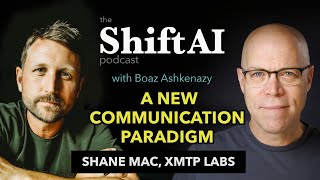
Shane Mac, founder of XMTP, discusses building remote-first companies and replacing office perks with virtual assistants. He explains how XMTP enables wallet-based messaging across Web3 and traditional platforms, and argues that privacy and better user experience, not just security, will drive adoption.
Chapters
It feels like technology is abstracting all that away. Everything's remote, everything's automated, everything's AI. We're all addicted to devices. And I think we have to get to a world where we realize the goal of all that is to spend more time together, to be more personal, to be in person more, and to actually use all of these tools to allow us to drive more personal interactions, personal connections, and personal relationships to all of us.
Hi, I'm Boaz, and I'm the CEO and founder of Simply Augmented, and I'm the host of the Shift AI podcast. I'm super excited that you're here. Shift is a show that explores AI and ML and the changing workplace in the digital age. So thrilled about our guest today. Today's guest is Shane Mac. Shane is one of my favorite people. He's an amazing entrepreneur, and I'm really, really excited to talk to him today. If you're someone interested in AI, messaging, startup culture, you're going to love this episode. It's really great to have Shane on the podcast. I can't wait to talk to him. Let's get to it. All right, Shane, welcome to the Shift AI podcast. Thanks for joining today.
Thanks for having me, man. It's great to be here.
Yeah, I'm really excited to talk with you. So, you know, I want to start a little bit and cover just some of your past. The way that I like to do it on the show is I'll read it to you based on what I know, and then you can correct me and we can fill in the blanks. Does that sound good?
Sounds good. There's probably a lot to correct.
So, um, after getting out of university, you moved to Seattle and you started working at GIST, and after GIST, moved to San Francisco to work on a project called Xarli. And from Xarli, after that experience, you moved on to doing your own project, Assist, which was sold and merged with another company and then acquired. And then more recently, you've gotten involved in your newest project as founder, which is XMTP, that was funded, venture-backed company in the blockchain space, and you guys are going full bore right now on that project. Is there anything that I missed work-wise along the way?
I would say the one thing that I co-founded while I was at Assist was actually Squared Away.
Oh yeah, Squared Away. Can you talk a little bit about that?
Yeah, so Squared Away is a platform to hire military spouses as executive assistants or personal assistants. And when when I was at Assist, we went remote first in 2014. So way before it was kind of accepted to be remote, we did it as a way to hire people out of Twitter and Airbnb and Facebook and Google and Apple and let them leave San Francisco or not have to commute down to the South Bay and work remotely. And so designing a remote culture, how to communicate, how do you do it well? How do you treat people equally who are in the office and not in the office? Like all these things that kind of, you know, everyone's had to learn in the last 3 years, we were doing a decade ago. And when I started to realize that when you have people who are in an office, but also half the company's not in an office, there's so many more things you have to think about around equality and fairness and perks. And if everyone has free lunch in the office, but the people at home don't, well, how do you start to think about what your benefits are and what your like, kind of beliefs are around treating everyone fairly, everyone who works here getting the same benefits. Um, and so we started thinking about perks and benefits and culture from a, um, an individual that has to work for everyone level, not an office level. And that was a big shift. And at the time, this idea I had was, what if we gave everyone a personal assistant that was virtual instead of free lunch at the office? And even the people at the office were like, Yeah, that'd be awesome. And so free lunch was actually really expensive. Twitter, Facebook, everyone else had it. So, you know, we were a startup. I wasn't going to have a better lunch than Michael Mina restaurant in the Twitter headquarters. But everyone thought that a personal assistant would be higher value to them. And so I was like, interesting. Yeah. So I called Michelle, who was my assistant at the time, actually. And I found her on this platform called Zirtual, which is a virtual assistant platform. And What's interesting is she, when I called her, I was like, she's a military spouse. And I said, do you have any other military spouses that are also wanting like remote work, but legitimate remote work? Because a lot of like outsourcers work from home jobs on the internet back then, a lot of kind of scammy stuff. And a lot of it wasn't real. And she's like, Shane, 700,000 military spouses are in the United States. 300,000 are unemployed. It's the highest class of unemployment in the United States at 30%. And I was like, holy shit. And she's like, what if we could really just employ all these military spouses? So I wrote an article called Let's Get Real About Perks in 2015, I think. And I kind of took a stab at free lunch and beanbags and skee-ball machines and ping-pong tables and kind of startup culture. And thinking about how do you make people more productive? How do we make a culture that is actually not about everyone staying at the office till 10 PM? It's actually about getting great work done and going home, having a life, being more of a mature startup, not like you feel bad if you leave and the CEO's sitting there till 8 o'clock in the startup office kind of like with everybody. And so I just sort of really started to try to think about that. And I called her, I said, hey, I want to give everyone a personal assistant, one assistant for every 5 employees. Do you have some people? And she's like, yeah. So I wrote this article, we did We did it. Everyone loved it. What's interesting is everyone started emailing me and all these founders and these VCs, top VC firms are like, who do you use for that military assistance service? And the truth was we didn't have a company. It was just Michelle. And I called Michelle. I was at South by Southwest. I'd had a few cocktails at the Four Seasons. And I remember walking out and I called her and I was like, hey, we should start a company. I'll be your co-founder. You should be CEO. I'll help you. I'll bring us all, you know, I'll think about the customers we can bring. We'll think about the service. We'll think about the military spouses, the mission. I think there's a big opportunity here. And long story short, that was kind of this little side thing that I started with Michelle. And she's really went on to kind of turn it into a real company. And last, last week, we're actually published in the main story of the Inc. 5000. It's the number 297 fastest growing company in the United States.
That's amazing. That is so cool.
If you have, here's the actual, the article. And then that shows awesome. Revenue grew 1908% in the past 3 years.
Oh my God, that's amazing.
So yeah, it's been a cool story. There's over 300 and 350 employees now, thousands of customers, a lot of venture, a lot of tech companies, et cetera. But I think one of those just, it came out of actually trying to do something unique for better culture and better work for the startup I was running. So it's a cool story.
I mean, I can tell you, I would, I'll I would take an assistant and bring my brown bag lunch to work in exchange for an assistant all day long. That sounds great.
Yeah, it's really affordable too. I mean, it starts at $500 a month. You can get an assistant for the first level plan and go up from there if you need it.
You know, the other thing I forgot to mention in that lead up where I was laying things out is when we first met, actually T.A. McCann, who you worked with at Gist, connected us because I was doing a video show where I would bring a bunch of people together and we would ask questions and talk with each other about technology. And he brought me to your attention because you were doing Ask. And I've always really been inspired about what you did back then. Can you explain Ask to the audience?
I mean, Ask was just a podcast where I tried to ask questions most people don't ask. And it's funny because I started it before podcast or video, and it felt really creepy at the time. It was 2008. I was sitting in my basement in Seattle, and I had eCam recorder. On Skype and people's Skype handles. And I would record the Skype calls and I'd publish the videos on YouTube and they were side-by-side Skype calls and people were like, this looks so weird. And it's funny, it's literally the entire content paradigm of how all interviews now happen.
That's hilarious.
But back then it was like, people were like, what's this Ecamm recorder? Can you record a Skype call? How does this even work? And I remember buying this little Mac plugin for $20. And as for me, I would just been really my whole life really insanely curious and try to understand what I don't know, try to ask questions about my bias, try to see things that I actually otherwise can't see unless I look at things differently. How do I connect dots that actually are disconnected? But really, actually, that's the art of innovation and connecting disconnected ideas is what leads to new ideas. And so I've always just been kind of inspired by that. And so what's interesting is I just won out of really being so passionate about the internet and the ability to just reach anybody because it was right when Twitter was happening, right when Facebook was happening. I just left college and I was like, I can just message any of these people on Twitter and they'll say yes. And I think it's actually how I got to TA. It's how I met my co-founder, Robert Stevens, who's the founder of Geek Squad and the CTO of Best Buy, was I sent him a tweet and said, hey, you want to do an interview on Ask? And all of these relationships came out of having these conversations and recording them. 15 years later, I'm like, oh, it's a podcast and you can listen to all the episodes. And I've done hundreds of podcasts over the last 15 years. And I turned it into a dinner series where I would bring a moderator and I would have 8 people plus a moderator. And we do really beautiful dinners, black and white attire, no phones allowed. This is kind of before, you know, now it's like people are like, turn off your phones, whatever. But this is 2010, 11. I was like, no phones. All private. Let's have conversations about things that are really hard to talk about. Let's ask questions about things that we're really afraid to ask and explore topics that were kind of nervous or interesting to talk about. I'll never forget one dinner, the former head of the Navy submarine was at dinner and the moderator and I were chatting and I kind of like prepped the person to be like, you know, are you open? Are you open to doing something a little more like really vulnerable? And, uh, We said, "How did it feel in the Navy to think about making a decision that might kill someone?" He told this incredible story about leadership and that there was only one decision as he tried to turn his entire submarine into giving away control, turning more leaders into leaders. Leaders turn others into leaders. But the only decision on the boat that he let no one else make was the red button. Of are we going to send a nuclear bomb and would it kill other people and have consequences to people's lives? And he told this incredible, like, crazy story about what a leader should take on and how leaders should give away most control. But there are moments where you need to keep that to yourself to actually protect everyone else. And, and so Ask for Me was my personal passion project, and it still is. It's out there today. I do one or two interviews a year if I really want to just have a conversation with someone. And to be honest, it was a reason. It was an excuse to have conversations with people I never dreamed I could talk to.
Yeah.
And it led to a belief of just really understanding how to be curious, how to ask questions, how to think differently about questions, how to understand what actually being curious means and doesn't mean. And over time, it's kept evolving. Like, I always thought I knew, oh, I got good at asking questions. And then you realize asking questions is more about listening than preparing. And then you get to these like, then every step of the way over the last 15 years, I've been like, every 5 years I'm like, oh my God, everything I thought about curiosity is wrong. And so it just keeps evolving. And for me, it's a life belief to just make the world a more curious place.
But let's talk more about that because I always think about you as someone that always knows what's happening with tools, what's kind of the most current stuff. You know, I kind of look to you for that. But then, you know, lately I've also thought about you as a much more humble person when it comes to culture, when it just comes to doing business. You know, now you in Nashville now compared to you in San Francisco, to me are two different people. So when we talk about curiosity, can you talk a little bit about how you evolved over time as a leader, knows a lot about the internet, but it's kind of really wanting to be more curious as you get older?
I think it's kind of a lifelong mission to always be kind of learning being more self-aware and recreating yourself. So it's a cool evolution, and I totally feel different. So I, I agree with you there. I think a lot of things have happened. A lot of the, like, intense confidence for me comes from, like, deep insecurity and the mask of trying to really pound your chest and run around when everyone else around you— when I was in San Francisco, felt like I was incompetent. I felt very, like, God, everyone here is building a billion-dollar company. I'm definitely not. Like everyone here is, you know, really built big things and done all this stuff. And even though I was like CEO at a young age, I felt very, very incompetent. And to be honest, I was. But what's different is now I'm able to say out loud, I'm really curious and focused on what I don't know and how to be open about that and vulnerable about that. And know what I'm really good at. I think that's how you're able to actually be able to say, I'm really good at this. I really love doing this. This is what I really feel like I was driven to do. And I'm not really good at this and I'm not really good at this and I really need help. And the ability to ask for help, the ability to say, I don't know about that kind of stuff, I think is something that I probably wasn't able to do because I was driven by such deep imposter syndrome and insecurity while running around San Francisco because I was in a role. I think when you're in these roles where at 25 you have a CEO title and you're broke, it's like, yeah, and you haven't really built it and it's not really working. And to be honest, startups feel like they're never really working. It always feels like you're like kind of just underwater and struggling. And the ability to not be honest and self-aware about that in the time, because I hadn't had the experience, you're kind of just overcompensating and overflexing the confidence to try to mask a much deeper insecurity. And for me, yeah, that was a huge, huge void. And then fuel that with alcohol, fuel that with manic persistence and really overworking and becoming really unhealthy. I mean, it's just like a bad poisonous formula that just fuels its own anxiety itself. And it's just this never-ending loop. And I think at default, a lot of entrepreneurs are just deeply insecure. And that actually drives a lot of the motivation that ends up being the thing that drives the success. But a lot of times at the expense of our own health and actually providing a better workspace, being more clear, being more aware of your decisions and making better decisions. Actually, I've found comes from the ability to pause. Comes from the ability to ask hard questions. What is irreversible? What is my role in this? And every time I make a decision, I'm taking away the autonomy and the permission for someone on the team to. And so I should make the least amount of decisions. I should make less decisions every day. If I'm not, then I'm actually, one, if I make the decision, nothing scales. And two is I'm taking away the opportunity for someone else to actually, who is probably has more information and is more competent to make that decision. And that's a thing that I don't want to do for the company and organization. And I also think, you know, I got sober, you know, over 2 years ago. And I think when you say Nashville Shane, I think you mean Nashville Shane who has been sober and now back building a company. And I do think it's a different person. I think being in recovery, being sober, practicing mindfulness, being more aware, and really understanding how to have more control over my emotional state and be more honest with myself is a journey that I'm just now on. And I feel like a completely different human than when I was before.
Yeah, that's amazing. Thanks for sharing that. I think it does make a big difference. And there's a lot of founders out there that are listening that are struggling with their businesses and also struggling with their personal stuff. And it's real. Do you—
And it really is like I've learned whether it's work or life, I think the secret of it all is the ability to say out loud to someone else something you're really, really scared to say is the thing that starts relieving the pain and the feeling and the insecurity and the doubt. And the more you do it, the easier it becomes and the better your life gets and the more at peace you feel. And the more you do it, the more you realize there's so much that you actually couldn't even see was causing you so much pain until you start actually doing it to get more even awareness to understand, holy shit, I ignored that so much that I couldn't even, I couldn't tell anyone a year ago because there's no way I would have been that honest with myself to say it. And I think that's the coolest shit that starts to happen. You know, it can sound kind of foo-foo or whatever, but I will say for me personally, like, it's brought so much joy and peace to my life to do the work and It's saying things out loud that you weren't able to say yesterday.
Yeah, that's cool. That's really cool. Did you have role models growing up, parents that talked about that kind of stuff, talked about business, talked about work, challenges around it? What did your parents do for a living?
I have amazing parents. They're awesome. But my mom and dad were not really talked about work and entrepreneurship and this kind of stuff, you know, like recovery type stuff at all. I grew up in a tiny town. My mom worked at the same company for 44 years, which was a chemical plant in town named Lonza. My dad was a steamfitter, so he was like, go to the trades. But my dad's values were awesome. Like, work really hard, do what you say you're going to do. He used to say, all you have is your word. And he's the most like disciplined person ever. I mean, our lawn, we mowed 4 days a week. We won lawn of the year. It was green as You could ever imagine. It was Scott's lawn video photos. And like, if I didn't cut it at the right quarter inch metric, he'd make me remow it. And it was like an insane discipline, like to the point where like my only reason to work in life is to not mow. Like that's how much trauma it caused me. But he's like incredibly, incredibly detailed and like just cares so much about those types of things. My mother was just like the most welcoming, always wanted to take care of everyone, et cetera. But we never had any tools. Therapy was a terrible terrible word. Self-awareness was a thing. Anxiety, I thought for my whole life, like, who the fuck are these people with anxiety? It turns out I have like the most fucking high, crazy anxiety in the world. I'm like grinding my teeth. I'm like, and I like the word even, I grew up in such a little town that like all those words to me were so stigmatized that I could never imagine people with it. And I'm like, oh, I'm like, I am it. I'm like operating at anxiety function 13 out of 10. And I call it, passion.
You know what I mean?
Like, it's like, yeah, crazy to start to really understand, like, oh, you know, you're saying I was so confident, like, that's actually like alcohol, imposter syndrome, and anxiety in a bottle running through San Francisco preaching. Just not— and the crazy part is that actually can drive a lot of momentum and it's a very, very poisonous dangerous thing to do for yourself, like for your own health. And like, even you miss things too, right? You make worse decisions. You're not, you're not slowing down. You kind of, oh, the bad decision I made. I can map back things that like weren't the right things, actually had negative consequences. The bad interactions that could have been better. Like they all came out of like that combustible bottle of those emotions. So my parents, awesome, but I didn't have I had no frameworks at all.
Yeah, sometimes that bottle of energy is not great for business either. I know you've had some great outcomes and you've had some not so great outcomes, and you probably look back on that and think, you know, yeah, I had a lot of energy and drive, but sometimes it's not being pointed in the right direction. I appreciate that.
Totally. And you end up sending the message you shouldn't have sent. I'm working on an article for David Marquet, who's the Navy captain's new book. and my article is called How Expensive Is a Pause? And it's about the moments when you think you should send the text message or the email. And actually, anytime you really feel like you should send the text message or the email, you should not send it.
Yes.
And that internal feeling and awareness when you're typing and deleting and typing and deleting and typing and deleting, and then copy and pasting and copy and pasting and I need to respond. And then you leave and you can't think of anything else and you're just going back to like, and you end up sending it because you think you need to send it. And what I've figured out is that if you don't have ambivalence towards the message, you should not send it. The only time to send the message is if you don't actually care if you send it right now or later and then send it because you've probably thought about it, you've done the work, but that other emotion and it actually, there's science around this where it triggers a blocker in the brain and you actually can't think with the front cortex of your brain and think with decision-making power. It's black, it blacks out. And you're just responding to this actual trigger and emotion that is a response mechanism to like threatening. And you're just trying to prove yourself back. And that's when all the bad decisions are made. And like, fuck, I can map, I can map all of my bad decisions to that thing. And then, you know, it's like crazy how powerful it is. But the thing you can do is the self-regulation to actually restrict yourself, know you're in that state, be aware of that state, and start to really think about how to give yourself the time, the people around you, the support system, the other conversations to not react in a state where you're blind to actually the real implications at hand.
Yeah, I could have used that article many, many times in the last 12 to 18 months.
You and me both.
You know, when you first started XMTP, and we'll talk more about it in detail in a second, but one of the things that you've posted on LinkedIn, I think you posted it on Twitter as well at the time, but it was a blog post about culture. And the blog post, you probably remember this, but I saw it and I was like, wow, you know, you were talking about things like, hey, we're going to get you set up with a light and a camera and, you know, so you can have great video calls. We're going to do different things around assistance in the company that nobody else is doing. There were like several things that you had mentioned in that blog post about culture and about getting your employees set up. It was very employee first, very remote first. And I want to talk a little bit about that because as much as this show is about AI and about the future of work and about all these things that are changing, it's also about the way that we communicate now with each other that's oftentimes not in person. And I really, that blog post struck me because it was really thinking about that and thinking about employees first. Can you kind of tell that story about that blog?
Sure. It's an evolution of what I was trying to do at Assist when I kind of went remote first there. And this company is fully remote, but it's the same principles and the same beliefs. And it goes back to the thing my old co-founder Robert told me, and he's kind of like my Yoda. He's so influential in my life. He's one of my best friends. And You know, we're sitting there and everyone's talking, what should our perks be? What should your benefits be? And he said, Shane, it's not your job in life to make everyone happy. You can't choose for people to be happy. But what you can do is help them be more productive. If you help them be more productive, hopefully we will help them be happier. I took that a step further. I said, also, can you use all these tools to learn leadership and delegation and giving away your job and all these things in startups that you have to do because they change so much? Where you also don't have entitlement over like, this is mine, don't touch it. And like you trying to protect your different orgs and all these things. Can you actually teach people the behaviors that we want of being able to give away your job, being able to delegate, being able to ask for help, et cetera? And can you use perks and culture and benefits to help get there? And what are all those things you can do? And so when we started thinking about it, you know, what's interesting is the assistant idea was one we talked about. That was really about a mindset of don't do things you don't want to do. Know what you're great at and figure out how to be confident and not forcing yourself through things that you don't enjoy doing and how to ask for help. How do you delegate? And I actually, what's funny is giving everyone assistant, the hardest part isn't designing a system and finding the assistants and having a service and starting a company called Squared Away. The hardest part is giving people Enough confidence and permission to know that you can ask someone else to help you with your job. People are so bad, all of us, at asking for someone to help because you think I'm hired to do work. And so helping people understand, even with AI now and all these things, we do the same thing with that. We just put out a plan where everyone internally, I share when I use ChatGPT because I watch people be scared to actually talk about, hey, is it cool that I use this to write this? It's not that the tool for ChatGPT can't edit and help you think through things and give you ideas. And there's many use cases it's amazing for, there's many it's not good for. It's that people actually having permission to tell people that they used it is the insecurity. So you have to create the safety in the culture to actually get people to feel excited to say, and I actually wrote this with ChatGPT, or I actually edited this, or I took my ideas and it morphed into something else, and I used Code Interpreter or whatever. So all of these came back to how do you have the most employee-centric company in the world? And how do you do things to make people more productive, to actually change behavior and mindset so that they get to do more of what they want to do in life? And so all of our perks are designed around that. And then can you give people the individual choice to also do things that make them better at whoever they want to be? So we don't just do assistant. We do, we just launched torch.io. So everyone in the company can have a coach and then everyone can have a coach for their career, get career coaching, have a one-on-one coach. Like that's an amazing thing. And then it also comes down to how you think about things you're doing that are employee first. And so one of those, we got rid of the cliff because the vesting, everyone's like, oh, you need a one-year cliff. If they don't stay for a year, they don't get any shares. And I just try to rethink everything through an employee-centric lens. And I was like, why? If you came here and did 7 months of work and you were a really valuable 7 months and you want to go start your own company and go do something else, that's amazing. You should go do that. Yeah. And we should give you the value of the 7 months of work you did. So we redid it with our lawyers. It's funny too, because these systems in like venture and equity and stuff just get created and people just kind of do them forever. And I'd ask our lawyers, I said, hey, I want to get rid of the 1-year cliff. Oh, that's really risky. I said, why is it really risky? Well, what if someone leaves after 7 months? I said, okay, but also if someone stayed for 7 months and did a lot of great work, but if they didn't really like it or they wanted to go do their own thing, but they were like, oh, I should stay for 5 more months to just get my equity. Is that good for either? Like, I don't want them to stay for 5 months if they don't want to be here and they just want to stay to get the equity. But if they only stay because they actually would love the 7 months, but they don't want to lose all the equity. It feels like a win-win. And I'll tell you, 2 years later after that decision, everyone was like, I don't really know if you should do that. It feels like a crazy thing. And I think it's the best decision we made. And it's not about a crazy thing that's hard to do. It's just these like philosophies get made up of like why it, you know, is the way it is. But it's, it's not, it's not about the tactic. It's the intention for the employee. And it's how do you build an employee for a company? How do you, yeah. Teach people and do things that are better for the team. And I think that's another just symbol of giving the team more control and more value is something that I just, I don't know, I just think a lot about and try to challenge the systems when I hear, you know, it's made this way. I'm like, did some VC make that up so they get more equity back in the company? Like, what is the reason this gets created?
Yeah.
And I don't, I don't know how it got started, but I know that we changed it and I know that it wasn't that hard to do and it actually feels amazing. We've had people leave within a year, not a lot, or we've had to part ways with someone. I actually feel great that they get equity. You know, it's like our, our decision to let you go, then you should get the equity even if you didn't stay for a year. And so there's just a lot of stuff like that. And that's kind of, I think, a ton about innovation around making it a better place to work, making people more productive, and making it a more mature startup where the behaviors and values of how we want people to behave are actually baked into the things that make their life better too.
The superpower behavior, thinking about your employees in that way, There's a lot of talk now with AI about being more creative and having the mundane tasks be done by the AI, but that's a really interesting way to think about it too, you know, with the coach and the, you know, human assistants. But now we have these AI assistants. I really, I really like that approach. That makes a ton of sense to me.
And 7 years ago, people were like, is this going to take away all the, like, non-creative jobs in the world and just going to be able to take over all the checklists and do all the mundane work and humans are going to be more creative? That was 7 years ago. I was building chatbots, so I know. And I was on NPR, and I was like, oh yeah, you know, all the like assistant work and blah, blah, blah. And it's actually funny, it went the opposite way. The thing that ChatGPT is incredible at, it's actually the opposite. It helps me think about ideas differently, edit things differently. Right. I took our Coinbase wallet PR announcement that someone sent me and I took the Google Doc and I said, write my CEO blog post. With this whole press release and all of this information everyone's shared. It was like a 7-page doc, had people wrote like the Shane blog post, all this stuff. And I said, write it as if Steve Jobs was writing his greatest product announcement in the world, speaking, and edit it down to 3 paragraphs. I didn't use exactly that, but like, I was like, this is incredible. There were like a couple lines. I was like, that's an incredible line. And so it's crazy. It actually went the other way and it drives creativity. It drives innovation. It drives ways. Because what it really does, it's mathematically and statistically connecting disconnected things that are kind of connected. And it really unlocks a way to see and view things that you otherwise wouldn't have seen. And I just feel like the unlocks here, if you lean into it versus like, oh, the AI, oh, people are like, that really helped me. That made my life a lot easier. And so I just really believe there's a ton of things that can happen with it. And I want everyone that works for us, everyone who doesn't and who wants to work with us, know that we are a permissioned— we call it a permissionless culture, but it is okay. And we should be talking about it, championing it, using it, being curious about it, and letting it help us.
So let's keep going on this because I've been dying to ask you this question. You know, when we were talking back in the Assist days, I mean, you were thinking about— you've been thinking about chatbots for a really long time. And, you know, I was just, I was asked, I wanted to ask you like, okay, in the last 9 months, now the whole world is talking about conversational AI and chat. And I just wanted to get your thoughts. And then also explain to the audience the early days of Assist when you were talking to these big companies, doing all these chat-related things and how that, in your mind, how you think about that now that we're in this craziness of ChatGPT.
Someone asked me the other day, they said, How does it feel to know that 10 years ago you actually were so far ahead of chatbots and really were inventing what is now what everyone knows about? Like, that must be so cool. How does it feel? And I said, it feels like I'm not a billionaire. And I was like joking, but I was, you know, I learned how markets work and I learned how you can be a decade early on technology. What's fascinating is exactly what's happening now. Is exactly the vision and what we were doing 10 years ago. And what's fascinating about that is one, Robert Stevens, my co-founder, who was the founder of Geek Squad, CTO of Best Buy, and really the person who came to me and was like, chatbots are the future. So one, it proves that I thought he could see the future. He can see the future. He is a very futuristic human and he can see things no one else in the world sees. He's like, I'm just going to be speaking to— he would sit next to me every day and be like, I'm just going to be speaking to keynote and Keynote's gonna just make slides. This whole Keynote shit I gotta fill out is so dumb. And in the future, and I was always like, what? Like, what are you talking about? You're just gonna like talk to the Keynote and Keynote's gonna just start making slides and bringing in a sun and make a pie chart and pull in data. And like, then I see Gamma launch and I'm like, oh, it's just talking to Keynote, you know? And I'm like, holy shit. So for me, it's actually been this really cool moment, but I think I think what's cool to think about is then and now. Then messaging was the interface. Chat was the interface, which is why everyone got excited about chatbots. A persistent state of a conversation was the perfect interface for chatbots, and ChatGPT, I think, nailed that and proved that. What we didn't have was LLMs, right? Google publishes the first thing around 2017. They have an LLM and start to actually makes sense, use this big data, they have the computational power and the amount of energy it takes to use LLMs to do word to VEX models, which is like, I don't know if you know how all of this works, but the further the distance from the word you're at, every single word is exponential computing power. So if you want to know the 7th word to come after the word the, the 7th word is exponentially harder than the second, because it could be the cat, the bird, the walk, the dog, but the dog went on a walk to, what's the next word? That's an infinite variable system, right? Now go do that for, they're able to write stories now, you know, like it's so computationally hard. So that didn't exist. And so we were doing is our innovation was the ability to handle error states. So the reason we got a lot of traction and it actually worked was we weren't just doing tree flows. We weren't just doing if this, then that bots. We would do if this, then that, but it fails over, keep the context. That context then can be used. Actually, actually, I want to go to New York. Okay, that's a city. Update the city from Chicago to New York. Now go to the next step. And you could navigate flows in any direction. So more like a circle than a line. That was a big innovation. We called it random access navigation, huge innovation. But without the LLMs, we never could truly get there. So we're doing like 5 to 10% of the call center. We could do basic stuff. We could do basic flows that could kind of work in any direction, but it really never got there. And so what I think now is it's real. LLMs were the unlock. And the thing is that without tons of money and computing power, you couldn't have done it. And so, you know, we were already powering a lot of Fortune 500 call centers. That was the business of then because messaging plus bots could do 10% better than the call center and it was better than the phone. And so like that was kind of the business and that's where we ended up ultimately getting acquired for, but had the same vision. And really, when we started, it was a 23232 number where you could text and do 15 things. You could get a haircut, you could book a hotel, So when I see like extensions launching on ChatGPT, flowers, that's how 1-800-Flowers happened. And so we were able to do it all. It just was like pretty basic and it wasn't mature enough as a market. And without LLMs, it didn't really work. And so when I see like code interpreter and plugins and all the things happening on ChatGPT, this is the real deal. And I think what's cool is for me is like, I can really know underneath the hood what's real and what's not. And still building a messaging platform, you know what's been cool about XMTP? I would have never guessed when we started XMTP that one of the killer use cases was going to be bots. And Coinbase Wallet launched onchainsummer.xyz. Onchainsummer.xyz is this huge campaign they're doing around Base. They just launched their whole new L2, and you can subscribe with wallet. And when you subscribe with wallet, you send a message, GM, to onchainsummer.xyz, um, or.eth inside of Coinbase Wallet, and a bot responds back. And this bot, every day, it's letting you know about new mints. It's letting you know about new things. You can talk to it. They're using it for testnet funds. We used a bot in Paris to do coffee and you're able to go to order.basecafe.eth in Paris with scanning a QR code and actually use USDC to buy coffee. And what's crazy to me is one of the killer use cases for XMTP is chatbots. And so for me, it's actually really cool because I see the utility and I always have. To be honest, I had to kind of unwind my skepticism and my jadedness from 10 years of trying to see it actually as— because everyone would be like, we should do bots, we should do bots. I'm like, oh my God, are we really going to do bots again? And then now I'm like, I need to have a naivete mindset. Okay, I need to walk back within. So what's changed? Is this different? And the reality is it is different, and it is real, and it is powerful. And then like, I wrote an article in 2016 called We Don't Need an App for That. It's on Medium still, you can read it. And I was like, the future is about bots per messaging interactions and use a bot for every messaging channel you have on these messaging apps or these wallets like we have, and they can drive commerce, they can drive testnet funds, they can drive checkout, they can drive information, alerts, whatever. That was our vision in 2016. I remember writing the article called, "You Don't Need an App for That." It just took, you know, 8 years to be able to come to life.
That's amazing. Well, you're still in the messaging game. And so I want the audience to understand what's happening there because I also want to explore, given all that's happened with the blockchain hype and you guys are still building, you guys have conviction. And so I want you to explain what you're doing, but also in the context of how that's going to play out for people. Because I don't think people understand the future and what's— when you explain it to me, I see you get lit up about it.
And I want you to talk about I mean, XMTP is a secure messaging network, and I think for Web3 is what it is today. I don't think most people are going to know about Web3. I don't think most people are going to know about blockchains. I don't even think most people will probably know about XMTP. If I'm just explaining it to you, I just show you my phone and I show you at the bottom I have iMessage, and next to it I have Converse. One is Apple, one is XMTP, right? They look exactly the same. It's just secure text messaging. And What's different is in today's world, all your messages live on Apple servers. Apple's doing the encryption and you're locked into Apple's app. If you ever want to leave, because say, let's say you've used a service for 15 years and all your DMs live in that service and they're all unencrypted and some rich guy buys a company and all of a sudden He can read all your DMs and you want to leave and take all your DMs and relationships and conversations with you. You can't. And so the future is being able to own your conversations and your relationships and your data like you can own assets on a blockchain in crypto. And in that world, you take your private key, you go to the next app that you trust, you log in and guess what? But all of your conversations show up. You're not locked inside of WhatsApp. You're not locked inside of iMessage. You're not locked inside of Twitter DMs. You're not locked inside of Facebook Messenger. It's yours. You're not locked inside of Telegram. It's yours. But with an XMTP decentralized network underneath of that, it allows for secure interoperability because we, right now, when you use SMS, you give up encryption. You give up security. You give up privacy. Everyone who sees the SMS message can read it. The AT&T carrier, the apps, everyone. There's no security of SMS. So how do you bring secure interoperability with modern-day messaging features and security and privacy to a new network? And I think we're starting with Web3 because there's a new identity that is a wallet address that couldn't communicate. Like people are like sending trillions of dollars between all these addresses and they're like, I just want to reach out to boaz.eth because I saw that he bought this thing in the community or I saw he minted this song or I saw he interacted with this community over here. Why can't I message them? And that was like more of an opportunity to build an entirely new paradigm. But I really do believe that the next messaging apps of the world can be built on a shared network that you don't have to have a cold start So you don't have to start a new messaging app, try to arbitrage SMS invites to everybody to get people on the app. And then every single one of those is a different silo. In this world, Coinbase Wallet just launched, right? I got on Coinbase Wallet. All my messages from the last 2 years on XMTP just showed up. But now, because Coinbase Wallet launched global payments, I'm able to use all of my relationships with new functionality that Coinbase brought. To do free USDC globally, which WhatsApp and Telegram, none of these apps can do because cross-country payment rails are so bad that you can't even do a Venmo or Cash App across the border. But now I can do secure communication globally with free global payments with USDC all inside of one app. But I still own that communication. I still own those conversations. And if I ever want to leave, I can take it with me because your private private key is the thing that actually is the access to all of your data and your conversations, not the app who owns the servers. And today, iCloud owns your conversations and Apple, not you.
Yeah. Yeah. And it's private and it's secure and it's encrypted. It's all the things that you want it to be. That's amazing.
We want to work with all of them. Like, how do you bring secure interoperability between iMessage and WhatsApp and Signal? And Telegram and Coinbase Wallet. And I think what's interesting is the opportunity in the future is to bring a secure interoperable layer, much like they use SMS to make sure phone numbers can communicate between an Android and an iPhone. But imagine in the future that it's a more secure network. I always say I really have this dream of there being a black bubble, not a green bubble. And the black bubble is XMTP inside of iMessage. And it's a secure communication message that also has payments that's also interoperable. And that could work with any application in the world. And I, because I think every identity in the world is going to have a wallet address associated with it. What people are going to realize is I can now own digital things. My digital tickets to the concert, someone just sent it to me. It just came to me. I didn't have to pay a 25% fee because I didn't have to go through StubHub. Boaz just sent Shane and I paid a $3 fee that paid some fee underneath that. I think it was a blockchain. I think it updated. I don't know what happened, but I was able to send a ticket without a middleware person or a middleware platform taking and arbitraging 25% fees, which is how the internet works today because there's no way to send digital items in proof of ownership. So therefore StubHub exists, right? And that's all these middlewares. But the consumer experience still sucks so bad in crypto and it has for the last 10 years, but it's getting a lot better quickly. Where all of this is being abstracted away. And it goes to a world where your iCloud identity, Shane at ShaneMac.com or my phone number, actually will have a wallet address associated with it underneath. The consumer might not ever know that 0x address even exists. But what they're going to know is there's an address that I can name that allows me to own digital things, have digital currency, buy digital tickets, exchange them peer-to-peer between people, and not have to interact with these middlewares that basically arbitrage all of the value out of it. And that world of how do you communicate between every identity that are all different needs a new paradigm, wallet addresses, to resolve to be able to send messages from A to B. And that's where we see XMTP in the future.
Are you finding that, you know, not for people in the Web3 world or people that understand crypto, but for just every normal Joe out there, is it getting to a point where younger folks are starting to say, I want my stuff private now. Are you feeling the momentum around that a little bit, or is it taking a lot of education?
I think people want to care a lot about privacy, and we have to care a lot about privacy for people. But I think that to get adoption, we have to do something more than privacy. I think we have to build experiences that are better than today, that are simpler than today, that are cheaper than today, that are making people's lives better. That were not possible in the way it was done before. And for me, that's what drives this market. When I hear people talking about educating people for Web3, it's because the use cases haven't been that good and they're starting to get there. And when you can send a ticket between two people instantly by tapping an NFC on an Android and iPhone, and that ticket can be transferred with a small, tiny fee without without having to go submit it to a marketplace and set up a seller account and log in with the thing. And then I can communicate to that ticket holder or the artist now knows who owns their ticket and they can send a message directly to it because of that address. That's going to happen. That's going to be 90% cheaper than what it was. Therefore, 100 times more valuable to people. We're almost there. And I think the abstractedness of like the complexity of what it's taken to do this just proves how hard it's been. But we have to move towards experiences that are better for people, cheaper for people, faster for people, and as simple as Web2. People always say like, does like Web2 messaging need a lot of improvements? Like, are you going to be better? I'm like, Web2 messaging is actually the best app on your phone. It's incredible. It works really well. Like, that's the baseline. So now what else do we need to add when you bring in digital ownership, when you bring in commerce, when you bring in interoperability, when you bring in the ability for any identity, when I Twitter identity can talk to my email address, can talk to my.eth address, and it's all in one app and like a universal app, like account abstraction and the ability to bring a wallet address connected to any identity is going to allow for this stuff to happen. That's better. And that really is driving value to the end user. And we need to, as a philosophy and a mission, make that private. Make that secure, give that to people. But I don't think that's really why people adopt. Some do, some go to Signal, some go to Brave. But I think the global shift has to be things that make people's lives better, and then it has to be private. And I think privacy is our duty, but not the thing that's going to drive the global adoption. I think, like, I just really deeply believe that.
Yeah, I think the ticket metaphor and the overseas sending of money metaphor makes sense because costs a lot of money and it's kind of a pain and you remove that, I'll do that all day long. I don't care if it's Web3 or Web2. So I love that.
Totally.
So one of the things that I love to read is when you send out your, these are the 3 things that I'm thinking about technology-wise emails. And I usually ask people on this show, like, you know, what do you think about the emerging technology that's happening in the next 5 years? And I am interested in what you have to say about that, but I want to do a kind of a special ask of you is like, what are you, thinking about right now that are your 3 technology things that you are loving that you want to share with the audience?
One I saw the other day that I've been using and testing out is called getreadytosend.com.
Okay.
And so Sam Altman on a talk like 2 years ago, he did a podcast interview. He said, there's going to be a day when I wake up in the morning and my inbox is just full of drafts that are written and I'm just reviewing the drafts and hitting send. And that's what they do. So you plug it in, you can tailor it with all these customizations on how I sound, how I want to respond. It mines all your past data to know that you CC your assistant and who that assistant's name is and add her to the email and all these things. I speak really brief. I want to be really personal. I want to be fun, kind of curious, find information about them, whatever. And it works. It works amazing. And so you wake up and actually any email that is a personal email, not like a marketing email, has a response already drafted. It mirrors what it heard. It asks questions. It knows the default response. It knows how to add your assistant if you're looking for a schedule. It's kind of wild. And stuff like that is a pretty extreme way of like what work could be where if you're actually just giving yourself more time to think and removing a lot of the like task-oriented work of just responding. And if 50% of it's just tactical, like, yeah, sure, here's my assistant, or yeah, sure, here's the answer to the question, or let me get back to you on that, or whatever. There's just so much logistical stuff happening. If I can start actually knowing my calendar, knowing my calendarly, knowing the time slots I have open, like, you can imagine where that goes. That's probably like super powerful in the future.
So can we go back to the personal for one second? I know there's a lot of people that have touched you throughout your life. I've heard you talk about, about many of them. When you think about mentorship, people that have mentored you that, that you think about, who are some of the people on that list?
It's funny, the same two always come to mind. It's T.A. McCann and it's Robert Stevens. Both are like the opposite person, and I value the different ways they see the world so much. TA is the guy who gave me my break, you know. He, he brought me into technology. I didn't know what venture was. I didn't know what product was. I didn't know what software was. I was just building stuff in college that I thought was cool on the internet. And he really helped me understand how to think about culture, how to drive a company, how to do a startup, what actually matters, how to be the most disciplined person in the world. I'm not even close to as disciplined as TA is. He, he would go swim 3 miles across Lake Washington, do a workout, go for a run, do some push-ups. Walk in the office at 8. I was hungover walking in. I was like 2008. And you know, he's like already done marathons and I'm just like waking up at 9. Just like, oh, it's great. What do you want me to do today? And you know, it was unbelievable. And I was always like, holy crap, this guy, I'll never, this is like insane. And he's just like the most operational person ever and has become just a huge mentor. And I think for both of them, what's cool is our mentor relationship turned into a true partnership. And they're now like really good friends of mine that we speak as partners. And we actually, it's a mutual mentorship back and forth because we all see the world very differently. And that combination of mentors who end up becoming partners, it's a hard transition to go through sometimes actually, because you're kind of like, there's a parent-child kind of thing going on. But over time, you learn to just value and respect and you get that back. And those relationships become some of the more impactful relationships in your life. And with both Robert and TA, I think I consider them both really good friends and partners, and we get to think about a lot of really interesting stuff, but they both started as mentors to me.
That's great. All right, last question for you. I asked this question to everybody. If you were going to describe the future of work and emerging technologies in two words, you can elaborate on the two words, but what would the two words be?
More personal. I think that it feels like, it feels like technology is abstracting all that away. Everything's remote. Everything's automated. Everything's AI. We're all addicted to devices. And I think we have to get to a world where we realize the goal of all that is to spend more time together, to be more personal, to be in person more, and to actually use all of these tools to allow us to drive more personal interactions, personal connections, and personal relationships to all of us. And that pendulum hasn't swung yet, but it has to. People think, oh, you're building a remote company, you lost love, just not having to go into an office and you don't even have to interact with it. It's not at all. I miss the office so much. I miss personal interaction so much, but I wouldn't give it up for the ability to hire anyone in the world in the way we are and build a company that is a global company and think about communication and our ability to lead. And attract people and not have to ask them, hmm, would you want to move to Tennessee? Like that would, that would be really hard. But it makes me want to have more offsites, do more exec get-togethers, spend more time in person, build more relationships in person. And we can't let remote work or AI or the future of all these things that we think are going to like take over as technology. Replace what actually makes doing work special, which is the people you work with, the relationships we have, and all of the time you get to spend together. And the whole point of me working on software is to hopefully give us time to not have to use software. The whole point of me being in person with you is not having to be on my phone. And I think finding the space for inefficient time, not efficient time. Efficient time is productivity and all these things are driving that so much. But the best ideas, the best relationships, the best moments in life actually happen in inefficient time. They happen in the times where you're not checking off a to-do list and just doing things. They're happening in the moments when you can actually think. And the goal should be to be able to have space to think more, time to connect with people more. Time to not be on our computers more. And that should be the goal. And I think it has to drive towards being more personal. And it has to go that direction because I think it's already swung so far the other way that it feels like, and then you add on all this AI and all this other stuff and all this remote work and we're just on Zoom all day and my eyes are fried. I'm still staring into this light. This can't be the future of work and it can't be. It cannot be the future of work. It's amazing that anyone in the world with a computer and a camera can work at a company. but we need to work really hard to go back to making it more personal.
I love that work for so much of us is personal, and I really appreciate that. Shane, I, I've really looked up to you over the years, and I look to you for, for advice and for understanding what's next. And so I really appreciate you being on the show. I really do appreciate you. Thank you.
Hey, I've always appreciated your just calm and just intentional professional demeanor. So I really appreciate the relationship we have. And if there's anything I can do to help, please let me know. But I had a, I had a blast today. Thank you very much for having me.
Thanks, Shane. All right, that's a wrap. Thanks for tuning in. It was really, really great to talk to Shane today. Really love chatting with him and learning about startup culture and AI and all the work that he's doing at XMTP. If you want to learn more about Shane, make sure to follow him on LinkedIn, him on Twitter and keep track of all his posts and activities online. I really, really appreciate you spending time with us today. I'm really excited about future guests and what we have in store on the Shift AI podcast. Thanks for listening and be sure to subscribe. As always, the Shift AI podcast is sponsored by Simply Augmented, and a shout out to Dave Angel for the theme music.
More from Shane
Sold His Company for $50 Million, Now He's Changing Messaging with Blockchain - Shane Mac - ECS EP35
Sharing the triumphs, trials, and invaluable lessons of being a founder with Shane Mac
Decentralized Messaging: Changing the Game | XMTP (Shane Mac) | Builder Series