45. How to Prove Your Value So Others Carve Out a Place for You, Hardcore and At Ease
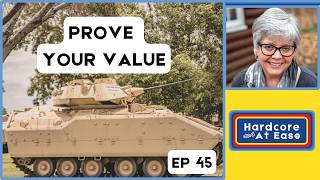
Angie Lohmann spent 26 years at BAE Systems, rising from university secretary to program director for the Bradley Fighting Vehicle by saying yes to unfamiliar work and proving her value quietly. She earned her PMP while seven months pregnant, survived Guillain-Barré syndrome, and credits mentors and a clear sense of purpose for her path.
Chapters
I was scared. I was resisting wanting to move. But now being able to look back 15 years, I'm like, what a great pleasure. What a wonderful journey I was able to take because I had somebody wisely tell me in the midst of change, there's opportunity. And I figured it out myself that when you're evaluating an option, you can't just look at the risk. You have to look at the opportunity too. This show is powered by Others Over Self. Hit that subscribe button to keep training your brain.
From Others Over Self, it's Hardcore and At Ease, a show about people who are keeping their edge without going over the edge. Does this sound familiar? You keep saying yes before you even know how to do the thing. And almost every time, it's working out better than you planned. I'm host Shelly Rood. Today's guest didn't ask for most of the rooms she ended up leading. She got pulled in, figured it out, and eventually Boeing pointed at her and told their own team, "That's what good looks like." We explore how you prove value so quietly and completely that other people start carving out a place for you before you even have to ask. This is Hardcore and At Ease. You keep saying yes before you even know how to do the thing. And almost every time it works out better than you'd planned. I'm living out this truth right now. You see, I committed to a launch date for Digital Shelly. She's our AI-powered peer support tool. And I did this date before I had a single answer for how we were actually gonna get there. We have a tech team with a group chat and we're constantly going back and forth about improvements. That is really uncomfortable to sit with, especially when you're the person that's supposed to have the answers. But here's what I know: the people who need what you're building, they can't wait for perfect. So we build excellent and we move. And I need you to do the same. You see, there's a version of ambition that waits for the map. It needs the full picture. It needs the right conditions before it can commit. And then there's a version of ambition that takes the next fork in the road, and it just trusts that clarity comes through motion. Did you catch that? Clarity comes through motion, not before it. Now don't credit Shelly Rood for that because every coach on the internet right now wants to put their name on that understanding. So I'm just gonna say that it's true and I'm gonna move on here. Clarity comes through motion, not before it. Today I'm bringing you a conversation with a guest that I have been dying to have an interview with for years. Angie Lohmann has spent 26 years building a career inside the national defense industry, rising from contracts team lead to program director overseeing the Bradley Fighting Vehicle program. Did you catch that? The Bradley Fighting Vehicle program at BAE Systems. She did not have a plan. She had a standard. She said yes to roles that she had never done, and she inherited problems that she did not create. Does that sound familiar? She walked into rooms where nobody expected her to have the answer, and she quietly became the standard that other companies measured themselves against. Now let's get into it.
I'll share that I'm really a A kid from North Dakota, very humble beginnings, never anticipated growing the ways that I did and advancing in my career in this manner. Honestly, if you would've asked me when I went off to college, I was going to find a basic job and stay in it for all of my life. I had very strong people that I worked with and for. I had great family support, even though I came from a single-parent household, and really didn't have many career people around me. We were really a, a blue-collar family. My mom was one of 10 kids. I was one of the first of the grandchildren to go to college and get a 4-year degree. So with that, I felt like I maybe had to do more. I had to drive higher, and opportunities presented themselves that allowed me to do so.
What was it like growing up in North Dakota? I've never been there.
Cold, cold. To me, Michigan is southern climates. We lived in the plains of North Dakota. I was in a small community called Larimore, which was just outside of one of the four major towns in, in the state. It was all about school activities, and we were near a college town, so I had friends that had college professors as parents, and so we did a lot of stuff at the college. So So I already knew, you know, by my freshman year in high school where I was going to go to college. There was no doubt I was going to attend the University of North Dakota and be a Fighting Sioux. And it just was a matter of what I was going to pursue when I got there.
And what did you end up pursuing?
Well, so I'll start with kind of a funny one, and that is I'm only here because I failed biology. Truly, truly. I was persistent. I was going to pass Biology 101, and I was on my way for my third F, and I went, really, this isn't working.
Your third F?
Yes. My sophomore year, I had enrolled the third time and was on my way to an F. I went to career counseling office and I said, clearly, I've got to find something different. So they put me through the Intra surveys and said, if you look at your stuff, you're kind of a rule follower and you're really good with numbers, which I was. So they said, maybe you should look at business or finance or police or military. And I'm like, oh, okay. So I stepped back and found a different major. I switched to our econ department and found an opportunity for a banking and finance major. At that point, they didn't have a finance department. And so I still wasn't sure where I was going to go with it. I figured I'd end up in banking, but that was kind of my first real-world challenge, right? I've got 3 Fs. What am I going to do about it?
And can I ask? What is it about biology that just did not—
I don't know. I honestly, to this day, can't figure it out. I cannot. I cannot. And there's a twist to the story too. So I finished my banking degree and at that time the banking industry was tanking. The finance world was horrible. So yeah, I went to my counselor and they're like, withdraw your application for graduation. Finish. You've got one semester and you'll have an accounting degree. Get your accounting degree too. So you have plan A and plan B. Okay, great. One more semester, got my accounting major and walked out and realized I really didn't wanna go to an accounting firm. And I'd been doing work study. Now I came from humble beginnings. I was paying for my own school. And so my work study manager said, apply to be in the secretarial pool. Just get a job. You need to have an income. You need to get insurance now that you're done with school. So I did. I interviewed and I got my first position. I started actually a week before I finished my degree. And so I went for orientation, got all the information, and they said, here you go. Here's your paperwork. Now that you're onboarded, head over to Starcher Hall. Go to room whatever it was. And I'm like, oh, OK. And in the back of my head, I'm going, Starcher Hall, Starcher Hall. That's not one of the business places. I wonder what that is, huh? I head over there and guess where I was assigned? The biology department.
Oh no.
I'm not kidding. I was going to be the secretary that did all of the miscellaneous minor admin for the professors doing those freshman-level classes.
Oh my goodness. So you were working as a secretary for the college that you attended.
Yeah. Right before you were graduating and they had you supporting the one thing that you couldn't do.
How did that feel? I mean, was that a humbling experience? Was it just like a slap in the face?
Well, I think I was distracted because I was 5 months away from my wedding date. I had a lot of, you know, activities planned with family. I was the lead in planning our family reunion. My mom was one of 10, right? We had a big, big family. So I just had a lot going on. So I just went, I got an income, I'm good. And it was really a relaxed apartment. I would sit there and do my stuff and try new things. And it was a role that no one ever stayed in very long. It was that entry so you could apply internally for other positions within the university. And so the lead secretary who had been there for over a decade knew, don't give this person too much because they're not going to be around to sustain it, right? So she just kept giving me the basics. But I kept pushing and saying, well, can I do the department newsletter? Can I do this? The guy that ran the greenhouse was also the guy that did all the IT stuff. So he'd give me all these software tools, right? So I was stretching the limits. And all of a sudden I started getting assignments to help writing, write proposals or prepare proposals, I should say, for the professor that taught Biology 101.
Is he the same one that failed you?
Yes. Oh, he was. He was. So, After a couple of months though, he started walking by and he'd stop and he'd look at me sideways, right? And I'd be like, what's that? What did I do something? What's wrong? So finally I was forward enough to say, hey professor, is everything okay? He's like, I know who you are. I'm like, great. What does that mean?
He wasn't really keeping it a secret.
Right.
Yeah.
He's like, I know I failed you and I think you're here to sabotage me. No. Yes. He had one of his colleagues spying on me, walking by, eavesdropping whenever I was on the phone. They just, they were these very paranoid old men. And I looked at him and I said, yes, you were my biology instructor. And yes, I didn't do well in that class, but I take responsibility for that.
Not you.
I said, it was me, not you. And he was like, what? It was my first moment of ownership, right? With a superior. And he was like, oh, really? Do you mean that? And I said, yeah. I said, I left there. I went to the counseling center and totally changed my degree because I was going to be an ophthalmologist. Clearly, that's not my plan if I can't get biology 101. And the doctor's like, yeah, you're pretty much right. And all of a sudden he started bombarding me. He was the most active grant writer in that department. He did corn research and he had corn plots from Hawaii to Kansas to North Dakota. So he had something going year round for his grad students. And he just kept piling on and on and on. And after about 6 months, he came in and he said, you know, you can't stay here. You've got to find something else, he said. And you are doing excellent with these grant applications. Have you ever considered doing something like being a grants and contracts officer? I said, I don't even know what that is. And so he had me go meet with the Energy and Environmental Research Center, which was a self-funded research department at the university. And that's where my government contracting career opened. Was right there at what was called EERC.
And I want to get into that, Angie, but I don't want to skip over the fact that you had this moment of what you called your first ownership moment.
Yeah.
And had you not chosen ownership, there was something happening outside of you that was making other people paranoid. That's so interesting to me because it's like, for those of us that choose not to take ownership of our own flaws, we can be, you know, I guess without meaning to, having a negative effect on other people, or other people can be much more weary or cautious of our true intentions. It's such a strong leadership lesson.
It was. It was my first, and it stuck with me all these years. And it took me a while to figure out how do I share that with others, right? How do you share a failure as a teaching point. But when it flipped and I had to support him, and then I got to be accountable for what I did in my performance as a student, it gave me a whole new perspective on how to help others in accountability, really.
Yeah, and the leader needed to hear it straight from you. Yeah. Like, I'm not here to screw you over. Right.
Right.
And so you made it into a different department.
Yep. So by 10 months after I joined the biology department, I moved over to ERC and was there for nearly 10 years as a grants and contracts officer. It was in that time that I encountered my next, I guess, life challenge, right? I don't think there was one big thing that changed my trajectory ever. It was all these like forks in the road, right? Where you have to make a decision. I had the opportunity, I guess I'll put it, to experience a 500-year flood. I lived in a city where the whole city was flooded. I had 2 feet of water on my main floor. I went back to my mom's house and stayed for 3 weeks until we could get back in and start the restoration. And it was in that moment, right, of quiet, where I wasn't working, I couldn't run errands, I wasn't working on the house, I had time. And it dawned on me that my boss wasn't gonna go anywhere. And if she's not going anywhere, there's no place else for me to go.
And this is 10 years in that you begin to feel this?
10 years in. Yeah. And my, you know, 9 years at that location and my, my head started spinning about, well, what could I do, right? And so I evaluated other government contracting opportunities within our community. There was really nothing in the community. There was other opportunities at the university, but nothing that had the entrepreneurial spirit that we enjoyed at EERC. And so there was that sit-down with my husband of, what are we going to do?
Yeah, because at this point, you're, I'm assuming, heading in into your 30s if you're not already there yet. And so you're an established woman, you have a family of your own.
No kids yet.
No kids. Okay.
Yeah. So it was, it was my husband and I, and we really were focused on being near family. We were near my mom, my brother. We were 30 minutes away from some of his family, 3 hours from his parents, his mom. And so we just said, well, we've got family in Minneapolis, Minnesota. There are a plethora of opportunities there. Let's go. And he was in the hospitality industry, so he could get work anywhere. And so it was really, what can I find? And so it was by December of '98, I had found a position. I had 3 offers, actually, for jobs in Minneapolis. And I don't know what drew me to pick what was then United Defense, later acquired by BAE Systems, but there was something about it that said, this is where you need to go.
And so, so did you make the move first or you applied?
Well, I'd applied. I had an offer for audit at 3M, an offer for— I wasn't clear on what the role was at BFGoodrich, and an offer for what I thought was a contracts officer at BAE Systems, or United Defense then. And I opted to take the United Defense position. There was just something about it that made me feel like it was the right place. And I was brought in thinking I was going to be in their contracts department, and they threw me a curveball. They put me in their subcontracts department, and they put me in charge of a teammate working the Crusader program, which was going to be the new howitzer for the Army back in the '90s.
Oh, if you're watching the video, you just saw Shelly smile a little bit. Army Shelly came out.
Yes, Army Shelly. So, I was very excited about the program. And of all things, I was responsible for our partnership with General Dynamics.
How long were you in that subcontract department?
So I started in December of '98, and Crusader got terminated. Donald Rumsfeld made the determination— Mr. Rumsfeld made the determination to sunset it in May of 2002, and the actual termination happened in August of 2002.
I have a 4-star coin from Rumsfeld, actually.
Awesome!
I haven't heard that name in years.
That's very cool. I'd say it was probably 2006 when I finally switched to a different role, and that was another pivot point, I guess, on my radar. In the midst of this, I was pursuing my MBA at a university in the Twin Cities, and so it kind of worked out. I was at the tail end of my accelerated MBA. And the termination was there, so I didn't have to travel anymore, right? I wasn't traveling to Detroit all the time to meet with GD or Muskegon, mostly Detroit. And so, you know, it worked out that I was able to really focus on what we needed for the termination, but also make sure that I was finishing my MBA. And during that MBA time, I kind of had that, wow, I really have a great systems view of things. Because when I was working on the subcontract, right, I was seeing the financials, the earned value, the scope, the performance, everything, right? I was essentially operating as a business manager overseeing this teammate in their scope and being that mediator between them and our IPT leads, our integrated product team leads, for the subsystems that we're integrating into the overarching vehicle. I kind of went, I like this. I think I'm good at it. I really think I can do more. I didn't want to be pigeonholed either. I didn't. I agree.
I mean, I think that's such a huge skill set to be able to look at all of those different moving pieces and make sense of it because some people just get lost.
Right. And not only make sense of it, help others understand and take them on the journey with you. And so I approached one of the leaders when I was bringing something to him for approval. And I said, so, you know, I really think that there's other things that I can do that would be of really good benefit to the company. And I said, so can we talk about sometime having an informational interview to let me know what other roles might these skills fit? So that I can be looking for and pursuing those opportunities.
Boy, that took confidence.
Yeah, yeah, it did. And it was one of— again, it was just like talking to Dr. Sheridan and saying, I own this, you know, it was— I want to do something more. And I see things from a systems perspective and I think I can make a contribution there. And we were just getting into future combat systems at that point and there was a gap. There's what we needed to provide to the customer. There's what we needed to do for our teams. But there were program directors overseeing each platform, and they weren't getting the data they needed for that meaty middle, right? We were set to give the customer their information, and we were set to give the working leads their information, but we didn't have a way to feed the information to these directors that owned the vehicles. And so they brought in what they called business coordinators. And so, I was assigned as the business coordinator for the non-line-of-sight cannon under Man-Ground Vehicles for Future Combat Systems. And it was a new role, and I got to frame it in the manner that I felt could fill that gap as best as possible and do it.
So, am I hearing it right that you witnessed a genuine need and collaboration that had to happen in order for the business to move forward? And is that where the confidence came from, you just being able to stand up and say, I see this, I know this, this is my lane?
Well, that's— they had defined it. And they said, so we think this is where you could fit, right? So I applied for the role, got chosen for the role, but then I got to define what the scope was because I was the first in the role. And I just kept taking more and more and more, right? I established processes, set up routines, standardized reporting, build relationships with the stakeholders, right? Because you can bet your bottom dollar that the gang working on the scheduling and trying to keep track of all the activities and the linkages and the starts and finishes on that project management earned value side and the engineers that are doing the work that don't want to do earned value are conflicted, right? They don't want to work together. So I'm serving as that bridge, helping them understand each other's needs just as I did on the GDLS subcontract, right?
So walk me through this idea of I wanted more and more and more and more. Because lately, I talk with a lot of business people, and when someone tends to step into a new position, I feel like they're, "Oh, I'm drinking from a fire hose. It's so much." But Angie, what I'm hearing from you is almost the opposite. You're like, "Give me the fire hose." Yeah, I can't say no.
I can't say no. When I see a need, I go find it. So the customer wanted weekly earned value. I was on the team that helped figure that out. Right? Weekly reporting. We got it done. They wanted to have project status review meetings on a weekly basis. We already had meetings up to our eyeballs. How were we going to squeeze this in, right? So we figured it out, right? So over time, I realized my boss was consumed, right, between customer meetings and corporate meetings and travel for training and this and that and the other thing, he was rarely there. So I started saying, just let me handle that meeting. I got all the data. I'm feeding you the data. Just let me handle it. And, you know, so it was kind of those things of, of seeing where others really needed to be up and out on their focus that I could be in and down and get it done. And I think one of the moments that I take extreme pride in is that, again, I drive to a process and everybody then knew what their role was to get it done. And there was no— it eliminated the conflict, right? We knew what the reporting was, when it was due, how we were going to do it, and who handled what. And then I'd compile it into a single picture for review by management and handle the meetings with the local customer that was overseeing our day-to-day performance. And guiding us. And so it was fun because I got everything streamlined, right? And that to me was joy. And the customers started seeing this. And when we'd have bigger meetings, right, I'd come with all our answers because I was in the data, right? I wasn't just passing paper. I was analyzing the data, which I love. Give me a spreadsheet and I'm happy, right? And—
Is that accountant in you coming out?
Yes, totally. Near the end of FCS, they hadn't gone through some of their staffing changes and it hadn't been terminated yet, or at least the manned ground vehicles portion hadn't been terminated. But their business leader at Boeing was hosting a session and you could really tell one of the teammates was struggling. And I, I was just an observer. And pretty soon she stood up and she looked at the program director for that particular team. And they— she looked around the room and she's like, I have your solution. You need to just go get yourself an Angie. And I'm like, whoa, wait, what? When did I become the standard? How did I do that? I had no idea. I was just driving to get things done to make it best operationally for our team. And in the, in the process of doing so, I'd made an impact on a big company like Boeing who said, said, if you're going to do this right, you need somebody managing the middle like Angie Lohmann does for BAE Systems. So—
How did you feel in that moment?
I was overwhelmed, to be honest, because that wasn't my goal. I wasn't trying to be indispensable. I wasn't trying to be the solution for everything. I was just trying to make it best for our team. And so I felt a lot of pride, and I still carry that today. When somebody said, well, get yourself an Angie, I'm like, wait, what? When did I become a standard?
You do have a unique perspective of more and more and more. I do. And that's not a bad thing. No, it's, it's actually a wonderful thing.
And I will tell you, for, for all my life I've been risk resistant, right? Like if it's risky, I don't wanna do it. Give me the solid steady Eddie. I, I, I will avoid risk. And it was when Crusader was being terminated, I was in the midst of buying a house. You know, and I looked at my colleagues and my boss and said, well, I don't think I should do that, right? Because I was head down getting stuff done. I didn't know how valued I was in the organization.
Did they tell you don't buy the house? What'd they say?
They said buy the house. You're fine. You've got a job for life. You know, because they could see, and I wasn't comparing myself to anyone else. I wasn't looking around at anyone else.
No, but the project you're on is literally terminated. Right. You're working towards a deadline.
Right. And they hadn't given me feedback about my value, so I couldn't— I didn't have that input. So I was just looking at the risk of, will I be on a job search that I can't pay for this house? And they like laughed at me and said, buy the house, you're fine. You know? And 26 years later, yeah, I was fine.
So Angie, how long were you stayed as a business developer through the majority of your career? Is that right?
Yeah. So I stayed in program management. Pretty much my entire career at BAe Systems, just different aspects of it. I got my— I finally pursued my formal, you know, project management certification, my PMP, in 2008 because I'd finished my MBA. I wanted another goal. I was doing well at work, but I wanted to understand how all these different puzzle pieces that I was touching better fit together. And I finally got the frame of the puzzle. By getting my PMP and realized life is really about project management. Everything is project managed in some sense, and I consider myself a perpetual project manager. It doesn't—
I need to get me an Angie.
And I sat for my PMP when I was 7 months pregnant. I still think about that going, what was I thinking?
Well, you passed, didn't you? I did. I did.
Took 2 bathroom breaks, but I did finish the exam.
Perfect. And so then did you go on maternity leave and you came back?
I came back, was it like baby brain fog? It was baby brain fog. I had some other unexpected medical things arise that extended my leave. I ended up in the emergency room a few times and was diagnosed with a condition called Guillain-Barré syndrome. It's where your immune system attacks your nervous system.
Oh my gosh.
Yeah. So you just, you get miswired and you can't quite figure out what's wrong with it. And about the same time, William the Fridge Perry contracted it. So it was in the news about what GBS was. And, you know, I was very persistent with my medical staff about, I'm going back to work, I'm not going to extend this. You know, in the meantime, the neurologist is saying, lady, you're going to learn how to walk with your daughter, right? And I'm like, no, we're not going to let that happen. Right? So I essentially managed my way out day 4. After going into the hospital, I was discharged, was told by the neurologist, this would have been like April, late March. And the, the neurologist said, you're not going back to work till August. I'm like, oh, okay. And then I go figure out that she doesn't approve my return to work. My general practitioner does. And so I was back to work part-time April 1st.
So, 'Cause you know how to project manage.
I know how to project manage, and I was gonna project manage my return to wellness. And so the interesting part though, during the midst of all of that, we had a major business shakeup and the program structures and the business structures were totally revamped. And so at that point, I had moved out of the business coordinator role. I'd done a stint managing the subcontract department and reestablishing that department and growing from 3 people to 7 in a matter of 4 months. Months to burn down the backlog of open transactions that we had and the contracts we needed to get in place. And I had moved into a business management role where I was really helping oversee all business management aspects for Army programs. And we had multiple contracts, you know, not just FCS. We had numerous individual contracts coming directly from the Army. And my boss calls and says, so, Yeah, there's, there's a challenge in that the role you're currently in will not exist at the end of this change.
Did your heart just drop?
It did. It did. And I was like, oh, okay. Flashback 2002. Should I buy this house? Well, this baby ain't going anywhere, right? She's here and she's staying. And so, you know, I was like, so Help me understand what the options are. And it was in that moment, right, that, that risk and that fear were really active. And my boss reminds me, with change comes opportunity. Remember, there's— he said, you are at a fork in the road where you get to decide what you want to do next. He said, you have phenomenal skills in finance. You have phenomenal skills in contract management, supply chain management, program management. What do you want? What department do you want to shift to? He said, because there is leadership roles abounding and you can go where you want. And I'm like, wow, you know, but I don't know these players. I don't know these people. This isn't my network and I'm not there. I'm on medical leave. And he says, it's okay. He said, we got you. You tell me what your top 2 are and I'm going to go promote you. To those two leaders because that leadership level's been set. He said, so, so let's just get you in front of them when you get back. I'm like, okay. I said, I'll think about it. I did overnight and went back and said, if I'm going to go into a department, I think I want to go into supply chain subcontract management again because I know that upside and down, or finance. I said, I've gotten a good flavor of operational finance. I have the flavor of earned value and I think I can do the rest. And he's like, okay. And so, you know, he kept promoting my name. He became truly an advocate. I know we, we have in the notes about who, who was your mentor, who was your guide. I think those are great people to have in your life and part of your personal board, but the other people you need are those advocates.
The advocates, right?
The people that are going to go out and fight for you, that are going to help you find those opportunities and promote you for those opportunities. And that's exactly what that leader did. I had two opportunities presented to me, and I opted to take the finance route and took over finance leadership of the wheeled vehicle platforms for BAE Systems, right? So now I was dancing.
What kind of wheeled vehicle platforms, Angie?
So we're talking MRAP, JLTV, all of that stuff. And it was insane, right? Here I am learning a new platform, something that doesn't have track, right?
Where's my howitzer?
Exactly, exactly. Where is that non-line-of-sight cannon? I'd like it back. But it was just insane, right, to now have to get up to speed on new programs, programs that had their own challenges with new company leadership. I should mention, BAE Systems acquired United Defense in 2006. And I was actually at a Boeing Future Combat Systems meeting related to small business on the day one when BAE Systems really put the banners up at all of the United Defense locations. And there were other BAE Systems teammates working on electronics and other areas of Future Combat Systems on the network side. And so all of a sudden, you know, we're sitting next to each other at this small business conference going, "Hey, how's it going, brother?" You know, I guess we work together now. So I wasn't even—
at this point, I mean, you've got to change not only in your job, but also the department, also the company itself. Angie, you've got a new baby at home. The shift into motherhood is not something that we can just lightly skip over. I mean, there's so much shaking up and happening here. How do you keep at ease through all of that? Because that seems like You either hold it or you don't.
Family. Family. My husband has been my cornerstone always. We leaned on our parents, my mom, his mom to help care for the baby when I was in the hospital. Um, my brother was, was there for whatever I needed. Kurt's brother, the day I went into the hospital, our neighbor who became family, literally we had 7 fam— families that lived in our neighborhood that were our family, right? We could call on any one of them. They were there to support us, uh, there in that small neighborhood in, in Maple Grove, Minnesota. And we still stay in contact with most of those families today, even though we've relocated. And it was, it, it was sometimes held together by a string, barely, but it was held together. And, you know, we, we just logistically figured it out, made sure Elise had what she needed. Family rotated through to support us. Neighbors brought meals. I'd get calls, what do you need at Target? You know, they'd pick up our Target run since I wasn't permitted to drive for a while. It just, it, you can't do it without family.
You can't do it alone. Absolutely.
Yeah. I'm very blessed from that perspective. Very blessed.
Well, you are because you kind of started talking about saying that you were coming from a single parent household. Yes.
Yes.
But you were never without family.
Never.
It sounds like even back then you had this big reunion that, you know, you were helping plan.
Yeah.
And so, um, do you feel like you, do you feel like you kind of fit the part of a matriarch that just wants to bring people together?
Yeah. And I didn't realize that until honestly, when we were getting ready to leave Minnesota, I didn't realize how heartbreaking it would be to leave our neighbors. I didn't realize how much of my life they were. And one of the wise older neighbors, you know, I'm standing there having this conversation. They were both pro— esteemed professionals in their careers. He finished out as a VP for Caterpillar and she was high up in the health organizations. And so I'm standing there talking to them and, and Jean's like, You do realize you built all this. She's like, you and Kurt were always the ones that were instigating our time together, instigating our plans. She's like, you've been the mom to all of us to keep this neighborhood family together.
Right.
And it was at that moment that I realized, wow, it, I, I did have that role. I did have that role.
I, I, it's interesting that they use the noun of mom.
Yeah. Yeah.
Whereas from the outside looking in, I think that's, I don't know that that's mom as much as it's just Angie. Because I know a lot of moms that don't do that.
Well, all the moms in my life had been the ones that get the family together. Yeah. Yeah. So it was, it was, um, you know, that was the third, I think, item in my life and we haven't really gotten to talk about, you know, what I think truly makes me hardcore and what kept me in the defense business all this time, but not just the business challenges, but understanding my why. But in any event, that third, like, part on my journey that was that hard decision was when I got that ask to relocate to Michigan from Minnesota. You know, I'd been in Minnesota for 13 years. I had a very great neighborhood. I had all of, you know, what I wanted and needed from a support network to, you know, what fulfilled me spiritually, emotionally, physically. It was all there. And yet it was at that juncture of, you can't imagine what else could be possible. And it might not happen in Minneapolis, but it will happen in Michigan. And I got asked twice. I said, I gotta think about it. I got asked a third time. I went to Curt and said, what do we do? He said, if we're doing it, we're doing it now before our daughter gets in school so that we can figure it out. We can be settled and she can have what we had. And what we had was because from kindergarten through our senior year, we were in the same school district, lived in the same house, had that same stability. And, you know, he wanted that for our daughter. I wanted that for our daughter. And so we said yes, and we listed our house and we relocated here in 2011. And it was quite a pivotal moment in my career, and it made all the difference. I thought I had a great career up till that point. I didn't know nothing. What came after that was even better. And it was kind of in that timeframe, right? Like in that 3, 4 years before we left Minnesota that I started to get a better grip on my why. I started to understand why United Defense and then BAE Systems meant something to me. It was the people, it was the challenge, it was the work. But what was the most important part in all of this, and will be for the rest of my life, is that— this is very personal— somebody did my jobs before me, or something related to my jobs. And because of that teamwork and because of what we did, we made sure that our soldiers and our airmen and our Marines could come home to their families. As Walt Havenstein, BAE Systems leader at the time of the acquisition, said, "Our mission is to protect those who protect us." And it was in that moment that I realized I was doing the job that somebody did before me that allowed my uncles to come home and have many years with us. I had two uncles that fought in Korea. I had one uncle that got pulled in just at the end of Vietnam, so he didn't get deployed. And I had— they were all Army guys. I had another uncle that— he's our squid. He went into the Navy. We love him dearly. But the situation there was, you know, he was in that era of you get caught and you get in trouble, the judge is going to give you one of two options. You either enlist or you join the military, and so, or you go to jail. And he came home and Grandpa said, "You're not joining my army." And my mom, like I said, one of 10, 6 girls, 4 boys, all 4 boys served, all 6 girls married men who served. And I think back to all of the time I had with that extended family, and how much I loved those family members and realized if there weren't people working for companies like BAE Systems or United Defense or General Dynamics, our warfighters would not have this unfair advantage and have the stellar equipment that allowed them to do their jobs and come home. And granted, not all of them get to come home. I'm fortunate that my family members did. And so, It became truly my mission to do my best in my roles to make sure we were doing that for today's families.
Now, Angie, you said you marked that moment. How old were you? Or like at what point in your career did that really hit you?
I think it hit me probably about 2003. In '96, the my, I had two uncles that served in Korea. Never, neither of them ever married. And so the younger of the two actually stayed in grandma's home and at grandma and grandpa's home and sustained it after they passed. When he passed in '96, my heart broke because there was a wall in the living room that had all the military pictures. And my mom and my aunt took those pictures down and they started started sending those pictures back to other families. And I went, but they're supposed to be together. They're supposed to be together. And, and Mom was like, Angie, we're not keeping the house. They can't stay together. And so after a few, like 5 years, I went, well, can I still have them together? And so I started asking Mom, can I get those pictures? Can I just borrow them? And so there I am sitting with, uh, and minimal desktop scanner, you know, and probably WordPerfect where I'm scanning these pictures in and dropping them into a document because I didn't have any graphics or photo software, right? And I print them on photo paper using a laser printer and I put them in a picture frame for my mom. So it's her dad in his uniform from, from World War at the tail end of, of World War I and the 4 uncles in their uniforms and brought that to my mom for Christmas when her sisters were there. And so I, I did that every year because a gift for them. But my mom, you know, I only made that for her, that set of 5 pictures in a collage. And my aunts went, well, where are mine? Where's mine? I want one. Right? So I made for all of my aunts and then I made for a couple of my uncles and The pictures were back together and all of a sudden I had that moment of, wait, where's mine? Right? And when I made my set and hung it in my office in Minneapolis, that's when it hit home. That was my why. And I still have it. I'm gonna do this.
You do have it? Show us. Oh, and so that hung in your office in Minneapolis?
Yes.
And so as people came into Angie's office, they got to see her why.
My why. Yep. And I got to see my why every day.
What kind of impact do you feel like that had on the people that you were leading or interacting with?
Oh, I think, you know, when I, in 2013, I transitioned out of finance and became the program director for our sustainment business for both Army and Navy programs and had responsibility for, I don't know, 600 field service reps that were out there maintaining our systems and upgrading our systems. And they're looking at this short white chick going, why are you here?
I may have been one of those judgy people in uniform, you know?
And I had to figure out how to tell them why our mission was important and why they were important. And so I framed my story of we're here, essentially the short story is to make reunions right, to make sure our warfighters get to come home to their families. And if you're in it with me, I'm in it with you, and let's do it.
And that's a legacy that I know that you've carried forward.
Yeah.
Even beyond, because you're retired now, you're still not at BAE.
I retired from getting a paycheck, but I'm still serving the defense industry here in Michigan.
You are, because I saw you recently at the Women in Defense Gala.
Yeah. Yes, and I remain on the National Defense Industrial Association, Michigan's chapter board of directors, oddly enough, serving as their treasurer.
Well, just as long as there's no biology in there.
There's no biology in there. And, you know, so I transitioned from work to serving on boards and being available for my family really was the other goal, to be able to be home and be here In current, my daughter's 17. She's fully independent. She's got her friend circles, her extracurricular activities, her part-time position. She's fully engaged in her own life, but I wanted to know that I was here for those moments she needs me. And that's made all the difference in the last year and a half of my retirement.
It has. So as we wrap up, Angie, that feeling of leaving that tight-knit community and making the shift over to Michigan, do you feel like you were able to reclaim a little bit of what you were walking away from?
Oh, totally, totally. Here I would say that close-knit family is really those folks that I volunteer with because I was at work more than I was at home when we moved here, right? So getting to know your neighbors and engaging with your neighbors in the fashion that we had in Minnesota didn't become as feasible. And the other thing is, when you're a transplant, right, often the people around you are still with their families, right? So, it's hard to say, "Hey, come on over for this event." "Oh no, I'm going to my mom's." I'm like, "Oh yeah, okay, great. Go for it." So, it was really that being embedded in Women in Defense and NDIA. I took another challenge in 2015 in my career, and that is I took over responsibility for our site here Sterling Heights at BAE Systems. So now I was like trying to help manage the facility and the capabilities within the facility, making sure we had employee engagement that was suitable for, you know, retention and activation of our employees, maintaining or improving the culture of a newly formed site, right? And that, that's a really unique challenge because we brought in people from all different sites, and each of those sites had their own culture. So how do you form that when folks are going, well, when's our United Way auction, or when's our diversity day? Because they're, they're thinking what they experienced at their other sites is, is corporation-wide when it was really geographic-centric. And so to maneuver through that, and then it also had me facing more of the community, right? And so before I knew it, I was on the Sterling Heights Community Foundation board. I was on the Sterling Heights Chamber Board. I was active in other foundations. This became my family, right? Was these volunteer roles where I got to know this amazing Southeast Michigan community, the business community, the defense community, the giving community. And it, it has meant more to me than I could ever have forecasted. I was scared. I was resisting wanting to move. But now being able to look back 15 years, I'm like, what, what a great pleasure. What a wonderful journey I was able to take because I had somebody wisely tell me in the midst of change, there's opportunity, right? And I figured it out myself that when you're evaluating an option, you can't just look at the risk. You have to look at the opportunity too.
And hearing you come all the way to the other side of the state, that's such a breath of fresh air. There's a lot of fear that's out there right now, and there's a lot of, you know, the people are worried about getting let go from their jobs and getting laid off. And it's so wonderful to hear a success story from the inside out, from someone who went from secretary to being program manager at one of the most incredible defense systems companies that exist out there, Angie. From the bottom of my heart, thank you for having the courage and the fortitude to continue to move up and to move forward and to say, "What's next? Give me more. What's next? Give me more." And they did.
I mean, I went from handling sustainment to handling the site along with my program director responsibilities. And then they handed off Bradley to me in 2019. Just as it was headed into the A4 upgrade. And there I was learning the production side and kicking off a whole upgrade in the midst of COVID getting to continue to learn that far into my career. And I did that for a few years and stepped back and said, boy, we've got so many people in the pipeline that are ready and we're going to make some changes to the business. I'm happy to continue doing Bradley and whatever else you want to combine with it. I'd see a total opportunity for me in the program management office because I can fix things system-wide, not just for a single program. And so that's what I did. I transitioned then and spent the last year and a half, 2 years in my career, probably 14 months in my career, working in the program management office and helping the big picture. And making sure that the team I handed the baton to for my past program director responsibilities was operating seamlessly and was there to support them through that. So I had the best movement through my career and even better way to hit a point and say, now I can finish by helping everyone.
That is amazing because I've been the one that stepped into the mess and have had to make sense of it. So for you to be the one to be able to tie the and hand off the package. That must feel incredible.
It truly was. Now, it still had, you know, challenges given our current world, right? There's always going to be supply chain issues. When I was starting to hand off the baton, I kept hold of one big problem. And I look to my right and laugh a little bit because we made a pseudo-fading piece to put into the platform. The parts were being reworked. Worked because there was a hiccup in supply chain. And so that fitting piece, that temporary pseudo unit, they put a plaque on it and sent it to me as my retirement gift.
Did they name it the Angie?
No, no, they did not. They did not. But every time I get to walk into this space and I get to smile because 'cause that was another one of, seriously, Lord, you're gonna give me this to fight with now of all things, right? I have to do this. And, uh, he, we got through it and the team proved that they could bring it to closure even after I retired by, by giving me that one placeholder that they knew and would assure me they never needed again.
They never needed it again. I love that, Angie. As we wrap up, is there anything that you wanna make sure that my listener gets to hear from you today?
I think it's, you, you do have to find that way to have your timeout, right? Did move full speed ahead so often, and there were pivotal times in my career where I found that was maybe detrimental. So be conscious about taking that pause to find your center, to find what energizes you, you and allows you to move forward. For me, it was continuous learning. And the company saw that, and they put me in leadership programs being worked at the corporate level or outside, things such as the International Women's Forum Fellowship Program, right, where I was permitted 1 year. I was still working full-time, but I went to 4 sessions with IWF. Of other fellows from across the world, from across different industries and education and whatnot. And when I put myself fully into that program and stepped back from work, I got so much more out of it. And not only did I get more out of it, I now had another network of women— strong, amazing, beautifully intelligent women— that I could call and say, help me think through this problem.
I love so much that you're using continued education as a way to be at ease, because a lot of us think that continued education is like one more to-do list check item, but you're saying that that's what actually helped you bring it all together and stay the beautiful person that you are. So we're back in the green room chatting, and Angie's sharing that she truly an introvert.
Yeah, I would rather be alone in a quiet space to figure stuff out on my own than in a group setting. But during the course of my career, I realized there were times that I had to put on a different hat and I had to be that extrovert to make sure the team was with us. And, you know, it's really a weird coat to put on, but, you know, I recall it most most really being the site lead and having to stand up in this crew, right, of 300 to 700 people depending on when it was in the journey and share why what we were doing was important and be there to field their questions, not knowing what they were going to ask, right? The thinker, the introvert in me wanted to go, "Give me the questions. I'll go think about it and come back." I didn't have that latitude. So I had to—
You had to do it live on site.
I had to do it live on site and figure it out. I, there's another term for it where you're both, but I think what it boils down to is that you as a person have many actors inside you and you will default to the ones you're most comfortable with. But there are times that you have to figure out how do you put on that different persona to accomplish the mission at hand. And I think there's a tool called the Enneagram that really helps with that.
Right.
Which, which Enneagram are you? What are you? I'm a Type 6.
Okay.
All right. Yeah. And so when you go through that and understand, you know, where you find your center, but that you can employ any one of those types doing so, you know, with integrity, right? Not from a manipulative standpoint, but with integrity to, to serve the mission and align your team or align those around you.
You can, and it gives us such strength to be able to watch self-proclaimed introvert be able to be one of the top leaders in the national defense community. Absolutely.
Thank you. Thank you. Yeah, it was, it was worth the journey and it's, it's worth it to continue to give today. You know, I continue to mentor for WID and also serve as a mentor in an organization called Mentium, which pairs up-and-comers with executives from other organizations. So it's a wonderful program. I mean, I've just had so many opportunities with IWF and Mentium and WID and NDIA, all of these different organizations bring strength to the journey that I was able to complete. It truly is because you encounter different perspectives. You now have a network of people, things like Women in Defense, WID Grid mentoring program, right? I've been a mentor since I think 2012. I've had at least one pairing every session. And I've gained more from those as a mentor than I would've ever imagined. And moments that reassure you that you've done the right thing by giving, by learning. You know, my favorite moment for Women in Defense Michigan, well, there are many. There are many. There's 2015 when they gave me my Horizon Award, and my husband was ignoring my speech. Only later I find out it was because he was getting text because our daughter was with the sitter and throwing up.
Oh, so you're saying that even at your level, you still have spouse and household drama? Yes.
He was trying to be a parent and not, you know, so I totally forgive him too. The Excellence in Leadership Award, but yet up there in my top 3 with WID is that moment I'm at one of their galas and they're introducing the new board and I look up, I'm like, oh, Oh, there's, oh, 4 of the new board members were all my past protégés.
I think you, you may have had something to do with their success.
I, I hope I did, but I think the other thing that is important for me to share with your audience is volunteering and giving back gets you so much in return as well. So don't look at it as just an outbound thing. Outbound because there's a lot of inbound that comes with it.
I love that. Well, Angie Lohmann, thank you so much for spending your time and your talents with us today.
Oh, thank you. It's been a wonderful conversation and I'm, I'm so glad that I can share and I look forward to helping any way I can in the future.
That was my conversation with Angie Lohmann and what a joy to be able to share that time with her. Here's what I keep coming back to from the conversation. She was never trying to be indispensable. She was just trying to make it the best for the team. And Boeing looked up one day and they said, "Get yourself an Angie." When you aim at that bullseye, you see, you hit all the rings. But when you aim at something like being indispensable, well, you rarely hit any of the others. So the other thing I want you to carry out of this conversation is the picture. Angie has 5 men in a uniform on her wall—her grandfather from World War I, 4 uncles. She scanned those photos herself, she printed them on a laser printer, put them in a frame, and she hung them in her office. And then she went to work overseeing the Bradley Fighting Vehicle program at BAE Systems, the same kind of equipment that kept the men in those photos alive, and continued her family legacy Angie, she is just as cool as those men are, and she looked at that picture every single day, not as a decoration on a wall, but as a reason. It gave her purpose when her work was hard, when the program got terminated, when the role she was in disappeared, when the company changed names. That picture, that picture stayed the same, and so did Angie. Now you You, my friend, you have a picture somewhere. Maybe it's not on a wall. Maybe it's an actual person or a promise that you made or a version of your life that you're still building toward. That's me. That's my picture. I want you to name it. I want you to print it out if you have to, but I want you to put it somewhere that you're going to see it every single day because when the yes gets hard, and it does, if it's not already hard, guess what? It's gonna get harder. When that yes gets hard, that picture is what holds you. Thank you so much for spending this time with me today. You could be anywhere, but you're here with me, and I appreciate that. Whatever nugget that you're taking away from today's conversation, put it in someone else's hands before I see you again next Tuesday. There's somebody in your circle right now who needs to hear this this message more than you know. And it's not your job to be the gatekeeper. Now, if you have yet to subscribe to our podcast of Hardcore and At Ease, do so now. Hit that subscribe button, because every Tuesday without fail, there's something here for you. So until then, I'm host Shelly Rood, and I want you to stay hardcore, be at ease, and trust the process.
You're listening to Hardcore and At Ease. Keep the conversation going at joinothersoverself.com.
More from Shelly

How to Get Time Back as a Coach or Creator: The 5 Tools I Use Every Day, ep 68 Hardcore and At Ease

ep67 “I’m the Eighth of Nine” How Listening Became a Superpower | Catherine DeDecker

How to Respond to "You're So Busy" And What to Ask Instead | Catherine DeDecker Hardcore and At Ease


Your Big Moment Runs on Private Work | Drag Racing Lessons, Hardcore and At Ease

Show Up Anyway: What to Do When You Feel Like You Don't Belong | Ep65 Hardcore and At Ease

How to Become a Lived Authority Without Anyone's Permission, Ep64 Hardcore and At Ease

Michigan's Defense Leadership, From Two Different Chairs: NDIA Scott Davis and AUSA Chuck Cogger

The Leadership Job That Never Clocks Out w/ Brig. Gen. Daniel Kramer, Ep 62 Hardcore and At Ease

How to Write a Personal Manifesto That Holds Steady When Life Won't, Hardcore and At Ease

What Advancement Demands of the Person Leading It, Hardcore and At Ease, ep 59 with Stacey Eeman SME