Meet Shelly C. Rood - U.S. Veteran & Entrepreneur
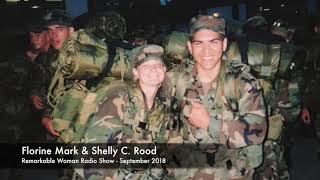
Shelly Rood, a Detroit-born Army captain turned intelligence director, founded Project Massilia, an online community that sends monthly gift boxes to female veterans and first-responders. She now works at the North Group, a global security firm handling surveillance and anti-human-trafficking operations, while studying to become a chaplain.
Chapters
Hi, I'm Florine Marc, and welcome to Remarkable Women. Remarkable women are everywhere. Some are in the headlines and others stay behind the scenes, touching the lives of others and making a real difference in their community. So join me here each week and meet moms, doctors, entertainers, writers, artists, CEOs, journalists, neighbors, and friends. They are women that I want to know and that I want you to know too. Hi, I'm Florine Marc, and good morning to you. My guest today is Shelley Rood. Shelley is the director of intelligence for the North Group. It's a multimillion-dollar global security solution. She's also the founder of Mission Ambitious, Ambition LLC. That's Mission Ambition LLC, offering public speaking and consulting services. She is a former Army captain. Mrs. Rood presents leadership and personal development in a dynamic and powerful, yet very humorous way. And if you don't have humor, I mean, you know, you don't have anything. Nicknamed Miss Ambitious, Shelley has shattered stereotypes as a public speaker and presenter. So welcome to the show, Shelley.
Thank you, Ms. Florine. It's my absolute honor to be on it.
Well, it's an honor for me to have you. I want to hear about you. Are you a Detroiter?
I am a Detroiter, born and raised in Harrison Township. I have been gone for well over 15 years and just moved back about 2 years ago.
Where is Harrison Township? Tell us.
Selfridge. Everybody knows where Selfridge is. I live on the bay right around the corner.
South?
Southridge. Southridge Air National Guard Base.
Oh, Southridge. Southridge. Okay. So that's— and you live right near there, right?
Yes.
And brothers, sisters?
I do. I have two sisters, one two years older and one five years younger.
And what do your sisters do?
It's a great question, isn't it? No, I'm just teasing. My older sister—
I love your humor.
She has a lot of passion. She's very interested in cars and collision work, bodywork for vehicles, as well as planting and nursery things. And my younger sister, she is an art teacher.
Fabulous. That's wonderful. And what did your dad do?
My father ran a construction company, Gale Company, down at Seven Mile and Van Dyke. I grew up swinging a hammer right next to him on the rooflines of Hamtramck and downtown Detroit since I could walk.
So you're the boy that he never had, right? Yep.
But he swears I'm a lady.
Right. That's terrific. Was your mother— did she work or was she able to stay home?
I was very blessed with a stay-at-home mother. And I Very lucky. I could never do that, not in a million years. So I know she's an angel.
Are you married with children?
I am. I am married. We just recently got married this last September. We're coming up on 1 year.
Fabulous.
And I do have a son from a previous marriage. He's coming up on 9 years old.
And what does your husband do?
He's an electrician and he also is the operations manager for our company.
Okay. Were you good in school?
Oh, I think that I fought the good girl title every day at school. I, you know, I did. I got good marks and then—
Did you like school or was it just—
I like reading. I really like reading. I really like stories. I went to school for journalism in college at Western Michigan University. And I just, I fall in love with other people, you know, good or bad. I fall in love with the stories of other people. And I really think that's a theme that has carried me through my life.
I don't wanna know how old you are, but I wanna know what month you were born.
October.
Is that a Libra?
It is. I'm at the very end, the cutoff for Libra.
Oh, so Libras are storytellers?
I think you're right. Gosh, you know your stuff.
So you went from high school. Was there ever any doubt that you were going to go to college?
No, I pretty much— I mean, I was raised in a very wonderful upbringing, you know, in Metro Detroit. I wanted for nothing. I was able to go to college. My last 2 years were paid for by a military scholarship. Unexpectedly, I joined ROTC and my Parents didn't have to take the burden of the last 2 years of college.
So what did you study in school?
Journalism.
That's right, you just said that.
Journalism, communications, and military science.
Wait, wait a second. Journalism and military science? I, I don't quite get their combination.
I don't know that anybody gets the combination.
What is military science? What is that? And you went to Western Michigan?
I did.
Great school. So what is military science?
Well, you know, you learn about war, you know, the art of war. War is not something that you just walk into, and not war necessarily, but even just being military when it comes to acting operationally and creating large-scale strategic planning. These things, you don't just wake up overnight and, you know, you're not just great at them. You do have to actually study, and that's what military science is. It's the science behind how we do what we do.
So you're telling me that our generals and captains in our Navy and our Coast Guard and all of these men and women that are working in this profession have all studied the art, the science of war.
And so there's actually something called PME, which is primary military education. And just as if you worked for the same company, as you grow in the company, you are expected to take some courses or work on your degree. Well, in the military, you do the same thing.
What kind of courses? What did you learn? What would it— name me some titles of course, is I just never would have thought of that. I thought you go in the Army and you're really good, you're a private, then you become a sergeant, from a sergeant you become a captain, and then you become a general, and that's it, right?
So those are the ranks. You do climb the ranks, but for your specialty of intelligence—
Do you have to have this education to climb the ranks?
You absolutely do.
Okay, tell me some of the subjects.
So I'm a military intelligence officer, which means that I have been to my military officer basic course called OBC. And the names and titles change over the years. The content gets refreshed, but, you know, it's pretty much the same base of you learn what you need to know to do your job.
What is OBC? What does it stand for?
Officer Basic Course.
Officer—
and what's different if you go into intelligence? Uh, you know, we learn the different types of intelligence. There's SIGINT, which is signal intelligence. There's HUMINT, which is human intelligence. What I learned from another human being is very different than what I learned from their bank account statements. The different disciplines of intelligence, you have to learn about them and the tools that we use to gather. Then once you have intelligence, what good is it? What we do is create what's called actionable intelligence, something that you can then take to the decision maker so that they can make a well-informed decision. Otherwise, a bunch of data, a bunch of numbers, it means nothing.
I just never knew that our generals and our captains and even our sergeants Many of them have, well, certainly higher up, but even sergeants, they study the art of war?
They do. And, you know, before you become a major, you have to go through something called ILE, and these are graduate-level courses, and you can get a master's degree out of these courses. Most of our military professionals do.
Okay, so here you are, let's go back. You're in college, you're at Western, and you're studying journalism. What made you decide to join the ROTC?
Oh, that's such a great question.
Isn't that? I thought that was a man's organization.
It was. No, I'm just teasing. Oh, I have to be honest with you, Florine, and I think you'll appreciate this. I was really scared of gaining the freshman 15. I was so scared.
You thought you were going to gain 15 pounds and it made you nervous, right?
I would see these beautiful women.
Have you ever thought of Weight Watchers instead of the ROTC?
The Army doesn't Weight Watchers. Right, right, right. Oh, but I would. I would see these wonderful women, you know, go away to school to learn and be knowledgeable, and they would come back looking like they did not take care of themselves. And I always had this fear that that was going to happen to me. So, I'm not going to lie, I took the course called Outdoor Survival Skills thinking that it was going to keep me in good shape, and it absolutely did. I mean, thanks to the military, shoot, I've run 2 miles every morning for the last 15 years of my life, whether I liked it or not.
And so, what was it— were there many women in those years in the ROTC as there were—
The numbers are growing. The numbers are growing. The average age for a female veteran right now is 46. And it's going down. It used to be 47. So, the number of women in the military in general are growing. We are expanding, but we are very, very niche. You know, you're talking about, let's say, 15% of anybody serves in the military, and you're talking about only 2% that are actually female, right? So, it's like the half of the half of the percent is who we are, and that's why it's so important for us to really come together and support each other.
So, when you were— when you joined the ROTC, what did you do and what was expected of you?
You did whatever they told you to do.
Which was?
Be on time. This is really what I fell in love with. I also joined a sorority, so I was part of the Greek life. And let's be honest, Western Michigan University Greek life is like something else. You can count on late nights and parties and drinking underage or overage or whatever. It's all there. Whatever kind of trouble you want to get into, you can. Well, I got to see the juxtaposition between sorority life, Greek life, and people who were going through a commitment to values, things like, I mean, they literally stood up and talked about taking oaths, duty, value, honor, selfless service, respect. Those were the things that my parents had ingrained in me from the time I was so young. And I'm looking around in this higher education world at these people just wasting their time. And I'm thinking, what are they doing? And so then when I looked at the ROTC crowd, I was the captain of the rifle team. I was a very good shot, unexpectedly. I didn't even know I was so good. But when I looked at that group of people, they just shined. And I think that the United States military, if you really back up and look at our civilian population and pair our military right next to them, you will see they shine. They have a level of duty and dedication and professionalism.
Discipline.
Discipline, yes. And it is very, very hard to find because it's so hard to do.
And so you, when did you join? Did you join it right away when you went into college?
I did not. I didn't join until my junior year of college.
Had you already gained the 15 pounds?
No, I've never gained the 15 pounds. Let me tell you what, all of you new mothers, the military gives you 4 months to drop the baby weight and be back at standard. And to me, it was 4 months to the day, and I will hold every woman to that same standard.
Hi, I'm Florine Marc, and my guest today is Shelley Rhode. Shelley is the Director of Intelligence for the North Group. It's a multi-million dollar global security solution. She's also the founder of Mission Ambition LLC, offering public speaking and consulting services. She's a former Army captain, and she's gorgeous. She is beautiful and thin and just beautiful. Mrs. Rood presents leadership and personal development in a dynamic and powerful, yet very funny way. Nicknamed Miss Ambitious, Shelley has shattered stereotypes as a public speaker and a presenter. Okay, we're back at the ROTC. So, this was— how much of your time in the last 2 years of college did you have to spend doing ROTC, whatever it is that you do?
Pretty much all of it. I mean, I also agreed to be what's called an SMP cadet, which is a simultaneous membership program. So, not only am I a full-time student, I'm also in the Army Reserves.
Did they pay you for this?
Oh, yeah.
Okay.
Well, you know, Army pay, but yeah.
Right, and they paid for your schooling?
They did, yes.
Okay, right.
And so once a month I went to my Army unit and I learned from them. I learned public relations, I learned media, I learned the intelligence world. I was fortunate enough to be part of a detail that went to South Korea my senior year of college, and I got to be boots on ground in South Korea. This was a time when Condoleezza Rice, right, was in office and Donald Rumsfeld, right, the greats. And if you've seen that building that sits on the border of the DMZ, the demilitarized zone, with a giant cherry wood table, right? It's a light blue building with a red cherry wood table at the middle of it. I have sat at that table. I have technically stepped foot in North Korea, and so I have wonderful memories and opportunities that I've gotten through the military that I really don't know that I would have had otherwise.
What kind of a degree did you get when you graduated after 4 years?
I have a Bachelor of Arts and Science.
So, the journalism was out the door.
Well, nope, my master's, or excuse me, my field of study was journalism. On paper it says journalism.
Okay, so after you graduated in 4 years, now you're still in the Army, right? Are you still in the Army?
I have been reserves for the last 16 years, yes.
Do you get ever called up to go like to Afghanistan or go to Iraq?
I do not, and that's one of the first things that I make sure everybody knows about me is there are people out there that are way more awesome than I am. I am that low man on the totem pole where I have never been active duty. I have always been reserve, but you know what? I have dedicated so much of my life to the military even as a reservist, and because of that, I have so much more respect for all of our combat veterans, and that's why I've really made it my mission in life to help support them because they are the ones that are so unbelievably humble that they will not accept the gift, right? They're the ones that will not say that they need the help, and you and I know that they need it the most.
Okay, so you graduated. Did you go right into a master's program right after your bachelor's?
No, oh, school is so boring. Absolutely not.
So what did you do?
I left Western Michigan University. I could not wait to get out of there. I could not wait. I felt like I was being held back by classes and times, and I couldn't wait to go out and better the world, right? Then I got out, started a civilian career in media. I didn't know where to go, where to do.
Here in Michigan?
Nope, I went down to North Carolina.
Why North Carolina?
Because I met somebody in college. We got married right out of college, which I do not recommend to anybody ever. I think you need to wait until you're at least 30. And so he was active duty military and he was to be stationed at Fort Bragg, North Carolina. So that was my first move out of Michigan.
Is he still in the Army? Oh no, you're not married to that one.
No, I'm not married.
You had a 9-year-old, you had a son, right?
Yes. And he lives, you know, he's out saving the world out in Washington, DC. He was in Afghanistan last year. Which is fine because I get the kids, so I'll raise them myself.
So what did you do in North Carolina?
Oh, I sold radio ads.
Oh, that's funny.
I feel like I'm catching my tail here. No, I did, you know, and then for the military, I had to take my military school. So I had to leave for 6 months to go out to Fort Huachuca, Arizona to attend a military officer basic course out there.
What happened to your son?
Well, he wasn't around yet.
Okay.
He wasn't around yet. So I had to invest in my military education for a number of years. And then on at the same timeline, right? So two tracks running parallel. I was, I still am a very independent businesswoman. And so I was trying to build a career in media, you know, whether it was print, I went from print to radio and then I made my way into broadcast television. I had a 7-year broadcast television career.
What did you do in broadcast television?
I was the director of marketing and branding for two different TV stations down south and also the head of production.
Did your son come into being at that time?
At the very tail end of my broadcast television career, yes.
Okay, so, but you still have to be at the ROTC. You still have to be in the Army. Even how often do you have to go to the camps or wherever you go?
More than you would think. Every National Guard and Reserve soldier, if you know them, you need to hug them because they are exhausted and they're not going to admit it. Definitely once a month. You're talking 2, 3, 4 days once a month.
Really? Where? I mean, I know we have some in Grayling. We have—
You don't even know where they all are. They're like hiding. It's so funny. Like, where's your unit? You know, you've got them hidden in little pockets everywhere. You would never even know.
So you— so once a month for 2, 3 days, you had to leave your house and go to— you put on uniforms and everything?
Oh yeah, absolutely.
And what did you do in the Army when you went for 2 or 3 days?
It depends on what your— right, so you get a different job wherever you are., and it depends on your job. I'm a military intelligence officer, so I'll just tell you my most recent position as the S2, which is the intelligence bucket. I was the head of intelligence for the 645th Regional Support Group. They are here out of Southfield, Michigan, and what that means, right, what does that mean? It means that I have a staff of intelligence professionals, and let's say that people get deployed to go somewhere. We are the people that they funnel through. We make sure that their background checks are done. We make sure that they're cleared to go. We make sure that there's nothing in their past that's going to bite them in the butt, like if they have some overdue debt or if the IRS is after them, then we just make sure that they can serve our country and they're not bogged down by so many details of life.
Is this what you do as Director of Intelligence for the North Group?
Oh, that's such an interesting thing. Oh my goodness. So this opportunity came to me just within the last few months here. Now, the North Group is based out of Metro Detroit, We have 4 divisions. The Intelligence Division is one of them. So, in my division, we offer everything from unmanned aerial vehicles, so like a blimp or a drone, right? It can do surveillance. It can sit on top of your building. That way, instead of having an armed guard in the lobby who's kind of threatening when somebody walks in, you can just have this cool little high-tech gadget that sits at the corner of your roof and it does exactly the same thing. And it might even be more reliable than Mr. Walter over in the corner who's 94. So yeah, with the North Group, we have just such an incredible array of what we do. Right now, we're working a protective mission out in Africa. So we have a missionary who is doing incredible work in the world, a little bit frightened of the political situation that's happening, and so they're looking for protective services to escort her. So we go with her, we make sure that she is well taken care of while she's there, and we make sure that she comes home safely.
This is not part of the Army, is it? No. Okay, so this is a— this is a different company.
North Group, right?
Absolutely. And tell us what else does, what is, how did you find North Group? Where is it and what is it?
North Group found me. Oh my goodness. You wanna talk about an honor, right? Is when somebody comes up and looks at you and points at you and says, we need you. So this happened at the, so Bunker Labs, I'm part of the Veterans in Residence program at Bunker Labs, which is an incubator for startups that veterans have. And I was pitching at the Detroit Startup Competition. And during a 4-minute pitch, a minute and a half of it was actually a video. So they heard me speak for not even 2 minutes. This is how good of a public speaker I am. They heard me speak for not even 2 minutes and literally looked and said at me, we want you, we need you, we want you to better our company. And they invited me on board. How do you turn that down?
You're absolutely right. My guest today, I'm Florine Marc, and my guest today is Shelly Rhode. Shelly is a director of intelligence for the North Group,. It's a multimillion-dollar global security solution. She's also the founder of Mission Ambition LLC, offering public speaking and consulting services. She is a former Army captain, and Mrs. Rhode presents leadership and personal development in a dynamic and powerful yet very humorous way. And because of this, she was nicknamed Miss Ambitious. Shelly has shattered stereotypes as a public speaker and presenter. So they found you This, I guess I'm a little slow today, but I've never heard of this company, the North Group. It's a global security solution. Does that mean you put cameras in houses and you do security for companies? And what does it actually do? What is the mission of the North Group?
It's the coolest thing you could ever imagine. I am a real-life, you know, secret agent, if you will. If you get Honestly, if your daughter disappears and you don't know where she is and you think she was kidnapped and sucked into the world of human trafficking, you call me and I will help get her back. We do everything from professional extraction techniques overseas, uh, to— yes, if you run a company and you're worried about somebody in your company who might be embezzling or stealing money from you, we do corporate espionage investigations. So we will come into your company, we'll even pretend to be, you know, the cable guy, right? But really, we're in there checking out your staff and we're keeping an eye on them, making sure that you Yeah, I just made everybody in the room nervous, didn't I? Y'all are looking at each other.
Is there offices in Michigan?
We are all over. We're global.
Yep.
So we are headquartered out of Detroit, Michigan. We have an office in Sarasota, Florida. We work out of Dubai. We work out of Africa. We work out of Kuwait. Oh my goodness.
Is it privately owned, the company? Yes, privately owned.
Who's the owner of it? Great question. So our executives are former Navy SEALs. We're former Green Berets.
Wow.
I'm not kidding. We are as cool as you can get.
Wow. Legally.
Wow.
I hope I never need your services, but at least I know if I need them, I know where you are. How do people get in touch with you if they need your services? I mean, I see all the time on TV a missing daughter or someone, whatever. Are you involved in these cases?
We absolutely are. So, you know, human trafficking— Detroit is the global hub for human trafficking. It is not a joke where we are, and we don't treat it as a joke. We, on a regular basis, we break up human trafficking rings. That is what we have as our mission. You can find— just look at me and I will help connect you with what you need. My name is Shelly Rood, S-H-E-L-L-Y-R-O-O-D. I am not hiding. Google me. You'll find my name, my phone number, my email, my websites, and I will help get you what you deserve.
Wow. Wow. Wow. Wow. Now tell me, you know, you are also a public speaker. How did you start this company?
Mission Ambition. Yes. So Mission Ambition is the name of my overarching company. Honestly, I was just doing the math. I can't believe I only founded it like a year and a half ago. It feels like that is what I've been doing my entire life.
You work full-time in it, but aren't you full-time at the other, at your company?
I'm full-time at everything. I'm an entrepreneur. Oh my God.
Who takes care of your 9-year-old son?
Great question. He does. He's the most independent 9-year-old son you've ever met. Okay. Yeah, so Mission Ambition. I love public speaking. Oh my goodness. If you are out there and you want somebody to address the crowd, maybe you need to raise funds for or your nonprofit, right?
You got to speak a little slower then if you're a good public speaker.
You know that. Just very excited to be with you today. I love a crowd because it's about the message, right? It's not about me. It's about the message of what do they need to hear. Anytime you're handed a microphone like right now, it is just a blessing and an honor, and every word that you say should be very carefully chosen. Through Mission Ambition, what I found is as I was speak, I would start to collect this group of women, right? Almost like fangirls, if you will. No, but they would follow me around and come to my events, and they really just created a support system. And what I realized was that they were really the support system for me. And so out of that came something called Project Missilia, M-I-S-S-I-L-I-A. Now, missilia is Latin for a group of missiles. These women, this community We are female veterans, we're female firefighters, female police officers, we're female ER nurses and doctors. We are just about as cool as you can get. And what we've created through Massilia is an online community, a place for us to just belong and get to know each other because we know when we see each other, right? Like, I ran into a lady, Kate, today and she was in uniform at an emergency services planning meeting through the city of Detroit and we fist bumped. We were like, yeah, you, yeah, you, and we serve totally different different areas of uniformed life, but we have that in common. And so that's where Massilia came up. And through that, what I have learned is that it's the identity of these women that really needs to be reinforced. So we do gift boxes once a month. I send gift boxes to my ladies, and I find sponsors to cover the cost of the gift box. To which ladies? To any ladies that are in my Massilia group. They can go ahead and subscribe to the boxes themselves. It's only $30 a month. And then while they're a subscriber, they have the opportunity to register to be sponsored. And so I have companies like Aubrey Brick and Landscape where they said, yes, we want to sponsor 7 women in September. And I was able to give 7 of my ladies free gift boxes. And these gift boxes are the ones that I gave you today.
I appreciate that. Tell me what's in it and what did they do with it?
So they are combinations of beauty and tactical items, things that women like us use on a daily basis. This. There's a snack in there. It's going to be clean eating, right? Natural, healthy, organic, vegan snacks. So an RX bar is in there. Beauty items that don't have a lot of fragrance in them because we're typically very outdoorsy women. And if you wear a beautiful perfume outside, you're going to get swamped with bugs. So very clean, very greaseless lotions, but high-end vendors, right, is who I'm looking for. And you also, like my women, we love things like pocket knives. We love things like natural sunscreens. So these are the types of products that go in my boxes.
How did you find these or how did they find you?
And is there an age group? So the women come to me and I reach out to them. These women are so humble. It's like pulling teeth trying to say, can I give you a gift? Right? Because everybody blushes and you know what they say? Florian, they say, don't give it to me, but I know somebody I want you to give it to, because they don't think that they deserve it. But, but here's what's happening within the world of female veterans. Number one, we don't even like the term veteran. So because we don't like the term veteran, we tend to not take advantage of our benefits, which means that we go untreated, which means that the female veteran suicide rate is double the suicide rate of a normal civilian woman. These are the statistics that I want to break. The other statistic I'll throw out at you is that 42% of female veterans say that they feel not respected and valued.
How— where do you have these events that these women get together, that you meet, and then they become part of Massilia?
Yes, so right now we are based out of Metro Detroit. We are working on expanding into larger areas, specifically in Michigan, just because it's easiest for us. And it is a dream. You always ask about next steps, right? It would definitely be a dream for us to have a Massilia chapter in every state.
What is an event?
You say you have an event where you're publishing— New adventures. Yes. So we do a lot of professional and personal development. I'm speaking at the WeWork building next week, actually next Thursday, and it's called Seize Your 7 Seconds. And this is about making a really awesome first impression. What do you do with those 7 seconds? And so our Massilia women are welcome to come together and invest in themselves, invest in the community of who we are.
And, you know, we also do—
Can anybody come to this event? Oh, absolutely. Absolutely.
We have tons of supporters. And where is it being held at again?
So this particular one is at the WeWork downtown. WeWork? WeWork, yeah. WeWork at 1001 Woodward Avenue, downtown Detroit. Okay. 11 o'clock on Thursday. If you can make it, I would love you to. And then if you want to meet more veteran women—
Is it for free or does it cost?
Oh, of course it's for free. Okay. If you want to meet more veteran women on September 20th, I know you've got a huge event that afternoon, but that evening you can come down to the same building and we are doing the launch party for our Bunker Labs Veterans in Residence program. So you'll get to meet me and shake my hand there.
How do we get more young girls interested in defending our country?
Oh gosh, Florine, that is such a great question. I think it comes from positive, you know, public relations of meeting women like me. The public has this idea in their brains that military women are one of two ways. We're either like G.I. Jane with a shaved head, or we're like, you know, Cadet Kelly, who's like a bubblehead that doesn't even belong in the military. And in reality, we are neither. We are the most beautiful, down-to-earth women that you will ever meet, and we are are so humbled to even be serving you. So, when you know of a female vet, or whether she's a police officer, EMS, whatever, just thank her for her service, because I'll tell you what, don't assume that somebody else thanked her because they don't. You have to take the initiative to come up to us, and it will mean something, and it will help change our lives just a little bit better.
What do you do for fun, Shelley?
You're wearing me out. This is fun. My whole life is fun. I am a child of God. It is my life's mission to glorify God, you know, and he gave me the gift of storytelling. He gave me the gift of communication. He gave me the gift of helps. What do I do for fun? I meet these women.
I meet— Do you play tennis? Do you knit? Do you run? Do you—
I know you run, but do you— Run is not fun.
Run is like, oh, shut it. That's work.
You need to cool down for a while.
But do you read? Do you go to movies?
What do you like to do? I do read. I'm actually a full-time seminary student right now. I'm working on my master's of divinity so that I can become a chaplain, so that I can take this level of help to the next level.
Oh, that's fabulous. Well, I'd like to thank Shelly Rood for sharing her story with us today. And I'd like to thank all of you for listening every week and for giving me this opportunity to share these remarkable women and their lives with you. I'm Florine Marc. Join me again next week for Remarkable Women. And don't forget to eat your fruits and vegetables.
More from Shelly

How to Get Time Back as a Coach or Creator: The 5 Tools I Use Every Day, ep 68 Hardcore and At Ease

ep67 “I’m the Eighth of Nine” How Listening Became a Superpower | Catherine DeDecker

How to Respond to "You're So Busy" And What to Ask Instead | Catherine DeDecker Hardcore and At Ease


Your Big Moment Runs on Private Work | Drag Racing Lessons, Hardcore and At Ease

Show Up Anyway: What to Do When You Feel Like You Don't Belong | Ep65 Hardcore and At Ease

How to Become a Lived Authority Without Anyone's Permission, Ep64 Hardcore and At Ease

Michigan's Defense Leadership, From Two Different Chairs: NDIA Scott Davis and AUSA Chuck Cogger

The Leadership Job That Never Clocks Out w/ Brig. Gen. Daniel Kramer, Ep 62 Hardcore and At Ease

How to Write a Personal Manifesto That Holds Steady When Life Won't, Hardcore and At Ease

What Advancement Demands of the Person Leading It, Hardcore and At Ease, ep 59 with Stacey Eeman SME