Sermon: Forgiving Without Excusing | Others Over Self®
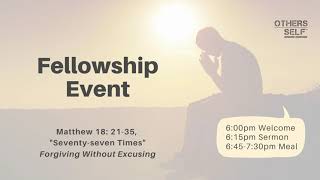
Shelly Rood examines Christian forgiveness through the story of her son Oliver's medical crisis and a nurse's mistake. She argues forgiveness is an action, not a feeling, and requires a clear moral stance. Drawing on Matthew 18 and the Charleston church shooting, she shows why we forgive not by excusing wrongdoing but by releasing the debt others owe us.
Chapters
Welcome everyone, and I'm glad that we can all be here tonight to hear from Shelley once again. I don't know how many of you were here a few weeks ago when she shared, but it was very, very good. So we're excited to hear from Others Over Self once again. And we do have a church that meets right in this room every Sunday at 11 AM. So if you don't have a church and would like to visit us sometime, You are always welcome, and every Sunday, 11 AM, right here. So we do want to welcome you. So I'll just pray and then we can get started. All right, Lord, we thank you that we can be here in this room tonight. We pray that you will speak to us. We pray that you will glorify your name in our midst. We thank you. We praise you that we can all be here tonight. In Jesus' name, amen. Amen.
Our youngest son, Oliver, was born with special needs earlier this year. His jaw was is half the normal size, and it basically sat in his throat, which prevented him from breathing on his own. My husband and I were able to hear his first precious little cry in life, and then after that, the breathing tube went in and the feeding tube went in, and it was quite a while until we heard another sound out of Mr. Oliver. And it took a toll on the family, truly. You know, we couldn't even hold him for quite a while. So just for a moment, for a moment, I want you to be conscious of your tongue in your mouth. Go ahead and feel it. Press it behind your front teeth, press it up on top of the roof of the mouth, and kind of like a raking motion, bring it all the way back to the back of your throat. So what you're feeling is your hard palate, your soft palate, and then your uvula that hangs down. You remember playing with that in the mirror when you were a kid? So Oliver was born with none of that. That's what you might know as a full cleft palate. So our situation, our family family situation required intense medical intervention, and the birth of Oliver came with the birth of the pandemic that we are in right now. So we were forced to be in a treatment hospital setting for long periods of time, and this was a time when really globally we were faced with chaos, we were faced with mass confusion, and the game kept changing every day. Something else, something new happened. Now by Day 2, the masks went on at Oliver's second day of life. And by day 3, that mandate was doubled. So now it's double masks or the face shields, and then the additional layers of protective clothing. By day 7, my husband had been laid off. And so our family finances and medical bills were through the roof and really in uncertain times. And then by day 7, we were told that we could only have one parent visiting the baby in the NICU. By the grace of God only, truly, Oliver survived surgeries and treatments day after day, mishap after mishap, and we could get through it all. We truly could. There's one time that really sticks out very strongly in my mind, and we had to change places out in the parking structure. Now, from the time that it took for my husband— for me to leave the room, go out to the parking structure, tag team him, hand off the pass, and for him to walk through the building to the NICU, which is the ICU for babies. He came into a room that was empty except for the baby, and the baby was swaddled like a mummy. You know how babies are stuck like that, and the baby couldn't move, was clearly having trouble breathing, and was in a lot of distress. I'm confident that if my husband had not walked in at that moment, we would have had a tragedy in our family. So when I walked out of that room, a new nurse that had never treated Oliver before was on shift, and she came in and performed oral care, and then she left. Well, if you remember, Oliver doesn't have the roof of his mouth, so he had a piece that's a prosthetic palate. It actually looks like a retainer that you stick in there, and it goes on with dental adhesive, or like dentures, you— it's glue, and you pop it up there. Well, this nurse had never done it before, and she had used so much of the glue that it fused his entire mouth, his tongue, his lips. Everything was glued shut. How do you forgive something like that? Of all the things that we witnessed and occurred to us day to day throughout everything that we went through with Oliver in those moments, we were very forgiving and very patient. When it comes to something like that, how do you forgive it? And I'm not the the only one in this mindset. Paul the disciple has this very same question as he's traveling with Jesus and the other disciples in Capernaum. So we're referring to Matthew chapter 18, 21 to 35 this evening. The narrator is Matthew, also known as Meticulous Matthew. He loves details, much like myself, and he actually records a lesson that's sparked by a question from one of the other disciples, Peter. So Peter is wondering how many times "Should a brother be forgiven?" If you don't mind, I would like to ask you to just stand and read at least this first verse for me. Then Peter came to Jesus and asked, "Lord, how many times shall I forgive my brother or sister who sins against me? Up to 7 times?" And Jesus answers with this direct statement. Aloud once again, please. "I tell you, not 7 times, but 77 times." Excellent. Go ahead and take your seats. So Jesus then goes into a parable that we're going to dig into in just a few minutes, but really our discussion today is framed mostly around this concept of why we even forgive. And then we are going to look deeper into that biblical term and the biblical use of the word forgive. And we are also going to touch briefly on how. How can we possibly apply a forgiving heart in an unforgiving world. So as we learn to be forgiving of others, I'm gonna give away the answer. Why? Because the Lord has forgiven us for far much more. And we're also learning how. And in that answer of how, Jesus has provided for us a general principle about the technique of Kingdom work. And if we apply it, we actually have the opportunity to bring a bit of heaven on earth. So that is the goal. Walking away today. Moral injury. Raise your hand if you've ever heard of the term moral injury. It's a bit of a hot-button term right now, especially in the mental health world. It's a psychoanalytical term, and it refers to the intense psychological distress that one feels when it follows either actions or inactions, lack of actions, that strongly clash with somebody's moral or ethical code. It is different than trauma, Post-traumatic stress disorder actually is a fear-based reaction, whereas moral injury is based in judgment, and it actually requires that you have a working conscious. Now, the two do share quite a few symptoms, such as depression and anger and addiction, but moral injury actually has no treatment, diagnosis, or protocols for how we move forward with it. It is very, very real, and it is recognized in the medical world. Now, even though Although Oliver survived that situation, our family was truly marked with moral injury. We believe that the inactions of the nurse and the support staff hurt us. We felt very, very betrayed. We felt that the value of human life was not elevated to the level that it should have been in the moment. And I would like to tell you of another story, another woman named Felicia Sanders. And Felicia also has feelings of betrayal, rightfully within her life. I lived in Charleston, South Carolina for many years, and on my way to work one day, I found myself stopped by cars, traffic unexpectedly, roads were closed, police blockades were up, and I came to learn that the night before, a young man, only 22 years old, had walked into a Bible study and had opened fire and killed 9 of the participants. Miss Sanders actually survived the shooting, and she did it by pretending to be dead and by holding her granddaughter, both of them pretending to be dead. But unfortunately, her son was also there, and her son did receive multiple wounds. At the sentencing hearing of Dylann Roof, Felicia Sanders, a mother of one of those victims, tells him I forgive you. How do you forgive that? And even before we can grapple with the question of how do we forgive that, why? Why are we even thinking that we need to forgive these types of heinous actions or even simple hurts against ourselves? The Bible includes two types of forgiveness. It includes forgiveness where God pardons our sins, and it also includes our obligation to pardon others. In this particular chapter of Matthew, the parable that Jesus tells compares the Kingdom of Heaven to being like a king on earth who wants to settle the accounts with his servants. Now, one of his servants owes an incredibly enormous debt. We are talking about 10,000 talents, or 10,000 bags of gold. And so as the servant comes forward, he says, "I can't pay." That amount is so massive, it's actually equal to the amount that David provided to help build with the construction of the Temple. And so comparatively speaking, the modern equivalent of 10,000 bags of gold is millions and millions, potentially even billions of dollars. If one talent is worth 600— excuse me, 6,000 denarii, and one denarius is the equivalent of one man's day of wage, wages, we're talking about a debt that would take over 164,000 years to pay off with no days off. If you're that far in debt, you don't get any days off. That's when you need those days off, right? So in front of the king, this man proclaims that he is unable to pay, and the master commands payment in full. And since he can't do it— no bankruptcy— and since he can't do it, the king orders servitude of the man's family. It's very common in biblical times, especially in the Old Testament, for the spouse and the children to be sold as slaves, essentially, to help contribute towards the debt. The servant falls to his knees, he worships the king, he's asking for patience, and he promises to pay in full. The king forgave the servant's debt. That action says so much about the character of the king because The king is introduced as a just ruler, right? He wants justice. He says, "Bring me my servants that are in debt. I need to have these accounts reconciled." So not only is he just, but his depth of character is revealed through this choice to forgive this man's sizable debt only after the man's sincere bout of pleading with patience, for patience. And it really alludes to the notion of this entangled with evil as part of the kingdom that leads to repentance. What's really interesting to me is this king— he saw no error in adjusting his decree because after he hears the pleading, he forgives the debt. How many kings do you know of that make a decree and then go back and change it? Kings don't do that. So not only do we see a picture here of a just king, but one who is compassionate, and he holds no no fear of his court's judgment in his choice to adjust those decrees. Now sometimes later, that very same servant, he finds a fellow servant who actually owes him a debt. And this fellow servant's debt was only 1% of the massive debt that he actually owed to that king. Now he goes up to this fellow servant, grabs the guy in a chokehold around the throat and demands, "Pay back what you owe me!" Melody's face— I know, can you believe this? And a similar scene occurs of what we saw with the king. So now this fellow servant, he falls to his knees, he is begging, he says, "I can't pay you right now, I just— I'm asking for peace, I'm promising to pay you in full." And the man forgave the fellow servant's debt? No. No! Can you believe it? He did not! No, he actually had the man thrown in prison and took the debt was paid in full. So the community hears about this, they're not happy, they're upset. So what did they do? They go run and they tell the king what is going on. Can you believe what he just did? So the king has a private audience with the servant and calls him in. Oh, to be a fly on that wall, right? The king calls the servant in, reminds him why his own debt was forgiven, and then he says this: 'Shouldn't you have had mercy on your fellow servant, just as I had mercy on you?' In his anger, his master handed him over to the jailers to be tortured until he should pay back all that he owed. If you remember the king's original punishment, did it include torture? No. So this time, why do we think that it included some sort of physical punishment? Because that servant got physical with the other servant, right? He put him in a chokehold and demanded. Well, you just upped the ante on your expectation of how we should be treating each other. Now, in a concluding verse, Jesus actually applies this lesson to unrepenting people at large. This is how my Heavenly Father will treat each of you unless you forgive your brother your sister from your heart. Now, when Jesus died on the cross, he took with him this eternal burden that all of mankind holds. We are inherently sinful, right? What started with Adam and Eve has only compounded over time. Generations and generations have led to us. Generations of screw-ups, generations of mankind trying to figure it out. Really doing horribly wrong with it. And so it was through the full reconciliation with God, through that act of the purest human ever to walk the earth. In the academic article titled "The Unforgiving Servant," Blomberg points out that that concluding verse, it really fits the parable because it brings out the point about the change of heart that is demanded by the love of God made manifest in Jesus' vision of God. So why are we so forgiving of others? As the Lord has forgiven far more in us. Now, before we can take steps on how to be more forgiving, we really need to have an understanding of what the biblical definition of forgiveness is. The Bible has plenty to say about forgiveness, and really it goes back to those two very specific ways. It goes back to God's pardon of our sins and our responsibility to pardon others. In an article titled "Five Myths About Forgiveness," theological scholar Dr. Maria Mayo points out, and I'm gonna read this so I don't screw it up: while Jesus mentions forgiveness several times, he never defines the term, leaving contemporary listeners like ourselves to fill in the blanks. So is forgiveness something that a person does? Does it indicate an action such as reconciliation or amnesty? Does forgiveness require action on the part of the offender? Is forgiveness something that a person feels? While modern conceptions of forgiveness focus mainly on its emotional dimensions, in Jesus's first-century context, forgiveness had more concrete implications. Now, the Greek word translates as forgive in the New Testament, which is aphaesis, carried a wide range of meanings, and it includes to remit a debt, to leave something or someone alone, to allow an action, to leave, to send away, to desert or abandon, and yes, even to divorce. Now, in fact, the Greek word for forgiveness actually appears 146 times in the New Testament, but it's only translated in most English versions as forgive only 38 of those times. Dr. Mayo makes it clear that biblical forgiveness was an action. Rather than a feeling. So what does biblical forgiveness actually look like? It looks like emitting a debt, something or somebody leaving them alone, following an action and allowing it, like allowing a hug after a fight. That's always really hard, isn't it? So mad, you're okay, let it out, leave it maybe even sending someone away, or even abandoning our focus on the topic. That's what biblical forgiveness really and truly looks like. It's action and not emotion. American terrorist Dylann Roof, he received the death sentence, and in a media interview, Reverend Sharon Richer, whose daughter was slain, said that she is against the death sentence. I still don't want you to die, die, she says to him, adding that she wants him to sit in a jail cell.
How?
Now that we know what forgiveness is, how do we forgive others, and how do we determine what action or what lack of action actually requires forgiveness on our part? Now notice that this particular parable follows Jesus's teachings about sin within the church. We need guidance on church discipline, and so we turn to Matthew chapter 18:15-20 for that. Forgiveness does not mean that we overlook sin. Church discipline cannot be carried out without a willingness to forgive the sinner. There are two pieces to the forgiveness. Defining sin brings us back to this issue of morality, and it's a very, very highly debated and very personal topic. Now, as Christians, we are being held responsible for our interpretation of scripture and for our teachings and living out of that scripture every single day in life. When we make it into those gates, every moment of our life is played before God, and whether we like it or not, he alone decides our eternal consequence. Now many years ago, I found myself as a struggling mom, a single mom, barely having enough money just to get by, but we did, we got by. And I'll never forget when my phone rang one time and it was an old Army buddy, so glad to hear from him, and he was struggling. He was struggling. He had an amazing career, he had an amazing home, home, his lifestyle was breathtaking, and yet he found himself in the situation of having to deal with an unplanned child. The true struggle was not that it was an unplanned child, it was that it was turning into an unwanted child. Up until that moment, I personally did not know how I felt about the abortion issue. I'll be honest with you, it was a topic that didn't personally affect me in my day-to-day life. So, you know, I was a woman born in the '90s, right? Women's rights, all of that. And so I just kind of let it be, and I never dug into it. But when my dear friend told me that he was considering this injustice against a life, I couldn't even speak, and I was shocked at the words that came Well, I said to him, give me the child. I can't raise that child very well. I'm a single mother barely getting by with my own son, but I could not fathom the thought of this incredible man's child perishing on his own accord. And it was then that I finally learned where I stand on that ethical issue. There are so many ethical issues. In fact, there's actually 11 of them, and we're going to go through them because it has to do with your ability to converse with other people as we try to have conversations and forgive. Now, how we determine what needs to be forgiven really does depend on where we stand morally. Theological scholar Scott B. Rae points out that technically morality refers to the actual content of right and wrong, and ethics is referring to the process of determining or discovering what is right and wrong. So that's the difference. Morality deals with knowledge, and ethics deals with moral reasoning and justification. For the sake of today's message, we are proposing that there are at least 11 areas of ethical importance. Importance. And your homework, really for the rest of your life, is to make sure that we are giving conscious thought to each of these 7 areas. I am going to read them for the sake of the recording. Beginning of life: where do we stand on issues including abortion and fertility treatments? Biotech, genetics, and human cloning. What about end of life? We're talking about medical intervention and suicide even. Where do we stand on capital punishment? Reverend Sharon Rischer, whose daughter was slain, didn't she— she knew where she stood on that one. War and violence, sexual ethics, creation care and the environment, economics, money and business. It is a spiritual matter, is it not? Violence and gun control. Control, race, gender, and diversity, immigration, refugees, borders. Can we all just picture the holidays coming up and how many of these things are going to be flying around our tables? Are we not terrified to have these discussions? Forgiveness of others really starts with the recognition of our own sinful nature. As our sins have been forgiven, it is key that we're embracing a biblical worldview and that our ethical stance is in alignment with Scripture. And then we can work to bring that truth to the world, shining brightly as the beacon of hope. It's my sincere hope that we are never challenged with a situation like Miss Sanders, and even so, people are inherently sinful. This world is fallen and broken, and that is not going to change anytime soon, regardless of your political affiliation. It starts with how we are interacting with each other. Now thankfully, Jesus has provided us with a guiding principle about the technique of kingdom work. In sending out the 12, Jesus said to them, I am sending you out like sheep among wolves. Therefore, be as shrewd as snakes and as innocent as doves. Oftentimes that word shrewd is translated as wise. This lesson is actually from Matthew once again, earlier though in chapter 10 before this lesson on forgiveness. Now when it comes to applying this lesson of forgiveness in daily conversation, it really starts with knowing what you're up against. 19th century pastor Charles Simeon provides this wonderful comment comment on the serpent and the dove imagery. Now, the wisdom of the one and the harmlessness of the other are very desirable to be combined in the Christian character. Ready for this? Because it is by such a union only that the Christian will be enabled to cope successfully with his more powerful enemies. By embracing both wisdom and innocence, we as Christians stand in stark contrast to the rest of the world. And we have the opportunity to bring a little piece of the Kingdom of Heaven down here on Earth. And it doesn't happen through a heated conversation on the holidays. It happens word by word, minute by minute, every relationship interaction that we have. One last thing on how we forgive. Let us remember what it looks like to sin to us, especially in the Christian mindset, that might not look like sin to the sinner. According to a media report, a video interview of that terrorist, Dylann Roof, it was conducted by an FBI agent shortly after he was captured, and it shows the shooter laughing. I can hardly say this. It shows the shooter laughing as he admits to the shooting. "I am guilty," he says in the video, laughing. And if you've ever seen that video, it is heart-wrenching, and I I couldn't even bring myself to show it to you. So how will you react to a more powerful enemy? With wisdom and innocence. What does forgiveness look like? An action, not an emotion. And why do we forgive others? As the Lord has forgiven us far more. You each should have a handout with you on the daily application of today's message. I hope that you will use that as a guide as you're interacting with people. Do your prep work. Know where you stand in each of those 11 sections of ethical and moral values. Not only know where you stand, but know which way and how far you're willing to compromise. And then when you're in the moment, I expect you to respond with wisdom wisdom and innocence. Learn the beliefs and the values of the person that you're talking with. And if it is a fellow Christian, then the way that you should be communicating with them should be done in a way where you are furthering their spiritual maturity. And when you're not sure what else to do, I encourage you to really learn the characters of the Bible. Find a Bible character that reminds you of this particular person and study how their heart changed, how did they come to the Lord, and maybe you'll learn some ways to plant some seeds for your friend. Now I leave you with a moment of encouragement as we do this, because this is a really hard assignment, maybe one of the hardest you'll ever get. Baby Oliver is alive. My Army buddy is a family man. Kept a baby. And a few words from others according to media reports. Bethany Middleton-Brown is the sister of one of the slain, and she said to Roof at the hearing, "I wanted to hate you, but my faith tells me no. I wanted to remain angry and bitter, but my view of life won't let me." And we will end with Felicia Sanders, the mother of one of the 9 victims who sheltered her granddaughter from fire. When recalling Roof's words words. In the confession video to the FBI, she says, he said he didn't have any friends. She goes on to say, but he had 9 friends sitting in the church that night. If only he had waited right after we had said the prayer, we all would have gathered around him and found out what his needs were, what his wants were, and we would have invited him to come back. Now we're leaving here to engage a broken world in meaningful conversation, and we have the opportunity to bring a bit of heaven down here to earth. We forgive others because the Lord has forgiven us far more.
Thank you. Mm-hmm.
More from Shelly

How to Get Time Back as a Coach or Creator: The 5 Tools I Use Every Day, ep 68 Hardcore and At Ease

ep67 “I’m the Eighth of Nine” How Listening Became a Superpower | Catherine DeDecker

How to Respond to "You're So Busy" And What to Ask Instead | Catherine DeDecker Hardcore and At Ease


Your Big Moment Runs on Private Work | Drag Racing Lessons, Hardcore and At Ease

Show Up Anyway: What to Do When You Feel Like You Don't Belong | Ep65 Hardcore and At Ease

How to Become a Lived Authority Without Anyone's Permission, Ep64 Hardcore and At Ease

Michigan's Defense Leadership, From Two Different Chairs: NDIA Scott Davis and AUSA Chuck Cogger

The Leadership Job That Never Clocks Out w/ Brig. Gen. Daniel Kramer, Ep 62 Hardcore and At Ease

How to Write a Personal Manifesto That Holds Steady When Life Won't, Hardcore and At Ease

What Advancement Demands of the Person Leading It, Hardcore and At Ease, ep 59 with Stacey Eeman SME