Top 5 Secrets for Owning Your Day, Every Day with Teena Cathey | Others Over Self Leadership
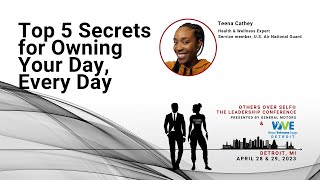
Teena Cathey walks through five daily self-care pillars: exercise (150 minutes weekly per CDC), sleep (7+ hours), nutrition, breathing, and journaling. She teaches habit stacking to attach new routines to existing ones, like squats while making coffee, and explains how chronic stress raises cortisol and triggers IBS and gut issues.
Chapters
According to the National Institute of Mental Health, self-care means taking the time to do things that help you live well and improve both your physical health and mental health. Now, with that being said, who is doing some self-care? Don't see a lot of hands raised. OK, there they go. You had to think about it. Just throw some things out. What kind of things are you doing for your self-care? Walk, journaling, exercise. Awesome. Massages. Yes. What was that? Quiet time. Yes. You all have great habits. Self-care is definitely essential. Waiting for my slide, because everything that you guys touched on and mentioned is under that umbrella for self-care. So self-care is— it can help if you keep incorporating that. It can help with chronic diseases, chronic pain, chronic stress, just to keep those things at bay. Now we're going to have stress throughout their day. That's just how we are made. It's just from far way back when we had to use it for survival. So stress, that fight or flight, is there for a reason, but it should not be on every day, all day. If you are— how your cortisol levels are really high, you have like IBS syndromes or irritable bowel syndrome or things like that, gut health, gut issues, it could be related to your chronic stress. If you're always worrying about something, that plays a role in that. And having some kind of self-care can help combat that. So things like exercise, you don't have to do a long— CDC recommends 150 minutes a week, which is what, 5 days a week for 30 minutes. Or you can do— trying to do my math in my head. You can do it shorter, 3 days a week, 50 minutes to 60 minutes. So it doesn't have to be a lot. It doesn't have to be long, and it can be something that you enjoy. Nutrition. Who knows that nutrition is healing and nutrition is healthy, right? Everyone, everyone knows that, right? Who actually does that? Who actually focuses on nutrition and worries about what goes in their body? Good. So would you— if you don't, that's absolutely fine, to each their own. But eating whole foods, plant-strong, things that are good for your body that make you feel good is going to help with your health. It's going to help with your stress. Because if you're eating things that raise your blood sugar really high and you get so high up there and you get that crash, it's like it's going to hit you hard. You get a hard high, a hard low. And eating something that's going to— that's nutritious, giving your body what it needs, is going to help with those stress levels. Sleep. Who gets 7— I did not do that. Who gets at least 7 hours of sleep every night? At least 7. Probably like 5 of you in this room. What are you all doing, watching Netflix? Binge watching? Yes. So sleep is important for recovery. It's essential. We need it. It's what our— when we're asleep, our body is doing all these great things. It's recovering from your day, building back those brain cells that we lost. So getting that sleep is going to be very important. Massages. Someone said massages. That's something that you can do as well. Relaxing. It's a dog right here. This is— I want to be like this right now. Relaxing, even just sitting down in a quiet spot, breathing. There's a lot going on in your day, and you might not be able to be able to go get a massage or work out at the moment. Just going in your room or even sitting in your car and just breathing, inhaling and exhaling can help lower those stress levels as well. Writing things down. I do that all the time. I have notebooks. I love notebooks. It is a great thing to do, a great practice. Again, you can use tech if you're a tech person. The old school pen and paper, that works as well. Gratitude. Who can tell me the definition of gratitude? Yes. It's just being— just as you said, Carmencita, just being grateful for what you have and where you are in the moment. I like to look at the silver lining in things because there's always I want to say always, but bad things or negative things happen even to good people. But it's good sometimes to see the silver lining of things because it could be worse. I think I was just talking to someone else about that in the bathroom. Like, it could be worse. I want to use a friend of mine yesterday. I want to say her name. She just walked in the room and she's pregnant. But like, she had to switch cars yesterday. And then she told me— I'm using your story because it's so awesome. So she had to switch cars yesterday because her battery ran out. And then they were going through a drive-through, and the guy was like, oh, it must be nice to be able to switch cars. And then her son was like, huh. You know, it's like the silver lining. Like, it's just those little things. And sometimes it takes the outside person to kind of like let you know. Hey, you know what? You're still good. Staying connected, that's one more I forgot. Who is still connecting with people, friends, or whatnot? After COVID, I know it might have been a little hard to reconnect, but keep connecting. Try not to isolate yourself. I know sometimes I like— I'm a— I think it's an ambivert. Is that the right word for it? I am OK with being alone. I don't mind being alone. Sometimes I like doing things like this, talking to people, engaging and whatnot, networking. But then sometimes I'm like, oh, I need to go home. I need to just be in my robe and just chilling. And don't no one talk to me, not even the kids. Like, leave me alone. You're hungry, figure it out. Sometimes you need to do that, like sit by yourself again, whether it's in your car, um, and whatnot. And also stay connected, have those accountability partners. So those days where you are a little stressed when it's a little too overwhelming for you, when prayer, meditation, exercise, those things are not helping you, have someone to lean on and someone to talk to. That getting what your thoughts out of your head, if you have that person to go vent to, is very healthy to do. It's not to say that you're being a negative person or you're doing that all the time. Again, you want to have those solutions and routines set up. But stay connected with people that you trust. It can be a peer. It can be someone that you are aspiring to be like. It could be a colleague, someone at work. But stay connected with people so that way when you are having those rough times and it's a little too stressful and overwhelming, you have someone to go to and talk to. Here's another general prompt. So what is the best time of day for you to engage in some form of self-care, and what will it be? If you're not doing it now, write that down, think about it, take that inventory. If you are and you want to introduce something else, then think about something else you might want to try. I just bought some skates. I think I've used them like 2 times, so my, my new form of self-care is going to try to go back roller skating. All right, here's a little nugget for you to take too. If you change nothing, nothing will change. So it's going to be uncomfortable. Change a lot of times is uncomfortable. Setting new routines and habits might be uncomfortable, and it, it's all for the greater good. It's going— if it's going to help enhance your life, your lifestyle, lower that stress, then I'm all for it. Do it. If it's positive, then go for it. Ways to lower stress. Prep for today yesterday. So what does that mean? Prep for today yesterday. So if, for example, I'll use myself for today. So I prep for today probably like a week ago. Then I had a halfway point to where I prep more things, and then the day before laying out clothes, packing my bag, getting my breakfast together, figuring out my route. So then that way when I get up in the morning, just in case that alarm clock doesn't go off, or let me be honest, just in case I hit snooze 2 times, I am not going to be late. I'm going to get out the door on time. I don't have to worry about it because all of my stuff is already where it should be. My clothes, I can just hurry up, jump, wash up, do what I need to do, get out the door. Same thing with the kids. I do this with the kids too. Get your— at a certain time, shutting down the end of the night. Oh my goodness, do I sound like a military person? Shutting it down at night and then laying out whatever snacks you want to grab for the morning for breakfast, lay out your clothes. That way there's no, oh, I don't want to wear this, or I can't find that, or I'm hungry. And then we're just out at a certain time, 6:50, we're out the door. It works. It took a little— it was a little rough at first because again, they're bonus kids. I have a 5-year-old and the other ones are teens. It was rough at first, but now I think we got it together. I I left him with Dad today, checked in. He said it worked out, so we're good. Be flexible. Who all— this is, this is gonna go back to change. Now, there are— as smooth as those mornings are sometimes, other times they're not. The other day we tried to go out the door and, you know, have the same routines or whatnot. I guess the 5-year-old decided that she didn't want to get up. She didn't want to brush her teeth. She didn't want— she just didn't want to. So that's where I had to be flexible. It's like, OK, you know what? It's fine. I know you're tired. I'll just basically do everything for you. I'll help you brush your teeth. I know I'm trying to get out the door on time. But if I lose it while she's losing it because she doesn't want to do it, that just creates chaos for everybody. And sets the tone for the day. So we want to try to take those deep breaths and then be flexible, go with that change. And same thing for work. Again, you might have something planned that you wanted to do that you needed to finish, and your boss probably comes in like, hey, we're going to start a meeting in 5 minutes. But you're like, wait, I have a deadline. There's stuff that I need to do. So being flexible is, is definitely going to be key. Sure. It does. So that's where those tools and routines come in to just stop, take that breath, and you can only control what you can control. So if it's beyond your control, there's kind of no point to getting stressed. But if that takes you there, there's tools that you can fall back on like that breathing and just know like, you know what, this is something that you got to pick your battles essentially. So if you— if those times come up, you know what, there's nothing I could do about it. Let me just breathe and just go with it. That's what I mean by being flexible. Great question. Meditation. Who meditates? Good. Do you guys meditate long? Is it short, long? Do you have a time limit? Short, however long you do it, there's great benefits in it. It helps reduce blood pressure, can ease IBS, can help relieve symptoms of PTSD. Just sitting there and just taking a breath. I know a lot of this is like breathing, it's super simple. You're just like, okay, if I'm stressed and I'm, you know, driving and someone cuts me off and I'm like super pissed about it, like, is breathing really going to help me? You gotta think about it like, is that something that you can control? Can that person even really hear you? Does it even really matter? So just take that time to slow down. And I know in this day and age it's hard to slow down. It's hard to just stop and take those breaths, but they do absolutely work. And I say this because I use it myself. And then there's different forms of meditation you can do. There's walking meditation. Where you can go outside and go for a walk. There's sitting crisscross applesauce. Do you guys know what that means? Sometimes I throw out kid terms and I just don't know if everyone knows what it means. So just sitting down, legs crossed, lying down flat on your back, just laying there breathing. That's a form of meditation. Your form of meditation is however you want to do it, however you feel comfortable to relieve your stress. It can be spiritual, it can be transcendental, it can be visualization. So if you want to focus on something, close your eyes, or have something in front of you, and you just focus on that and get everything else out of your mind, that is a form of meditation. Something that you can do throughout your day. It doesn't have to take long, take like 2 minutes, 5 minutes, an hour, however you want to do that. Has anyone heard of MBSR? One. Where did you hear from it? Meditation app. Awesome. So mindfulness-based stress reduction, MBSR. So that is another form of meditation. Anyone can get certified in that too. So if you are someone who is like, HR at your job, if you want that to be brought into your job, you can have someone— you can get trained to do that for colleagues, or you can do it yourself. It can also help with the reduction— just meditation, period. It can help with the reduction of menopause. Again, it can help with— because stress can increase those hot flashes, so it can help breathing, slowing your heart rate down, and help with those symptoms as well to help you get some kind of relief. All right. I think we got another prompt coming up here. All right, this is your last one, last journal prompt, I believe. Maybe one more after that. What actions can you take today to eliminate stress tomorrow? So think about just taking inventory. What things are you doing now What can you implement to help lower your stress? Clutter. Who— look at these pictures. Whose drawers look like this? I have 2 drawers that look like that. Now we're gonna lie. Yes, clutter. Not the bedroom one. There's just like a designated junk drawer. So clutter, moving around your home and clutter. This is very stressful. Just looking at this, how do you, what, how do you feel looking at this? Anxiety. Somebody looks disgusted. I see some disgusted looks. Just like, but yeah, so anxiety, stress, disgusted. So imagine you walking your home. I know. Sometimes it gets like this depending on the day or the week or whatever, or if you got 5 kids in the house, it can get like this. So this— you guys throw all those, those words and it's like it just looking at it, it's like, man, it's bringing me down. I know it's bringing you down. So just imagine you trying to go throughout you. Outside and you've already dealt with all of your stress. Imagine coming home into that. How is that going to help your stress levels? Is that going to make you feel good? Not at all. When you walk inside your home, you want that feeling of peace, right? You want the feeling of, man, I'm at home. I can't wait to lay my head down. Not, oh my gosh, I got to pick up the shoes. I got to vacuum. I got to do this and do that. So how do we move away from this clutter. So I got some tips from AARP. One, remove the trash. Of course, you know, clear the trash out. Choose one small area to organize at a time. So this looks like a lot. It is a lot, but choose maybe one room and then maybe one area in that room to start with. A lot of times people want to go to the bedroom, to the kitchen, to the bathroom, and it— that's overwhelming. It's a lot of movement throughout your day. A lot of pieces that you need to get, things to clean, vacuum, sweep, whatever it is you have to do. So just start with one thing. Maybe it's a junk drawer. But then that junk drawer can probably snowball into so many other things. Maybe you start with your bedroom. And then how do you do that? You have a few piles. You have a donate, a keep, or even a trash pile because some things don't need to be donated. Some things do need to just go in the trash. Let it go. It was from the '70s. Let it go. OK. It is my 15-year-old. She had on mom jeans, like the acid wash. She was rocking it. Like, I'm like, you think you're cool, right? I'm like, you are. But you know that's like old school, right? She's like, this is the thing now. I'm like, OK. Shopping. Who likes to shop? But if you bring something in the house, you're adding. Do you take it out? That's exactly, that's exactly how you eliminate that clutter. If you bring something in, something has to come out. Now I will be honest, my— I am that person. My fiancé is like, what are you bringing in the house? I'm like, well, I need it for blah blah blah blah. He's like, where are you going to put it? I'm like, I don't know, I'll figure it out. And I don't. And it just ends up on his side of the dresser. And he's like, pushes back on my side. And I push it on his side. So I'm getting better at doing that, bringing stuff in the house and taking stuff out. So then it's not creating clutter. But I am good at throwing away things. Ask my 5-year-old. I've thrown away a bag of toys before because I stepped on too many, too many toys. And I know that made me sound like a terrible mom, but they were old baby toys. She's 5, so she doesn't need them anymore, and they could not be donated. So again, clearing out the clutter helps with the stress. And then what— that way, when you're going into your home, you have that feeling of peace. You can actually exhale without having more stuff to do after you've already had a full day. All right, which area in your home can use some decluttering, and how will this help your stress? And write that down again, take that inventory. Kelly, tell me when I need to shut up. All right, everyone good on this one? Okay, this is my favorite. This is— I couldn't wait to get to this one. So who has heard of habit stacking? You can't wait to reach— do you use it? Yes. You perfect. Bless you. Yes, getting those glutes ready for the summer. So habit stacking is the practice of attaching a new habit to an old habit. So again, she used that, uh, the habit stack of, oh, I'm brushing my teeth, I'm gonna do some squats. Making my coffee, I'm gonna do some squats. So it's just, you already have habits throughout your day. So if there's something that you want to add in your day, add it to something that you are already doing. It sounds simple. That's because it is. The hard part is the consistency. Are you consistent? Yay! Good for you. Keep going, keep going. It is, but with, but with control. With control because it has a purpose. So there's a purpose. There's probably an end goal that you are trying to go for. I don't know what your end goal is with your squats, but— I don't want to squat. That's a good goal. Squats actually help— having stronger— just a little side note. Having stronger glutes helps with your lower back pain. It can help alleviate lower back pain because that's part of your foundation. So then if you're sitting all day, and having that constricted spine, having a strong— stronger glutes and legs will actually help with that as well. Yes. How many have you done so far? Whoa! Oh my goodness! Yes, give her a round of applause. Goodness! Good for you! I love it. Perfect. That's a good one. Squats and then jumping jacks. So I heard, I don't know where you all heard of the term, for those of you who heard the term habit stacking. I learned it from BJ Fogg. Has anyone heard of BJ Fogg? He's an author, PhD of psychology. He created habit stack. So it's an implementation just to pair your new habit with an old one. And he has a book, and I'm gonna have a list of books too, so be prepared to write that down. So if you have questions about the books, he wrote the book Tiny Habits, which is an awesome book if you're looking to help yourself develop more healthy habits, or if you know someone else that could use that, that information. That's a great book to read on audiobook as well. So what do you do for habit stacking? Start small again, same thing with the decluttering. You want to start small. Begin with a small habit, attach something new. Choose a consistent time and location. So I'm going to use your example. You're making coffee in the kitchen. That was very specific. You're making coffee. I'm going to do my squats while I'm making coffee. Create a trigger to remind yourself to perform the new habit after the existing one. So your trigger is probably like that coffee, that coffee smell. So now every time you probably drink coffee, you've got that classical conditioning going on. You're like, man, thinking about coffee, I need to do some squats. So you want to get— have it be easy. You don't want it to be hard. Make it enjoyable. So is that hard or difficult at all? Yeah. Same with the jumping jacks. It's not hard. It's not anything difficult to do. It's something that you can just do right in the comfort of your own home. Immediately after you shower, put your socks on, track your progress. You both are tracking your progress. You're seeing your progress. So that's awesome. You can again write it down, put it in your phone, take pictures. You know, Mary, take no selfies. So you can do that. So we're gonna go into our books, book list. If you're trying to create those habits. And the whole point of creating those habits too is so you eventually don't think about it. So it's something that becomes second nature to you. So now we were taught as kids, right, to brush our teeth in the morning. So now, as soon as you get up in the morning, what's the first thing you're most likely do? To go brush your teeth, right? So that is something that our parents ingrained in us. They didn't know what they were having, you know, doing habit stacking with us. So brushing your teeth, probably using the bathroom, then after that you either shower, wash up, get dressed. So all of that is— you're already doing habit stacking. So you guys are all good to go. Um, again, more habit personal development books if you want to check those out or share that with someone else. Um, Atomic Habits is an extension of BJ Fogg's Tiny Habits. I love that book too. Look, read that like 3 times. Power of Habits by Charles Duhigg. That's also a great book. Think and Grow Rich, Napoleon Hill. Have that on hardcover, highlighted the crap out of that book. That's also a great one, um, to check out. The 4-Hour Workweek, which I think everyone should have a 4-hour work week, right? Yes, let's Let's create that 4-hour work weeks for everybody. Is everyone good on the list? Okay, I don't want anyone to miss out on that. I don't know what I'm doing. What did I just do? Okay, that's the last. This is the last journal prompt. So list one habit that you can stack on a current habit to have a more productive day. Maybe there's something that you— a goal that you've been trying to reach, whether it be physical, mental, spiritual, whatever it is, you can use habit stacking to achieve that goal. And again, give yourself grace. It's going to take consistency. It's not going to happen overnight. Some days you might forget, but continue to do that. Also, I did mention the meditation piece. I do want to say that tomorrow I will be doing meditation, not meditation, 4-7-8 breathing. There's also Laverne and Aaron that's going to be talking about that as well. So if you guys are interested more into like that breathing technique, lowering stress levels, there is going to be more pieces and extensions of that as well. All right. So that is all for for me today. I really appreciate you guys taking the time to listen. I hope you enjoy the rest of the event today and tomorrow, and see you then.
More from Shelly

How to Get Time Back as a Coach or Creator: The 5 Tools I Use Every Day, ep 68 Hardcore and At Ease

ep67 “I’m the Eighth of Nine” How Listening Became a Superpower | Catherine DeDecker

How to Respond to "You're So Busy" And What to Ask Instead | Catherine DeDecker Hardcore and At Ease


Your Big Moment Runs on Private Work | Drag Racing Lessons, Hardcore and At Ease

Show Up Anyway: What to Do When You Feel Like You Don't Belong | Ep65 Hardcore and At Ease

How to Become a Lived Authority Without Anyone's Permission, Ep64 Hardcore and At Ease

Michigan's Defense Leadership, From Two Different Chairs: NDIA Scott Davis and AUSA Chuck Cogger

The Leadership Job That Never Clocks Out w/ Brig. Gen. Daniel Kramer, Ep 62 Hardcore and At Ease

How to Write a Personal Manifesto That Holds Steady When Life Won't, Hardcore and At Ease

What Advancement Demands of the Person Leading It, Hardcore and At Ease, ep 59 with Stacey Eeman SME