Violent Positivity: Doing Extraordinary Things with What You Have Right Now
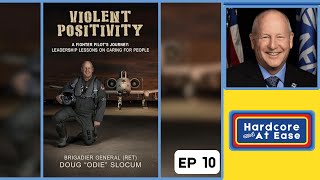
Retired Brigadier General Doug Slocum explains violent positivity, a leadership philosophy that pairs high standards with genuine care for people. He shares the 90% accuracy principle, how telling people they're good actually raises performance, and why Christian faith anchors his decisions in combat, peacetime, and civilian life.
Chapters
This show is powered by Others Over Self. Hit that subscribe button to keep training your brain. From Others Over Self, it's Hardcore and At Ease, a show about people who are keeping their edge without going over the edge. I'm host Shelly Rude, and today's guest is Doug Ody Slocum, who discovered how to inspire rather than intimidate your team while maintaining impossible standards of excellence. A retired brigadier general who led 5,000 people, Odi developed the violent positivity leadership philosophy. It transforms team performance. We're talking about the Hawthorne effect. It gets people to match your energy, and there's a conscious choice framework that's going to help you raise the bar without burning out your people. This is Hardcore and At Ease. General Slocum, welcome to the show.
It's great to be with you today, Shelley.
Now, you and I have had a little bit of history at this point. We've known each other, oh my goodness, 2018 maybe?
I thought it was pretty much since I moved here, which would be late 2014. So sometime in that area.
Yep, sometime in that area. And when I knew you, you were still in uniform. You had that great big one-star on your chest. There's just something about a general. When I served, I served on the general staff, and so I just was always there and always present. And now that I am not in the military anymore, I still like fangirl around generals, male and female, because you just, you have so much knowledge, sir, and I've learned so much from you over the years.
I appreciate that a lot. And, you know, I kind of think of it, and when you say that now, I kind of scoff, but I remember, you know, when I was in and even a full bird colonel would come up and talk or something like that and how much I was in awe. So I guess that's one of the reasons I've always tried to connect, you know, with people on that human level, you know, to try to break that barrier just a little bit so people realize it's just, you know, the reason I wear the star is to take care of people. That's it. It's nothing highfalutin or anything else. It is simply a way to open the door or get into situations where you can help people get the job done or to take care of them.
And that really is what you're genuinely good at. I mean, honestly, sir, as long as I've known you, you've been consistent and you've been constant and you've been truthful when you say that you're about people. I mean, just so that your book, for instance, one of the things that is so unique and special about it is when you get to the, towards the end of it, it's just name after name after name of people that have had a significant impact in your life. And people don't do that, sir, right? When, like, how often do you read a book and then at the end of it, the author's like, oh, by the way, props to like 2 or 3 people. But I mean, you've got props to like tens and twenties and thirties of people in here.
I have a little hall of fame in the back of the book. Absolutely. I kind of joke with the book 'cause I use people's names in the book, you know, that I've encountered throughout. And I said, well, the book's, you know, about positivity. So if I use somebody's name, It's positive. So if there's ever a situation where it's not positive, I said I relegate them to pronouns. So they just become hims, hers, thems, whatever it happens to be. So I don't use people's names in a bad sense ever.
So, and that's a, that's a great piece of advice for those of us that are trying to learn from our leadership lessons and share those lessons out with the world. We want to tell them, but we also don't wanna be responsible for any sort of you know, harm or disgrace on another person either.
That's why I said a lot of people said, you read the book? Is your name in it? Oh, and I just walk away.
Not sure.
Sucks to be you.
So tell me about writing your book because it is done in a little bit of an autobiographical style, autobiography style. But it's not necessarily an autobiography. It genuinely is a book of leadership lessons that applies to non-military people.
You bring up some great points in your question. You know, the process of writing a book, I guess I've always wanted to. I've spent a large portion, especially in my later years of my career, traveling, teaching, whether it was safety, leadership, all sorts of different things. And I actually ended up writing a safety program that was adopted by the Guard, then by the Air Force, then by multiple Air Forces around the world, which led me to traveling, teaching a lot. And I had a very specific safety, let's call it a program, I guess, that I would lay out for organizations to be able to follow. To impact how they do business. I wanted to write a book to reflect those, and I started off to write it with the principles and then trying to tell the stories, and it was always so clunky and awkward and everything. I finally just took a sabbatical and went up to a cabin up in Grayling for a week, and it was me and a laptop and pizza and coffee, and I got maybe 30 or 40 pages into it, but I realized I needed to tell the story of how I got to where I was to begin with. Before I could talk about the principles that resulted from it. So it was not intended to be that way. But as I reorganized it in a way that it would make sense for me to tell the story, it did end up somewhat like an autobiography. So it starts off when I was a little kid and tries to hit some of those highlight seminal moments in life.
Like riding your dirt bike into barbed wire.
Yeah, a few things like that. There are some pretty embarrassing stories in the book that I talk about, but, you know, I don't know how to relay my experience that led me to doing what I'm doing without sharing that kind of stuff.
And you do. You know what I love so much about this and just about you as a person is that we get the opportunity to know you. I don't wanna say intimately, but to know you at that truly personal level. We all know those leaders that never share their dirty laundry. And it's not that you wanna air your dirty laundry every day, but you do wanna be a little bit vulnerable. And this book is a wonderful recap of some of those moments of your life, um, because when you're going through your leadership journey, you know, if you've been in management or on a team for just a handful of years, that looks very different when you fast forward to a decade later and you've learned some stuff. And it's so important that we don't dismiss our failures., but we actually remember them and turn them into leadership lessons, not just for ourselves, but for others. Is that where your mind was going when you, you, when you try, because you kind of backed into that and you tried to start with the lesson.
Yeah. And it, and then to try and explain the stories afterwards was a little bit awkward. But you know, the way you just phrased that question made me think, for example, when I, when I moved from Arizona to Washington, DC, I figured, you know, that's that big sucking sound of the swamp in DC that I would never escape. From that, that I'd probably end up retiring there, you know, being a Beltway Bandit in a civilian capacity or something like that. Then this opportunity came up with Selfridge and looking at Selfridge's history, and I can remember when the opportunity came up, I just thought it was very odd, interesting, you know, possibility, threw my name in the hat. And when I was selected for the job, I can just remember sitting in my guest room at my house and staring at the ceiling And thinking to myself, why me? The base had some challenges. There were some things going on. Why am I the person who's dropping in to do this, especially from the outside? Because I was not from Michigan. It was new to the organization. But that actually is what I think the organization needed.
And what you're referring to is being chosen as the commanding general of Selfridge Air National Guard Base, which is the largest National Guard base in the country. And on it, you had the honor of leading the air wing that's attached to the base and top fighter aircraft that are on the base as well. Can you kind of walk me through what it means to be a commanding general of a base like that?
Wow, there are so many aspects to that part of your question. To me, it's about keeping the people focused. When I showed up, like I said, there were challenges and everything. As I told people all the time, I cannot forecast to you how we're going to deal with things. You know, specifically, though they're going to pop up, but we have to look at things through the lens of our core values to begin with, you know, the integrity, service, excellence. And does our response to any situation fit into those criteria the way that they're supposed to? And it takes a little bit of, you know, stepping back every now and then. The second is when you have an organization that's been stressed, I'm going to share kind of the advice I gave to my buddy when he was thrown into a similar situation. Much smaller organization in his case. And I basically asked him, I said, so how many people, you know, do you have in the wing? And I think he said, you know, 600 or 700, something like that. I said, okay, here's my advice to you. Every day, find 2 people in the organization. One, start by asking about animals and family, pets and family. I said, that's one of those non-controversial things and people like to talk about. You could normally get kind of a hook and get people to relate to you at that point. And of course, you have to share about yourself. I used to carry pictures of my young daughter around with me, et cetera. But then ask, why are they there? What was their motive? Why are they part of the organization? Ask them what they do. Ask them what they want to do and where they see themselves 5 or 10 years from now. And then end it with the great question always, and how can I help you get there? And as I told him, you're going to connect with one person at a time and you're going to build a team. And eventually that team is going to help you solve the problems. You're not going to. They are. Your job is to connect with them, lead them, have that vision for the future and motivate them, and then get the heck out of their way for the most part. But it is really about making that connection with people. So to me, you know, when I dropped into Selfridge, the first challenge there was just communication. There's never one time that you have all the people in one place at one time on that massive base with so many things going on. So we had to take this multifaceted approach of simply how to communicate to begin with. So kind of a long answer to your question there, but I think that's kind of the primer. When people ask me if I miss it, my normal question is, I think I miss the people, but I do continue to have some connection out there and I get to see folks every now and then. So it's not like I'm completely disconnected, but you know, your legacy is gonna be in the people who follow in your footsteps.
When you're outside of an organization or you retire or you leave, you still have an opportunity to make impact into that organization and into the people. You can choose, right? That's a choice whether or not you continue to have those relationships and, and want to move things forward, or if it's time truly to put your hand up and say farewell. Now, I do want to lean into a couple of things that you said there, sir, because these lessons are absolutely incredible for the leaders that are out there that are wanting to glean off of General Slocum, the first thing that you said was that it starts with core values. And before it even goes into the mission values, because as soon as you started to list off some of those values, they sounded familiar, right? Those are the Air Force values. But before we even go there, it starts with the individual's core values. And I know you as a human being, you are a Christian, And you do share that in your book, and you go into even the— you share the story of how you became a Christian.
Yep, absolutely. I think it's an important part of, as you said, you can't tell that story without.
So how— tell me about the importance of a leader knowing who they are and their personal values before they even arrive or attempt to make an impact on an external organization.
I mean, to have a vision of where an organization needs to go, to be able to drive people to the goals, you have to, if you will, have a set of a shared vision, which I think the baseline of that is going to be those shared values. So I think we've seen a lot of cases where we've seen leaders that don't necessarily have those core values set, and when they're variable and when they move and You can see how that puts uncertainty into an organization.
Can you give me an example of that that you've seen in your time?
I have studied leaders through the years, and I always like to say that I mimic the things that I like, and I make sure I never do the things that I don't like. So I kind of consider my leadership style through the years to have adapted based on my experiences and people that I know. And one example from my Hall of Fame at the end of the book that you mentioned, Bud Wyatt. He was the director of the Air National Guard. So he was the 3-star director of, you know, all the Air National Guards across the country. They were at 106,700 people at the time. But he was a federal judge by trade, and he was always consistent. You always knew what you were getting from him. Every time you walked into the office, it was no surprise. He was the same personality, the same tempo, the same value system, always being consistent. And that was so comforting. It was so easy to work within that environment. And then there's been other leaders that, you know, you kind of have to go do a temperature check. You look around the hall, you know, around the doorstop to see if he's gonna throw something at you or listen to if he's yelling at somebody to try and figure out how you're gonna have to, you know, that is a tough working environment. You know, it's—
Those challenges, I mean, you're talking about a 1-star to a 3-star. Those challenges exist at the absolute lowest level of flipping a burger and where's my manager?
So— Absolutely. And I'm gonna, by the way, you just brought that up. So I'm gonna say all through high school and college, I worked fast food. And in my office in Selfridge, I set it up on purpose. You know, we used to have plaques, trophies, all those different things all over the office. I set my office up on purpose to be somewhat intimidating to people. But my favorite thing at the end of the plaques on the wall was my 5-year employee. It was actually the employee of the month plaque from Wendy's of the summer of 1980. And then my 5-year pin was jammed into that plaque that I worked there for 5 years. And I always tell people, that's where I started. On the weekends, they made me climb into dumpsters and scrape the crap out from the inside of dumpsters and things like that. I said, but I was the best hamburger flipper that they had in at Wendy's. You have to take pride in what you do at whatever level you do. You have to take that ownership. And I think that translates. You have to be good at wherever you are right now. And that's what's going to prepare you for that next step, whatever it happens to be.
Why did you set your office up to be slightly intimidating or intimidating to anybody that comes in? Because that's a very unique point of view to set up an office, right? Like a counselor would do the absolute opposite of that. And here you are leading hundreds of thousands, and that first feeling that you want them to have is intimidation. That's interesting to me.
Well, however you want to phrase it, I say intimidation, maybe not the right word. I want it to leave an impression. We actually did a study. It was fun because it became a point of contention, a fun point of contention between me and the folks who followed me out there at Selfridge, painting the office the right colors. And I wanted, because of the history of everything out there, I wanted it to be very calm, you know, soothing, relaxing type of a thing. And it was this ended up with this— it was almost like a baby blue color that we ended up painting everything. And it was very much on purpose. And like I said, and then the decor of the office, and then there were couches that were set up. I never like to sit and talk with people with me behind my desk with them sitting out there. It would be if I'm going to talk with somebody, I go sit on one couch, they sit on the other. So to me, it was a lot about just controlling the environment because that's going to set the expectations, I think, a lot. But when people came into the office, I also wanted to know that they're dealing with professionals, know what we're doing, that have the credibility and that type of a thing.
So yeah, I love this so much because, you know, the care and the time that I've built, that I've spent into building my own studio here. And when I jump on phone calls that are Zoom, I mean, how many of those do we do right every single day now? But I'll jump on with the head of some major organization and my setup will look better than theirs. And it, and I love that. I love that it leaves an impression. That's such an, that's such an incredible nugget to take away from you, sir. And I also wanted to lean into this part of the leadership wisdom that you just shared with us. It starts with the core values, and you said that right off the bat, you want to leave an impression with one of your new teammates that I'm not walking in here to tell you that we're going to fix this huge conglomerate of issues, right, which usually exists whenever you walk onto a scene, if you will. But what you said is, what I can provide is the lens that we can look through as we move forward together to handle it.
Yeah. Yeah. I mean, it really is about building the team and letting people do things. The smartest thing you can do as a leader is surround yourself with smart people, organize, train, equip, and motivate them, and get out of their way. But the way you just asked that question made me think when I very first showed up at Selfridge, in fact, I hadn't even taken command yet. It was one of the group commanders, one of the key leaders at the base said, hey, why don't I go drive you around and show you some things? I'm in civilian clothes and we're driving around and we go past this one part of the base. And he said, yeah, when this and this happened, and pardon my French, he says, I got torn anew. And I remember I pulled the car over and I stopped. And I said, you know what, I have no idea what's going to go on between you and I for the next few years. And, you know, as I take the leadership here, I said, but I can guarantee you, you will never summarize a conversation with me the way that you just summarized the conversation that you just had. I said, that is not how we're going to deal with each other going forward. And it's just setting that expectation. I think a lot of times with people, hopefully it left the right impression. With folks. And one of the things with leadership is sometimes you get feedback from folks that a lesson has taken hold or they've learned something based on that experience. A lot of times you don't get that feedback necessarily. But when I see some of these people that have now gone on, one of these key leaders that I'm talking about now is a 2-star general. The good friend that was in Puerto Rico that I talked about, get to know each other, whatever, he is an active duty 2-star general now. And he was a colonel at the time of all this, you know. So I smile and think, I hope that, you know, maybe I've had a little bit of influence on some of these people that have cool future roles. The ultimate of that is, I tell people now, makes me feel old, you know, but we have this new chairman of the Joint Chiefs of Staff. It was the 3-star Guard general who retired and then was brought out of retirement and now is running everything from the Joint Chiefs level. He was one of my students. I taught him to fly F-16s. So I feel kind of old. I hope that, you know, Maybe it just had a little bit of part of the law of primacy of preparing this great warrior for what he's doing now.
There are so many things about you, sir, that are hardcore. I mean, you've flown some incredible jets in your day. You've obviously been in charge of a lot of different things, but I want to know how you would define yourself. What in your life are you so hardcore about that it just drives your actions and your decisions? Every single day.
I think it was a hard-learned lesson for me. You know, I like to define things if I look back on my career, and I think that's why I wrote the book. And I tell people, when you look at the COVID the guy that helped me with the COVID between the photographer and the artist and what they did, I said, it is a cool looking, you know, it's an A-10 in the background. And I said, you think we're talking about putting warheads on foreheads and all that cool stuff.
It is cool. It's so cool.
But really, The book is about caring for people. It's about safety things. It's about saving lives. It's about how to improve quality of life and things like that. And I was put into a position in Washington, D.C. Once again, I was a fighter pilot, got to do all those things. I ran safety programs, not just national level, international level suicide prevention programs. For a year, I was the spokesperson for the Sexual Assault Prevention Program. Who would figure that a fighter pilot in a flight suit would be standing up with that as a topic.
I, you know, I wanna lean into that, sir, because I come from an Army background and you're Air Force, and I know that they're two totally different beasts, but there is something extremely special about your personality and what you bring to the table as a top-level leader because you do have that consistent leadership. You're not somebody who's gonna go off the rails. As you just shared, you know, having to pull that car over and, and tell your subordinates, listen, I'm not gonna do that. That's amazing. That's very rare from what I've seen in military leadership. And I, I wanna commend you on holding up your leadership style. And obviously you've coined it at this point, violent positivity, but it's such a gentlemanly way to lead. And I think we need more of that.
And, you know, to get back to the point of the title, a lot of people, you know, the title itself, Violent Positivity. And I said, well, one, it's about positivity. So starting with that second word is we are so bombarded with negativity nowadays. And I'm guessing a lot of what you were just talking about with leadership comes from leaders who probably took that authoritarian negative approach to dealing with people.
Well, I mean, on my desk I've got, you know, good old Patton's quotes right here next to me. Like, this is the Army fashion 100%, right?
Well, he's a wartime leader too. That's, there's a little bit of difference with that. And I'll lead into that with it. But, you know, just focusing on caring for people and everything else, you know, there's a time and a place. When I retired, not long after I retired, you know, I spent a year running for Congress unsuccessfully. But I can remember at one of the town halls, it was a question that I was asked when somebody said, you know, well, you're just a general. If somebody doesn't agree with you, you just give an order or whatever. And I, I said, all right, let's talk about this a second.
Yeah, that is not how that works.
I said, there are like 5,000 people that work at Selfridge. You know, when you look at the wing and all the associates, tenants that are out there at the base. And I said, I've been there almost 5 years, and I would dare you to find anybody at any given time that in that 5-year period would characterize a discussion with me as I got ordered by General Slocum to fill in the blank with anything. So that's just not how you deal with people, especially in a situation like this. Now, if I'm a flight lead on an F-4 or F-16 in combat and somebody shoots at my wingman, I am going to be very directive. I'm going to tell him, break left, or tell him or her, break left now. And I don't expect a discussion, an explanation, or anything else. I'm being directive because that's what needs to happen in that situation.
Yeah, but you're not following it up with that bleep word either. Turn left now.
Bleep. Well, I'm sure that's probably said on the intercom, but I guess my point is that there are situations where you need to be directive. And I used to use the example, I said, I love my daughter. I always used her as an example. I always showed her picture at the end of every safety briefing when I talked about safety is always about family. Most of the time I'd get choked up talking about it because it does get very stinking personal. But I would use the example, I said, my daughter is running towards a busy road. I can explain to her the kinematics of a vehicle and what if you were to impact it and how that could— we could get into this long discussion about that. But if she's running towards the road, this little darling that I love to death, I'm going to yell, "Stop now!" And I expect compliance right then and there because this is a life and death situation. Once I get her into a position where, okay, now things are safe, give her a hug, and now we can have this geeky conversation about the kinematics of cars. So there are, I guess, times and places. And that's why I was saying with combat leadership, there are times that you just are directive.
You make an incredible point here that there's a difference between being direct and being derogatory.
Oh, absolutely.
That's like a huge— there's no gray area. I really don't think there's a gray area there. I think that that's a black, black line that is drawn in leadership. And I think there's a choice to make as to whether or not you are going to be a direct leader, which you should be, or if you're going to be a derogatory leader, which a lot of us tend to lean in that direction, if not by social pressure, right? Maybe it's not within, you know, how you feel as a human being, I mean, or as a Christian or, you know, whoever or however your values sit. But it's easy, isn't it, to share in those really derogatory comments and to lean into the dirty jokes? But I know you've also been the one responsible for lifting up a zero tolerance policy.
Absolutely. Back to the topic of the sexual assault and everything else, making that very clear, as I would tell people unambiguously, this is our core values. Here's what we can expect. We would talk about the continuum of harm, and I would say, where on this are we allowed to sit? And the reality is you can't draw a line anywhere on here. So it has to be over here on the side. I said, so how much of this is going to be acceptable? Absolutely Zero.
So the continuum of harm is a tool that every leader should pay attention to and teach.
Well, it's anywhere from, as you were talking, off-color jokes or something like that that people deem harmless, all the way over to sexual assault and rape and the like. And, you know, that's why I said, where on this continuum do you think is the okay place to draw the line of what's acceptable and what's not? And that's where I get to the two This is the value of the organization. And I can remember, you know, I kind of stole it from an Australian general who made a video that was famous there for a while. But it basically was, here's what is expected from you in this organization when it comes to our values. And if it's not compatible with you, or you can't meet up to these standards, get out. We don't want you in this organization. This is simply the way we have to be in certain cases. I'm talking At the moment, you'd say I'm not being positive the way that I'm talking. But at the same time, I think actually the boundaries of the expectations of the organization, that's going to define our culture. I think it's actually very, very positive. I'm not calling anybody a name. I'm simply saying, here is the line in the sand that we can't cross as an organization. And something else you said I want to share. Sorry, I'm going to share a story. My lesson, my leadership lesson of Applebee's, because I just love it because it it is a shared experience with my buddy. I mentioned Ed Vaughn, callsign Hertz, more than anybody else in the book from our adventures through the years. But we went to a restaurant and it was an Applebee's restaurant. Half the restaurant was empty. The employees didn't quite know what to do. There's nobody at the tables.
So were you in uniform? I just have to know.
No, this is not— we were just not in uniform.
So you're just a random dude walking in with a buddy.
Yeah. And we're just observing right now. And the employees didn't know what to do. The tables weren't full. They couldn't get the food there. The customers were frustrated, the employees were frustrated, and the restaurant's not making money. I said, and we were kind of watching this clown act go on. In walked this leader guy, kind of in a nice little suit or whatever, and he comes in and starts telling these young employees, okay, you over here, go do this. You over here need to do this. You do this. He was giving direction. He was giving a framework of expectations. And pretty soon the people got sat down, the food was coming up, they were getting served, people were happy, the employees were happy because people like organization. They like good leadership. In fact, people crave good leadership. And I think sometimes people are, I don't want to be in a place because I have to be the boss. No, this is your opportunity to provide that framework and inspire them. That's going to be good for everybody. In this case, the employees, the customers, and the business itself all were doing better because of this one individual's leadership. And like I said, that's my leadership lesson from Applebee's.
Well, you definitely are hardcore people, and people work is not easy. I mean, it, it grinds on you. I'm sure you have had many, many sleepless nights over your years, or sleepless days if you're on, you know, that the off shift. How can you deal with it? You know, so how can you possibly stay so hardcore caring for people and still maintain this beautiful command presence of being at ease and maintaining calmness?
That's all a facade. No, I'm just— no, it's even like with positivity. And I think I use the phrase almost verbatim of what I'm gonna say in the book is I meet naturally positive people. I envy them. I was going to say I hate them, but I don't. I don't think that I have that natural adrenaline perkiness, engaging type of personality. To me, it was always having to make that conscious decision. Everything I had to look at is how do I handle this positively? How do I approach dealing with this within the core values and everything else? So to me, it became this labor of work.
Am I hearing you say that positivity is a choice?
Absolutely. It is a cognitive choice. And to me, it was a choice I had to make multiple times every day. It wasn't just a, I'm going to lead like this and it happened because that wasn't my nature. So to deal with things, a lot of times it kind of went against what I wanted to do and I had to consciously go, this is the right thing that I need to do. You know, just as I tell people, and it's also in the book, is I am very much a natural introvert. You put me into a crowd, I normally want to run the other way. I am a trained extrovert. I have learned to work the room. I've learned to deal with people. I've learned to engage. And once again, it has to be a conscious decision a lot of times because it's not necessarily my natural reaction to a situation.
So one of the main reasons that I invited General Slocum to share with us today in his leadership lessons is because as we move through the Hardcore and Addies framework, one of the rings that we need to focus on is generating momentum. And that means that you have to work with other people. That means that you have to engage in team building. So, sir, I know that you have a lesson on teamwork. Will you share your favorite lesson with us that has to do with percentages?
Absolutely. And I normally premise this by talking about, you know, People make mistakes. There's nothing you're going to do to make people perfect. We have to understand our fallibility. But, you know, if you're by yourself, let's put it in the military framework. If you're in an infantry situation and you get stuck by yourself, you're going to get low, get fast, get home. You're going to figure out a way to survive. The best you're going to do by yourself in most situations is survive. You know, you're not even going to be able to accomplish a goal.
Or you're going to be a mid-level manager that hates your job and walks home with a paycheck. And that's about it.
Yeah. And I take it over to the, you know, to the fighter pilot side. Same thing. If you're by yourself in an airplane, you can't see under, you can't see behind your airplane. You know, you're very, very vulnerable if you're by yourself. Once again, get low, get fast, get home. The best, you know, that you can really hope for is to survive till the next day. It takes teamwork. It takes people working together to accomplish anything that we want to do. We would never think of going as fighter pilots again into combat without at least 2 people. That's what we call mutual support. But let's take that into the analogy that you were talking about. And I would tell people, it's like, okay, let's say that whatever I do with training Shelly, I can only make you 90% accurate at what you do. I said, but now I'm going to bring in somebody else that I've trained who's only 90% accurate. And they're going to work with you and they're going to catch 90% of that 10% of the errors that you make. Now we bring in a supervisor who checks the work. They're only 90% good, but they catch 90% of the 10% of the 10% errors that were made. And suddenly a 2-person team with correct supervision working together effectively are going to have an error rate of less than 1 in 1,000. Yet nobody on that team is better than 90% good to begin with.
So this is incredibly valuable because I know of a gentleman that has a job as a supervisor, and he's not in charge of anybody or anything, but it is literally his job to watch the construction crews that are executing a program and make sure that they're doing it to spec. And he was so frustrated in his day-to-day work because it was rarely to spec., and he consistently had to walk over with the ruler and say, nope, you gotta add another half an inch. And over time, those small failures of other people made him feel like, I shouldn't have a job. I shouldn't have a job because if they just did their job correctly— you see where I'm going with this? It's, it's like the values of some people to not live up to doing their job 100% affects the other people.
Absolutely. And we can get into a sports analogy if you want, but in his particular case, one, identifying a training shortfall to begin with, training or motivation or cultural shortfall of the workers. But he is that supervisory level, that last layer of defense, that safety net to the organization to keep those non-compliance items from becoming vulnerabilities for the business, safety issues, and that type of a thing. I mean, the role that he had, especially in that situation, was vital. He actually should have been motivated to do the work at the same time addressing how can we keep those mistakes from happening to begin with. But there are so many different situations. You know, I could talk about a sports team. You know, if you're playing football and you want to—
You're going to lose me on football. That's the one sport that I just cannot handle.
Well, let's make it a real quick example, though. You put 11 people out there on the field, you call a pass play, and it's supposed to be a post pattern to the left. And, you know, the wide receiver— everybody executes perfectly, but the wide receiver goes, you know what, I think I'm going to go to the right today instead of to the left, and turns the other way. What happens with that play? It's either an incomplete pass or an interception. You know, one way or the other, you know, it's not going to be effective for what you wanted. Now, when that person comes back to the huddle, what do you think the other 10 people are going to do with that person? They're going to give him a hug, ask him how he feels about it? No, not in any football team I know. They're going to grab him by the face mask and pull him here and go, why did you do that?
So there has to be that correction.
But there's a why you did it. He could say one of two things. One, I screwed up, I'm sorry, give me another chance and I'll do it right. Or he's going to say, I did it on purpose, I think the coach is an idiot, you call that play and I'm going to do it again. And then the response is Go sit on the bench. But how many people does it take to mess up that team? It's just one. We have to police ourselves. We have to hold people accountable. We have to grab them by the face mask and ask, why did you do what you did? Because we have standards. We have expectations within the organization. And we cannot function properly without having that common set of beliefs. Let's go back to that core values discussion.
It does. And just because we're calling you out, doesn't mean we don't like you, right? It doesn't mean that we're being derogatory. It doesn't mean that we don't support XYZ in your life. All we're doing is addressing a— if you want to call it failure, you can call it failure. We call it not operating to standard. Yeah. And I feel like so often right now, when we are operating in our day-to-day and somebody calls us out on something that needs to be called out, just that those lines of defensiveness jump right to the front. And we can't achieve great things if we're always being on the defense.
And let's jump— that is a perfect segue. And when we talked about violent positivity, the core of that concept is a thing called the Hawthorne effect, otherwise known as the teacher expectancy effect. And here's the idea. Think of it as dealing with anybody. If you tell somebody that they're good, they're going to think that they're good, they're going to act like they're good, and they're going to get better. It's just like a child. If they're in school and you tell them that they're good, they're going to try and raise to that level of expectation wherever you set it. So this, this self-fulfilling prophecy known as the Hawthorne effect is the whole idea. And there are so many examples I could give, but, you know, basically is back to dealing with people. Being positive is going to have them raise their expectations. They're going to try harder. They're going to get better just because of the environment that you have created in this particular case. The opposite of that, as I tell people, I bet everybody sitting here listening right now can think of hurtful things that people have said to them in the past that still bug them to this day. And that's called the Gollum effect. That's the opposite of what I just talked about. That when somebody tells you that you're good, it's going to demotivate you. You're not going to try as hard. And you can see what happens when it sours the culture, it sours a person as a result.
And so you said the Gollum effect, as in the character from Lord of the Rings.
I don't think that's where that came from. Ah, I don't know the, but if you actually look it up, you can Google it.
G-O-L-L-U-M.
I believe.
I'm going to, I'll, I'll do a little research and let our listeners know where I came with.
Yeah. But the Hawthorne effect is the positive side of it. So that's why I said choosing that, you're never gonna know. As I said, I was swimming in Maryland. I used to swim. You'd never know by the way I look now, but I was swimming one time, got out of a swim, went in, was changing clothes. Somebody I didn't know walked up to me and said, said, dude, I think you're a pretty good swimmer. And I thought, that is the weirdest thing for one guy to say to another guy in a locker room. Situation— it was, it was a bro code violation because partially dressed, you just don't say that. I thought it was awkward.
You've told me about bro code violations.
But it was about a month later when I realized that, you know, that person making that comment— I had been swimming a lot more often that last month And I said, I think that dude's comment affected me. It impacted me. And back to those little comments that we can make with people that leave that little seed, that make that little difference, that add that motivation, especially in a position of leadership, why not sprinkle your organization with that all day long? You don't have— it's a tool you have. It's an arrow in your quiver that you could help just take care of people. Uh, and it's an easy one to use. And once again, to me, it's just, you have to decide it every time.
You have to decide it. And I love this so much, sir, because this leans into the outmost ring of the Hardcore and Addie's framework, which is to trust the process. And in your book, you go through your principle number 7 is focus on the future. And it's exactly what you said. You have a responsibility and a duty as a leader to leave them with a feeling and a picture of what lies ahead and to help instill hope in them that goodness is following. How much has that principle really led you through your career and your life up until this point?
You know, that, that comes back to what I was talking about when I watch people. And here's would be my challenge to anybody who's listening to this right now is, when politicians are talking, leaders are talking in an organization. There's a difference between people who talk about what's going on right now and the people who talk about what's going to go on in the future and to setting that vision. And as I tell people, if you are in a position of leadership, your job is to set that vision. You talk about the future. Management can talk about today. That's doing things right and everything else. Leadership is about where we're going to go over the horizon, where we're going to go in the future. There are very few people that could actually effectively do both of those things. Every now and then you get somebody who's blessed who can. Managers do wonderful stuff. They're necessary in an organization, but that's a different skill set than the leadership that needs to go out there. But just listen to people talk. You know, I could throw out examples all day. And, you know, from my Hall of Fame, my former boss, my commander in chief of the Michigan Guard, Governor Snyder, always talked about the future. He was always talking about what things— it was so clear when you would hear him talk. And it was very easy, you know, once I said, you know, I kind of studied this and watched and observed people to admire folks that would do that. And I think that's one of those key leadership traits that sometimes we have a tendency to kind of miss out on.
Well, you've definitely instilled that in me, sir. And I hope that our listener will run out and grab Violent Positivity. It's an incredible book. A Fighter Pilot's Journey: Leadership Lessons on Caring for People. Tell me one more time, sir, how is it that we can get connected with your book and learn more from you?
Easiest, that website, violentpositivity.com. There's ways to email, there's ways to order the book through Amazon. It's on Amazon, but the link is right there. But there's also a lot of video shorts, some of the lessons we've talked about, just so people understand what the book is about and why I wrote the book to begin with. I had 35 years of serving some of the most amazing men and women you'd ever want to meet. And I think there were stories about that that are just important to share.
Thank you, sir. You're definitely making an impact on my life. So thank you for being with us today.
I'm glad to be on this new podcast.
That was my interview with Odie. What really hit me about this particular conversation was this idea that positivity is a conscious Cognitive choice, and you make it multiple times every day. This is critical to understand because in my experience in working with ambitious leaders, we sort of pride ourselves on saying that we're not Susie Sunshine and we're not cheerleaders. There's this idea out there that we think that we have to choose between being demanding and being positive. But ODI has proved today that's a false choice. What I've learned working across all different environments is that the leaders who get exponential results without burning people out have figured out the Hawthorne effect: telling people that they're good actually makes them good. This is what Hardcore in Eddies looks like in practice. Instead of choosing between high standards and team morale, you'll be able to use ODI's continuum of Harm approach while operating from violent positivity. What if you tried his 90% accuracy principle this week? 3 imperfect people working together can create near-perfect results. Now, speaking of violent positivity, I have been carrying Ody's book around for years at this point. Every time I open it, I find another reminder that leadership life really is about caring for people. So grab your copy of Violent Positivity: A Fighter Pilot's Journey. I have the link for it below, and you can also grab it at violentpositivity.com. Now, if you're tired of feeling like the bad guy trying to maintain standards of excellence, please know that I'm here for that conversation, and you can connect with us at join.othersoverself.com. This week's question: What would change if you made positivity a conscious choice instead of waiting to feel positive naturally? I'm Shelly Rood, and I'll be back next Tuesday with Ambition Alignment. We're talking about when personal drive meets organizational reality. What if your heart does not align with where your workplace is headed? Don't miss it. And until then, I want I want you to stay hardcore, be at ease, and trust the process.
You're listening to Hardcore and At Ease. Keep the conversation going at join.othersoverself.com.
More from Shelly

How to Get Time Back as a Coach or Creator: The 5 Tools I Use Every Day, ep 68 Hardcore and At Ease

ep67 “I’m the Eighth of Nine” How Listening Became a Superpower | Catherine DeDecker

How to Respond to "You're So Busy" And What to Ask Instead | Catherine DeDecker Hardcore and At Ease


Your Big Moment Runs on Private Work | Drag Racing Lessons, Hardcore and At Ease

Show Up Anyway: What to Do When You Feel Like You Don't Belong | Ep65 Hardcore and At Ease

How to Become a Lived Authority Without Anyone's Permission, Ep64 Hardcore and At Ease

Michigan's Defense Leadership, From Two Different Chairs: NDIA Scott Davis and AUSA Chuck Cogger

The Leadership Job That Never Clocks Out w/ Brig. Gen. Daniel Kramer, Ep 62 Hardcore and At Ease

How to Write a Personal Manifesto That Holds Steady When Life Won't, Hardcore and At Ease

What Advancement Demands of the Person Leading It, Hardcore and At Ease, ep 59 with Stacey Eeman SME