10 Minoxidil Hacks for REAL Hair Growth from a Dermatologist! | Dr. Shereene Idriss
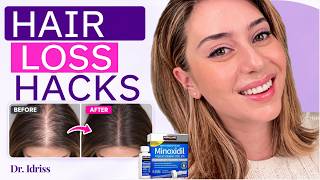
This is a YouTube video titled "10 Minoxidil Hacks for REAL Hair Growth from a Dermatologist! | Dr. Shereene Idriss" created in June 2025. It features Dr. Shereene Idriss, a board-certified dermatologist, sharing an in-depth monologue about hair loss, focusing on the use of minoxidil for hair regrowth. The content is educational and aimed at empowering viewers with practical tips and medical insights on managing hair loss using over-the-counter and prescription treatments. The video is a single-speaker presentation without conversational interaction.
If you have been noticing your hair shedding, falling, each time you run your hands through your hair, you have more than 20 hairs in your hands. Or worse, you see your scalp through your hairline, especially under midday light. This video is for you. I have experienced all of those things. My name is Dr. Shereen Idris. I'm a board certified dermatologist. I have been on a hair loss journey for almost seven years and in the past year I finally feel like I'm reversing that for myself. So today I wanted to share my top nine 10 tips about an over the counter ingredient that is often used for hair loss. Also known as Minoxidil, this is an ingredient that has been very misunderstood. And because of that misunderstanding, people have the wrong expectations. And because they have the wrong expectations, they then give up and they don't help themselves in the process. My goal is to always empower you so that you have the knowledge to know how to help yourselves. And that's what Pillow Talk Derm is all about. We do this every Saturday morning at 10am so if you're new here, welcome. Subscribe. Like this video? Let me know what you want to learn about. And if you are losing your hair and you're stressing out about looking at your scalp, follow along. Because today we're diving into the world of minoxidil. Minoxidil is a medication that was originally created in the 1950s for people with high blood pressure. It was a pill that was taken orally and prescribed solely through your doctor. In the 70s, in a clinical trial, they realized it's actually increasing your hair growth as well. And they started to utilize it for people with androgenetic alopecia. Female pattern hair loss, male pattern hair loss. But in the 80s they took it a step further and made it available over the counter in the form of a foam that can be utilized locally to the areas where you are losing your hair. And that's when Rogaine was born. You can now find Rogaine at any drugstore in the U.S. you can even find the generic minoxidil. And it's usually available anywhere between 2 to 5%. We're going to get into that in a second. In my 10 tips, prescriptions are still available anywhere from 0.25mg to two 5mg pills. The way topical minoxidil works is not fully fully understood, but we have our theories surrounding it. Number one, we believe that it causes your blood vessels to dilate in the area where you apply it. So that's going to increase the oxygen, the nutrients and the blood flow to that area to feed those hair follicles. Number two, it helps to promote your hair to switch from a resting phase to a growth phase phase. Every hair follicle has a life cycle between resting growth and shedding phases. Okay, I'm simplifying it for you guys. When you apply topical minoxidil, it shifts the hair from that resting telogen phase to that growth antigen phase, and it allows your hair to stay on your head longer. And three, it is believed that Rogaine increases the thickness of your hair so it appears fuller and denser. And so it's not increasing brand new hairs on your head, but it's keeping the hairs that you have on your head there long, making them appear thicker so your hair looks fuller. Now that we have an understanding of what Rogaine does, let's jump into the top tips. Number one, over the counter, you're going to find two strengths of topical minoxidil. Whether it is generic or brand Rogaine, it's either going to be 2% or 5%. Do not fall for this and just go for the 5%, because 2% or 5% can be used on either men or women. Which leads me to number two, my second tip. Women's Rogaine. Women's topical minoxidil is often marketed as the 2% version because of this potential risk of increased hair growth elsewhere, which we will get into in a second. But women can absolutely use the 5% strength as well, as long as you know how to use it and you are an educated consumer. The reason why that's important is because the 2% Rogaine or topical minoxidil that is often marketed to women comes with a pill pink tax, meaning they charge women more for less. And that is something that is un. An unfortunate, ugly truth to the beauty industry. It's something that I try to expose whenever I come across it. Topical minoxidal, whether the generic version or the branded version, do this to women all the time. And I have done several TikToks and YouTube shorts and Instagram reels about this. So don't fall prey for this. You can absolutely use the men's formula if you are a biological woman. If you are a biological man and you want to use the woman's formula, sure, knock yourself out if you want to be ripped off, but you do not need to. So stick to the 5% strength, okay? And when you see on the 5% strength bottle, don't use this. If You're a woman. It's probably because they only tested it on a cohort of men and so they only have the claim to say that it's good for men. But women can absolutely use the 5% strength of topical minoxidil. So now you're going to use something more effective and you're going to save yourself a couple of bucks, but you're going to use it because you're going to know how to use it. Which leads me to number three. When it comes to topical minoxidil, it is all about consistency over intensity. Look at your hair routine over the course of a week. The same way you should look at your skincare routine and think of Rogaine as getting something over getting nothing. A lot of people do not want to apply topical minoxidil every day to their scalp, especially not women, because it will ruin your hairstyle. But if you are introducing something, some minoxidil several times a week onto your scalp, you're going to get an effect in the very long run. If you are desperate and you are losing hair at a pace that you cannot tolerate, you obviously want to use it more regularly, ideally twice a day. But if you were someone like me who couldn't tolerate the look of the minoxidil in your hair, or you would get itchy from it, which was my case, ended up getting an allergic reaction to it, try to just use it several times a week instead of every day and look at the results in a long term view. Just change your perspective so that you can appreciate it more. Ideally, they recommend using it twice a day. Consistent use for best results. I can obviously see why. But if you cannot tolerate the reality of it, just spread it out over the course of a week. Number four, when you start topical minoxidil, there is an initial shedding phase, which sounds scary. Between week two and six, your hair will shed because like I said, it converts your hair from that telogen phase to the anagen phase. So some of the hairs will fall off, but beyond weeks six through 12, that should stop. If the shedding phase goes longer than four months, check with your doctor obviously, but really try to power through at least three months to really see the results come through. And that's something that you should not be nervous about. Tip number five, be very specific on where you apply it. Do not do what my husband does, which is he goes, good night, absolutely not. He's had a couple of hairs growing in the middle of his forehead, which is really interesting to see, especially if you are Trying to avoid facial hair. You do not want it coming down on your hair. Some people recommend applying it at night and then wearing either like a bonet or a shower cap or some sort of bandana to minimize any transfer onto the face because it can lead to unwanted facial hair. Especially if you have it on your fingers and you start scratching your face or even body hair. So you have to be careful. But there's a bonus to this because everything bad has a positive because it can lead to increased hair growth elsewhere. If we are losing our eyebrows and we were part of the generation that over plucked or we are part of Gen Z who decided to over pluck just a year ago and now your hair isn't growing back, you can get a spoolie and apply Rogaine to your spoolie and basically just apply it through your hair to get your eyebrows to grow back through thicker and fuller. And it does absolutely make a difference. Just make sure you clean around the area once you're done applying it. And you can probably do this a little bit more regularly because you're not worried about the hairstyle of your eyebrows. Which leads me to number seven. How can we make sure that the Rogaine gets the best result possible? You want to micro needle your scalp. This is a tricky one though because I don't trust you. Not because I've never really met you or maybe I have, but because I think people like to go wrong and strong at home. If you have the and you have to be honest with yourself, the ability to keep yourself in check and not go crazy wrong and strong. You can lightly micro needle an area that has been balding and apply the Rogaine there. It will work better. The reason I have to preface this by saying I don't trust you is because if you're going really hard on your hair, you may cause hair breakage which might lead to a worsening look and you will not be happy. So, so don't go crazy with the microneedling barrel. If you have something at home, keep it very pinpoint to the area that has the worst hair loss and apply the Rogaine just there. Just make sure you're cleaning your microneedling device really, really well. Especially if you're somebody who's going to be doing this regularly. And change those needles regularly because they will blunt out and you don't want them to get rusty and you don't want them to get dirty and you don't want to get an infection. Okay, I just had to add those PSAs but the bigger PSA is the PSA for pet owners, which is my eighth tip. If you have a dog or a cat, do not use the Rogaine around your pets. Keep the Rogaine somewhere hidden. Consider it a lethal drug for them because it is lethal and it can really be very toxic to cats and dogs, especially if ingested or even absorbed through their skin. So let's say you apply it on your fingertips and you massage it on your hair, and then you jump in your bed and you're petting your dog. That's all good. Always, always, always wash your hands after you use it. If you have a pet, any residue can be toxic to an animal. And so that is why you really do have to be careful if you have pets. And tip number nine, if all of this sounds too much of a hassle for you or you develop an allergic reaction. So I started using topical minoxidil. It was working nicely, but then I reached the phase where my scalp would get so itchy and I looked like I had so much dandruff. But it wasn't. It was just my scalp leaking off from not being able to tolerate the Rogaine. I ended up switching to oral minoxidil. Now, oral minoxidil has a lot of contraindications. You have to be careful. When you are going to go get it, you can't just get it over the counter. You have to see a doctor. Anybody with heart disease should not take it. Pulmonary high blood pressure should not take it. If you have uncontrolled high blood pressure, you shouldn't take it. Go get checked by a doctor. And if you have really low blood pressure, you shouldn't take it because it can make your blood pressure lower. So you have to be careful. If you have any heart conditions as well, it's not going to be for you. But if you are healthy and you get the green light, it's been a game changer because I don't have to think about applying it. I don't have to worry about my hairstyle and I don't get that allergic reaction. But with oral minoxidil, you're going to get hairy elsewhere. Okay? Elsewhere, we don't have to get into the details. Luckily, I have a laser hair device at my practice. I have access to the kitchen. But if you don't have access to the kitchen, you have to weigh the risk of, do I prefer hair on my scalp or on my body? I prefer hair on my scalp and I'll take the risk of the hair on the Body, I'll deal with it. But a lot of people don't want to deal with that. So it's something that you should have an honest conversation with yourself about. And last, the tenth step, I'm going to rip the band aid off and I'm just going to say it as it is. And this is actually the most important tips I hope you've watched till now. Topical minoxidil and even oral minoxidil is not a cure. And it's like a band aid. That is exactly what it is. It is going to give you the look of fuller hair. It is going to give you the appearance of a denser, fuller scalp as long as you use it. But it is not a permanent solution. That is curing your problem. And once you stop it, you will go back to where you were. So I just want to make sure that you guys understand that, because people are often like, but I stopped and I lost all my hair again. Of course you did. Because it's not curing the problem, because we don't know yet how to cure that problem from the inside out. So that is why I tell patients, just throw the kitchen sink at your hair loss issues. Honestly, the psychological impact of hair loss is so distressing that sometimes it's better to try everything all at once and then to peer back to see what's sticking and what isn't. It's not what I usually preach, not in my practice for skin care, especially not for skin care, but when it comes to hair, because of that psychological component. Take your supplements if you want to try your supplements. I do not like any supplements with biotin, so I try to take supplements that do not have biotin. You can even try prenatal vitamins in addition to, for example, the vegan neutrophil, which is my preferred type of neutropol. If you're going to go down that route, you can also try PRP or PRF to your scalp to see if that can help stimulate it. Of course, hair transplants exist, but hair transplants are not a cure either, because as long as you keep losing hair, the hair transplant is going to stick, but it's going to get lighter around where the hair transplant was put. So, again, there are so many other things we can talk about when it comes to hair thinning and hair loss, but I really wanted to focus on what you could help yourself with, which is over the counter and minoxidil being the most prominent one. I hope this video was helpful. I hope you guys have a beautiful Saturday and I cannot wait to see your progress when it comes to your hair photos. All right, I'll see you guys next week. Have a great day.
More from Shereene










3 Ways I Prevent Post-Menopause Skin Issues + What Really Helps Elasticity After 50