How to Layer Anti-aging Prescriptions (Tretinoin & Hydroquinone ) | Dr. Shereene Idriss
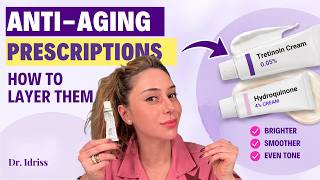
Dr. Shereene Idriss breaks down tretinoin and hydroquinone, the two most effective prescription anti-aging ingredients, and how to layer them safely. Hydroquinone must be cycled (one month on, two months off) to avoid damage, while tretinoin requires gradual tolerance building starting with OTC retinol. A consistent routine with the right weekly schedule beats intensity.
Chapters
What if I told you guys that there were two prescription ingredients that do way more for aging than almost any other skincare products that you guys have encountered, but people are either way too scared to use them or they're layering them completely wrong? Would you want to know what they were? If the answer is yes, you've landed in the right place because that is what we are going to be covering today. My two most favorite anti-aging prescription medications that will give you the biggest bang for your buck and that I rely on in my practice. And no, they are not serums. No, they supplements, they are not peptides, they are not whatever is trending on TikTok. They are actual prescriptions with proven track records. Number 1 is an ingredient that will even out your skin tone, and we're going to get into the details of this and why it's important in a minute. And number 2 is an ingredient that's going to help to rebuild your collagen from the inside out while helping your skin behave like your younger skin used to behave, because fetal skin is the goal. Um, but I'm also going to show you, which is most important in this video, how to incorporate incorporate these two ingredients together into your skincare routine, because when you do not incorporate them correctly, you will wreck your skin barrier, and that is not going to give you the results that you're looking for. So let us get nerdy today with me. Who the hell am I? I am Dr. Shereene Idriss, a board-certified dermatologist, and welcome back to Pillow Talk Derm, where we do this thing every Saturday at 10 AM. So make sure to subscribe and love the video below. But before we get into the ingredients, I need you guys to understand my philosophy when it comes aging as a dermatologist whose focus is on cosmetics. Most people do not fail because they're not using the right ingredients or they're not using enough products. Most people fail because they are doing way too much or they're doing it wrong. And it is so important to understand the framework first. Number one, especially when we're talking about anti-aging— I'm not talking about if you have an active acne problem, I'm talking about purely from an anti-aging perspective through— as we go through this thing called life, okay? We want to have a consistent over-the-counter skincare routine, one that we know our skin loves, one that we know we can stick to, one that we know we can adhere to, because nothing works without consistency. It is the name of the game. It is not sexy, but it's the truth. Number 2, once we are consistent with our skincare routine— washing our face, using our moisturizer, applying our sunscreen— we introduce prescriptions. And we're going to talk about today the 2 biggest anti-aging prescriptions that will give you the biggest bang for your But if you are not consistent with your over-the-counter skincare routine, you're not just going to start using prescriptions because guess what? Most— one of these two prescriptions you cannot use forever. You just can't. And number 3, once we have step 1 and step 2 locked in, we consider in-office procedures because there is no point in going in for a laser treatment if you are not consistent with the routine at home. It's almost as if you went to your dentist, got a dental cleaning, but you're not brushing your teeth every day. Do you really think that dental cleaning is going to keep you sustained for the rest of the year? Your partner would strongly disagree. So let us start with the anti-aging ingredient that I think most people have never thought of as an anti-aging ingredient. It gets a ton of fear, a shit ton of drama online, and then even more shit ton load of misinformation associated with it. But honestly, it is one of the most effective tools that we have when it comes to making your skin look more radiant and younger, and it is hydroquinone. Here's the thing most people do not realize: an uneven skin tone is one of the biggest visual markers of aging. And I'm going to read this so I don't mess it up, so you guys fully understand what I'm saying. Research has shown that your skin tone uniformity is a stronger cue of youthful appearance than wrinkles. Let me say it again. People perceive an even skin tone as younger than smooth skin with uneven color. Okay? Dark spots, sun damage, patches, pigment, melasma, all of that makes you look muddy and tired. And it's not just a cosmetic annoyance that you're— it is your skin visibly aging. And hydroquinone is a very effective tool to help to reverse that. So what exactly is hydroquinone? It is the gold standard topical treatment within the derm world for hyperpigmentation and melasma. It's been used in dermatology since the 1950s, and it has over 70 years worth of clinical data behind it. And it is not a trendy ingredient that just popped up or one that we just discovered that could be potentially dangerous or not. It is truly proven within the field of dermatology and has helped millions of people look and feel better about themselves. And yes, I prescribe it for patients with melasma, people who cannot get it under control, and also for patients who have a lot of post-inflammatory hyperpigmentation who who basically, no matter what they do, develop dark spots on their skin, and over-the-counter skincare cannot necessarily touch it. In the US, it is only available via prescription, and rightfully so, and we will explain that in a second. But how it works is what is interesting. This is the science simplified so you have a better understanding, but your skin makes pigment through an enzyme called tyrosinase within a cell known as your melanocytes. Melanocyte. Tyrosinase is going to convert an amino acid, right? You've probably heard that term because of peptides taking over the internet, but amino acid called tyrosine into pigment known as melanin. So tyrosine works through tyrosinase, becomes melanin. Guess what blocks tyrosinase? Ba ba! Hydroquinone. It's really important to understand that when that enzyme is blocked, your pigment production will slow down and your melanocytes make that pigment will calm down. As we get older in life and as our melanocytes become damaged from repetitive sun exposure and the DNA is inherently damaged, they tend to overproduce pigment faster. So they go into a hyper mode. So when you're using hydroquinone, it just calms it down, minimizing the look of the sunspots, the dark patches, the hyperpigmentation, making your skin more uniform over time and more youthful. It also does interfere with how your melanosomes are formed and that pigment is transferred throughout your skin, meaning it's not just minimizing how it's hyperpigmenting, but it's also reducing the pigment that is already on its way to the surface so that you look much more even. The dose is what makes the poison, okay? And we shouldn't be afraid of hydroquinone, quote unquote, bleaching your skin if you're using it at the right concentration and less Less is more. At 4%, the Journal of the American Academy of Dermatology has shown that it significantly, significantly improves pigmentation within about 8 to 12 weeks. In my practice, I range from 4%, 6%. I never go above 8% depending on your skin type and tone and the severity of your hyperpigmentation. And the most important thing is how you use hydroquinone. You should not be on it forever. That is not the goal. The goal is to get your pigment cells to just calm down so that they could stay at a calmer, steady state. When you are using hydroquinone, you have to take breaks, okay? And that is why I usually recommend cycling: 1 month on, 2 months off, etc. Otherwise, you don't want to get an unwanted side effect, also known as exogenous ochronosis, which looks like this. And it is pigment that will just never disappear. So because you're cycling on and off hydroquinone for 2 months on and 2 months off, it is so important that when you are on the off cycle specifically, you are on a very solid over-the-counter skincare routine that is going to maintain the results of looking even. And that is one of the main reasons why I created the Major Fade line. Okay, I created this with pigment targeting ingredients, stacking pigment targeting ingredients in 3 simple steps so I could stay consistent with my over-the-counter skincare routine, working in parallel with hydroquinone to keep my skin looking uniform, looking even, looking happy. Obviously, the biggest non-negotiable to hydroquinone is sunscreen and protecting what you are working towards, because if you're not wearing sunscreen while using hydroquinone, you're basically undoing everything. And there's no point in doing that. So just wear the damn sunscreen. Now to the drama. Hydroquinone gets a lot of fear online, and it is mostly based off of misinterpreted research, and that goes viral. So the cancer concern with hydroquinone comes from extremely high doses of hydroquinone that were systemically introduced into rodents. I am not eating the hydroquinone. I am not prescribing it orally. I am applying it topically. To a body surface area that is less than 3% of your full body surface area. So there has been no proven link between topical hydroquinone and cancer in humans. And when used appropriately and cycled properly, prescribed by somebody who understands it, it still remains undisputedly so one of the most effective anti-aging tools that dermatologists have. And one more thing though, before I sign off, off of hydroquinone, do not buy it off the black market. A lot of people buy hydroquinone off the black market because they don't have access to a physician who can prescribe it. But if you are buying hydroquinone off the black market, oftentimes it is laced with mercury, which is extremely toxic. But they put the mercury in there so you can see results faster, and that is not what we are looking for. So please do not get it other than from a pharmacy through a licensed physician. Okay, so hydroquinone handles one pillar of anti-aging, which is evening out your skin tone to make your skin look more even on the surface. But the second pillar of aging has to do with rebuilding what aging has taken away, and that is your collagen. And the second one is tretinoin, which is a retinoid and is one of the most studied topical ingredients in all of dermatology that has one of the strongest proven track records in terms of collagen production, thickening your skin over time, evening out your skin tone, helping to minimize the look of fine lines, and improving the look of laxity. It is the most powerful anti-aging ingredient that we have, and nothing, nothing— no PDRN, no exosomes, no salmon DNA, no shmexosomes, no growth factors— at least topically in over-the-counter skincare stands close to it. So tretinoin does two things when it comes to aging. One, it increases cell turnover. So as we, you know, live life every day, our skin cells go from the lowest layer of our skin to the highest layer of our skin, and it cycles over 28 days. But as we get wiser in life, our cycling slows down from 28 days to 38 days to 48 days, and your skin starts to look tired and ruddy and a little dull. Tret basically helps to make sure that that keeps going at a regular pace so that as you get older, the cells come up faster, your skin stays brighter, and your skin looks more even. The second, and this is a very big one that some, you know, so-called physicians online with skincare brands who are not even dermatologists just don't know, but it's a big one, it stimulates collagen production, okay? Collagen is a structural protein that keeps our skin firm, okay, and plump and resilient. But starting in our mid-20s, we start to lose at approximately 1% a year collagen. And it is very, very sad because as we enter perimenopause and then menopause, it declines at an even faster rate, not to mention the fact that we're not able to hold on to hydration as well, and we start to look a little bit more prune-like. But if we want to keep our collagen stimulated, Tret has been shown to truly stimulate collagen over time. Now notice I am focusing on Tret as a prescription, but that doesn't mean that over-the-counter is not as effective, and that could be a video for another day. But today's video is purely focused on prescription. So the point here is these two ingredients, hydroquinone and tretinoin, are a system, and it's not just a pairing. One, tretinoin helps other active ingredients penetrate better. And when you use tretinoin with hydroquinone, hydroquinone reaches your pigment-producing cells, your melanocytes, much more effectively. So one handles the surface, the other helps to rebuild the structure underneath, and they do make each other stronger. But before jumping to tretinoin prescription strength, I recommend building consistency with an over-the-counter retinol first. It is not just about percentages when it comes to retinoids and this category in general. It is truly about getting it in your skincare routine over the course of a week very, very consistently at a percentage that your skin can tolerate and gradually building up so you don't wreck your skin barrier and you don't introduce chronic inflammation into your skin. So when do you start it? You start it at night. You use it 1 to 2 nights a week at most, and you increase gradually as your skin can tolerate it. And on the nights that you're not using tretinoin, you can try even using the over-the-counter retinol if you want, or try to get more nights of the week with an over-the-counter retinol and at least 1 night with a prescription. Okay, so I have, I have actually a full video that I will link below on how to start retinol, and if you haven't watched it, go watch it first and come back and watch this. Because order does matter. So now that we understand both pillars of aging, hydroquinone for skin tone, tretinoin for collagen, it is important to know that people now get tripped up because they don't know how to layer them. So the most important mindset, mindset shift about anti-aging is you have to stop thinking about your skincare routine on a daily basis and really start thinking of it on a long-term term view and thinking about it as a weekly thing that you have to get into. When you plan your skincare routine week by week, you can alternate stronger treatments on certain nights with lighter treatments on other nights, and over the test of time, you're going to get a little bit of everything. And that is the goal with life, your skin, and aging. And that is how you can stay consistent long-term instead of flaming out after 2 weeks because your skin is red and peeling. So prescriptions go after cleansing and any exfoliating treatment. If we are exfoliating and we do not know how we tolerate the prescription, do not use these two prescriptions on the night that you are exfoliating and understand how you, understand how you respond to the prescription first before marrying it to the night that you exfoliate. But after you have washed your face, exfoliated, use your prescription, then you can go into your serums and your moisturizers. So your prescription layer is really sitting between your prep and your support. If you are very, very sensitive, you can alternate it where you wash your face, exfoliate if you may, use your serum, your moisturizer, and then use the prescriptions. And you're using your over-the-counter skincare routine as a buffer to, yes, weaken the prescriptions, but that doesn't mean you're still— you're not getting the benefit of those prescription medications. It just means they're not going to be as aggressive, and that is better for you long term. So your full routine step by step. Step 1, we're going to use a gentle cleanser, nothing fancy, something that you can clean your skin with. I love my Dr. Idriss Soft Wash because I like to open my eyes when I wash my face, and I don't like to wear very, very heavy makeup. So so it's just enough to clean my sunscreen and the makeup that I use every day off. Number 2, active treatments. And this is going to alternate by night. Some nights you're going to use an exfoliating mask, some nights you're going to use a retinol or tretinoin. You're not necessarily doing both on the same night, especially if you are just beginning. So this is where the weekly view matters. So map out the nights that you want to exfoliate and the nights that you want to use a tretinoin. Number 3, hydroquinone. I prefer pads and I mix them in my practice. So I have my patients get pads because I can control how many pads they get, so I can control how long they're using the hydroquinone for. Ideally, you just want to do this for 2, maximum 3 months at a time. And usually I tell patients at this step, you can use the hydroquinone pads. If you're going to use a cream, this is where you would use the hydroquinone cream. But make sure that you're not overusing it because less is more, and precision does matter with this ingredient. Okay, step 4 is your serums. This is your supporting cast members, whether it is arbutin, kojic acid, licorice root, niacinamide. This is where the powerhouse comes in, and this is where for me the Major Fade Hyper Serum is the counterpart to hydroquinone, the over-the-counter counterpart to hydroquinone that does what I need it to do. And step 5 is your moisturizer that locks everything in. I like to get my vitamin C in 24 hours a day, so I use a vitamin fancy ester, and that is why I have this in the Active Seal, which also has 4-butylresorcinol and glutathione to continue my brightening journey while keeping my skin barrier supported. It has ceramides as well in this moisturizer. Like I mentioned, for the sensitive folks, I would not jump in with the retinol and the hydroquinone before the serum and the moisturizer. I would buffer those by using the serum and the moisturizer first and then going into the retinoid. I would also make sure that you can tolerate the retinoid and the hydroquinone on the same nights. And for a fun fact for you, there is a medication called Triluma. If you've watched this long, I hope you have, this is very important. It is a medication that combines hydroquinone, tretinoin, and a steroid. The reason why there is the steroid in this prescription medication is because hydroquinone and tretinoin can be irritating. So they put the steroid in so it calms the irritation, and you can use both together. But this is where having a weekly overview of a routine is super important. I don't love Triluma. I don't love people using a steroid long-term on their face. So if you're able to space out the nights that you can tolerate the retinoid versus the nights that you can tolerate the hydroquinone, and you're doing it in a way that is not inflammatory to your skin, your results are going to outlast time because that means you're going to be consistent over time and you're going to be able to maintain those results as you continuously age. It's not a hack, it is just common sense that unfortunately most people do not take the time to understand because they want results yesterday. But it's not sexy. The name of the game is consistency over intensity, always. So that's it. Those are the two pillars when it comes to anti-aging: hydroquinone to even out your skin tone, because your skin tone is the strongest signal for youthful skin, and number Number 2, tretinoin to help to rebuild collagen and to speed up cell turnover because that is what's going to keep your skin looking firm and alive. And together it is chef's kiss. That is absolutely the goal. So we can all be aging like tiny little grapes and not raisins. I hope you guys enjoyed this video. I hope it helps you understand the prescriptions better when it comes to anti-aging, but also how to incorporate them into your routine. Um, and if you guys have any questions please, as always, leave them below and we will dive in deeper together. But without further ado, I hope you guys have a beautiful Saturday and I will see you guys next week.
More from Shereene










3 Ways I Prevent Post-Menopause Skin Issues + What Really Helps Elasticity After 50