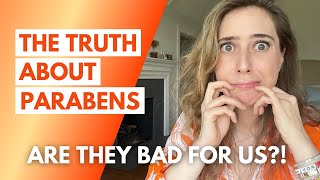
In this 2021 YouTube video, Dr. Shereene Idriss, a physician and skincare influencer, addresses the widespread fear surrounding parabens, a class of preservatives used in cosmetics for nearly a century. She begins by thanking her 200,000 followers and explaining her recent social‑media break, then outlines her motivation to debunk the “paraben nightmare.” Idriss defines parabens, explains their natural origins (parahydroxybenzoic acid in fruits and vegetables), and describes their function in preventing microbial growth in water‑based products. She reviews the two pivotal studies that sparked public alarm – a 1998 Rutledge study showing weak estrogenic activity in vitro and a 2004 Darber study detecting parabens in breast‑cancer tissue without proper controls – and critiques their methodology, dosage relevance, and the logical fallacy of equating correlation with causation. Idriss then summarizes the consensus of major regulatory bodies (U.S. FDA, EU Scientific Committee on Consumer Safety, Cosmetic Ingredient Review, Cancer Council Australia, National Cancer Institute), noting that parabens are not banned in the EU (only five specific types are) and are deemed safe at concentrations up to 0.3 %. She dispels common myths about parabens causing cancer, being unsafe for sensitive skin, and being more harmful than other estrogen sources such as birth‑control pills. Idriss shares her personal business perspective: while she plans to launch a skincare line, limited finances mean she will initially avoid parabens, but she will not market her products as “paraben‑free” to avoid fear‑mongering. Throughout, she urges viewers to read scientific studies critically, understand study design, and not let sensationalized media dictate personal skincare choices. The video concludes with a call for informed discussion and a reminder to like, subscribe, and comment.
Chapters
Good morning my little skin nerds. I am very grateful for all of you, for 200,000 of you following along. Muchas gracias. Merci, Shukran, Salamatpo, Dankushen, whatever you want to say, any language out there. I'm extremely grateful for every single one of you for joining along this ride. I was away last weekend because I've decided to take a few weeks off of all social to really be fully mentally and physically and emotionally present with my family. I have some exciting news coming up. I don't know yet when I'm going to feel ready to share it with everyone, but it's coming up, so stay tuned. It's not about the skincare line and I wanted to dive in today into a controversial topic, a topic that I have always found confusing as to why people are so worried and scared about this particular group of ingredients. So I figured better to get back onto social media after a good week off of mental relaxation than now. So let's dive in. Let's get into the parabens scary nightmare train. The train in which this ingredient has become the focus of many, many groups to slander it, to kill it, to annihilate it, to make sure that these ingredients get completely wiped off the map. So I figured what better time than now to defend it. All right, please make sure to like subscribe and comment below. I am ready to get a million of comments from a certain group attacking this video, but that is okay. I think conversation questions coming up is always a healthy thing and I embrace it. And I hope you guys read these comments and questions and it's, you know, lights up a light bulb in your head or you know, turns on a match or whatever the expression is and know starts the discussion. So let's start with my introduction, which is basically what I hear every single day in practice. Aren't you afraid of parabens? I don't want breast cancer. I'm not going to take a parabens. I'm not going to use it in my skincare products. Isn't it toxic? I have allergies. I have sensitive skin. I want things that are parabens free. Can you prescribe parabens? Free steroids? I hear this on the daily and inside my head. Outwardly I'm always like polite or I try to be as polite as can be. In my head I'm like, no, no, no, no, no, no, no. Because it's wrong. And I'm all about being wrong and strong when it comes to her confidence. You might think my Dress is hideous. Or that how can she go on camera with hair like this? That she didn't even brush this morning. But I did a braid last night. I'm not about wrong and strong when it comes to scientific data that has been butchered throughout the years. Just a small little side note, I am a physician. I spent 12 years studying to get my medical degree. It does not make me better than anyone else. However, even with this experience under my enlarging belt, I've had too much ice cream this past two weeks. I will say it's extremely hard to read scientific studies. It's not made for the layperson to read. I still don't fully understand statistics. And any number if you've read enough studies can be twisted to portray the information in the light that you want to portray it. So you have to read studies with a hypercritical eye. Understanding the multifacetets around a single study. And not just that, understanding what the study actually is. Is it a randomized control study? Is it a double blind study? Is it a review study? Is it a questionnaire? Like there are so many different studies out there that they are not all created equal. So that's just the tip of the iceberg. So let's dive in before we get into the actual studies discussing or what has ignited the fear on parabens. First of all, what are they? What are parabens? Parabens are a family of preservatives. Okay. There are hundreds of them. Okay. There's a lot of different ones. And they were first introduced in the 1920s, nearly, actually a century ago. They've been around for 100 years. They were initially derived from. I'm going to read this parahydroxybenzoic acid, which, which is derived from vegetables and fruits. Because this chemical is actually in present in many different vegetables and fruits. And no, you cannot request a paraben free banana. It does not exist. Okay. Or a parabens free edamame. It does not exist. Phytoestrogens such as parahydroxybenzoic acid is a thing that we cannot control because they are around us in nature. They have been using cosmetics because with the intent of suppressing the growth of microbes, sustaining the life of your products, making them safer for you to use in the long run. Because anything that is formulated with water is a breeding ground for microbes, bacteria, fungus, you name it. Because water is the essence of life. Yes, I love Zoolander. And without water, the cosmetic products are subpar. Not all of them, but for the most part, they're not as good as what they can be. So we need water. Like everything in life, everything is a yin and a yang. It's about finding the right balance. Too much sun is terrible. No sun at all is not good for you either. Too much heat is gonna kill us. No heat at all. We're gonna freeze to death. So extremes are not good. Okay. The most common types of parabens that we are going to be discussing in this video are methylparabens, ethylparabens, propylparabens and butylparabens. These parabens are the most commonly found in cosmetics, and they are usually limited in the amount that is allowed. At 0.01% to maximum. 0.3%. Okay. In formulations. So why did parabens get a bad rep? Let's go back to 1998, shall we? There was a study by the Rutledge Group. I don't know if I butchered how they say their last name. And they showed that parabens mimics certain types of hormones like estradiol, estrogen, and could potentially disrupt your hormone balance. But when tested, the amount of activity of the parabens were thousands to millions of times weaker than your natural estrogen levels. Number one. Number two, when tested in vivo, they injected high concentrations of these parabens under the surface of rats skin. Last I checked, rats and humans are very different. Last I checked, I'm not injecting my glycolic acid under my skin or my moisturizer or my toner, or my essence, or my serum or my whatever under my skin. I'm applying it to my skin. And last I checked, the concentration of the parabens in products is Limited at 0.3%, whereas in the study it was at high nuclear concentrations. So you're really comparing apples to steak. Separate food categories, separate food groups, because they're not comparable at all. Interestingly, in the study, I will say this, I found quite interesting because I like numbers. Methylparabens is 2.5 million times weaker in vitro than estradiol. Ethylparabens comes next. Propyl parabens come next. And Butyl parabens is 10,000 times weaker in vitro. So in the petri dish, just to kind of keep things again into perspective, phytoestrogens, the types that we find in our foods, are actually 10,000 times more potent than the parabens that were studied in this study. So Whole Foods better get a PR rep on them because they for sure as hell are going to get attacked at some point. In the future on tofu, edamame, soy milk, you name it. Okay. Also side note, in birth control studies, or in birth controls, rather not studies, ethanyl estradiol is a huge component of birth controls. Ethanyl estradiol. And you are ingesting that through your mouth. You're not applying it topically. That is millions of times more potent than butyl parabens, which is the most potent paraben that we're talking about, and it is ingested. Plus, with that being said, the risk has been shown to be minimal in increasing your risk of cancer. And how many millions of women are taking birth control pills on the daily. Just saying. And what I find most ironic is the patients who come come into my practice fearing parabens are usually on a birth control pill with ethanyl estradiol. Just a side note. Okay. Then there was a second study in 2004 by the Darber group. Again, I'm butchering their names. And they found five parabens present in breast tissue of 19 out of 20 women with breast cancer. Gasp. No, because they didn't study women who don't have breast cancer. They had no control group. They basically took women with breast cancer and said, let's see if there's parabens in these breast cancer tissue, and found 19 out of 20 had parabens. But what about women who don't have breast cancer? Did they even study them? Because I can assure you, if I went back to those 20 women, I said, let me see if there's water in breast cancer tissue. 20 out of 20 would have had water. Correlation does not equate causation. Not because breast cancer tissue has water means water causes breast cancer. Just because breast cancer tissue has parabens does not mean the parabens cause the breast cancer. It's interesting, yes, that parabens actually go deep enough to be found in tissue, but it does not imply that it causes it. And that study set off and ignited a train of misinformation surrounding parabens, killing an ingredient that has been shown over the past century to actually be very useful in preserving our cosmetic products and making them them safer for us. I will never name brands and nor will I ever bash brands, but there have been certain brands that are very green with certain forms, or they grow their ecosystems on them in order to create very clean products that have no parabens that I've opened six months after opening, because I've opened it once or twice just to see and I've left it, I've forgotten about it, mold is growing in there and the products are completely deteriorated. And these are expensive products, like hundreds of dollars. I mean, I don't know about you, but I'm not going to be buying $100 cream and every two weeks to make sure that it stays as preserved as possibly can be. Not happening. So I am clearly worked up because I blame the media. I blame the cosmetic media. I blame the cosmetic industry for taking something so small because they like a sound bite, okay? And blowing it way out of proportion where it makes zero sense. And since that time, since 2004, the Darber Group re evaluated. In 2015, the cosmetic ingredient review has opened up this topic at least three separate times to evaluate the safety of parabens and cosmetic products. And they have all stated that the use of parabens are very unlikely, linked to any sort of cancer and therefore deemed safe in your products. So it is a myth number one that parabens are unsafe for use in cosmetics. The US FDA has actually never said that, and they have not come down to that sort of consensus. Yes, the FDA is not necessarily the most rigid regulatory body, but the European Commission of scientific committee on consumer safety is pretty rigid. The Cancer Council in Australia is pretty rigid. The National Cancer Institute is pretty rigid, and the cdc, some can argue, but we're not going to get into that. And therefore all of these groups have actually come up with that same joint statement. Myth number two. Well, if parabens are so safe, why are they banned in the eu? I love that one because I always hear it with that voice in my head. Parabens are not fully banned in the eu. Only five of them are actually banned in the eu. Isopropyl, isobutyl, phenyl, benzyl and pentol, methyl, ethyl, propyl and butyl are not banned in the eu. Take that. Okay. They're actually still widely available in the eu, Japan, Australia and Canada for that matter. And the cap is 0.3% to be perfectly transparent in cosmetic formulations. So that is a myth that needs to get squashed. Other myth, I have extremely sensitive skin and I'm very allergic to very different ingredients. And so I don't want any parabens in my products because I'm very sensitive. Parabens have been shown to be sensitizing on open wounds and cuts, not so much on intact skin. But that being said, you, if you are very sensitive, can actually be sensitive to many different other ingredients, such as even fragrances or certain alcohols or other kinds of preservatives like phenoxy Ethanol, like it doesn't mean that you're just sensitive to parabens. But it's easier to have a name that you hold onto that you say I don't want any of this without knowing the full story. And finally, well, if there is any question around parabens, I would just rather avoid it. Live a simpler life. Sure, sure, no problem. But walking out the door every morning to go to work or to go wherever you're going, you might get hit by a car, you might be in a car accident, you might slip on a banana peel, you might actually trip on a rock. All of those are really possibilities within the realm of possibilities. But do you not go out the door every morning because you fear those potential tiny risks? No. You still live your life. And same goes for cosmetic products. Same goes for having parabens in your cream. Now I'm going to sound hypocritical and I'm okay. I am a very small, potentially starting business owner. I'm hoping to start my own skincare line at some point down the road. It's never something I've hid from you guys. Am I going to have parabens in my skincare products? Initially the answer is going to be no. Because I have a very limited financial bank account that is helping create these products. And I'm not ready to put my family in jeopardy and to die on the parabens hill taking that risk because I don't have the large funds that larger conglomerates have. So when I see brands backed by estee Lauder, l', Oreal, Procter and gamble, you name it, have parabens in their products, I get happy because I certainly hope that one day these larger brands are going to funnel their money into re educating the consumer, shifting the narrative and really enlightening people as to why j shouldn't be feared. And I really hope it opens the road for smaller brands, hopefully in the future like myself, to be able to take that risk of having parabens in their products without fearing going into financial ruin and bankruptcy. So that is why I'm personally not going to have the parabens in my products. But I will never market my products as being parabens free. It is purely a financial risk that I'm not willing to take because it's going to put my own self and my own family in jeopardy. And it's not a hill I'm able to die on at this time and moment in time financially. So that is my stand on parabens. I hope this video was enlightening Um, I hope you guys understand now that everything is dependent on how you slice and dice it, and that studies are not meant to be read leisurely from a beauty magazine. They actually have to be read, really with a deep pen and paper. Glasses need to be on, highlighter is out, facts reading written down. And they have to be questioned. Because if you're not questioning what you're reading, the end is near. My friends always, always question. So with that, I am Dr. Shereen Idris. I hope this video was enlightening and I hope you guys learned a thing, or hopefully too. Then for me, it was a success. I wish you all a great Saturday. Please don't forget to like, subscribe, follow along and leave any comment below. I'm very curious to see the discussions that get stirred up today. Have a great weekend.