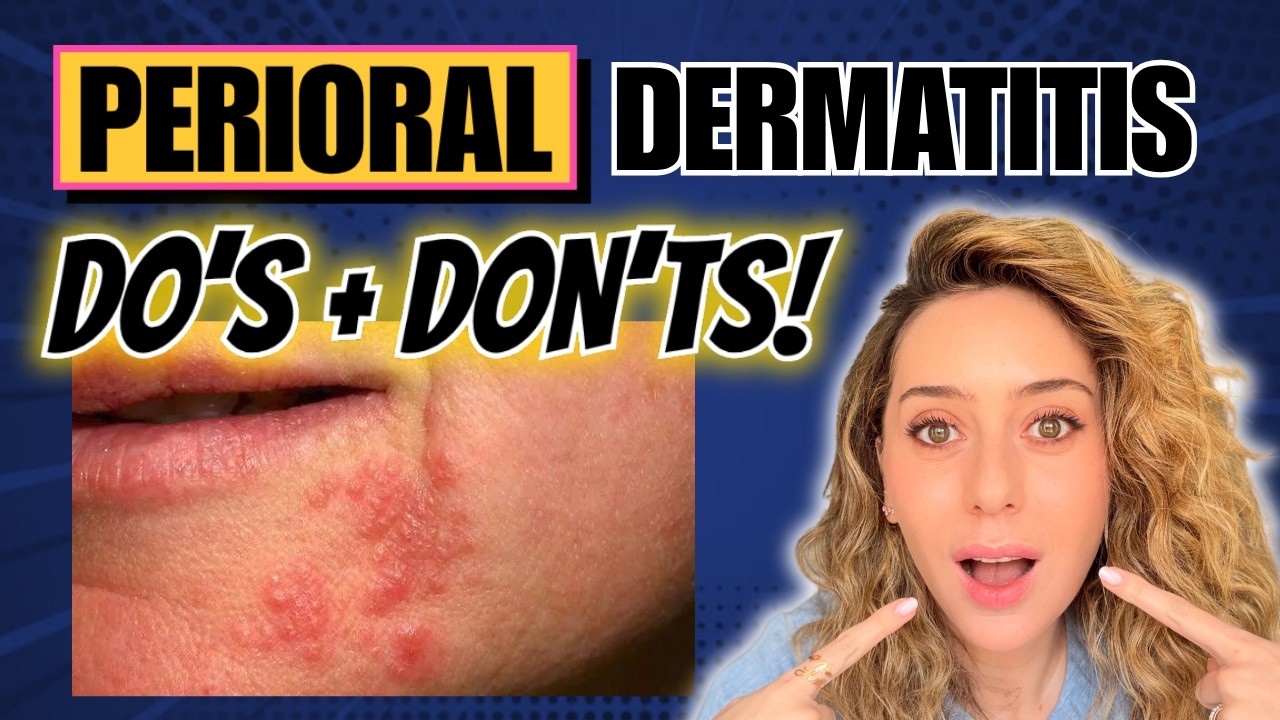
In this solo, informational YouTube video Dr. Shereene Idriss explains perioral (and peri‑ocular) dermatitis, a rash that many mistake for acne. She first teaches viewers how to differentiate it from acne and rosacea by describing its characteristic uniform pink‑red papules that cluster around the mouth and sometimes the eyes, and by noting the absence of blackheads, whiteheads, and involvement of the nasolabial folds. She then outlines the most common triggers: topical or systemic steroids, irritating skincare actives (retinoids, exfoliants), fluoride‑containing toothpaste, and hormonal or environmental fluctuations (stress, heat, wind, UV). Idriss critiques popular internet‑sourced “cures,” warning against diaper‑rash cream (zinc‑oxide occlusive barrier) and azelaic acid during active flares, and she dismisses other DIY remedies. Her core management recommendation is a “zero‑therapy” reset: stop all topical products, use only a very gentle, non‑exfoliating cleanser, limit moisturization to non‑affected areas, avoid heavy occlusives and possibly sunscreen on the rash‑prone zone, and give the skin weeks to calm before re‑introducing products gradually. She explains when self‑care is insufficient and a board‑certified dermatologist should be consulted—persistent or quality‑of‑life‑impacting flares. For medical treatment she describes the typical dermatologic ladder: topical antibiotics (metronidazole, erythromycin) or non‑steroidal anti‑inflammatories, and often oral tetracycline‑class antibiotics for their anti‑inflammatory effect at low doses. Idriss shares her personal experience of developing the condition during COVID‑mask wearing, trialing various home remedies, and ultimately achieving clearance with a short course of oral antibiotics, emphasizing that stress and hormonal changes can cause recurrences. The video concludes with a call for viewers to comment on what products they were using when their rash flared, framing it as a informal “market study.”
Chapters
If you are somebody who struggles with tiny little bumps around your mouth or even your eyes and you treat it like acne, you need to drop it like it's hot and step away because it is not acne. And what you are doing is probably making the problem worse. So perioral dermatitis, what we are gonna be covering in depth today, is taking over the internet by storm. Whether it is Reddit threads, TikTok, Instagrams, dedicated YouTubes like this one today, subscribe below. All of these channels have their own miracle cures, lotions, and potions to help you get through it. From like toothpaste to diaper rash creams, which, By the way, I'm so sorry, we need to talk about in a second. But all of that stuff might be in fact triggering it and making it absolutely worse. And I say this not just as a dermatologist, as somebody who struggles with perioral dermatitis, and as somebody who has a skincare brand. Sometimes your skin needs to be left the hell alone. So today, what are we going to talk about? How to know if you actually have it, number 1. Number 2, the triggers that I really want you to think about. Number 3, the internet cures that I would absolutely want nothing to do with. 4, what I would do instead. And 5, probably the most important, when to know when you got to throw in the towel and actually go see a board-certified dermatologist. So without further ado, let's jump in. Very first problem with perioral dermatitis is that it looks like acne. And so you're going to reach for your salicylic acid or benzoyl peroxide. And guess what? You're going to blow your face up in the process. So what do we need to look for? We need to look for tiny, equal-sized bumps just like this that suddenly appear out of nowhere. And these bumps are all equal in appearance. They are uniform. They tend to be pink or red, and they tend to cluster around your mouth. Side note, they can also happen around your eyes, and when they happen around your mouth and your eyes, it's known as periocular dermatitis. But for the most part, we're just going to focus on the mouth today. They also can be a little bit flaky, and the best way I could ever describe them to you is this, okay? It's not a word, it's not a sound effect, it's a gesture, because they're not itchy, they're not burning, they're not irritated, but it feels like your skin is alive before you fully see them, okay? The biggest clue to perioral dermatitis is that it's going to your lip border. And this is a huge clue for you because that is how you can differentiate different conditions in dermatology. So perioral dermatitis versus acne, for example. Acne has blackheads and whiteheads, and that is key, just like over here. So if you have these tiny bumps but you see blackheads and whiteheads, you do not have perioral dermatitis, you got acne. Now what about rosacea? Rosacea has a lot of bumps as well and redness, papules and pustules, but rosacea, the doesn't have blackheads or whiteheads, and rosacea spares your nasolabial folds. So every single condition has its own little characteristic that I think is cool for you guys to know about so you know how to differentiate it. I developed perioral dermatitis in my late 30s during COVID when I was wearing that mask all day, every day, not to mention the stress, and I felt like my nose was on fire. And so I can truly speak about my experience with perioral dermatitis because it has come and gone ever since, and I'm going to be interweaving that throughout this video. Let's say this really is perioral dermatitis. Why the hell then did it all of a sudden show up? The sad part is we have no idea what actually causes perioral dermatitis, but we do know that certain things can trigger it and make it worse. But that doesn't mean that if you're in the clear, you need to avoid these things at all costs, right? Because, for example, the first one, steroids— if you have asthma and you need to use your inhaler and this is not flaring up, please go ahead and use your inhaler. That's what I'm trying to get at. But steroids can absolutely make it worse once it is there. So I'm talking about steroid creams, I'm talking about steroid nasal sprays, which I use for my allergies, I'm talking about steroid inhalers if you have asthma. All of this has been shown to absolutely aggravate perioral dermatitis. Skincare and cosmetics— the thing that we usually turn to to try to help ourselves is probably the thing you need to avoid when a flare-up is happening, especially if you are somebody who's trying to exfoliate and buff your skin down to smoothness, or if you love a retinoid retinol, you probably want to avoid it in this area specifically because all that stuff can absolutely make it worse. Number 3, fluoride-containing toothpaste. Now, this is one where the internet is right because your toothpaste matters. If you are using a fluoride-containing toothpaste while you have an active flare-up, you want to avoid that type of toothpaste and look for a fluoride-free toothpaste instead. And that's what I would temporarily switch to. But that does not mean that fluoride is bad, and it does not mean that you have to remove it from your routine forever. And last, hormonal and environmental factors. Because perioral dermatitis is an emotionally volatile little shit— it is— so are your hormones. And as your hormones fluctuate, be it before your period or even through pregnancy, patients and people notice that it tends to get worse. And honestly, I do think that that's also why mine got triggered. But environmental factors like heat, wind, UV exposure can also be a huge trigger. So now let's quickly shift gears and talk about what the internet is telling you to put on your rash. If you search perioral dermatitis online, you're going to find so many people suggesting millions of different things, including one that I take full responsibility for, which we're going to talk about in a second. But it is during an active flare-up that I do not want you to experiment at all. Okay. And the first one is diaper rash cream for your perioral dermatitis. Now, I take full ownership over this because I quite literally invented face basting a few years ago. And if you look back far enough, you would not find anybody, and certainly not any dermatologist, telling you to put diaper rash cream on your face. I absolutely love putting diaper rash cream on my face, and this is something that I still do and I still live and swear by. But during an active perioral dermatitis flare, I think you got to put it down because although zinc oxide in diaper rash cream is extremely calming and soothing and has anti-inflammatory effects, and for sure it can maybe soothe temporarily some of the bumps, diaper rash cream is very thick and occlusive and it can trap heat, especially in an area that is inflamed and that is actually getting more aggravated, it can make things worse. So although you may get some temporary relief in the long run, it's probably doing you more harm than good if you have an active flare. So put the diaper rash cream and no face basing during an active flare-up. The second one, which might also shock you, is azelaic acid cured mine, which I suggest to stop because although azelaic acid is an amazing ingredient, we just did a deep dive not too long ago. I will link it below. I really love it for people with inflammatory rosacea or even certain types of acne. And it does have anti-inflammatory properties. That could be potential treatments for perioral dermatitis, when your face is actively inflamed, irritated, angry, etc., you don't want to be adding necessarily another active on it during that point in time because you might develop a sensitivity and most definitely make it worse. So I'm even telling you to put your azelaic acid down, which leads me to the 3rd suggestion that I find online. Zero Therapy. And this is where I want you to start. It's not about what else can I put on my skin to help calm my perioral dermatitis down. It's about what can I take away from my skincare routine to calm my perioral dermatitis down? Because you sometimes need to put everything down and reset your skin from zero in order to get to a better baseline. And with perioral dermatitis, this is exactly how we're going to approach it. So how do I reset my skin during a flare-up? Number 1, stop everything. Absolutely everything. And quick side note, and I mentioned earlier in the video about topical steroids, people oftentimes will use a topical steroid and be like, look, but it went away. The problem with a topical steroid is that it causes this terrible abusive relationship with skincare and your skin where the steroid makes it go away and the second you stop the steroid, it comes back with a vengeance. So you think you need the steroid again and it becomes this dependent cycle of disaster. Okay? And so you need to stop everything, including a topical steroid. Literally stop everything. No diaper rash cream, No moisturizer right now, no serums, nothing, literally nothing. And I want you to strip your routine all the way back to basically number 2, just a very gentle cleanser. Finding a cleanser that is extremely gentle with your skin, that doesn't have any exfoliating acids in it, that's not trying to reduce any redness, that's basically the— like my Soft Wash, for example. I will link it below. I absolutely love it. Vanicream is another option as well. But light, gentle cleansers, okay? And when you're washing your face, no scrubbing, no washcloth, nothing. Like literally just this. So when I use my soft wash and it flares up, I always use a soft wash on dry skin and I just literally wash my face and gently throw water at it and I'm not using a washcloth. Number 3, this is now dependent on your environment. If you're living somewhere very, very dry or if it's winter and the heaters are on, but moisturize only if you need it. Putting too much moisturizer all over your face, especially in this area, is going to be bad. So if you live somewhere dry, let's say, and you still want to moisturize, but you know it can't fully tolerate it, piecemeal your face. Just moisturize the rest of your face, but avoid this area specifically. Okay? And I'm telling you, you do not want to go heavier. You don't want heavy occlusives. You don't want heavy ointments. You don't want Vaseline. Number 4 is controversial because as a dermatologist, we all know that I always say wear the damn sunscreen, but maybe sometimes skip the sunscreen. Use the sunscreen all over the rest of your face, but avoid this area. Now, some of you, I could already hear you say, oh my God, but what about mineral sunscreen? Isn't it better? Not always, because even though mineral sunscreen might have zinc oxide, which we know can act like an anti-inflammatory, other things in the formulation might aggravate your perioral dermatitis, including preservatives, fragrances, who the hell knows what else is in that formula. So use the sunscreen if you want, but on the rest of your face. Avoid this area. If you fully cannot tolerate it, use a UV visor or just avoid being outside during peak hours or when the UV index is higher than 3. And number 5, and this is probably the hardest one, leave it the hell alone. Step away. Try not to touch it. Try not to feel it. Try not to put something on it. Give your skin time to calm down. If it suddenly feels better after 2 days, that's not a green light for you to start putting stuff again. You really want it to be calm for at least 1 to 2 weeks before you start going back to your old routine, because it does have a slow burn in terms of getting out of your system. And if you try to jump back on your routine and try to jump back into your normal habits, it will definitely flare up. And trust me, I have lived it. So when do you know when to go into a dermatologist or when is enough enough? This is probably one of the most important parts of this video so you can really understand when to get yourself some help. Mild perioral dermatitis can absolutely be treated by doing nothing and you probably will clear. And so that's the good news. But for a lot of people it doesn't. And then they find themselves in this terrible cycle of looking down the internet to find treatments and they're never clearing and they're living in hell because it actually hurts. So I want you to see a dermatologist when it's not improving, it keeps coming back regardless of you avoiding everything and not even putting anything on it. Your quality of life is getting impacted where you find yourself not wanting to go out and not socialize, or you find yourself in physical pain because of it, I want you guys to go in to see a dermatologist to actually treat it. Now, when we treat perioral dermatitis, there are several layers to this onion and everybody has their own special sauce that they like to do for this. As a dermatologist, not everybody practices equally the same, but most people will start off with a topical antibiotic like metronidazole or erythromycin, or even use a topical anti-inflammatory that's not a steroid. But the hard thing with topicals, like we just discussed, is sometimes other things in the formula can aggravate it. So oftentimes we go the oral route and we use an oral antibiotic to treat your perioral dermatitis. And you might be wondering, but wait, if it's not an infection, why are we using an antibiotic? An antibiotic is often used to treat perioral dermatitis because antibiotics like oral tetracyclines, say Cera, doxycycline, minocycline, can have anti-inflammatory effects at a lower dose. And so sometimes we treat patients on a lower dose of an antibiotic for a longer period of time to kill that inflammation so that you can be released and relieved from the hell that you're living in. And doesn't mean everybody needs an oral antibiotic. And it's really a case-by-case basis, how extensive it is, how impactful it is on your quality of life, how much have you tried on your own, etc., that allows us to get to that conclusion. And for me, I had Basically, it's funny. When it first came up, I was kind of naive to the condition because even though I knew about it, I never lived it. And you can learn all about something, but until you live it, it's a different experience. And so I tried all the things. At first, I used hypochlorous acid in my mask because I thought that's what was causing it. And then I did try to moisturize. It made it worse. I did try to put my diaper rash cream. It didn't help. I did not go down the steroid route because that I had learned about and I knew that was a huge no-no until finally I did go on the oral antibiotics and I went on it for a few weeks and it absolutely cleared. And it probably comes back every year and a half or so, or when I'm very stressed. But it's not a long-term treatment, it's a short-term treatment but for a longer period of time. And I will tell you that skincare can absolutely support it. So like when I notice it's coming on, I avoid exfoliating, I avoid using a retinoid, I avoid using thicker creams, and it does absolutely veer the ship in the other direction so it doesn't ignite. And it makes a huge difference. So I hope you guys Take something away from this video, because if I need you to remember one thing from this video, it's to do less if you feel your perioral dermatitis is coming on, and doing more is the absolute worst thing you can do for your skin. Hope this video was helpful. I hope we shed some light on perioral dermatitis, including what you can do to help yourself, but also in-office treatments for this condition. And I'm just so curious, if you're somebody who struggles with perioral dermatitis, what were you using on your skin when you noticed your perioral dermatitis? start to flare up? Not what did you use to treat it, but what were you using on your skin when it was triggered? I think we're going to see some very interesting comments in the comment section below. This is kind of like a little study, a little market study that we are doing together. So let me know below what you noticed you were using when your perioral dermatitis flared up. And in the meantime, I hope you have a beautiful Saturday. I'll see you guys next week.