The Truth About Hidden Sun Damage From a Dermatologist | Dr. Shereene Idriss
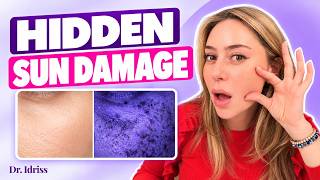
Dr. Shereene Idriss explains how sun damage hides beneath the skin using a Wood's lamp to reveal it. Sunspots are cumulative DNA damage, not just surface pigment. She recommends an 8-10 week at-home routine with kojic acid, tranexamic acid, and 4-butylresorcinol before considering lasers, which can backfire without proper skincare first.
Chapters
Hey, little nerds! Sun damage. It can look like this, it can look like that, and it can even look like that. But it's hiding beneath the surface of your skin. If you don't believe me, this is my skin underneath a Woods lamp. So if you take a look at my skin today, this is what I look like. There's no filter. This is me. Yes, I have makeup, but if you looked at my face through a Woods lamp, this is what I look like. So how do you tell if you have damage lying underneath the surface of your skin is something that I'm going to help you with today as a dermatologist figure out. But by the end of this video, I want you to know more than that. I want you to know how to differentiate between different types of sun damage in the form of dark spots. I also want you to know that there are 3 underrated ingredients, and you're going to understand them by the end of this video, that I love to incorporate into a skincare routine and that I put in every patient's routine. And we're also going to talk about the biggest mistake some of my patients make before they ever try to help themselves when they come into my office looking for a laser treatment. So without further ado, I'm Dr. Shereene Idriss. Welcome back to Pillow Talk Derm. We do this thing every Saturday morning at 10 AM. Make sure to like this video, comment, subscribe, and follow along for more. Before we find the hidden stuff lurking underneath the surface of your skin, we have to name the visible stuff, and I'm talking about the stuff that's on the surface of your skin. How do you differentiate between a sunspot versus a freckle, which is the age-old question? Freckles have been romanticized, they've been cutified. Everyone loves to have freckles when they're younger because they're looking like sexy California surfer girl, Hailey Bieber, and we're drawing them on our faces. But freckles' medical name is ephelides, okay? They're genetic, and you'll see them in childhood. And what happens with freckles is they appear more prominently in the summer or when you are exposed to UV rays, and then they disappear in the winter or when the UV index goes down. But freckles are your skin's way of responding to UV in real time, and we're going to talk about what they're actually doing because Freckles are pigmentation that is forming on the surface of your skin in order to help protect your skin. We'll get to that in a second. Sunspots are different. Their medical name is solar lentigenes, and they tend to appear later in life, in your later 20s or 30s or 40s and beyond, and they're due to cumulative sun exposure in the form of sun damage. Because with sunspots, your DNA is getting damaged as well. What's happening is those brown spots are sitting on the surface of your skin and they are appearing more prominently, and they're becoming bigger over time. But the difference between a sunspot versus a freckle is a sunspot never has the chance to disappear and come back. Now, when you get tanned, you may think, oh, they're not as obvious because the rest of your skin is darker. But counterintuitively, those sunspots, when the tan fades, are going to be darker than where they were before you ever tanned. So that's the difference between a sunspot and a freckle. And they usually both tend to show up on areas that are constantly exposed to the sun, AKA your face, AKA the bridge of your nose and your cheeks and the high points of your face. Here's the thing though that most people do not realize about sun damage. By the time the spot appears on the surface of the skin, it has been lingering for years underneath the surface of the skin. The spot that you're seeing is sort of the last sign because it's actually living deeper down in the deeper layers. Every time UV hits your skin, right, your melanocytes, your pigment-forming cells, are going to produce melanin. And melanin is acting as a defense mechanism protecting your skin like an umbrella shielding your skin from the sun. So when you're a kid and you're getting freckles, each time you're getting those freckles, that melanin that's getting created is trying to protect your skin from the sun. Each time you're out in the sun and you're getting a tan, that tan is protecting your skin from the sun. Now, as you get older and the freckles linger and they don't disappear in the winter anymore and your sunspots become more prominent, that is the DNA having been damaged time and time again. That can no longer recover and recuperate itself, and so it lingers on the surface of your skin, and that is what you're seeing on the surface. But at the same token, there is pigment that is going deeper in the dermal layer, in this layer of your skin, and that dermal melanin is the melanin that is going to linger there and play the long game in terms of trying to appear over time more prominently. The conversation is not about just removing the surface pigment in the form of sun damage as you get older and it's starting to bother you, but it's really about addressing the root cause within the dermis and keeping that pigment quiet over time. Now, this is a handy-dandy tool called a Woods Lamp, and it is a UV light that is going to pick up the pigment deeper in your skin in a way that your visible— your naked eye cannot see it. It basically smushes all the layers of the skin and shows you all the pigments on the same playing field. And the deeper pigments tend to appear darker and more pronounced, and the more superficial pigment will look a little bit lighter. In fact, this is the same type of light that will help to detect whether or not your money is counterfeit or not. Um, and if it is real, you will see a little strip light up, and if it is fake, you will not have that strip. So you better go to the bank and figure out what are you doing with your life, or maybe run and not go to the bank because then you'll end up in another institution. That being said, I will link the Woods Lamp on Amazon below. I'm not going to link the medical one, I'll link the cheaper one because you don't need the bigger one, but it can essentially give you more or less the same information. Now, the lucky generation of kids who have parents running after them with sunscreen and protecting their faces are not going to have as much sun damage lurking underneath the surface of their skin in 20 or 30 years. Our generation, and me unfortunately, burnt a lot in our youth, and so the damage is is sadly there, although we have learned to fake it quite well and suppress it so that it does not appear on the surface of the skin. And this is why I am militant with a skincare routine. I want to be clear about this next section, which is treatments in office for pigmentation that is the number one sign of sun damage. I love lasers. I have a ton of lasers in my office. Lasers are incredible tools when you know how to use them, what to use them for, often to use them, and when not to use them. But I am anti-laser when it is the first move to address sun damage in the form of pigment. Because like we just talked about, most people are just looking to remove the superficial noise that they see. But the problem is, let's say I remove that superficial noise and you go back in the sun, right? Or 1 or 2 months later, you're just living your life, not adhering to anything at home. Those deeper brown spots that I just described are going to creep up to the surface of your skin and wake up. And guess what? They're gonna appear back on your skin and you are gonna be an angry patient who just spent thousands of dollars and your results did not last. Yeah, of course they didn't last because the damage is under the surface of the skin. And so when it comes to lasers for pigmentation, you're trying to treat sun damage in the form of dark spots, sunspots, or pigment, you have to be militant with an at-home routine that targets pigmentation because you want to make sure that you are suppressing that deeper pigment so it doesn't wake up and your results get reversed pretty fast. The second thing about lasers and pigmentation that I worry about is if you are prone to post-inflammatory hyperpigmentation and you're not on the right skincare at home. If you're prone to post-inflammatory hyperpigmentation, lasers are going to basically attack your melanin, the pigment that's underneath your skin, by scattering it and breaking it apart. And when it breaks it apart on a microscopic level, an inflammatory reaction comes into play to eat up all that pigment. But with an inflammatory reaction, if you are prone to hyperpigmentation, you can make your pigmentation indirectly worse, and that is not the goal. And the third subset of people are people with melasma. I will not address your melasma with a laser as a first-line treatment without ever trying any sort of over-the-counter routine married to a prescription medication, because melasma is a very, very special beast of a condition that is triggered by inflammation heat, hormones, you name it. And adding insult to injury is not a good look or the way to go if you have melasma. That is where I stand with regards to lasers. Here's what I tell every single patient of mine who comes in who wants a laser treatment for sun damage in the form of dark spots or sunspots or pigment: let us give ourselves a chance of being militant to a skincare routine for at least 8 to 10 weeks, okay, before we go ahead and spend thousands of dollars at my office, which of course I'm very grateful for, I want you to be a happy person first and foremost, and a happy patient with good outcomes. Let us see how much skincare can do, plus or minus a prescription, and then reassess the situation in 8 to 10 weeks to then decide, after having been educated and having given ourselves a chance, do I want to do the laser treatment? And it's really a toss-up. A lot of my patients are super happy after the 8 to 10 weeks, and they do not want to necessarily spend the money at that point on a laser treatment. The other half are happy, but they need a bit more, and so then we move on with the laser treatments. But both of these patients were set up for success from the get-go because they're doing most of the work at home, and therefore they're going to be seeing results from that work that they're doing, and they're giving themselves a chance to save money down the road on a laser treatment that they may not need. And so lasers are not the enemy, but they're not my first choice when it comes to sun damage in the form of pigmentation. And my first choice is always and will always be what can you do for yourself at home first, which leads me to skincare routine. Everybody has talked about the ingredients that you think you need. We all know vitamin C is great, we all know glycolic acid, great, chef's kiss, and I'm not negating that. On their own though, they're not wonderful and they must be used with other actives. But there are 3 underrated active ingredients that people hardly ever talk about that really does surprise me, and I want to just quickly talk about them right now. The first Kojic acid, which is derived from a fungus. There's a fungus among us, and it's also the oldest of the three that I'm going to talk about. But this was first identified in sake workers in Japan, the sake fermentation process, and that is how it was introduced into Japanese skincare first and why Japanese skincare was really ahead of the curve before anyone else. It is a tyrosinase inhibitor. Now, tyrosinase is the enzyme that makes pigment, so it's blocking the enzyme from forming the pigment. So the pigment never gets really produced or doesn't get produced as much as it would have in the first place. But less is more. The sweet spot for kojic acid is around 1%. If you try to go stronger, like at 4%, you're just going to buy yourself an inflammatory reaction, which is not ideal, especially if you're prone to melasma or post-inflammatory hyperpigmentation. The second ingredient is tranexamic acid, and this one has a wild backstory. It was first initially used for decades by OB-GYNs during childbirth or for women with really heavy periods to minimize bleeding. They saw is that people who had melasma, their pigmentation got better as well. And so it started being used as a medication for melasma, although it doesn't really have that indication yet. In its oral form, it can be used for melasma, and around 60% of people are really happy with it, especially those with deeper dermal melasma. But topically, it also works, and it works in a very interesting way and not one that we've ever really talked about, but it inhibits plasmin production. And so plasmin, this, this pathway is going to trigger an inflammatory cascade and it's going to minimize that inflammatory cascade from forming. So if you're prone to any sort of pigment that is reactive to inflammation, or if you're prone to post-inflammatory hyperpigmentation, it's going to calm that inflammation down in those areas. And that's why I really like it as an adjunct, especially if you do have melasma or you're prone to PIH. It's not the most effective ingredient on its own when used topically, and therefore I like to marry it to an exfoliating acid like glycolic acid, because when you put them together, it's going to minimize not just inflammatory reaction from the exfoliating acid, but it's also going to give it a better chance to do its job. Third ingredient is 4-butylresorcinol, also known as Ruscinol, a very long name with a simple job. It is also a tyrosinase inhibitor like kojic acid, but it goes a step further and inhibits something called TRP-1, which is like basically shutting down the factory. If kojic acid is just turning off a worker, 4-butylresorcinol is turning off the machine where the worker is working at, in addition to turning off the worker. And it really does have its own merits. And in a head-to-head study with hydroquinone, it holds its own weight minus the reactions of hydroquinone, especially in terms of irritation. Now, the reason I am walking you through these 3 ingredients is that they work beautifully together because they don't compete with one another. But when you put them together, they stack really beautifully well and they overlap in terms of what they do. So if, for example, addressing pigmentation requires 1 road, 2 roads, 3 roads, right? How can I visualize this? Let's say these 3 roads, 4 roads results in pigmentation. You're gonna turn off one, you're gonna have three others. You gotta turn off this one, then you're gonna turn off this one, then you're gonna have to turn off that one, right? You cannot just get one ingredient at its maximum concentration and expect this pigment to turn off. You're gonna need to get all three ingredients if you want this pigment to not appear as prominently. And that is the goal of stacking actives. It's not about hammering in one ingredient at its highest form or percentage, but it's about addressing through multiple different pathways. And that's what we've done in my brand at Dr. Idriss with the Major Fade Protocol. This 3 are just 3 of 13 different actives, including the ones that you have come to know and love, like vitamin C and glycolic acid. But we're not going to talk about that here because that's not the purpose of this video. I'm also going to link my products below, but I'm going to also link products beyond my brand below. And by the way, it's Memorial Day weekend around the corner. If you are interested, I will put below a special, um, bonus for you guys watching this to catch the sale before the Memorial Day weekend, which starts on Wednesday the 20th and runs through the weekend. The coverage that you see is a fraction of everything that you're seeing. The deeper pigment is really what's causing the long game to be a long game that you want to keep quiet. Lasers are a finishing tool, they're not a starting off tool. And when you're talking about a skincare routine, you can have a simplified skincare routine with multiple actives addressing pigment but you have to always make sure that you're wearing the damn sunscreen so you prevent new damage from forming and not just the old damage that's there. And if you take one thing from this video, it is never, ever, ever too late to get control of your skin, whether you are 30, 40, 50, 50, 60, 70, 80, 90, who knows. You can always make a difference with your skin through the products that you use, and I want you guys to really feel emboldened and empowered by that statement. And I hope you guys have a beautiful weekend. I will see you guys next weekend while the sale is in high gear, and I'll make sure that you guys know about it then too. But if you're watching this video, you guys got a very special sneak peek preview to our upcoming Memorial Day sale. Have a beautiful Saturday, and I'll see you guys next week.
More from Shereene










3 Ways I Prevent Post-Menopause Skin Issues + What Really Helps Elasticity After 50