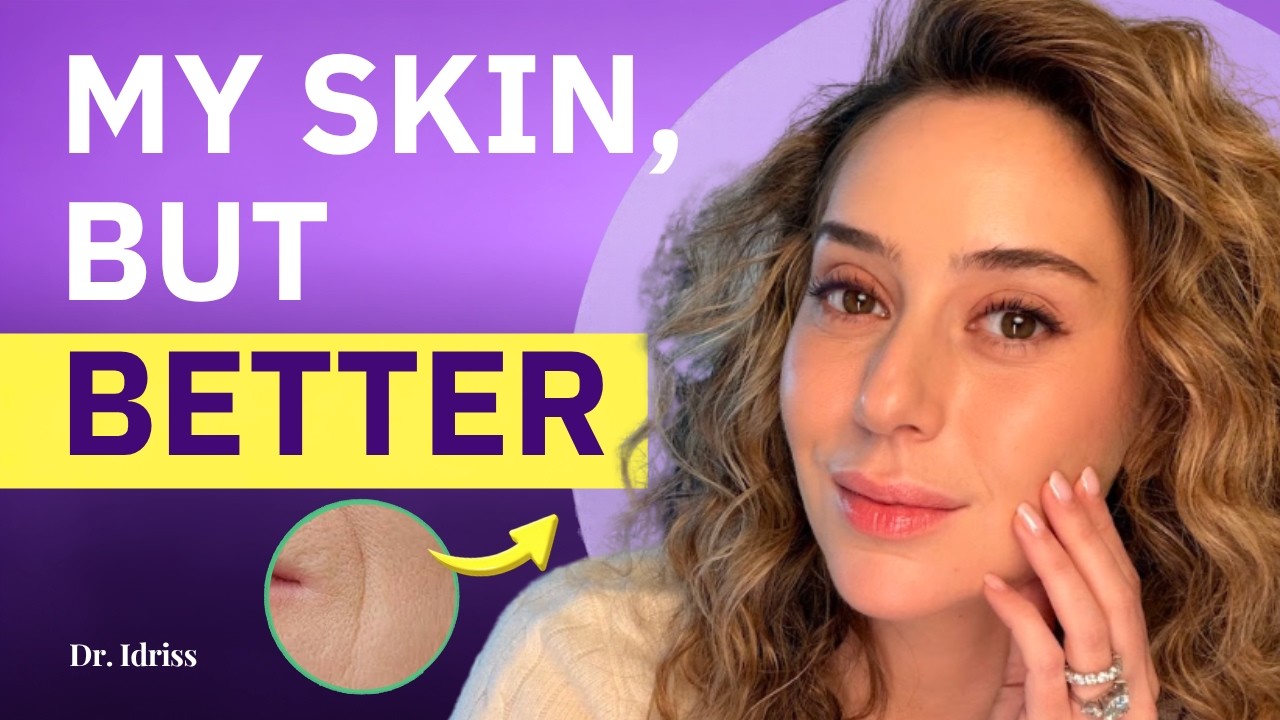
In this solo video, Dr. Shereene Idriss, a cosmetic dermatologist, shifts from discussing patients’ under‑eye concerns to examining her own at age 42. She explains that dark circles arise from several distinct mechanisms—pigment, visible vasculature due to thinning skin, hollowness, puffiness, and structural bags—emphasizing the need to diagnose the specific cause before choosing a treatment. Idriss reviews the role and limits of topical skincare (hydration, collagen support, brightening serums) and why creams cannot restore lost volume or structural support. She outlines her historically conservative stance on under‑eye fillers and Botox, noting the delicate anatomy and risk of over‑filling. The core of the video details her decision to undergo an autologous fat transfer using microfat for cheek support and nanofat for under‑eye tissue regeneration, harvested from her inner thighs. She describes the procedure workflow, recovery timeline, and the gradual improvement observed over three to four months—thicker skin, reduced vascular visibility, and a healthier appearance—while acknowledging that results are subtle, not a return to youthful eyes, and that the treatment is not annual. Idriss concludes with a philosophy of “looking like yourself, just better,” advocating for selective, anatomy‑driven interventions, honest patient‑selection criteria, and a balanced view of surgical versus non‑surgical options.
Chapters
I have spent years online talking about your under eyes, about my patients' under eyes, about other people's under eyes. But now at 42, I'm ready to talk about my own under eyes because I am finally really seeing that hollowness, that crepiness, and that darkness start to creep through. And interestingly enough, not all of that darkness has to do with pigment. Some of it is literally because my skin is getting thinner under my eyes and the blood vessels are coming through, and that is the shadow that we are all starting to notice. And over the years, I have also been very honest about what I've tried. I have tried skincare, PRP, PRF. I even did a CO2 laser last November. But there is one thing that I did this year that made a noticeable, very big difference for me more than anything else, and it was not under-eye fillers. So I want to show you guys today what I did, why I chose to do it, and how I really think about treating this area now. Because the biggest mistake I think we all make about our under eyes is assuming that it is an eye look tired problem when it really isn't, because looking tired is a description and that is not a diagnosis. All right, first question for you to actually look at yourself and answer is, what are you seeing? When somebody comes to me and tells me my dark circles are getting worse, my first question and instinct is, what exactly is making them look dark to begin with? Because there are so many different, completely separate problems that get lumped together as dark circles. You can have pigment. You can also have visible blood vessels that are becoming much more apparent as your skin is thinning out. You can have hollowness that is creating a shadow. You can have temporary puffiness as well, or you can have a structural under-eye eye bag that is pooping out. Plus, you can have crepey, thinning skin. And most of us, myself included, have more than one. And at 42, I have lost a little bit of volume, so there's more hollowing. The skin itself has become thinner and crepier. And because it is thinner, I personally see much more vasculature underneath that is creeping through, that is making the area look darker. And that distinction absolutely matters because you could be spending hundreds and hundreds, if not thousands of dollars trying to treat pigment when the actual problem might be a shadow, or you're buying eye creams when there's really something structural happening underneath. What skincare can actually do. So I absolutely use skincare around my eyes, but I know what my goal is. My goal is hydration, maintaining the skin quality, supporting collagen, and addressing any discoloration that is coming from pigment in my skin. And for me, I have been using the Major Fade Hyper Serum around my eyes for years for that hydration, the antioxidant support, and the brightening that comes with it. But I also layer the Major Fade Active Seal because I love the vitamin C, glutathione, and peptide support for my skin as well. But now that I've gotten older, I will tell you that I do appreciate a targeted hydration cream for this area than I did in my 30s. But it is important that you understand that there is a ceiling because skincare can improve the canvas, but it can never rebuild the architecture underneath it. An eye cream is going to help with crepey-looking skin, and it can help with hydration and certain types of pigment, but it will never replace the volume. It can never fill a true tear trough, and And it cannot make an actual under-eye fat pad disappear. And that is where I think we all have to stop asking the skincare to do a job that it physically was never able to do. It was a true impossibility for it to get done. As a cosmetic dermatologist, why I never just filled my under eyes. I personally have always been extremely conservative with under-eye filler. Not every hole needs to be filled, and a hollow does not automatically mean you need to fill the hole. The skin there is incredibly thin and the anatomy is super complicated. Plus hyaluronic acid attracts water. So a tiny amount can look beautiful in the right person with the right structure, but too much of it can make somebody look puffy, heavy, or actually more tired. And your bone structure absolutely matters. It dictates everything. There are people whose anatomy makes them great candidates for a very tiny amount of filler, but there are others where if you place filler, even if you place it perfectly, you will be fighting their underlying architecture and they will eventually look puffy. So as I've gotten older, I have become much more interested in this question: instead of simply filling the hollow, can we actually improve the tissue quality itself? The thing that made the biggest difference for me— this is where my approach has now changed. So I have previously done PRP and then I've done PRF around my eyes. And I like this procedure because for me, I know they worked. PRP and PRF are like a fertilizer. It's only going to fertilize as good as your environment is. And I did get some temporary improvement in terms of underlying volume, but they required repeated maintenance and treatments like every 3 to 4 months. So in my 40s, I also started to notice that my biggest issue was not just volume. The internal quality of my skin was changing. It was getting thinner, it was getting crepier. And so I decided earlier this year in June to do a fat transfer using both microfat and nanofat, both of which I took from my inner thighs. And sadly, it didn't really make a dent on how my inner thighs appear because you do need just a very tiny amount of fat, but that's where I took it from. So we took a tiny amount of fat from my inner thighs, We processed it the same day, and I do this in my office. And I used a little bit of microfat higher in my cheeks because that's where I wanted some structural support, and that's what microfat can offer. But it is important for you guys to understand that microfat, not all of it sticks around, and maybe 50% of it has been left behind because the rest gets absorbed. But under my eyes, I chose to inject nanofat because my goal here was not about filling but about really improving the internal quality of my skin. And nano fat has the ability to really help regenerate tissue, and that is the beauty of fat. It is a living tissue that can help improve the quality of your skin over time. So this was not an overnight transformation. The first, I would say, 1 to 2 weeks post, I was a little bit swollen, but I was completely presentable. So much so that 5 days post-surgery, I was literally on the Today Show, which is wild to think that I chose to do this 5 days before. But the fact that the procedure is done under local anesthesia means that you can bounce back like this. And then a couple of months went by, and this is where I became my own worst nightmare patient, where I started wondering, did I do enough? Should I have done more? Why didn't we put enough? Because I didn't see much of a difference. But around month 3, I will tell you that patients started telling me, why do you look so refreshed? You look really good. And then people online, you guys have been telling me, you look so awake. So at 4 months, I decided to do my before and after pictures to really see where I was at. And that is when I really started to see the difference. My skin looks firmer, the fine lines look better, and it looks much thicker overall in this area and just healthier. And I could see much less of that vascularity from underneath my skin. And in my experience, I think this procedure has made the biggest difference in my under eyes, even more than the CO2 that I have done that I did last November. And in fact, the before picture was taken eight months after my CO2. So would I do the fat transfer again? Hell yes! But I need to be very clear: this is not a procedure that we do every year. It needs to be spaced out for the right person at the right time. And for me, this was the right time and the right choice. In my opinion. And I do perform this surgery in my office, and it is, though I want you to know, a real surgery. The biggest difference is that you are awake, so you can— it can seem like it's not that intense of a procedure, but it is still a surgery, and it is expensive because it takes a very long time. Mine took about 4.5 hours under local anesthesia, where you have to numb the area, you have to suck the fat out, you have to process the fat, And then you have to inject the fat. And it does come with some soreness and recovery at the site from which the fat was taken. But it is absolutely not something I think that everybody should run out and do. But damn, I am so glad that I prioritized this procedure for myself this year. Why I like the result. So the reason I like this procedure so much is not because I suddenly look like I have 25-year-old eyes, because I most definitely do not. And it's not because I'm trying to look younger, but it's because I still look like me. My baseline just looks better and healthier. And that is increasingly what I am interested in as I get older. Not how do I erase every single line that I've ever had as I've aged, but more how do I improve the quality of what I have without changing who I am? How can I appear and look and actually be healthier? And that is a very different goal. So what I don't do around my eyes. I have personally never done filler under my eyes. And I'm also extremely conservative when it comes to Botox for this area. I like some Botox around the lateral eye to lift my brow, but I never want to eliminate all of my crow's feet below because when you smile, your eyes are supposed to smile too. It's the door to your soul, right? And I would much rather have a few lines and still look like myself than have no lines and completely different expression. Botox also, by the way, cannot fill a hollow. It cannot replace lost volume, even if you try to hit the under eyes. And if you use too much or weaken the wrong muscle, it can make certain under-eye issues look way more noticeable. So my approach has always been to soften and never to fully erase. And if my eyes keep changing, they most certainly will, and I am pretty happy with them right now, so I am going to continue to maintain what I have. I'm protecting the keeping the quality as good as I can, hydrating and brightening with the HyperSerum and Major Fade Active Seal, and I'm watching how my anatomy changes over time. Would I repeat a fat transfer? Most likely, if I look at my face later on and I think I actually need it. And would I ever consider surgery someday? Abso-freaking-lutely! If I eventually have a structural problem that a non-surgical treatment cannot realistically fix, I would rather do the treatment designed to Solve the problem than spend years trying to work around it. It is very, very important that you understand that I'm not anti-surgery, but I am anti-pretending that a non-surgical treatment is the devil or that a non-surgical treatment will do the job of surgery. It will not. And that is why it is so important for you all to understand what non-surgical treatments are trying to do and what they're trying to achieve. But you have to understand what is your problem in order to know what it is that you're trying to achieve. And this is probably the biggest thing that I want you all to take away from watching this video. You can absolutely notice something changing in your face without deciding that it needs to be treated. For me, the threshold is when something goes from, oh, I see that, to, oh, I keep thinking about this and I genuinely think that I would feel better about myself if I address it. Then I would ask, what is actually causing the issue? And is the treatment that I'm considering actually going to fix that problem? Because darkness is not hollowness. Hollowness is not puffiness. Fine lines are not bags. And getting older doesn't mean ignoring everything that bothers you, but it also doesn't mean treating everything you notice. My goal personally is to look like myself, just well maintained.