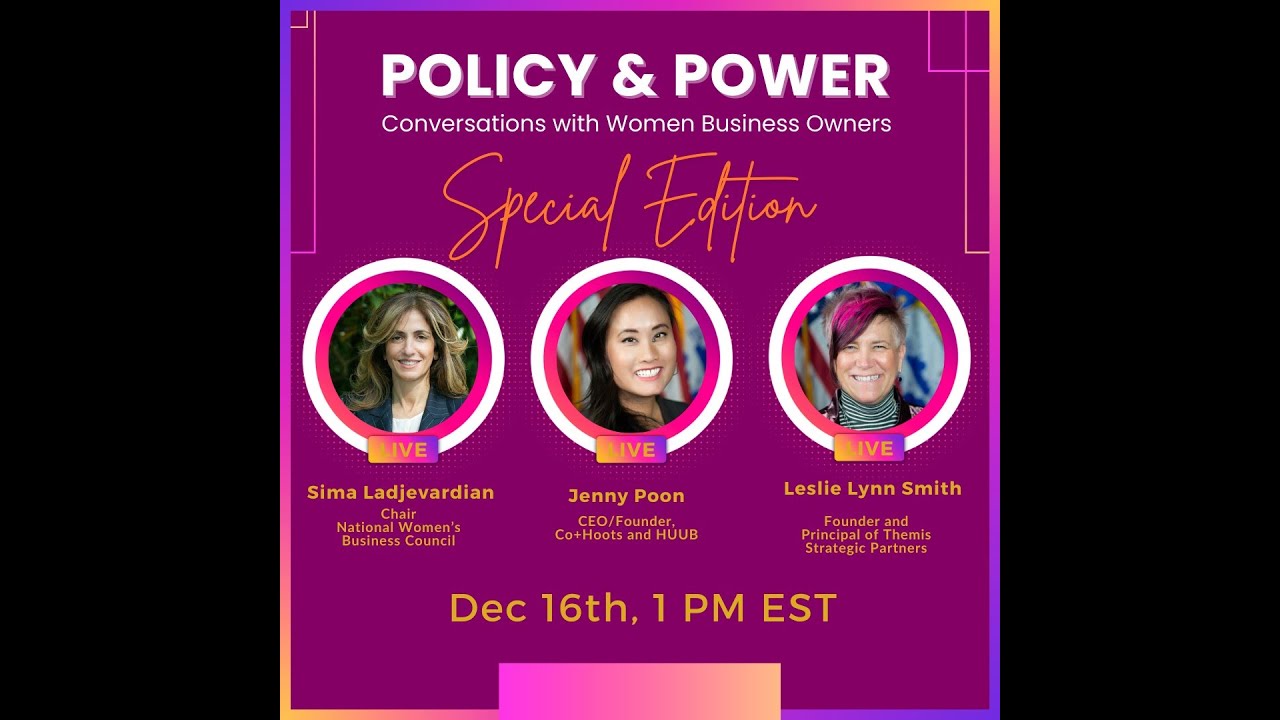
IG Live Series: Policy & Power with Chair Sima Ladjevardian | Fifth Episode - Special Edition
Sima Ladjevardian and the National Women's Business Council present their 2024 policy report with three main recommendations: a standardized, bias-reduced loan-review model; entrepreneurship education in K-12 schools; and gender-disaggregated data collection. The council also calls for streamlined applications, expanded childcare infrastructure, and targeted outreach to tribal and rural women entrepreneurs.
Chapters
Good morning, everyone. We are going to add our amazing speakers. We are on. Yay! Okay. Good morning, everyone, to our Instagram Live series, Power and Policy. This time we have our own incredible council member, Jenny Poon, and Leslie Lynn Smith. Uh, you can look at our past recordings on our website, on YouTube, and you can see the incredible speakers we've had in the past. The purpose of the IG Live has generally been to highlight the journeys of incredible women business entrepreneurs and help them mentor and inspire everybody who's looking to start their own business. Both of these incredible ladies could help on that, but today we're here for another reason, and we will get into that shortly. I just wanted to give you a little bit of an update on who we are at NWBC. I am the proud chair of the National Women's Business Council, which is a nonpartisan, independent federal advisory committee. We were— we came into existence in 1988 with an act of the Women Business Ownership Act. And if you believe it, 36 years ago, women could not take loans out without a male cosigner. At the same time, women business centers came into fruition, and there's about 160 of them right now. We are appointed— the council members are appointed women entrepreneurs from both parties and leaders of women national organizations. This is a— we're the only advisory council that represents 13 million business women-owned, and we pretty much advise and counsel the President, Congress, and the SBA Administrator on anything to do with women entrepreneurs. We have 3 subcommittees: access to capital, access to opportunity, and inclusive entrepreneurial ecosystems. Every year we'd release an annual report that covers pretty much all of our policy recommendations, our engagements, the research we've been doing, and all the additional information and resources that will be helpful to women. And we come up with these policy recommendations based on countless engagement via roundtables, get-togethers, and with council members, stakeholders, policyholders. And today is the day that we have the incredible I guess honored to have our 2 of our council members who are gonna go over these policies that we have come up with and just excited to do this. I'm gonna give you a short overview of both of them, which is very difficult because they're just both so accomplished, and then we'll start. So Jenny Poon is a serial entrepreneur and founder of Hub, a data-driven capital platform. Digital platform for governments to streamline the delivery of small business support services. As the daughter of Vietnamese refugee and self-made business person, she speaks, writes, and advocates daily for safer entrepreneurs ecosystem for women and people of color. She's also CEO of Hub. Before Hub, Jenny founded Cohoots, the first co-working space in Phoenix, Arizona, which she grew to 2 locations, creating thousands of jobs and serving more than 1,000 entrepreneurs monthly. Jenny contributes regularly to the Kauffman Foundation, the Business Journal, and the Arizona Republic, USA Today. She serves as an advisory for numerous startups, as board chairs of Cohoots Foundation nonprofit organization, and as a mentor for several young entrepreneurs. Jenny was named Phoenix Business Journal 2016 Person of the Year— Business Person of the Year, and she was the first minority and the first woman to receive the honor. And then Leslie. Leslie is a member of the United We Viewing Marion Kaufman Foundation Commission on Child Care and Women's Entrepreneurship and the founder and principal of Themis Strategic Partners, a consulting firm focused on developing actionable strategies at the intersection of equity and growth. Prior to this, Leslie was the National Executive Director for Get Cities at Second Muse, advocating for gender equality in tech. Leslie's extensive career in economic growth and community-based business development has shaped her belief that local entrepreneurs are best positioned to address community challenges and foster equity. She has served on numerous boards and has led numerous organizations. Like, she founded and was president and CEO of Epicenter. She also led Tech Town Detroit's leading business incubator, launching innovative urban development programs and fostering regional entrepreneurship collaborations. Her leadership has been recognized in publications like Forbes, Fortune, SciBlueprint, and she has been featured as a TED speaker. She was named one of Memphis Business Journal's Superwomen of Business in 2019. As you can see, we are incredibly lucky to have both of them on. So we're going to dive in and then have this incredible discussion. Please make sure if you have any questions, you put it on the chat and then we'll try to get to it once we're done. We're going to leave 10 minutes at the end to be doing that. Um, I guess I'm going to start with Leslie and then Jenny. Looking back over the past year and knowing that REC's recommendations don't come in a vacuum, what is the process of developing these recommendations in the annual report?
Yeah, thanks, Sima, and thank you for the introduction. I'm so excited to be here with the two of you. I think you mentioned in your opening remarks that we really do want to make sure that the voices of women entrepreneurs are lifted up and held as sort of a critical driving force to all of our policy recommendations. And those voices of their experiences are melted together with research that we perform in partnership with many other organizations or agencies within the federal government and around this work and come together to solve what we view in each year to be the most pervasive challenges, blocks, or barriers to success for women entrepreneurs across the country. And so we take all of those ideas and work them out through our subcommittees. We sort of arm wrestle a bit over what we think we can actually accomplish in a given year because we want to be able to make sure we follow these policy recommendations to action and not just sort of discussion. And then we publish them in our annual report and spend an entire year talking about them to policymakers and That was perfect explanation of that.
Jenny? The only thing I'll add to that is each of us as council members dig into a focus area. We obviously are passionate about all the other areas that we cover across this council, but we do dedicate a good amount of our time every month to dig into the specific topics that we are involved with. And so I would add that, that like we do have focused times where we have our, you know, our specific areas of expertise that we're digging into and things that we're specifically passionate about too, which I'm sure we're going to be talking about.
So there's a lot of time and passion invested in these policy recommendations and And it takes a lot of time from everyone. This year's report highlights the importance of unlocking entrepreneurial potential through innovative policy solutions. Would you mind sharing a few of the most impactful recommendations and explain why they're especially relevant right now? And Jenny, I'm going to start with you this time.
Sure, I'll pull up my top 3 favorite recommendations. We learned a lot through the pandemic through the kind of failure of the first PPP round and then the success of the second round. And one of the big areas under access to capital that we're really digging into is how do we develop a criteria that is honestly based off of a lot of what we've learned over the last few years around how the SBA deploys loans and create a standard that really works. Because of what we saw, that ability— well, one, it's really challenging for entrepreneurs, especially underrepresented and women entrepreneurs, to understand and navigate the loan process. And oftentimes it's, you know, there's bias that inherently goes into having somebody identify whether your business is a risky business or not. And so how do we create a standardized model of reviewing those applications, take out as much of the bias as possible, and potentially extend this opportunity of forgiving a loan so that we get businesses into just understanding how to navigate that loan process. So I think that's one of the areas of exploration, which is really exciting because never has it ever been done that small businesses, especially the micro individual businesses, like get loan forgiveness opportunities. And that happens at a large scale, like big corporations get loan forgiveness and handouts all the time, but it never comes down to the small businesses who need it the most. And so really looking at what are the ways we can get these businesses that oftentimes like fail in the first few years, how do we get them further along to the point where they can get a loan and understand that process? So looking at that first recommendation, access to capital is a key lever of growing small businesses, especially women-owned businesses. So that's one area. Another area that I really like, especially in my area of focus is inclusive entrepreneur ecosystems, is really trying to get— and I've been, I've been kind of cheerleading this for a very long time— is getting entrepreneur education earlier into schools. And we know that the more opportunity that you expose businesses or young people to entrepreneurship, the faster they fail and the faster they learn from it. and the faster they can grow. So how do we get that entrepreneurship experience early on into schools, into education, local agencies? And, and so that's a focus area in making entrepreneurship a key component of education early on. And then the last piece that is dear to my heart is, as we've like dug into the challenges of helping women-owned businesses, was the realization that a lot of data is not being collected around gender. And I think I think there's a history around why that wasn't done before, but I think we're at a point now if we really want to grow women-owned businesses, we need to start collecting the data on one. If we're, if we're deploying funds from the federal government to the state, to the cities, like, is that going to the people that really, really need it? And so creating first doing an assessment of what is the data that's being collected and how do we standardize that so that it can be compared across communities, across the nation. and across its efficacy. So those are the 3 areas that I will call out that I think are really, really important.
Thank you so much, Jenny. Leslie?
Yeah, thank you. Just to piggyback on a few things that Jenny said relative to access to capital, which is one of our primary focuses, to unlock access to capital for women-owned businesses, there's a couple of other things that I'd like to add. Streamlined access through common applications. So right now entrepreneurs entrepreneurs have to complete a bunch of really complex documents, and those change depending on the agency or type of loan. So we're always looking for ways to streamline the application process, and you'll see that our policies not only sort of sit at the strategic level relative to solving big challenges for women entrepreneurs, but the very tactical level. What can we do to make these processes easier? easier, and sometimes it's as simple as just making the application process easier. We have specific experience— I have specific experience with that in Memphis, where we got all of the community development finance institutions aligned around a common application and saw not only access to capital expand, but the timeline for accessing that capital shrink significantly. So we're really excited to bring that forward. I'm also always looking for ways to bring more equitable decisioning since women and other marginalized entrepreneurs have not always gotten the same approval sort of percentages. So what can we do to ensure that that process is increasingly equitable? And then one of my passion projects, as Jenny said, we work on a lot of things we know well, but also a lot of things that we care a lot about. And one of the things that we care a lot about is economic infrastructure and sort of leading the path of our concern. Relative to policies, access to childcare, and are there ways that we can more creatively advance innovation to make access to childcare on behalf of families easier, more affordable, safer, and more streamlined? And so our idea is really about the sort of federal agencies allocating additional public support. Jenny talked about what we learned in the pandemic through a variety of loan offerings, but also through child tax credits and direct payments to families that helped them access the resources they needed to survive the sort of clunkiness and disarming nature of the pandemic. And we think that some of those lessons can be carried forward into making child care more widely accessible. And we know that that will unlock economic potential for women. And Sima loves to talk about the Trillions, that's T of dollars that will be unlocked if we fully and faithfully support.
Exactly. To your point, we right now contribute to the economy $3.3 trillion.
There it is.
Could go as up to $10.2 trillion. So that's a lot of contribution to the economy if we have all that.
100%. So back to the point that data drives our decisions as well as the lived experience of women entrepreneurs, we are constantly constantly looking at what the data are telling us and the ways that we can activate to unlock that full potential, as Sima just said.
And the one that speaks to me a lot is that, and I know we've all talked about it, is the microtargeting, like the federal government actually microtargeting women, because especially tribal women, rural women, there is so much information out there and very hard to access it. So making a concerted effort to make sure that we go into those communities, Let them know about Women Business Centers or anything else that's happening, you know, how to get the contracts. And I, I think that's something that we've all seen. It's so important to do because it's, it's just, you, you would assume that it's there, but there's just so, there are so many resources. So we want to make sure that we're able to reach that.
Like every day I feel like I'm learning about a new resource that has existed for decades, you know, and I've been in business for more than a decade, right? And very active in the entrepreneurial community. And so if I don't know it, I'm just like, how does everybody else even find out about this? So I think the big problem often comes from not devoting funding towards marketing, which has traditionally been a no-no for federal funding. And so I think trying to push to focus on the ability to, to to create more marketing outreach to those businesses, because how else will you reach them?
Absolutely. So for entrepreneurs, policymakers, and the public tuning in, how can you influence the recommendations and the work that goes into the annual report each year? Is there a way for stakeholders to get involved, share feedback, and be part of the conversation? So I will start with Leslie.
Wonderful, thank you, Seema. This is my favorite question, in part because over the decades of my time as an entrepreneur, an economic developer, ecosystem builder, I've increasingly become more and more aware of policy and its importance, not only from the development of policy and the passing of law to adopt that policy, but also the administration of that policy. And I think it's important for everyone listening to know that we all have a role to play and that it's important that you understand locally, at the state level, and at the national level what policy implications there are relative to your economic autonomy. And so the first thing I would say is read the report. It is awesome. It is beautiful. It is filled with insights and recommendations that we think are really important to unlocking entrepreneurial sort of power and innovation across the entire US. And then figure out ways to get involved. I mean, reach out to us. You can find any of us on LinkedIn. We're all over the NWBC social media channels, but also have our own sort of social media personas. We would love to hear from you. And then, as we're planning our public meetings, try to attend. Many of them are virtual, or if you happen to be in the DC region, you can attend. We also do entrepreneurial roundtables around the country, so keep your eye out for those because they're pretty fun to attend. I find as an entrepreneur that our roundtables unlock that we are in fact not alone and that together we can build a really strong community of practice, not only doing entrepreneurship and running our businesses on the ground, but making it easier for all of us and for future generations.
Jenny?
Yeah, I think, you know, for a very long time I was very afraid to be anywhere connected to government. I was told as a child to stay away from the government. You know, as an immigrant child, it's, it's scary, like, being involved at all with the government because all we know is oftentimes the regulations regulatory side of government. What I didn't realize until I was an adult, and probably much too late, is that there's actually whole other departments that are all about the collaboration between public and like the general public and the government. Economic developers in general are here to cheerlead small business. And so after I discovered that, I realized, one, that the government works for us. We pay them and we employ them, so we are actually their boss. So you should be vocal about your needs. Um, and second, that they're actually not as inaccessible as you think they are. Your city council has meetings every single month where you can come and you can state your, your ideas and what your challenges are, and they want to hear that. They take all of that back to They're in meetings and they start building policies around what they hear, just like what we do on this council. I would say even your state representatives, they have those meetings, right? I know it sounds complicated and like it's time out of your day, but there are ways, especially with the way social media works now, like emailing your city person, city council person, your state representative, any of those things are helpful. I sit on a government regulatory board here in Arizona. And I will tell you that every comment that gets sent is included in the updates that we get. And so it is important for you to share that— call, email, whatever you can do that is convenient— to vocalize the things that you're running into and if you have an idea. Now, if you are also— if that seems still too intimidating, I would also lean on your community groups. There are local chambers, there's local advocacy groups that have the ear of your legislator and share those with them. Share your feedback and get involved in that way.
Absolutely. It's never too late. And I think it's so important for everybody to know that your voice matters. You can actually make a difference. As we look ahead to the release of the annual report, what do you hope its findings and recommendations will spark? And how should we envision the role of the policy proposal in driving sustainable, inclusive growth for women-owned businesses in 2025 and beyond?
Yeah, well, I'll tell you, I have a daughter, right? And she's a fiery little girl. And I hope that every little girl believes and can see other women be successful and be inspired by that so that they can start. And also, like, that we won't have this conversation in the future, that this— hopefully this council may not exist in the 2 generations from now because we will have reached the parity that we're looking for. All of these recommendations are to get us there, to create more power within our communities, for more women to start businesses, for them to get the funding to grow, to become millionaires in and of themselves and create the generational wealth that we hope to see, to buy homes and create other millionaires between the businesses and employees that they create. That is the hope. But we can't do any of that until we start making positive and like targeted changes on the system that we have today.
Very inspiring. Yes, Leslie.
Yeah, it's always hard to follow Jenny or Sima. I think what I love are the conversations that are started as a result of our policy recommendations. My favorite days are when we're in D.C. carrying the book around and sharing them with legislators and talking about all of the voices and research that went into the policy framework and having, like, dynamic, engaged conversations about why these policies are important for American communities and seeing the faces of legislators light up when they hear the stories of people in their communities who are informing these policies. And so, I think my favorite part is unlocking them and activating them and watching them come to life. I don't think we often spend enough time celebrating the passage of the legislation on behalf of recommendations we've made in the past because we're always driving toward that. sort of future that Jenny so beautifully described where we don't have to have these conversations because we are participating at the rate we sort of show up in society. But until then, I think those conversations are really my favorite part and seeing folks get excited about the ways they can support this agenda.
You're so correct, Leslie. I mean, we've been in these meetings with whether it's the, you know, agencies or the elected officials we walk to, they really appreciate what we bring to the table because they don't have time and this is what we do all day long. And I think a lot of these recommendations are listened and happen. Like as an example, look, there's a childcare requirement in the CHIPS Act. You know, like, so there are so many of those which, you know, you'll see in our annual report, but they do listen. It may take sometimes, but things do happen. So I think that's really, really exciting. Uh, God, I mean, there's so much to talk about and I feel like we're almost out of time. So I'm gonna have one question and, and, uh, either of you can answer that. Um, and I'll see if we can do maybe another one. In what ways do you see NWBC— no, sorry, that wasn't actually— actually, do you know of an impactful conversation NWBC had with someone, a woman entrepreneur, And how that role impacted them in shaping our recommendation.
Yeah, I mean, one immediately comes to mind and I bring it up almost every time we're together, which is at a public meeting we had when an entrepreneur was talking to us about what recertification felt like under a recent challenge to 8 loan certification. And we were able in real time to onboard that feedback, corroborate it with other people in the room and carry the message to the administrator through your leadership and Tene, our executive directors, and immediately start sort of action in support of entrepreneurs, which for me was so powerful because it was all about being in the room. So when Tene talks about going to these meetings and we invite you to come, it really is a place to be heard and activate this energy and resourcing in your favor. So That's one of my favorite stories where we get to sort of live through the experiences of our entrepreneurs in real time.
Yeah, I, I'd agree with that one. That was the one I was going to say too, Leslie. The other one that I can think of is at a— at one of the in-person ones we held in DC, we talked about the format for RFP solicitations. And we opened up one of just standard RFP solicitation, and it was 60 pages long, and you didn't get to the meat of the scope of the work until page 40. And so, just being able to see that in front of— and I think you— we sat there, and we watched as other leaders in the government kind of saw that for the first time and saw it through their own eyes, the shock of like, oh, I see from a business owner's perspective, this is really overwhelming, and that it started to settle in that, like, what has always been done isn't the way that it always needs to be, and we should think about the streamlining of processes that often get very complicated, overly complicated, when, when we move them into the government.
I mean, going back to what we talked about, that's why everyone's voices matter, and Yeah. Going back to what Leslie said, please don't be shy. Email us, join us when we have these meetings, these roundtables. If there's something you want to talk about, just make sure we can bring that up. We're going to— our policy recommendations actually come out this week. We are going to present them at our public meeting. Please join us either virtually or in person. It's going to be January 7th. Just sign up on our newsletters, sign up on our social media. I know you're bombarded by stuff, but just please do that because this is— we're all here to help and we're all— everyone on the council is very busy, super passionate, and this is really a work of love.
Yeah, we don't get paid for any of this, so you can tell we really love it.
We just, we, we just, uh, love what we do. Um, I'm gonna see if we can do just one more question, and I hate to stop this because this is honestly one of my favorite Instagram we're having. Um, what do you see NWBC supporting innovation in the female business ecosystem in the year to come?
What do we— what do you see us supporting?
Um, I think innovation in the, in the, I guess, in our ecosystem.
Well, I'd go back to that grant process and like the streamlining of sharing information. I think from many of the meetings we've had between the MBDA, the SBA, the EDA, everybody is managing that data separately. But we as all business owners are interacting with all of these different programs. And so from just the work that I do on a regular basis, I see the fatigue of a business owner being like, okay, I have to fill out this and then I have to fill out this and I have to fill out this and I have to fill out this. And they're all the same things, right? This is also with the loan process. Like anytime I go to one loan vendor to another to like shop around, I have to fill out the exact same form, right? Is there a way to streamline that process? Because we're all collecting the same thing. And so I think my dream is— this isn't probably in the next year— my dream is just like we have health data centralized, is there business data that's centralized that we could just be like, okay, I'm applying for the loan, let me share this information with XYZ government agency or whatever, being instead of having to start all over and refill it out, you know? That's a— I know we're not talking about specifically the The one recommendation, but I think it stems from the recommendation of streamlining.
Absolutely. Okay, I'm gonna— we're gonna have to sadly wrap this up, but Leslie, I'm gonna let you have the last word and then we'll wrap it up.
Let's do it, Leslie, close us out.
Yay!
Well, I just think sort of I'm inspired by your question about looking to the future, Sima, and I think we can continue to challenge the status quo and make recommendations that are informed by women entrepreneurs and actionable by those of us with sort of influence over resources. And so I think once we've tackled childcare, there are other areas of concern, whether it's access to elder care, healthcare, retirement security, a whole variety of sort of Institutional economic infrastructure. Yeah, paid family leave. There are a lot of additional sort of infrastructure innovations that I think we can be on the bleeding edge of that will help not only America's entrepreneurs but our families and communities.
And I just want to say, say that NWBC doesn't advocate. We just research and propose policy solutions. So I just want to make sure I make that distinction. Thank you so much, both of you. Just, it's an honor to serve both of you. Looking so forward to do so much more together. To the audience, we're going to have a recording of this on our YouTube channel, on the website. Join us on our Instagram. Our website is nwbc.gov. And just really excited to be there and see you all hopefully January 7th.
Thank you.
Yay! Thank you. Happy holidays, everyone.
Happy holidays.
New Year.
More from Sima
Instagram Live Series with Chair Sima Ladjevardian | First Episode with Guest Christina Hale