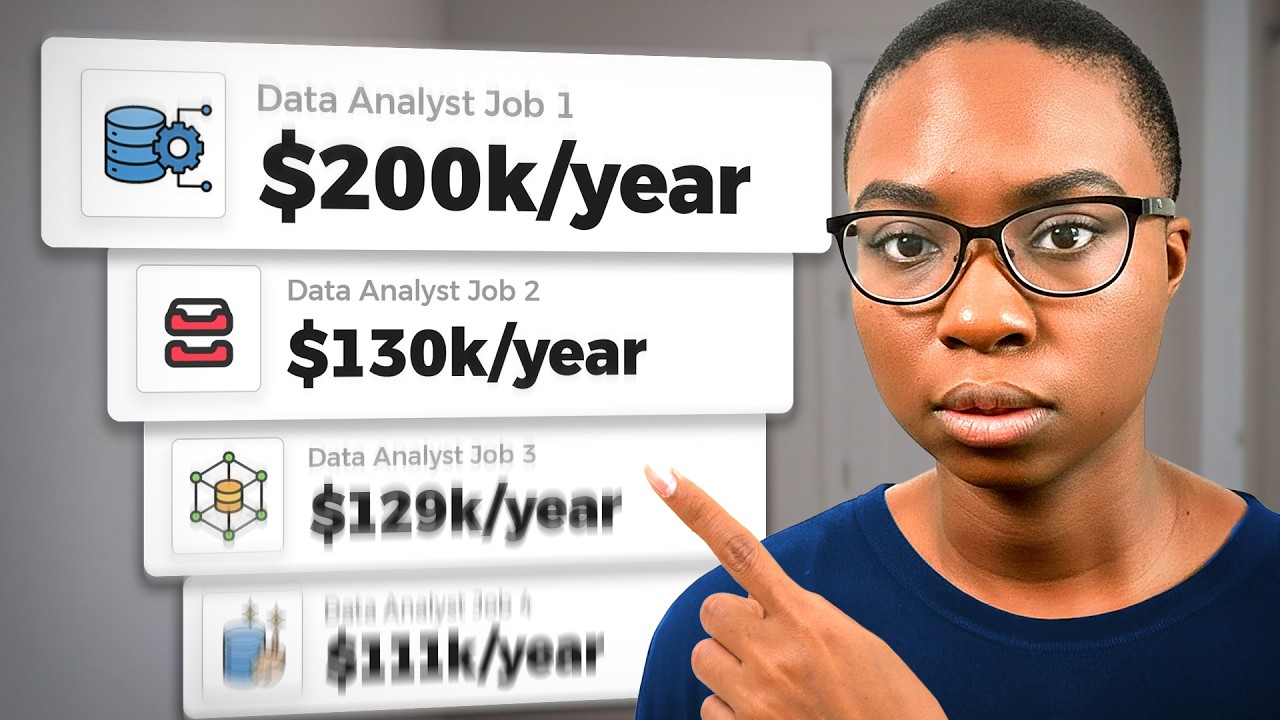
In this career‑advice video, Kedisha Bryan challenges the common, oversaturated advice of learning basic SQL and earning a certificate to become a data analyst. She argues that those generic paths no longer secure high‑paying jobs because thousands of candidates compete for the same entry‑level titles. Instead, she reveals five specialized data‑analytics roles that pay significantly more—ranging from $150K to over $370K—and are actively hiring. For each role she explains what the job entails, typical salary ranges, the core technical and business skills required, and how a career‑changer can pivot into the position without returning to school or spending on costly certificates. The five roles are: (1) Analytics Engineer – the bridge between analysts and engineers, focusing on data modeling, advanced SQL, dbt, and workflow orchestration; (2) Business Intelligence (BI) Engineer – builds and maintains dashboard infrastructure, requiring strong SQL, Python, cloud (AWS/Azure), and Tableau/Power BI expertise; (3) Product Analyst – embedded in product teams, using SQL, A/B testing, and strong communication to influence product decisions; (4) People Analyst – applies analytics to HR data, needing SQL, Excel, and knowledge of HR metrics to improve workforce outcomes; (5) Marketing Analyst – drives revenue by analyzing customer behavior, requiring SQL, marketing metrics, Google Analytics, and storytelling. Kedisha emphasizes that all five share a foundation of SQL, analytical thinking, business communication, and storytelling, but each applies these to a distinct domain, which justifies the higher compensation. She concludes with a call‑to‑action, inviting viewers to book a free strategy session to map a personalized pivot plan, and encourages comments and subscriptions.
Chapters
Everyone keeps giving you the same recycled advice on how to become a data analyst. Learn SQL, build a dashboard, just grab a certificate, and somehow that's supposed to magically land you a high-paying data analyst job. Let's be real, this advice doesn't get you in the game anymore, especially when you're competing with thousands of other people doing the exact same thing. While everyone else is fighting over the same data analyst titles, there are 5 high-paying data analytics positions that most people don't even know exist. I'm talking about high-paying positions that pay $150K, $200K, even up to $374,000, and they're wide open because no one's teaching people how to get into them. Now, these aren't fantasy jobs. They don't require you to get a PhD from MIT. These are real roles that real companies are hiring for right now, and most of them are just one smart pivot away from exactly where you already are. So if you wanna stop spinning your wheels in a career or job that's going nowhere and start positioning yourself for high-paying data analyst careers that actually pays you what you're worth, Stay tuned. I'm gonna break down exactly what these 5 roles are, what they pay, and what skills you need to learn, and more importantly, how you can pivot into each of them without going back to school or spending another dime on a certificate. If this is your first time here, my name is Kedisha. I used to deliver pizzas for $8 an hour, and now I deliver insights as a self-taught data scientist. And I've coached thousands of other career changers how to break into data analytics without going back to school and wasting the time and thousands of dollars on courses that just don't work. Now let's get into these 5 high-paying roles that's hiding in plain sight. First up is the analytics engineer. And I wanna be clear, this isn't just some trendy job title. This role is absolutely essential to how modern data teams operate. Analytics engineers are the glue between analysts and engineers. While analysts focus on interpreting data and engineers focus on building the infrastructure, analytics engineers, they are the layer in between cleaning, transforming, and organizing raw data into usable business-friendly formats. They're responsible for designing the data models that analysts and stakeholders rely on. And unlike traditional data engineers, they also speak the technical language of code and the business language of impact. That's why companies are willing to pay them the big money. Right now, the average salary for an analytics engineer is around $111K, but in tech hubs and enterprise companies, that can go easily over $200K. Some are even clearing that with stock options and bonuses. Now, what do you need to learn? Advanced SQL, hands down. And I'm not just talking about regular SELECT FROM. I'm talking about complex joins, window functions, CTEs. You need to know how to think in SQL. Now, you also may need to know what's called dbt, which stands for Data Build Tool. It's becoming an industry standard for transforming data in the modern data stack. And finally, you need to understand how to orchestrate workflows using tools like Apache Airflow or Prefect. But here's the good news. If you already know SQL, You're not starting from scratch. You just need to level up, learn the tools, practice building data models, and shift your thinking from how do I analyze this dataset to how do I design a system that keeps this data clean and usable every single day? That's the analytics engineer mindset. And if you can learn how to think like that, you can absolutely break into this role. Next up, let's talk about the business intelligence engineer or BI engineer for short. Now, if you're someone who already enjoys building dashboards, this might be a perfect way to level up your career. BI engineers don't just create pretty charts. They also design and manage the infrastructure behind the dashboards, the pipelines, the data flows, the systems that deliver the right insights to the right people at the right time. And they're not just reporting on data. They're solving complex problems and delivering insights directly to the decision makers. The average salary for a BI engineer is around $119K. But many roles offer clear paths to senior leadership and even director-level positions, especially if you combine your BI skills with your strong business understanding, and leadership. So what skills do you need? You need strong SQL and Python skills, especially for building and automating data pipelines. You also need to get comfortable with cloud platforms like AWS or Azure. These are the environments that a lot of BI pipelines live. And of course, you need to master dashboard tools like Tableau or Power BI with a focus on advanced functionality and user experience. BI engineers are in demand because they don't just deliver reports, they deliver real impact. and they solve real problems and they make executives look good. That's why they get paid well and that's why there's so much opportunity in this space. All right, now let's get into something a little different, the product analyst. This role is perfect if you love understanding how users interact with a product and wanna be right at the intersection of data, business, and user experience. Product analysts are embedded within product teams. They help answer questions like, what features are our users loving? Where are they getting stuck? Which updates lead to more engagement and revenue. You're essentially using data to shape the evolution of a product, and this is not just internal analytics. Your insights directly influence what gets built, what gets scrapped, and how fast your company can iterate and grow. The feedback loop is tight and your work makes visible impact. The average base salary for a product analyst starts around $79K, but as you climb to senior roles, you're looking at $160K and up. Top performers, especially at companies like Google, Meta, and high-growth startups, can pull in total comp packages north of over $370K when you include things like bonuses and stock options. Now let's talk about skills. Business acumen is a must. You need to understand how the product makes money and how user behavior ties into a company's strategy. SQL is essential for behavior analysis, and you need to be comfortable designing and interpreting A/B tests because experimentation is everything in product. But just as important are your communication skills. You will be constantly presenting insights to product managers, developers, and even executives. You need to be able to explain your findings clearly and persuasively so your recommendations can get implemented. If you're the kind of person who's curious about why users click, convert, or bounce, this is the role that feels like second nature. You're not just telling stories with data, you are shaping the future of a product, and that kind of value gets rewarded. Now the next one is a sleeper pick, but it's growing quickly— the people analyst. Most folks don't even know this role exists, but it's where data meets HR. And if you think HR is just paperwork and performance reviews, think again. Companies are now using data to understand employee behavior, improve engagement, and drive organizational change. People analysts use analytics to answer questions like, why are employees leaving? What drives team performance? How can we improve hiring, retention, or training? You are using data to make the workplace smarter, healthier, and more efficient. And the salary, it starts around $73K, but as you move up into more senior or director-level roles in workforce analytics, you can be looking at $160K or even over $200K. Yes, over $200 grand to analyze HR data. But what exactly do you need to learn? Well, first you need solid data analysis skills. SQL, Excel are a must. But you need to also understand key HR metrics, retention rates, engagement scores, performance indicators, turnover trends, and the more you can connect the data to people and outcomes, the more valuable you become. You need to also be a strong communicator because unlike dashboards that just sit in a cloud, these insights often require deep conversations with your HR leaders, your managers, and your executives. So if you come from operations, admin, or HR, this could be the perfect bridge into analytics. You're combining your people experience with data literacy. And that combo is powerful. One of my students made this pivot from a non-technical background and now consults for HR teams at major companies. This is proof that you don't need a computer science degree. You just need to know how to use data to solve problems, and that's exactly what people analysts do. Okay, last but definitely not least, let's talk about the marketing analyst. In this one, this is where data directly translates into dollars. Marketing analyst helps companies understand how customers behave, what messaging works, what channels drive results, and ultimately how to grow revenue. You're tracking campaigns, analyzing funnels, and identifying exactly where money is being made or lost. This role is perfect for you if you love consumer psychology, experimentation, and business growth. You're basically using data to decode what makes people click, buy, and stay loyal. The average salary starts around $74K, but it ramps up quickly. Senior marketing analysts routinely pull 6 figures, and high performers working in tech or with large ad budgets can clear over $170K with bonuses. So what skills do you need? Strong SQL is a non-negotiable. You need to analyze customer data and behavior patterns. You should also understand key marketing metrics: customer acquisition cost, lifetime value, conversion rates, attribution modeling. In terms of tools, Google Analytics is a must. You'll also likely work with marketing automation platforms, CRMs, and customer data platforms. But more than the tools, you need to know how to think critically. What story is the data actually telling, and what is the friction in the funnel, and how can we optimize? Communication skills are huge here too, because your insights influence decisions on budget, creative, and overall marketing strategy. You need to be able to explain your analysis clearly and make recommendations that drive action. If you ever worked in sales, customer service, or even content creation, the pivot makes sense. You already understand the customer. Now you're just learning how to back it up with data. One of my students made the leap from a content coordinator role into marketing analytics just after 3 months of targeted upskilling. Now she works with an e-commerce brand. That's what happens when you combine your curiosity with actual data skills. And that's why this role isn't just high-paying, it's very fulfilling. Because when you can connect your analysis to real revenue growth, that's career-changing. All right, so let's zoom out. All 5 of these roles use the same foundation: SQL, business communication, analytical thinking, and storytelling. But they each apply these specific skills to a specific domain, and that's what allows them to command a higher pay. Analytics engineers focus on scalable data systems. BI engineers deliver insights to leadership. Product analysts drive product strategy. People analysts optimize workforce performance. And marketing analysts drive growth through customer data. If you're ready to compete and land your first role in data analytics and start carving your own lane into one of these high-paying specialized positions, I want you to click the link in the description and book your free strategy session. We'll sit down and we will map where you are now and the path that makes the most sense based on your background and how we can make your pivot possible in the next 3 to 6 months. No fluff, no guesswork, just a real clear roadmap. But spots fill up very quickly, so don't wait. While everyone else is out here fighting over the same basic roles, now you know 5 other career paths that are not only paying more, but they're hiring right now. So which one of these caught your eye? Drop it in the comments and hit the subscribe button if this gave you any value, and I'll see you in the next one.