In this 2026 YouTube presentation, Kedeisha Bryan argues that AI is not a threat to data analyst jobs but a productivity partner. She cites research showing analysts who use AI complete 14‑35% more work than those who don’t, especially newer analysts who can boost output by up to a third. Bryan walks through seven concrete ways analysts can leverage AI today: (1) automating messy‑data cleaning while retaining judgment on duplicates and missing values; (2) generating draft SQL queries in plain English and then validating them; (3) creating complex Excel formulas on demand; (4) producing first‑draft dashboards (charts, layouts, and narrative) to overcome the “blank page” problem; (5) using AI as a 24/7 personal tutor for concepts like SQL or statistics; (6) performing rapid sentiment analysis on customer feedback; and (7) translating analytical insights into concise, non‑technical executive summaries. Throughout, she stresses that AI handles repetitive, boring tasks, freeing analysts to apply business context, storytelling, and decision‑making—the true value drivers for hiring and promotion. The talk ends with a teaser about a high‑paying analyst skill unrelated to AI, encouraging viewers to watch a follow‑up video.
Chapters
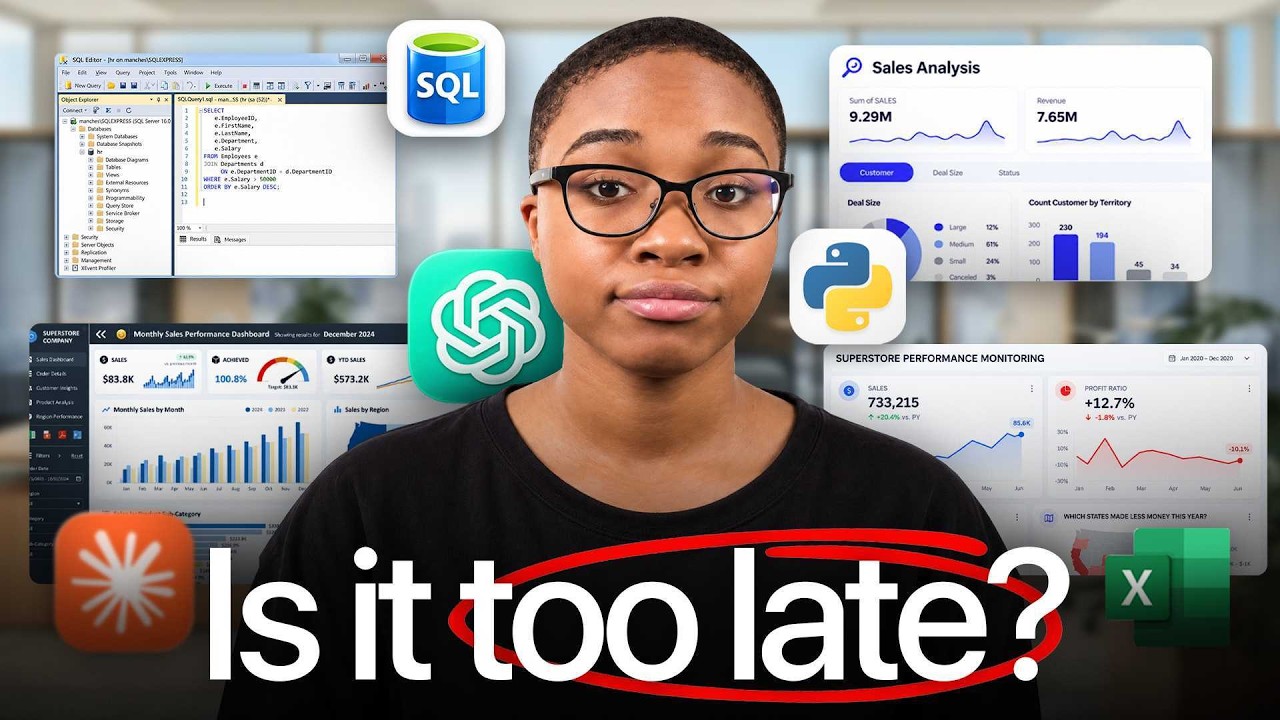
There are 7 simple ways data analysts are winning with AI right now, and almost no one is talking about them. Honestly, everyone keeps telling you that AI is going to take your data analyst job, but the people actually doing the job, they're not getting replaced. They're actually getting faster and more efficient and more productive. Studies show real workers are getting 14 to 35% more work done in the same amount of time as people who refuse to use AI. And here's the part no one else is mentioning: AI isn't doing the job For them, they're using AI as a tool, handling the boring parts so they have more time to do the work that actually gets them hired and promoted. Today, I want to show you seven simple ways data analysts are winning with AI right now, and I think this might change how you feel about the whole AI conversation because here's what I'm seeing in my own community: career changers are landing data analyst jobs faster than even the smartest ones. And no, they're not the ones with the most certificates, the most degrees; they are the ones who figured out how to use AI as a teammate—not a replacement, but a teammate—the kind that handles the boring stuff so you can. Focus on the parts that actually get you hired and promoted. So today I'm going to be walking you through 7 of the smartest ways I'm seeing analysts use AI. Real ways, real numbers, and the research to back it up. So let's get started. All right, before I get into the meat and potatoes, I want to address something head on. The whole AI conversation in data analytics has been fearmongering. AI is going to replace you. Data analysts are dying. Why bother in 2026? That's not what the research says. Research at MIT and Stanford ran a huge study where 5,000 workers Half got an AI helper and half didn't. The workers with the AI tools got 14% more work done. The newer workers, the ones still learning, got 34% more done than the workers who didn't. Think about that for a second. If you and a coworker start the same job on the same day, they use AI and you didn't, by the end of the month, they've gotten a third more of the work done than you did. 3 months in, they look like a superstar and you look like you're stuck and not really making much progress. Not because they're smarter than you, but because they use AI to make them more productive. Here's the part I want you to hold on throughout the entire video. AI did not do the job for them. AI just handled the boring parts. They still did the thinking. They still did the judgment. They still did the strategy. They did the work that got both of you hired. AI just gave them more time to do it. That's the point. AI is a tool, not a replacement. Calculators, for example, did not replace mathematicians. That's how I want you to think about it so we can grasp how analysts are actually winning with AI right now. So here are the 7 specific ways data analysts are winning with AI. Every way will show you what AI handles and just as importantly, what stays in your hands. All right, number 1, cleaning up the messy data. Picture your kitchen sink drawer. You probably have a random bag of taco seasoning, the typical tape, batteries, takeout menus, the one screw you don't remember saving that probably came as extras when you bought that new table. If I asked you to find a specific receipt in there, you'd be digging around for hours. That's exactly what raw data is like. Duplicate rows, missing values, inconsistent formatting, and just data that should not be there. Names with extra spaces. And you as an analyst, your first job before you do anything is to clean it up. Beginners don't realize this, but cleaning data is where most analysts spend the bulk of their time. It's slow, it's repetitive, but it's the part that no one tells you about when they're selling you the dream. Yes, there are roles that are paying $150K, $180K. Yes, you can launch your career with an $85K role, $90K role, whatever it is, but it is not all rainbows and sunshine. There is a lot of grunt work when it comes down to cleaning messy data. And the thing that people will do is they will just take their Excel sheet and just put it into AI. Don't do that. What you do is you look at it yourself manually, then you can ask AI to help create functions or even kind of walk you through how to go about the data cleaning. But you don't want to just blindly put the data into the AI. Now, there are a lot of companies adopting AI into their enterprise. For example, companies that are building internal tools with, say, Claude, for example, where if that data is going to stay internal and not be used to be trained outside your organization, that is a situation that will allow yourself to upload an Excel sheet or whatever file into your AI. That's it though. And once you do, you can tell your AI to look at this and see if you can spot anything wrong, right? Instead of 3 hours of digging through it yourself, that turns into less than 5 minutes. AI will flag the duplicates, the missing values, and the weird formats. But here's the other part that people miss. AI doesn't decide what you do about it. That is still you. AI tells you maybe a customer name appears 47 times, but you decide if those are actual duplicates or not, or just different customers with the same name. AI will flag the missing values, but you will decide whether to fill them in, drop them, or just flag them for the team. The cleanup is the boring part, but the judgment is still in your hands. AI is the assistant who just helps you organize the junk drawer. You're the one who decides what gets kept and what gets thrown away. All right, way number 2, writing SQL code. Quick explanation if SQL is new to you. SQL is a language that you use to ask a database questions. In English, you basically say, hey database, show me every customer who spent more than $100 last month. The database answered, That's basically SQL. SQL is like asking a librarian to find a book. Ask very clearly. Let's say the 1953 edition of Fahrenheit 451. They grab it for you in seconds. Ask vaguely, that one book with the COVID I saw one time. You get nothing. But the language of asking clearly has rules. A lot of them. Forget one comma, one wrong join, and the whole thing breaks. You're staring at a screen wondering why your query won't run. If you've never had this happen, congratulations, you've never written SQL. The rest of us have spent a share of evenings yelling at our monitors. But here is what's changed. You don't memorize every rule of the language anymore. You can tell AI what you want in say plain English. And again, if your enterprise has integrated AI into their systems, you can do what I'm about to tell you. You can say, hey, I need a query that say pulls 10 customers by sales last quarter joined with their last order date and product category. AI can write the SQL, you read it and you make sure you test and validate it. But here's something else I wanna be honest about. AI writing the SQL doesn't make you the analyst. Reviewing the SQL is what makes you the analyst, right? Because AI is wrong sometimes, actually a lot of the times. It will hallucinate table names, it will forget a join condition, it assumes your data looks one way when it actually looks like another, and it confidently will hand you a query that runs perfectly and give you the completely wrong answer. If you blindly run AI-generated SQL without reading it and validating it, you're going to get fired. If you read it, understand what it's doing, fix what's off, and ship it in working condition, you will save hours and keep your job. Again, AI drafts the query, you will always verify and build from it. AI is just the assistant, but you are the analyst. All right, way number 3, Excel formulas. Okay, quick reality check. Excel still shows up in 70% of entry-level data analyst job postings. So if you've been told that Excel is dead, somebody lied to you. It's not. You still have to know it. It's still the bread and butter of data analytics, but you don't have to memorize every single formula anymore. Excel formulas are like recipes. There are way too many. The classic ones, SUM, AVERAGE, VLOOKUP, those you will use every day. But the weirder, more powerful ones, INDEX MATCH, XLOOKUP combinations, array formulas, you'd have to look those up in a cookbook every time you need to use them. AI can be your cookbook, except it's a chef who writes the recipe for whatever you're trying to cook. You say, hey, I need to find the highest sales month for each region. AI can give you the structure of the formula that you paste in and fill in the important information, and then it can work. Here's the part where you stay relevant though. AI doesn't know which question to ask the data. It can build a formula template for you that calculates anything that you ask, but it can't tell you what's actually worth calculating. That's still your job. That is your business thinking. AI can handle the syntax, but you always always bring the questions in the context. If you don't know what to ask, the most powerful formula in the world becomes useless. And honestly, this is huge for career changers. The old path was memorize all these different formulas for 3 months and then you can be useful. That kept a lot of smart people out of the field though. The new path is you bring your business and domain thinking from your last job, use AI for the syntax, and then you start being useful from day one. Okay, way number 4, building dashboards. A dashboard is basically a one-page report or even multiple-page reports of what's happening in the business. Sales up, customers in this region are buying more, this product is a flop. That's a dashboard. Building one from scratch is like decorating a room. You stare at the empty walls forever, trying to figure out what to put where, which charts, which colors, which numbers go on top, what are the KPIs, the blank page problem. And again, here's what's actually happening in organizations right now. You can actually drop your data into an AI or Power BI's Copilot, for example, and within minutes you can have a basic draft of a dashboard with some charts, with some groupings, even a written summary. Your blank page is now a rough draft, but here's the thing that most beginners get wrong. They think that the dashboard that the AI gave them is a finished product, and it's not. It's the same thing like the default chart that gets made whenever you use Excel, Tableau, or even Power BI. There's always more work to do. That's not the final product. It does not know your business. It does not know that your CEO hates pie charts or that your CEO loves treemaps for whatever reason and wants to see it on every single report, even when you know it makes no sense. But hey, that's what he wants. It also doesn't know that your audience cares about regional breakdowns more than monthly trends. It doesn't know which metric will save the meeting. That's still all on you. Again, AI just gives you a rough draft so you don't start from a blank canvas every time. You add the context and you pick which numbers go on the big bold letters at the top. You tell the story. Anyone can build a dashboard, but telling the story is what gets you hired and promoted. All right, way number 5, AI as your personal tutor. And this one is quietly changing how people are breaking into data analytics because the biggest barrier for career changers is not the tools, it is understanding why something works. Imagine you're learning to drive. You read every single chapter of a how-to-drive manual. You can watch videos, but the moment that you make a left turn at a busy intersection, none of that matters until someone in the passenger seat says, slow down, check your mirror, turn now. That is what a tutor does. They explain in real time, in your situation, in a language that you understand. In 2026, anyone learning data analytics has a tutor available 24/7. If you're stuck on a SQL concept, paste it in. Explain this like I'm a 5-year-old. Use a real-world example or my favorite, include analogies. Clear answer in less than 5 seconds. But here's something that everyone misses. AI explaining something to you is not the same as you knowing it. The tutor in the car can give you instructions all day, but if you never grab the wheel yourself, you're never going to learn how to drive. Use AI to understand, then go practice on your own. Write the SQL yourself, build a dashboard yourself, make the mistakes, reverse engineer dashboards that you can find online like Tableau Public, for example. That is how it sticks with you. AI can be your tutor, but you still have to do the homework. All right, now way number 6, reading what customers are saying, also called sentiment analysis. Imagine you own a coffee shop and you get 500 reviews online. Some are great, some are not so great, and some are just plain confusing. If I asked you, what do customers actually feel about your shop? You'd have to read every single review to try to summarize. Hours of work. This used to be the job of a specialized data scientist. Python code, tools like spaCy or NLP libraries, very slow and complicated. Now you can take those 500 reviews and drop them into an AI and say, what are the top 3 things customers love? What do they complain about? And sort each review as positive, negative, or neutral. 5 minutes, done. But notice what AI didn't do. It did not tell you what to do about it. AI can say, hey, 40% of the complaints are all about wait times. Great. Now what? Do you hire more staff? Do you redesign the workflow? Add a mobile order app? Open earlier. AI doesn't know those things. The data points to a problem, but the decision is yours. That is the analyst's job. AI can read the reviews, but you read the business. And by the way, quick side note: this is also one of the best portfolio projects that you can build right now. It solves a real problem, and it shows that you can do things most beginners can't. And it lets you show off the human judgment part. What do you actually recommend the business do based on what you found? Honestly, sentiment analysis is one of the underrated use cases of AI that's actually useful. I don't know why. Doesn't really get that much attention, but actually using AI to analyze survey data is one of the biggest things and levers you can pull. Okay, way number 7, and this is the one that separates analysts who are getting hired from those who don't, and that's communicating what you found. And this is something that most career changers learn the hard way. A dashboard isn't an answer, a SQL query isn't an answer, and a beautiful chart is not an answer. The answer is what you can say to your boss after you've done the analysis. The clear message that says, hey, customers in California are leaving us Here's why, and here's what we should do about it. 3 sentences. That's the answer. Think about it like this. You're a chef and you spend 8 hours making the most amazing dinner. Then you put it on a plate without explaining what it is. Your customer just looks at it confused. It's literally the same with analysis. You can do the brilliant work, but if you can't explain what it means, it does not matter. AI helps with this. Once you've done the analysis, once you understand what you found, you can paste your raw findings into AI and ask it to help you draft a short summary for a non-technical audience. Audience. But understand what's happening here. AI can help you draft the message, but AI is not telling you what the message should be. You did the analysis, you know the business context, and you know which findings actually matter. AI just helps you say it cleanly. Most beginners try to use AI as a shortcut. They will paste messy findings and let AI tell them what to think. That's how you get fired. Use AI to translate your insight, not to manufacture one. The judgment is still yours. AI just polishes the Now I want to leave you with something the AI hype bandwagon won't tell you. AI is not coming for your data analyst job. AI is coming for the parts of the job that you don't even like doing. The boring cleanup, the repetitive Excel formulas, the blank page problem when you start a new dashboard, and the first draft of a SQL query that you spent 2 hours on. AI handles those things now. What it doesn't do, or rather what it can't do, is the part that actually gets you hired and promoted today. The judgment, the business context, the story that you tell with the data, the conversation with your VP about what to actually do next. That is still you, and that's only ever you. The data analysts who are winning with AI in 2026 are not the ones who let AI replace their thinking. They're the ones who use it as a tool to do the boring work faster, so they have more time to do the work that actually gets them promoted. But there's something else that I did not cover in full detail here, and that is the highest paying data analyst skill that most people are refusing to learn. Hint, it's not AI. I talk about it in this next video. I'll see you there.
More from Kedeisha


Data Analyst Portfolio Project with AI | NBA Championship Prediction Model (End-to-End Project)