In this 2025 YouTube video, self‑taught data scientist and career coach Kedeisha Bryan argues that aspiring data analysts are failing to get hired because their portfolios consist of flashy but impractical projects. Drawing on her own experience of over 100 rejected applications and subsequent rapid success (four interviews and four six‑figure offers within three weeks), she outlines three high‑impact, business‑problem‑focused portfolio projects that consistently land mid‑ and senior‑level roles. The first project is a clean, KPI‑driven functional business dashboard that demonstrates the ability to build tools executives can actually use. The second adds a consulting‑style slide deck to the dashboard, showcasing analytical thinking and executive‑level communication. The third is a full end‑to‑end project that includes defining a business question, sourcing and cleaning data, analyzing it, and delivering findings via a dashboard and slide deck with actionable recommendations. Each project receives a perfect ROI score of 5/5, and Bryan backs each with student anecdotes of interview calls and job offers. She emphasizes that the tools (Excel, Tableau, Power BI) are secondary to solving real business problems, and she invites viewers to a free training for step‑by‑step guidance. The video concludes with a call to action to subscribe and use the provided resources.
Chapters
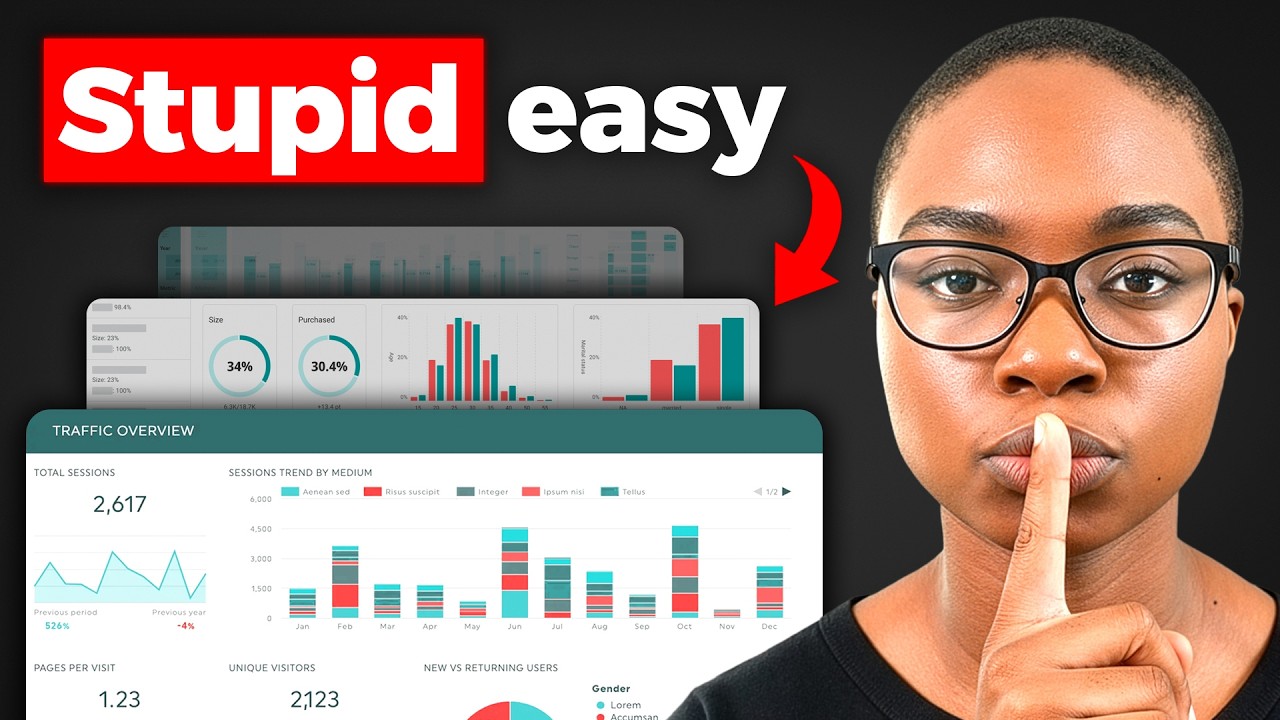
Most people are wasting time building the wrong data projects and wondering why no one's calling them back after they apply for roles. The truth is, the data analysts getting hired in 2025 aren't the ones with the flashiest portfolios. They're the ones building projects that actually solve business problems. And chances are you've never seen the kinds of projects I'm about to show you in this video. I've discovered this the hard way after over 100 rejected applications, using the same exact portfolio projects everyone else was recommending online, I changed my whole approach. And within 3 weeks, I had 4 interviews and 4 job offers, all paying over 6 figures. And I've helped other career changers do the exact same thing. Now, these aren't classroom exercises. These are gonna be real-world, high-impact projects that are getting people hired and fast. So before someone else copies these for their portfolio and beats you to the job, you might wanna watch this the end. Now let's dive into the 3 types of data analyst projects that are still landing 6-figure roles this year. You can use them to do the same. And the best part, while everyone else is fighting over the same entry-level positions, you'll be getting offers for mid and senior-level roles. Now, if this is your first time here, my name is Kedeisha Bryan. I used to deliver pizzas, and now I deliver insights as a self-taught data scientist, and I've coached thousands of other career changers to break into tech without going back to school. And I'm here to teach you how to do the same. So let's dive in. Let's start with the project that every aspiring analyst needs to have on their portfolio, a functional business dashboard. Not one of those cluttered, look what I can do dashboards with a million charts. I'm talking about something clean, focused, and built to solve a real business problem. Dashboards only seem basic to people who've never had to explain performance to an executive. Trust me, basic isn't the problem. Useless is. This kind of project proves that you can focus on KPIs that matter, build a tool that answers specific business questions, and simplify data so decision makers can act fast. You're building for utility. Not for art. Now, what should you include? A clear business objective, for example, track monthly churn by segment. 3 to 5 powerful metrics. Interactivity such as filters, dropdowns, and tooltips in a clean layout using smart color and no fluff. The tools that you use don't matter. You can use Excel, Tableau, Power BI, all are fine. What matters is, can this dashboard drive actions? One of my students used this exact project format, a simple dashboard, sharp KPI focus, to land interviews without a master's degree or fancy bootcamp. Why? Because it showed hiring managers she could build tools they'd actually use. This isn't art, it's analytics, and when it's done right, it hits hard. Now I'm gonna give this type of project an ROI score of 5 out of 5. This project shows that you can do the job. It's fast to build, easy to explain, and instantly proves your value to hiring managers. Project 2, dashboard plus slide deck. This is where 99% of applicants fall flat and where you can instantly stand out. Most people stop at the dashboard, but analysts don't just create visuals. We communicate insights. And the most powerful way to do that is by turning your data into a consulting-style slide deck. This project combines 2 skills that hiring managers love: analytical thinking and executive-level communication. You take the insights from your dashboard and build a slide deck that tells a business story. Not just, here's the data, but here's what's happening, here's why it matters, and here's what you should do next. Each slide should deliver one clear idea, with an action title, one focused chart, and a takeaway. You're not just reporting, you're recommending. That's what separates analysts from report generators. One of my students added this format to their portfolio and started getting real traction. Why? Because it looked like the work they'd actually do on the job. And that's the point of the portfolio, to show you're already thinking like someone who belongs in the role of a data analyst. No one else is doing it, which is exactly why you should. I'm going to give this project an ROI score of 5 out of 5. Why? Because this project gives you an instant edge. It showcases real-world communication skills, and hiring managers love it because it mirrors the work they need done tomorrow. Project number 3, end-to-end project. If you want to prove you're ready to be hired, this is the one. You take a real-world business problem, find a dataset, clean it, analyze it, and present your findings in a clear decision-ready format. This is what I call an end-to-end project because it mirrors what analysts actually do in the real world. Not just dashboards, not just visuals, but problem solving from start to finish. So here's the structure: define the business question, then source your data. It could be clean or messy. Analyze for trends, patterns, and anomalies, then deliver insights in a dashboard and a slide deck with recommendations. What makes this powerful is that it shows you can carry a project like a consultant, thinking about the business impact, not just the tech. One of my students with zero tech background built an end-to-end project for a local nonprofit, and that one project helped them pivot into a full-time data analysis role in under 90 days. Not a project full of fluff, one real complete solution. You can even pitch this to a real organization, volunteer, help a small business or nonprofit, and use it as proof of your value. You're not waiting for experience, now you're creating it. I'm giving this an ROI score of 5 out of 5. This is going to be the highest value project you can have. It shows depth, problem solving, business impact, and storytelling all in one. It's the closest thing to job experience without actually being on the payroll. So now you've seen the 3 data analyst projects that actually get people hired and still work in 2025. Now I'm telling you right now, if these aren't in your portfolio yet, you're not ready to apply. But here's the good news: you can start building any one of these this week. You don't need a degree, you don't need to spend $10K on a boot camp, you just need strategy that works. If you want help building these step by step, knowing what to say, how to present it, and how to make recruiters take you seriously, I break it down in my free training, which I will leave in the link below. That training is where I show you how I've helped thousands of people with all types of backgrounds— teachers, truck drivers, admin— build portfolios that actually get them hired. Because remember, it's not about the tools that you know, it's about the business problems that you can solve with data. Now, if you enjoyed this video, please remember to subscribe, and I'll see you next time.