How I Would Become a Data Analyst In 2026 (If I Had to Start Over Again)

In this instructional video, Kedisha Bryan shares the mistakes she made while transitioning into data analytics and outlines a concise, market‑driven playbook for anyone starting the journey in 2026. She emphasizes that passive consumption of tutorials and certificates is insufficient; instead, learners should begin building real, outcome‑focused projects within a week of learning a new tool. She recommends following the industry‑validated skill sequence—Excel, then SQL, then a BI visualization tool, followed by Python for automation, and finally storytelling. Kedisha stresses the importance of a domain‑specific portfolio that solves high‑value business problems and includes actionable recommendations, rather than generic “copy‑and‑paste” dashboards. She advises early optimization of a LinkedIn profile, proactive networking through personalized connection requests and coffee chats, and building a network of 1,500+ contacts to increase visibility. Regarding AI, she positions it as a helpful copilot for tasks like query debugging or dashboard critique, but warns against relying on it for judgment or decision‑making, as human context remains the core value of analysts. Throughout, she uses personal anecdotes, concrete examples, and a step‑by‑step framework (define problem, diagnose root cause, implement solution, create sustainable artifact) to illustrate each point, urging viewers to act imperfectly and iteratively rather than waiting for perfection.
Chapters
I made a lot of mistakes when I was trying to break into data analytics, and I don't talk about them enough because most content in this space only shows you the highlight reels. The certification, the job offer, the degree, the salary. What no one shows you is all the months I spent completely in the wrong direction before any of that happened. So in this video, that's what I'm going to talk about. What I do on day 1 that I didn't do until month 6. If I'm going to be honest, and that's kind of my whole thing, I did not become a data analyst efficiently. I took detours that went nowhere. I spent time on things that didn't matter, and I learned tools in the wrong order. And I figured most of it out by making mistakes that I could have avoided if someone had told me the truth upfront. So consider this video me telling you that truth upfront. What I'd actually do if I was starting my data career from scratch today in 2026. Now, if this is your first time here, I'm Kedisha. And 6 years ago, I was delivering pizzas and Amazon packages for $8 an hour. And today I'm running a community of over 80,000 current and aspiring data professionals. And I've helped thousands of other career changers break into data analytics. Without going back to school and wasting money on courses that just don't work. I have watched this career field transform in real time, and my only goal is to help you cut through all the noise of endless information online so you can get to where you want to be in the least amount of time. So here's what actually happened when I was starting out. I spent the first few months doing what everyone else said to do. I watched all the tutorials, I signed up for all the courses, I collected all the certificates. I told myself I was making progress because I was busy and I was busy. I was just busy doing all the wrong things. The first wake-up call was a mock interview. I had been studying SQL for weeks and I thought I was ready. The moment that the questions moved past basic queries into CTEs and window functions, I immediately froze and I didn't know them at that moment. Not because nobody had told me they existed, it's because I had been watching videos about SQL instead of actually writing my own SQL. The second wake-up call was my portfolio. I had built projects, a Netflix dashboard, Titanic, the same exact copy and paste projects. Every other beginner was building that they saw in a YouTube tutorial. And I remember sitting in an interview and the hiring manager looked at my portfolio and just moved on. He had nothing really interesting to say. He wasn't impressed at all. Just, this is fine. And that was it. That was the moment I understood that doing the thing is not the same thing as doing the thing well. Fine is not hireable. Fine is a word someone uses when they're trying to be polite about no. Think about when someone has made you a very nice dish and you don't want to be honest that it doesn't taste very good. You just say it's fine. And the third one, the one that actually changed everything, was a conversation that I had with someone who was already doing the job that I wanted. Not a mentor, just a person I messaged on LinkedIn. Was kind enough to respond. She told me something that I didn't expect. She said she didn't care about any of the certificates I had. She didn't care about the courses that I took. She only wanted to know if I could solve messy business problems, find the data, and tell her what to do about it. That conversation rewired how I thought about the entire career transition. Because up until that point, I had been focused on learning skills. And she was telling me the job is not about skills. The job is about outcomes and results. That is the thing I would tell myself on day one if I was starting over. You are not trying to become someone who just knows data analytics. You're trying to become someone who solves business problems using data. Those 2 things sound similar, but they're not. And if you want the actual playbook for this, I do a free training on exactly how to build a portfolio that gets you hired. Link is in the description if that's useful for you. All right. So if I was starting over in 2026, here's the first thing I'd change. I would stop learning and start doing much earlier. Earlier, like embarrassingly earlier. I would give myself 1 week maximum with any tutorial before I had to produce something with what I learned. Not a perfect something, not a polished something, just proof that I could apply it to a real question without getting my hand held. Because here's what no one tells you about tutorials. It feels like learning, and you are. Yes, your brain is engaged, you're taking notes, you feel productive, but passive consumption is not the same as skill building. It's not the same as active learning. The only way to build a skill is to use it on a problem that doesn't have an answer at the bottom of the page. So practically, what does that mean? It means the first time you learn a pivot table in Excel, you don't just watch the next video. You can go to Kaggle and download a real dataset that you can use that pivot table on to answer a question that you actually want to know the answer to. If that means the first time you learn a join in SQL, you don't have to move on to subqueries yet. Find a dataset with 2 tables and write a query that combines them to answer something specific. You don't move forward until it works. And more importantly, you don't move forward until you can explain why it works. The great thing about Kaggle is that you can download the datasets, the CSV files, and download them into MySQL, for example, and actually do SQL on those types of datasets, which allows you to practice SQL in more variety of datasets instead of the same old Northwind or DVD rentals and so forth and so forth. SQL appears in over 80% of data analyst job postings. It is the single most filtered for skill before a candidate reaches a final interview. And it means when you build a dashboard in Tableau or Power BI, you don't just build it to show that you know it. You build it to answer one specific question for one type of decision maker. That constraint, who is reading this and what they need to decide, is what separates a portfolio that will get you hired from one that will politely get you ignored. I've seen so many dashboards for nobody in particular. Sleek dashboards, amazing color schemes, things what I call Picasso dashboards, things that fit better in an art museum than an actual boardroom. But there's no real point. No one was making decisions from these dashboards. They were just like vibe-coded dashboards. The second thing I'd change is the order that I learned things in, because I learned some things way too late and some things way too early. For example, I actually learned R before I learned SQL, which was the biggest mistake ever. R was a perfectly good tool. Companies largely didn't care about it though at the entry level. The market is telling you the order. Excel, SQL, BI tool, Python for automation in that sequence. I would just follow the market and not just hype that keeps recommending Python machine learning videos because you watched one about data science in 2022. The algorithm is not your career coach. I'm your career coach. So learn from me and my mistakes, not the algorithm. Another thing I would think about is what domain do I want to specialize in? If you're a career changer, most likely you already have some domain expertise. So you can either double down on it or some people may want to go to an adjacent niche. So for example, if you work in retail, but maybe you don't understand all the deep business acumen with retail, I would make sure I go in depth into that domain. You can read Harvard Business Case Studies and actually read how business leaders use data and other things to make decisions in that specific domain. There's plenty of data that backs up the notion that specialists make way more money than generalists. So I highly, highly, highly recommend specializing and double downing on whatever domain you want to be a data analyst in. All right. So the thing that I got most wrong early also was what I built. I was doing what everyone else was doing, same datasets, the same projects. And I thought I was fine because at least I had a portfolio, right? What I didn't understand was that a portfolio full of the same projects everyone else was doing is not a differentiator at all. Hiring managers say they will hire a candidate without a relevant degree if they have a portfolio that demonstrates the exact technical skills. That stat used to excite me, but now I read it differently. A portfolio can replace a degree, but Only if it shows something a hiring manager hasn't already seen 50 times that week. So what would I build instead? I already just talked about doubling down on a domain and specializing in something rather than being a generalist. So I would pick one industry that I actually understand or one that I would desperately want to work in. And I would find a real problem in that industry. High value problems, not just any problems, but ones that keep the executives in that industry up at night and actually pays them the big bucks to solve and make decisions over. And then I would solve it end to end, pull the data, clean it, analyze it, and build a dashboard around a specific insight, and then wrap it in a consulting-style presentation that says, here's a problem, here's what I found, and here's what I think you should do, and here's why. The last part, the here's what I think you should do, that is the part most people leave out, and it is the part that hiring managers are desperately looking for. I think about one member of my community who did this the right way. She was an occupational therapist for several years, no tech background at all. And instead of building a Netflix dashboard like everyone else, she went out and found real public healthcare data and built an analysis around patient readmission rates, not because someone told her to, not because LinkedIn recommended it, and not because it was a hot job at the time. It was because she knew that world already. She already understood what mattered in a hospital system, and she packaged it like a consultant walking into a boardroom with problems, findings, recommendations, and impact. And then she was hired a few months later for an analytical role in healthcare. The hiring manager told her directly that her portfolio was the only one that showed them that she understood what their world was already about. So that is what I would build, not a project that just checks a box. But a project that I understood a high-value problem in a domain or industry that I wanted to work in. A great 4-step problem-solving framework is 1, you can define the problem, 2, diagnose the root cause, and 3, identify and implement a solution, and 4, create something your stakeholder can use to sustain or monitor the results. This is where a Tableau or Power BI dashboard would come in, for example. Okay, so one thing that I got wrong that took me the longest to fix was how I showed up professionally. Specifically on LinkedIn. I was doing the work, I was building the things, but nobody was seeing it. My LinkedIn headline said nothing about data. My profile said nothing about what I was building. And I was basically a ghost with a resume. And that matters so much because when I posted about a data analyst job posting about a few months ago, I got well over 300 messages in my inbox. Over 300 people saying that they were interested. And I went through those profiles. An overwhelming majority Safe to assume 99%, and I'm not even joking, had LinkedIn profiles that gave me no signal at all that they were serious about data. Irrelevant headlines, if they had one at all, no projects, no posts, no nothing. Being invisible is not cool anymore, and neither is it hireable. I know a lot of us don't like social media. I completely understand. But in this job market, not having an optimized LinkedIn is just not acceptable anymore. You can be the most skilled person in the room, and if no one can find you or understand what you can do in 5 seconds, then you don't exist professionally in this job market. If your LinkedIn headline does not say data analyst at all, you already failed the first filter. Recruiters are headhunting on LinkedIn for hours and hours and hours a day. And if you refuse to not have an optimized profile so you can be found, how can you complain about not getting interviews if you're not giving yourself a good shot at getting found online. So if I was starting over, I would fix my LinkedIn headline on week 1. I wouldn't even wait until after I finished all my courses. I would change my headline and I would start documenting what I was learning, not in a performative way, because it's not about being an influencer. Honestly, it's about what I built that day, what I learned, and what I was just trying to do. It's never about building a following. It's about building a real network and being trackable and legible to people who are actively looking to hire. And I would start by having my coffee chats. Much earlier. Not to ask for jobs, not to ask for handouts, not to ask for favors, just to understand the actual day-to-day work of people who are already in places that I wanted to be in. One 30-minute conversation or a back and forth DM will tell me more about the job than any job description ever will. And here's how I would do it. Find 5 people on LinkedIn with the exact job title that you want and something that is related or connects you to, whether it's your alma mater, whether it's your local hometown, whatever it is, but you have to have something that relates to one another. Send a connection request with one specific sentence about who you are, what you're working on, and more importantly about them. And then always mention something that connects you to, again, if you went to the same school, you worked at the same job, whatever it is, but you have to drop something that's relatable. And then just ask for 20 minutes of their time. Send a connection request saying that you'd love to learn about their career journey, what you're working on, and what you'd like to learn from them. And just ask for 20 minutes of their time. I started doing this and eventually had about 1,500 people in my LinkedIn network and that same network of 1,500 people is the reason I got every single job after my very first one. Again, not my resume, not my certs, the relationships I built within that first 1,500 LinkedIn network that I built being genuinely curious about other people's work, not about being selfish and just asking for handouts. All right. So the last thing I want to talk about is AI, because if I was starting in 2026, the AI question would be everywhere and I would need to get a clear head about it. Here's what I would tell myself. AI is your copilot. It is not your replacement. It's also not a It is just your copilot. Think about it like this. The GPS replaced the need to memorize directions or read a paper map, but it didn't replace drivers. It made driving easier. And yes, Tesla has copilot. You got Waymos on the road now. We've also seen the Waymos drive in the wrong directions on the road. The thing is, the car still needs a human, right? Even Waymos have a whole call center on standby whenever things go wrong, and they always do, as we know. AI and data analytics works the same way. It can write basic queries, it can make very basic visualizations, it can even maybe clean a dataset. What it cannot do is understand why the numbers don't make sense. It cannot catch when the data itself is wrong, and it cannot walk into a room with the CFO and explain what the business should be doing differently based on what the data is showing. The humans who understand the data with context are always going to be more valuable, not less. So what would I actually do with AI if I was starting over today? I would use it as a feedback loop. I would feed it the structure of maybe some of my queries or on my code or an error message and ask it to tell me what was wrong with my logic. I'll maybe upload screenshots of some dashboards and ask it to critique my storytelling. I would use it to speed up boring parts of, say, like data cleaning so I could spend more time on the parts that actually matter. But I would never let it think for me because the moment you stop thinking for yourself in this field is the moment you stop being hireable in this field. The whole reason companies need analysts Is because AI cannot replace human judgment. No matter what those AI bros tell you online, it's all a lie. The second you outsource your judgment to AI, you have removed the only thing that has made you valuable. Okay, so again, if I had to start over in 2026, here is the honest version. I would stop learning and start building much sooner. I would follow the order that the market is actually telling me: Excel, SQL, BI tool, Python, storytelling—all in that sequence instead of whatever the hype. Says to do. I would build projects that solve actual business problems in industries that I already understand or industries that I want to work in. Not just general projects that look good on a checklist. I'd also fix my LinkedIn on week 1, not week 6. I would also start having real conversations with people already with the jobs that I wanted. And I would only use AI as a tool carefully, not as a replacement. Because the thing companies are paying for is human judgment and no shortcut replaces that. None of this is complicated, but what makes this hard is it requires you to do real things before you feel ready. Build things before it's perfect. Put yourself out there before you have all the right answers and have a conversation before you feel qualified to have it. The people who made this transition in my community did not do it because they're more talented than you. They did it because they stopped waiting to feel ready and started just doing the work anyway. You can keep waiting, you keep researching, keep watching videos until you feel like you're ready enough to start. There'll always be one more video to watch though. Or you can start today, imperfect, early, and figure it out as you go. That's what I did. And honestly, it's really the only thing that actually works in anything. In life, really. And if you want to see the full version of exactly how I got hired, the complete version, every step that worked and every step that didn't, that video is right here. So I'll see you there.
More from Kedeisha


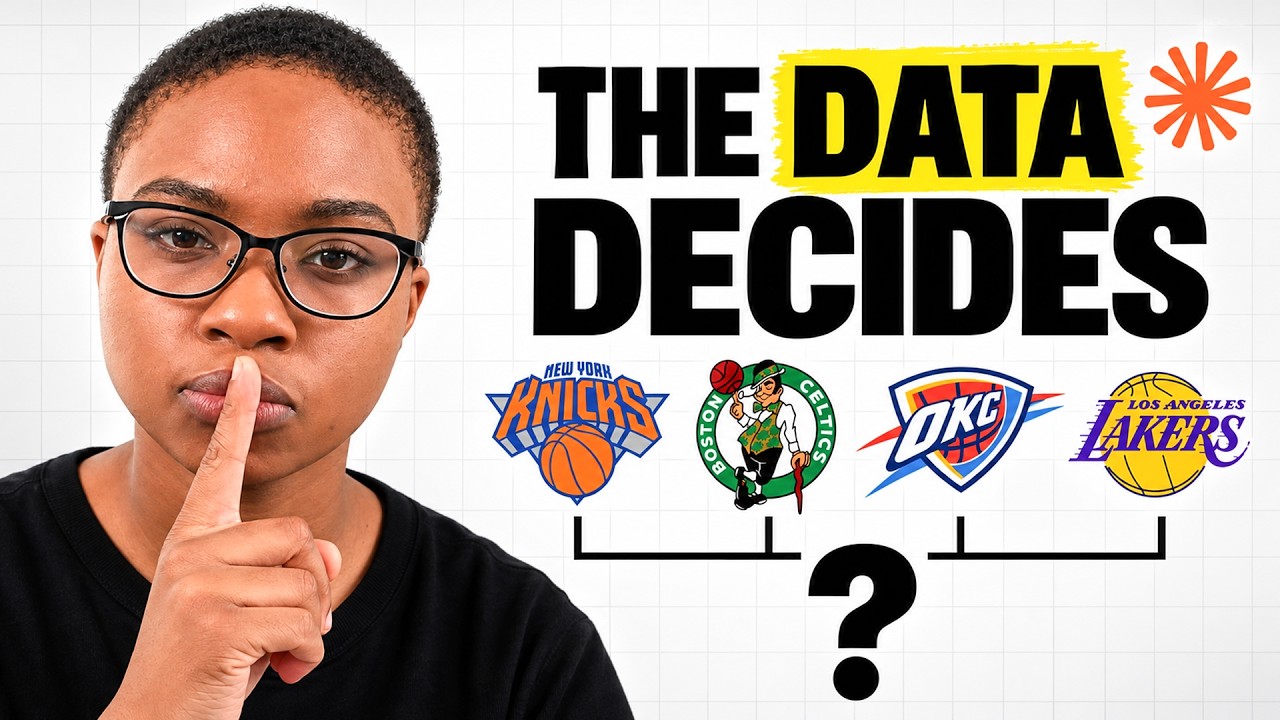
Data Analyst Portfolio Project with AI | NBA Championship Prediction Model (End-to-End Project)