I Ranked Every Data Analyst Skill So You Don't Waste 6 Months
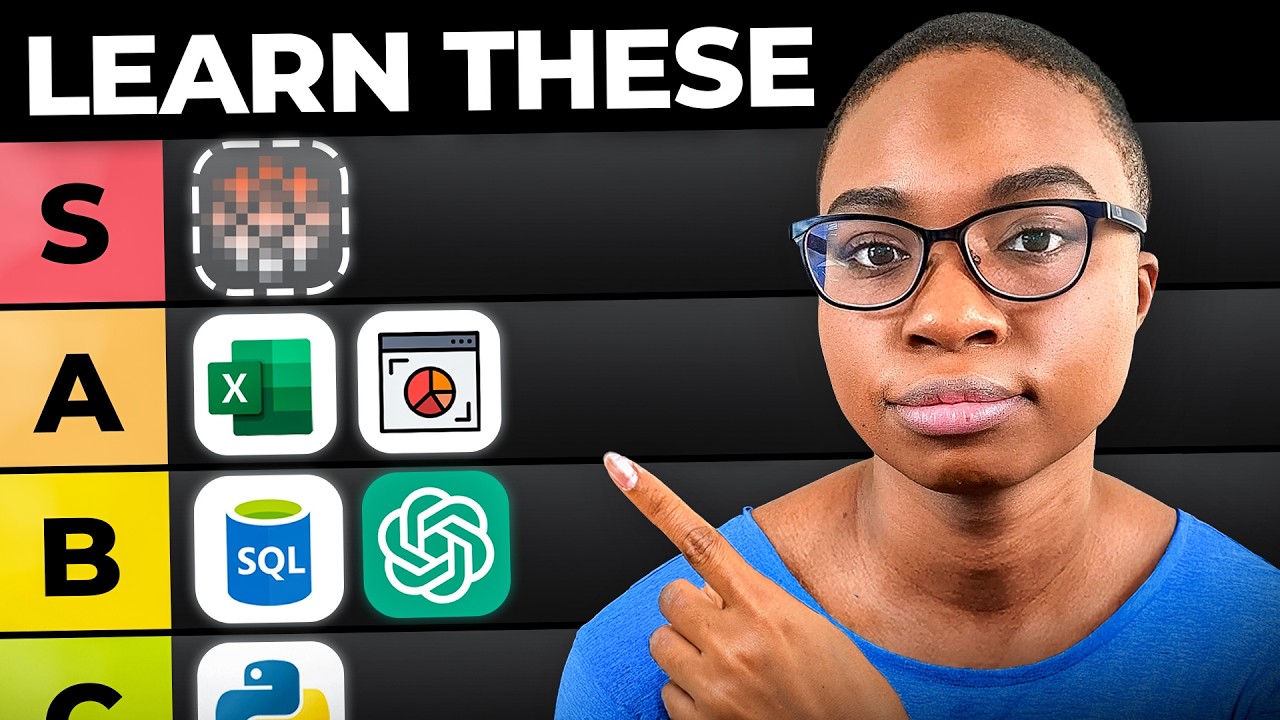
In this 2026‑focused video, the presenter argues that many aspiring data analysts waste months learning the wrong tools and concepts, leading to missed interview opportunities. She introduces a three‑criterion framework—hiring signal, leverage, and durability—to rank data‑analytics skills by their current market value. Bottom‑tier skills such as Python, advanced statistics, cloud platforms, and Power Query are deemed low‑ROI for early‑career learners because they no longer differentiate candidates. Mid‑tier skills, specifically AI fluency and AI‑assisted troubleshooting, are presented as essential accelerators that boost productivity but do not by themselves secure a job. The top‑tier, hiring‑critical skills are Excel, SQL, and a single BI visualization tool (Tableau or Power BI), which together form the core technical foundation required in most interviews. Core data‑engineering abilities—advanced data cleaning, pipeline building, and data‑quality management—are highlighted as the next step toward a full‑stack analyst role. The video emphasizes data storytelling as the ultimate force‑multiplier, turning technical work into influence and higher earnings. Finally, a practical roadmap is offered: audit current abilities, tie each skill to a real‑world project, learn concepts before tools, and sequence learning based on personal bottlenecks. The presenter urges viewers to focus on mastering the high‑impact skills in the prescribed order rather than accumulating badges, leveraging AI to accelerate learning while maintaining depth and narrative skill.
Chapters
If you're learning data analytics right now, there's a real chance you're wasting time and you don't realize it until interviews stop coming. Not because you're not capable, but because you're focusing on skills that may feel important while you're missing out on the ones that will actually get you hired. That mistake costs people months and real income, and I see it all the time. So today I'm going to rank the data analytics skills that actually matter in 2026 based on what companies are actually testing for, reward, and still value in our AI-driven market. So if you want to stop guessing and make choices that actually pay off, this will give you the clarity that you need. So let's get into it. All right, so no one wants to say this out loud, but a flat list of skills no longer works. You've seen those videos, learn these 10 skills to become a data analyst, and they treat everything like it's equally important. Python, SQL, machine learning, cloud computing, statistics, Tableau, Excel, R, Power Query, and whatever else sounds impressive. But that's just not how the real world operates anymore. The International Monetary Fund warned us that AI is going to be hitting the global labor market like a tsunami, affecting about 60% of jobs in the advanced economies. And that's not a distant future prediction anymore. It's actually happening right now. What makes it worse, according to reports, there's already a 41% skill gap in data analytics roles. So companies have the tools, but they just don't have the people who know which tool to use for which problem. So the market isn't shrinking, it's actually shifting. And most people are learning skills that made sense 3 or 4 years ago, but ignoring what actually matters today. Michael Porter said it best, the essence of strategy is choosing what not to do. And that's what this video is about. It's not about listing everything that you could learn, but ranking what actually moves careers forward right now. I'm evaluating each skill on 3 criteria. One, hiring signal. Does this skill show up in interviews and do companies actually test for it? Next, leverage. Does mastering this skill actually multiply your impact? Then 3, durability. Does this skill actually hold value as AI continues to evolve? So this isn't an opinion. This is about pattern recognition from helping thousands of people land data analytics roles and watching what actually gets people hired today. So let's start from the bottom and work our way up. All right, now these skills aren't useless, but they're no longer the differentiators that people think they are. And let me explain what I mean by that. These are the skills that still hold value in certain contexts, but If you're spending a bulk of your learning time here, especially early in your journey, you're just making a strategic mistake. The return on investment just isn't there anymore. So first up, Python. This one might come as a surprise because Python is very valuable, but most analysts don't get hired because they know Python. They get hired because they can answer business questions no matter what tool it's in. Python is just a tool that can help you do things faster, but it's not the thing that wins the interview. Think about it this way: when you're sitting across from a hiring manager, they're not thinking, "Hey, does this person know pandas?" They're thinking. Hey, can this person help us understand why revenue dropped last quarter? Now, yes, Python can help you get to the answer, but so can SQL, so can Excel, so can Tableau. The language isn't the point; it's the thinking behind it. And the data also backs this up: entry-level roles focused purely on Python and coding have fallen nearly one-third since the rise of agentic AI. Why? Because AI can now write Python code for us. What AI cannot do is understand the business context and nuance. Asking the right questions and validating whether the output actually makes sense. I've seen people spend months and months grinding through Python tutorials, learning Python, Matplotlib, automation scripts, and then they bomb the interview because they couldn't explain what a window function does in SQL or build a dashboard that tells a clear story. They learned the tool, but they did not learn the thinking. Python is a cherry on top today, not the main dish anymore. So if you're just starting out, Python should be the very last thing that you learn. Get your fundamentals solid and then add Python to automate and scale which you already know how to do. All right, next up, statistics beyond the basics. Yes, you need practical stats, descriptive statistics, understanding distributions, knowing how to handle outliers. That is essential. You cannot be an analyst without understanding the mean, median, mode, standard deviation, and knowing how to spot when something just looks off in your data. But going deep into, say, inferential statistics, regression modeling, or hypothesis testing early in your journey, that's usually a distraction from what's actually getting tested today. The reality is most entry-level or even mid-level analyst roles don't really require you to build predictive models. They require you to clean data, find patterns, and communicate insights. I've talked to hiring managers who tell me the same thing. They're not looking for someone who can run a complex regression. They're looking for someone who can take a messy dataset and tell them what exactly is going on. So if you finding yourself spending months on advanced statistics before you can build a solid dashboard or write a clean SQL query, you're learning in the wrong order. You're optimizing for a job that you're not even applying for yet. Master descriptive statistics, understand the basics of probability, And know when to use what type of chart. That is enough to get hired. You can go deeper later on when the role actually requires it. Okay, next up, cloud platforms. I see people slapping AWS or Azure on their resume and LinkedIn headline like it's going to open all of the doors. Not necessarily anymore. The reason is simple: cloud knowledge is infrastructure knowledge. It is about where data lives and how systems connect, and that definitely matters for data engineers specifically. It definitely matters for more senior analysts that maybe are working for more larger scale systems. But for most Most analyst roles, especially the ones that you're probably trying to break into, nobody necessarily cares if you know how to spin up an EC2 instance. What they care about is whether you can take data and communicate what it actually means. Cloud knowledge definitely helps later on in your career when you're working on bigger systems and more complex pipelines, but early on it's just a distraction. It's learning heavy infrastructure before you even learned about insights. A cloud cert without real analysis to show doesn't really help you. Hiring managers will just scroll right past it. All right, next up, Power Query. Now listen, Power Query is super useful. I teach it to my students, and if you're working heavily in Excel and Power BI, it can save you serious time on data cleaning and transformation. It is a legitimate skill, but it's rarely the thing that wins the interview anymore. You're not gonna really hear many hiring managers say, we really need someone who knows heavy Power Query. What they normally say is, we just need someone who can clean messy data and build dashboards that make sense. Power Query is one way to do that, and it's a tool within a tool. So it's a nice to have, but not a must have, especially if you want to just get at Tableau roles. But if you're already deep in the Microsoft ecosystem, definitely learn it, but don't prioritize it over, say, SQL or storytelling or over the fundamentals that are actually getting tested in interviews. The takeaway for this tier is these skills don't hurt you, but they don't carry heavy weight anymore. The mistake that I see people making is leading with these skills, spending months on Python before they can write SQL join, chasing cloud certifications before they even build a dashboard, and going deep in statistics before they can build a story with a bar chart. You can learn these skills eventually and grow into later, but not at first, and not at the expense of what's actually important in the job market today. All right, now we're gonna move on to skills that keep you in the game. You need these skills to be credible, but they won't make you stand out necessarily on their own. Think of these as baseline expectations. If you don't have them, you're behind, and if you do have them, you're just keeping up. All right, first off, AI fluency. This isn't about writing clever prompts that go viral on Twitter. This is about using AI as your copilot for daily work. Drafting queries, summarizing data, generating options or opinions, and building first phases of code and cleanup logic. Let me give you a concrete example. So you need to write a SQL query that joins tables and calculates a rolling 7-day average. In the old days, you'd probably spend 30 minutes testing it, debugging it, and even much longer probably troubleshooting it. Now you can kind of describe what you need to ChatGPT, Claude, or even Copilot, and it can provide you a framework of code that you can at least get started with. You can review it, you can tweak it and validate it, and you're going to be finished much faster than it used to be. That's not necessarily cheating. That is efficiency. And the analysts winning right now aren't afraid of AI. They're leveraging it to move faster so they can focus on strategy and storytelling. And the market has noticed demand for AI fluency in job descriptions have surged 7x since 2024. So let that sink in. That's 7 times. It's no longer a bonus skill. So if you show up to a job in 2026 and you're not comfortable with any AI tools, you're going to be looking very outdated. And you're gonna look very slow. But the nuance still matters. If AI fluency is your only edge, you're not ahead either because everyone is learning to adopt AI. It's becoming table stakes. The question is, what can you do with it with the time that it saves you? If you can use AI to write queries faster, but you still can't tell a story with the results, you haven't gained anything. You've just automated the wrong part of the job. AI fluency is necessary, but it's not necessarily sufficient anymore. All right, next up is troubleshooting with AI. So this is related but different, and it's where most people lose massive amounts of time. Code is gonna break always. So you stare at an error message, you Google it, you find it on Stack Overflow thread from 2019 that kind of relates but not really. You try something, it breaks differently, and then you spend more hours just going in circles. Does this sound familiar? This is where AI changes the game. Recent surveys show that AI agents are now handling roughly 30 to 40% of routine debugging and boilerplate code generation. That means If you're not leveraging AI for troubleshooting, you're literally 40% slower than your peers are right now. So the analysts who can debug faster than everyone else will also outproduce everyone else, period, because they're not staying stuck. They're not spinning their wheels. They are moving. But again, this is a multiplier. It makes your other skills more valuable. It doesn't necessarily replace them. If you don't understand what the code is supposed to do in the first place, AI won't help you. If you can't even validate whether the fix actually works, you're just blindly trusting the output. And AI hallucinates. It will make mistakes. And it will confidently give you the wrong answers. So you need to know enough to check the work, and that's why the fundamentals still matter. So the takeaway for this tier, so these middle tier skills are required to stay in the game today, not what wins it. Think of it this way, AI fluency and troubleshooting is like knowing how to use a calculator. You need it, everyone expects you to have it, but no one's going to hire you just because you know how to use a calculator. They're going to hire you because of what you can do with the answers. These skills definitely make you faster, they make you more efficient, but they don't make you valuable just on their own. They amplify whatever you bring to the table. So build them, use them, but don't rely on them on their own. All right. Next up, these are the top tier skills. So this is a core payoff. These are the skills that get you hired, get you promoted, and get you paid. First up, Excel. Excel should be your very first tool, not your last, not something that you rush through just to get to the real stuff. And here's why this matters. When you're learning data analytics, you're not just learning tools, you're learning how to think. How to clean data, how to explore, how to spot patterns, and how to tell a story with it. So if you try to learn these concepts in a brand new tool, you're fighting 2 battles at once. You're trying to learn the concept and learn the software, and that slows down everything. But most people already have familiarity with Excel. So when you learn data cleaning in Excel first, for example, you can focus entirely on understanding how to handle missing values and what that means, what datetime manipulation is, and how to treat outliers. The thinking becomes more clear because the tool doesn't get in the way. Then when you move on to Python or SQL later, you're just learning the new syntax. The thinking is already there. Same thing with data storytelling. When you learn how to build charts that communicate clearly in Excel, those principles transfer directly into Tableau and Power BI. So you're building on a foundation, not just starting from scratch. People love to hate on Excel and they think that it's outdated, but a study found that SQL still appears in about 54% of all job descriptions, higher than Python and higher than any cloud certification. I had an Excel and data viz reference book on my desk on my very first data analyst job. That foundation carried me further than any advanced tool I ever learned later. Don't skip Excel because it doesn't sound impressive. Master it because everything you learn there makes everything else easier. All right, next up is SQL. So SQL is the gatekeeper both in interviews and on the job, and here's why it matters so much. On the job, SQL is how you access data. It's how you pull what you need and validate what you're seeing and answer questions in real time. If you can't write SQL, you're just dependent on other people to get you data. You're waiting on engineers, you're asking colleagues for reports, and then you stay stuck waiting on other people, and you can't really move on until someone else moves first. But if you can write your own SQL fluently, you're independent. You can answer your own questions, you can explore data on your own, and you can move faster. That independence is incredibly valuable to employers. In interviews, SQL is still the most tested skill in technical assessments. When companies want to see if you can actually do the work, they will give you a SQL test. Though I have watched people with impressive resumes and great portfolios get eliminated because they could not pass a SQL screen. All that other stuff did not matter. They hit the gate and they couldn't get through. Every decent data role expects you to know joins, subqueries, window functions, CTEs, and aggregations in SQL. Not just know them, but be comfortable with them. Be able to explain them with your own words. And a McKinsey report also found that SQL reporting is among the top 5 tasks exposed by AI automation. All right, so next up, Tableau or Power BI. You don't need both. You just need to know one very deeply. And here's why it matters so much. As a data analyst, you can write the most cleanest SQL in the world. You can pull the most accurate data. But if no one sees it, it doesn't matter. Dashboards is how your work becomes visible. That's how stakeholders interact with the data on a daily basis, and that's how executives make decisions without having to ask you every single question or pull a new report every single time they have a question. So when you build a great dashboard, you're not just displaying data, you are creating a functional tool that people actually use and a tool that answers questions before people are even asked, a tool that drives action. And that's why business intelligence skills are so invaluable. You're building the interface between data and decisions, but most people just mess this up and they think building a dashboard just means throwing 10 charts on a page and just calling it a day. A real dashboard answers core business questions. Every chart should direct attention and every layout decision should make insights obvious. I have my students build dashboards that look like they came from a consulting firm, not from someone who just finished a random YouTube tutorial. If your portfolio is filled with cluttered rainbow-colored dashboard with no clear message, no one's gonna hire you. If you master data storytelling in Excel just like how I teach, building your dashboards become way easier. You already understand the principles, you're just applying them in a more powerful tool. Okay, next up, core data engineering skills. This is where you go from analyst to full-stack analyst, and here's why it matters. Most analysts can take clean data and analyze it, but in the real world Data is never clean. It's messy. It can be scattered across multiple sources. It's inconsistent and usually incomplete. The analysts who can handle that mess, who can clean it, combine it, and prepare it for analysis are far more valuable today than those who can only work on data that was already prepared for them. And companies know this. 74% of employers specifically mention data quality as a core requirement. Cleaning, joins, handling nulls. That is what they're looking for. They want analysts who can own the data from source to story, not just the analysis part, the whole pipeline. Advanced data cleaning, handling missing values, treating outliers, and building simple pipelines, and understanding how data flows from source to dashboard. I'll tell you my very first data project as an analyst. I was handed a monthly HR report. The source of it was just a bunch of Excel files dumped in a shared folder. Inconsistent formatting, missing entries, the kind of mess that makes you question your career choice. I cleaned it all up, combined the data, and built out the dashboard. I felt pretty good about it, but I was tasked to automate the refresh every month. I had no idea how to do that, and Python was not on my radar yet. So I taught myself Python about 45 days to get comfortable with the basics, and 3 months later I had built a pipeline that handled the entire process without manual intervention. No one necessarily asked me to do that. It wasn't necessarily part of my job description, but that initiative is exactly what separated me from the other analysts on my team, and it opened doors I didn't even know existed. The Bottom line for this tier: AI did not kill these skills. AI just made them even more important. The expectation now is that you can do it faster, cleaner, and with less handholding. The fundamentals has not changed at all. The speed has. Okay, so let me introduce you to the skill that amplifies everything else: data storytelling. This is a skill that turns you from the person who just made a dashboard into the person who leaders listen to. A study showed that communication was the number one requested soft skill, appearing in 82% of job postings. So it's not a nice-to-have. This is one of the most in-demand skills in the entire job market. But let me be clear about what data storytelling actually is, because most people get this wrong too. Data storytelling isn't just about color theory, spacing. It's not just about making things look pretty. It's about crafting narratives with your data. Your data never speaks for itself, ever. After a presentation, only about 5% of people remember a specific statistic, but 63% of people will remember stories that they were told. So you can have the most accurate analysis in the world. You can the cleanest data, you can build the most technically impressive dashboard, but if you can't craft a narrative around it, no one's gonna remember it. And if they do remember it, they're not gonna act on it. The massive problem in most companies, according to Gartner, is up to 70% of data gathered by enterprises go completely unused for decision-making. Not because the data is necessarily bad, but because no one actually translated into something the business could actually use and act on. So companies are drowning in data and starving for insights. The person who can bridge that gap becomes incredibly valuable. And think about what actually happens in a business. The average executive makes roughly 35,000 decisions a day. They are cognitively overwhelmed. So whenever you present a dashboard or a spreadsheet or any report without a clear story, you're asking them to do a lot of heavy lifting to figure out what you need them to see. Your job is to do that for them, to craft a narrative so clear that they can quickly grasp it, understand it, and be persuaded by it. So data storytelling reduces the cognitive load, and that is why leaders pay a premium for analysts analyst, or really anyone who can do that very well. And this is exactly why I have my students learn data storytelling principles in Excel before they even touch Tableau or Power BI or SQL. Because if you cannot craft a narrative with a simple bar chart, adding more powerful tools will not fix that. It'll just make prettier noise. So what separates the analysts making, say, $50K and those making 6 figures? The high earners, they don't just report what happened, they craft narratives that explain what it means and what to do next. They actually influence decisions. A study found that communication skills are actually rated as more important than technical proficiency when it comes down to leadership promotions. So yes, technical skills will get you hired, but storytelling is going to get you promoted. Stephen Few, a data viz expert, said it well: numbers have an important story to tell, and they rely on you to give them a voice. That is the job. You're the voice, and it's becoming more important Not less. AI can now do a lot of the cleaning or querying, but AI cannot understand the nuance of a specific company's culture to persuade a human decision maker. That requires judgment, that requires context, and that requires you. In 2026, the analysts who win aren't the ones with the most tools; they're the ones who can craft narratives that explain what the numbers mean and persuade stakeholders on what to do next. If you master data storytelling, every other skill you have becomes. Becomes more valuable. If you skip it, you'll plateau no matter how technical you get. Okay, so what do you do with all these rankings, right? Most people learn skills like they're collecting badges. SQL check, Python check, Tableau check. And they mistakenly stack certifications and tutorials thinking that more is better. But that is not how skill building works anymore. And that's definitely not how hiring works. The people who break in fastest into data analytics aren't the ones who learn the most things. They're the ones who learn the right things in the right order and can prove they know how to use So let me give you a framework on how to actually apply this ranking. First, audit where you are right now. Be honest with yourself. Look at the top tier skills: Excel, SQL, Tableau, Power BI. How confident are you in each one? Not oh, I just took a course confident, but actually confident. Could you pass a technical interview? Can you build a dashboard that clearly tells a story? If the answer is a no to any of those, or you're not super confident, that is where your focus needs to be. Not on Python, not on cloud certifications, not on. Advanced statistics, the fundamentals. Second, stop learning in isolation. Every skill that you build should connect to a project that you can show. When you learn SQL, don't just do practice problems. Build a project where you can pull real data, clean it, and answer a business question. When you learn Tableau, don't just follow a tutorial. Pull a dashboard that solves a problem someone actually cares about. When you learn data storytelling, don't just read about the pyramid principle. Create a slide deck that presents your analysis like a consultant would. Skills without proof are just claims, and claims don't get you hired anymore. Proof does. Third, learn concepts before tools. This is why I have my students start in Excel, not because Excel is the most powerful tool, but because it's familiar enough that you can focus on the concepts without fighting the software. Learn what data cleaning actually means in SQL first. Then down the road when you move on to Python, you're just learning the pandas syntax, but the thinking is already there. Learn what a good chart actually looks like in Excel. Then when you move to Tableau, you're just learning a new interface, but the storytelling principles are already there. Learn how to structure analysis in Excel. Then when you move on to SQL, you already understand the questions to ask before you even write a single query. That is how you accelerate. You're not starting over every single time you learn a tool. You're building on a foundation that transfers every single time. Fourth, prioritize based on where you're stuck. If you're not getting interviews, the problem is probably your portfolio, your resume, or how you're just showing up. You need more proof, you need more projects, or you just need more better storytelling. Let's say you are getting interviews, but you're not getting any offers. The problem is usually maybe your technical skills or communication. Sharper SQL, maybe better explain your thinking. If you're getting offers, but they're very low, the problem may be your positioning. You need to demonstrate higher level thinking, more strategic projects, and consulting style presentations. The ranking I gave you isn't just about what to learn. It's about diagnosing where you're falling short and fixing the right things. The bottom line is AI has changed the game, but not in the way that most people think. The barrier to learning these skills is lower than ever. You can use AI to help you understand concepts faster, debug your code, get unstuck when you're confused. So what used to take months of grinding now can happen in weeks. But that's not a reason to relax. It's a reason to raise your standards. Because if everyone can learn the basics faster, the basics is no longer what sets you apart. What sets you apart is the quality of your work. Your dashboards need to be cleaner. Your analysis needs to be sharper, and your data storytelling needs to be more compelling. Your SQL needs to be more precise. AI gave you back time. The question is, what are you doing with it? Most people will just use that time to maybe learn more tools, collect more badges or certificates, and stay surface level on everything. The people who win are the ones who go level deeper, master fewer things at a higher level to produce work that actually stands That is a shift. It's not about learning more, it's about executing better. Focus on mastery, focus on excellent work. That is what gets you hired in 2026. Okay, so I'll leave you with this. So the ranking is not about perfection, it's about focus. You might be starting from zero, you might be at the mid-career point looking to level up, or you might be stuck in tutorial loop wondering why nothing's clicking. Different starting points, same principles. Spend your time on where the market actually rewards you. Bottom tier skills, learn them eventually, but don't lead with them. Them. Middle-tier skills, build them as accelerators, but don't rely on them alone. And top-tier skills, master them. They're your foundation and start with Excel so everything else clicks faster. And data storytelling, that is your force multiplier. Without it, your technical skills hit a ceiling. With it, you become the person in the room who shapes decisions, not just the person who makes the charts. You now have the clarity to make better decisions on where you invest your time. The question is whether you'll act on it. So now that you understand what actually matters and how to prioritize, there's one more thing that need. Because knowing what to learn is half the battle. The other is knowing how to sequence it so you're not wasting months on the wrong things at the wrong time. And that's exactly what I break down in my roadmap video. I walk you through the exact order to learn these skills phase by phase, and so you can go from where you are now to landing a data analyst role in 6 months or less. This video tells you what matters, and the next video tells you how to build it step by step. Click it now while you're still in learning mode, and I'll see you there.
More from Kedeisha


Data Analyst Portfolio Project with AI | NBA Championship Prediction Model (End-to-End Project)