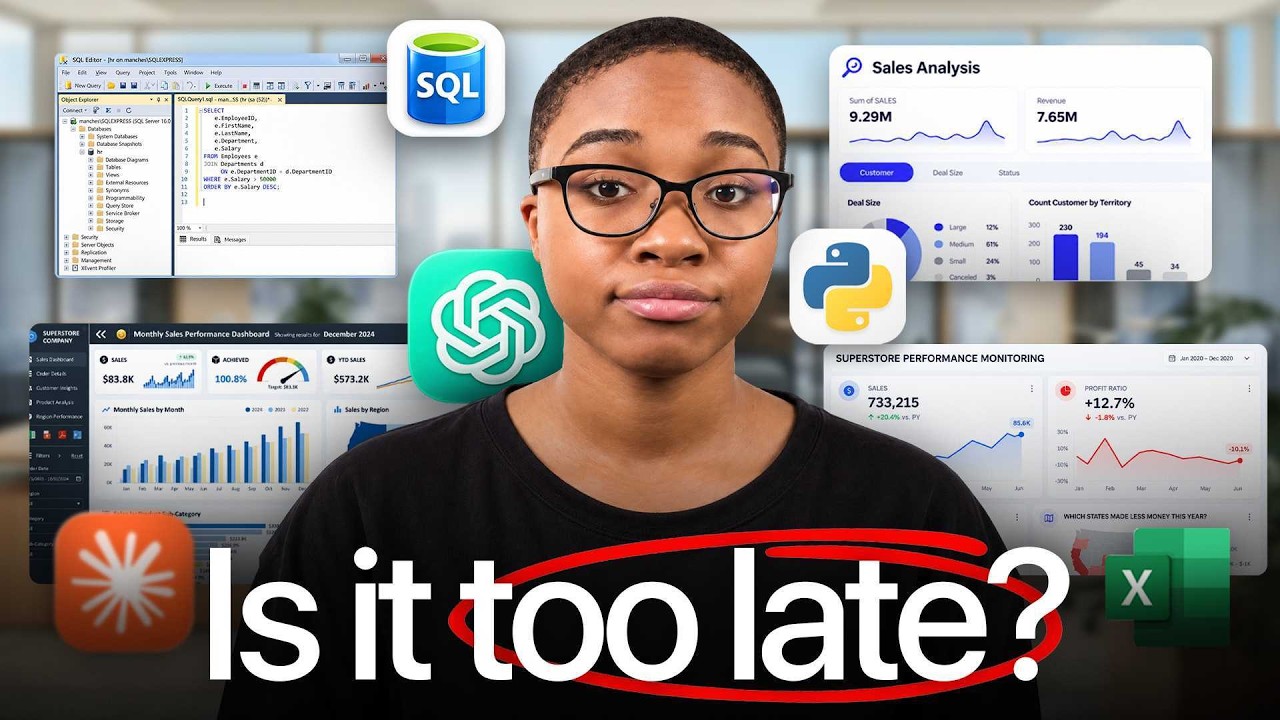
In this career‑advice video, the speaker recounts a conversation with a hiring manager who warned that thousands of resumes claim SQL and Tableau skills, yet few candidates can solve problems end‑to‑end. The speaker explains that traditional data analyst roles are being squeezed and that companies now seek "builders" who can automate, think strategically, and work with emerging technology. A step‑by‑step skill roadmap is presented: (1) Excel and data‑storytelling fundamentals to develop analytical thinking and clear communication; (2) mastery of a single BI tool (Tableau or Power BI) to create visual insights; (3) consulting‑style slide decks using the pyramid principle, with action‑oriented titles for executive impact; (4) SQL (joins, CTEs, window functions, subqueries) and Python (Pandas for cleaning, scripting for automation) as automation superpowers, while de‑emphasizing machine‑learning at this stage. The speaker urges viewers to position themselves as solution‑providers rather than AI‑fearing analysts, and promotes a paid roadmap/course via a link in the description, emphasizing urgency and limited opportunity.
Chapters
I was talking to a hiring manager last week and she told me something that would terrify every aspiring analyst out there. She said, we get thousands of resumes from people who say they can do SQL and Tableau, but what we can't find are people who can actually solve problems end to end. So here's what's really happening. Traditional data analyst roles are getting squeezed from both sides. Companies want people who can do more than just analyze. They want builders, automation, and strategic thinkers. The market is shifting, and while everyone else is panicking about AI taking their jobs, you can position yourself as the person who works with the technology and not against it. So what does this actually look like in this transition? First, your foundation will be Excel and data storytelling. Yeah, you still need Excel, not because you'll be living in spreadsheets. You need it because it's where you learn to think analytically and communicate insights clearly. But here's another key. You need to learn data storytelling principles in Excel first because you'll apply these same principles in every other tool. Second, BI tools. Pick Tableau or Power BI. It doesn't matter which one, just get really good at one first. Third core area, consulting-style slide decks, your secret weapon. This is where you separate yourself from 90% of the competition. Most analysts can't present their findings in a way that executives can actually care about. You need to learn the pyramid principle. Lead with the answer and support with key insights and structure for decisions. Every slide should have an action title, not just a description. Instead of saying sales by region, your title should be the West Coast sales are down by 15%. Fourth, SQL and Python, your automation superpowers. This is where the magic also happens. And where most people get intimidated for no reason. For SQL, you need to learn joins, CTEs, window functions, and subqueries. You're not trying to become a database administrator. You're just learning how to pull and shape data efficiently. For Python, I want you to focus on 2 things: data cleaning with Pandas and automation with scripts. Forget machine learning for now. Forget deep learning. Focus on making your life easier through automation. If you're ready to make this shift and want the exact roadmap that my students use to land these high-paying roles without going back to school, click the link in the description and I'll show you the exact step-by-step process and how to position yourself as a solution that companies are desperately looking to hire. Don't wait until everyone else figures this out. The opportunity is out there, but it won't stay wide open forever. So click the link and let's get you positioned for the career that you actually deserve.