Live LinkedIn & Portfolio Audits for Data Analysts

In this live, interactive session the host walks participants through real‑time reviews of LinkedIn profiles and data‑analytics portfolios. The session begins with audience check‑ins, then dives into concrete, step‑by‑step feedback on profile elements—banner, profile photo, headline, About section, experience bullets, and skill keywords—explaining that recruiters spend an average of 15 seconds on a profile, with half of that time on the banner. The host stresses the need for a custom Canva banner that amplifies personal branding, a professional headshot, and an About section that reads like an elevator pitch with quantifiable achievements. Experience sections should mirror resume bullet points and include measurable results. Skill sections must feature data‑analyst keywords (SQL, Excel, Tableau, Power BI, DAX, data storytelling, etc.) and be placed prominently. The bulk of the session focuses on portfolio presentation. The host advises against using raw GitHub repos as a portfolio, recommending a one‑page Canva site that showcases project screenshots, concise write‑ups, and code snippets (via Carbon or Markdown) to minimize friction for recruiters. Dashboard design tips include avoiding multi‑slice pie charts, using a limited primary‑color palette with grayscale, removing clutter, and ensuring each visual tells a clear story. The host also shares practical resources—Canva template replay, secta.ai for AI‑generated headshots, AI data generation for practice projects, and a Google Form for submitting profiles for further review. The session ends with logistical notes about a possible week off and encouragement to apply the discussed improvements.
Chapters
All right, let's see if I am— if y'all can hear me, please post in the chat you guys can hear me. If y'all can hear me, just post in the chat that you can hear me. All right, okay, okay, all right. Post where— as folks are coming in, post where you are watching from, where you're located. Where is everyone located? Let's see. Post where you are watching from. All right, Indianapolis is in the house. All right, anyone else? Where's everyone at? Is uh, no one wants to hang out with me on a? Friday evening. No one else wants— all right, no one wants to— where's everyone else at? Hmm, I didn't post enough about this, so maybe it might be a slim crowd tonight, but that's fine. It's all right. All right, even if you got two people, that's fine. All right, we'll keep going. All right, Oxford, UK. Nice. Okay, Oxford is in the house. Let's just wait a little bit for people to come in. Hope you guys are doing well. Yesterday we did a. You know, we had, you know, folks with, you know, tech recruiter experience, you know, teach or give a little bit on, you know, how y'all can use AI to power your job search and get more interviews. We went over how to create some custom GPTs. So if you missed it, you can definitely catch the recording either on my YouTube or on LinkedIn. We did it yesterday. If you check the live pan, uh, the live tab on the, on the YouTube, you'll see it. It's pretty good. Um, all right, okay, all right. Who's ready for some reviews today? Who's ready for some views today? Who is ready for some reviews? You know, it's interesting, some people posted or submitted that they wanted a LinkedIn and portfolio review, but they gave me no portfolio to review. So I'm not sure what that's about. But let's just get on started. Our first one. Share screen. Okay. All right, let's get started with our first LinkedIn profile review. So okay, so if anyone has If you're new here, if you've been watching for the past couple of weeks or so, when it comes down to a LinkedIn profile, on average, people spend about 15 seconds on your LinkedIn profile. And they spend about half of that on one section of that profile. So about 7.5 seconds out of that 15 is spent on one particular part. Most people get it wrong. People spend about 7.5 seconds on our banner. So if you think about it, as soon as you go on someone's page, before scrolling down, this is the very first impression you provide. The worst thing you can do is not have a banner. So, you know, the second worst thing you can do is have one of LinkedIn's default banners, but it's better than having no banner. But what you should do above all is just create a banner in Canva. And again, when we talk about great simple examples, Grace, right? Simple, clean name, your target role, and then some sort of maybe positioning statements or skills that you specialize in, right? So something— your banner needs to amplify your brand. Anything that's like stock images doesn't amplify your brand. No banner doesn't amplify your brand. And these LinkedIn default banners do not amplify your brand. So go on Canva. I showed a little like 5-minute tutorial on that last week. Go on Canva and make a very quick, simple banner, but you don't want to have no banner. Okay, so profile photo is nice. I would maybe want it zoomed in a bit. So I know if I would edit this, I would just cut this out a bit and just zoom in. It's like It's like, yeah, I would just cut this out a bit so it kind of like focuses on your face and your head more, but it's a good, very good photo. Okay, policy and advocacy, data enthusiast, immigrant. So I'm not sure what— let me see. When I see what's your number one goal, to basically become a data analyst. Policy and advocacy is your first one. Okay, okay. So this tells me this could be a you know some industry thing that you're good to go with, like an industry that you're specializing in. I don't like data enthusiasts, and this is just me. I feel like enthusiast is things that were like for me maybe you know I like I like true crime, but I don't get paid to watch or consume true crime stuff. So I'm a true crime enthusiast. I don't get paid for it. But if you're a professional, I don't really like the enthusiast word. So it should say like data analyst, and it should be like the very first one in my opinion. Um, you should be data analyst. Um, I do like that you have your, you know, stuff, you know, industries or areas of expertise. Uh, but then you can add in like Excel, SQL, Tableau, etc. as well. Okay, your About section. Strong passion for research, potential shape the future, power to uncover patterns, excited to contribute. Okay, interesting. This is all right. Remember, your About Me is like your elevator pitch per se. I don't know, it seems like a data dump of just keywords here. It seems very generic. Like, this is something that we kind of see all the time. But otherwise, I'm glad that you have something here. So we say you have hands-on experience in quantitative and qualitative research. You can expand on that. And I would lead with that in your About section. I would lead with that. Okay, I'm glad that you have some activity here, so you're a real person. Um, okay, intern. Um, intern. So it looks like you're probably still in school or just graduated. Um, I don't see a year here. It says— okay, so it says completed, so I'm assuming you're already graduated. Um, and you are in the— you are looking for a role. So, um, if you're already graduated though, I would put the year here. 'Cause it's not clear if you're done or not. You know, it's not that well, now I see completed, but it would be nice to see the year, like the end year. Um, yeah, but it looks like all this and, you know, you, you have internship experience, uh, you know, research experience as an intern. Yeah. This stuff, she should be leading with this stuff in your, in your about section. Um, I, you know, a lot of, you definitely have way more experience than the average, you know, college student. Um, or the college graduate. Uh, yeah, definitely be— you know, you're definitely underselling yourself. Um, yeah, you definitely need to be, you know, expanding on that experience in your About section up here. Um, I do like that you have, uh, information here and under your roles. Um, at the very least, I always say just copy and paste whatever bullets you have in your resume. I know for a fact There's no way this is how your resume looks for these roles. So I would, you know, paste your bullets. It's better than like these kind of like paragraph sentences here. And let's see your skills. So, hmm. Okay. So if you're trying to be a data analyst, I want to see some more data analyst keywords, SQL, Excel, Tableau, Power BI. I haven't really seen any of that, but you definitely want to have that. Um, I don't— I haven't really come across any of those keywords. Um, so you're definitely missing those keywords. You definitely would like— I definitely would see— you only— we only get 2 that's shown up here. And this, right, again, this is just underselling yourself. You don't need pressure. Um, I don't even know what that means. If it means like working under pressure, sure, but, uh, it doesn't come across here like, again, like SQL, you know, stuff like that. Um, let's look at your skills. Uh, so it's down here. Yeah, definitely put it up here. Uh, yeah, so you got them all down here. You gotta put them up there. And they also— these keywords need to be inside your experience. I don't see any of those keywords up here at all. Um, and also in your About Me, I don't see any of those keywords here about me as well. All right, so yeah, you got a lot of good stuff here. Underselling. Um, all right, let's, uh, let's see what else. Let's see what else. All right, but good start so far. Good start so far. I got a lot to work with. Um, Let's see if we can do a portfolio. All right, here's a portfolio. All right, so when I said send me a link to your portfolio, This is what you bring me to. All right. Um, okay. Got some visuals here. Um, okay. Looks like this is a write-up. All right. Business problem. I gotta be honest with you. I don't. You know, I'm just not a fan of this Power BI. I am not a fan of this Power BI chart here. But that's that's just a personal thing. Okay, a lot of okay, a nice write up. No one's gonna read all of it. So whatever. So. It would be nice if this was. No, this is. Let's say this is go. So you got the sequel. Um. Um. I think. Well, I guess if you want to show again, no one's going to read all of this, but I do. This is nice that you have everything. You know, you could also use Carbon. and to show your code. Though this is README. If this is a README, this is a Markdown. If you're writing this in Markdown, you should be able to have a code block. I would just do that instead of just pasting this. The code blocks would look a lot better. It would just look a lot cleaner for the code. It will also take up less space. You got SQL. I think it looks like these are some questions here. When I think of maybe like a— I think it would be nice if there was maybe another or maybe a better overall dashboard type of visual. Instead of just the visual, just the charts that answers. Looks like these are just a set of questions. Otherwise, the setup is really nice. I really like the setup. The setup is really nice. This is definitely one of the better ones. Now, when I said link to your portfolio, this is where you sent me. So I'm not sure when you're sending people to your portfolio, you're always sending them to this one project. Um, yeah, it looks like— yeah, it looks like it's just GitHub. So like I said, I, I just avoid using GitHub all around. So this looks like a write-up for one project, but you should, you know, whatever your front, you know, front end— you know, when I say like go to your, your portfolio, whatever, like kind of, you know, website or something like that— one-pager would be nice. And it would be nice if you did that off of GitHub. But, you know, if you had a link on your, like, a website like Canva or something and went here, this is one of the better GitHub write-ups though. I'd say I would get a website other than GitHub to host your portfolio. This is a much better write-up than most. So this is actually good work. Okay. Let's see. All right. Let's see who's next. All right, let's do another portfolio. Or let's do— looks like this is LinkedIn and portfolio, so this is nice. All right, all right. Um, I like the— I like the banner here. Okay, this photo, it looks like it is, you know, kind of outside. I would— yeah, they could— you can tell this is like outside, um, you know, not the— you can definitely get a better— like, you definitely dressed for the part. Um, I would just do something where you have like an intentional you know, professional photo, one where, you know, they're kind of like right in front of you. This one looks like, you know, maybe like a group photo or something like that. You're just like, hey, I'm outside out here, just take a picture of me, and they just like did a crop. Um, so more intentional profile photo, but other than that, it's, it's good. But I could just tell, you know, it's kind of far away. Um, and then you can also, you know, remove the background and just Use like a clear one color background in Canva, so you know the background isn't you know clutter or distracting. All right, software engineer, entry level data analyst. Okay, so a lot of I'm not sure what. Okay, so MS software engineer, entry level data analyst. You know a lot a lot of stuff going on here. Like what do we? What are you, a software engineer, or are you a data analyst? The— I do like that you have the keywords here. That's good. Okay, for your featured— I'm glad that you have a featured section. And putting your resume is not bad of a thing to do for your featured section. It's good that you have posts, and it's good that you have some activity here. So you are real. Okay, so last thing, you were a software engineer. So off the bat, so again, when it comes to your experience, bare minimum, just paste the bullets. And let me go to your— yeah, paste again, paste the bullets that you have in your resume under the experience, under the jobs on your LinkedIn. Treat your— yeah, treat your LinkedIn as like your living resume. So if you have— I know you don't have nothing under this, you know, software engineer, you know, internship because I just looked at it. So just paste the bullets. Um, you want to paste the bullets, you don't want to just leave them empty. Okay, you just graduated master's, uh, in May. Um, but okay, but where are we— where are we trying to go? Are we trying to be a software engineer or are we trying to be a data analyst? I'm not sure. I see like SQL, data analysis, Tableau. So it looks like for the most part, data analyst, I think. Okay, so I'm looking at skills. I see DSA, data structure. I think it looks like data structure is— it looks like data structure is spelled incorrectly. And DSA, I'm assuming that's data structures and algorithms. So yeah, it looks like a mixture of you know software engineering and data analysis stuff. So again, the first two things that we see are DSA and data structure. So that's not you know PJ two min heaps. You know that's just I don't know what that means. You know that's probably software engineer terms. So if you're trying to go for like data analyst, you know I would definitely put the data analysis skills at the top. But it looks like a mix here. So, you know, what do we want to do? Do we want to be a data analyst? Do we want to be a data engineer? Maybe that's a kind of a mixture of the two. Do you want to do that? You know, do you want to mix software engineer or, you know, a data analyst? Not sure. But other than, yeah, I would get that. Oh, Wait, you, you don't have an About Me section. Where's your— oh, you have nothing here. So you have nothing in your About section. All right, so that's— so your About section, look, it's your— it's, it's the second one here and it's, it's, it's empty. Your About section is your— it's your, um, it's your, um, you know, elevator pitch, and you have nothing there. So yeah, you gotta fill that in with something. You got a lot of— looks like you got good stuff to work with here, but one, uh, need to figure out, are you trying to be a data analyst or software engineer, or are you trying to mix the two? Um, it can— the branding can definitely be much better here. Um, it can definitely be much better here. And again, definitely paste your bullets from your resume onto your experience. Um, Bare minimum. Um, but other than that, yeah, I really like this. Uh, if sad equals— yeah, I like, I like this though. This is clearly, I think, JavaScript. You know, again, I am not a software engineer person. Um, so it definitely speaks software. And so like, this speaks software engineer, this speaks software engineer, data analyst. Um, IBM certified in what? Like, what is what is IBM certified? I don't know what IBM certified technically means. You know this. I know this. This kind of speak analyst. Yeah. So it's like definitely the branding can do a lot better here. All right. Let's look at your portfolio because you wanted both. I like that. All right. So your your choice is to bring me to a GitHub. So I always go against GitHub, but all right. Um, master's in computer software engineering, expert, expert. Listen, expert is all right. Expert in SQL, Python, data viz. Oh, I saw no data viz on your LinkedIn, but you are an expert. See, data viz. Okay, so I like this picture here. Um, this picture Why does it look different? I don't know why it's more close up. Okay, maybe it's just because it's more close up here. I don't know, I guess it looks different with close-up. Okay, but again, get a picture that's a more intentional profile photo. Like, I can tell there's shade here covering your eyes and things like that, you know. Maybe you're like a, you know, under some sort of like building thing. But okay, otherwise, um, I like that your, you know, GitHub has some effort here. Now, again, I don't— where am I supposed to click to see the projects? This is why I recommend to not use GitHub as your portfolio. Okay, let me go to your Tableau. All right. Anything. Since you're a software engineer, I know you can, you know, crank up a website. Crank up a website. You need to crank up a website, and that's what your portfolio should go. And I should just see visualizations of your projects, um, instead of having to like click around too much. I'm clicking too many clicks, too many clicks. Um, so I'm not sure where exactly to go. Like, if I'm like, you know, maybe someone who's not very familiar I'm not exactly sure where to go to like see your projects per se. So, but is it? I'm not okay. But let's go to Tableau. So, all right. So one thing with Tableau, I know it's always set up to like the very first one usually is going to be the latest one that you uploaded, but you can feature your your your top. You can feature. You know your favorite or your best one, your your best dashboard, and then it will be always right here. So I'm just gonna assume you know this is what you want me to go to. You know your very first one. Um, I will say this. So like most of us when we're first learning Tableau, right? Okay, we we understand you know how to get around it. Um, but then we have to figure out like design layout. So the entire, you know, visual says like a story here. Even though it's, it's just technically it's just 1, 2, 3, 4, 5 charts. I'm not— no, I don't know what the story is here. On the right side, I see this one primary color of this orangish here. On this left side, I see You know, two area charts, but I'm not really sure what the whole story is here. So now I clearly you know how to use Tableau, but we need to you know work on you know layout, dashboard layout design, the whole story. Clutter too, like removing clutter. I will say having all these labels data labels here is definitely. Clutter. Yeah. So, but yeah, so there's that. So yeah, I'll just, you know, make sure these are telling a story better for these dashboards. And the color, well, you're not too bad with the color, but okay. Now again, you said experts in SQL, Python. Where's your other— okay, maybe down here. These are your other projects. So again, I, I can maneuver through GitHub, but most people cannot. Like, in terms of like maybe like a recruiter, they're not going to know what to— they're not really know how to maneuver here. So that's why I recommend to not use GitHub. for your portfolio. But glad that you got something. You know, you're a software engineer. What about an actual portfolio site? Don't be going— don't be taking us to GitHub. Can you suggest other sites to use aside GitHub? Yes, Canva. I have a whole live replay of a no-code portfolio template for free on how to whip up a Canva portfolio. It's on my YouTube channel. Let me share. If you go to that— no, shorts. Go to me on my page, go live. The very first one, how to build the perfect data analyst portfolio without any code. I go step by step. I show you how to do it in Canva. Canva has a whole bunch of templates you can do. You can do that in 30 minutes. You can have your own portfolio done by the end of this weekend. So that is what you should do rather than using GitHub. And that's just like bare minimum, right? You don't have to— you don't want to fancy yourself with like, you know, coding up a website yourself. So Canva is a good option. All right, let's see what else. Would it be ideal to keep one's portfolio solely on LinkedIn for engagement? I'm not sure what you mean by that, Isaiah. Uh, harp on that a bit more. What do you mean by would it be ideal to keep one's portfolio solely on LinkedIn for engagement? It shouldn't be only on your portfolio. So, all right, let's go with the next one. Okay, so off the bat, banner, name, data analyst. Though you got a lot of real estate here. You can add in other, maybe like some other tools or skills like data storytelling or something like that here too. But otherwise I like this here, but I would put it more so in the middle, maybe move this over. There's a lot of real estate. make this bigger, you can, you can make this bigger. But overall, I like that, you know. Um, so again, similar to the last picture, like, this is not— I could tell, like, this, you know, obviously it looks like you're out somewhere, maybe out and about, and just have like this crop, this as your— but this should be— you should have like an intentional professional photo. If you don't have one, right, if you— if anyone here does not have a professional headshot Don't be like, oh my gosh, I gotta go figure it out. Just go to secta.ai. No, I have zero monetary gain of showing this. I am not affiliated with this whatsoever. But no more— like, we should not be, you know, not having professional headshots. Uh, secta.ai provides very realistic professional headshots. Um, you know, you have to put in like, I don't know, 40 or so pictures. But again, gotta have a professional headshot. Um, for those of us who are probably like, you know, career changing, um, LinkedIn may not— may be pretty foreign, but when it comes down to LinkedIn, you want to look, you know, you want to appear like you would look on the job, you know. So Yeah, so that make sure we make sure you know you can fix that today or fix that this weekend. Okay, data analyst PL 300. Okay, that's a okay. Power BI, SQL, DAX helping businesses uncover inefficiencies and drive data-backed decisions. Okay, cool. I think you can also add a bit more tools like Power BI, SQL, DAX. Um, is there maybe data storytelling or maybe something like that? Otherwise, this is good. You have, um, some credibility here. So it looks like PL-300. I know this is a— this is one of those certifications, um, probably this one, I'm assuming. Is this like an associate? Um, maybe writing it down, writing it out would be better, but— or Could be useful, but otherwise I like this. This is good. DC area. Did you want your portfolio reviewed? Yep, we'll take a look. So I'm glad that you have a link here. So this is good. Okay, your about section. This is your elevator pitch: data analyst specializing in Power BI, SQL Server, Power Platform certified. With a portfolio, currently focused on building projects. Okay, so based off of what I see here, you have no experience in anything because you pretty much just been talking about say you're a data analyst specializing in XYZ, but you're not. You didn't talk about any maybe experience that you have here, like working experience at all, and you're talking about mainly focus, you know. It's basically focused on your projects here. Okay, so I'm glad that you have stuff here in your featured section. Um, I'm glad that you have activity here. Okay, you got education licenses. Um, where's your experience at? Come on, where's your experience at? I don't see any experience. I know you got some experience. You gotta put your experience up here. All right, let's go to your portfolio. Nice, this is what I'm talking about. Go to it. So you're using GitHub Pages. Okay, so if you use GitHub Pages, GitHub Pages is basically just using, um, it's just a way to, uh, GitHub Pages is, is also a good Another option, you know, it's a little, little work, but you know, it's an option for hosting your portfolio as well. The— my very first portfolio was GitHub Pages as well, but I found it too time-consuming to update, so now I use Canva. Okay, Isaiah's work. So here's the thing, I, you know, would be nice to have like your photo here, you know, of similar thing. And then like, you know, maybe a link that goes to, you know, I can download your resume, a link to your LinkedIn. That would be nice here. Because, you know, oh, it's down here. No, man, that needs to go up there. About, yeah, that needs to go back up there. And it needs to have your photo. All right, let's see. So I'm assuming this is your best project because it's At the top. No. All right. So this is your frontend. And I'm going to click. And no. So this is, you know, your README is like where you can have your write-up. Your README, it's set up in Markdown. So you can You can put pictures, you can put pictures of your charts, you can get pictures of your dashboards. You can have everything in the README. I'm not sure if you want me to click here, but again, for most people, most recruiters and things like that, they're not going to know how to maneuver. You want at least the least amount of friction as possible. It would be nice to just have it all here. I'm just going to click here for the heck of it. All right. So this would be your portfolio. This would be your dashboards. And then you would want this in your README. Again, this is Markdown. And Markdown, you can just look up Markdown cheat sheet and it will show you exactly how to have pictures. In here. Okay, now looking at the looking at this, my first question is: Is this like a is this something? Okay, so nice that you have the KPI cards up here. Um. I'm not sure why. What's going on here? This is like your LinkedIn and then your GitHub. This is like, why is this here? This is like, I'm not understanding why is this here? It's kind of clutter in the way. I also feel like these KPI things can be a little— well, at least maybe these— this ring out here can be a little smaller and then the borders can be smaller too. My— so that's your first project? My most updated projects are solely on LinkedIn. Well, listen, Isaiah, this is— listen, it— here's the thing. It says portfolio, okay? And this is where you brought me, okay? So it has to— you, you got to be on point everywhere. So if it's not updated, then don't put it up there. Don't put your portfolio up there. Um, so I would make sure this is updated. Your portfolio should have your best projects. And once you have your best projects, then you don't have to update it again for a while. So, um, okay, but again, this is— this again, this is— this is the top project on your portfolio. Your portfolio, you know, again, so your portfolio is supposed to be your best projects. So And your top one should be your best one, cuz no one's gonna look at all of them down there. So, okay, so glad that you have your— so this one's recent. All right. Okay, so number one, I do. Okay, this is obviously— so again, this should be on your portfolio, right? So I would work on that. This again, if that's— if you, if you don't have your most updated projects on your portfolio, then, um, you know, remove that link or update it until you, you know, remove the link until you update it. Uh, number one, remember it is a sin to use a pie chart with this many sections. Absolute sin. This should be a bar chart. It is a— this is a no-go. Absolute no-go. Um, you know, otherwise the design is, you know, nice here, but yeah, this is an absolute no-go. Absolute no-go. What you can do is you can remove this and then you can actually have more space for the— for your map. Maps need space, right? So the way it looks like, like, this would look way better zoomed in. And I know because he got this one dot up in Alaska. That, that makes it, you know, messed, you know, that kind of messes things up, kind of screws it all up. But maps definitely need a lot of space, and if you remove this, you know, pie chart with 30, I don't know how many sections, um, this will give it more space. Uh, if you're gonna use a pie chart, total delays over 15 minutes, you know, you can do maybe do top 5 or something like that, but again, you never want to have a pie chart with this many sections. Um, also when it comes down to— okay, so this is percentage of flight delayed. So this 0.19 needs to be shown as a percentage. So 19%, 19, then percentage sign. Um, colors I'm not seeing. And again, I would, you know, I like to say like 1 or 2 primary colors and then everything grayscale. So I like to use that. Because it's not really obvious what to look, what to focus on. But otherwise, it's definitely way better. Definitely a lot of good stuff to work with. Just a few things to tweak. Just the storytelling, stuff like that, just tweak. But obviously, the dashboard design itself in terms of the layout, impressive. But yeah, in terms of these charts, that pie chart has to go. Just that has to go. Okay, um, all right, definitely got some sharpening there. Good work. Um, um, let's see. See if anyone had any questions here. Anyone have any overall questions? Yeah, we might take the week off next week. Might take a week off next week. Let's see other ones. All right, all right, so this is a Canva site. Nice, I like, I like that it's a Canva site and it's a one-pager. I just scroll down and I see your work. This is a— this is perfect. This is what I'm talking about. Okay, now nice, got your name up there. Photo, you know, this is what you, you know, photo. Obviously you're looking down at your phone. Put it up, put it up so you're looking. It needs to be eye level up so you're not looking down. You're obviously looking down, um, with your phone on your lap. Look up, you know, look up with a smile and then remove the background. You know, take a picture where you remove that background. Um, and then use Canva and use like a gradient, you know, background, you know, replace it with like a gradient background or something. Um, there's a lot of real estate here. Um, this you could definitely utilize this way better. Um, this is off, obviously you can see the alignment is off. Um, so you already say, you know, your name here, portfolio, you got your name here again. You know, I would Utilize— yeah, I would utilize this much better. So let me see if I can find mine, or let me show you one of my students' portfolios. So kind of similar, like left side photo, name, and then with links like email, resume, and these will go to her LinkedIn and Tableau. And the right side have your like about me similar Um, you know, about me, like an elevator pitch, and then your skills. So you wanna— you can definitely utilize this space way better. And here's an example of how you can do that. So look at, look at all this jam-packed good stuff that just hits your— that's, that's— you don't have to scroll down to see. Um, that's what I would add to— that's what I would do here. You have a lot of You have a lot of, uh, real estate here that's not utilized the most efficiently. I'm gonna go down. Okay, it's about me. Yeah, put it— yeah, you can make this smaller. You can put it up here. Yeah, you can put that up here, and then we can go straight into the projects. Okay, so this is— let me tell you, this is— this is what I'm talking about. This is— this, this is it. This is what I'm talking about. I— does— if anyone's been watching this whole time, the, the least amount of friction to see his work. This is, this is what a portfolio should do. This is exactly A1. Other than, like we talked about, gotta get better at this. But this is what you scroll down. I don't gotta do a bunch of clicks. I don't gotta do— it's just right here. Perfect. Diabetes, uh, nice. You got, you got your objective here. Got you some insights. Scroll down, see another dashboard. Objective Insights. Scroll down. This is it right here. Um, you know, I would— okay, so let's talk about this stuff. The Get in Touch here, this should be in that top section, right? This should be in that top section, and that About Me should be in that top section. But this is, this is exactly— this is a great portfolio here in terms of like the setup here. Um, one-pager. Um, I like how you have your colors are simple down here. Um, uh, maybe I would bold the, the numbers. Um, I would make these bold a little bit. Um, I would also have the be able to, you know, if you have like a link or something. Like, if I can click on it, you can say like, hey, here's a link to the dashboard. It would be nice so I can look at it. Um, this is really, really good. Um, yeah, this is nice. This is nice. Um, you know, there's definitely— yeah, it would be nice if you had like a picture or like the link so we can look at Um, you know, you know, look at the— actually click on there, or, you know, click on the dashboards here. But, um, all right, I mean, everyone can see the difference, right, between what we see now, what we see before. Um, okay. Yeah, um, yeah, this is obviously your best one here, so I like how it's, it's at the top. Um, but yeah, you can make way better. There's all that about me, your contact information. You can definitely do better, do better with the photo. It can also be maybe smaller. You can definitely do way better with this real estate. This is your first impression. Um, but yeah, this is good. That's good. Um, all right, we are headed about 10 minutes left. Oh wait, did I review your profile? Let me see. You wanted a LinkedIn profile too. All right, all right, it's the same photo. So same thing, um, put the camera up, put your phone, bring the phone up, smile, and then remove that background. But it's obviously that you're looking down. Again, stock photo, this doesn't amplify your brand. This is generic stock photo. Go into Canva. You are clearly— you have Canva because you made your thing in Canva, your portfolio in Canva. Go into Canva, name, you know, location, Data analyst, you know, Power BI, market analyst thing, whatever it is, playing back, whatever it is. But you know what to do. Go into Canva, look up LinkedIn banners, and do something that amplifies your brand. Data analyst, business analyst, market research consultant. You can definitely add a bit more, you know, add the keywords of like SQL, Excel, et cetera. Also include your like positioning statement, you know. You know, you know, I don't know, like data analysts, you know, specializing in marketing, whatever, something like that. Um, little positioning statement. Uh, okay, your about me. I'm a data analyst, business analyst, and market research consultant specializing in providing insights for business growth expertise, creating interactive dashboards, data transformation and cleaning. Yeah, this again, this looks like it's just a data dump of keywords. This is what it reminds me of. All right, you got some activity. That's good. Okay, good. So what I was telling folks before, you want to have something in, in here. So at minimum, bullets of whatever's in your, you know, resume. I will say you're just off the bat, I can clearly— I don't see like any like numbers. I don't see any, you know, quantitative results. Um, I don't see any quantitative results here in your bullets, so that's definitely missing. Um, these are just lists of tasks, but I don't see like results, like nothing got improved X percent, nothing got saved by X percent. You're missing all that stuff here, but I'm glad— I like that you actually have bullets, um, under your job, so that's good. And then you have a bunch of experience. Why don't you need to lead with experience? Okay, so again, you're underselling yourself a lot. You have a lot of experience and you're not leading with that experience. Um, market research consultant. Listen, this is big time stuff here. Like, I want to know, like, Explain this. Explain, explain what? Explain your, um, explain your experience with that, right? Explain your experience with that. Um, all right. Um, yeah, underselling yourself. You should be, uh, underselling yourself. Okay, for folks who— let me go to streamer. Okay, so if you don't have a portfolio but you have things done for work, you want to share the data. What if— so if you want to replicate that work, what you can do is, yeah, you can— if you really want to make you know, a project that's very similar to what you do at work. Um, yeah, I would— you can, if you can't find anything that's kind of similar online, yeah, you can definitely make your own dataset. Or yeah, if you can find— I would first try to find something similar online. Um, I'd definitely find something similar online first. Um, but it's perfectly fine that You know, it's definitely like most people aren't able to, you know, post their projects from work. So I would definitely replicate it as much as you can. So I would first try to find something similar online though. So I don't know if you work in like marketing or something like that, those are pretty common to find online. But otherwise, yes, you can you can replicate it also yourself. You know, AI is definitely super advanced now. You can literally tell it things and give it parameters and yeah, it could give you pretty good datasets if you want. But yeah, I would first try to find it online, find something realistic online. And again, you can make your portfolio really in under 30 minutes this weekend, go on Canva, I got the recorded workshop on that. Let's see. Yep. Again, go on Canva. Just one-pagers. These one-pagers, they hit. These are, again, just make it easier to make it easy for people. You don't got to click around or nothing. All right, um, I would say, okay, the only thing I would say also, addition, the color scheme is a little odd to me. Like, here I see it, like, it's kind of got green, red, orange, the inside. Like, why? I don't understand the blue, the purple, you know what I'm saying? Like, it's not, it's not, it's not gelling. You can— I would Again, one or two primary colors and kind of grayscale. Like, uh, yeah, I don't— I'm not, I'm not, I'm not understanding the, uh, the color. So that, that's definitely one of the things I would change. I mean, that's, you know, minor, but, you know, the color scheme doesn't match unless this follows some sort of brand, but I don't see a logo. Um, but yeah, the colors— yeah, I, I say you can do much better with the color Palette here. Like the charts are fine, but the color palettes on the outside, you can definitely do better. That would definitely take it over the top there. But I do like how like you remove the grid lines, you know, not much, not remove the clutter on the charts. Like nice here. One thing too, like, you guys, you know, we can— you can change. So like how it says blood pressure and it's like one word, you can change that, right? So when we talk about like presenting, like, you can, you know, you can do the edits so that you can like make it 2 words. You don't have to keep— you don't have to keep, you know, keep it one word. I know that's how it usually is, like you know, in SQL and stuff like that. But when it comes on to presenting it, you can edit it so that it's, you know, you can split up the words. Um, all right, we're in our last 4 minutes. Um, yeah, we are in the lab, we are in the home stretch. Um, anyone have any questions? Before we go, before we go for the weekend. Good stuff here today, y'all. This was good stuff today. We might take the week off next week, but good stuff today. Any, any last minute questions? Um, yeah, if you want your portfolio or LinkedIn reviewed, the link— I'm going to post a link again to share or post. It's a Google Form. I'm gonna post it in there, then I'm gonna post on LinkedIn. Let's see what we have. Yeah, remember, so anything— your portfolio should have your best projects, your best, best, best projects, and the best one should be at the top. You don't need a bunch of them. You don't need a bunch on your portfolio. Think of your portfolio like the Olympics, right? You know, think of your portfolio like the Olympics, you know, your 100-meter dashes. Um, you know, you just go to the Olympics, you run, you know, a few 100-meter dash rounds, but you're, you know, you do way more projects in the background. But your very best, your very best few needs to be on your portfolio. With Python projects, The best documented in LinkedIn. I'm not really sure what's up with this, like, link. Like, yeah, you can document, you can share your— you can post your Python projects on LinkedIn. Um, yeah, so if you want to, like, post your code, uh, you can do code snippets, you can use Carbon. So you can use Carbon. Let me share my screen. Yeah, you can use Carbon. And so you could just paste whatever code snippet, Python, you can use whatever, like color scheme or whatever. Just paste whatever code. It'll do all the color thingies, and then you just save it as a PNG, and you can post that. There's a lot of like those posts usually do very well. Let me show you a here's one of my students, and here is an example of what I'm talking about. So that's a code. Well, that's actually a screenshot of. VS Code. That's VS Code 2. So right here, so here's an example of like a code snippet, you know. So you can do that and post that on LinkedIn. But yeah, we're talking about documenting Python projects. Like, it's not like everyone wants to see like your full, you know, 1,000, 2,000 lines of code. That's not the point. Again, though, if you want your I— the link to submit your portfolio or profile for review is in the chat, is in the chat on LinkedIn and YouTube. And we are out of time. Um, yeah, it was nice, nice catching up with y'all again. Um, if you were— if this was your first time here, nice to meet you. Um, we might take a week off next week. It might be back the week after, but, um, yeah. Um, I hope you guys learned good learning stuff today. Um, again, if you don't have a portfolio, go make one on Canva this weekend. If you've been using GitHub as your portfolio, you make one on Canva this weekend. I have the— I have a live replay and also a free template on creating your own portfolio. Plus, again, Canva has plenty of portfolio templates way better than mine. You know, to be honest, mine is just like very bare basic, but it gets the job done. Again, don't use GitHub repos as your portfolio. Use Canva. And again, no one— we don't care about like your 20,000 lines of code. You don't have to put that in your portfolio project per se. If you want to have— if you want to document it, you know, your stuff like in a GitHub repo, fine. But in terms of your portfolio, we don't care about all that code. You can have like snippets. So I'll show you an example of what I'm talking about. Um, I'll show you an example of exactly what I'm talking about. About. So this is one of my earlier projects back in 2021. Yeah, back in 2021, 4 years ago. Was it 4 years ago? Yeah, 4 years ago. Okay, so here's the write-up. I'm just going to scroll down really quickly so you'll see what kind of what I'm talking about. But this project had a whole bunch of code, but I just have like snippets. And this is what— this is in GitHub Pages, but this is— this right here is made in like a markdown file. So for those who have a README, this would— this is the kind of design just like a README. So, you know, paragraph, words, you know, code block, paragraph, words, code block, uh, PNG photo, paragraph, you know, words, code block, PNG photo, and then paragraph. And then this is like a combination of like a dashboard and like a slide type of thing. So, so yeah, so this is, this is what I'm talking about. Like, again, this project had a whole bunch of time, a whole bunch of code, but very just, just the— this is the Olympics. Like, like I said, this is the Olympics, you know. So This is what I'm talking about. We don't care about your 20,000 lines of code, just the basics pretty much, or just snippets. But yeah, this is an example of a write-up. Again, there are some people who— I'm glad that you had write-ups, but no one's going to scroll down for 10 minutes to read your stuff. More pictures, the better. Like I said, I highly always recommend people learn PowerPoint. And look at this. This is kind of like a PowerPoint type of thing. This was 4 years ago. Bear in mind, I did this 4 years ago before I even really knew PowerPoint very much. But this is kind of similar to what I'm talking about. This is like kind of designed almost like a PowerPoint-esque type of slide. So yeah, look how much better this kind of looks than a whole bunch of text and stuff like that. So, okay, um, that is it. I hope you guys, uh, took some notes. Um, and, um, yeah, I'll see you guys next time. Bye.
More from Kedeisha


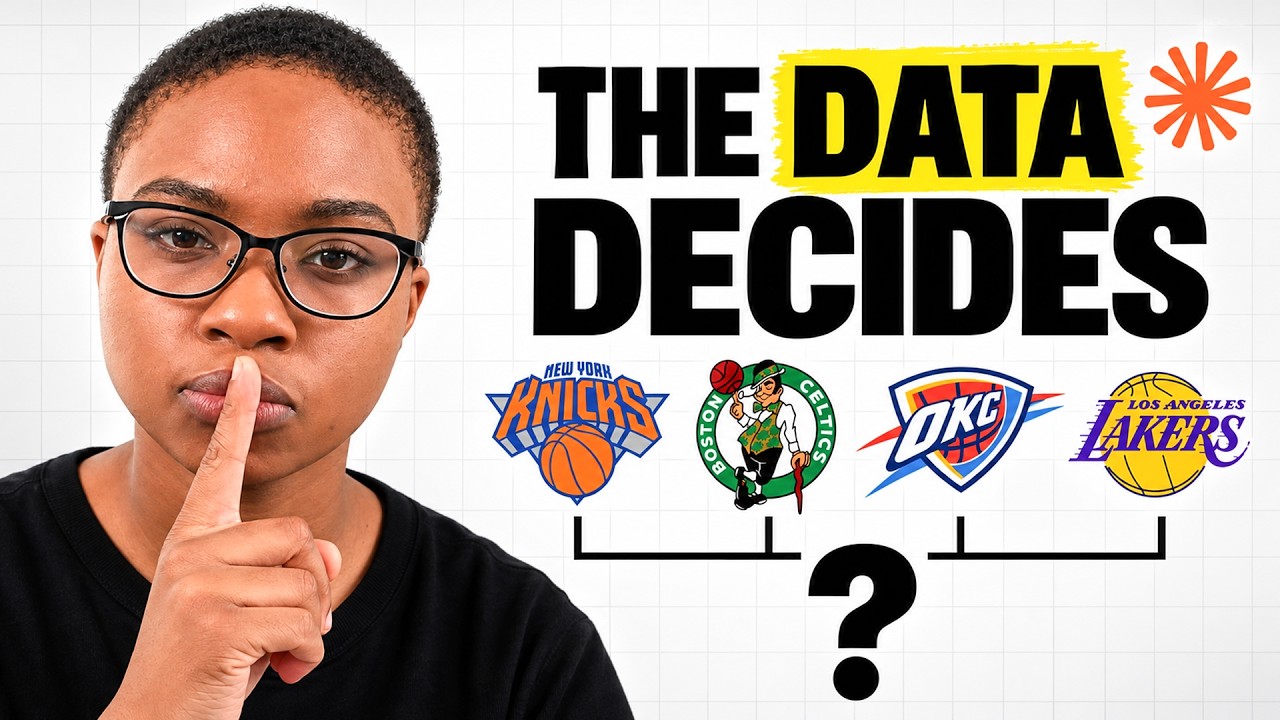
Data Analyst Portfolio Project with AI | NBA Championship Prediction Model (End-to-End Project)