In this video, Kedisha Bryan interprets Meta’s recent layoff of 8,000 employees as a clear signal that AI‑augmented, small‑team work is now the industry standard for data analytics. She argues that the traditional data analyst role is being replaced by a "full‑stack data analyst" who must master a broad toolset (SQL, Excel, data‑visualization, Python, and basic data‑engineering) and combine it with deep business domain expertise. While AI dramatically lowers the learning curve for these tools, it simultaneously raises the baseline expectations for analysts. Kedisha outlines four non‑negotiable competencies that every modern analyst must possess: (1) solid fundamentals of data manipulation and query logic, (2) the ability to operate AI responsibly—knowing when and how to use it and how to verify its output, (3) specialized business domain knowledge, and (4) critical thinking and ownership of insights. She warns against over‑reliance on AI for resume writing, project execution, and interview preparation, emphasizing that analysts must retain the ability to defend and explain their work. The video concludes with a call to action for viewers to develop these skills, offering a free strategy session, and uses an analogy that AI is a vehicle—not an autopilot—requiring a skilled driver to avoid crashing.
Chapters
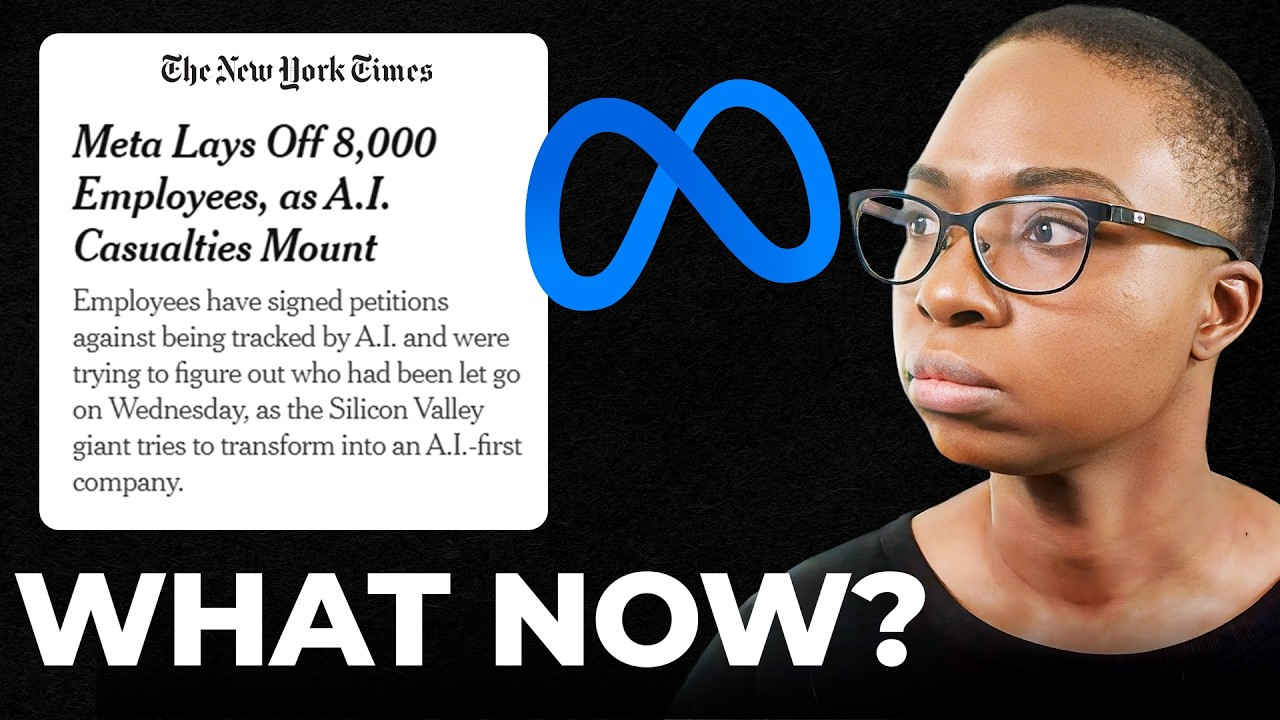
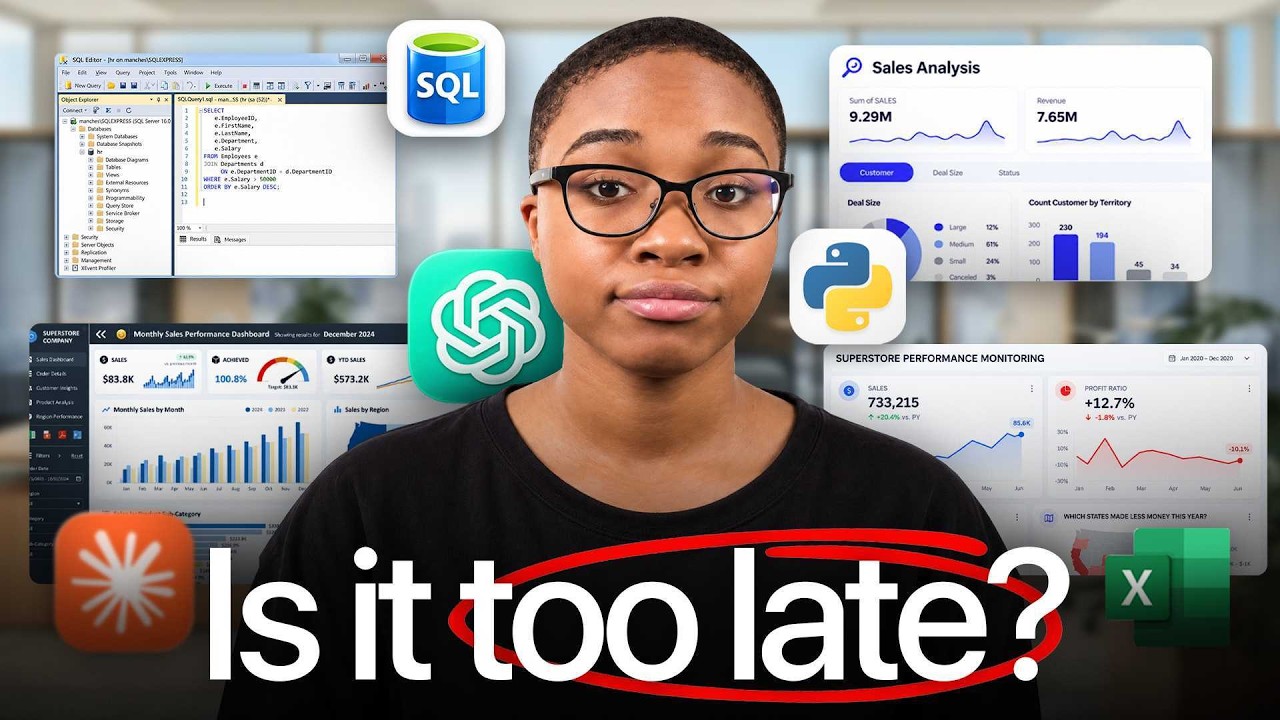
All right, so Meta just laid off 8,000 people this week, and Mark Zuckerberg got on stage and defended it. He didn't blame the economy. He didn't blame overhiring. He said that there are constant examples of people completing projects in a week that used to take entire teams months. Read that sentence again, because that one sentence is the whole story. So this wasn't a layoff. This was the announcement. And if you're trying to break into data analytics right now, or you're already in this field, what I'm about to say in this video is going to make a lot of you uncomfortable, but you're going to have to hear it because the bare minimum to break in and keep a career in this industry is different now. And the people who refuse to accept that are going to find themselves on the wrong side of this history. If you're new here, I'm Kedisha, and 6 years ago I was delivering pizzas and pulling warehouse shifts. And today I run a community of over 80,000 current and aspiring data professionals. And I've been watching this shift coming for a while now. This week just made it official. So in this video, I'm going to be covering 3 things. One, I want to talk honestly about what Zuckerberg's statement actually means for your data career, not the panic version, Not the cope version, but the real one. And 2, I want to introduce you to the role that just replaced the old data analyst job. I'm calling it the full-stack data analyst, and you have no choice but to become one. And 3, I want to give you the 4 things that are now table stakes, the things that you cannot skip, even with AI doing half of the work. Let's get into it. All right, so before I go any further, I need to say something. There's a lot of noise about AI right now. On one side, you have people screaming that AI is going to take every job and no one will work again. Complete panic. And then on the other side, you got people in Complete denial, telling you that AI is just a fancy autocomplete, nothing to worry about, business as usual. The thing is, both takes are plain wrong. The actual truth is somewhere in the middle. And the middle is this. We are at the beginning of an industrial revolution level shift. Not a trend, not a hype cycle, a structural change of how work gets done. But here's the thing that worries me, because I see this every day in the data community. Every single day, AI is getting smarter. But us people using it, I'm not so sure anymore. Our critical thinking isn't what it used to be. People are just copying and pasting AI answers without even checking if it's correct or not. They're letting AI write all their resumes, cover letters, project explanations, their emails, and they can't defend their own work in interviews because they didn't actually do the work. AI is getting smarter and humans are just getting dumber at the same time, unfortunately. It's true, had to say it. This is a recipe for disaster, and the people who understand that, who use AI without losing their own brain in the process, those are the people who are going to win in the next 10+ years in this industry. So when Meta cuts 8,000 jobs and tells us straight up, the small teams plus AI can now do what larger teams used to do, believe them. This is not a threat. This is just a roadmap. They just told you exactly what the new bar looks like. All right. So here's where I want to get really practical with you. This is the era of the full stack data analyst. And no, I don't mean it as a buzzword. I mean it as a description of reality. You don't get to specialize narrowly anymore. You don't get to say I just do SQL or I'm just a Tableau person or I'm just a Power BI person. The narrow specialization in tools is disappearing right now in front of us. You've got to know Excel, data viz, SQL, and you have to know Python to be dangerous. A little data engineering as well because data quality is still terrible everywhere. Pipelines break, columns are wrong, numbers don't add up. That's not going away. If anything, AI just made bad data move faster. Now here's the good news inside of all of this. And I want you to hear this part. It doesn't take as long to learn these tools anymore. When I broke into data analytics, it took me over 45 days to learn Python. 45 days. But if I had access to the AI tools that existed today, I could have probably done it in about 2 weeks, maybe less. That is a gift at this moment. The learning curve collapsed. Skills that used to take 6 months to learn, you could probably do in 6 weeks. The barrier to entry from a skill standpoint is much lower than it has been in the history of this space. But this is the part no one wants to hear. The bar for what actually counts as a real analyst though has went up at the same time because everyone else has that same gift. Everyone has access to ChatGPT, to Claude, to Gemini. Everyone can prompt a dashboard now. So the question isn't, hey, can I learn the tools? Yes, you can. We all can faster than ever actually. The real question is now, well, now that everyone has the tools, what makes me the one that they choose to hire? And so that brings me to the 4 things that are not negotiable anymore. These are the new bare minimums. If you don't have all 4, you're not even going to be in the running for a role. All right, so number 1, the fundamentals. And I can't say this loud enough, you gotta know the fundamentals. How a join actually works, what a window function does, why your data is grouped the way you grouped it. AI can and will write a query for us, sure, but if you don't understand what it just wrote, you wouldn't be able to defend it in a meeting. You can't debug it, you can't adjust it. The fundamentals are now more important than ever, not less. All right, so number 2, you have to know how to operate the AI, not just use it. Operate it. There's a difference. Operating AI is knowing when to bring it in and when to keep it out. What to give it as context and what to never give it. And how to verify what it gives you back. Companies now have in-house AI tools where you can upload a CSV and it can spit out an analysis. That's cool. But if you don't know how to check that analysis, you are now a liability to that company. Not useful, a liability. Number 3, business domain knowledge. This one is way more important than it has ever been. And it's only getting more important. Pick a domain, marketing, product, finance, healthcare, supply chain. Pick one and be an expert in that domain. You can read Harvard Business Reviews, read earnings calls, read Reddit threads, understand how the industry makes money. Because right now, almost nobody wants to do this. Everybody wants a shortcut. Everyone just wants the tool. The person who actually goes deep in one domain is going to outshine everyone else in the room. That's your unfair advantage. Number 4, critical thinking and ownership. Yes, AI can build the slide. It can probably format the dashboard. It can probably write an executive summary. None of that matters if the numbers are wrong, or if the insight isn't important, or if you can't stand behind the recommendation when a VP questions it. The aesthetic layer has gotten commoditized. The judgment layer is where you need to live in now. All right, quick pause. If you want help building out this full-stack skill set without going back to school, the link is in the description for a free strategy session with me and my team, and we'll map out exactly what you're missing and see how we can help. All right, let's close this out. All right, I want to leave you with this analogy that I keep coming back to when I think about this whole moment. AI is the boat. It's the plane. It's the vehicle. It can get you to where you're trying to go faster than anything in human history, but you still have to know how to drive the dang boat, how to steer the wheel, how to fly the plane. It is not an autopilot. It has never been an autopilot. And people who think it is, they're going to crash. If you don't know where you're going, AI won't be able to save you. It just helps you fail faster. AI helps you ship the wrong answer at scale. And right now in this moment, in this industry, that's exactly what's happening to thousands of aspiring analysts. Heck, even professional ones. They're shipping resumes they didn't write, projects they don't understand, portfolios that fall apart the second a real interview asks them, walk me through your decision-making process here. Don't be one of those people. The Meta news this week wasn't a tragedy. It was an honest signal. They told us out loud that one person plus AI can now do what 10 people used to do. Okay, now that you know, now you can plan around it. You don't have to be afraid of this moment, but you have to respect it. 6 years ago, I was delivering pizzas. Didn't have my degree, no connections, no money, and no plan. The only thing I had was a willingness to do the work that shortcut takers wouldn't do. That's the exact same thing I'm asking from you today. Do not take the shortcut. Learn the fundamentals, pick a domain, operate the AI, and own your work. If you do those 4 things, you're not going to be on the wrong side of this history. You're going to be one of the people who gets to write it. If this video was helpful, hit the like, subscribe, and I'll see you in the next one.