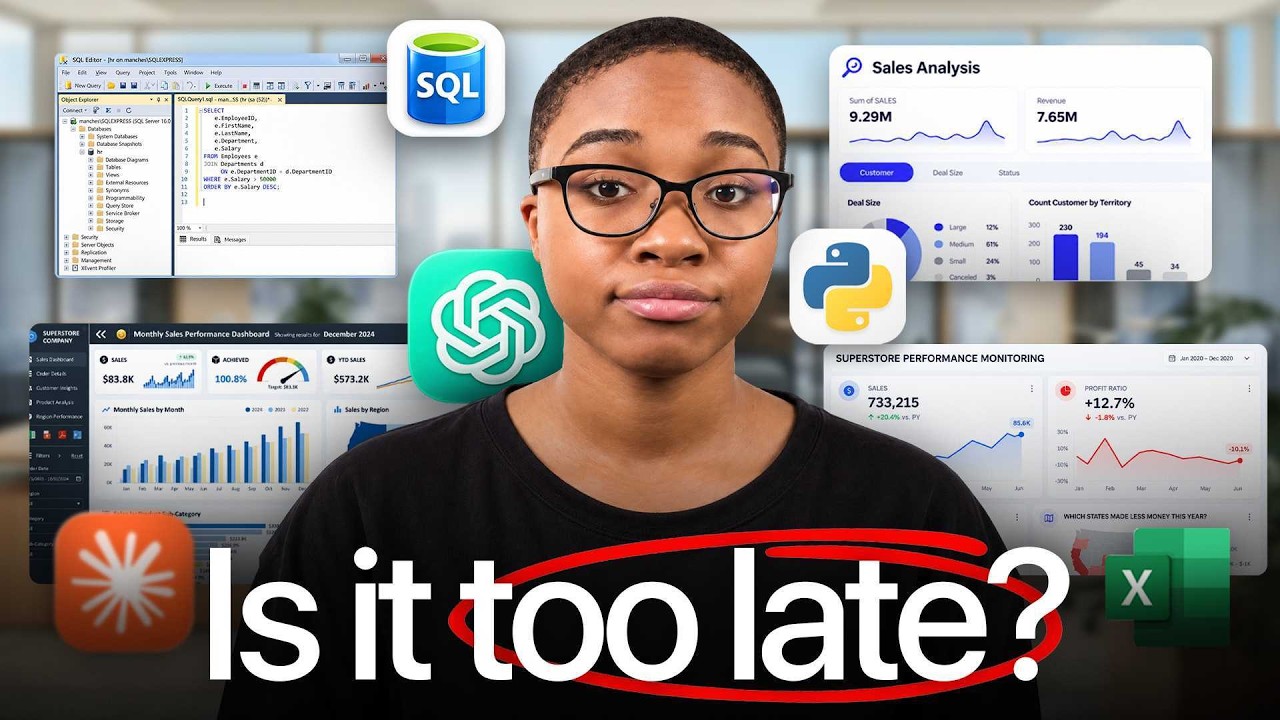
In this career‑advice video, the speaker argues that the traditional path of learning machine learning and data science is becoming commoditized and no longer the most reliable route to six‑figure tech salaries. She explains that many senior data roles—such as senior business intelligence analysts, revenue operations analysts, principal data analysts, and analytics engineering managers—pay $150K‑$250K without requiring deep ML expertise. The core reason companies value impact over algorithms. She introduces the "Analytics Value Ladder" framework, which categorizes data professionals into three levels: tool users (basic reporting), problem solvers (answering business questions), and decision drivers (shaping strategy). Salaries rise dramatically as one moves up the ladder. The speaker then outlines the five high‑ROI skill areas to focus on instead of ML: (1) data foundations (Excel, SQL, Tableau/Power BI, PowerPoint), (2) business‑centric analytics and domain knowledge, (3) data storytelling and communication, (4) AI integration as a productivity copilot (e.g., ChatGPT, Claude), and (5) basic data‑engineering concepts (ETL/ELT, pipelines, data quality). She backs her claims with personal background (from pizza delivery to leading a 60k‑member data community) and student success stories, and promotes a paid coaching program for fast‑track job placement. The overall message is to pivot toward impact‑focused data roles that leverage existing tools and business insight rather than chasing oversaturated ML positions.
Chapters
If you're grinding through another machine learning course right now, you might be wasting your time. And I know that sounds crazy because everyone is telling you data science and machine learning are the golden tickets to 6-figure tech careers. But here's what no one else is talking about. While you're spending months trying to master neural networks and algorithms, there's a whole category of data professionals quietly landing 6-figure roles doing work that's way more in demand and honestly way less crowded. I'm talking about jobs that are literally hiring faster than companies can find qualified people. Roles where you don't need a PhD in statistics or years of ML experience. And the best part, most people have no clue that these opportunities even exist. So in this video, I'm going to break down exactly what I'd learn instead of data science if I were starting over today and why the traditional ML path is becoming a commodity and the 5 high ROI skills that are actually getting people hired right now. And if you stick around to the end, I'm going to show you this one framework that separates analysts making $50K to the ones earning as high as $150K. K+ and it has nothing to do with coding. But first, let me tell you why I'm so confident that this shift is happening. Five years ago, I was delivering pizzas for eight dollars an hour. Today, I'm running a community of over sixty thousand current and aspiring data professionals, and I've helped thousands of other career changers break into data analytics without going back to school and wasting money on courses that just don't work. And I've watched this industry transform in real time. The people getting hired now—they're not the ones grinding through Kaggle competitions; they're the ones who understand. Where the market is actually heading. And by the way, if you ever want to work with me one-on-one to land your first data role in the next 3 to 6 months, there's a link in the description where we can start working together. So let's dive into what's really happening to data careers right now. Here's the lie that's keeping most people broke. You need machine learning to make real money in data. That's completely garbage and I can prove it. Most people think the money is in data science and ML because that's what gets all the hype. But here's what no one tells you. Many senior data analyst positions are paying $150K to even upwards to $200K right now. No machine learning or data science required. I've seen a couple of my students even land these $180K+ senior analyst roles in the past 15 months. Neither one built a single neural network. They just mastered the fundamentals and learned how to solve real business problems. Meanwhile, I watch people with data science and business analytics master's degrees struggle to find even $60K entry-level positions because they're competing with thousands of other candidates who have the same cookie-cutter portfolios and backgrounds. The truth? Companies don't care about your algorithms. They care about your impact. And the highest impact roles in data right now aren't the ones building models. They're the ones building systems, solving problems, and driving decisions. So let's address the elephant in the room. The golden age of data science is over. Over a decade ago, Harvard claimed that data scientist was the sexiest job of the 21st century. Well, not anymore. Not because the field is dying, but because it's becoming commoditized faster than anyone expected. What used to require some PhD-level data scientists is now done with pre-trained models, APIs, and one-click solutions. So think about it. When was the last time you built a recommendation system from scratch? You didn't. You probably used a pre-built API. The barrier to entry is dropping every single day, which means less career leverage for traditional ML roles. Companies don't need armies of data scientists anymore. They need people who can integrate these tools, clean the data that feeds them, and translates that output into business decisions. So where is the real money? Let me blow your mind with some salary data that most people don't see. Senior business intelligence analysts can be making upwards to $140,000 to $180,000. Senior revenue operations analysts could be making $150,000 to $200,000. Principal data analysts could be making $160,000 to $220,000. And analytics engineering managers could be making upwards to $180,000 to $250,000. None of these require any machine learning. They require business acumen, advanced SQL, data storytelling, and the ability to build systems at scale. The pattern here, these high-paying roles aren't about technical complexity. They're about business impact. Now, let me introduce you to a framework that I use with every single one of my students, the Analytics Value Ladder. It's the difference between getting stuck at entry-level pay and fast-tracking to senior roles. At level 1, you have your tool users. You push buttons, you follow tutorials, you copy code. This is where 90% of people get stuck, and it's completely replaceable because anyone could do it. These are the people who could run a select statement in SQL, but build a basic bar chart in Tableau. And they're just following instructions. They're not really thinking strategically about the business problem they're solving. I see this all the time in portfolios. Someone builds a Netflix dashboard showing movie ratings by genre. It looks pretty, but it doesn't solve any real business problems. It's just a data visualization just for the sake of visualization. Then you have level 2. You're problem solvers. You use data to answer real business questions, analyze KPIs, and make recommendations. This is where you start becoming more valuable, where the salaries jump to $75K to $120K. At this level, you're not just making charts. You're asking key questions like, why did our customer churn rate spike last month? And then digging into the data to find those answers. You're identifying trends, spotting anomalies, and providing insights that help businesses make better decisions. Here's what it looks like in practice. Instead of just showing that sales are down, you're analyzing which products are underperforming, which regions are struggling, which sales reps need additional training, and you're connecting the dots between the different data sources to tell a complete story. And then you have level 3, your decision drivers. You influence strategy, revenue, and growth. You don't just show the numbers, you shape direction. And this is where you become irreplaceable and where salaries could hit over $150K plus. These are the people who can walk into meetings and say, based on my analysis, we should shift our marketing budget from Facebook to LinkedIn because our B2B conversions are 3x higher there. And here's a 90-day plan to make that transition. They're not just reporting what happened, they're guiding on what should happen next. And this is where those high-paying roles live. No, you're not building machine learning models, but you're using data to drive million-dollar decisions. Companies will pay a premium for that level of impact. And most people never make it past level 1 because they're just focused on the wrong things. They're learning tools instead of learning how to think like business leaders or strategic thinkers. But I'm going to show you exactly what to focus on instead. So if I were starting over, here's what I learned in the exact order. So number 1, data foundations that matter: Excel, SQL, Tableau, or Power BI, PowerPoint presentations, and problem solving. Then you have analytics for business impact, right? Tools alone just don't cut it. You need business acumen. So if you're in e-commerce, understand customer acquisition costs, lifetime value, funnels, drop-off rates, and make recommendations that drive revenue. If you're in SaaS, Master monthly recurring revenue, yearly recurring revenue, churn, expansion, and usage metrics. Domain knowledge will be your differentiation. One of my students even leveraged her logistic experience to land a process analyst role. Next, data storytelling and communication. Most analysts fail here. Dashboards do not equal stories. Start with the business context. Why did Q3 revenue drop 15%? Then use the pyramid principle. Lead with your insight, back with data. Clean visuals, one chart, one message per slide. Then you have your action titles. This is how analysts become high-earning leaders. Next, AI integration. Don't waste time trying to build everything from scratch. You can use tools like ChatGPT, Claude Code, and more. One of my students used GPT and Power Query to automate 80% of reports that she had, freeing time to find more insights. AI is your copilot, not your replacement, so learn how to effectively prompt validate, and refine. Lastly, data engineering foundations. Understand ETL and ELT and data pipelines. Companies need analysts to ensure clean and reliable data. And mastering data transformations, quality testing, and documentation can get you upwards to $120K+ roles. Now look, the data industry is changing fast. And the people who adapt are going to thrive. The ones who keep chasing yesterday's trends are going to get left behind. You just need to understand where the market is heading and position yourself accordingly. In the words of Peter Drucker, the greatest danger in times of turbulence is not turbulence. It is to act with yesterday's logic. So the choice is yours. You can keep following the crowd, competing for oversaturated data science roles, or you can position yourself for the high-paying opportunities that are available to you right now. And if you want the exact roadmap that my students use to land these high-paying data roles without going back to school, click the link in the description. I'll show you the step-by-step process that we use to get people hired in 6 months or less, and we can talk about how we can work together to fast-track your transition. Don't waste another month learning the wrong things. The market is moving and you need to move with it.